1000 Mg of Metformin: A Practical UK Patient Guide
A clear UK guide to 1000 mg of metformin covering doses, safety, side effects and renal function, plus pharmacist tips.
A 1000 mg metformin tablet is a common UK maintenance strength, usually taken once or twice daily, but the right amount for you depends on your kidney function, formulation and total daily target. If you've just picked up a box and wondered whether that single tablet is “the dose”, you're not alone.
SEO brief
Primary keyword: 1000 mg of metformin Secondary keywords: metformin 1000 mg, metformin dose, prolonged-release metformin, immediate-release metformin, eGFR metformin, metformin side effects Search intent: Patient education, dosage understanding, safety guidance Target reader: UK adults taking or starting metformin Product/service mention: Courier Pharmacy online pharmacy and testing services Internal links available: Courier Pharmacy relevant treatment and testing pages
Five key takeaways
- 1000 mg is a tablet strength, not always the full daily dose.
- The right dose depends on the tablet type, your meals and kidney function.
- Immediate-release and prolonged-release tablets are taken differently.
- Stomach upset is common at dose increases, and taking it with food helps.
- If you feel unwell, dehydrated or breathless, seek medical help quickly.
A man at the counter often says the same thing in different words, “Is this one tablet my whole treatment, or just part of it?” The answer depends on the prescription. 1000 mg of metformin can be a stepping stone, a steady maintenance dose, or the top end of what's safe for some people in UK practice, especially when kidney function needs extra care [1][2].
What 1000 mg of Metformin Really Means
You might see a white oblong tablet, a box label, and a dose written as 1000 mg or 1 g. That figure tells you the strength of one tablet, and nothing about your total daily intake. In UK practice, the active ingredient is metformin hydrochloride, and the familiar tablet strengths sit around 500 mg, 850 mg and 1000 mg [1].
A prescription can say 1000 mg once daily, 1000 mg twice daily, or something like 500 mg in the morning and 1000 mg in the evening. Those are very different total daily amounts, even though the same tablet strength appears in all of them. That's why the safest question isn't “Is 1000 mg a lot?”, it's “What is my total daily target, and what type of tablet have I been given?” [1][3].
Practical rule: always check whether your prescription refers to the tablet strength or the daily dose.
A 1000 mg tablet can reduce tablet burden for people who need a larger daily amount, so treatment is easier to keep up with long term [2]. That matters for someone who is busy, forgets midday doses, or prefers fewer tablets to manage.
For many people, 1000 mg of metformin is a maintenance amount that sits in the middle of treatment. It can be held while the body adjusts, increased later, or reduced if kidney results change [1][2]. The same number can therefore mean a step up, a steady dose, or a step down. In UK practice, it may also be the highest dose allowed for some people when kidney function needs closer review [1][2].
How UK Patients Reach the 1000 mg Dose
UK prescribers usually begin metformin at 500 mg once daily and increase it gradually, often every 10 to 15 days if the tablets are being tolerated [1][2]. That gradual climb gives the gut time to settle, because stomach side effects often show up before any benefit is felt in blood sugar readings.
The usual route up
A common path towards 1000 mg looks like this, although your prescriber may choose a different pattern:
| Typical UK titration schedule towards 1000 mg of metformin | |||
|---|---|---|---|
| Week | Morning dose | Evening dose | Notes |
| 1 | 500 mg | 500 mg, if prescribed twice daily | Start low, take with food |
| 2 | 500 mg | 1000 mg, if tolerated | A common step-up point |
| 3 to 4 | 1000 mg | 1000 mg, if needed | Often a maintenance pattern |
| Later | Review only | Review only | Stay, step down or adjust |
This careful rise helps reduce nausea, loose stools and cramping, which are the usual reasons people struggle when the dose goes up too quickly [2][4]. If those effects appear, keep the dose where it is for now, do not increase again yet, and speak to a pharmacist or GP.
Where 1000 mg often appears
For some people, 1000 mg is the first dose that controls things well enough to keep using. For others, it is a short stop on the way to a higher dose. It can also be the point where treatment is reduced after a kidney function review, because the total daily amount needs to stay within safer limits [1][2].
The number on the tablet only makes sense alongside the plan around it. A busy parent may take the dose with breakfast and tea, then find the evening tablet is the one that upsets the stomach. A shift worker may cope better once meals are regular again. The same strength can feel very different, depending on timing, food, and how the kidneys are working.
That is why 1000 mg of metformin can mean three different things in UK practice. It may be a stepping stone, a maintenance dose, or the highest dose allowed while kidney results need closer attention. The practical question is not just how strong the tablet is, but whether the body can handle that amount today.
For more on how medicines are supplied and checked in practice, see this UK pharmacy guide on diabetes medicines and heart health.
Immediate-Release vs Prolonged-Release 1000 mg
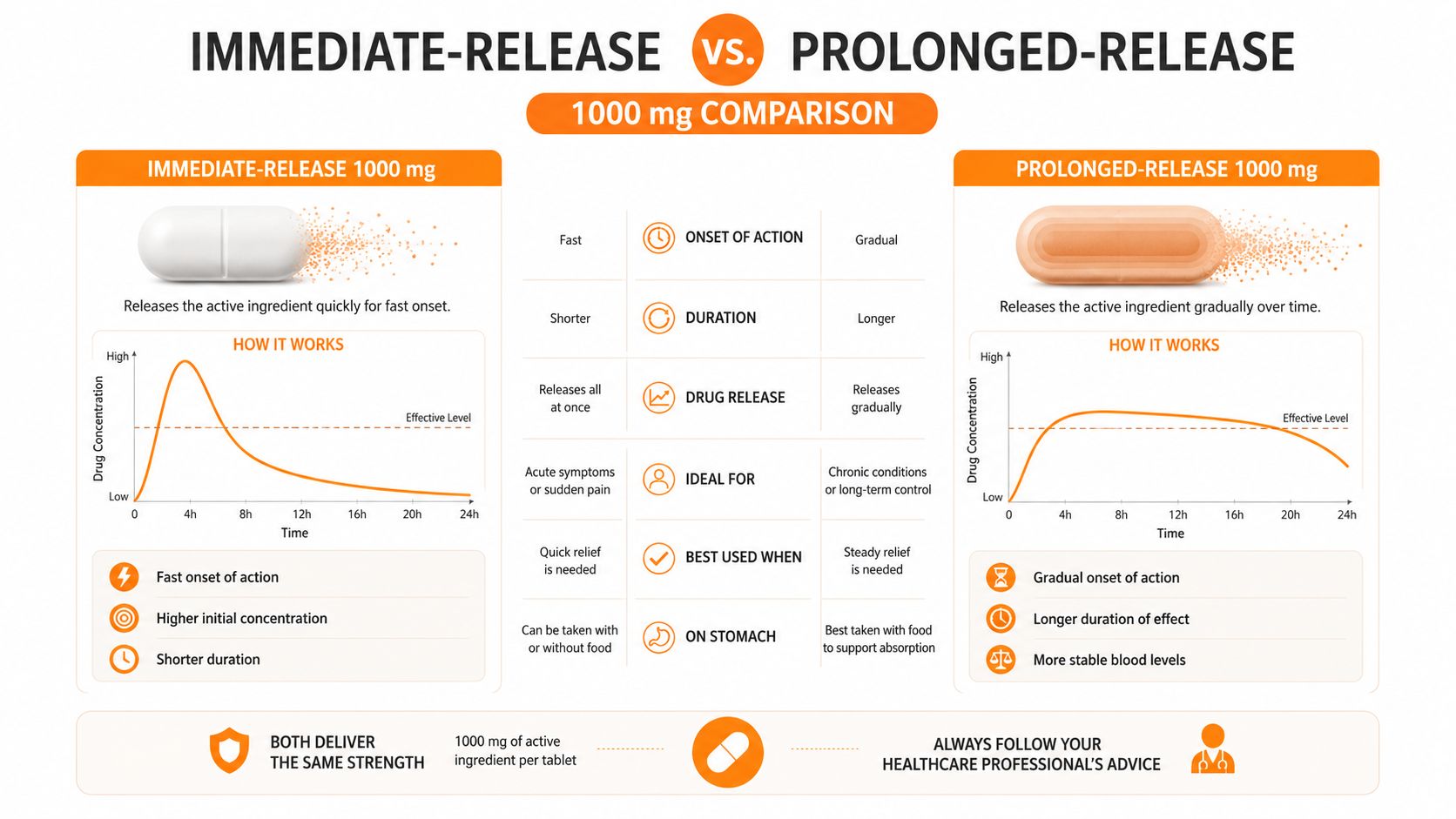
The tablet strength can be identical, yet the release type changes how the dose behaves through the day. Immediate-release metformin enters the body faster. Prolonged-release metformin releases the medicine more slowly, so it often sits easier in the stomach [2][5].
What changes in daily life
Immediate-release 1000 mg is usually taken with meals, often split into morning and evening doses. That suits people with regular meal times and gives prescribers more room to adjust the total dose [1][2]. The trade-off is that stomach upset can show up more clearly, especially at the start.
Prolonged-release 1000 mg is generally taken once daily with the evening meal, or after the same meal each day [2][5]. It is often used for maintenance, and for people who have loose stools or nausea on standard tablets. A simpler routine can make treatment easier to keep up.
Pharmacist's tip: if a tablet leaves you rushing to the loo, the release type may matter as much as the dose.
How to match the tablet to the routine
A shift worker who eats at odd times may find immediate-release easier, because meals become the anchor rather than the clock. Someone with a steady evening meal may do better on prolonged-release, because it fits one fixed daily habit. Neither option is superior; each suits a different routine.
The same 1000 mg on the box does not always behave the same way once swallowed. The maximum daily dose can differ by formulation, and the tablet type changes how the body handles the medicine [1][2][5]. That difference matters because stomach tolerance often decides which version a person can keep using long term.
Daily Dose Limits and When 1000 mg Is the Target
UK guidance sets different ceiling doses for immediate-release and prolonged-release metformin. That means 1000 mg can be the end point, or just one step on the way, depending on the tablet you have and the reason it was prescribed [1][2].
The dose ceiling depends on the formulation
| Metformin 1000 mg. Daily dose ceilings by formulation | |||
|---|---|---|---|
| Formulation | Typical max daily dose | How 1000 mg fits | Dosing pattern |
| Immediate-release | Up to 3000 mg daily in UK product information [1] | Could be one third, half, or the full daily target in reduced-dose plans | Usually split into 2 to 3 doses |
| Prolonged-release | 2000 mg daily for some products [2][5] | Often a full maintenance dose, or half of the maximum | Usually once daily with food |
| Reduced kidney function scenarios | 1000 mg daily in some UK guidance [1] | May be the maximum allowed amount | Usually a cautious maintenance dose |
A simple way to read that table is to separate the tablet strength from the total daily amount. A person may collect a 1000 mg tablet from the pharmacy, yet still take more or less than 1000 mg across the whole day depending on the prescription. The tablet is the unit, the daily dose is the plan.
That distinction matters because the same strength can serve different roles. For someone starting treatment, 1000 mg may be a stepping stone. For someone stable on treatment, it may be the maintenance dose. For another person, especially where kidney function has fallen, it may be the highest dose allowed [1].
A practical way to read your prescription
If your label says 1000 mg once daily, ask whether that is the full day's dose or the first stage of treatment. If it says 1000 mg twice daily, the total is 2000 mg a day, which is a different plan altogether [1][3]. If it says prolonged-release 1000 mg, it is usually taken once daily with the evening meal [2][5].
A concrete example helps. Someone with an eGFR in the lower 30 to 45 range may be kept at 1000 mg daily rather than stepped higher, because that amount can sit within UK dose-reduction guidance [1]. In that situation, 1000 mg is not a halfway house to a bigger dose. It is the ceiling.
Practical rule: ask, “How many milligrams do I take in total each day?”
That question is the one to check when tablet strengths change, repeats are issued, or a new clinician reviews the prescription. It keeps the focus on the whole daily amount, not just the number printed on one tablet.
Kidney Function and the 1000 mg Decision
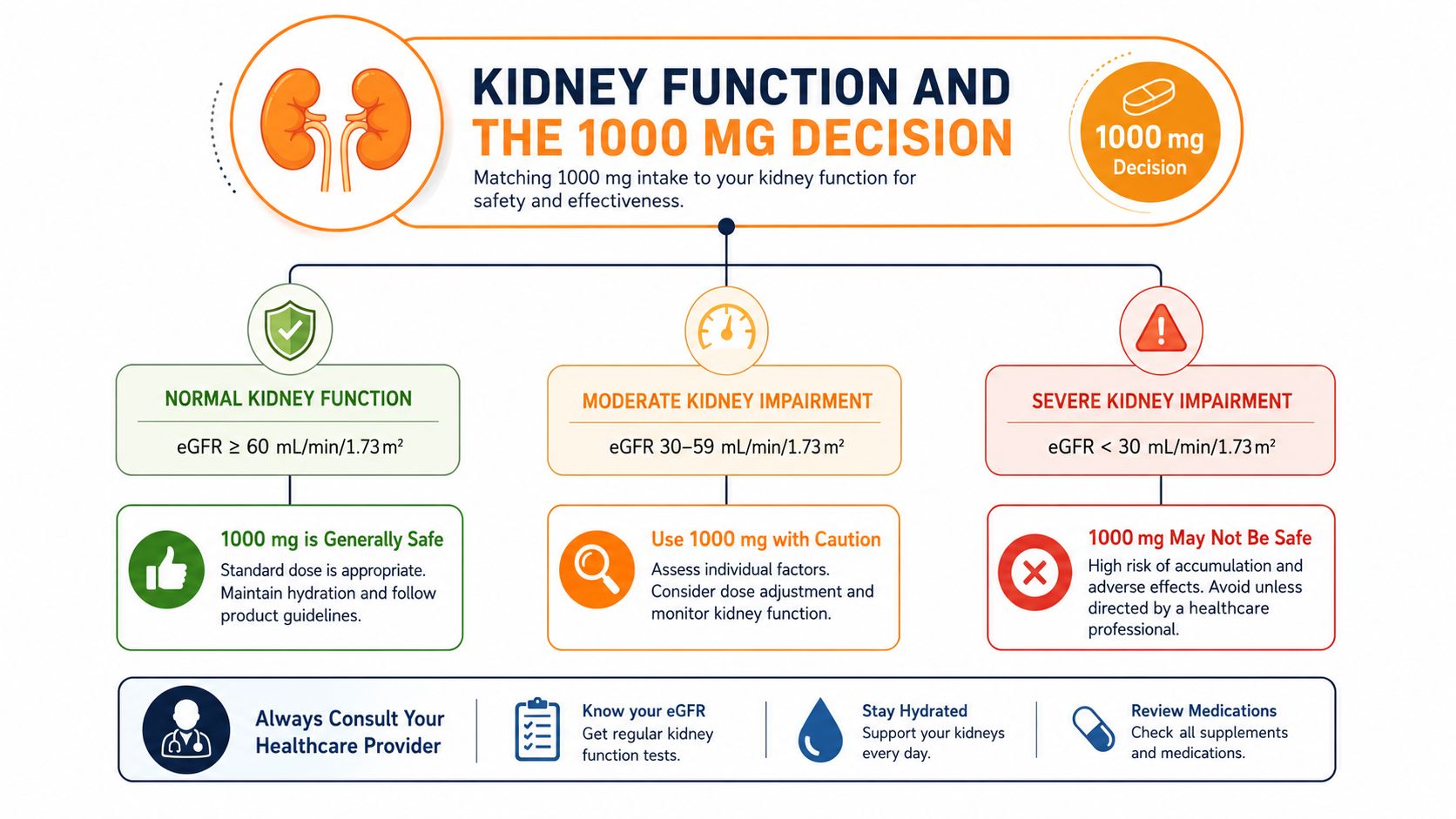
A 1000 mg dose can sit at very different points in treatment, depending on kidney function. UK guidance uses eGFR, which estimates how well the kidneys filter, to decide whether metformin can stay the same, should come down, or needs to stop [1][2].
What the eGFR bands mean
At 60 to 89 ml/min, treatment is usually continued with routine checks. At 45 to 59 ml/min, metformin can often stay in place, but it needs closer review. At 30 to 45 ml/min, some UK guidance reduces the total daily dose to 1000 mg. Below that, metformin may need to be stopped [1][2].
That is why 1000 mg can mean different things in clinic. For one person, it is a maintenance dose. For another, it is the limit that keeps treatment within the safe range once kidney function has fallen [1].
A home blood test can help when regular monitoring is needed, especially if results are changing or a clinician wants a fresh check between appointments. See how home testing can support routine monitoring
Times when kidney function can dip quickly
Kidney function can drop during dehydration, vomiting, acute illness, or after contrast dye used for some scans. In those situations, metformin may need to be paused while a clinician checks whether it is still safe [1][2].
If you are unwell and cannot keep fluids down, do not carry on as normal. Hold the medicine and ask for advice. The issue is the mix of illness and reduced kidney clearance, not the tablet on its own.
Practical rule: when hydration drops, metformin safety needs a fresh look.
That applies after a scan, a stomach bug, or anything that cuts your fluid intake. A quick call can prevent a bigger problem later.
Side Effects, Lactic Acidosis and When to Seek Help
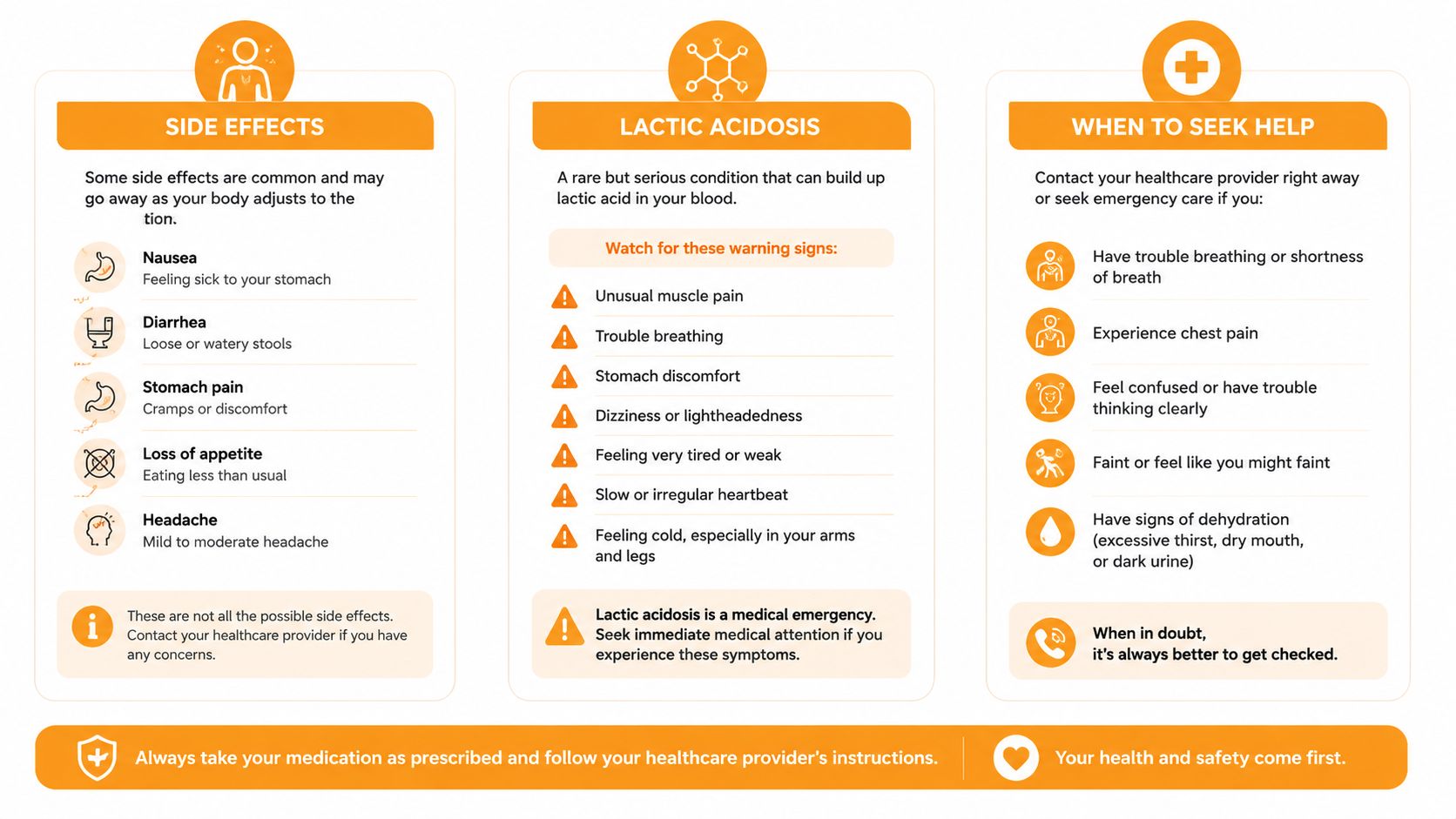
The most common complaints at 1000 mg are gut-related. People talk about nausea, loose stools, bloating and a metallic taste, and those effects often show up when the dose first rises [2][4].
What usually helps
Taking the tablet with the middle of a meal often reduces stomach upset. So can switching to a prolonged-release version if the standard tablet keeps causing trouble [2][5]. Many people settle within a couple of weeks once their body gets used to the dose.
If symptoms are mild, the usual move is patience plus food. If they're strong, the dose may need to stay where it is for longer. If they're persistent, the prescriber may want to change the formulation or lower the amount.
The rare warning you must not ignore
Lactic acidosis is rare, but it's serious. Warning signs include unusual tiredness, deep rapid breathing, severe stomach pain, muscle aches, feeling cold or dizzy, and sudden deterioration when you're already unwell [2][4].
Get same-day medical help if you have persistent vomiting, signs of dehydration, reduced urine output, or an acute illness with fever. These are the moments when metformin and the illness may stop being a safe combination.
Pharmacist's tip: if you can't keep fluids down, stop guessing and get advice the same day.
A note on vitamin B12
Long-term metformin can lower vitamin B12, so tell your pharmacist or GP if you notice tiredness, pins and needles, or numb feet. That doesn't prove a B12 problem, but it's a good reason to book a blood test and check [4]. If you've been on metformin for a while, B12 is worth keeping on the radar.
Check what a liver blood test can and can't tell you
Real UK Scenarios for Taking 1000 mg of Metformin
A dose makes more sense when it lives inside a real day. A tablet is easy to discuss in theory. It's much clearer when it has to fit around a commute, a meal break, or a gym bag.
A night-shift nurse
Maya works nights and sleeps through the middle of the day. Her clinician gives her prolonged-release 1000 mg with her breakfast after a shift and again with her evening meal on days when her plan calls for two doses. That keeps the medicine tied to food, not the clock.
Her main risk is a missed meal. If she skips food, she shouldn't casually take the tablet anyway, especially if her stomach is already unsettled. On her hardest weeks, consistency matters more than squeezing tablets into awkward gaps.
A gym-goer with a fixed routine
Tom takes immediate-release 1000 mg after breakfast and after tea. It fits his training because he can take each dose with a proper meal, then head to the gym later without the stomach churn he gets from taking it on an empty stomach.
His pitfall is post-workout nausea. If he's had a hard session and then feels washed out, he shouldn't double up because he missed the timing by an hour or two. The safer move is to keep to the usual schedule and ask a pharmacist if the pattern keeps happening.
Find out how order-to-treatment systems work in practice
Both examples show the same point. 1000 mg of metformin only works well when the tablet strength, meal pattern and total daily dose line up. The dose is part of the routine, not a standalone number.
Safety Checklist and Common Questions on 1000 mg of Metformin
A 1000 mg tablet can look like a full dose on the box and still be only part of the story. For some people it is a stepping stone while the prescriber increases treatment. For others it is the maintenance amount that keeps blood glucose steady. In people with reduced kidney function, it can also be the highest amount they are allowed to take, so the tablet strength alone never tells you enough.
Before a patient settles into 1000 mg of metformin, the safe route still starts with kidney function, then the total daily dose, then whether the tablet is immediate-release or prolonged-release. That is the order that matters at the counter, because the same tablet can mean very different things depending on the person and the rest of the prescription [1][2][4].
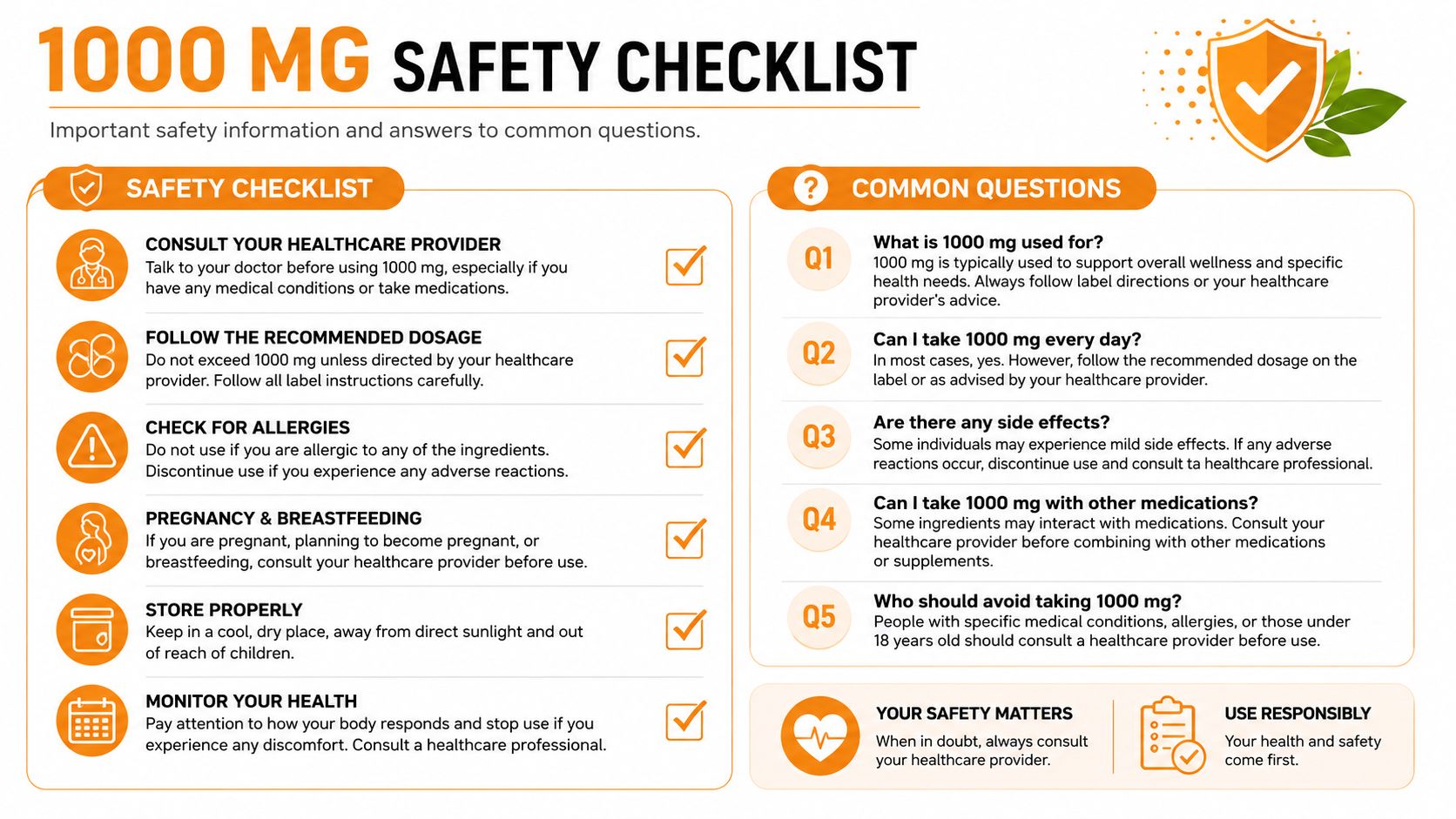
A quick pharmacist-style checklist
- Check kidney function first: eGFR tells the prescriber whether 1000 mg is a routine dose, a limit, or too much for that person [1][2].
- Take it with meals: this lowers the chance of nausea and diarrhoea [2][5].
- Do not push through dehydration or severe illness: vomiting, poor fluid intake and marked weakness can make metformin unsafe [2][4].
- Keep B12 in mind: longer-term use can affect levels, so numbness, tiredness or tingling should be discussed and may need a blood test [4].
- Review alcohol habits honestly: heavy drinking raises risk and needs a proper conversation with a clinician [4].
- Use a safe supply route: if you order online, follow a safer online pharmacy route for medication and advice so you are not relying on a poor-quality source.
Common questions at the counter
Can I take metformin with my statin?
Usually, yes. These medicines are often used together in diabetes care. The question is not whether they clash in general, but whether your full list of medicines leaves any kidney, muscle or stomach issues that need checking.
What happens if I miss a dose after a gym session?
Do not make up the dose just because you have finished training. Take the next dose at the usual time, with food, and keep to the prescribed pattern. If missed doses are becoming common around exercise, the routine may need adjusting so the medicine fits your day rather than fighting it.
Can I cut a 1000 mg tablet?
Only if that exact product is meant to be split. Many prolonged-release tablets should stay whole, because cutting them can change how the drug is released.
What if I miss a dose?
Take the next dose at the usual time. Do not take two doses together unless your prescriber has told you to do that.
Should I take it before or after food?
Take it with food, not on an empty stomach. That advice is especially important if your stomach has been sensitive before. For prolonged-release tablets, the evening meal is often the usual anchor point [2][5].
Can I drink alcohol on metformin?
This depends on amount and pattern. Light drinking may be discussed case by case, but heavy alcohol use raises the risk and should be reviewed with your prescriber [4].
How often should my dose be reviewed?
At least yearly, and sooner if kidney function changes, symptoms appear, or another medicine is added.
Summary
1000 mg of metformin is a common strength, but the number on the tablet is only one part of safe treatment. The core question is the total daily dose, plus whether the tablet is immediate-release or prolonged-release. For some people, 1000 mg is a maintenance amount. For others it is a step on the way up. In people with reduced kidney function, it may be the upper limit their clinician is willing to use.
Side effects are usually stomach-related and often improve with food or a slower increase [2][4]. Seek medical help quickly if you become very unwell, dehydrated, breathless, or develop worrying symptoms after taking it.
If the prescription label, your kidney results and your daily routine do not seem to fit together, take them to a pharmacist or GP and ask for a proper review.


