How Does Norethisterone Work? a UK Guide to Period Delay
Wondering how does norethisterone work? It holds the womb lining steady to delay a period. Learn the UK dosing, timing and safety checks.

Norethisterone is a synthetic progestogen that copies the hormone progesterone, holds the womb lining steady and so delays a period. The standard UK period-delay dose is 5 mg three times daily, starting at least 3 days before your expected period.
But if a medicine can change when you bleed, why doesn't it also prevent pregnancy? That's an important distinction, especially if you're worried about side effects or unsure how to plan treatment. Period delay and contraception aren't the same thing. Understanding the hormone effect helps explain why the start date, regular doses and stop date matter. It also helps you spot the difference between mild symptoms you can discuss with a pharmacist and warning signs that need urgent care.
Five key takeaways at a glance
Norethisterone gives your body a temporary progesterone-like effect. It postpones bleeding rather than ending periods for good.
- How it works: It helps keep the womb lining stable until you finish the prescribed course.
- UK licence: It's the only progestogen licensed in the UK specifically for period delay. [1]
- Timing matters: Start before your expected bleed and follow the dose schedule your prescriber gives you.
- Separate contraception: Period-delay tablets don't protect against pregnancy. Use condoms or another reliable method if needed. [2]
- Know the warning signs: Chest pain, breathlessness, sudden weakness, face drooping or a swollen, painful calf need urgent medical attention.
Don't copy someone else's treatment plan, even if their tablets look identical. Your health history, other medicines and cycle dates all affect whether this medicine is suitable.
How Norethisterone Works in the Body
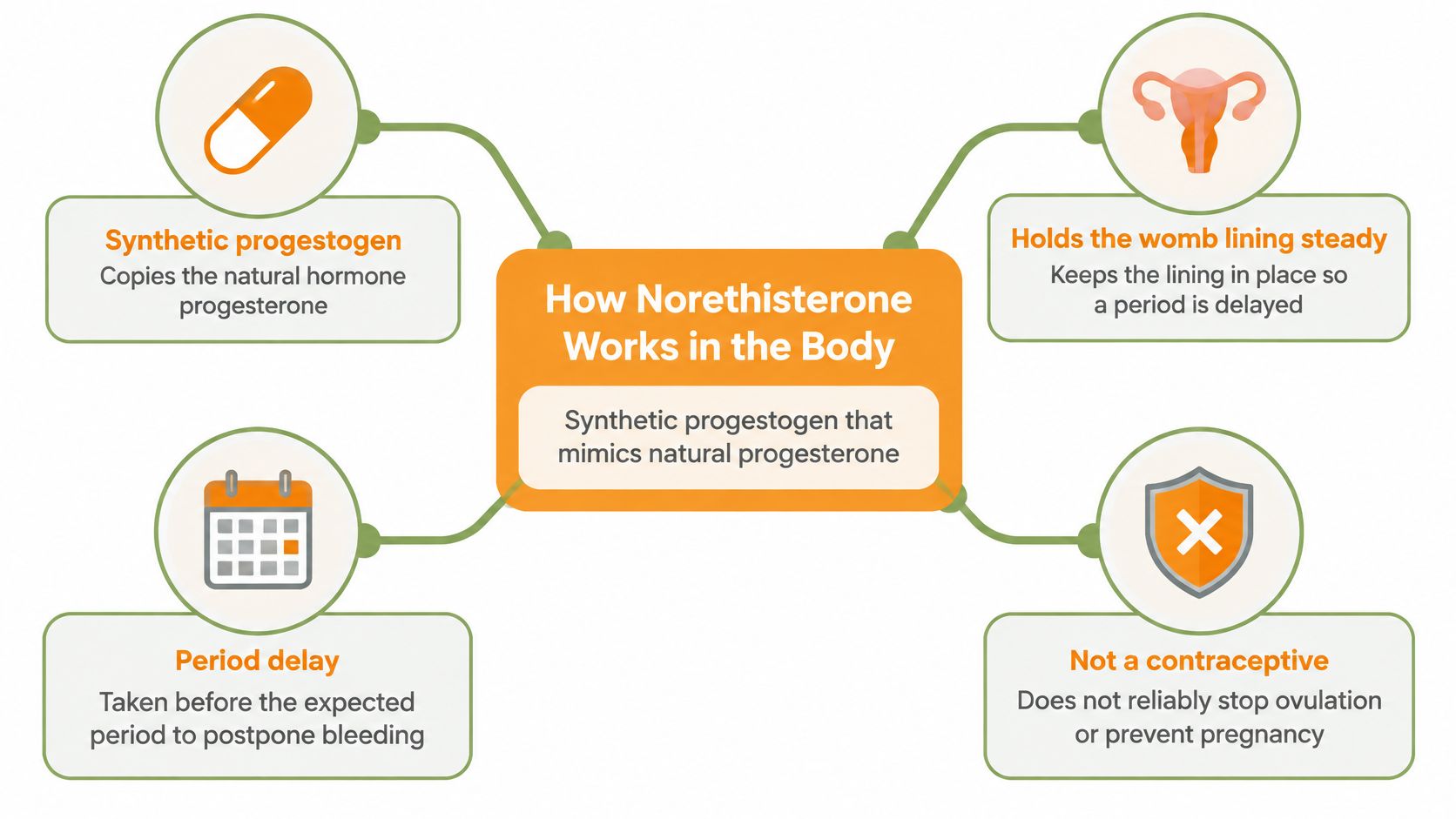
Norethisterone is a synthetic progestogen, a medicine that acts like your natural hormone progesterone. It helps hold the womb lining steady, which delays the expected bleed.
A progestogen means a substance with progesterone-like effects. It isn't the same as replacing every hormone involved in your cycle.
What normally triggers a period
After ovulation, when an ovary releases an egg, progesterone rises. This hormone helps maintain the lining of your womb, also called the endometrium.
Towards the end of the cycle, progesterone falls. The lining then breaks down and leaves the body as a period.
Think of progesterone as a message telling the lining to stay in place. Norethisterone keeps sending that message for longer.
The NHS Specialist Pharmacy Service guidance identifies norethisterone as the only progestogen licensed in the UK specifically for delaying periods. It says treatment can continue for up to 3 to 4 weeks when clinically appropriate, with the prescriber deciding the duration. [1]
Different uses need different instructions
Norethisterone also has uses beyond short-term period delay. These include:
- Heavy menstrual bleeding: A clinician may prescribe it to help manage bleeding.
- Endometriosis symptoms: Treatment follows a different clinical plan.
- Some contraceptive pills: These use a separate formulation and dosing schedule.
Don't assume that instructions for one use apply to another. In particular, a period-delay course isn't interchangeable with a contraceptive pill.
If you already use hormonal contraception, understanding your period on the pill can help you ask the right questions before changing anything.
Practical rule: Norethisterone doesn't physically block blood or permanently switch off periods. It temporarily changes the hormonal support for the womb lining.
Once that support ends, the lining can shed. That's why a planned stop date matters just as much as a start date.
Check safety and pregnancy before you start
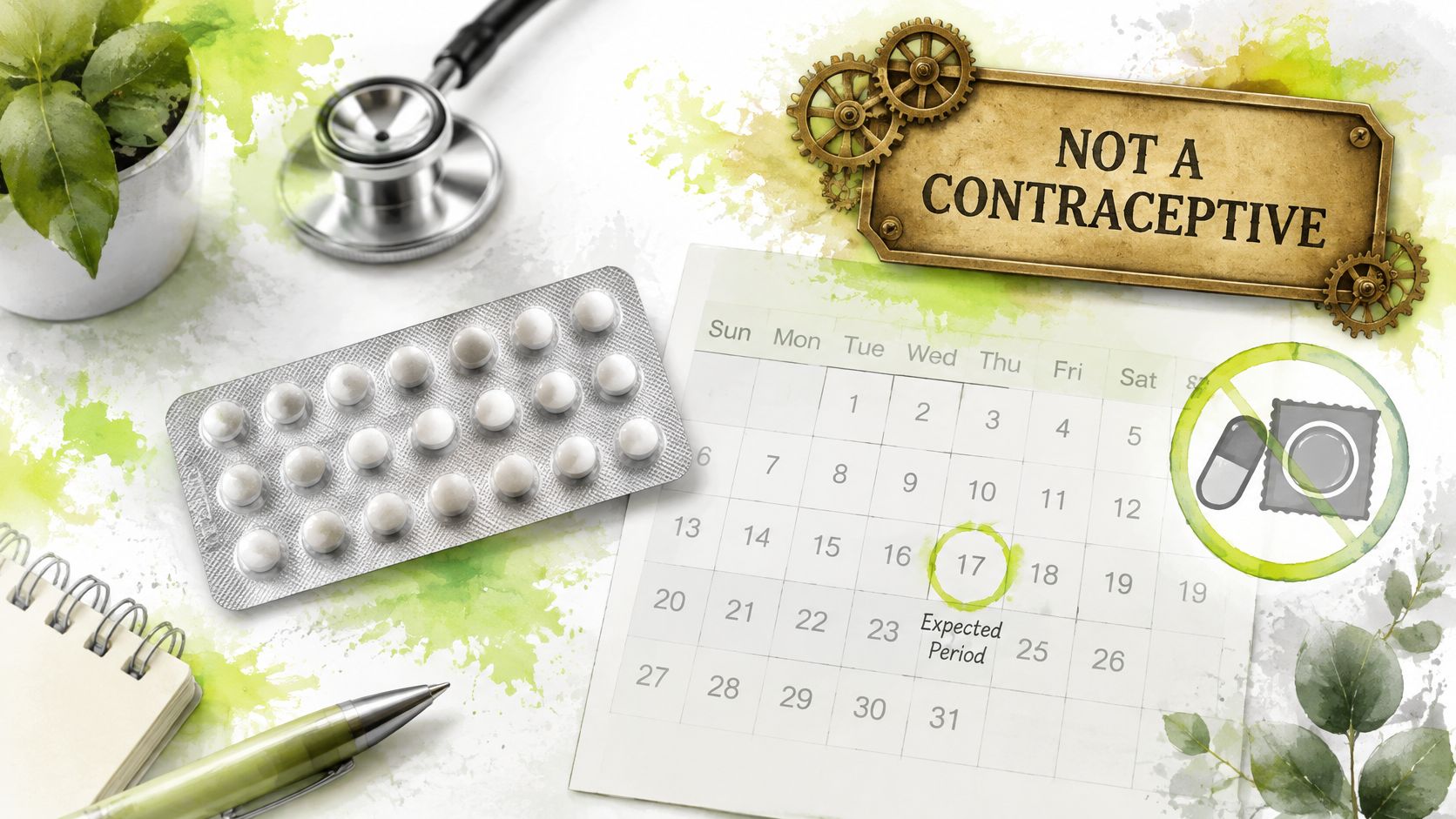
Could you become pregnant while taking norethisterone to delay a period? Yes. Period-delay norethisterone is not contraception, and not bleeding does not mean pregnancy is prevented.
The NHS-hosted period-delay advice from Collingwood Surgery recommends using separate contraception, such as condoms, if you want to avoid pregnancy. Norethisterone changes support for the womb lining; it does not protect against conception. For a separate question about hormonal contraception, read about the chances of getting pregnant on the pill.
Safety screening matters for another reason. At higher doses, some norethisterone can convert to ethinylestradiol, a form of oestrogen. This is why a prescriber should assess your blood-clot risk before treatment. Hormone exposure is not the same as contraceptive protection.
Your pre-start checklist
- Check pregnancy risk. Tell the prescriber if pregnancy is possible. Ask whether you need a test and when to take it.
- Share any history of blood clots, liver disease or unexplained vaginal bleeding.
- List everything you take, including prescribed medicines, shop-bought treatments and supplements. Some medicines can affect how the liver breaks down hormones.
- Agree a start date based on when your period is expected, rather than only on your travel date.
- Ask for a clear stop date and what to do if bleeding starts early.
- Keep a simple record of doses, spotting and symptoms.
If you already use contraception, tell the prescriber which pill you take and whether you have missed any doses. These details help them advise you on pregnancy risk and whether a separate contraceptive method is needed.
How this looks in everyday life
A teacher planning a school trip might want to avoid bleeding while away. She checks when her period is expected, shares her medical history and agrees a treatment plan with the prescriber. Packing tablets comes after the safety check, not instead of it.
A nurse covering night shifts may need advice on fitting doses around changing sleep times. She can ask a pharmacist how to follow the prescribed schedule without bunching doses together.
- Pharmacist's tip: Bring a medicine list or photos of the packets to your consultation.
- Pharmacist's tip: Tell the prescriber if your cycle is irregular. An app's date prediction may not be exact.
- Pharmacist's tip: Ask about contraception before taking the first tablet.
Spotting can still happen, and individual responses vary. Use the safety check to discuss your circumstances with a GP or pharmacist. This information does not replace personal medical advice.
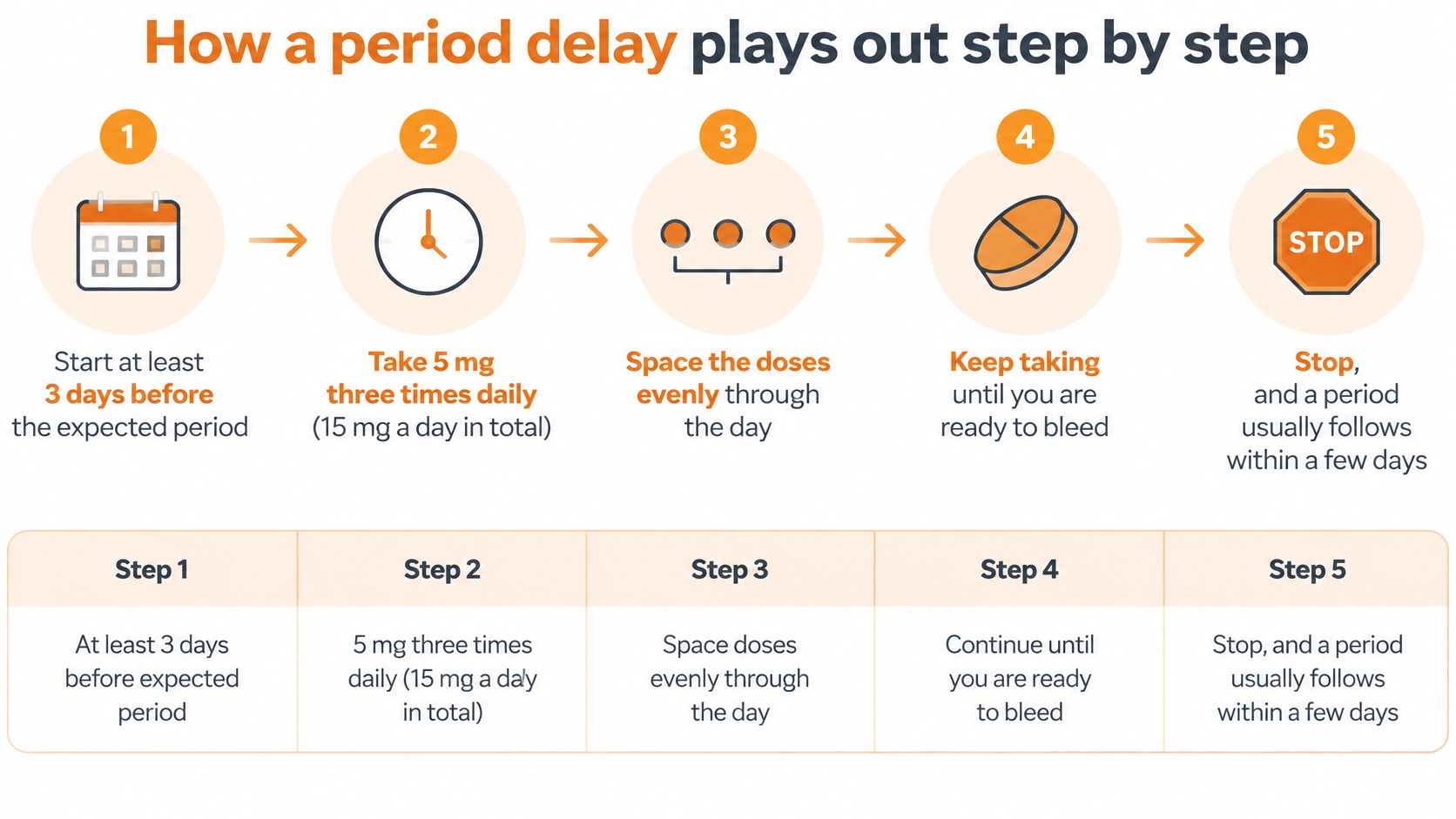
How a period delay plays out step by step
Period delay timeline and dosing
| Stage | When | What happens | What you do |
|---|---|---|---|
| Start | At least 3 days before the expected period | Medicine starts holding the womb lining steady | Take 5 mg three times daily, as prescribed |
| Treatment | Daily, up to the planned stop date | The lining stays supported, though spotting can happen | Space doses across the day and keep to the schedule |
| Stop | Date set by the prescriber, usually within 3 to 4 weeks | Medicine support ends | Expect bleeding within about 3 days of stopping |
The UK norethisterone product information gives the period-delay regimen as 5 mg three times daily, starting 3 days before the expected period, with bleeding usually following within about 3 days of stopping. [3] The maximum course length requires an individual prescribing decision. [1]
Follow the dates, not just the event
Start before bleeding is due. The aim is to support the lining before the usual shedding process begins. Starting late doesn't mean you should take extra tablets.
Take each prescribed dose across the day. The standard schedule totals 15 mg daily. [3] Don't take the whole day's tablets together to make the routine easier.
Continue only for the agreed course. Don't extend treatment because you still have tablets left. If plans change, contact the prescribing service.
Stop on the agreed date. Allow some flexibility afterwards because the return of bleeding isn't an exact appointment.
A busy parent's holiday plan
Say a parent expects her period on Saturday, when the school holiday begins. Her prescriber agrees that she should start on Wednesday and continue through the holiday week.
She records each dose and stops on the agreed Sunday evening at the end of the trip. She doesn't assume that Sunday's final tablet means bleeding must begin on Monday morning.
This example works because the expected period date matches the planned start. Starting on Wednesday wouldn't automatically suit someone whose period was due on Thursday.
Write the expected period date, first dose and final dose on your calendar before treatment starts.
If your cycles are hard to predict or bleeding has already begun, ask for advice rather than changing the dose yourself. Period delay also doesn't replace care for recurring pain. Our guide to a painkiller for period pain discusses that separate need.
Why Norethisterone Needs Doses Spread Across the Day
Key absorption and clearance figures for oral norethisterone
| Measure | Typical value | What it means for dosing |
|---|---|---|
| Time to peak level | 1 to 3 hours | Blood levels rise within a few hours of each dose |
| Oral exposure compared with intravenous injection | About 60% | The liver processes part of the dose before it reaches the circulation |
| Elimination half-life | 5 to 12 hours, mean 7.6 hours | Levels fall within a day, so regular dosing matters |
| Route of clearance | About 60% removed as metabolites in urine and faeces | The body breaks down the medicine and removes the resulting substances |
These figures come from the UK Summary of Product Characteristics for norethisterone tablets. It reports peak levels within 1 to 3 hours, oral exposure of about 60% compared with intravenous dosing, and a mean half-life of 7.6 hours. [4]
What half-life means in plain English
Half-life means the time it takes for the medicine's blood level to fall by half. It doesn't mean that the medicine suddenly stops working at that point.
Think of a bucket with a slow leak. Each dose adds medicine, while your body keeps breaking it down and removing it. Spreading the prescribed doses across the day helps maintain the hormone effect.
The liver also processes part of each tablet before the medicine reaches the wider circulation. Clinicians call this first-pass metabolism. It isn't a reason to increase your dose.
If a dose is late or missed
A missed or delayed dose may weaken support for the lining. That can make breakthrough bleeding more likely, although spotting doesn't prove you missed a tablet.
- Record the timing: Note when the dose was due and when you last took a tablet.
- Ask for advice: Contact your pharmacist or prescriber about the next step.
- Don't improvise: Don't double up or bunch doses together unless your clinician specifically directs you.
Liver disease and medicines that speed up liver enzymes can change how much norethisterone your body receives. Tell your prescriber about these before treatment rather than stopping another medicine yourself.
Pharmacist's tip: Set named phone alarms and tick off each dose. If you miss one, check the leaflet and contact your pharmacist rather than guessing.
Side Effects and When to Seek Urgent Help
Side effects can happen, but not every symptom means something dangerous. Some effects are mild and short-lived. Your own response may differ from someone else's.
Possible effects include:
- Headache: Ask for advice if it persists, worsens or feels unusual.
- Bloating: Record whether it affects eating, sleep or daily comfort.
- Breast tenderness: Mention persistent or troublesome symptoms.
- Mood changes: Tell your prescriber if these affect your wellbeing.
- Spotting: Keep a note of bleeding during treatment.
Match the symptom to the right action
Symptoms by urgency and what to do
| Symptom | How urgent | What to do |
|---|---|---|
| Mild headache, bloating or breast tenderness | Usually not urgent when mild | Mention it at follow-up; ask a pharmacist if it persists |
| Spotting or breakthrough bleeding | Usually not urgent when light | Note the dates and tell the prescriber |
| Swelling, pain or warmth in one calf | Urgent | Seek same-day assessment through your GP or NHS 111 |
| Sudden chest pain or breathlessness | Emergency | Call 999 |
| Sudden weakness, face drooping or speech trouble | Emergency | Call 999 immediately |
| Yellowing of the skin or eyes, or severe abdominal pain | Urgent | Seek urgent assessment through your GP or NHS 111; call 999 if severe or with collapse |
| Heavy bleeding that soaks a pad every hour | Urgent | Seek urgent advice; call 999 if you faint, collapse or feel severely unwell |
Don't wait for a routine appointment if you have emergency symptoms. A painful, swollen calf may indicate a clot in the leg. Sudden chest pain or breathlessness may indicate a clot in the lungs or another serious problem.
Face drooping, arm weakness and speech trouble can be signs of stroke. Call for emergency help even if symptoms start to improve.
When to contact your prescriber
Stop taking norethisterone and seek urgent medical advice if you develop symptoms that could suggest a blood clot. Take the medicine packet with you if you attend urgent care.
Yellow skin or eyes can suggest a liver problem. Severe abdominal pain also needs assessment rather than an assumption that it's a normal hormone effect.
Contact your GP or pharmacist promptly if you suspect pregnancy. Don't start another course to postpone an unexplained missed period.
A medication contraindication means a health factor that may make a medicine unsafe for you. Share any new diagnosis or symptoms, even if your original consultation went smoothly.
Keep a record of each symptom, its date and the doses taken. That gives your prescriber useful detail without asking you to remember everything while worried.
Frequently asked questions about norethisterone
Does norethisterone stop periods for good?
No. Norethisterone delays bleeding while you take it, rather than permanently stopping your cycle. A bleed usually follows within a few days of finishing treatment. The start and stop dates matter because the medicine holds the womb lining steady during treatment; it does not end your periods. [1, 3]
Does it prevent pregnancy?
No. Norethisterone prescribed to delay a period is not contraception. Use condoms or another reliable contraceptive method if you need protection from pregnancy. [2]
How long can I take it?
Your prescriber sets the length of treatment based on your health and plans. Follow the agreed course, and check with them before extending or repeating it. [1]
Can I use it if I already take the combined pill?
Don't add norethisterone without advice. NHS guidance describes it as a period-delay option for people who are not already using the combined pill. Ask your prescriber which approach fits your contraceptive pill and circumstances. [1]
What if I miss a dose?
Check the patient information leaflet and contact your pharmacist or prescriber if you are unsure what to do. Tell them when you last took a dose. Don't take an extra dose to make up for one you missed unless they advise you to.
Who should not take it?
Possible pregnancy, a history of blood clots, liver disease or unexplained bleeding need assessment before treatment. Your prescriber can decide whether norethisterone is suitable after reviewing your health history. [2]
Bleeding can have different causes. Read about light pink discharge for general context, but the information cannot identify the cause of bleeding during treatment.
Summary
Norethisterone delays bleeding temporarily by supporting the womb lining.
Follow the prescribed start date, stop date and dose schedule.
Use separate contraception if you need pregnancy protection.
Seek urgent help for possible clot or stroke symptoms.
Courier Pharmacy uses an online questionnaire reviewed by a prescriber. The review helps assess whether a treatment is suitable for your health history.