Impetigo Treatment Adults: What Works and When
Impetigo treatment adults: UK creams, tablets, self-care and when to see a GP, pharmacist or NHS 111.
You have woken up with a sore, sticky patch on your face and you want a straight answer on impetigo treatment for adults that you can start today. For a small, localised patch in someone who feels well, UK guidance starts with an antiseptic cream, not a tablet. If the rash is widespread, blistering, or you feel ill, the route changes.
The NICE pathway works like a short decision tree. First question: how much skin is involved, and do you feel well? A small non-bullous patch in a well adult usually starts with hydrogen peroxide 1% cream. Wider spread, bullous blisters, fever, or a higher-risk situation moves you onto antibiotic tablets. Once treatment starts, finish the days you were given, then get the skin checked again if the sores are not settling.
Work sits on the same tree. In a close-contact job, such as care, food handling, or childcare, stay off until the sores are dry and crusted, or until 48 hours after antibiotics start. A desk role with little skin contact is a different branch. Your pharmacist or GP can match the pause to the work you do.
Five takeaways
- Match the route to the rash. Small and well often means cream. Bullous, feverish or high risk means tablets.
- Hydrogen peroxide 1% cream is the usual first cream for localised non-bullous impetigo.
- Finish the days you were given, even when the crusts look better.
- Stay off close-contact work until sores are dry and crusted, or until 48 hours after antibiotics start.
- Get same-day help if redness spreads, you feel unwell, or sores sit around the eyes.
What Impetigo Is and How to Recognise It
Say you finish a warehouse shift, shave, and notice honey-coloured crusts on your chin. They sting. You wonder if this is impetigo or just razor burn.
Impetigo is a common, contagious skin infection. The usual bacteria are Staphylococcus aureus or Streptococcus pyogenes. They get in through a nick, a scratch or cracked skin.
There are two forms.
Non-bullous impetigo is the usual form in adults. Red sores burst and dry into golden, honey-coloured crusts. They often sit around the nose, mouth and hands.
Bullous impetigo is less common. It causes larger fluid-filled blisters, usually on the trunk or limbs. The blister roof is thin and it breaks easily.

It spreads by skin contact and by shared towels, razors, flannels and bedding. Mild cases can settle on their own. Antibiotics shorten the illness and cut the chance you pass it on.
Eczema, cold sores and shingles can look similar. A broken patch of eczema that then crusts is easy to misread, which is why an infected eczema check helps if the skin was already sore. Ask a pharmacist if you are unsure.
Three checks you can make today
- Look of the crusts: golden and stuck-on, or a different pattern.
- How many areas: one small patch, or several places.
- How you feel: well, or feverish and generally unwell.
Practical rule: If you feel well and the patch is small, you can often start with pharmacy advice the same day. Feeling ill moves you toward a prescriber.
Choosing Between Topical and Oral Treatment
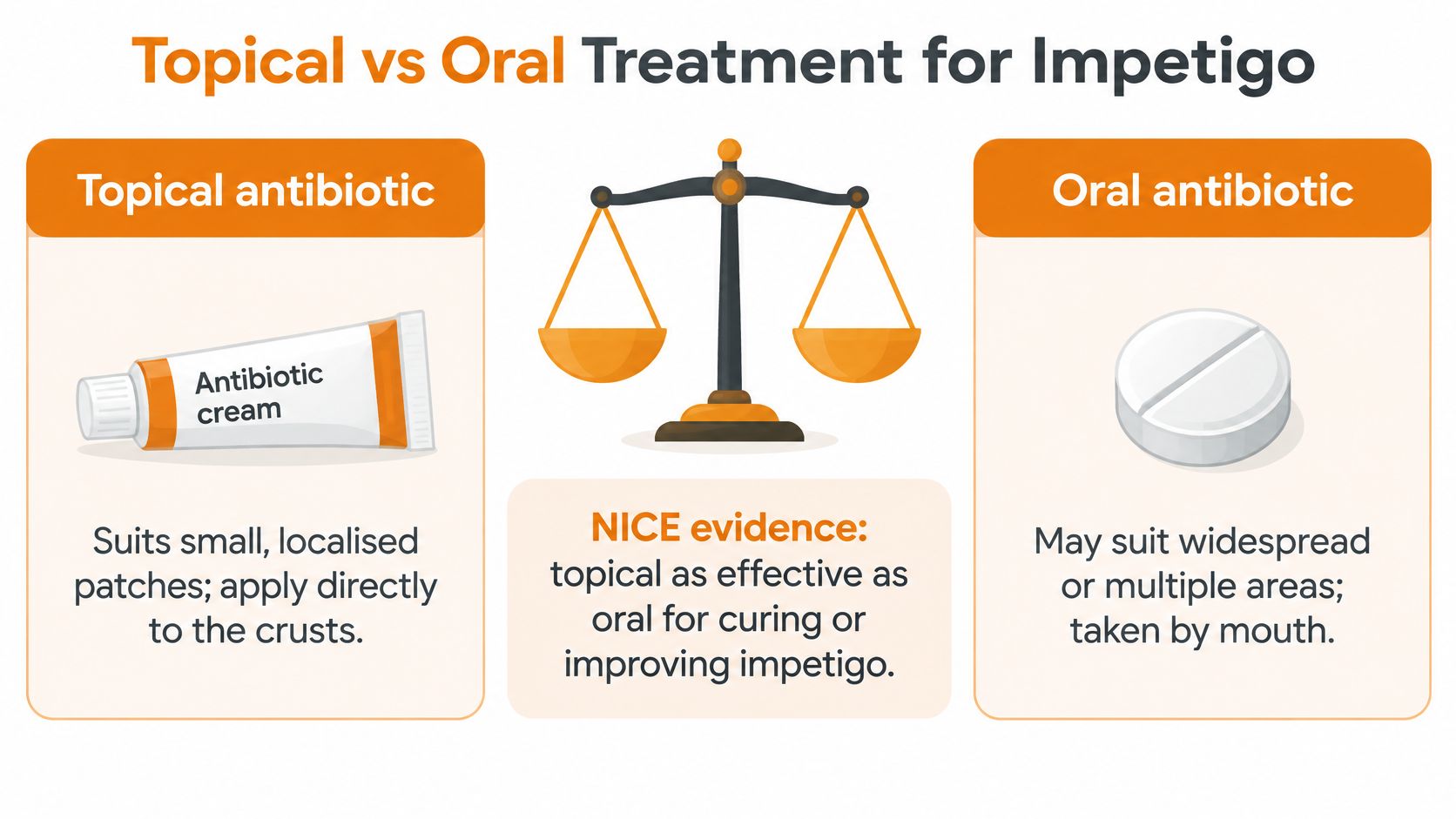
Tablets are not automatically the stronger choice. NICE's evidence review for NG153 found topical antibiotics were as effective as oral antibiotics for curing or improving impetigo.
A topical treatment may suit a small, localised infection when you are not systemically unwell and you are not at high risk of complications. Widespread non-bullous impetigo may need either a cream or tablets. An oral antibiotic becomes necessary when infection is more extensive, or when treatment has to reach beyond each sore.
Four decision points
- How many areas are affected, one cheek or both arms.
- Whether you feel unwell or feverish.
- Whether blisters are large and fluid-filled.
- Whether you have a higher risk of complications, such as a weakened immune system.
Suspected or confirmed MRSA needs a conversation with a local microbiologist. A standard antibiotic is not the automatic next step.
A busy parent with three spots on one cheek, who feels well, usually suits a cream. A gym-goer with spreading sores on both arms and a fever needs a prescriber to review tablets. Where fusidic acid resistance is the concern, a prescriber may choose mupirocin 2% ointment instead.
Questions worth asking
- Does this look localised enough for a cream?
- Do I need tablets because of blisters, fever or risk?
- When should I re-check, and what would count as getting worse?
Use those answers to pick a route, then match the row in the table below.
Pharmacist's tip: Don't ask for tablets "just in case" when a small patch would suit a cream. Saving antibiotics for the cases that need them keeps them working.
Topical and Oral Treatment Options at a Glance
Read the row that matches how the skin looks and how you feel. These are standard adult options from UK guidance, not a self-selection list. A prescriber or pharmacist confirms the choice.
| Route | Medicine and strength | How often | Duration | Used when |
|---|---|---|---|---|
| Topical first choice | Hydrogen peroxide 1% cream | 2 or 3 times daily | 5 days | Localised non-bullous impetigo, not systemically unwell |
| Topical alternative | Fusidic acid 2% | 3 times daily | 5 days | Hydrogen peroxide unsuitable (e.g. lesions around the eyes) or ineffective |
| Topical alternative | Mupirocin 2% | 3 times daily | 5 days | Fusidic acid resistance suspected or confirmed |
| Oral first choice | Flucloxacillin 500 mg | 4 times daily | 5 days | Bullous impetigo, systemic illness or high complication risk |
| Oral alternative | Clarithromycin 250 mg | Twice daily | 5 days | Penicillin allergy or flucloxacillin unsuitable (non-pregnant adults) |
| Oral in pregnancy-related cases | Erythromycin 250-500 mg | 4 times daily | 5 days, extend to 7 if lesions are numerous or severe | Pregnancy-related circumstances, prescriber decides |
NICE guidance NG153 sets this severity-based pathway for adults aged 18 and over. For localised non-bullous impetigo, when you are not systemically unwell and not at high risk of complications, the first option is hydrogen peroxide 1% cream, two or three times daily for 5 days.
If the first cream is not the right fit
Hydrogen peroxide is unsuitable around the eyes, and sometimes it fails to clear the sores. NICE then recommends fusidic acid 2% three times daily for 5 days. If fusidic acid resistance is suspected or confirmed, mupirocin 2% three times daily for 5 days is the alternative. Our Fucidin cream guide walks through how fusidic acid is used on skin infections, so you know what the tube is for before you start.
For widespread non-bullous infection, either a topical or an oral antibiotic may be used. Bullous impetigo, systemic illness, or a high risk of complications warrants an oral antibiotic.
Tablets and how long to continue
The first-choice oral treatment is flucloxacillin 500 mg four times daily for 5 days. If you have a penicillin allergy, or flucloxacillin doesn't suit you, clarithromycin 250 mg twice daily is the alternative in non-pregnant adults. Erythromycin 250–500 mg four times daily is the option NICE identifies for pregnancy-related circumstances. A prescriber chooses the dose inside that range.
NICE states treatment can extend to 7 days according to lesion number and severity. It also advises against combining topical and oral antibiotics routinely. The point is effective treatment with less unnecessary resistance.
Find the row that matches your symptoms, then confirm it with a prescriber. Guideline doses are a map, not a checkout list.
Pharmacist's tip: Tell the prescriber about allergy, pregnancy, breastfeeding and any antibiotic you have used recently. That one sentence often changes the row.
How to apply treatment and finish the course
Oral treatment is the UK pathway when impetigo is bullous, you are systemically unwell, complication risk is high, or cream is impractical. A NICE summary of NG153 lists flucloxacillin 500 mg four times daily for 5 days as the first-choice adult oral regimen. Most cases are expected to respond to 5 days. A 7-day course may be justified when disease is more severe or lesions are numerous. If you are prescribed capsules, the flucloxacillin 500 mg listing shows the strength that matches that first-choice adult dose, so you can check the pack against what was prescribed.
A simple order that keeps the cream on the sore
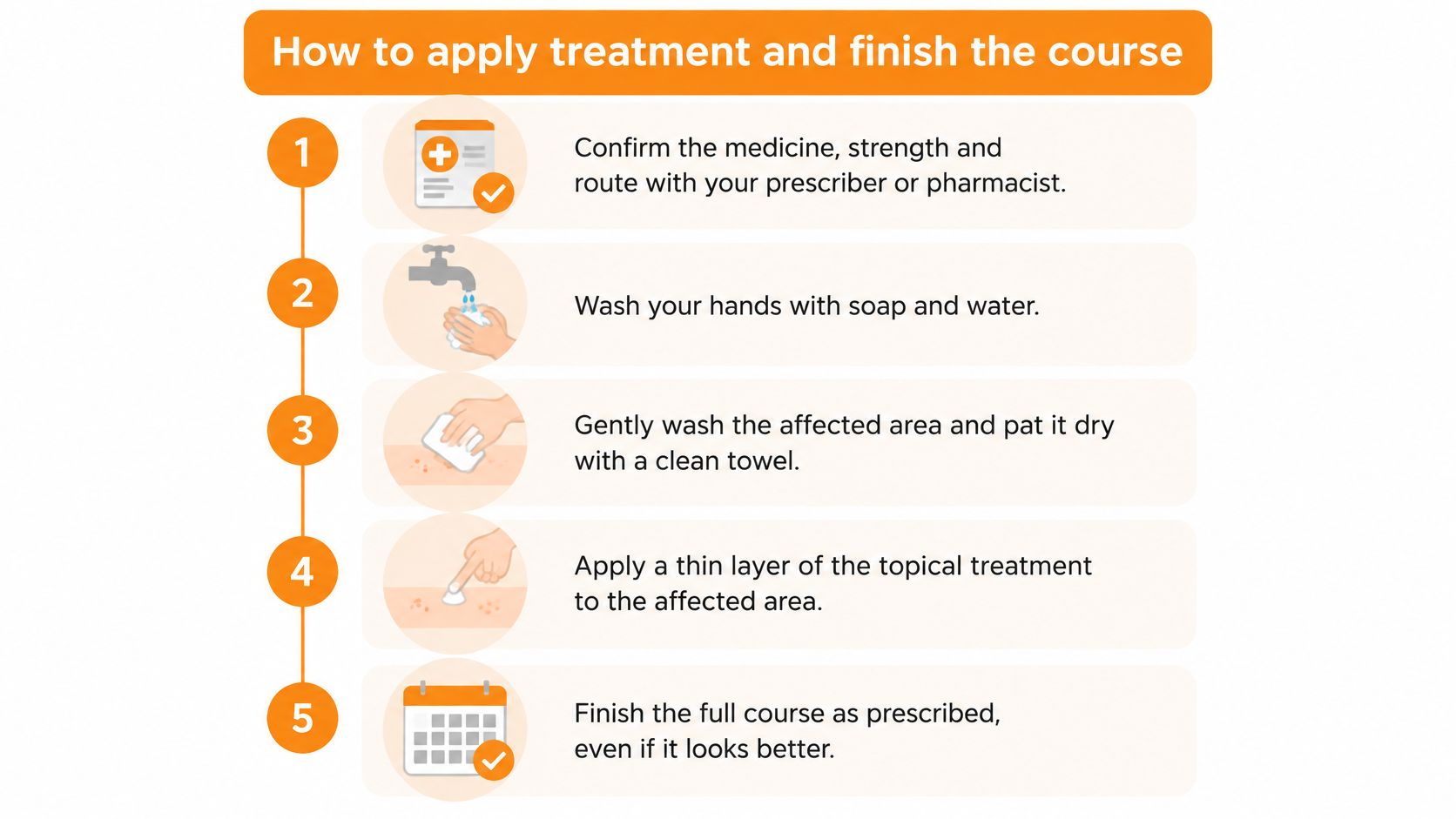
- Confirm the medicine. Check the name, strength and whether it is cream or capsules before the first dose.
- Wash your hands with soap and water.
- Clean the skin gently. Wash the area and pat it dry. Loosen crusts. Don't scrub.
- Apply a thin layer over each sore and a small margin, as often as prescribed.
- Wash again and use a fresh towel so you don't put bacteria back on the skin.
- For tablets, space the doses and finish every day you were given, even when the skin looks better.
- Look on day 3 and at the end. Note spreading redness or new blisters.
- Don't add a second antibiotic unless a clinician tells you to use both.
- Missed a tablet? Ask a pharmacist what to do. Don't double up on a guess.
A parent with spots on the face applies the cream for five days, checks on day three, and still finishes the tube's course when the spots already look calmer. Stopping early is how a quiet patch flares again.
If the skin doesn't settle
The prescriber sets the length. If impetigo worsens or fails to improve after you finish oral treatment, a skin swab should be considered. The swab names the bacteria and points to a narrower antibiotic. Choice should also account for local resistance, allergy, interactions and other conditions. One fixed regimen doesn't fit every adult.
Pharmacist's tip: Set a phone reminder for day 3. A quick photo in the same light makes it easier to see whether the edge is creeping outward.
Self-care, hygiene and time off work
Home steps cut spread while the medicine works. They don't replace it.
Cover sores with a loose dressing when you are around other people. Keep nails short. Avoid scratching. Wash your hands often, especially after you touch a crust.
Don't share towels, flannels, clothing, razors or bedding. Wash towels and bedding on a hot cycle and dry them fully. A childcare worker can keep a separate towel at home and wipe shared surfaces after each handover. That small split stops one flannel serving the whole house.
The return-to-work rule
NICE's record of UK infection-control advice states that adults should stay away from work until lesions are healed, dry and crusted over, or until 48 hours after starting antibiotics.
This matters most in close contact. Healthcare workers, childcare staff, gym instructors and shift workers share equipment, changing rooms or hands-on care. A covered sore on a desk job is a different risk from coaching a class.
Say a gym instructor starts antibiotics on Monday morning. They text the manager a return time of Wednesday morning, 48 hours later, and only if the sores are not still weeping. Guessing "I'll see how I feel" leaves the team short and the mats at risk.
Covering lesions, not scratching, washing hands, and not sharing towels, clothing, razors or bedding reduces spread while treatment takes effect. Seek clinical advice if infection is spreading, lesions are extensive, symptoms are worsening, or you have signs of systemic illness. Those signs can change both the route and the length of treatment.
Home care supports the medicine. It doesn't stand in for it. If the rash moves or you feel worse, get advice rather than adding another cream from the cupboard.
When to get urgent, GP or pharmacy help
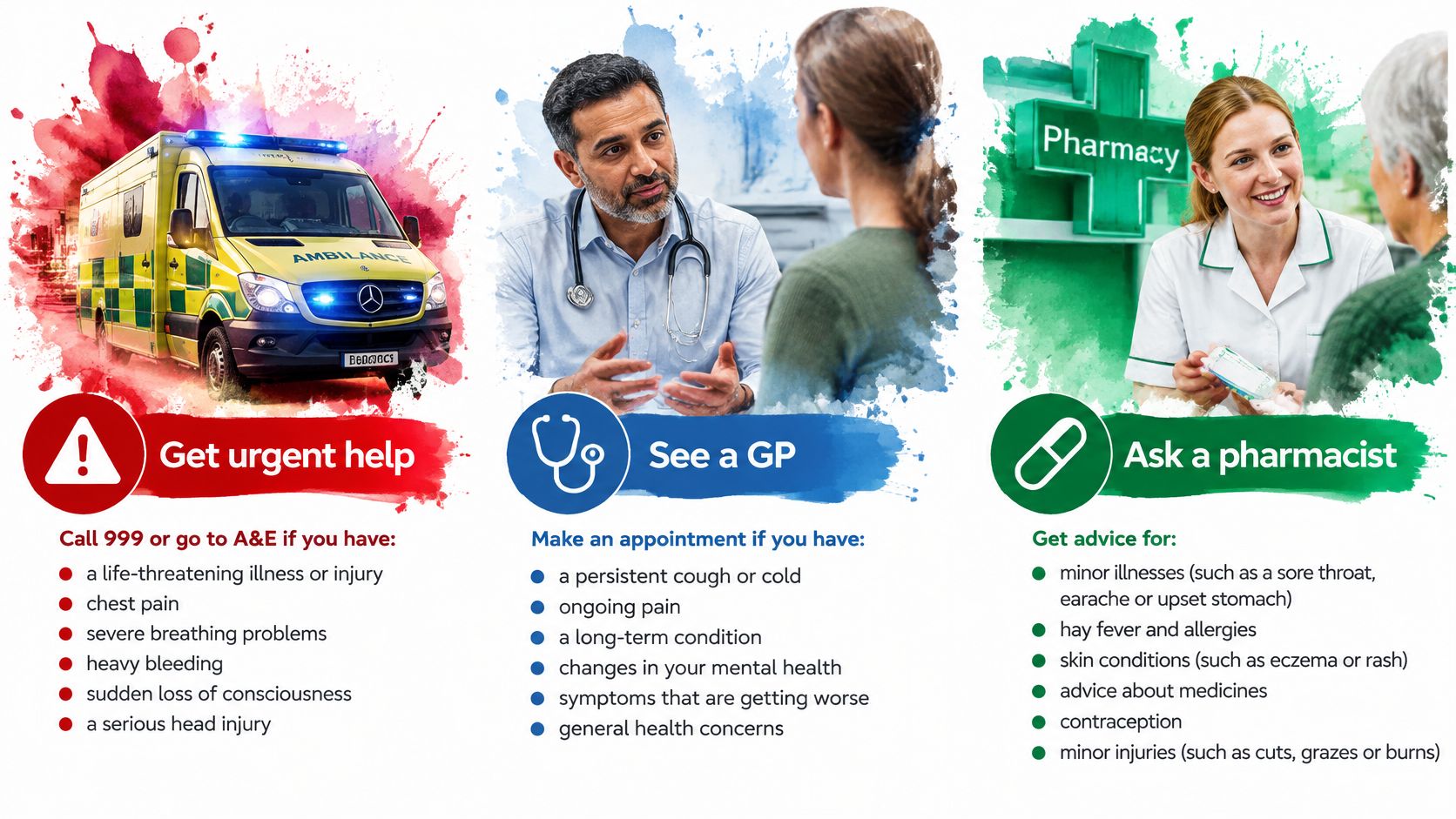
Most adult cases are handled at home or in a pharmacy. A few signs need a same-day review, and one set needs emergency care.
Match the sign to the action
| Symptom or situation | What to do |
|---|---|
| Redness, swelling or pain spreading quickly | Same-day call to a GP or NHS 111 |
| Fever, shivering or feeling generally unwell | Same-day call to a GP or NHS 111 |
| Lesions around the eyes | Speak to a GP or pharmacist for the right treatment |
| Not improving after several days of treatment | Book a GP review; a swab may guide a different antibiotic |
| Pregnant or breastfeeding and need an antibiotic | Speak to a GP or midwife before starting |
| Trouble breathing, confusion or rapidly worsening illness | Call 999 straight away |
Sores around the eyes need a different product choice, because the usual first cream is unsuitable there. If several days of treatment bring no improvement, a swab can point away from the first antibiotic. Pregnancy and breastfeeding change which antibiotic is appropriate, so don't start one from a previous pack.
A short path you can follow
- Check the warning signs in the table.
- If an emergency sign applies, call 999 now.
- If a same-day sign applies, contact your GP or NHS 111 today.
- For a small, localised area with no warning signs, ask a pharmacist about hydrogen peroxide 1% cream.
- Ask which route fits and when to re-check.
- Start treatment and set reminders for day 3 and the last day.
A short video on recognising spreading skin infection can help you judge whether redness is creeping past the original sore.
If you would rather start online, a prescriber can review a request through an online skin infection consultation. Customers who order antibiotics for water, ear or skin infections receive a FREE follow-up call from a prescriber to check the infection has resolved. Check that any medicine suits you before you start. This guide is informational only and doesn't replace advice from a doctor or pharmacist.
Frequently asked questions about adult impetigo
A colleague covers a golden crust on their chin and asks two things at once: can they still share a towel, and can they do a close-contact shift tomorrow? Treat the answers like a short decision tree. How widespread is the rash, how unwell do they feel, and has treatment already started?
Is impetigo contagious? Yes. It passes by direct skin contact and by shared towels and razors. The crusts work like sticky labels: whatever touches them can carry the bacteria to the next person. Keep sores covered and wash your hands often. You do not need to shut yourself in a bedroom. You do need to stop other people touching the crusts.
Can impetigo clear up without treatment? Mild cases can settle on their own. Antibiotics shorten the illness and cut the time you can pass it on, which matters if you live with other people or work skin-to-skin with clients. Waiting it out leaves you contagious for longer.
What is the first treatment for a small area? For localised non-bullous impetigo in an adult who is otherwise well, NICE recommends hydrogen peroxide 1% cream for 5 days. A pharmacist can check it suits the site, especially if sores are near the eyes. If the rash is more than a small patch, that first cream is the wrong branch of the pathway.
When do I need tablets? Tablets are used for bullous impetigo, illness with fever, a high risk of complications, or when cream is impractical. Three spots on one cheek in someone who feels well is a different case from blisters plus fever. The prescriber chooses the route. You do not pick a tablet from an old pack.
Can I go back to work? Stay away until lesions are healed, dry and crusted over, or until 48 hours after starting antibiotics. For close-contact roles, treat that as a firm rule, not a rough guide. Tell your manager the date treatment started so the 48-hour clock is clear. A desk job with covered sores is not the same decision as nursing, childcare, or food handling.
Can I use a cream and tablets together? Use both only if a clinician advises it. Adding a second antibiotic on your own does not speed healing and can add side effects.
Is impetigo the same as eczema or a cold sore? They can look alike, especially on a face that is already dry or cracked. Ask a pharmacist or GP if you are unsure before you treat it as impetigo.
What if I miss a dose? Ask your pharmacist rather than guessing or doubling the next dose. Then carry on and finish the course you were given. Set a reminder for day 3, when you should see whether the sores are drying, and another for the last day.
In short: match cream or tablets to how widespread the rash is and how you feel, use the guideline course, keep hygiene simple, and pause close-contact work until sores are dry and crusted or you are 48 hours into antibiotics. Re-check on day 3. Get same-day help if you are worsening, and call 999 for breathing trouble, confusion or rapid decline.
Byline: Written by a UK pharmacist educator for Courier Pharmacy.
References [1] National Institute for Health and Care Excellence (2020) Impetigo: antimicrobial prescribing. NICE guideline NG153. Available at: https://www.nice.org.uk/guidance/ng153/chapter/recommendations (accessed 2026). [2] National Institute for Health and Care Excellence (2020) Impetigo: antimicrobial prescribing, summary paper. Available at: https://www.nice.org.uk/guidance/ng153/documents/summary-paper (accessed 2026). [3] National Institute for Health and Care Excellence (2020) Impetigo: antimicrobial prescribing guideline evidence review. Available at: https://www.nice.org.uk/guidance/ng153/evidence/impetigo-antimicrobial-prescribing-guideline-pdf-7084856126 (accessed 2026). [4] National Institute for Health and Care Excellence (2019) NG153 consultation comments and responses. Available at: https://www.nice.org.uk/guidance/ng153/documents/consultation-comments-and-responses (accessed 2026).
If you want a prescriber to review whether a cream or capsules fit your rash, Courier Pharmacy can assess an online consultation for skin infections and, where an antibiotic is supplied, arrange a free follow-up call to check it has settled. Bring your allergy history and a clear photo of the sores. Start at Courier Pharmacy.


