LDN Side Effects and When to Call a Clinician
A plain-English UK guide to ldn side effects, covering mild sleep and stomach changes, rare liver or mood warnings, and when to contact a clinician today.

Most reported LDN side effects are mild and often settle, and the eye-catching figures, the ones that put stomach upset, poor sleep and low energy in more than 1 in 10 people, come from standard-dose naltrexone rather than low-dose naltrexone. Chest pain, yellow skin or eyes, or suicidal thoughts need prompt clinical help, not a wait-and-see approach.
If you've just read a naltrexone leaflet and come away wondering whether your small dose carries the same odds, you're asking the right question. The answer sits in the gap between licensed 50 mg tablets and the much lower doses prescribed off-label. What follows covers what people notice, which numbers you can borrow, which you can't, and the handful of symptoms that mean ring someone today.
Five things worth knowing first
- Most effects are mild and temporary. Stomach upset, headache, poor sleep and aches tend to ease as the body adjusts.
- The percentages are borrowed. The "more than 1 in 10" rates describe standard-dose naltrexone used for alcohol or opioid dependence, not compounded low doses.
- Sleep is the practical one. Difficulty dropping off, or feeling wired after a late dose, is the complaint that most often needs a timing change.
- Chest pain, jaundice or a sudden mood crash need action today, not a note for next month's review.
- No opioid alongside LDN. Codeine and dihydrocodeine count, and the withdrawal reaction can run for up to 48 hours.
Common LDN side effects at a glance
Reported naltrexone effects and how to read them for LDN
| Effect group | Examples | Standard-dose frequency (licensed 50 mg data, not LDN odds) | Usual course |
|---|---|---|---|
| Sleep and nerves | Difficulty sleeping, anxiety, nervousness | More than 1 in 10 | Often mild and may ease |
| Stomach | Abdominal cramps, nausea, vomiting | More than 1 in 10 | Often settles over the early weeks |
| Energy and aches | Low energy, joint or muscle pain, headache | More than 1 in 10 | Usually mild and short-lived |
| Gut and fluids | Reduced appetite, diarrhoea, constipation, thirst, increased energy | Fewer than 1 in 10 | Report if they persist |
| Skin and temperature | Rash, chills, increased sweating | Fewer than 1 in 10 | Seek advice if a rash spreads |
| Mood, balance and chest | Low mood, irritability, dizziness, chest pain | Fewer than 1 in 10 | Chest pain needs same-day care |
| Other less common effects | Watery eyes, delayed ejaculation, reduced potency | Fewer than 1 in 10 | Mention at a planned review |
| Serious but uncommon | Depression, suicidal thoughts, hallucinations, liver trouble | Rare on licensed-dose data | Get urgent clinical help |
Those frequencies come from the NHS Knowledge Now shared care agreement for naltrexone, a UK prescribing document that sorts adverse effects into two bands. Read the third column closely. The data relate mainly to standard-dose treatment for alcohol or opioid dependence, not to low-dose naltrexone, so they're a safety baseline rather than a personal forecast.
In the more-than-10% band you'll find difficulty sleeping, anxiety, nervousness, abdominal pain or cramps, nausea and vomiting, low energy, joint or muscle pain, and headache. In the fewer-than-10% band sit reduced appetite, diarrhoea, constipation, increased thirst, increased energy, low mood, irritability, dizziness, skin rash, chills, increased sweating, chest pain, increased tear production, delayed ejaculation, and reduced potency.
That's a long and slightly alarming read. UK clinical guidance describes many of these as mild, transient and improving with time, particularly stomach symptoms, headache, dizziness, sleep disturbance, and muscle or joint discomfort. The effects that tend to disrupt an ordinary day are the queasy morning, the broken night, and the dull headache by mid-afternoon.
Plain-English translation: "more than 1 in 10" means at least one person in every ten, so out of a room of twenty you'd expect two or more. "Fewer than 1 in 10" leaves most of the room unaffected.
The row to keep is the last one. Depression, suicidal thoughts, hallucinations and liver trouble sit there because they need a different response from a queasy morning. They're uncommon, and uncommon isn't the same as optional to know about.
Treat the table as a map of what to watch and what to report. It is not a list of things likely to happen to you.
Why 50 mg data is a poor map for LDN
Here's the gap most side effect pages skate past. LDN is naltrexone prescribed off-label at a much lower dose than the licensed 50 mg tablet used for alcohol or opioid dependence.
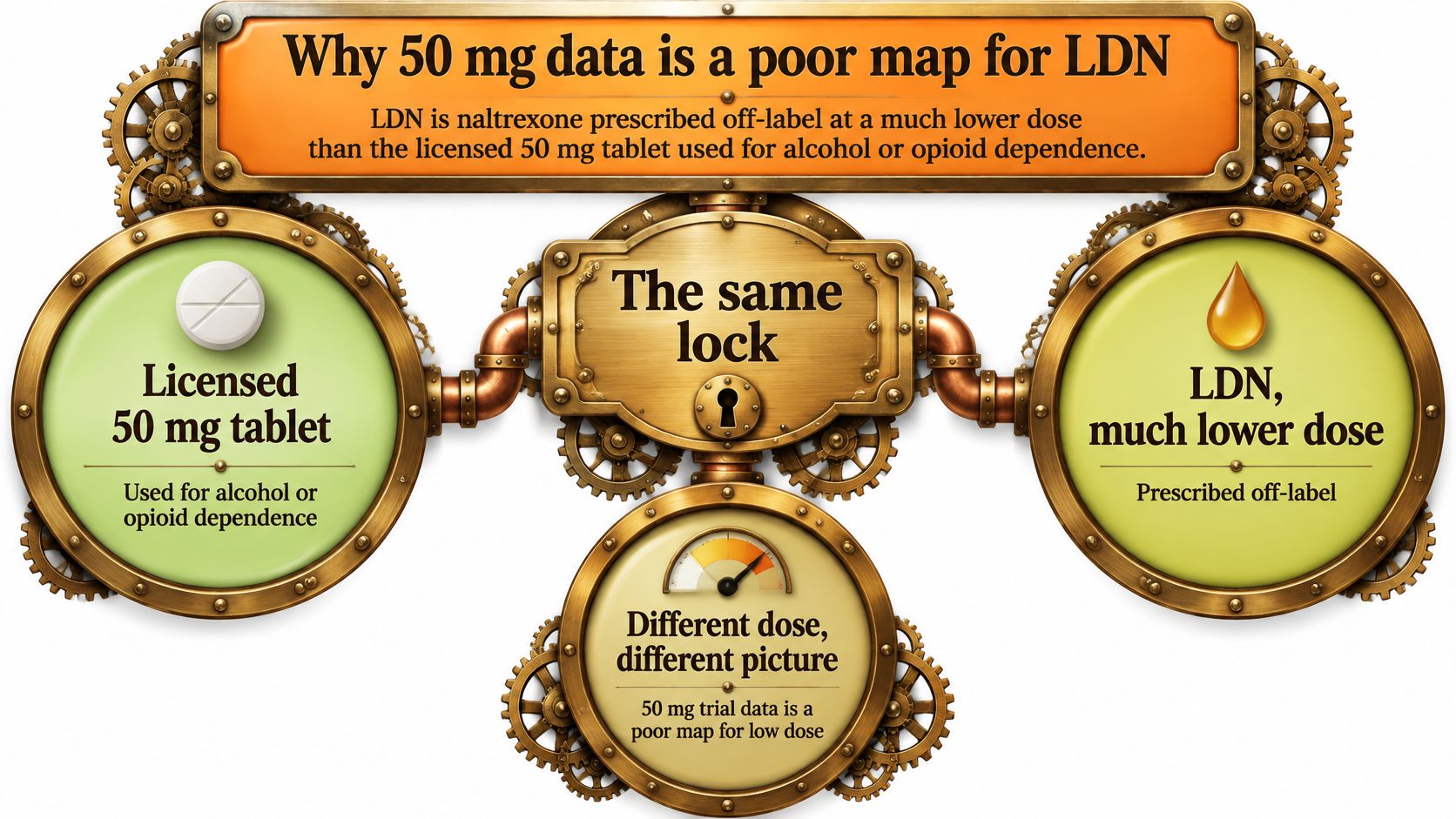
Same lock, much smaller key. Naltrexone still occupies opioid receptors, but the amount involved is a fraction of a licensed tablet, so both the wanted and the unwanted effects can behave differently. That's the whole reason the frequency table above needs a caveat rather than a warning sticker.
The electronic Medicines Compendium patient leaflet for the 50 mg product lists insomnia, anxiety, nausea, abdominal pain, headache, weakness, and muscle or joint pain among its very common effects. It's describing a licensed 50 mg tablet. A compounded capsule is not that product, and the leaflet's wording doesn't transfer across.
Here's the same idea in a slightly different format.
The consent problem nobody warns you about
People living with chronic pain, fatigue or an inflammatory condition tend to be careful observers of their own bodies. That's usually a strength. With LDN it can misfire in two directions.
A new ache in the first week isn't automatic proof the medicine doesn't suit you. A quiet first week isn't proof that uncommon liver or mood effects can't happen later either. Both readings come from treating borrowed frequencies as personal predictions.
The NHS Royal Free leaflet describes nausea, dizziness, reduced appetite, nervousness and gut discomfort as common, and flags depression, suicidality and hallucinations as serious concerns, without saying how those risks translate to off-label low dose. Nobody has the answer to that at the precision patients would like.
One practical rule: frequency estimates cannot be copied onto capsules or liquids made at a low dose, because the published numbers come from a different product, a different indication, and a different amount.
What to expect before your first dose
A careful prescriber covers four things before you start, and this is the order that works:
- Every medicine you take, including codeine and other opioids, plus supplements.
- Your opioid history, including anything in the past few weeks and any cough or pain remedy containing an opioid.
- Your liver history, including previous abnormal liver tests.
- Your mood history, so a change later is measured against a baseline.
Curious how the partial receptor block differs from full blockade? How LDN works walks through the mechanism without the pharmacology fog.
Everyday effects and real-life examples
What people notice between reviews
Sleep shifts first. Some people drop off fine and then wake at three, wide awake and irritated. Others feel wired about an hour after a late dose, as though a strong coffee landed at the wrong moment. Vivid or unusually detailed dreams come up too, and they're usually interesting rather than distressing.
The stomach grumbles early. Queasiness, a knot of cramping, or a reduced appetite, often within the first days rather than weeks. A snack alongside the dose takes the edge off for a lot of people.
Then there's the background noise: a dull headache, flat tiredness, or aching joints and muscles that look exactly like a flare of whatever you're treating. That overlap is where confusion sets in. An inflammatory flare and a drug-related ache can feel identical on a Tuesday morning.
Pharmacist's tip: if nausea appears, take your dose with a small snack and a full glass of water, unless your prescriber has set a different plan for you.
Three UK routines and the one change that helps
A busy parent starts a morning dose, then does the school run feeling queasy and light-headed. The fix isn't dramatic: a small snack with the next dose, water, and a note of how day five compares with day one. If day five is worse than day one, that's a message to the prescriber, not a reason to grind through another fortnight.
A night-shift worker takes the dose at 7am when they get home, then lies awake until ten. The useful question isn't which sleep tablet to add. It's whether the dose can move to waking time after the main sleep. Timing changes belong to the prescriber, but they're worth asking about, and nobody should drive home foggy with dizziness on top.
A gym-goer notices aching thighs after two sessions in the first week and blames the new programme. Compare the ache with the start date. If it arrived with the first dose and doesn't behave like normal soreness, it goes in the review notes. If it turns up with chest pain, dark urine or a mood that has dropped off a cliff, that's same-day help, not a rest day.
A three-question check before you ring anyone
- Is it new since the dose started? A symptom that predates treatment is a different conversation.
- Is it mild enough that you got through a normal day? Function matters more than the label on the leaflet.
- Is it improving over several days, even slowly? Slow improvement is still the right direction.
Yes, yes and yes means note it and raise it at your review. Any flip in those answers means make contact. Chest pain is never a wait-and-see ache, whatever else is going on.
For a patient-facing rundown of the effects people report most, naltrexone side effects before starting the Sinclair Method covers the standard-dose picture in detail.
Some symptoms need an entirely different response, and they don't belong on a wait-and-see list at all.
Liver mood and opioid warning signs
A low dose doesn't remove the opioid interaction, and it doesn't remove the need to watch the liver and mood.
UK prescribing documents treat liver abnormalities as uncommon but clinically important, and recommend liver-function testing before treatment and during therapy where it's indicated, because naltrexone-associated enzyme rises can be dose dependent (NHS guidance on naltrexone in alcohol dependence). The same documents classify hepatic disorders and severe psychiatric effects as rare, in the region of 1 in 10,000 to fewer than 1 in 1,000 exposures.
| What you notice | What it may mean | What to do |
|---|---|---|
| Yellow skin or eyes, dark urine, pale stools, ongoing tummy pain | Possible liver problem | Same-day clinical assessment |
| Suicidal thoughts, hallucinations, or a severe mood drop | Rare but serious psychiatric effect | Call 999 or go to A&E if there is immediate danger |
| Chest pain, or pain with breathlessness or collapse | Uncommon listed effect or another emergency | Call 999 and don't drive yourself |
| Widespread rash, swelling, or trouble breathing | Possible allergic reaction | Stop the medicine and call 999 if breathing is affected |
| Codeine or another opioid taken by mistake | Withdrawal that can last up to 48 hours | Contact the prescriber or urgent care |
| Mild nausea or poor sleep that is slowly improving | Common early effect on standard-dose data | Note it and raise it at review |
Drug-related hepatitis is described as very rare, yet those liver clues still need prompt assessment rather than a shrug. The Royal Free patient leaflet on naltrexone also flags depression, suicidal thoughts and hallucinations as uncommon or rare effects that warrant urgent review, particularly if mood deteriorates sharply.
Precipitated withdrawal is the one people underestimate. Naltrexone given while opioids are still in the body can trigger uncomfortable or severe withdrawal lasting up to 48 hours. Everyday sources get forgotten: codeine, dihydrocodeine, co-codamol, and some cough and anti-diarrhoea remedies.
Pharmacist's tip: tell the prescriber about every painkiller, any liver problem, and heavy alcohol use before the first dose, even if it feels unrelated.
If you're unsure whether LDN is safe for your history, who should avoid naltrexone sets out the checks that matter.
What to do when a mild effect lingers
For effects that are uncomfortable but not on the urgent list, a short written routine beats a forum search.
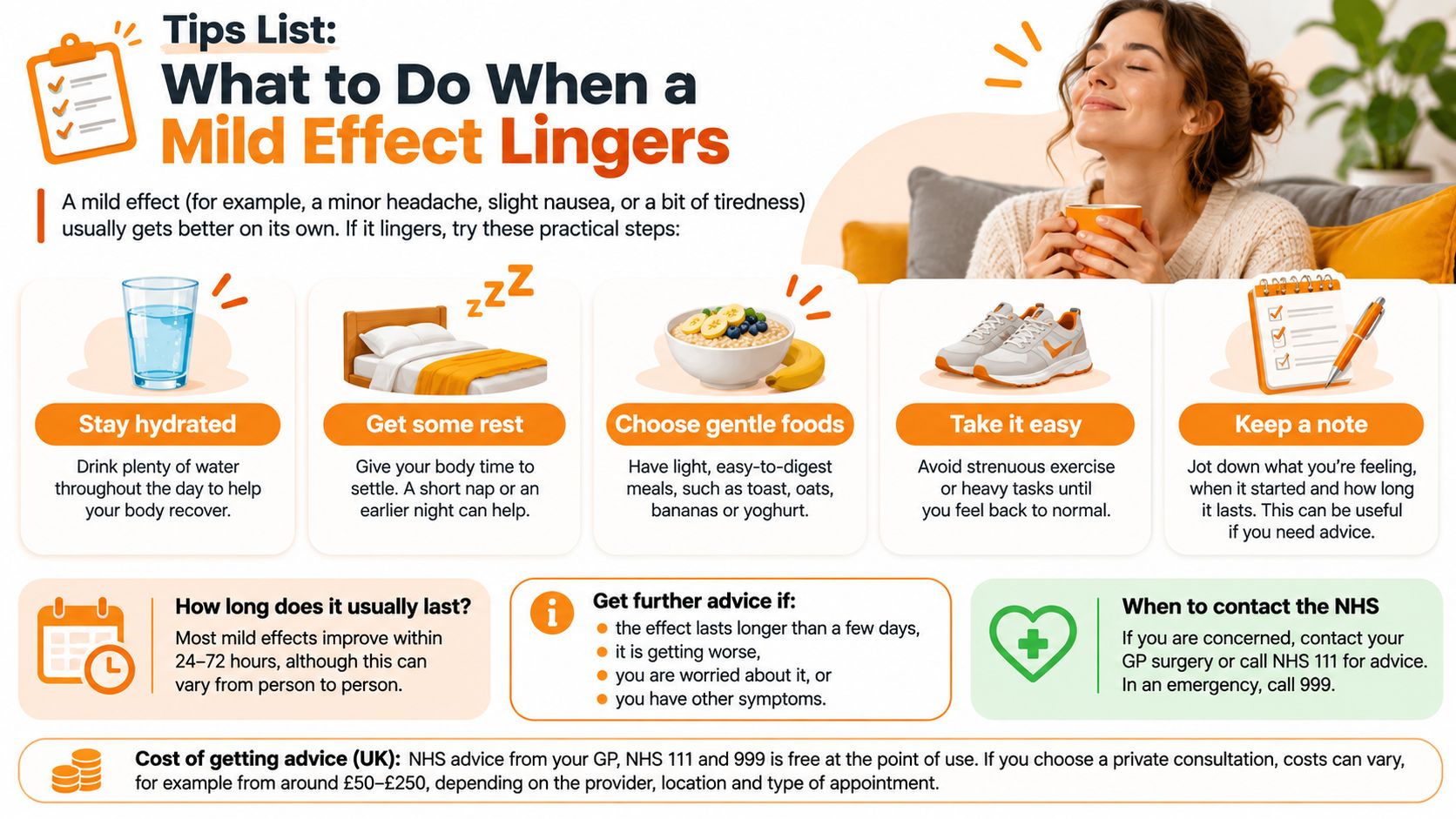
- Write it down. The start date, the dose time, and the symptom in a few words.
- List every other medicine, including painkillers, herbal products and anything bought over the counter.
- Don't raise, cut or stop the dose because a friend did. Dose changes are individual and belong to the prescriber.
- Give mild stomach, sleep or headache effects a short watch, but only if you can still function.
- Book a review if they're not easing, if mood is sliding, or if you need an opioid for surgery or an injury.
Clinicians sometimes change the dose or move the timing, and that decision is personal. There's no single day count that fits everyone. Worsening after an early improvement deserves a call.
UK shared-care guidance is blunt about one thing: people with known liver disease, unexplained abdominal symptoms, dark urine, yellowing of the eyes or skin, or persistent vomiting should contact a prescriber promptly rather than assuming it's a routine reaction (NHS Dorset shared care for naltrexone).
Pharmacist's tip: bring the bottle or capsule details to the review, including the strength and the pharmacy that made it, so the prescriber knows the exact preparation. Medicines can also affect blood-test readings, so your medicine list should travel with any liver test.
Compounded preparations vary in strength and filler, which is why a UK compounding pharmacy should be able to tell you exactly what's in the capsule. Your notes then become a decision, and that decision is the next section.
Decide whether to wait, adjust or get help
Mild sleep, stomach, headache and ache effects often settle on their own. Standard-dose percentages are not your personal odds, and a first quiet week doesn't rule out later problems. Chest pain, yellow skin or eyes, suicidal thoughts, hallucinations, allergic signs and unexpected opioid use need urgent contact rather than patience. That's the whole picture in five lines.
- Wait and note it if the effect is mild, you're functioning, and it's improving.
- Ask for a review if it lingers, affects work or driving, or you need a painkiller containing an opioid.
- Use urgent care for anything in the red-flag table, and call 999 where there's immediate danger.
This guide is information, not a personal prescription, and it doesn't replace medical advice from your own clinician.
If you'd rather have the dose matched to your other medicines and your liver history, a prescriber-reviewed LDN consultation can do that properly. Is LDN safe sets out how that assessment works.
Frequently asked questions
How long do mild LDN side effects last?
Many settle over the first few weeks, particularly stomach upset, headache and sleep changes, and UK guidance describes these as mild and improving with time. Some people notice nothing at all. The useful pattern is direction: a little better week by week is reassuring. If an effect is still there after several weeks, getting worse, or interfering with work, ask for a review rather than waiting it out.
Can I drink alcohol while taking LDN?
Have that conversation with your prescriber before you start. Alcohol affects the liver, and liver function is one of the things worth monitoring on naltrexone, including at low dose. If your prescriber says an occasional drink is acceptable, stay within that limit and be honest about how much you drink. Don't assume a small dose makes heavy drinking irrelevant.
Is it safe to drive if I feel dizzy?
No. Wait until the dizziness has fully passed before you get behind the wheel. Dizziness is one of the listed effects, and driving while light-headed puts you and everyone else at risk. If it keeps happening, that's a review conversation.
Is LDN safe in pregnancy or breastfeeding?
Your prescriber needs to answer this one. Safety data in pregnancy and breastfeeding are limited, so the decision needs an individual assessment of risks and benefits. They may suggest extra monitoring, a different plan, or delaying treatment. Don't start or stop any prescription medicine during pregnancy based on something you read online.
Can I just stop my LDN if I'm fed up with it?
Plan the stop with the prescriber. The key issue is opioid pain relief: if you later need an opioid for surgery, dental work or an injury, the timing matters, and so does telling every clinician that you take naltrexone. If an operation or dental procedure is coming up, raise it early so nobody has to improvise.
Is compounded LDN the same as the 50 mg tablet?
No. It's the same active ingredient at a much lower strength, usually made up by a specialist pharmacy because the low dose isn't commercially available. Published frequencies for the licensed 50 mg product come from a different dose and different clinical use. Bring them to your consultation as context, and let the prescriber translate them into what matters at LDN doses.
Written by: the clinical content team at Courier Pharmacy, a GPhC-registered UK online pharmacy operating since 2014.
References
- NHS Knowledge Now (2025) Shared care agreement: naltrexone, version 6.0, July 2025. NHS Knowledge Now.
- electronic Medicines Compendium (no date) Naltrexone 50 mg film-coated tablets: patient information leaflet. electronic Medicines Compendium.
- NHS Hull and East Yorkshire (2016) Naltrexone and alcohol: prescribing and patient information. NHS Hull and East Yorkshire.
- Royal Free London NHS Foundation Trust (no date) Naltrexone: patient information leaflet. Royal Free London NHS Foundation Trust.
- NHS Dorset (no date) Shared care for naltrexone (Nalorex) for opioid dependence. NHS Dorset.
If you'd like your dose matched to your other medicines, your opioid history and your liver results, Courier Pharmacy offers low dose naltrexone consultations reviewed by a UK prescriber. It also lists consultations for fibromyalgia, long COVID and pain relief, so the conversation can cover the whole picture rather than one symptom in isolation. Start with the online consultation at Courier Pharmacy and bring your medicine list with you.