20 and Bald: Causes, Diagnosis and Treatment Options
Feeling 20 and bald? Learn the common causes, how UK clinicians diagnose early hair loss, medical and non-medical options, and when to see a GP or specialist.
You spot a thinner crown in a photo, then check the mirror from every angle. Being 20 and bald, or noticing the first signs of thinning, can feel unsettling. Hair loss can start at this age, but it isn't always male-pattern baldness. The most useful first step is a diagnosis, not a rushed purchase. The pattern, speed and condition of your scalp help a clinician work out what's happening. You'll find practical guidance below on what needs checking, what treatments can realistically offer, and how to choose a safe route forward in the UK.
SEO brief: Primary keyword: 20 and bald. Secondary keywords: hair loss at 20, male-pattern baldness, receding hairline, alopecia areata, hair loss treatment UK. Search intent: understand causes and choose safe next steps. Target reader: UK young adults concerned about hair loss. Service context: online pharmacy assessment where appropriate. No Medical Mojo internal page URLs were supplied.
Five key takeaways
- Check the cause: Age alone can't tell you why you're losing hair.
- Notice the pattern: Gradual recession differs from sudden shedding or bald patches.
- Get worrying changes assessed: Pain, inflammation or possible scarring need medical review.
- Keep expectations realistic: Medicines don't guarantee regrowth or provide a permanent cure.
- Protect your wellbeing: You don't have to dismiss distress as “just hair”.
Why hair loss can start in your twenties
A photo can make you notice something your bathroom mirror hasn't. Perhaps the crown looks thinner under bright light. Perhaps your hairline seems different from older pictures.
That doesn't tell you the cause. Hair loss at 20 needs context, including family history, the shape of the loss and how quickly it appeared.
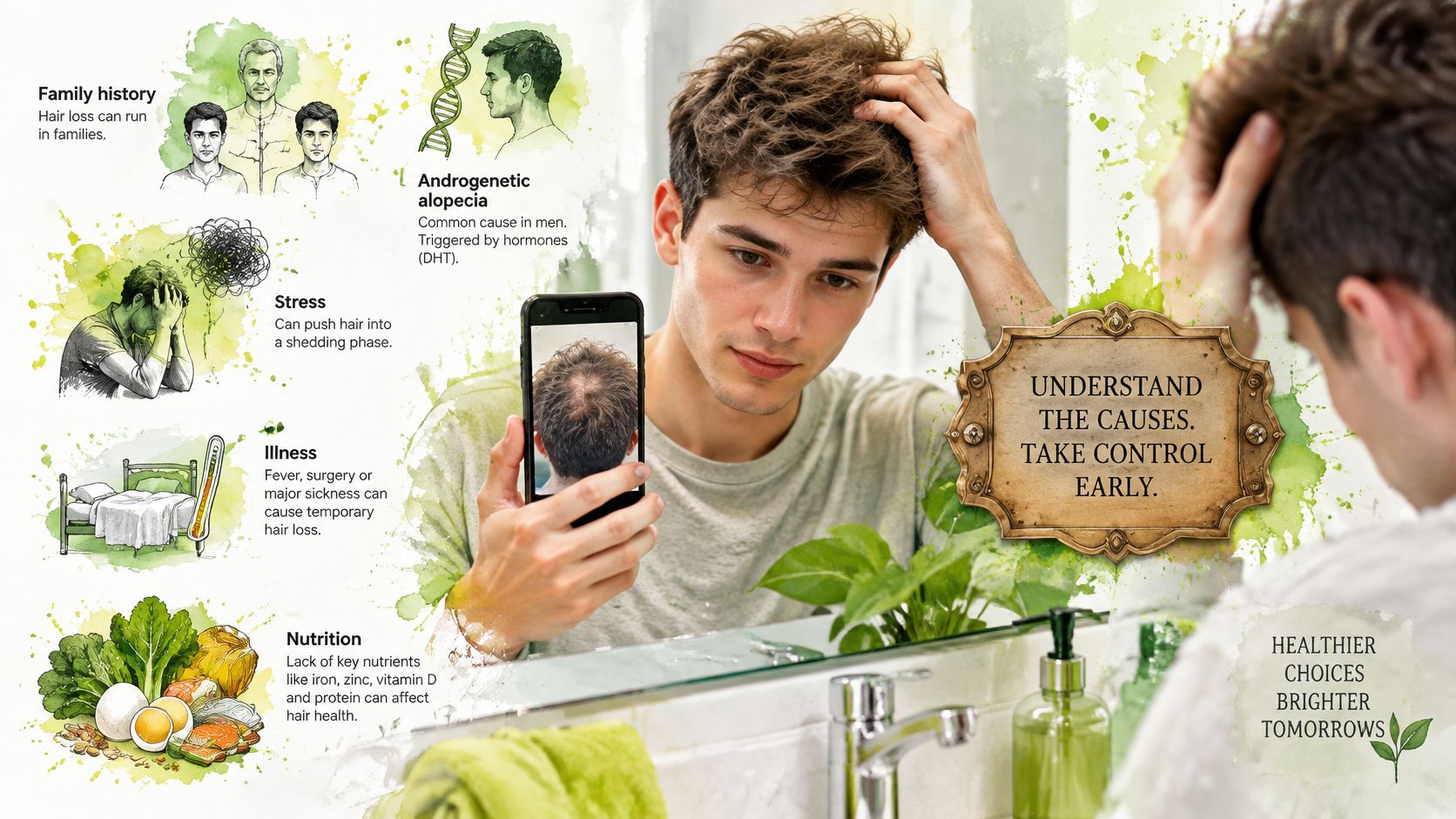
The illustration below highlights some of the different causes.
When inherited hair loss starts early
Androgenetic alopecia is the medical name for male-pattern baldness. In susceptible follicles, a hormone called dihydrotestosterone, or DHT, gradually makes hairs finer. DHT forms from testosterone through an enzyme called 5-alpha-reductase. The usual pattern affects the front and crown, with relative sparing at the sides and back, as explained by the British Association of Dermatologists' male-pattern hair loss guidance, reference 1.
Earlier onset can go with faster progression, but it doesn't predict your exact future. Nor does a relative's hairline act as a timetable for yours.
A UK Biobank study examined 52,874 men, whose mean age was 57.2 years, and found a substantial genetic contribution to baldness. 68.4% reported some hair loss, but these figures describe an older cohort, not the prevalence among 20-year-olds, in the UK Biobank genetic study, reference 2.
When the cause isn't inherited recession
Alopecia areata is different. It involves the immune system and can cause patchy, non-scarring hair loss. A UK primary-care study found that new diagnoses peaked at ages 25–29 in both sexes, showing that this condition often emerges in early adulthood, according to the population-based alopecia areata study, reference 3.
Keep these distinctions in mind:
- Gradual front or crown thinning: This may fit male-pattern baldness.
- Distinct patches or abrupt changes: These need a broader assessment.
- Family history: It's useful evidence, but it doesn't replace examination.
For background reading, the discussion of prostaglandin D2, mast cells and male-pattern baldness explores another biological angle. It isn't a way to diagnose your own hair loss.
How doctors tell male-pattern baldness from other causes
A useful appointment starts with your story, not a treatment menu. Your GP or prescribing clinician needs to know what changed, when it changed and what else was happening.
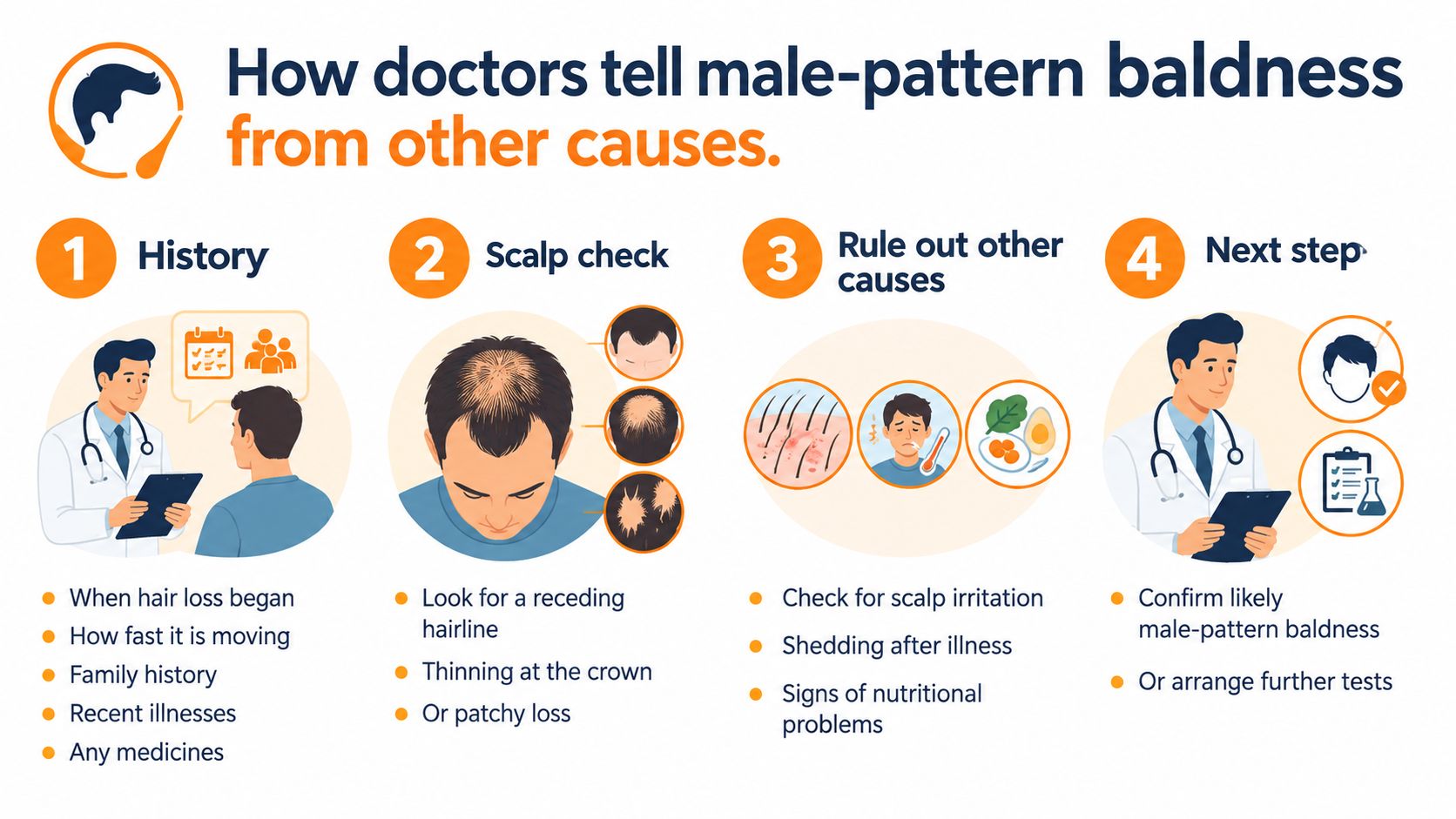
The checklist below shows the broad assessment process.
Start with the history
Explain whether you first noticed extra shedding, a changing hairline or a thinner patch. Mention recent illnesses, medicines, weight changes and any scalp symptoms. Bring details of hair loss in your family without assuming the same diagnosis applies to you.
Next, the clinician examines your scalp. They look at where hair has thinned and check for redness, scaling, inflammation or possible scarring.
History and examination can support a likely diagnosis. However, being young doesn't justify skipping that assessment. NHS Inform advises seeking help when hair loss worries you and describes assessment, possible tests and referral in its alopecia guidance, reference 4.
Do you need blood tests?
Blood tests aren't an automatic requirement for every case. The clinician should choose investigations to answer a specific question, rather than order a broad package without a clear reason.
For example, a full blood count is a blood test, not a diagnosis of hair loss. This guide to understanding a full blood count offers background if your clinician recommends one.
Before your appointment:
- Record the onset: Note when you first noticed a change.
- Describe the pace: Say whether it feels gradual, sudden or variable.
- List symptoms: Include itching, tenderness, scaling and hair loss elsewhere.
- Bring medicine details: Include non-prescription products and supplements.
- Collect photographs: Use comparable lighting, angles and hair position.
Pharmacist's tip: Keep the packaging or ingredient lists for anything you've tried. That makes it easier to review your current routine.
Photographs taken over time can help show changes that memory misses. Avoid judging progress from pictures with very different lighting or wetness.
If you'd like a visual companion to the assessment discussion, the video below provides another format.
Warning signs that need prompt medical review
Don't assume every bald patch is hereditary hair loss. A sudden change or an uncomfortable scalp deserves attention before you start treating it yourself.
For example, a slowly changing hairline and a newly painful, patchy scalp are different problems. They shouldn't lead automatically to the same medicine.
Signs to book a GP appointment soon
Use the pattern of change as a guide, rather than trying to name the condition yourself.
| What you notice | What to do |
|---|---|
| Sudden shedding across the scalp | Arrange an assessment and explain the timing |
| Smooth bald patches | Ask your GP to check the cause |
| Pain, redness or scaling | Request prompt review of the scalp |
| Possible scarring | Seek prompt assessment rather than waiting for cosmetic treatment |
| Loss of eyebrows or body hair | Mention all affected areas |
| Persistent or extensive loss | Discuss whether a dermatology referral would help |
A UK survey illustrates why hair loss needs careful description. Among 94 men with alopecia areata, 55% reported alopecia universalis, 10% alopecia totalis and 35% patchy loss. These figures describe a selected study sample, not the general population, in the survey of men with alopecia areata and androgenetic alopecia, reference 5.
Alopecia totalis refers to loss of scalp hair. Alopecia universalis involves more widespread body hair loss. Those presentations need a different discussion from ordinary recession.
When specialist advice makes sense
Diagnostic uncertainty, suspected scarring, and persistent or extensive loss are reasons to discuss dermatology referral. Your GP can assess which route fits the findings.
A sensible plan for this week is simple:
- If the change is gradual: Arrange a routine assessment if it concerns you.
- If patches, pain or inflammation appear: Contact your GP promptly.
- If you can't describe the change clearly: Take photographs and show the affected areas.
Seeking a diagnosis isn't an overreaction. It's how you avoid treating the wrong problem.
Hair loss by itself doesn't usually call for emergency care. Immediate danger, such as feeling unable to keep yourself safe, does require emergency help. Medicine-related warning signs also need attention, as outlined below.
Medical treatments and what to expect
For confirmed male-pattern baldness, topical minoxidil and oral finasteride are common options. Neither guarantees a full head of hair, and neither suits every person.
The decision should reflect your diagnosis, health, preferences and willingness to maintain a routine. A convenient product isn't useful if it's wrong for the cause.
Topical minoxidil and oral finasteride at a glance
| Factor | Topical minoxidil | Oral finasteride |
|---|---|---|
| How you use it | Apply it to the scalp as directed | Take a tablet as prescribed |
| Main practical issue | Keeping up the application routine | Assessing suitability for an oral medicine |
| Access and cost | Check the product and local arrangements | Prescription-only; hair-loss treatment requires a private prescription in England |
| What to discuss | Early shedding and when to review progress | Sexual side effects, mood and other safety concerns |
| Long-term commitment | Benefits depend on continued use | Benefits depend on continued use |
Finasteride is generally taken once daily. NHS information lists reduced sexual interest and difficulty getting an erection as common side effects. It also describes rare reported mood changes, depression and thoughts of self-harm in its finasteride medicine guidance, reference 6.
Seek prompt medical help for new mood changes. Thoughts of self-harm require urgent help; use emergency services if you feel at immediate risk.
Give treatment time, without ignoring symptoms
Minoxidil can take up to six months to work. Initial extra shedding may settle within the first six weeks, according to the Royal Berkshire NHS minoxidil leaflet, reference 7. That doesn't mean every episode of severe or persistent shedding should be dismissed.
The same leaflet describes wider effects with oral treatment, including fluid retention, ankle swelling, palpitations, low blood pressure, dizziness and fainting. It advises against higher-dose treatment in people already taking blood-pressure-lowering medicines. Don't start oral minoxidil without an appropriate clinical assessment.
For practical background, see how long minoxidil takes to work.
Pharmacist's tip: Ask for a clear review plan before starting. Know which symptoms mean you should contact the prescriber rather than wait.
Set a realistic goal
Maintaining existing hair may be a more realistic aim than restoring your earlier hairline. Cheshire and Merseyside NHS policy describes partial regrowth at best, potentially better outcomes with earlier treatment, and loss of benefit after stopping in its hair-loss treatment policy, reference 8.
Ask about ongoing cost as well as likely benefit. Treatment access and NHS funding arrangements vary, so don't assume assessment and cosmetic treatment have the same funding rules.
Non-medical options and everyday habits to protect your hair
Choosing not to take medicine is a valid choice. So is changing your haircut while you decide what matters to you.
A shorter style, a different parting or cosmetic camouflage may make thinning less noticeable. Treat these as appearance choices, not evidence that the underlying condition has changed.
Make the routine easier on your hair
Consider this illustrative example. A gym-goer pulls their hair tightly back for each session because it stays out of the way. Choosing a looser style is a practical way to reduce pulling, but it isn't a treatment for DHT-sensitive follicles.
The distinction matters. Protecting existing hair and treating diagnosed hair loss aren't the same task.
A gentle-care checklist can help:
- Avoid repeated pulling: Choose styles that don't feel tight at the roots.
- Handle wet hair gently: Don't tug through tangles.
- Review heat styling: Consider whether you can use less of it.
- Be cautious with harsh treatments: Discuss your concerns with your hairdresser.
- Support general health: Keep meals and sleep routines manageable, without expecting them to reverse pattern baldness.
These are sensible care choices, not a promise of regrowth. Don't blame yourself if careful styling doesn't stop an inherited process.
Keep products in perspective
You don't need an elaborate bathroom shelf to show you're taking the problem seriously. Before adding another product, ask what it's meant to do and how you'll judge whether it's useful.
Pharmacist's tip: Bring your whole hair-care and treatment list to a consultation. Ask which products have a clear purpose and which merely add cost or effort.
If hair loss followed a medicine change, tell the prescriber rather than stopping treatment yourself. Readers using weight-management medicines may find the discussion of Mounjaro and hair loss useful for preparing questions, but the timing alone doesn't prove a cause.
A helpful routine should fit your life. If camouflage, styling or daily checking starts taking over your day, simplifying the routine may be worth discussing too.
Looking after your confidence and wellbeing
Hair loss can feel especially unfair when you didn't expect to face it yet. You might worry about dating, photographs or looking older than your friends.
You don't have to pretend it doesn't matter. Equally, you don't have to make an immediate decision about treatment, shaving or telling other people.
Two everyday situations
These examples are illustrative, not patient case histories.
A busy young parent starts avoiding school-event photos because their scalp shows under bright lights. A useful first goal might be joining the next photograph without spending the whole event checking their hair.
A shift worker begins turning down social plans because getting ready feels stressful. They might start by explaining the worry to a trusted friend and arranging a low-pressure meeting.
Neither person needs someone to say, “Just shave it.” They need room to decide what helps.
- Tell someone specific: Explain what you're avoiding and why.
- Set boundaries: Ask friends not to comment on your hair.
- Choose manageable goals: Focus on returning to an activity you miss.
- Discuss persistent distress: Tell your GP if worry affects daily life or sleep.
When mood needs more support
If low mood or anxiety keeps getting in the way, ask your GP about support. You can also ask about counselling or psychological therapy through the NHS, depending on local access.
Support groups may offer a place to share experiences. Choose spaces that leave you feeling informed rather than pressured to buy something or compare yourself constantly.
A useful reframe: You can't choose every change in your hair. You can choose who supports you and how you make decisions.
If you take finasteride, follow the medicine safety advice above for any significant mood change. Don't put severe distress down to vanity or wait until the next routine review.
Choosing the right route and your next step
A proper consultation should come before a purchase. The right route depends on whether your case looks straightforward, needs examination or remains uncertain.
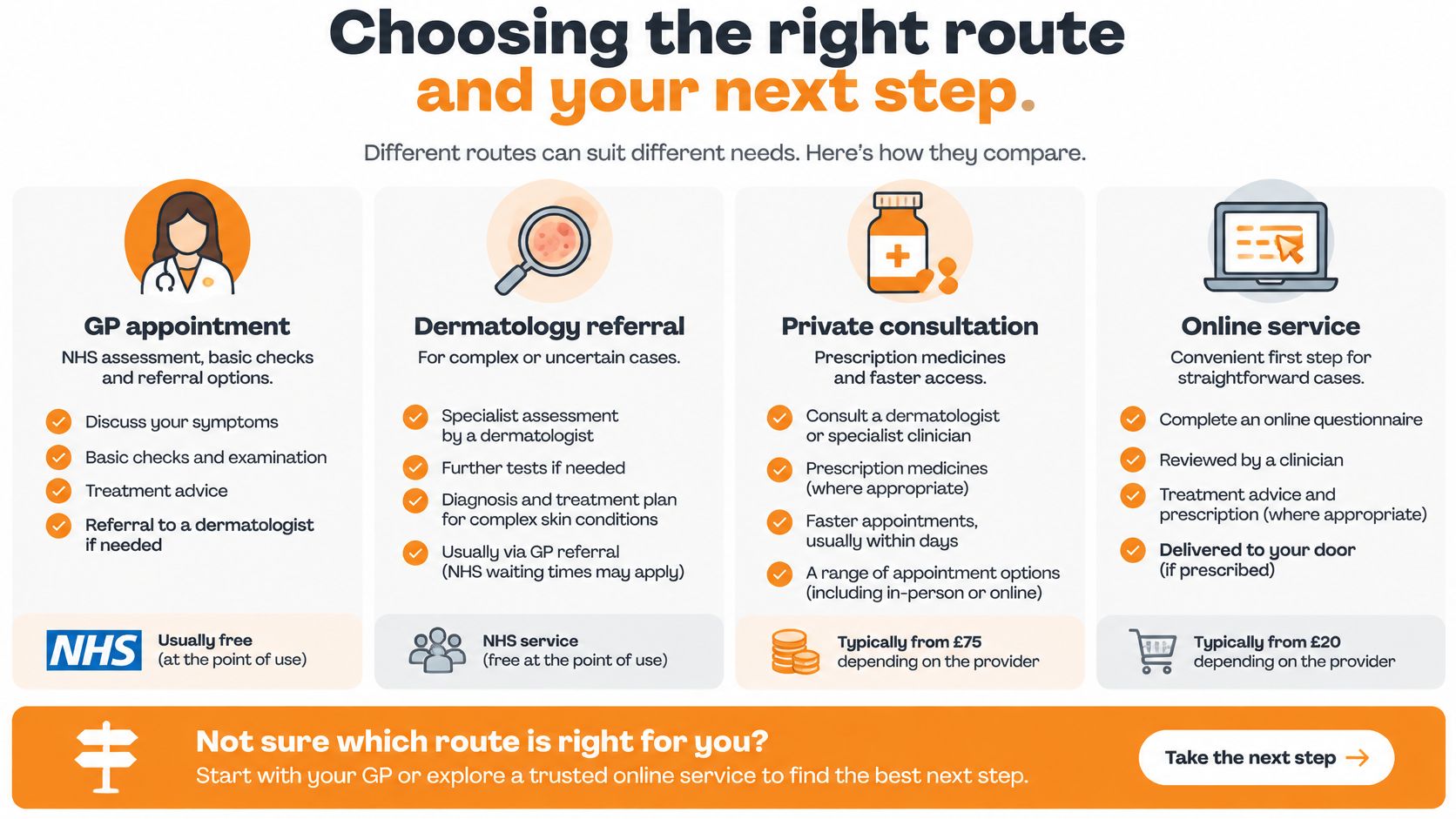
The comparison below summarises the available pathways.
Choose an assessment that fits the problem
- GP appointment: A sensible starting point for worrying or unexplained loss.
- Dermatology referral: Useful when findings are complex or the diagnosis is unclear.
- Private consultation: An option for assessing prescription treatment suitability.
- Online pharmacy assessment: Potentially convenient for suitable cases, but not a replacement for examination when warning signs exist.
Ask the clinician to cover diagnosis, expected benefit, side effects, duration and cost. You should also understand the plan if treatment doesn't help or you stop using it.
If you're comparing medicines, this discussion of finasteride and dutasteride can help you prepare questions. It shouldn't replace an individual prescribing decision.
Common questions about being 20 and bald
Is going bald at 20 normal?
It can happen, but age doesn't confirm the cause. A new or worrying change deserves assessment.
Does a receding hairline mean I'll lose all my hair?
No individual outcome follows from the hairline alone. A clinician can assess the pattern but can't promise an exact future course.
Can I diagnose myself from photographs?
Photographs help document change. They don't show everything a scalp examination can reveal.
Should I buy a blood-test package first?
Ask what clinical question the test would answer. Tests should support assessment, not replace it.
Can I choose not to use medicine?
Yes, after considering the cause and your options. Styling, camouflage or accepting the change are personal choices.
Should I shave before seeing my GP?
You don't need to change your hairstyle for the appointment. Bring older photographs if they help show what has changed.
Summary
Being young doesn't rule out genuine hair loss.
Your pattern and symptoms matter more than age alone.
Get unusual or uncomfortable changes checked.
Choose treatment with clear expectations and safety advice.
Look after your confidence as well as your scalp.
Start by recording the change and arranging a suitable assessment.
Publication and source notes
Meta description: 20 and bald? Understand early hair loss, signs that need a GP check, and UK treatment options, with clear advice on diagnosis, safety and your next steps.
Suggested Medical Mojo internal links: An early hair-loss assessment guide, a minoxidil guide, a finasteride safety guide and an alopecia areata guide. Confirm existing page addresses before linking.
Byline: Educational editorial draft; named author and credentials not supplied.
Clinical review: Named reviewer and credentials require confirmation before publication.
How this content was created: This educational draft draws on the NHS, British Association of Dermatologists and peer-reviewed research listed below. It distinguishes research findings from illustrative scenarios; a completed clinical review has not been documented.
Designer suggestions: Consider a painterly mirror scene in bright lime green, pale yellow-green and light grey with an ornate brass plaque. Alt text: “Young adult checking a thinning crown.” A second visual could use steampunk-inspired route markers. Alt text: “GP, specialist and pharmacy routes for hair-loss assessment.”
Disclaimer: This information supports understanding and isn't a substitute for personal medical advice.
References
The numbered source links appear at their first relevant mention above.
- British Association of Dermatologists (n.d.) Hair loss, male pattern (androgenetic alopecia). Patient information leaflet.
- Hagenaars, S.P. et al. (2017) ‘Genetic prediction of male pattern baldness', PLOS Genetics, 13(2), e1006594.
- British Journal of Dermatology (n.d.) UK population-based cohort study of alopecia areata. doi:10.1111/bjd.20628.
- NHS Inform (n.d.) Alopecia. Public health information.
- Skin Health and Disease (2024) Survey of men with alopecia areata and androgenetic alopecia, 4(5), ski2.420.
- NHS (n.d.) About finasteride. Medicines information.
- Royal Berkshire NHS Foundation Trust (2025) Minoxidil for hair loss. Patient information leaflet.
- NHS Cheshire and Merseyside (n.d.) Hair loss. Commissioning policy, version 5.
Courier Pharmacy offers online hair-loss assessments, with secure questionnaires reviewed by human prescribers, alongside prescription and testing services where appropriate. Visit Courier Pharmacy to explore a suitable consultation, but book a GP assessment first if you have sudden patches, scalp pain or possible scarring.


