Adhesive Wound Dressing Guide: How to Choose and Apply
Learn how to choose, apply and remove an adhesive wound dressing safely, including skin-friendly options for allergies and when to seek urgent NHS help.
You're standing in the pharmacy aisle with a grazed knee, a cut finger or a dressing that's already peeling at the edge, and every box promises strong hold. An adhesive wound dressing is a sterile pad or film with a sticky border that holds it over a wound, and the best choice depends on how much fluid the wound makes and how your skin copes at removal. You'll learn which type suits which wound, how to apply and remove it gently, what to do if your skin reacts, and which warning signs mean you need clinical help.
Adhesive wound dressing types and what each one suits
Wound fluid, often called exudate, is the fluid a wound produces while it heals. Match the dressing to that fluid first. A product that can't absorb will leak, while an overly bulky pad makes a small graze harder to manage.
Most wound care happens outside hospital. A population-based study of wound care in England found 74.1% of patients received treatment in the community by district nurses. That makes a simple, well-fitting home choice important.
| Dressing type | Typical use | Fluid handling | Adhesive strength and skin impact |
|---|---|---|---|
| Transparent film | Shallow, dry wounds and cannula or line sites | Low, cannot absorb fluid | Strong seal, can irritate fragile skin |
| Hydrocolloid | Light to moderate fluid, minor burns and pressure areas | Light to moderate, forms a gel | Moderate hold, edges may lift |
| Bordered foam | Moderate to heavy fluid, areas that move or bend | Moderate to heavy, absorbs and cushions | Moderate border adhesive |
| Island (absorbent pad with adhesive border) | Grazes and cuts that weep a little | Light to moderate | Adhesive only on the edges, pad stays off the skin |
| Silicone-bordered | Fragile or sensitive skin and frequent changes | Low to moderate in most pharmacy sizes | Gentler adhesive, lower risk of skin stripping |
| Antimicrobial adhesive | Wounds with clinical signs of infection | Low to heavy, set by the pad type | Border strength set by the product, check for silicone |
The three types most people meet
Transparent film lets you see the wound. It can't absorb fluid, so it suits dry or shallow wounds only. If fluid pools under it, choose a pad instead.
Bordered foam absorbs more and cushions knocks. It's useful on heels, elbows and other moving areas. An island dressing suits most everyday grazes because the centre pad absorbs a little fluid and only the edges stick.
Antimicrobial products aren't the default. In a UK community survey, 36% of 3,038 patients with recorded dressing data received an antimicrobial primary dressing. Use that type for the right wound, not by habit.
Choose by wound, fluid and skin, not by brand or strongest claim. If you're stocking a home kit, our medical supplies range helps you compare basic options before you buy.
How to Choose the Right Adhesive Dressing for Your Wound
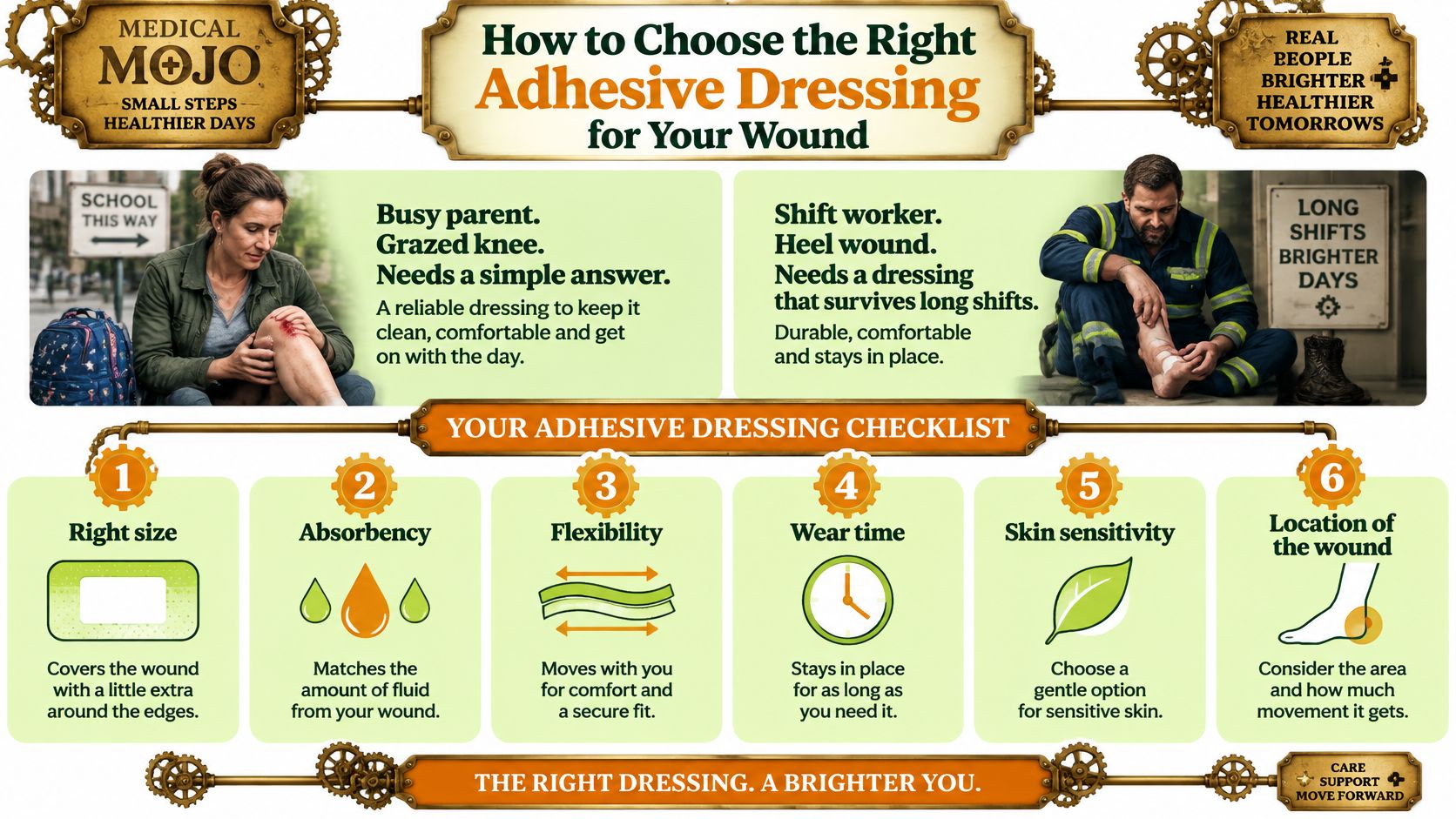
Say you're a busy parent after the school run. Your child has a grazed knee that weeps slightly. A simple island dressing usually fits that job.
Now picture a shift worker with a heel wound. Boots rub, shifts run long, and edges lift. That wound needs cushioning, flexibility and longer wear.
This visual sums up the checks before you choose.
A ten-point check
Work through this list. It takes less than a minute.
- Wound type and stage: Is it a graze, cut, surgical wound or sore?
- Fluid amount: Dry, lightly weeping or soaking through?
- Infection or odour: Any heat, pus or unusual smell?
- Position: Joints, heels and feet move and rub more.
- Surrounding skin: Is it dry, sore, fragile or already red?
- Pain on changes: Choose a gentler border if removal hurts.
- Wear time: How many days must it stay secure?
- Ease of removal: Will it come off without stripping skin?
- Fit: Does it bend and stay smooth on that body area?
- Capacity: Can the pad hold the expected fluid?
That structured approach reflects NICE key points on dressing choice, which link adhesiveness to ease of removal, irritation, skin protection and pain during changes. NICE also advises choosing the least costly dressing that meets the wound's needs when no specific product is justified.
A strong hold isn't automatically better. If peel strength tears sore skin, each change sets healing back. I'd start with the gentlest product that still seals and absorbs enough.
Pharmacist's tip: Ask the pharmacist to check the adhesive type and dressing size before first use, especially if you have eczema or a latex allergy.
If the wound is deep, heavily weeping, infected or not improving, don't guess. Ask a pharmacist, practice nurse or GP first.
Skin-Friendly Adhesive Options for Allergies and Sensitive Skin
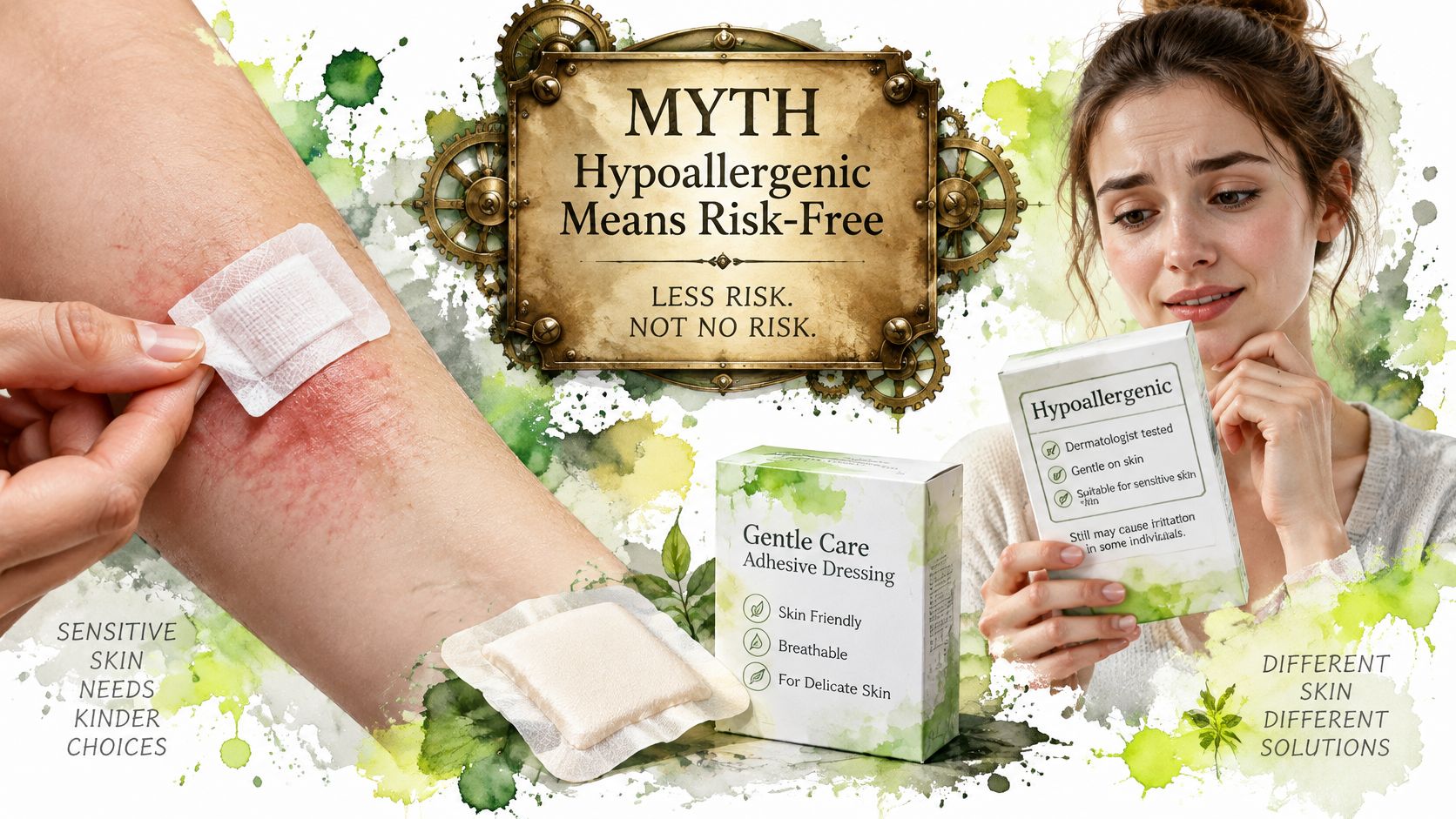
Hypoallergenic doesn't mean risk-free. A labelled product can still irritate your skin. Some local NHS formularies advise avoiding any adhesive when you have a known allergy.
This image captures that common moment of doubt at the shelf.
The NHS medical adhesive-related skin injury pathway describes reactions including irritant or allergic dermatitis, blistering, cracking and skin stripping. It advises stopping the suspected product, removing dressings less often, checking skin regularly and considering adhesive remover.
Say you're an older adult using steroid creams. Your skin thins and tears when a border pulls away. A silicone border or a pad held by a gentle wrap often works better.
Or say you're a gym-goer. Sweat loosens a film dressing during training. The lifted edge rubs and leaves a sore outline. Dry skin well, choose a flexible border, and change it after heavy sweating if it no longer seals.
This short video shows gentle handling in practice.
Alternatives that avoid a sticky border
- Silicone contact layer: Sits on the wound under a pad and bandage.
- Absorbent pad with gentle wrap: Holds without sticking to sore skin.
- Silicone-bordered dressing: Gives hold with less pull at removal.
Patch test a new adhesive on unbroken skin first when you can. Check packs carefully if you have eczema or latex allergy, and read our UK guide to creams for dermatitis if past reactions affect your choice.
Pharmacist's tip: If tape or plasters have reacted on your skin before, say so at the counter before you buy.
Itchy, blistered or sharply shaped redness at the edge points to the adhesive. Spreading redness, heat, swelling, pus or feeling unwell points to possible infection and needs clinical assessment.
How to Apply and Remove an Adhesive Dressing Safely
Good technique protects both wound and skin. Slow down for two minutes. Rushing causes most stuck pads and sore edges.
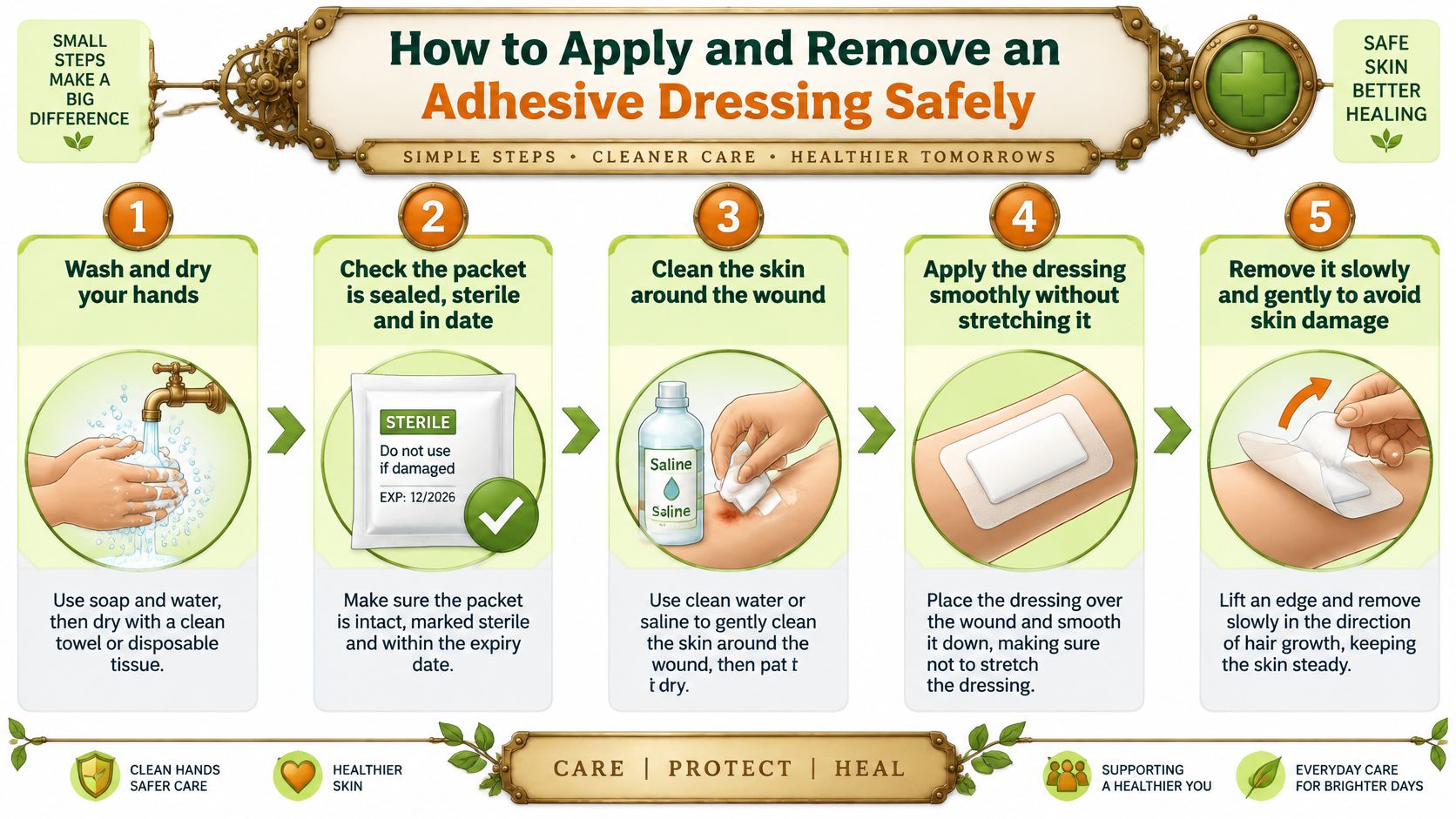
This step-by-step visual gives you the sequence at a glance.
How to apply it
Use the aseptic non-touch technique. Wash your hands, then avoid touching the wound and the dressing surface that will sit on it. NICE recommends this approach for surgical wounds, and it's sensible at home too.
- Wash and dry your hands: Clean hands lower the risk of contamination.
- Check the packet: It should be sealed, sterile and in date.
- Clean around the wound: Use water or saline, then pat dry.
- Prepare the skin: Make sure it's dry. Trim hair only if it blocks the seal.
- Handle by the edges: Don't touch the pad placed over the wound.
- Press from centre outwards: Smooth it down without stretching the border.
- Note the date: Write the change date on the dressing if a clinician advises it.
Don't stretch the border as you apply it. Stretched adhesive pulls back, lifts sooner and can blister skin. Leave a margin of healthy skin around the wound so the pad, not the sticky edge, covers broken skin.
Pharmacist's tip: Time a planned change for after a shower or when you can soak a stuck edge, so you don't tug at dry adhesive.
How to remove it
The NHS looking after your wound guidance gives a specific method. Don't pull straight upwards, because that can hurt skin and damage the wound.
- Check first: Change it only if it's due, saturated, loose, dirty or painful.
- Soak if stuck: Use water or saline and wait for it to loosen.
- Lift one corner: Start at the loosest edge.
- Stretch sideways: Pull horizontally along the skin to break the adhesive bond.
- Work slowly: Support nearby skin with your other hand.
- Stop if it resists: Soak again rather than forcing it.
Stretching sideways breaks the bond across a wider area. Pulling upwards concentrates force on one sore line of skin. That's why the sideways method feels easier.
Dressings don't follow one fixed timetable. Follow the manufacturer's instructions or your clinician's plan. Change sooner if the dressing becomes saturated, loose, dirty or painful.
Keep spare dressings dry and sealed. Bin used dressings in household waste unless your nurse tells you otherwise. Wash your hands again after each change.
Common pitfalls with adhesive dressings and how to avoid them
Many people buy an antimicrobial adhesive dressing for a clean cut because it sounds safer. It isn't an automatic upgrade. Some antimicrobial dressings work without containing antibiotics, so they don't replace medical assessment.
The North East London NHS wound dressing formulary says antimicrobial dressings should be used only when clinical signs and symptoms of infection are present, reviewed after two weeks, and avoided long term. Spreading or whole-body infection may need antibiotics and clinical care.
| Symptom or problem | Likely cause | What to do first |
|---|---|---|
| Antimicrobial dressing used on a clean cut | No signs of infection | Stop and seek advice; reassess after two weeks if used for infection |
| Edges lift within a day | Skin oils, moisture or poor preparation | Dry and prepare the skin, then check the dressing size |
| Heavy leaks under a bordered dressing | Fluid beyond the dressing's capacity | Switch to an absorbent pad or bordered foam, with a silicone contact layer where needed |
| Dressing changed on a fixed timetable | Change not based on the wound | Follow the clinician or manufacturer advice and reassess |
Heavy fluid often defeats a sticky border. Use a silicone contact layer or absorbent pad first. Move to a bordered dressing once leakage reduces.
Build three habits. Check the dressing daily, note each change, and don't reuse it. Don't cut dressings unless a professional advises it, especially if your skin already has eczema and dermatitis.
Get Clinical Help When Warning Signs Appear
Some fluid is normal early on. NHS wound-care guidance notes that clear, straw-coloured fluid can be normal during the first 36 hours. A dry dressing and settling pain usually support that picture.
Other changes need advice. Watch for increasing pain, spreading redness or swelling, heat, more leakage or thick yellow discharge. An unusual or offensive smell, wound enlargement or breakdown, fever, or feeling generally unwell also matter.
Blood or discharge soaking through means the dressing may need changing sooner. Don't just add another pad on top for days. Change it cleanly and ask for advice if soaking keeps happening.
| Situation | What to do | How quickly |
|---|---|---|
| Clear or straw-coloured fluid in the first 36 hours, dressing dry | Keep to the plan and check the dressing daily | Routine |
| Blood or fluid soaking through the dressing | Change the dressing sooner and call the practice nurse | Same day |
| Itchy, blistered or sharply shaped redness at the dressing edge | Remove the dressing, stop that product and seek advice | Same day |
| Spreading redness, heat, swelling or worsening pain | Contact the GP or NHS 111 | Same day |
| Thick yellow discharge or an offensive smell | Contact the GP or practice nurse | Same day |
| Fever or feeling generally unwell | Contact NHS 111, or call 999 if severe or breathing is affected | Urgent |
| No improvement after two weeks on an antimicrobial dressing | Ask for tissue-viability or specialist advice | Within the week |
If you're unsure which box fits, get it checked. That's safer than swapping products and hoping. Read more about skin infections if redness or pain is spreading.
Trust the overall trend. A healing wound usually hurts less over time. Pain that steadily worsens deserves same-day advice, even if the dressing looks tidy.
This guide is for information only. It doesn't replace medical advice from your GP, nurse or pharmacist.
Adhesive wound dressing questions answered
What is an adhesive wound dressing
An adhesive wound dressing is a sterile pad or film with a sticky border that holds it over a wound. The pad protects the wound and may absorb fluid. The border sticks to healthy skin, not to the wound itself.
How often should I change it
Follow your clinician's or the manufacturer's instructions. Change it sooner if it's saturated, loose, dirty or painful. There's no single timetable for every wound.
Can I cut a dressing to fit
Cut it only if the pack instructions allow it. Cutting can damage the pad or leave sticky edges in the wrong place. Ask a pharmacist first if the shape doesn't fit.
Does hypoallergenic mean no reaction
No. A hypoallergenic product can still irritate skin. Stop that product if you get itching, blistering or sharply shaped redness, then seek advice.
What if the dressing is stuck
Soak it with water or saline and give it time to loosen. Lift one corner and stretch sideways along the skin. Don't pull straight upwards.
Are antimicrobial dressings always better
No. They suit wounds with clinical signs of infection and need review after two weeks. They don't replace assessment, and our guide to treating skin infections explains that wider context.
When should I see a doctor
See a doctor or contact NHS 111 if pain increases, redness spreads, or you notice heat, swelling, pus or an offensive smell. Fever or feeling generally unwell also needs prompt advice.
If you're unsure which dressing size, pad or adhesive type suits your wound and skin, our UK-regulated pharmacy team can help you choose practical medical supplies and advise when you need in-person care instead. Visit Courier Pharmacy to browse suitable options and get pharmacist support before you order.


