Amorolfine Nail Lacquer: How Long Treatment Takes
Amorolfine nail lacquer is a slow weekly treatment for selected fungal nails. Learn UK suitability, application, side effects and realistic grow-out times.
Amorolfine nail lacquer is a 5% antifungal used once or twice weekly. Treatment usually takes about 6 months for fingernails and 9–12 months for toenails, according to the UK product information for amorolfine. It is intended for limited fungal infection, not every discoloured nail.
The key question is whether fungus is causing the change and whether lacquer can reach the affected area. Even with infrequent application, treatment takes patience. Success means seeing a clear band of new nail grow from the base, not getting a quick cosmetic tidy-up. Knowing which nails may suit treatment, how to apply the lacquer and when to ask about testing can help avoid months of guesswork.
Is Amorolfine Nail Lacquer Right for Your Nail
Amorolfine nail lacquer is an antifungal nail paint for fungal nail infection, also called onychomycosis. It treats susceptible fungi, including the skin-loving fungi called dermatophytes, yeasts and moulds, but the damaged nail must grow out before it looks healthy.
Think of it as treating a stain within a wooden board, not wiping dirt off its surface. The medicine and the visible repair do different jobs.
Five key takeaways
The UK patient leaflet and product information on emc describe once- or twice-weekly use, about 6 months for fingernails, 9–12 months for toenails, and review at roughly 3-month intervals.[1]
- Use on set days: this is usually a weekly routine, not a daily one.
- Allow fingernails time: expect a full grow-out rather than quick whitening.
- Expect slower toenails: the damaged section can remain visible for months.
- Keep expectations realistic: topical treatment doesn't clear every infection.
- Check the cause: colour alone doesn't prove fungus.
Nottinghamshire prescribing guidance puts topical cure rates at approximately 15–30%, and reserves amorolfine mainly for early, distal or superficial infection, or when oral treatment is unsuitable.[2]
Who amorolfine suits and how long to continue
The timing below follows the product information cited above. Treatment choice also needs a check of the nail's growth area and the extent of disease.
| Situation | How often | How long | What to expect |
|---|---|---|---|
| Fingernail, limited infection | Once or twice weekly | About 6 months | Clear nail only as the nail grows out |
| Toenail, limited infection | Once or twice weekly | 9–12 months | Slower growth; review about every 3 months |
| Superficial white or early distal disease | Once or twice weekly | Full grow-out period | Topical cure often only 15–30% |
| Matrix involved, many nails, or very thick nail | Not lacquer alone | Test, then consider oral or combination treatment | Higher clearance with systemic therapy in trials |
| Pregnancy, breastfeeding, or never confirmed as fungus | Don't self-start | Get advice or a nail test first | Appearance alone can mislead |
A superficial white patch sits near the nail's surface. Distal means the tip, while lateral means the side. These limited patterns are more suitable for lacquer than change spreading from the nail's base.
The matrix is the growth area under the cuticle. Changes there, several affected nails, or marked thickening call for assessment, not just a larger bottle.
NHS Scotland's fungal nail pathway also stresses diagnosis and limited disease when considering topical treatment.[3] Psoriasis, injury, eczema and bacterial infection can look like fungus.
Pharmacist's tip: don't start months of self-treatment on colour alone if you have diabetes, weak immunity, pain or spreading redness.
Match your nail to a table row before choosing treatment. The fungal nail infection information page can help you prepare for that discussion.
How Amorolfine Gets Through the Nail Plate
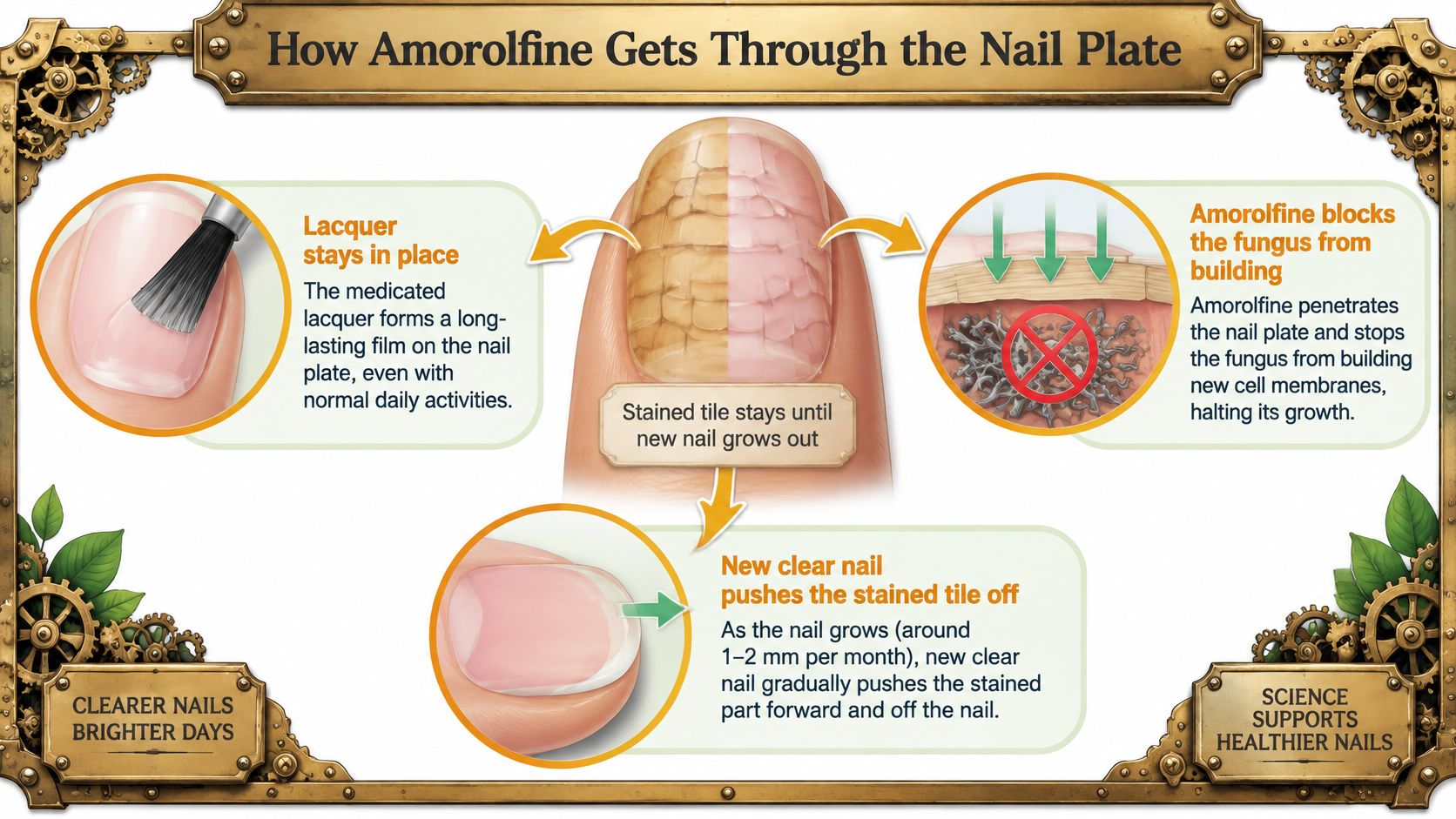
A nail is like a slow-growing roof tile. Lacquer treats the tile in place, but the discoloured part must grow out before it disappears. A weekly treatment can be low-risk, yet it will not suit every nail or clear the colour quickly.
Fungi need ergosterol to build their outer membrane. Amorolfine disrupts this process, weakening the fungus's protective barrier.
The amorolfine product information on emc says the medicine penetrates the nail within about 24 hours.[4] This means it enters the nail, not that the infection disappears overnight. A thicker or altered nail can make it harder for the lacquer to reach the affected area.
Why thickness and position matter
A thick, crumbly nail can be a less reliable route for the medicine. Gentle filing removes loose diseased material and prepares the surface. Aggressive filing, though, will not make advanced infection suitable for lacquer alone.
Position matters too. Infection near the nail's growth area is harder to treat with lacquer alone. A prescriber can assess where it starts, rather than judging only by how yellow the tip looks.
Pharmacist's tip: Ask whether the infection involves the nail's growth area before relying on lacquer alone.
What the trial results mean
A University of Southampton review of nail infection treatment reports that oral terbinafine cleared fungal nail infection more often than amorolfine lacquer in a published comparison.[5] This helps explain why a clinician may recommend tablets for more extensive infection. Tablets have different risks and checks, so they are not automatically the right choice.
Mycological cure means laboratory evidence that the fungus has cleared. It is different from a nail looking better: visible improvement depends on the affected part growing out over many months.
Lacquer can also be part of a combined plan. That decision depends on the infection and your health. Correct application gives topical treatment its best chance, but it cannot correct a wrong diagnosis or make the medicine reach every affected area.
How to Apply Amorolfine Nail Lacquer Each Week
Choose a time when you can sit down, prepare the nail and let the lacquer dry. Keep the bottle, supplied file, swabs and applicator together.
The product instructions on emc advise application once or twice weekly, according to the specific product, until healthy nail has regrown and infection has cleared.[6] Your own leaflet takes priority because packs and applicators differ.
A practical application routine
- Wash and dry the nail. Dry it fully so you're not painting onto a damp surface.
- Gently file the diseased area with the supplied file. Don't use that file on healthy nails or share it, as this can spread infected material.
- Clean the nail with the supplied swab and let it dry. This removes dust, grease and old lacquer.
- Coat the whole affected nail surface. Keep the medicine off surrounding skin, eyes and other sensitive areas.
- Let the lacquer dry fully. Keep wet lacquer away from naked flames and heat because it contains flammable solvents.
- At the next scheduled application, remove the old coat as directed. File again if your leaflet says to, then clean and reapply.
- Continue until the diseased area has grown out and your clinician agrees you can stop. A neater-looking tip alone isn't a reliable stopping point.
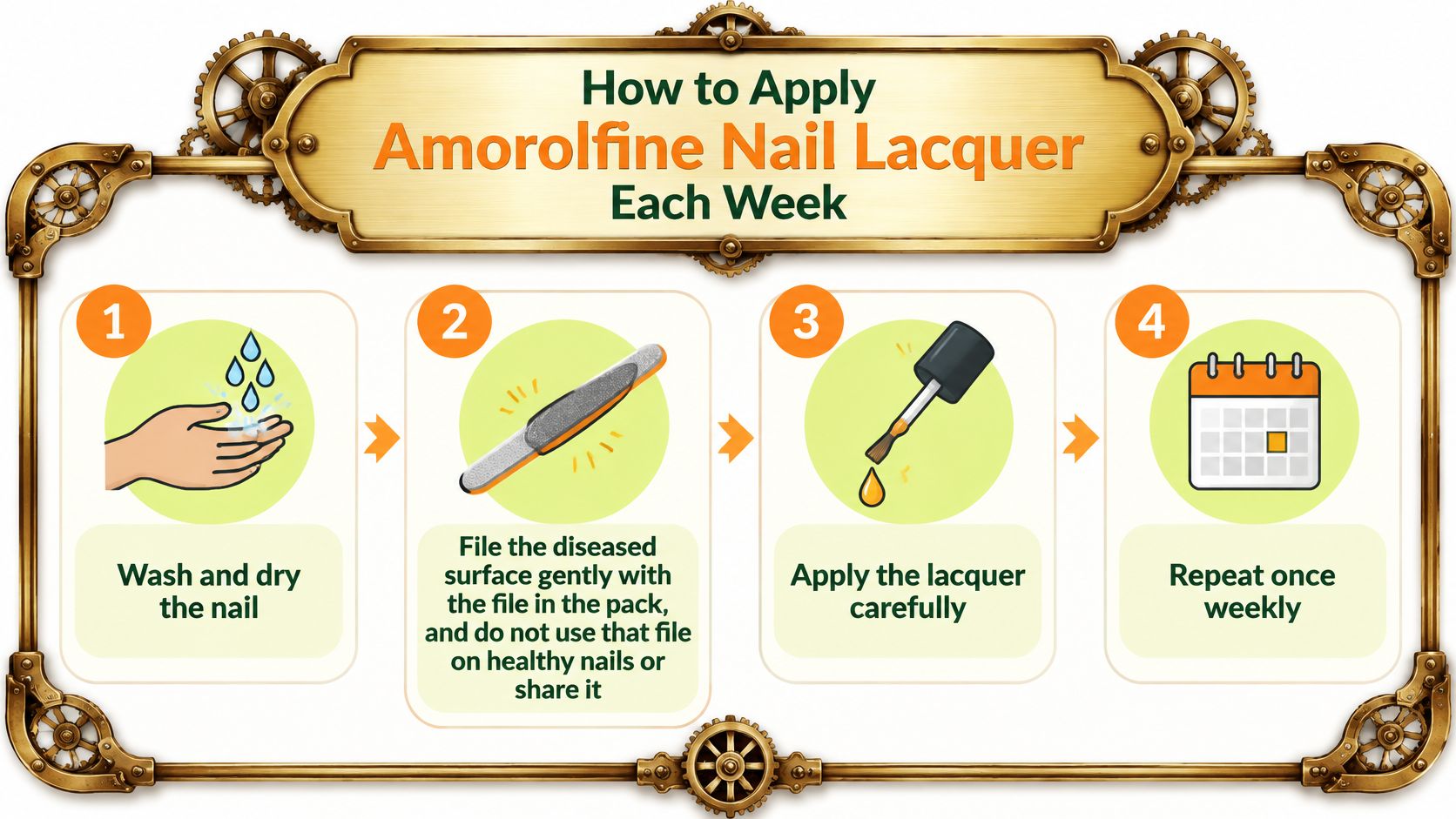
The illustration is a reminder, not a replacement for your leaflet. If your pack directs more frequent use than the image suggests, follow the pack or prescriber.
Missed doses and nail cosmetics
If you forget an application, apply it when you remember and return to your normal schedule. Don't add extra coats on the same day to catch up.
Avoid gels and artificial nails during treatment. Cosmetic varnish rules differ between products, so don't assume it's allowed: some leaflets permit it under specific conditions, while others advise against it. Never paint medicine over cosmetic varnish.
Keep the bottle tightly closed, in its pack, away from heat and children. Don't use it after its expiry date, and clean any reusable applicator exactly as the leaflet directs.
Pharmacist's tip: link treatment to something you already remember, such as bin night. If your pack requires two weekly applications, choose two suitable days and keep your supplies in one pouch.
Correct use looks rather ordinary: prepare, clean, paint, dry and repeat on schedule. More filing, thicker coats or daily use won't make up for the wrong treatment choice.
How to Judge Progress Before You Stop
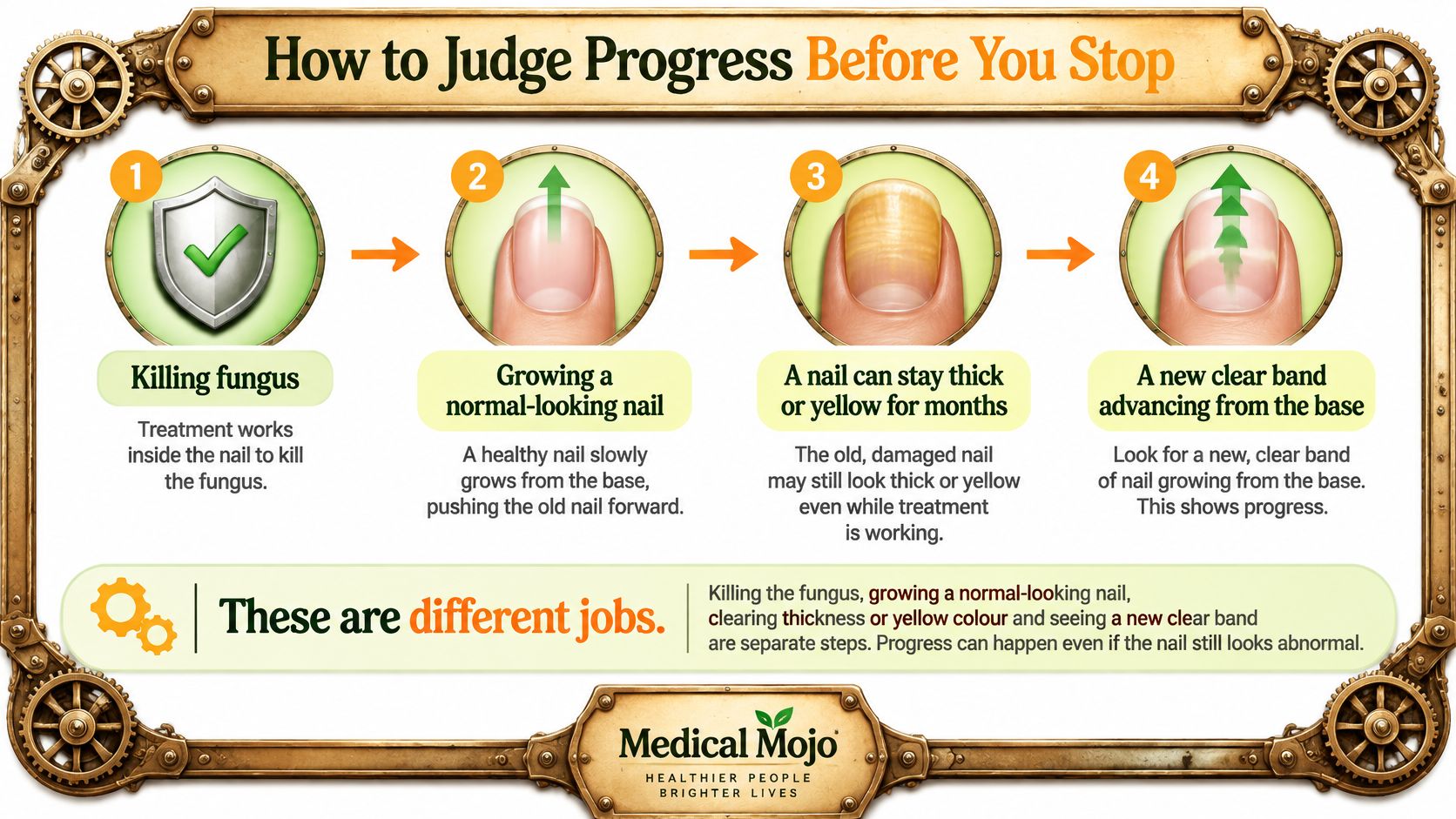
Look for a clear band growing from the base of the nail. That's more useful than asking whether the old yellow tip looks prettier.
Killing fungus and growing a normal-looking nail are different jobs. A thick or discoloured section can remain while healthy nail grows behind it.
The UK product information on emc supports review at about 3 months, with usual treatment periods of approximately 6 months for fingernails and 9–12 months for toenails.[7] Use these as review points, not automatic stop dates.
What to look for at each review point
| When | What you may see | What to do |
|---|---|---|
| Day 1 | Full view of colour, thickness and how much nail is involved | Photograph, then start the prescribed routine |
| About 3 months | A narrow clear band from the cuticle if treatment is working | Pharmacist or GP review; discuss testing if there's no clear growth |
| About 6 months | Fingernail often largely replaced if growth is normal | Continue if infected nail remains, with clinical advice |
| 9–12 months | Usual toenail endpoint | Stop only when healthy nail has grown through; reassess if unchanged |
These checkpoints reflect the product information above, not a promise that every nail will follow the same timetable.
Make change easier to see
Take progress photos regularly, using the same background, angle and lighting. Put a small ruler beside the nail and record the date.
Compare the clear growth zone, not just the overall colour. Reflections, fresh filing and different lighting can make a nail seem better or worse.
- Encouraging change: clear nail advances from the base towards the tip.
- Reason for review: no meaningful clear growth by your planned check.
- Another warning: fresh crumbling at the base or change in more nails.
A photograph can show progress, but it can't confirm fungal clearance. If the pattern doesn't fit, ask about a clipping test rather than extending treatment without a plan.
Brittle or broken nails and colour changes can occur during use. Report these at review; seek advice sooner for rash or worsening irritation. Pregnancy and breastfeeding also need personal medical advice before treatment.[7]
Pharmacist's tip: don't file repeatedly just to make the nail look smooth. Excessive thinning can damage it, and polish can hide the features your reviewer needs to see.
Weekly Routines That Fit Real UK Life
The following are illustrative situations, not patient reports or promised results. Their useful feature is the habit, not a guaranteed finish date.
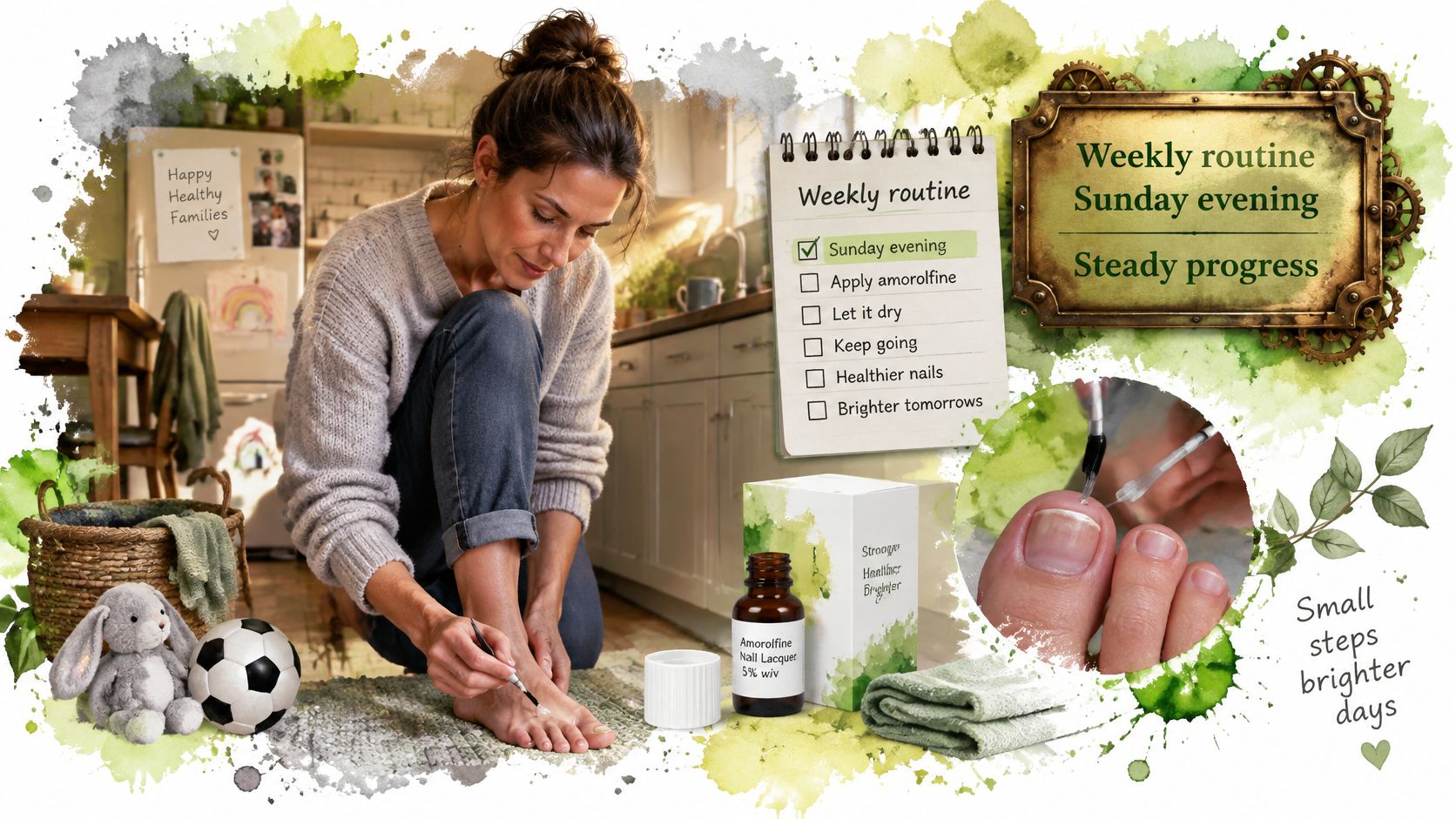
A busy parent
Say a parent has a confirmed superficial white patch on one big toenail. Their pack directs weekly use, so they choose Sunday evening after the children are in bed.
They keep the file and swabs in a wash bag and take a photo on payday. Months later, the photos show that clear nail has replaced most of the patch, though an affected section remains near the tip.
The practical result isn't a sudden perfect nail. It's visible progress and a routine they can maintain without relying on memory.
A night-shift worker
A shift worker finds morning reminders useless because their mornings keep changing. Their prescribed schedule needs separate weekly applications, so they attach each one to a regular day off.
After a missed application, they resume the plan rather than layering on extra medicine. At the scheduled review, the nail still shows no convincing clear growth.
Instead of buying another brand, they ask their GP practice about a clipping test. Keeping the routine helped make the lack of response clear, which is useful information too.
A gym-goer
A gym-goer treats an early change in a single nail after assessment. They stop sharing emery boards, leave the treated nail free of polish and wear suitable footwear in shared showers.
When another nail changes colour, they arrange a review rather than assuming the same bottle will cover every future problem. They also ask about peeling skin between the toes, using the athlete's foot information page to prepare.
- Keep the habit simple: use a reliable event as your reminder.
- Keep evidence visible: take comparable photos without nail cosmetics.
- Change the plan when needed: spreading changes or poor response warrant assessment.
If your experience resembles the unchanged nail in the shift-worker example, request a review and discuss testing.
Side Effects and When to Get Help
A lacquer is often chosen because it treats the nail directly. That doesn't mean you should ignore irritation or assume every new symptom comes from fungus.
Local irritation and nail changes
Possible local effects include:
- Skin discomfort: burning, redness or itching around the treated nail.
- Nail changes: altered colour, brittleness or breakage.
- Persistent irritation: soreness or rash that worsens with continued use.
Mild irritation can settle, but stop and ask a pharmacist if it gets worse. Don't paint over sore skin to keep your treatment streak going.
Allergy and urgent foot problems
Treat allergy separately from ordinary nail changes. A spreading rash or swelling needs urgent advice; breathing trouble needs emergency help.
| Symptom | What to do |
|---|---|
| Burning, redness or itching on the nail | Often mild; ask a pharmacist if it gets worse |
| Nail becomes brittle, breaks or changes colour | Mention it at your review |
| Spreading rash, or swelling of the face or lips | Stop treatment and seek urgent medical help; call 999 if swelling affects breathing or the throat |
| Trouble breathing | Call 999 immediately |
| Hot, painful foot, red streaks, pus or a bad smell | Same-day clinical help, not another coat of lacquer |
| Foot problem with diabetes or a weak immune system | Same-day clinical help |
Pain, heat and pus may suggest a separate bacterial problem. The nail-bed infection information page explains why these symptoms need a different assessment.
Check before starting
Don't use amorolfine if you've had an allergy to it or another ingredient. Ask for medical advice during pregnancy or breastfeeding, and don't use an adult pack for a child without specialist advice.
Avoid contact with eyes, ears and the moist lining of the mouth or nose. Rinse accidental splashes thoroughly and seek advice if irritation remains.
Only a small amount reaches the bloodstream, so medicine interactions are less likely than with tablets. Still, tell your pharmacist what you use and don't layer other nail medicines onto it without advice.
Pharmacist's tip: bring the bottle and box to any appointment. The ingredient list can help distinguish irritation from a possible allergy.
Common questions about amorolfine nail lacquer
Does amorolfine treat athlete's foot?
Nail lacquer isn't a treatment for athlete's foot on the skin. Ask a pharmacist for a suitable skin product, especially if you have both problems.
What is a compounded alternative?
A compounded medicine is made for a specific clinical need, such as avoiding an ingredient that causes an allergy. It isn't automatically stronger, more effective or interchangeable with a licensed lacquer.
How do I get a nail test?
Ask your GP practice or a pharmacy that offers nail sampling. A clinician may collect a clipping and material from the affected area for laboratory testing; ask how and when you'll receive the result.
What if the clipping is negative?
A negative result may mean the change isn't fungal, although sampling can sometimes miss infection. Psoriasis, injury, eczema or bacterial infection may need consideration, so ask for review before buying more lacquer.
What should I ask at the first visit?
Ask whether the appearance needs testing, whether the growth area is involved and when you should return for review. If tablets come up, ask about suitability, medicine interactions and monitoring; oral terbinafine treatment information can support that discussion.
Can the infection come back?
Yes, especially if infection remains or you encounter fungus again through damp footwear or shared items. Keep footwear dry, avoid sharing towels and nail tools, complete your agreed course and report new changes.
Choose a test or treatment and start safely
A weekly lacquer can be a low-risk option, but it will not suit every changed nail. It works best when the infection is confirmed and limited. Progress is slow: look for a clear band of new nail growing from the base, rather than a quick cosmetic change at the tip. Agree on a review plan before you start.
Choose your next step
Confirmed, early or superficial infection: ask a pharmacist or prescriber whether lacquer suits you. Agree how to apply it and when to review progress.
Uncertain diagnosis, several changed nails or involvement near the nail's growth area: ask for an assessment and discuss whether a clipping test is needed. Oral treatment or a combination may be considered.
A Centre for Reviews and Dissemination appraisal reports overall success at 18 months of 59.2% with terbinafine plus amorolfine, compared with 45.0% with terbinafine alone.[8] Its evidence summary also reports higher odds of complete clearance with combination treatment (OR 1.97), without a clear increase in adverse-event odds.[8]
If you would like an online assessment, start a consultation with Courier Pharmacy by completing its secure questionnaire for human prescriber review. Courier Pharmacy is a GPhC-registered UK pharmacy, and its licensed medicines come from MHRA-registered wholesalers. Where appropriate, its team can arrange follow-up calls.
A pharmacist can advise on a separate skin infection and whether terbinafine cream for skin is suitable. Nail lacquer is intended for the nail, so the right product depends on where the infection is.
This article is for information, not a personal prescription or a substitute for medical advice.
Editorial and clinical status
Author: patient-education editorial content. No named superintendent pharmacist or independent-prescriber authorship has been verified.
Clinical review: no named reviewer or completed clinical review has been verified. A registered pharmacist should check the final copy before publication.
How this content was created: this article draws on UK medicine leaflets, prescribing pathways and treatment evidence listed below. NHS-linked guidance and emc documents inform the practical advice; it does not claim a separate NICE or MHRA review.
Meta description
Amorolfine nail lacquer takes months to work. Learn who it suits, how to apply it, signs of healthy nail growth, side effects and when to ask for a nail test.
Suggested internal links
No verified Medical Mojo page addresses were available. Suitable existing pages to identify before publication are:
- Fungal nail infection: symptoms and diagnosis.
- Athlete's foot: skin treatment and prevention.
- Oral terbinafine: suitability and monitoring.
- Nail testing: sampling and results.
Visual design suggestions
Use bright lime green, pale yellow-green and light grey, with painterly detail and restrained steampunk-style brass plaque overlays.
- Nail growth comparison: show clear growth at the base beside an unchanged damaged tip. Alt text: “Clear new nail growing behind a discoloured nail tip.”
- Treatment kit layout: show a bottle, separate file, swabs and reminder calendar. Alt text: “Nail lacquer supplies arranged for a regular treatment routine.”
- Decision card: contrast limited surface change with signs needing assessment. Alt text: “Nail changes suitable for assessment before choosing antifungal treatment.”
References
The numbered source names link to the relevant documents at their first use above.
- Electronic Medicines Compendium (n.d.) Amorolfine nail lacquer patient leaflet and product information. Medicine record 26183.
- Nottinghamshire Area Prescribing Committee (n.d.) Fungal nail infection.
- NHS Scotland, Right Decisions (n.d.) Fungal nail infections.
- Electronic Medicines Compendium (n.d.) Amorolfine nail lacquer summary of product characteristics. Product record 7413.
- University of Southampton repository (n.d.) Onychomycosis: a review of presentation and treatment.
- Electronic Medicines Compendium (n.d.) Amorolfine nail lacquer summary of product characteristics. Product record 12670.
- Electronic Medicines Compendium (n.d.) Amorolfine nail lacquer summary of product characteristics. Product record 9436.
- Centre for Reviews and Dissemination (n.d.) Appraisal of combined amorolfine and terbinafine treatment. CRD record 22007001318.
Courier Pharmacy offers online assessment and fungal nail treatment where a prescriber finds it appropriate. Visit Courier Pharmacy with your nail history, current medicines and any progress photos to discuss whether lacquer suits you or whether you need testing first.


