Your Complete Guide to the B12 Blood Test in the UK
Feeling tired? Learn about the B12 blood test, UK levels, symptoms, and home testing options to understand if a deficiency could be the cause.

In this article
- Five Key Takeaways
- What is a B12 blood test and why does it matter?
- From vague symptoms to clear answers
- Being ‘in range’ vs. being ‘optimal’
- Who should consider a B12 blood test?
- Are you at risk for B12 deficiency? A quick checklist
- Dietary choices
- Your age and health conditions
- Long-term medication use
- What are the different types of B12 test?
- The standard test: total serum B12
- The more insightful test: active B12 (Holotranscobalamin)
- Functional markers: the warning lights
- How do I get a B12 blood test in the UK?
- Getting a test through the NHS
- Private testing and at-home kits
- Comparing B12 blood test sample collection methods
- What do my B12 test results mean?
- Understanding UK B12 reference ranges
- What happens if my B12 level is low or borderline?
- The importance of follow-up
- Your B12 blood test questions answered
- How long do I need to stop B12 supplements before a test?
- Can my B12 test be normal even if I have deficiency symptoms?
- What is the difference between B12 and folate deficiency?
- Does a low B12 result automatically mean I have pernicious anaemia?
A B12 blood test is a simple blood test that measures the amount of vitamin B12 in your body. It's often the first step in understanding why you might be feeling constantly tired, foggy-headed, or experiencing strange symptoms like tingling in your hands and feet. This guide will walk you through everything you need to know, from who should get tested to what your results really mean. We’ll explain the process in simple, UK-relevant terms, helping you feel more confident in conversations with your doctor or pharmacist.
Five Key Takeaways
- What it is: A B12 blood test checks for a deficiency in this vital nutrient, which is essential for energy, nerve function, and red blood cell production.
- Who is at risk: Vegans, adults over 60, people with digestive conditions (like Crohn's), and those on certain long-term medications (like metformin) are at higher risk.
- How to get tested: You can ask your GP for a test on the NHS or use a private service, including convenient at-home finger-prick kits.
- What results mean: A result below 150 pmol/L usually signals a deficiency, but symptoms can appear in the 'borderline' range (150–250 pmol/L).
- What happens next: Treatment for low B12 typically involves B12 injections or high-dose oral supplements to restore your levels and relieve symptoms.
What is a B12 blood test and why does it matter?
A B12 blood test measures the level of vitamin B12 in your blood, providing a clear picture of whether you have enough of this crucial nutrient.
Vitamin B12 is a powerhouse. It helps your body make energy, supports a healthy nervous system, and is vital for producing the red blood cells that carry oxygen everywhere. When your B12 levels drop too low, your body can’t perform at its best.
From vague symptoms to clear answers
Many people dismiss early signs of low B12, like tiredness or 'brain fog', as just part of a busy life. However, these are classic red flags that your B12 levels might be falling. A B12 blood test turns these vague feelings into a concrete starting point for you and your doctor.
In the UK, a normal serum vitamin B12 level is typically between 133–675 pmol/L. A result below 150 pmol/L usually indicates a deficiency. However, a result in the 'grey area' of 150–250 pmol/L often requires a closer look, as symptoms can appear in this borderline range.
Being ‘in range’ vs. being ‘optimal’
It’s important to understand that being technically ‘in range’ doesn’t always mean your level is optimal for you. Some people experience real deficiency symptoms even with low-normal results.
This is why a B12 blood test is more than just a number. It’s a key piece of your personal health puzzle. When viewed alongside your symptoms and risk factors, it helps build a complete picture.
If you want to get a broader understanding of your nutritional health, you can explore more about other essential vitamins and minerals in our comprehensive guides.
Who should consider a B12 blood test?
While a B12 blood test can be useful for anyone with symptoms like persistent fatigue, it's particularly important for certain groups. Some people are at a much higher risk of developing a deficiency.
Knowing if you fall into a high-risk category helps you stay proactive about your health. It allows you to have a more productive conversation with your doctor and spot potential problems early.
Are you at risk for B12 deficiency? A quick checklist
This checklist helps you see if you have common risk factors. If you tick one or more boxes, you might want to keep a closer eye on your B12 levels.
| Risk Factor Category | Examples and Why It Increases Risk | Recommended Action |
|---|---|---|
| Dietary Choices | Following a vegan or strict vegetarian diet. B12 is almost exclusively found in animal products. | Get B12 from fortified foods or reliable supplements. Consider regular testing. |
| Age | Being over 60. Stomach acid declines with age, making it harder to absorb B12 from food. | Discuss routine B12 screening with your GP. Don't dismiss symptoms as just "getting older." |
| Digestive Conditions | Crohn's disease, coeliac disease, or history of stomach surgery (e.g., gastric bypass). | These conditions can damage the parts of the gut that absorb B12. Discuss regular monitoring with your healthcare provider. |
| Long-Term Medication | Regular use of metformin (for diabetes) or Proton Pump Inhibitors (PPIs) like omeprazole. | These drugs can interfere with B12 absorption. Discuss monitoring with your GP or pharmacist. |
Dietary choices
Your diet is a major factor. Vitamin B12 is naturally found almost entirely in animal-based foods like meat, fish, eggs, and dairy.
- Vegans: If you eat no animal products, you must get B12 from fortified foods (like some plant milks or cereals) or a supplement. Without a reliable source, deficiency is almost certain over time.
- Strict Vegetarians: Even if you eat eggs and dairy, you could fall short if you limit them.
Real-life example: Priya, a 28-year-old busy parent in Manchester, had been vegan for three years. She felt incredibly tired and struggled to concentrate. She put it down to her hectic schedule, but when she started getting pins and needles in her feet, a friend suggested a B12 test. The results showed she was deficient. With supplements, her energy and focus returned within a few months.
Your age and health conditions
As we get older, our bodies become less efficient at absorbing vitamin B12 from food. This is often because we produce less stomach acid, which is needed to release B12 from food proteins.
In the UK, it’s estimated that B12 deficiency affects about 6% of people under 60. For those over 60, that figure jumps to 20%. This makes testing a critical health check for older adults.
Certain medical conditions can also block B12 absorption:
- Pernicious Anaemia: An autoimmune condition where the body can't make a protein needed to absorb B12.
- Crohn's Disease and Coeliac Disease: Both cause inflammation that can damage the part of the intestine where B12 is absorbed.
Real-life example: David, a 67-year-old retired shift worker from Bristol, took long-term medication for acid reflux. He grew worried about his memory, often forgetting names. His GP suggested a blood test, which revealed a major B12 deficiency, likely worsened by his age and medication. Starting B12 injections helped clear his "brain fog."
Long-term medication use
Some common medicines can interfere with your B12 levels over time. It’s crucial to be aware of this if you're on long-term treatment.
Two of the most well-known culprits are:
- Metformin: A first-line drug for managing type 2 diabetes.
- Proton Pump Inhibitors (PPIs): Medicines like omeprazole and lansoprazole, which reduce stomach acid.
Pharmacist's tip: If you take metformin or a PPI long-term, ask your GP or pharmacist about monitoring your B12 levels. Never stop taking your prescribed medication without speaking to your doctor first.
A B12 check can sometimes be done with other routine blood work, like a full blood count test.
What are the different types of B12 test?

When you have a B12 blood test, you might think it's a simple yes-or-no answer. But there's more to it. Different tests provide different levels of detail about your B12 status.
The standard test: total serum B12
The most common test your GP will order is a serum total B12 test. It measures the total amount of vitamin B12 in your blood. This includes both active B12 (the useful kind your body can use) and inactive B12 (the kind just being stored).
This means someone could have a "normal" total B12 level on paper but still have a functional deficiency because their active B12 is low.
The more insightful test: active B12 (Holotranscobalamin)
What is an active B12 test? The active B12 test measures only the biologically useful form of vitamin B12, giving a more accurate picture of deficiency.
This test is also known as the holotranscobalamin or HoloTC test. It only measures the B12 that is ready for your cells to use.
Because of this, the active B12 test is much better at spotting a true deficiency, especially in "grey area" or borderline cases. It is a more reliable indicator of what’s happening at a cellular level.
For a closer look at the steps involved in home testing, you can read our practical guide to using a home blood test kit in the UK.
Functional markers: the warning lights
Sometimes, doctors look at "functional markers." These are other substances in your blood that build up when you don't have enough B12. Think of them as warning lights on your car's dashboard.
The two main functional markers are:
- Methylmalonic Acid (MMA): Vitamin B12 helps break down MMA. If B12 is low, MMA levels in your blood and urine will rise. A high MMA level is a very specific and early sign of B12 deficiency.
- Homocysteine: Both B12 and folate are needed to keep homocysteine levels in check. High levels can point to a deficiency in either vitamin.
These follow-up tests are very useful when someone has clear symptoms, but their initial B12 test results are inconclusive.
How do I get a B12 blood test in the UK?
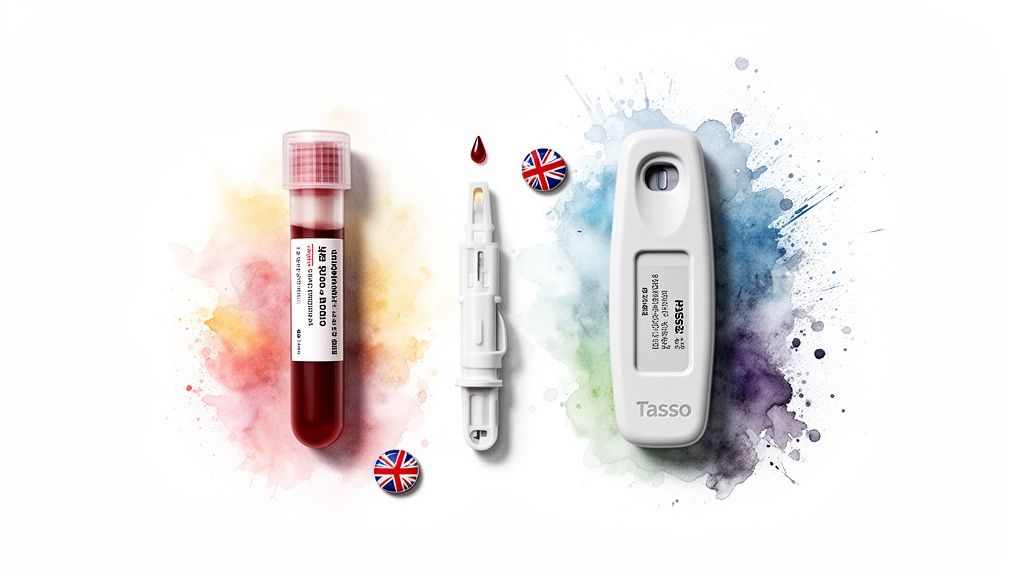
If you're wondering if low vitamin B12 is behind your symptoms, getting a B12 blood test is the only way to find out for sure. In the UK, you have two main options: go through your GP on the NHS, or use a private test.
Getting a test through the NHS
Your GP is the traditional first step. The NHS offers B12 testing for patients with clear symptoms or known risk factors.
To get the most out of your GP visit, go prepared. Before your appointment, write down a list of:
- Your symptoms: Be specific. When did they start? How do they affect your day?
- Your risk factors: Mention if you have a vegan diet, are over 60, have a condition like Crohn’s disease, or take medicines like metformin.
If your doctor agrees a test is needed, they will arrange a blood draw at a local clinic. This is usually done from a vein in your arm.
Private testing and at-home kits
If you prefer a faster or more proactive approach, private testing is a great alternative. It's quick, convenient, and puts you in control. A major benefit is the freedom to choose your test, such as an active B12 test, for a clearer picture from the start.
You can explore a wide selection of home blood test kits that let you manage your health on your own terms.
Comparing B12 blood test sample collection methods
Your blood sample can be collected in a few different ways. Here’s a quick look at the main methods.
| Method | How It Works | Pros | Cons | Best For |
|---|---|---|---|---|
| Venous Blood Draw | A professional draws blood from a vein in your arm. | 'Gold standard' for a high-quality sample. | You have to visit a clinic. Can be stressful for some. | NHS tests or when several tests are needed at once. |
| Finger-Prick Test | You use a lancet to prick your fingertip and collect blood drops. | Very convenient, can be done at home. | Can be tricky to collect enough blood, which may lead to sample rejection. | People who want a quick, easy at-home test. |
| Tasso Device | A small device on your upper arm uses a vacuum to draw blood. | Almost painless and very simple to use with a high success rate. | Newer technology, so not all providers offer it yet. | Anyone with a needle phobia or who finds finger-prick tests difficult. |
Pharmacist's tip: For a reliable B12 blood test, stop taking any B12 supplements (including multivitamins containing B12) for at least 2 weeks before your test. Testing too soon after taking a supplement can give a falsely high result, which might hide a real deficiency and delay your diagnosis.
What do my B12 test results mean?
Getting a lab report can feel confusing. When it comes to a B12 blood test, understanding what the numbers mean is the first step to taking back control of your health.
Let's translate your results into plain English. We’ll look at the different result categories and the practical steps you can take.
Understanding UK B12 reference ranges
Your B12 level is shown in picomoles per litre (pmol/L). The exact numbers can vary between labs, but your results will generally fall into one of three categories. It is vital to discuss your specific results with your doctor or pharmacist.
| Result Category | Typical Range (pmol/L) | What It Generally Means |
|---|---|---|
| Sufficient | Above 200-250 | Your B12 level is considered adequate. However, if you have strong symptoms, this doesn't automatically mean everything is fine. |
| Borderline | 150 - 250 | This is the 'grey area.' Your level isn't low enough for a clear deficiency diagnosis, but it could still be causing your symptoms. |
| Deficient | Below 150 | This result points to a clear B12 deficiency. Treatment is almost always recommended to prevent symptoms from getting worse. |
Remember, ‘normal’ doesn't always feel ‘optimal.’ Some people feel the effects of deficiency even when their results are in the low-normal range. This is often why further tests, like an active B12 or MMA test, are suggested.
What happens if my B12 level is low or borderline?
A low or borderline result is a clear signal to take action. The next steps depend on the severity and cause, but the goal is to replenish your B12 stores and get you feeling well again. Your healthcare provider will help you decide on the best plan, usually involving B12 injections or high-dose oral supplements.
Treatment Option 1: B12 injections
For a confirmed deficiency, B12 injections are the standard initial treatment in the UK. This is especially true if you have neurological symptoms like pins and needles. The NHS most commonly uses hydroxocobalamin.
Pharmacist's tip: Injections are very effective because they bypass the digestive system entirely. This is crucial for anyone with absorption problems, such as pernicious anaemia. The B12 goes directly into the muscle and then the bloodstream.
Treatment usually starts with a 'loading dose' (a series of injections over a few weeks) followed by a maintenance dose every 2-3 months.
Treatment Option 2: high-dose oral supplements
For those with a less severe deficiency or where diet is the likely cause, high-dose oral B12 tablets or sprays are a very effective and convenient option.
This approach is becoming more common. NHS data from England shows that prescriptions for oral B12 tablets more than doubled between 2019 and 2023. You can read the full analysis of NHS prescribing data to learn more.
The most common forms are cyanocobalamin and methylcobalamin. Both have been shown to be effective. Your doctor will help you figure out the right form and dose for you.
The importance of follow-up
Starting treatment is just the beginning. Monitoring your progress is key. Your doctor will likely schedule a follow-up blood test a few months after you start treatment to:
- Confirm the treatment is working.
- Check that your B12 levels are rising.
- Adjust your dose or treatment type if needed.
Pharmacist's tip: Keep a simple symptom diary. Each week, note how you're feeling—your energy, concentration, and any specific symptoms. This provides valuable feedback for you and your doctor, beyond just the numbers on a lab report.
An Energy Level Home Blood Test Kit can be a handy way to keep an eye on your B12 and other energy markers from home.
Your B12 blood test questions answered
How long do I need to stop B12 supplements before a test?
For an accurate result, you should stop taking any B12 supplements for at least 2 weeks before your blood test. This includes dedicated B12 tablets, sprays, and multivitamins containing B12. This ‘washout period’ ensures the test measures your body's natural B12 level, not the supplement.
Can my B12 test be normal even if I have deficiency symptoms?
Yes, absolutely. It’s possible to have a "normal" or "borderline" serum B12 result while still having real deficiency symptoms. This can happen because the standard test measures total B12, but much of it may be an inactive form your body can't use. If your symptoms persist despite a normal result, talk to your doctor about further testing, such as an Active B12 or MMA test.
This flowchart shows how B12 blood test results typically guide the next steps.
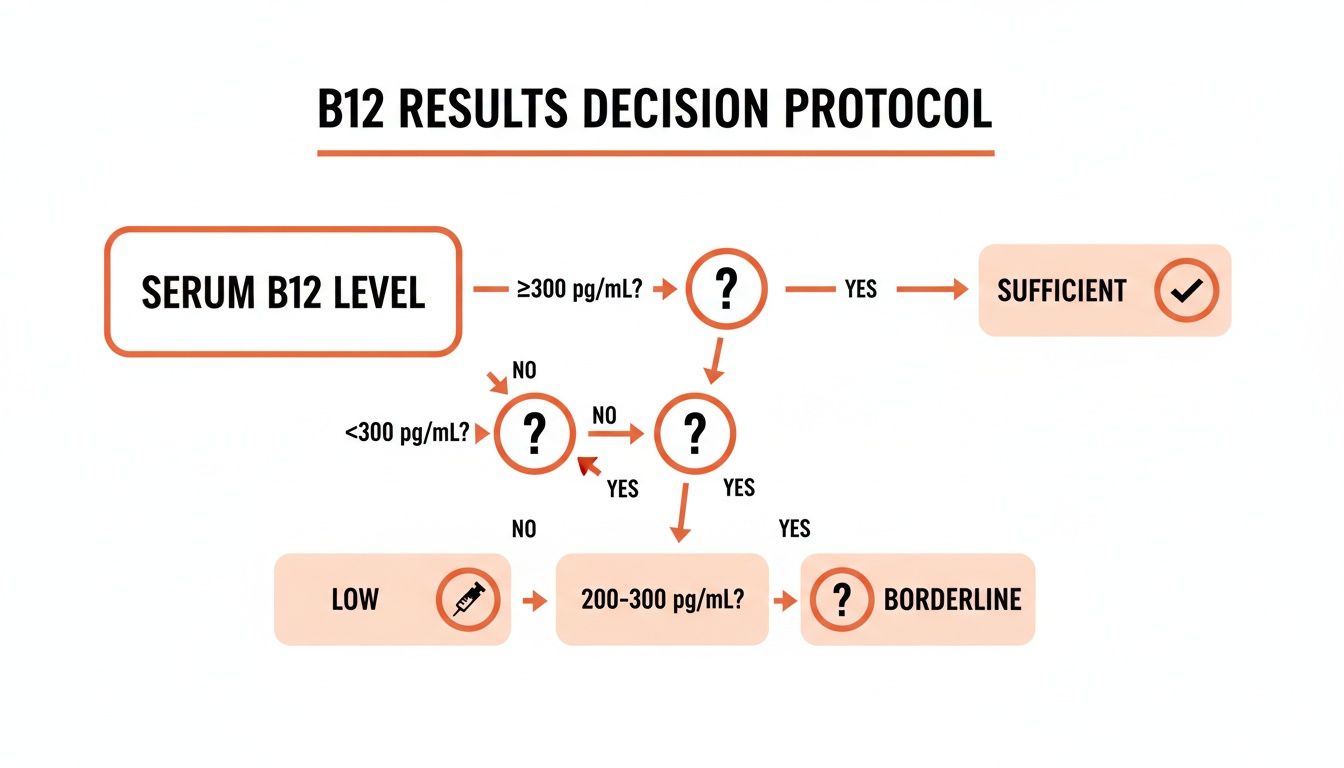
As you can see, borderline results often lead to more investigation, while low results usually lead straight to treatment.
What is the difference between B12 and folate deficiency?
Vitamin B12 and folate (vitamin B9) work together, and their deficiencies can cause similar symptoms, including a type of anaemia. The key difference is that untreated B12 deficiency can cause irreversible nerve damage, whereas folate deficiency typically does not. It is vital to test for both, as taking folate supplements alone can mask a B12 deficiency, allowing neurological damage to silently worsen.
Does a low B12 result automatically mean I have pernicious anaemia?
No. While pernicious anaemia is a common cause of B12 deficiency in the UK, it is just one possibility. Other causes include dietary issues (especially a vegan diet), absorption problems from conditions like Crohn's disease, or long-term use of certain medicines like metformin. A specific blood test for 'intrinsic factor antibodies' is needed to diagnose pernicious anaemia.
At Medical Mojo, we're dedicated to helping you make sense of your health. Our team of pharmacists and healthcare experts create clear, reliable, and practical content you can trust. This article is for informational purposes only and does not constitute medical advice. Always consult with a healthcare professional for any health concerns or before making any decisions related to your health or treatment.
To find out more about our services, please visit Courier Pharmacy.


