Benzocaine Throat Spray: Uses, Safety and Age Limits
Benzocaine throat spray explained: how it numbs a sore throat, safe age limits, dosing tips, the rare methaemoglobinaemia risk and when to seek urgent help.
You've woken with a scratchy throat, swallowing hurts, and you still need to get through work or the school run. A numbing spray may help with comfort, but choosing one can feel confusing. Is it suitable for your child? Can you have a hot drink afterwards? And how worried should you be about side effects?
Benzocaine throat spray numbs the throat for a short time to ease pain. It doesn't treat the infection causing the sore throat.
Treat it as a medicine: check the age limit, dose and warnings before the first use. Age limits and directions differ between brands, so a spray that suits you may not suit your child. The numbness lingers after each dose, which is why you should wait until normal feeling returns before eating or drinking anything hot. Your health history matters too, including blood conditions and any past reaction to a local anaesthetic.
Used as directed, side effects are uncommon. Blue lips, breathing trouble or facial swelling are different and need emergency help straight away. Blue lips in particular can signal a rare effect on the oxygen carried in the blood, so these warning signs are worth knowing even though the spray is sold without a prescription.
What Benzocaine Throat Spray Is and How It Works
Swallowing can hurt so much that even sipping water feels like a chore. Benzocaine throat spray tackles that problem differently from a lozenge or a painkiller: it is an over-the-counter local anaesthetic, a medicine that reduces feeling in the area where you apply it.
Benzocaine blocks pain signals from nerve endings near the surface of the mouth and throat. It works like a temporary mute button on the sore patch: the soreness carries on, but you feel less of it.
That targeted numbing is what makes the spray appealing for a raw, scratchy throat that stings with every swallow.
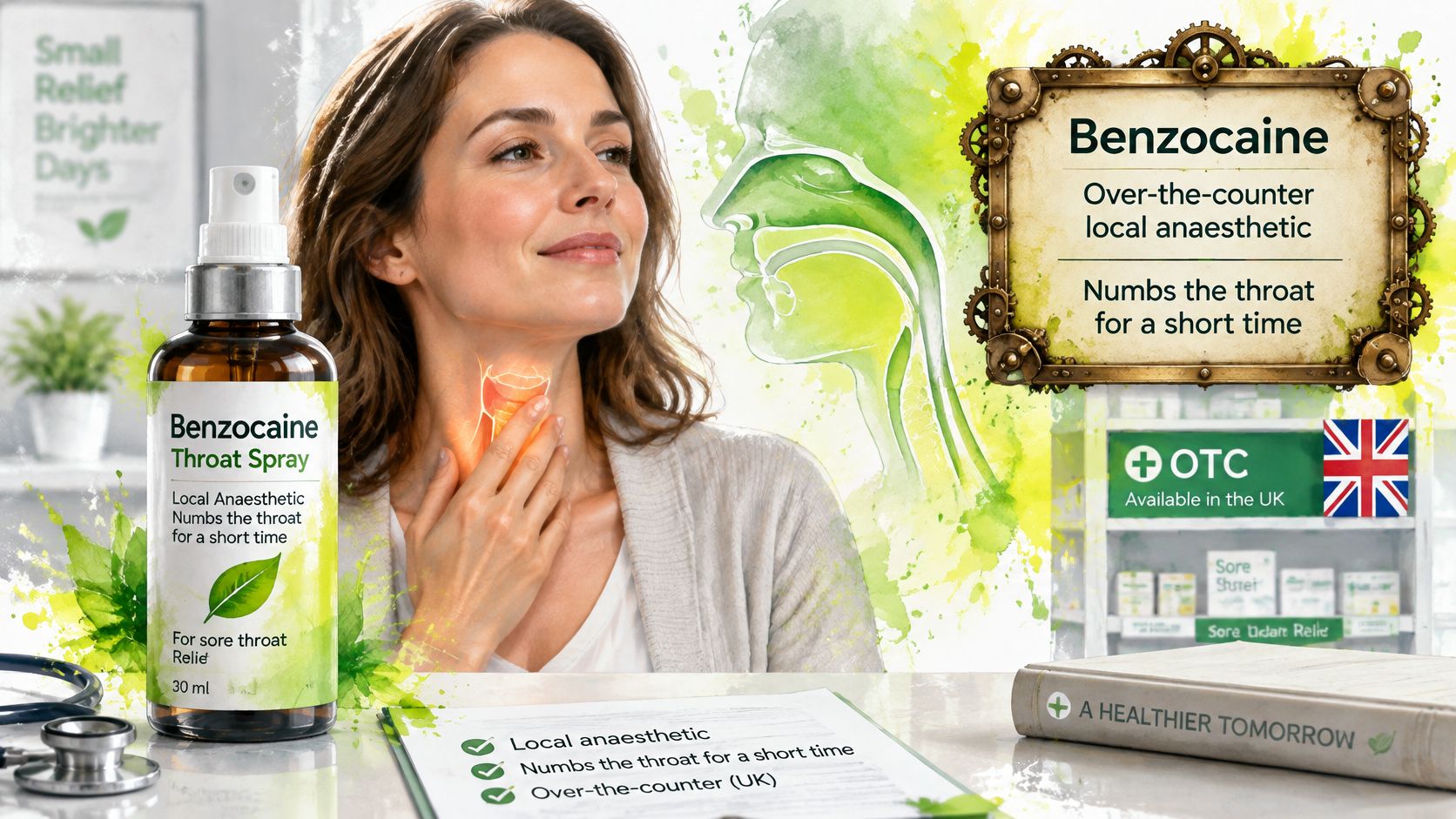
What its UK medicine status means
The NHS Dorset self-care guide lists benzocaine as a General Sales List medicine, includes throat sprays such as Ultra Chloraseptic among sore-throat self-care options, and notes brand-specific age restrictions for children under 6 or under 12. [1]
General Sales List status means you can buy the spray without a prescription. Each brand still sets its own age limit, so a child needs a product labelled for their age rather than an adult's bottle.
The same NHS guide supports simple painkillers and gargling with warm salty water. It also notes limited evidence that sprays or lozenges improve the cause of the condition, so their real strength is comfort while you recover.
Numbing pain while the illness runs its course
Benzocaine is a local anaesthetic, and its numbing action does not kill germs or shorten the illness. Less pain makes the wait for recovery easier to bear.
You might find speaking or swallowing more comfortable after a dose. Keep watching for worsening pain, fever or trouble swallowing, because a comfortable hour is still only a comfortable hour.
For wider symptom information, this coughs and cold guide may help you separate throat discomfort from other symptoms.
Pharmacist's tip: Choose a spray for the symptom you want to ease. A product labelled for throat pain may not treat a cough or clear mucus.
Age Limits and Who Can Use It Safely
Can children use benzocaine throat spray? Only when the exact product leaflet permits their age group. There isn't one age rule for every throat spray.
The box and leaflet must agree with the person using it. Don't use directions from a similar-looking bottle, an old pack or a different country.
Age groups and what to check before using benzocaine throat spray
| Age group | What UK guidance says | What to do first |
|---|---|---|
| Adults | Use the labelled adult dose in the product leaflet | Don't exceed the dose or repeat it sooner than allowed |
| Children aged 12 and over | Check the brand leaflet for the labelled minimum age | Confirm the age limit on the pack before use |
| Children aged 6 to 11 | Some brands restrict use under 12; product limits differ | Check the leaflet; ask a pharmacist first |
| Children under 6 | Some brands restrict use under 6; guidance lists limits by brand | Ask a pharmacist or GP before use |
| Infants | A few reported cases of methaemoglobinaemia have included infants | Avoid unless a doctor advises |
These age bands reflect the product-specific restrictions described in UK guidance, not permission to use every spray within a band. [1] Rare reports after benzocaine use on skin or moist body linings have involved infants, children and adults. [3]
A busy parent's check
Say a parent finds an adult throat spray in the bathroom cupboard before school. Their child can gargle and swallow tablets, so the parent assumes the spray will also be suitable.
Those skills don't establish the medicine's age limit. The safer choice is to check the brand leaflet before giving it, rather than guessing a smaller dose.
Children may also struggle to describe an unusual reaction. Ask for advice if a child seems unexpectedly weak, breathless or unwell after any medicine.
Match the child's age to the exact brand before the first spray. A smaller amount doesn't make an unsuitable product suitable.
Older adults should check too. Their medical conditions, allergies and other medicines may change the advice even when the adult age requirement is clear.
If you're considering a different pain medicine, paracetamol tablets have their own suitability checks. An adult tablet page isn't a dosing guide for a child.
Pharmacist's tip: Keep the carton until you've finished using the medicine. It makes checking the brand, ingredients and age limit much easier.
Who Should Avoid It and Medicine Interactions
Known methaemoglobinaemia is a reason to avoid benzocaine altogether. This is the condition where blood carries less oxygen than it should, and benzocaine can trigger it. If it already appears on your medical record, the spray stays on the shelf.
The product information for one UK benzocaine oromucosal spray limits use to three days. [2] The same leaflet advises against use with known methaemoglobinaemia and lists allergic reactions, temporary breathing difficulty, facial or mouth swelling, and potentially irritating ingredients such as propylene glycol among its warnings.
Who should avoid benzocaine throat spray or check first
| Person or situation | Why caution matters | What to do first |
|---|---|---|
| Known methaemoglobinaemia | Benzocaine can trigger it | Don't use; tell a GP or pharmacist |
| Family history of methaemoglobinaemia | Product advice warns against use | Avoid use and speak to a GP or pharmacist |
| Previous reaction to ester local anaesthetics | Possible allergic or related reaction | Avoid until a clinician has checked |
| Blood disorders | Some can affect oxygen transport | Ask a GP before use |
| Other medicines that affect blood oxygen | Effects may add together | Ask a pharmacist to check the full medicine list |
| Pregnancy or breastfeeding | Leaflets may not give a clear yes or no | Check the leaflet and ask a pharmacist or GP |
Check ingredients as well as the active medicine
Benzocaine belongs to the ester group of local anaesthetics. A past reaction to one ester anaesthetic raises the question of whether others will suit you, so tell the pharmacist exactly what happened and, if you know it, the anaesthetic's name. Even “I had a bad reaction at the dentist” gives them something useful to work with.
Some sprays contain propylene glycol, an ingredient that may irritate sensitive users. Checking the full ingredient list takes a few seconds and can spare you a sore mouth on top of a sore throat.
Pregnant or breastfeeding? Read the leaflet and ask a pharmacist or GP before use. The available information does not give one clear answer for everyone.
Thinking about ibuprofen tablets instead? Another medicine brings its own precautions, so switching products still calls for a fresh suitability check.
Pharmacist's tip: Bring the box and your current medicine list to the pharmacy counter. Include prescribed medicines, shop-bought remedies and supplements, because anything already in your system can change the advice.
How to Use the Spray Step by Step
Start with the leaflet supplied in the pack. It sets the strength, priming steps, dose and gap for that bottle, and those details can differ between brands.
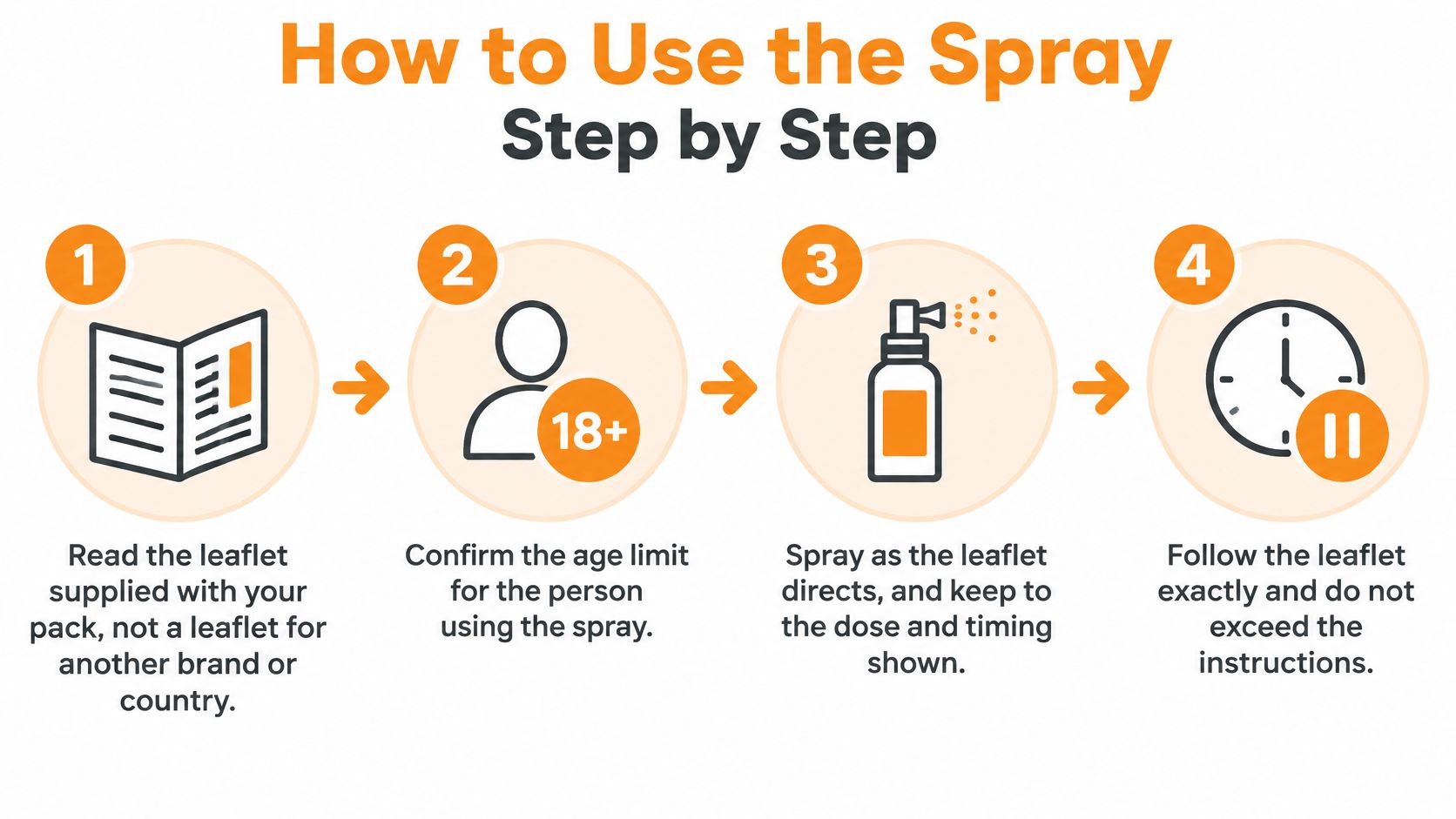
Before and during each dose
Read the leaflet supplied with your pack. Use its preparation and nozzle instructions. Another brand may have a different strength or spray mechanism.
Confirm the user's age. Check before opening or priming the bottle. Don't work out a child's dose by reducing an adult dose yourself.
Use the labelled number of sprays. Aim and operate the nozzle exactly as directed. Don't add extra sprays because the first dose feels less strong than expected.
Keep to the stated gap between doses. Make a note of when you used it if you're tired or busy. Pain returning isn't permission to shorten that gap.
Check feeling has returned before food or drink. Numbness can hide an accidental bite and make swallowing harder to judge.
Treat heat as a burn risk while numb. A drink that feels merely warm may still be hot enough to scald.
Use the shortest course your leaflet allows. If regular numbing is still needed after that point, ask a pharmacist or GP before continuing.
Stop self-treatment when symptoms need assessment. Severe, persistent or recurring symptoms warrant advice. Get urgent help for breathing problems or significant swallowing difficulty.
A timing example
A before-work dose can make a hot coffee tempting on the way in. The safer sequence is dose, note the time, wait for normal throat feeling, then drink. If pain returns during the commute or shift, check the noted time against the leaflet gap instead of estimating from memory.
Practical rule: If the dose, age limit or timing is unclear, pause. Show the pack to a pharmacist rather than guessing or borrowing someone else's bottle.
Some brands set a specific maximum course, and product advice warns against continuous use. [2,3] Over-the-counter access still calls for the same care as any medicine: right user, right dose, right gap, clear stop point.
Methaemoglobinaemia and Other Safety Concerns
A winter cold leaves your throat raw, and a couple of sprays takes the edge off within minutes. If your lips or skin then look blue or grey, or your face starts to swell, stop using the spray and call 999.
That colour change can point to methaemoglobinaemia, a rare reaction that affects haemoglobin. Haemoglobin is the substance in red blood cells that carries oxygen around your body. It works like a fleet of delivery vans: this reaction leaves the vans running but unable to unload their oxygen where it is needed.
The UK benzocaine Summary of Product Characteristics describes a few reported cases after use on skin or moist body linings. It also records hypersensitivity reactions and contact dermatitis, an itchy or inflamed skin reaction. [3]
Because reported cases are few, product information cannot give a reliable numerical risk for someone using a particular throat spray. Rare still means possible, so recognising the signs matters more than knowing the odds.
Recognise signs that need action
Symptoms can appear on the skin, in your breathing, or in how you feel. The checklist below groups each warning sign with the action to take.
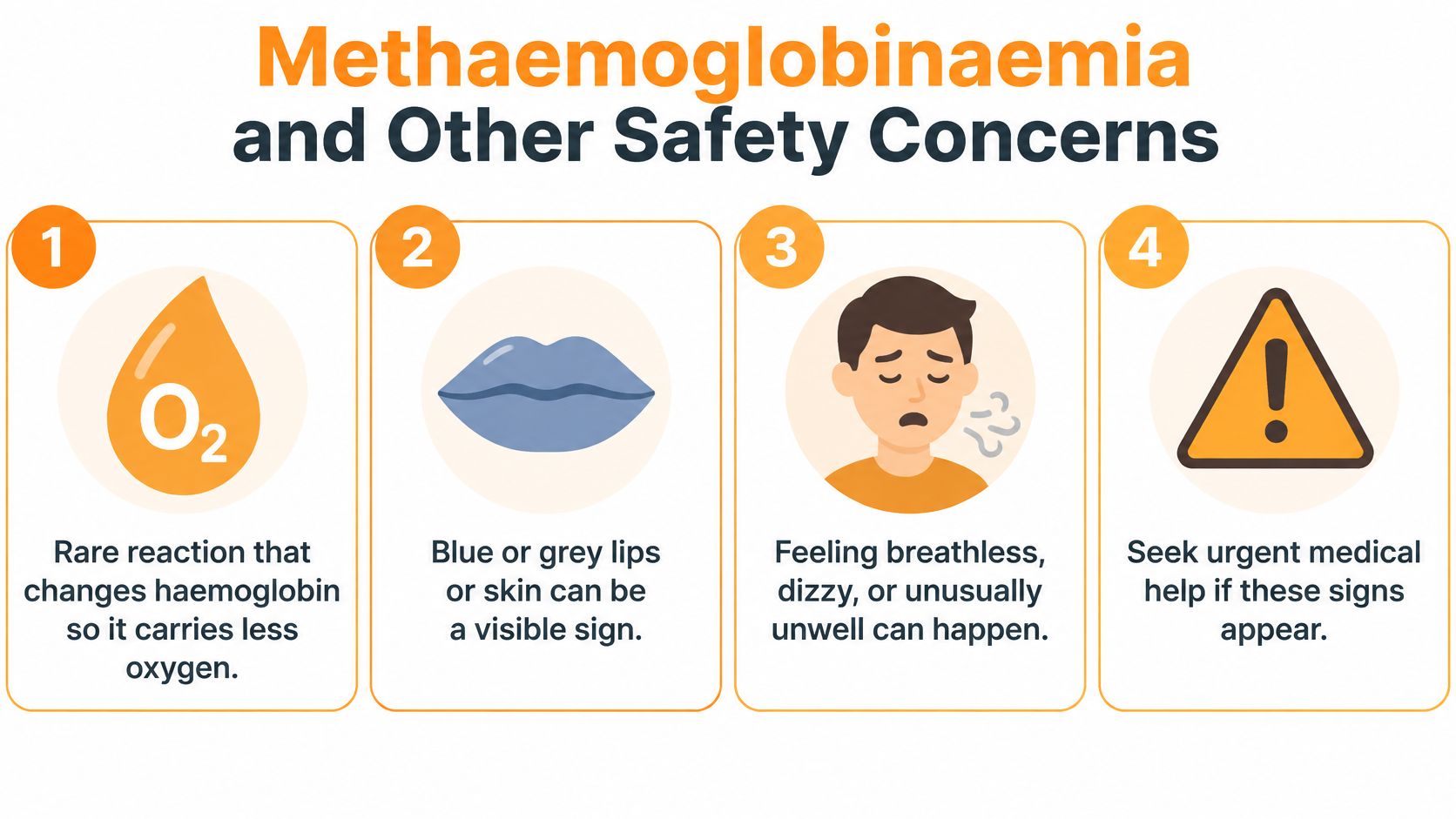
Warning signs after benzocaine throat spray and the action to take
| Warning sign | What it may mean | What to do |
|---|---|---|
| Blue or grey lips, tongue or skin | Possible low oxygen in the blood, called cyanosis | Stop the spray and call 999 |
| Unusual breathlessness | Possible reduced oxygen reaching the body | Stop and seek urgent help; call 999 if severe |
| Dizziness, marked weakness or fast heartbeat | Possible methaemoglobinaemia | Stop the spray and seek urgent medical help |
| Headache, nausea, vomiting or fever | Warning symptoms listed in product information | Stop the spray; get medical advice the same day |
| Swelling of the face, lips or mouth | Possible allergic reaction | Stop the spray and call 999 |
| Burns after eating or drinking while numb | Reduced feeling in the mouth | Avoid further heat; get advice if blistering or pain persists |
These symptoms can have other causes, including the infection itself. Don't try to decide at home whether serious symptoms come from the spray or the illness.
Take the medicine pack with you if you seek help. Tell the clinician when you used the spray and how much you took.
Reporting a suspected reaction
The MHRA Yellow Card scheme accepts suspected medicine side-effect reports from the public and healthcare professionals. You don't need proof that the medicine caused the problem to report a concern. [4]
Get medical care first when symptoms are severe. Reporting supports medicine safety monitoring, but it does not arrange treatment.
Alternatives for Sore Throat Relief
Sore throats often clear up on their own, so simple self-care is usually enough. A numbing spray is only one option, and you can pick whichever approach suits you best.
Comfort measures also fit easily around rest at home.
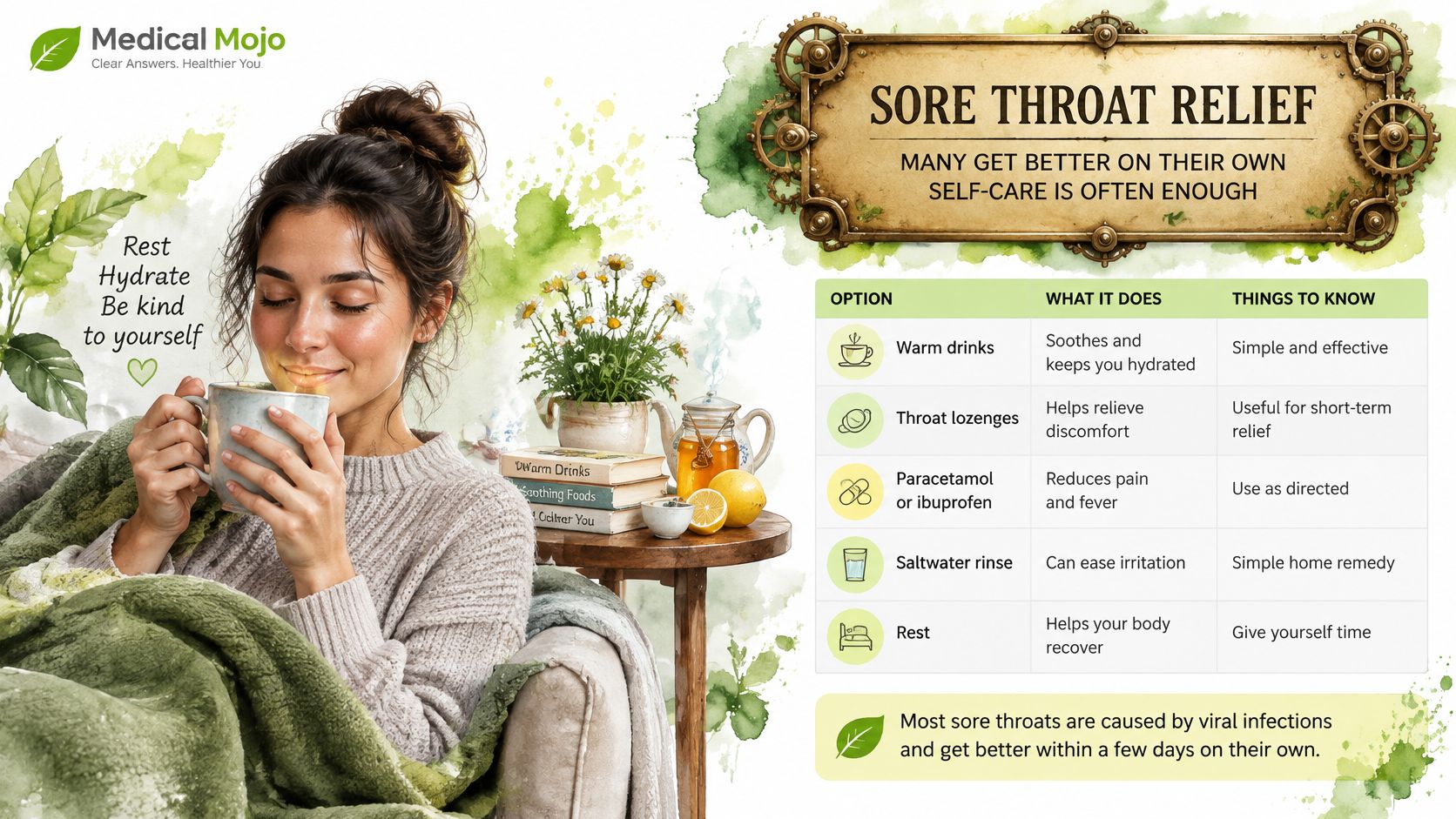
Sore throat relief options compared
| Option | How it helps | Limits or evidence |
|---|---|---|
| Simple painkillers, such as paracetamol or ibuprofen | Ease pain and fever | Follow pack limits; check suitability with a pharmacist |
| Gargling with warm salty water | Soothes the throat | Short-term comfort; suitable only if you can gargle safely |
| Throat lozenges | Soothe and may ease discomfort | Limited evidence for improving the cause |
| Fluids and rest | Support comfort and recovery | Don't treat an infection |
| Benzocaine throat spray | Provides local numbing | Short-term use only; rare serious risks |
| Seeing a GP or pharmacist | Checks whether treatment is needed | Important for severe, persistent or recurring symptoms |
Choose a painkiller you can safely take, rather than assuming one suits everyone. Check cold-and-flu products too, as they may already contain the same painkiller.
Warm salty water may help an adult who can gargle and spit it out. Don't use it for a young child who might swallow it or struggle to gargle. Lozenges soothe while they dissolve, but they ease the feeling rather than fixing the cause.
Match the remedy to the symptom
Where mucus is the main problem, a product such as Benylin Mucus Max Honey and Lemon needs its own ingredient and suitability check.
For a child or someone with a blood disorder, ask a pharmacist which alternative offers appropriate relief. Don't swap to another local anaesthetic without checking.
The video below provides an additional sore-throat resource.
Buying online and your next step
A sore throat can make the first spray in the search results look tempting. Give the seller two minutes of scrutiny before you hand over your card details. Check the seller's registration before the discount.
A UK online pharmacy should be identifiable, with registration details you can check against the General Pharmaceutical Council's public register. Look for the pharmacy's name and registered premises, and confirm the register entry matches the site you are buying from. A logo on a homepage proves nothing by itself.
Registration means the seller answers to a regulator. It does not mean every medicine it sells suits you. A careful seller will still ask about age, symptoms and health history before supplying, so be cautious with any site that skips those questions. Benzocaine carries age limits and a rare blood-oxygen risk, which is exactly why the answers matter.
Check the medicine as carefully as the seller
The MHRA medicines-information service provides authorised medicine information, including patient leaflets and summaries of product characteristics. Search by product name, active ingredient or licence details to find the document for the exact spray you are considering. The leaflet tells you who can use it, how much to use and how long a course should last.
Compare that information with the pack you receive when the order arrives. Don't copy a dose from a discussion forum, an imported product page or another person's bottle. Those sources may describe a different strength or a different country's rules.
Take a parent ordering for a school-age child. They should confirm the exact brand's age limit before paying, because sprays that look similar can carry different age restrictions. A comparison page saying "for children" isn't enough.
For practical help with the seller side of this check, use this UK online pharmacy guide. Then confirm the current registration entry yourself before ordering.
Before you pay, settle four things
- The exact product: a named brand and strength, rather than a listing described only as "throat spray".
- The user: the person's age and health history match what that product's leaflet permits.
- The seller: its registration checked on the regulator's own register, rather than only claimed on its website.
- The fallback: where you will turn if the spray is unsuitable or fails to help, such as a pharmacist or NHS 111.
FAQs
Is benzocaine throat spray an antibiotic?
No. It's a local anaesthetic that reduces feeling in the throat. It doesn't treat an infection that needs medical care.
Can I use an adult spray for my child?
Only if that exact product's label permits the child's age and gives directions for them. Never guess a smaller dose. Ask a pharmacist if the label is unclear.
Can I eat after using it?
Wait until normal feeling returns. Numbness can make swallowing less safe and can hide bites or burns.
What if I accidentally use too much?
Don't take another dose. Contact a pharmacist or NHS 111 promptly with the pack and details of the amount used. Call 999 for serious symptoms.
Can I use it with other medicines?
Ask a pharmacist to check your full medicine list if you're unsure. This matters particularly with medicines that can affect blood oxygen.
What if the spray doesn't help?
Don't keep increasing the dose. Ask a pharmacist about another option, and seek assessment if pain is severe, persistent or keeps returning.
Courier Pharmacy offers online access to medicines and pharmacist support for checking suitable treatment options. If you're unsure which sore-throat remedy fits your age, symptoms or current medicines, visit Courier Pharmacy to ask about the next step.


