Best GLP 1 Patches in the UK: Are They Licensed?
Looking for the best GLP 1 patches? Learn why they lack MHRA approval, what the evidence shows, and which licensed options to discuss with a prescriber.
The best GLP-1 patch sold in the UK is not a patch. No patch on the market holds MHRA authorisation for weight loss, so the defensible choice is a licensed prescription medicine, such as Wegovy or Mounjaro, or a structured lifestyle plan agreed with a clinician.
Popular lists rank best GLP-1 patches by herbs, stickiness, or a promise of no needles. That advice treats a wellness sticker as if it were a medicine. An MHRA licence means the UK regulator has checked quality, safety and effect before a product reaches a shelf. A patch that has skipped that process carries an unverified dose and unverified purity.
This guide shows how to check a patch, how to read trial numbers, who can access NHS treatment, and when symptoms need urgent help. It does not sell a patch.
Five takeaways
- No UK patch is a licensed weight-loss medicine. Treat "natural GLP-1" wording as a marketing line.
- Wegovy and Mounjaro hold UK licences and have been through NICE review. Patches have no matching trial results.
- Check the active ingredient, the seller, and the evidence before you pay.
- Needle-free does not mean lower risk. An unknown dose and unverified purity are risks in themselves.
- Eligibility is a reason to see a clinician, not a reason to buy from a social seller.
Which GLP-1 option is best in the UK
In the UK, no GLP-1 patch holds an MHRA authorisation for weight loss. The better choice is a licensed, prescriber-supervised medicine, or a structured lifestyle plan. Best, in this article, means independently checkable UK authorisation and trial evidence. It does not mean the loudest advert.
The NHS England medicines for obesity page records the timeline. Semaglutide, sold as Wegovy, was the first UK-licensed medicine specifically used for weight loss in 2021. Tirzepatide, sold as Mounjaro, followed in 2023. NICE then backed NHS use of Wegovy in September 2023 and Mounjaro in December 2024. The UK Government GLP-1 guide lists licensed forms such as injections and the tablet Rybelsus. It does not list a transdermal patch.
| Option | UK regulatory status | Evidence strength | Best suited to |
|---|---|---|---|
| Marketed GLP-1 patches | Not MHRA-authorised | No robust UK clinical trial data | Not recommended for weight loss |
| Wegovy (semaglutide injection) | Licensed for weight management (2021) | Licensing review and NICE appraisal | Adults meeting NHS or prescriber criteria, under specialist care |
| Mounjaro (tirzepatide injection) | Licensed for weight management (2023) | Licensing review, NICE appraisal and randomised trial data | Adults meeting NHS or prescriber criteria, under specialist care |
| Rybelsus (oral semaglutide tablet) | Licensed for type 2 diabetes | Licensed tablet evidence for diabetes, not a weight-loss licence | People with type 2 diabetes who need a tablet, per prescriber |
| Lifestyle programmes | No medicine licence needed | Recommended alongside medicines in NICE guidance | Everyone, as the base of any weight plan |
Marketed patches suit nobody who wants a proven weight-loss drug. Wegovy suits adults who meet NHS or private prescribing criteria and can use specialist care. Mounjaro suits the same kind of supervised route, with randomised trial data behind the higher dose. If you are comparing those two injections, read switching from Mounjaro to Wegovy with a prescriber, not from a forum. Rybelsus suits some people with type 2 diabetes who need a tablet. It is not a patch, and it is not licensed here as a weight-loss product. Lifestyle programmes suit everyone. They sit under any medicine plan.
Pharmacist's tip: If a seller cannot name a licensed active ingredient and a UK authorisation number, do not rank that patch against Wegovy or Mounjaro.
How to check a GLP-1 patch before you buy
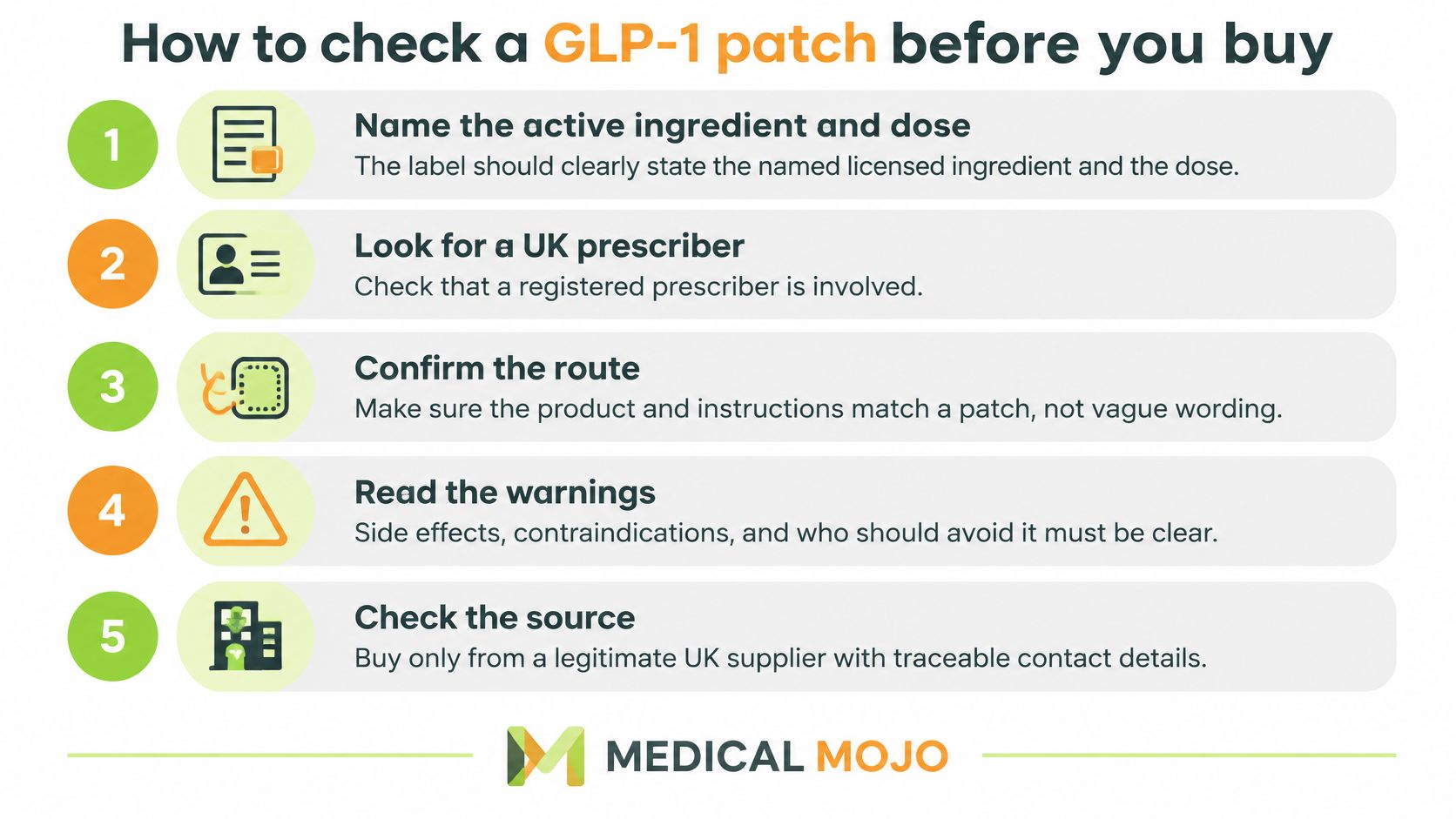
Run these five checks before you pay. One fail is enough to walk away.
The MHRA, ASA and GPhC warning on weight-management promotions draws a hard line. The ASA has not seen convincing evidence that unlicensed slimming patches cause weight loss. UK rules also stop people marketing a medicinal product without the required authorisation. There is no established benchmark showing that consumer patches deliver licensed semaglutide or tirzepatide through the skin.
1. Name the active ingredient and the dose. If the label only says "natural GLP-1" or "appetite support", treat it as unproven. A real medicine names the drug and the amount.
2. Look for UK authorisation. You want an MHRA marketing authorisation. If none is shown, the product is not authorised. A pretty box is not a licence.
3. Confirm the supplier and the prescriber. You should see a UK-registered pharmacy and a named clinician. A UK online pharmacy should show its regulatory status, not hide behind a social handle.
4. Ask for trial evidence. Look for randomised results on weight change, side effects, and how long any effect lasts. Botanicals, microneedle claims, and appetite testimonials do not prove the patch matches a prescription GLP-1 medicine.
5. Spot pressure tactics. Rapid fat-loss promises, star reviews, and sellers on social media or unregulated websites are warning signs. Those channels often cannot show dose, sterility, or authenticity.
Why these checks protect you
Licensed injections come with dose steps, product information, reasons not to take the drug, safety monitoring, and a prescriber. Typical commercial patches do not. A patch should not be called a clinical alternative unless it shows an authorised active ingredient, a tested skin-delivery system, human results on blood levels, and randomised trial outcomes.
If any check fails, stop. Do not buy. Speak to a GP or a pharmacist.
Pharmacist's tip: Save a photo of the label. If you feel unwell later, that photo helps a clinician see what you actually used.
What the evidence shows for each option
Licensed medicines have a number you can test. Marketed patches do not.
In SURMOUNT-1, a 72-week randomised, double-blind trial, tirzepatide 15 mg produced about 20.1 percentage points more weight loss than placebo. The 95% confidence interval was 19.0 to 21.2 percentage points. That figure comes from the NICE committee discussion of tirzepatide. "Percentage points against placebo" means this. Researchers compared people on the drug with people on a dummy treatment. The gap between those groups was about 20 points, not a promise that every person loses 20% of their weight.
NICE also says clinicians should reassess treatment if a person loses less than 5% of their starting weight after 6 months on the highest tolerated dose. That rule stops open-ended use when the medicine is not doing enough.
| Option | Key study or review | Reported weight change | Limits or next step |
|---|---|---|---|
| Tirzepatide 15 mg (Mounjaro) | SURMOUNT-1, 72 weeks, randomised and double-blind | About 20.1 percentage points more than placebo (95% CI 19.0 to 21.2) | Reassess if under 5% loss after 6 months on highest tolerated dose |
| Semaglutide up to 2.4 mg (Wegovy) | NICE appraisal and licensing review | No single percentage is set in the maintenance-dose advice used here | Consider stopping if under 5% loss after 6 months |
| Marketed GLP-1 patches | None published for UK-authorised products | None published | No randomised data on weight, persistence, side effects or dose response |
How to read the Wegovy row
Wegovy's row is a licensing and NICE standard, not a copy of the tirzepatide trial. The practical test is the same idea. If loss stays under the 5% line after six months, the prescriber should rethink the plan. Do not treat a marketing "before and after" as that test.
What the blank patch row means
No published UK randomised data cover weight loss, how long any effect lasts, adverse-event rates, or dose response for a marketed patch. You cannot give that product a reliable percentage. If a seller quotes one, they are not quoting this evidence set.
If a product cannot show comparable trial data, treat the claim as marketing. Do not line it up against Mounjaro's 20.1 point gap.
People with complex conditions still need the medicine evidence, not a sticker. A prescriber can also look at wider GLP-1 questions, including GLP-1 medicines and mast cell disorders, when that history matters.
Safety risks patches cannot remove, and when to seek urgent help
A patch feels gentler because you skip the needle. The needle was never the whole risk.

The MHRA reminder on GLP-1 side effects states that gastrointestinal side effects from GLP-1 agonists may affect more than 1 in 10 patients. That figure is for authorised GLP-1 medicines, not for unlicensed patches. In January 2026, UK authorities updated guidance to stress a small but potentially severe risk of acute pancreatitis, including rare severe cases. The MHRA update for prescribers and patients highlights persistent severe abdominal pain that may spread to the back, plus nausea and vomiting.
Avoiding a needle does not remove medicine-specific risks, pregnancy restrictions, or the need for follow-up. An unlicensed patch adds a different problem. You may not know the dose, the purity, or whether the product was sterile.
| Symptom | What it may signal | What to do |
|---|---|---|
| Persistent severe abdominal pain, possibly spreading to the back | Possible acute pancreatitis | Call 999 or go to A&E |
| Nausea and vomiting | Common side effect, or a sign of pancreatitis | Contact NHS 111 if unsure. Seek urgent care if pain is severe and persistent |
| Constipation, diarrhoea or reflux | Common gastrointestinal side effects | Speak to a prescriber or pharmacist before changing treatment |
| Unexplained symptoms after using an unlicensed patch | Unknown ingredients, dose or sterility | Stop using the product and speak to a GP or pharmacist |
Call 999 or go to A&E for severe, persistent abdominal pain, especially with vomiting. Contact NHS 111 when you are unsure and you are not in that emergency picture.
A missed or detached patch is not a puzzle to solve from a comment thread. Ask a pharmacist what to do next. Do not stick on an extra patch to "catch up".
Licensed treatment still needs a check for other medicines and for pregnancy plans. Read practical detail on Mounjaro side effects with your own prescriber's advice, not instead of it.
Do not stop a prescribed medicine on your own. Tell the prescriber about side effects and let them change the plan.
Pharmacist's tip: Write down when the pain started, whether it reaches your back, and whether you are vomiting. That timeline helps urgent care staff.
Who qualifies for licensed GLP-1 treatment in the UK
NHS access is tighter than a private advert suggests. A patch does not skip the threshold.
NHS England's weight-management injections guidance sets the semaglutide route. Most adults need a BMI of at least 35 plus at least one weight-related health problem. People of Asian, Chinese, Middle Eastern, Black African, or African-Caribbean origin qualify from a BMI of 32.5, with the same health-problem rule. Adults with a BMI of 30 to 34.9, or 27.5 to 32.4 in those groups, may qualify only when they also meet referral criteria for a specialist weight-management service.
The MHRA licence for semaglutide covers a wider group of adults than routine NHS supply. It does not turn an unlicensed patch into treatment. A prescriber still decides from the full picture. These numbers are not a reason to self-prescribe a patch.
| Group | BMI threshold | Extra requirement |
|---|---|---|
| Most adults | 35 or above | At least one weight-related health problem |
| Asian, Chinese, Middle Eastern, Black African or African-Caribbean origin | 32.5 or above | At least one weight-related health problem |
| Most adults with BMI 30 to 34.9 | 30 to 34.9 | Criteria for referral to a specialist weight-management service |
| Asian, Chinese, Middle Eastern, Black African or African-Caribbean origin, BMI 27.5 to 32.4 | 27.5 to 32.4 | Criteria for referral to a specialist weight-management service |
The table is a referral map, not a shopping list. Each row leads back to a clinical assessment.
Three people, three routes
Busy parent. BMI 33, plus high blood pressure. You are in the 30 to 34.9 band. Ask your GP whether you meet specialist referral criteria. Do not order a patch while you wait.
Shift worker. You want something needle-free because nights already feel hard. You still cannot prescribe for yourself. A clinician decides whether any licensed option, including a tablet for the right condition, fits your job and your health.
Gym-goer. BMI 26 and no weight-related condition in this example. You sit below the NHS bands. Build the plan around food, activity, and sleep. A patch will not turn that into treatment.
Eligibility is a reason to book a clinician, including through a weight-loss consultation. It is not a coupon for an unlicensed product. If no licensed option fits, the most defensible choice is no patch at all.
Choosing a route and confirming it with a prescriber
NICE guidance on medicines and surgery recommends semaglutide for weight management only inside a specialist weight-management service. You also need a reduced-calorie diet and more physical activity. The maintenance dose is up to 2.4 mg once weekly. Access is generally for a maximum of 2 years. NICE also says clinicians should consider stopping if you lose less than 5% of your initial body weight after 6 months.
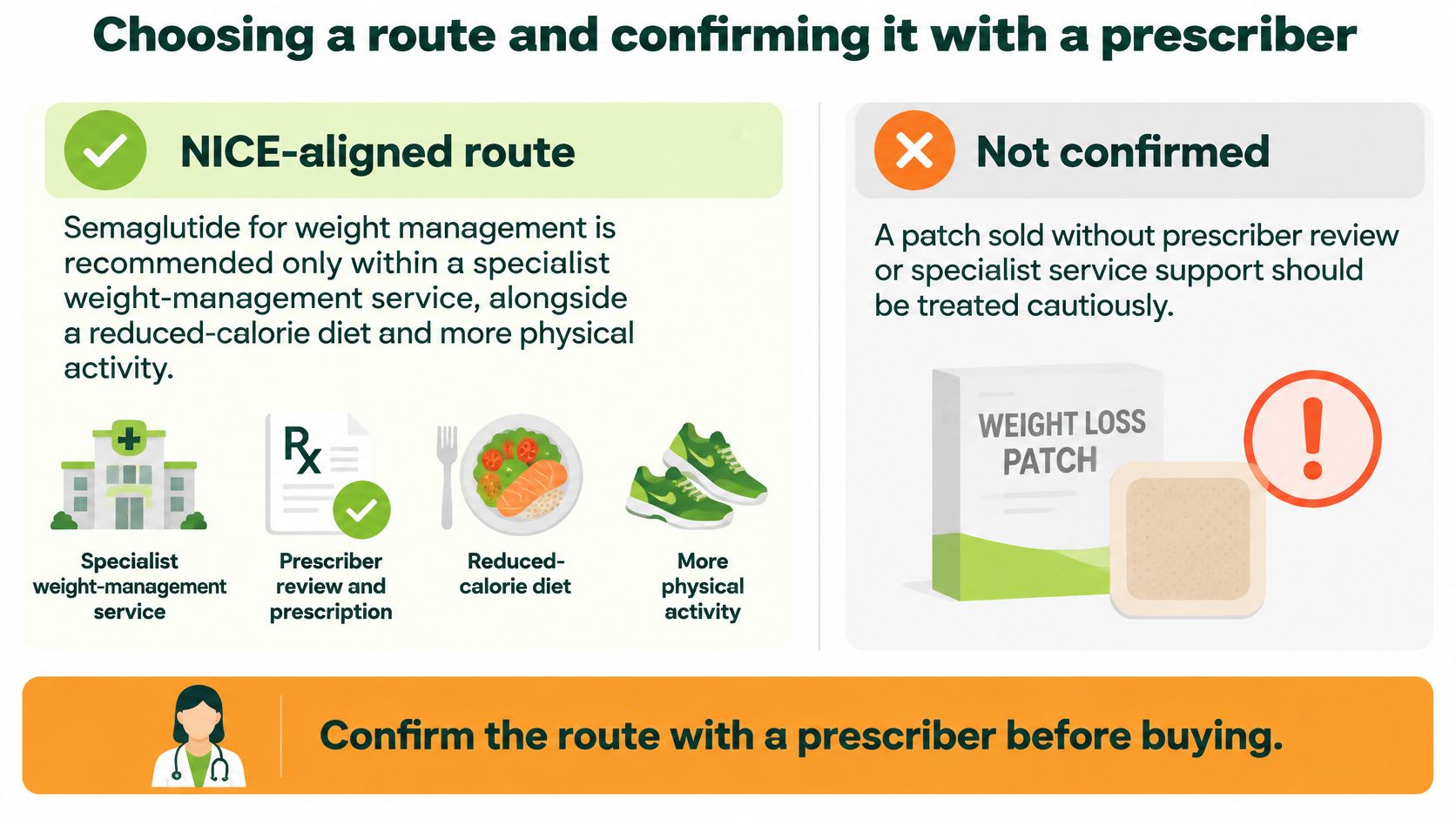
The practical question is which route a prescriber can defend from your history, your BMI and your risk factors. A patch has no MHRA weight-loss licence, so it cannot be the starting point. A licensed medicine can be, if you qualify.
Three routes, not one shortcut
Licensed injection or tablet. A prescriber reviews you and monitors you. Courier Pharmacy offers popular GLP-1 weight-loss medicines such as Wegovy and Mounjaro, and online consultations. The pharmacy is accredited by the General Pharmaceutical Council (GPhC). The medicine still needs a clinical decision, a dose plan and a review date.
Lifestyle change alone. No medicine licence is needed. This route suits people below the thresholds, and it stays in place even if a medicine is added later.
Coaching. It can add structure and accountability. It is not a medicine, and it does not replace a clinical assessment.
Match your situation
If you meet NHS or licence criteria, ask for a prescriber review. If you sit below the thresholds, build a plan with a GP or a dietitian. If you dislike injections, ask whether a licensed oral option suits your diagnosis. Rybelsus is a diabetes tablet, not a patch, so it only enters the conversation if the clinical picture fits. A prescriber makes that call.
Steps to confirm the route
- Book the GP, or ask which specialist referral criteria apply to you.
- Gather BMI, weight history, conditions, and a full medicine list. Include supplements.
- Ask whether a licensed medicine suits you, and what monitoring it needs.
- If you use a private online service, check GPhC registration and confirm a clinician reviews each request.
- Ask what happens if loss stays under 5% after 6 months. Agree the review date now.
- Log side effects and report concerns through the MHRA Yellow Card scheme.
Call 999 or go to A&E for severe abdominal pain, especially with vomiting. Use NHS 111 if you are unsure and not in that emergency.
What the route does not change
No UK GLP-1 patch has an MHRA weight-loss licence or a matching trial. Wegovy and Mounjaro do, inside strict rules. Lifestyle support remains the base. Check labels, sellers, and evidence. Get urgent help for severe abdominal pain. See a clinician before you buy anything that claims to replace a prescription. For some readers the best patch will be no patch at all, because the licensed route is the only one with a regulatory paper trail.
FAQs
Are best GLP-1 patches licensed in the UK? No. Marketed patches are not MHRA-authorised for weight loss. Licensed options are specific injections and, for diabetes, the tablet Rybelsus.
Do patches contain semaglutide or tirzepatide? You should not assume they do. A label that only says "GLP-1 support" is not a licensed medicine.
Can I use a patch if I hate needles? Tell a prescriber. They can discuss licensed options that fit you. A sticker is not an automatic substitute.
When should I get urgent help? Call 999 or go to A&E for persistent severe abdominal pain, especially with vomiting. Use NHS 111 if you are unsure and not in that emergency.
What should I ask about monitoring? Ask who reviews your dose, when the review happens, and what the plan is if weight loss stays under 5% at six months.
Courier Pharmacy offers online consultations for licensed GLP-1 weight-loss medicines such as Wegovy and Mounjaro, reviewed by a prescriber rather than sold as an unlicensed patch. If you want that route checked against your own health, visit Courier Pharmacy and start a consultation.


