Blister Pack of Tablets: What It Is, Types and Safe Use
Learn what a blister pack of tablets is, the types pharmacies use, how to take and store doses safely, and how to recycle empty packs in the UK.
A blister pack of tablets is a sheet of plastic and foil with one sealed pocket per dose, and UK guidance uses the same name for two different formats. You might be holding a strip from a new prescription, or helping a relative with a tray marked by day and time.
The difference matters. The pack helps protect the medicine and keeps key details close to each dose. But a pack that looks well organised may still be hard to open or unsuitable for certain tablets. This guide explains the types, safe handling, storage and UK disposal routes, so you can ask your pharmacy the right questions.
Five key takeaways
- Check the format: A factory-sealed strip differs from a pharmacy-filled medicine tray.
- Keep the protection: Leave tablets in their original pockets until needed.
- Ask about access: Painful hands or poor sight deserve a packaging review.
- Follow the label: Storage and opening instructions depend on the medicine.
- Sort the waste: Cardboard, empty strips and unused tablets need different routes.
What a blister pack of tablets is and its types
A tablet in a factory-sealed strip stays in its own pocket until you press or peel it out. The pocket is shaped plastic sealed with foil, much like a small compartment with a lid. The pack is designed for a particular medicine, so follow its opening instructions.
Blister pack types, how they are made and when they are used
| Pack type | How it is made | Typical use | Main caveat |
|---|---|---|---|
| Manufacturer blister strip | The manufacturer seals medicine between formed plastic and foil | One medicine on repeat prescription | Keep it in the original pack and carton until use |
| Pharmacy-filled compliance aid (MCA) | The pharmacy sorts medicines by day and dosing time | Several medicines taken at set times | Requires an individual assessment and is not automatically safer |
In UK use, blister pack can mean either format. A multi-compartment compliance aid, or MCA, may also be called a monitored dosage system, Dosette box or tray. Its compartments group doses by times such as breakfast, lunch, dinner and bedtime. The NHS medication compliance support resource [1] explains the difference and why an individual assessment is needed.
What the original strip does
The manufacturer chooses and seals packaging for the medicine. Details printed on the foil, including the medicine name and strength, help identify what is inside.
Each sealed pocket also helps protect the medicine. Removing a tablet before it is needed changes the conditions around it, so leave it in its pocket until use.
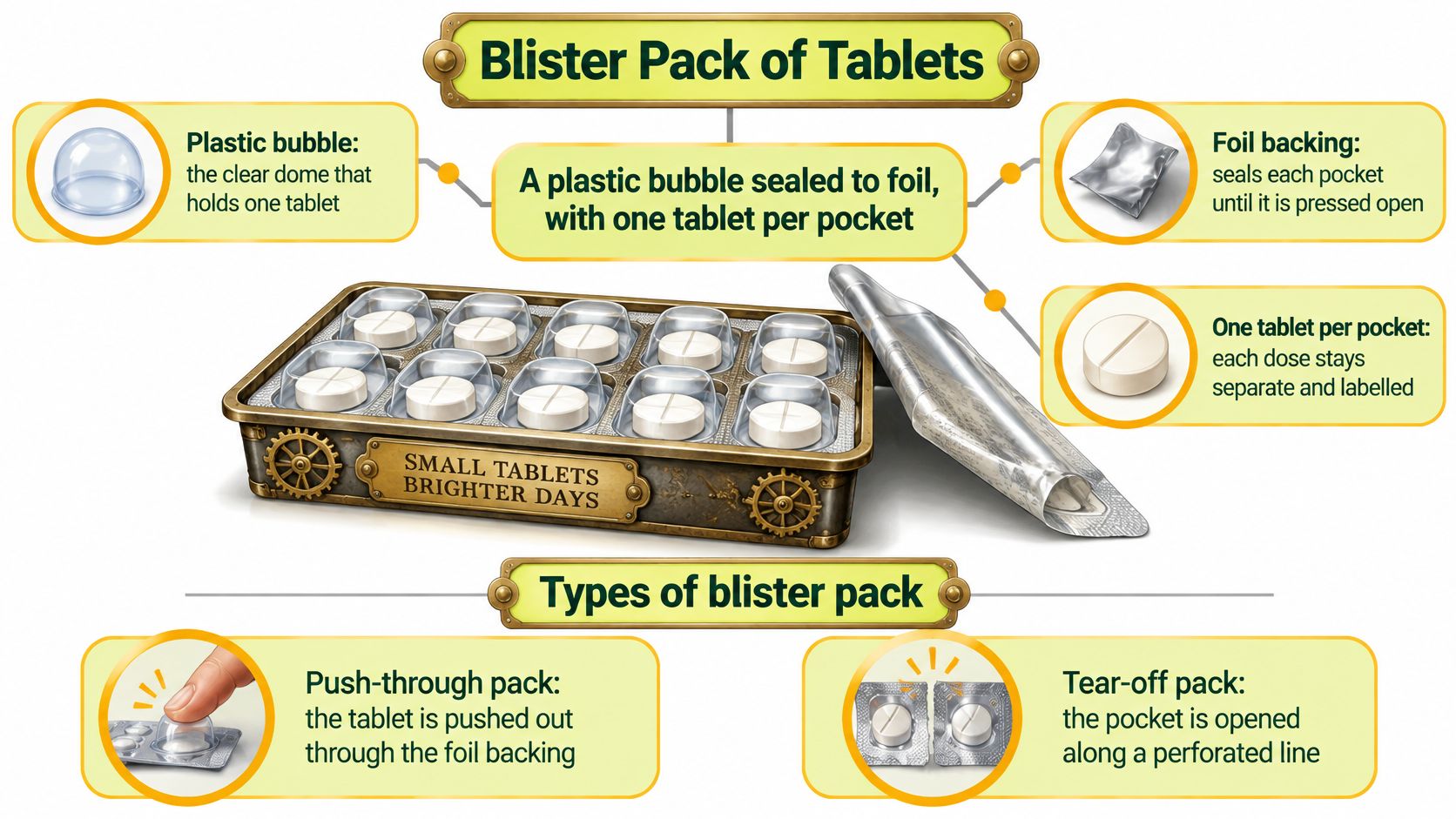
The illustration shows the basic parts and common opening styles. Packs can differ, so follow the instructions on your own strip.
What a pharmacy-filled tray does
A pharmacy-filled tray groups suitable medicines by the times they are due. It may help someone who finds separate packs difficult to manage, but it does not replace every original strip.
An MCA isn't automatically safer. NHS Dorset reports limited evidence that these aids improve adherence, meaning taking medicines as prescribed. Its guidance on managing compliance aids [2] favours original manufacturer packs with suitable support when there is no specific need for an aid.
A pharmacist should assess the person's needs before selecting another format. The review can consider:
- Hand movement: Can the person hold the pack and release a dose?
- Sight and understanding: Can they read the label and follow the schedule?
- Medicine suitability: Can each medicine safely be removed from its original container?
- Routine: Do fixed time slots fit the person's day?
Practical rule: If someone says “your blister pack”, ask whether they mean the original strip or a pharmacy-filled tray.
Benefits and limits for adherence and safety
It's tempting to think an organised pack will fix missed doses. However, the useful question is whether the person can use that particular pack safely.
Blister packaging offers practical benefits:
- Identification: Printed details help you check the medicine and strength.
- Protection: An intact pocket limits exposure to air and moisture.
- Dose tracking: Empty pockets can help you see which doses you've removed.
That last point needs care. An empty pocket shows that someone removed a tablet, not that they swallowed it.
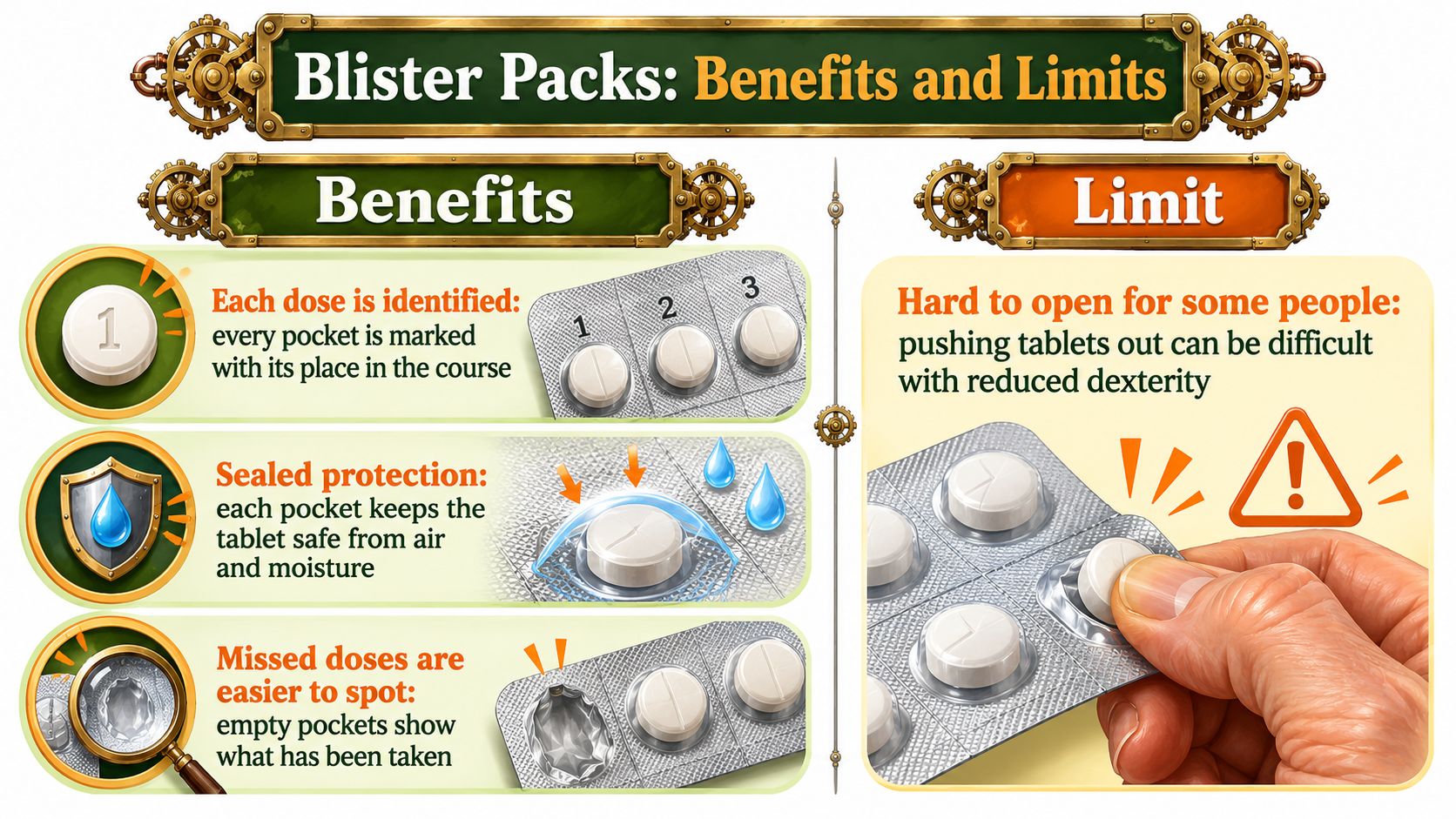
The benefits and limits are shown below. Day or course markings depend on the product, so don't assume every pocket has a date.
When the pack becomes the problem
The NHS Dorset guidance cited earlier describes difficulties for people with arthritis or poor eyesight. Tablets may also fall out of compliance aids or stick behind adhesive covers.
Transferring medicines introduces other concerns. The NHS Specialist Pharmacy Service guidance on compliance-aid stability [3] explains that manufacturers generally can't guarantee stability, safety or effectiveness after transfer. Such use may fall outside the medicine's licence.
Practical limits include:
- Opening problems: A person may understand the schedule but struggle with the packaging.
- Changes in treatment: An already prepared tray may be difficult to amend.
- Care transitions: Hospital admission or discharge can make medicine changes harder to track.
More packaging doesn't necessarily mean better adherence. The pack itself can become the barrier.
Other support may fit better
Ask the pharmacy about large-print labels, suitable easy-open containers, reminder charts or electronic prompts. An easy-open option still needs a safe storage plan, especially where children may gain access.
Pharmacist's tip: Bring the actual pack to an accessibility review. Showing where you struggle is often clearer than saying the tablets are “difficult”.
Pharmacies must consider reasonable adjustments for long-term disabilities. A compliance aid is one possible adjustment, not the only answer.
Three UK scenarios
These are illustrative examples, not real patients or reported outcomes. They show how a packaging decision might work in everyday UK life.
Sam, a busy parent
Sam takes a daily tablet and a separate weekly medicine. Between school bags and breakfast, the main worry is mixing up the routines.
In this example, Sam keeps the manufacturer strips, sets separate phone reminders and stores each leaflet with its pack. The outcome is a clear plan without moving medicines into another container.
The lesson: A short routine may need better reminders rather than different packaging. Sam would still ask the pharmacist what to do after a missed dose, because the answer depends on the medicine.
Priya, a nurse working rotating nights
Priya's waking hours change with her shifts. A tray labelled breakfast, lunch and bedtime sounds helpful, but those words don't always match her working day.
She asks the pharmacist to review the prescribed timing before choosing a tray. The pharmacist explains that Priya shouldn't change dose intervals herself, and that a prepared pack may be hard to alter at short notice.
The outcome: Priya leaves with a timing question to resolve before repacking. The lesson: Match the schedule to the prescription, not just to the names on the compartments.
For online treatment, reading how ordering treatment and clinical contact work can help you understand the service process. Raise packaging and timing questions directly rather than assuming a call will happen.
Margaret, an older adult with arthritis
Margaret can follow her prescription, but pressing tablets through foil hurts her hands. She worries that asking for help means she can no longer manage her medicines.
In this example, the pharmacy offers an accessibility review. It explores an easy-open approach, a reminder chart and large-print labels if useful, while checking medicine suitability.
The outcome: Margaret has options to discuss rather than an automatic tray replacement. The lesson: Difficulty opening a pack is a valid reason to ask for support.
How to take a tablet from a blister pack safely
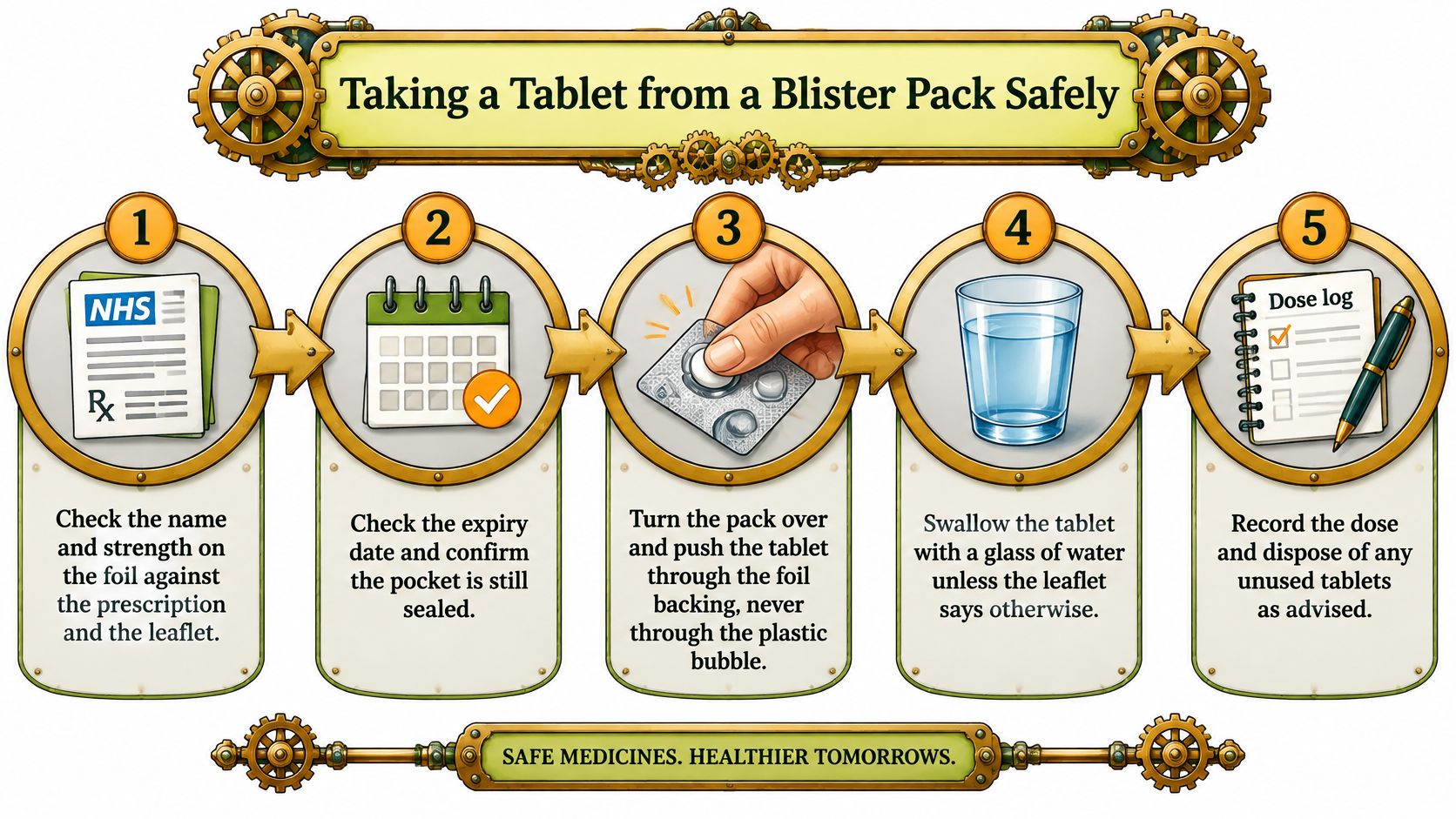
The right way to open a blister depends on its design. Check the pack and leaflet first, because the packaging protects the tablet and helps identify it. A push-through method is suitable only for packs made for it.
- Check the name and strength against the dispensing label and leaflet. Tablet colour or shape alone cannot confirm what it is.
- Check the expiry date and seal. A damaged pocket may no longer protect the tablet.
- Use the stated opening method. For a push-through pack, press the tablet through the foil backing, not the plastic.
- Keep the strip intact. Cutting, folding or squeezing it can damage the packaging and its protection.
- Follow the swallowing instructions. Use a full glass of water unless the leaflet or your clinician advises otherwise.
- Record the dose after taking it, with a chart or phone reminder if that helps.
- Keep the leaflet with the pack so you can check warnings and what to do about a missed dose.
NHS guidance describes risks linked to damaged packaging and unsuitable repacking in its medicines compliance and dispensing policy.
Pharmacist's tip: Check the name and strength printed on the foil before removing a tablet. Once it is loose, its appearance may not be enough to identify it.
The MHRA's blister-labelling guidance says these details should appear over each pocket where practicable, or repeat centrally across the pack. A separated pocket may still be difficult to identify.
Missed doses and opening difficulties
If you miss a dose, check the leaflet or ask a pharmacist before taking another. Taking doses together to catch up may be unsafe unless your medicine's instructions specifically allow it.
A Pillmate pill cutter is designed for cutting suitable tablets, not opening blister strips. Ask a pharmacist before cutting a tablet, because some medicines should not be split.
The video below demonstrates the process.
If a tablet or foil gets stuck in the throat, or breathing or swallowing becomes difficult, call 999 straight away.
How to store blister packs at home
A strip left on a sunny windowsill or in a damp bathroom may be exposed to conditions that affect the tablets. Keep medicine in its original blister pack and carton, and follow the storage instructions on the label or leaflet. A temperature limit below 25°C applies to some medicines, not all.
Heat, moisture, light and air can affect medicine quality. The pack is part of the medicine's protection system: intact pockets help shield tablets until each dose is due, while the carton may provide further protection and keep the medicine's name and instructions together. More packaging, such as moving tablets into another container, does not automatically offer better protection.
Where and how to store blister packs at home
| Situation | Where to keep it | Why it matters |
|---|---|---|
| Standard tablets | In the original box, in a dry place, and below 25°C if the label says so | Heat and moisture can affect stability |
| Moisture-sensitive tablets | Leave tablets in intact pockets until each dose is due | Removing them early may weaken the protective barrier |
| Opened strip with an in-use limit | Follow the specific label or leaflet | Opening may start a limited period for use |
| Medicine that requires refrigeration | Follow the labelled temperature range, including 2–8°C where stated | The medicine needs the stated storage conditions |
| Bathroom, car or sunny windowsill | Choose another place | Damp, heat or direct light may breach storage conditions |
| Compliance aid trays | Store and use them as the pharmacy advises | Transferred tablets may not retain the stability tested in their original packs |
Check the instructions for your medicine
Storage and in-use limits differ between medicines and sometimes between products. Read the label or leaflet for the specific pack, including any instructions that apply after opening. Do not assume that a limit for one medicine applies to another.
Pharmacist's tip: Ask a pharmacist whether opening the strip starts an in-use limit. Check before moving tablets into a pill organiser, because removing them from their original pockets may affect their protection.
If a delivery arrives damaged, or you think it may have become too hot or damp, contact the dispensing pharmacy before using it. The pharmacy can advise whether the medicine is still suitable.
How to recycle and dispose of empty packs
Sort the medicine pack into its separate parts before disposal. The cardboard carton, plastic-and-foil strip and remaining tablets don't all follow the same route.
The NHS Specialist Pharmacy Service guide to pharmaceutical waste [7] distinguishes packaging waste from medicine waste and recommends checking appropriate local routes.
Where each part of a medicine pack should go
| Item | Where it goes | What to avoid |
|---|---|---|
| Outer cardboard carton | Paper or card recycling, subject to local rules | Mixing it with unused medicine |
| Patient information leaflet | Paper recycling once no longer needed; remove personal details | Discarding it while you still use the medicine |
| Empty blister strip | Local pharmaceutical waste route or approved blister collection point | Household recycling bin |
| Unused or unwanted tablets | Return to a pharmacy | Flushing, bins or drains |
| Empty compliance aid tray | Ask the pharmacy that filled it | Assuming household recycling accepts it |
Check the collection point first
Household kerbside recycling generally doesn't accept medicine blister strips. A container that looks similar to other recyclable packaging may still need a specialist route.
UK collection options have expanded, including retailer schemes. However, availability depends on location, and an individual pharmacy may not collect empty strips.
Before travelling:
- Check acceptance: Confirm that the collection point takes medicine blister packs.
- Check contents: Keep unwanted tablets separate from empty packaging.
- Protect privacy: Remove or cover personal details on cartons before recycling.
- Ask about trays: Pharmacy-filled aids may need different disposal advice.
Empty packaging isn't the same as unwanted medicine. Keep the two separate when asking where they should go.
Don't put tablets down the toilet or sink. If you're unsure whether a pack is completely empty, ask the pharmacy how to handle it.
Confirm your pack suits you before the next repeat
At your next repeat or collection, tell the pharmacy if the pack is difficult to open, the label is hard to read, or your dose times have changed. Ask them to check that the packaging still suits your medicine and your needs before preparing the next supply. The original blister strip may be the safer option when a tray could make medicine identification or storage less suitable.
Check these points with the pharmacy:
- Identity: Confirm the medicine name and strength.
- Leaflet: Make sure you have the current patient information leaflet.
- Storage: Check the stated storage conditions and any limit on how long the medicine can be kept after opening.
- Access: Explain if you cannot open the pack or read its labels.
- Timing: Ask how a prescription change would affect a tray already prepared.
The leaflet helps you check how to use the medicine, its warnings and possible side effects. UK medicine packs must include one unless the packaging itself provides all necessary information. The leaflet is based on approved product information, as explained in government guidance on medicine packaging and leaflets [8]. Keep it while you take the medicine so you can refer to it again.
Ask for an accessibility review if the packaging or label is hard to manage. If you order through an online pharmacy in the UK, ask the dispensing team how your medicines will arrive and whether the format suits your needs.
Speak to your GP or pharmacy if a tablet looks different, you have an unexpected side effect, or you miss a dose. Ask for medicine-specific advice rather than taking an extra tablet if you are unsure. For urgent advice, contact NHS 111. Call 999 for a life-threatening emergency.
Summary
Packaging helps protect and identify your medicine, and the most helpful format depends on the medicine as well as your needs. A standard blister strip may be a safer fit than a pharmacy-filled tray. Tell the pharmacy about opening or reading difficulties before the next repeat. Follow the label for storage and missed-dose advice, and keep medicine waste separate from recyclable cardboard.
Frequently asked questions
What is a blister pack of tablets?
It is packaging with separate sealed pockets for tablets or capsules. In the UK, people may also use the term for a pharmacy-filled tray that sorts doses by day and time, so ask which type is meant.
Is a blister pack the same as a Dosette box?
Not necessarily. Those names are sometimes used for a compliance aid, while a manufacturer blister strip is a different type of packaging. The pharmacy can confirm which one you have.
Can I ask my pharmacy for a compliance aid?
Yes. Ask the pharmacist for an assessment. They should consider your medicines, routine and access needs before deciding whether a tray or another adjustment could help. A tray is not automatically the safest choice for everyone or every medicine.
Can I remove all the tablets in advance?
Do not do this without advice from your pharmacy. Some medicines need the protection of their original packaging, and removing them can also make them harder to identify.
What if the foil is damaged?
Check with the pharmacy before using the affected dose. A broken seal may mean that the pocket no longer protects the medicine as intended.
Can an empty pocket prove I've taken my tablet?
No. It shows the tablet is no longer in the pocket, but cannot confirm that you swallowed it. If you are unsure whether you took a dose, seek advice specific to your medicine before taking more.
Can empty blister packs go in household recycling?
Generally, no. Check with your council, pharmacy or a participating retailer for an approved collection route.
Should I throw away the leaflet after reading it?
Keep it while you are using the medicine. You may need to check its advice about side effects, storage or a missed dose.
Disclaimer
This information is for understanding and does not replace advice from your pharmacist or GP, or the leaflet supplied with your medicine.
References
The numbered references correspond to the clickable citations above.
- NHS Knowledge Now (n.d.) Medication compliance support resource pack.
- NHS Dorset (2025) Managing compliance aids in NHS Dorset.
- NHS Specialist Pharmacy Service (n.d.) Using the medicines compliance aid stability tool.
- Black Country ICB (n.d.) 7-day and MDS prescribing policy, version 6.1.
- Medicines and Healthcare products Regulatory Agency (n.d.) Best practice guidance on labelling medicines.
- Medicines and Healthcare products Regulatory Agency (n.d.) Nicorandil product assessment documentation.
- NHS Specialist Pharmacy Service (n.d.) Identifying types of pharmaceutical waste and disposal containers.
- Medicines and Healthcare products Regulatory Agency (n.d.) Medicines packaging, labelling and patient information leaflets.
Courier Pharmacy offers online access to prescription and over-the-counter medicines, with a team you can contact about your supply. Before your next order, visit Courier Pharmacy and ask about packaging, storage or any difficulty opening your tablets.


