Blue Inhaler vs Brown Inhaler: A UK Patient Guide
Struggling to understand your blue inhaler and brown inhaler? Our guide clarifies their roles, how to use them, and why correct use is key for asthma control.
In this article
- What is the difference between a blue inhaler and a brown inhaler?
- The blue inhaler (your reliever)
- A real-life example of using a reliever inhaler
- The brown inhaler (your preventer)
- A real-life example of using a preventer inhaler
- Perfecting your inhaler technique
- The power of a spacer device
- How to use an inhaler with a spacer
- How to recognise an asthma emergency
- When to call 999 immediately
- Summary
- Frequently Asked Questions
- Is it safe to use my blue inhaler every day?
- What should I do if I forget to take my brown inhaler?
- Can I buy a blue or brown inhaler over the counter in the UK?
- Why would my doctor change my inhaler?
- Can I use an inhaler that has expired?
- How often should I have an asthma review?
A blue inhaler is a 'reliever' for fast symptom relief, while a brown inhaler is a 'preventer' for long-term asthma control. Think of them as a firefighter and a fireproofer for your airways. Understanding the difference between a blue inhaler and a brown inhaler is the most important step towards managing your asthma well. It helps you breathe easier and live life with fewer interruptions.
If you have asthma, your doctor has likely prescribed one or both of these inhalers. This guide will break down what each inhaler does and when you should use it. You will learn why both are vital for a complete asthma plan. We will also cover how to use them correctly and when to seek urgent help.
Here are five key takeaways:
- Blue is for rescue: Use your blue inhaler when you feel asthma symptoms like wheezing, coughing, or breathlessness.
- Brown is for routine: Take your brown inhaler every day as prescribed, even when you feel completely fine.
- Different jobs, different actions: Relievers work fast to open your airways. Preventers work over time to calm airway inflammation.
- Don't overuse your blue inhaler: Using your blue inhaler more than twice a week is a sign your asthma may not be well controlled.
- Technique is everything: Correctly using your inhalers ensures the medicine reaches your lungs where it is needed most.
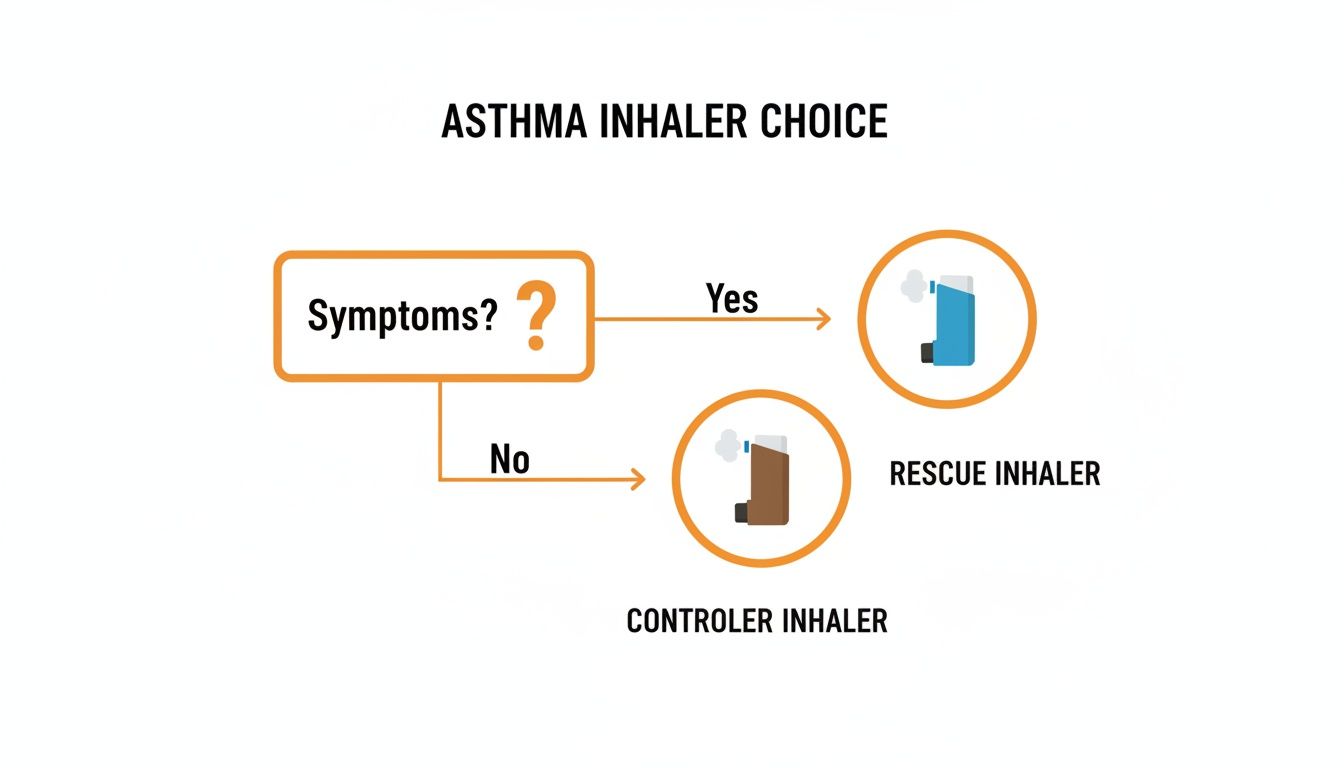
This simple chart shows when to use each inhaler. Active symptoms signal a need for your blue 'rescue' inhaler. In contrast, the brown 'preventer' inhaler manages your asthma daily when you have no symptoms.
What is the difference between a blue inhaler and a brown inhaler?
The main difference between a blue and brown inhaler is their job. A blue inhaler provides fast relief from asthma symptoms, while a brown inhaler prevents symptoms from starting in the first place.
This table gives a quick summary of their different roles.
| Feature | Blue Inhaler (Reliever) | Brown Inhaler (Preventer) |
|---|---|---|
| Main Purpose | Provides fast relief from asthma symptoms. | Prevents asthma symptoms from starting. |
| When to Use | During an asthma attack or before exercise. | Every day, usually twice a day. |
| How It Works | Relaxes airway muscles to open them up. | Reduces swelling and inflammation in the airways. |
| Speed of Action | Works within minutes. | Takes days or weeks to build up effect. |
This comparison highlights the key difference: one is for emergencies, and the other is for daily maintenance. In the UK, many people rely too heavily on their blue reliever inhaler. A survey by Asthma + Lung UK found that 76% of people use their reliever more than twice a week [1].
This over-reliance suggests their underlying inflammation is not being managed properly with a preventer inhaler. It is a key sign that your asthma control could be improved. You can learn more about asthma in our detailed guide.
The blue inhaler (your reliever)

Think of your blue inhaler as your personal emergency service. Its official name is a 'reliever' or a short-acting beta-agonist (SABA). Its job is to help you breathe easier, fast. When you feel a wheeze, chest tightness, or breathlessness, this is the inhaler you reach for.
The active ingredient in most UK blue inhalers is Salbutamol. This medicine works by quickly relaxing the muscles around your airways. This widens them and lets air flow more freely. You should feel the effects within a few minutes.
Because it works so quickly, the blue inhaler is perfect for tackling sudden asthma symptoms. You use it to get back in control during a flare-up. For a deeper dive, you can read our guide on Ventolin inhalers, a common brand of Salbutamol.
A real-life example of using a reliever inhaler
Let's look at a practical example.
Meet Alex, the gym-goer: Alex loves his weekly spin class but knows intense cardio can trigger his asthma. To prevent this, he takes two puffs of his blue Salbutamol inhaler about 15 minutes before his workout. This simple step keeps his airways open. It allows him to exercise without getting breathless or wheezy.
This shows how you can use a reliever not just to treat symptoms but to prevent them when you know a trigger is coming. However, this preventive use should be occasional. If you need it before every workout, you should chat with your GP or asthma nurse.
The blue inhaler’s job is to provide on-the-spot relief. It doesn't treat the underlying inflammation that causes asthma. That’s the job of your brown inhaler.
Pharmacist's tip: If you reach for your blue reliever inhaler more than three times a week, it's a major red flag. This suggests your asthma isn't well-controlled. Your airways are likely more inflamed than they should be. It is time to book a review with your doctor to discuss your treatment; you may need to start or adjust a preventer inhaler.
The brown inhaler (your preventer)

While your blue inhaler is for fast relief, the brown inhaler plays a different role. It is your long-term protector, working behind the scenes to keep your asthma under control. We call this a ‘preventer,’ and it’s the most important part of managing your condition daily.
The medicine inside is usually an inhaled corticosteroid (ICS). A common example is Beclometasone, found in brands like Clenil. This is not the kind of steroid used in sports. It is a therapeutic medicine that gently calms the swelling in your airways.
You won’t feel an immediate effect like with the blue inhaler. The brown inhaler works by building up a protective effect over days and weeks. That’s why you must take it every day, usually twice a day, without fail. Consistency is everything.
A real-life example of using a preventer inhaler
It’s easy to think you can skip your brown inhaler when you feel fine. But that’s when the inflammation can quietly return. This leaves you much more vulnerable to a sudden asthma attack.
Meet Sarah, a busy parent: Sarah, a mum with two young children, often forgot her brown inhaler during the chaotic morning routine. She soon realised she was reaching for her blue inhaler more often. Her simple fix? She now keeps her brown inhaler right next to her toothbrush. This small change helps her take her two puffs every morning and evening. Her asthma stays stable, and she can enjoy family time without worry.
Simply taking your brown inhaler isn’t enough. Using the correct technique is vital. A recent report showed that only 32.2% of patients in the UK receive the full basic care package, which includes an inhaler technique check [2].
A common worry with brown inhalers is the risk of a sore mouth or oral thrush. The good news is this is usually easy to prevent. You can learn more in our guide to managing asthma medication side effects.
Pharmacist's tip: After using your brown inhaler, always rinse your mouth with water, gargle, and spit it out. This simple step washes away any medicine left in your mouth and throat. It dramatically lowers your risk of oral thrush. If you use a spacer with a mask, also wash your face where the mask touched your skin.
Perfecting your inhaler technique
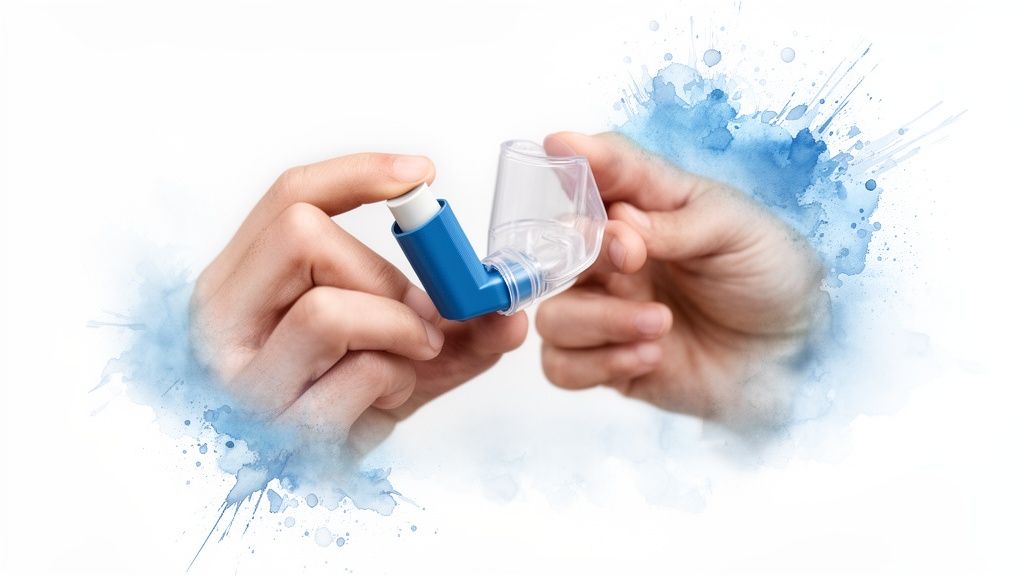
Having the right inhaler is only half the battle. If the medicine doesn’t reach deep into your lungs, it cannot work. Whether you use a blue inhaler, a brown inhaler, or both, mastering your technique is essential.
Most people use a metered-dose inhaler (MDI), but they can be tricky. You have to press the canister and breathe in at the same time. Many people get this wrong. This means a lot of the medicine ends up in your mouth instead of your airways.
The power of a spacer device
A spacer is a simple but very effective tool that solves this coordination problem. It is a hollow plastic chamber that attaches to your inhaler. When you press the inhaler, the medicine fills the chamber. You can then just breathe it in slowly and deeply.
What is a spacer for an inhaler? A spacer is a device that attaches to your inhaler to make it easier to use. It holds the medicine in a chamber so you can breathe it in slowly, helping more of it reach your lungs.
Using a spacer can increase the amount of medicine reaching your lungs by up to 75% [3]. This means you get the full benefit of your dose. It also cuts down on side effects like a sore throat or oral thrush, which can be an issue with brown (steroid) inhalers. We recommend spacers for most people, especially children and anyone who finds the "press and breathe" timing difficult. You can find more details about a common device, the AeroChamber Plus spacer for adults, on our product page.
How to use an inhaler with a spacer
Follow these simple steps to get the full dose every time:
- Prepare: First, remove the cap from your inhaler and shake it well for five seconds.
- Assemble: Fit the inhaler's mouthpiece into the back of the spacer.
- Breathe Out: Stand or sit up straight and gently breathe out to empty your lungs.
- Seal and Press: Put the spacer’s mouthpiece in your mouth and make a tight seal with your lips. Press the inhaler canister once.
- Breathe In: Immediately, breathe in slowly and deeply through your mouth. Hold your breath for up to 10 seconds.
- Exhale: Finally, breathe out slowly away from the spacer.
If you need more than one puff, wait about 30 seconds. Then shake the inhaler again and repeat the steps.
Pharmacist's tip: Don't forget to clean your gear! Wash your inhaler mouthpiece and spacer at least once a week. Take the spacer apart and wash it in warm, soapy water, then let it air dry. Wiping it with a cloth can create static, which makes the medicine stick to the sides. A clean device works better.
How to recognise an asthma emergency
Knowing how to use your blue and brown inhalers is key for daily asthma management. But it is just as vital to know when a flare-up becomes an emergency. An asthma attack can become life-threatening very quickly. Recognising the danger signs could save a life.
In the UK, over half of all asthma-related deaths could be prevented with better self-management [4]. A huge part of this is knowing when to call for help. If you or someone you're with is having an asthma attack, you must act fast.
When to call 999 immediately
An asthma attack is an emergency if you spot any of these red flags. These signs mean the attack is severe and needs urgent medical help.
Call 999 for an ambulance if:
- You are so breathless you can’t speak a full sentence, eat, or sleep.
- Your breathing is getting faster and you can’t catch your breath.
- Your blue reliever inhaler is not helping or its effects are wearing off quickly.
- Your lips or fingernails are turning blue or grey.
- You feel confused, drowsy, or like you might faint.
These are signs your body is not getting enough oxygen. While waiting for the ambulance, sit upright and try to take slow, steady breaths. Keep taking one puff of your blue reliever inhaler every 30 to 60 seconds, up to a maximum of 10 puffs.
Pharmacist's tip: Never be afraid to call 999 if you feel your asthma is getting dangerously out of control. It is always better to be safe. Your written asthma action plan, created with your GP or asthma nurse, will have specific instructions for emergencies. Keep it where you and your family can find it easily.
Summary
The blue inhaler and brown inhaler work as a team to control your asthma. The blue reliever inhaler offers quick, on-the-spot relief from symptoms like wheezing and breathlessness. You use it only when you need it. In contrast, the brown preventer inhaler works quietly in the background. You must use it every single day to calm the underlying inflammation in your airways, stopping symptoms before they start.
Relying on your blue inhaler more than twice a week is a clear sign your asthma is not well controlled. This means you need a review with your doctor or nurse. Mastering your inhaler technique, often with a spacer, is also crucial to ensure the medicine works effectively. Finally, always know the signs of an asthma emergency and never hesitate to call 999.
Frequently Asked Questions
Is it safe to use my blue inhaler every day?
Using your blue inhaler daily is a sign your asthma isn't well controlled. While occasional use isn't harmful, daily reliance means your airways are likely inflamed. This puts you at a greater risk of a serious asthma attack. If you use your blue inhaler more than twice a week, book a review with your doctor. They may need to start or adjust your brown preventer inhaler.
What should I do if I forget to take my brown inhaler?
If you miss a dose of your brown inhaler, take it as soon as you remember. However, if it's nearly time for your next dose, just skip the missed one. Never take a double dose to make up for a forgotten one. Forgetting once is okay, but regular missed doses reduce its protective effect. Try linking it to a daily habit, like brushing your teeth.
Can I buy a blue or brown inhaler over the counter in the UK?
No, you cannot buy a blue or brown inhaler over the counter in the UK. Both are Prescription-Only Medicines (POM). This means you need a valid prescription from a UK-qualified prescriber, like a GP or pharmacist. This rule ensures a healthcare professional has assessed your asthma and confirmed the treatment is right for you.
Why would my doctor change my inhaler?
Your doctor might change your inhaler for several reasons. You might be using your blue reliever too often, meaning your current preventer isn't working well enough. You could be having side effects, or a different device might be easier for you to use. Sometimes, switching to a combination inhaler that contains both a preventer and a long-acting reliever can simplify your routine and improve control.
Can I use an inhaler that has expired?
You should never use an expired inhaler. The medicine can become less effective. This means it might not relieve your symptoms during an attack or prevent inflammation properly. Always check the expiry date on the box and the canister itself. Order a new prescription before your current one runs out.
How often should I have an asthma review?
Anyone with asthma in the UK should have a full review with their GP or asthma nurse at least once a year. This is a chance to discuss your symptoms, check your medication, and update your personal asthma action plan. If your symptoms worsen or you use your blue inhaler more often, book a review sooner.
Disclaimer: This article is for informational purposes only and does not constitute medical advice. Always consult with a healthcare professional for diagnosis and treatment of medical conditions.
About This Content
Author: F. Z. Ali, MPharm Pharmacist Independent Prescriber
Clinically Reviewed By: Dr. S. R. Johnson, MBChB, MRCGP General Practitioner
How This Content Was Created: This article was written by a qualified pharmacist and reviewed by a practising UK GP. All information is based on current UK clinical guidelines and evidence from reputable sources, including the NHS, NICE, and Asthma + Lung UK. Our goal is to provide clear, accurate, and practical health information for patients and their families.
References:
[1] Asthma + Lung UK. 2024. Over-reliance on reliever inhalers. [Online]. Available at: https://www.asthmaandlung.org.uk/news-and-campaigns/campaigns/campaigns-and-policy-wins/over-reliance-reliever-inhalers [Accessed 25 October 2024]. [2] Asthma + Lung UK. 2022. Life with a lung condition in 2026: The fight for breath in a changing world. [Online]. Available at: https://www.asthmaandlung.org.uk/blog/research/life-lung-condition-2026 [Accessed 25 October 2024]. [3] National Institute for Health and Care Excellence (NICE). 2021. Spacers for inhaled corticosteroids in asthma. [Online]. Available at: https://www.nice.org.uk/advice/es10/chapter/Key-points-from-the-evidence [Accessed 25 October 2024]. [4] Royal College of Physicians. 2014. Why asthma still kills: The National Review of Asthma Deaths (NRAD). [Online]. Available at: https://www.rcplondon.ac.uk/projects/outputs/why-asthma-still-kills [Accessed 25 October 2024].
At Courier Pharmacy, we make managing your asthma simpler. From online consultations to the discreet delivery of your blue and brown inhalers, our GPhC-regulated service is built for your convenience and safety. Get started with your confidential asthma consultation today.


