Can Lack of Sleep Cause Hair Loss What Science Says
Can lack of sleep cause hair loss? Explore UK evidence, stress and hormone links, types of hair loss and practical steps to protect sleep and hair health.
Can lack of sleep cause hair loss? Not as a primary NHS-recognised cause, but chronic poor sleep may contribute indirectly through stress signalling and inflammation, especially to temporary shedding called telogen effluvium. A UK report found that people sleeping less than 6 hours were 30% more likely to report hair-thinning problems, although this doesn't prove that sleep loss directly causes alopecia. 2
Could your late nights be affecting your hair, or are you blaming sleep for a problem caused by something else? Hair shedding can follow stress, illness, weight loss, iron deficiency, thyroid disease, medicines or inherited pattern loss. Sleep may act as an indirect amplifier, rather than a single root cause.
This guide explains what UK evidence shows, how poor sleep might affect the hair-growth cycle, why timing can matter, and how to recognise different hair-loss patterns. You'll also find practical sleep advice, pharmacist safety tips, realistic examples and clear guidance on when to seek help.
Featured answer: Lack of sleep may contribute to temporary hair shedding, but the NHS doesn't list it as a direct primary cause of hair loss. Persistent or patchy loss needs proper assessment.
Five key takeaways
- Sleep is a possible contributor, not a complete diagnosis.
- Telogen effluvium can appear around 2–4 months after a trigger.
- Six hours or less has been linked with more hair-thinning concerns, but not proven as a direct cause.
- Late or irregular sleep may matter as well as total sleep time.
- Ongoing, sudden or patchy loss deserves advice from a GP, pharmacist or hair-loss clinician.
Introduction and Quick Answer
Could poor sleep be affecting your hair, or is it drawing attention away from another cause? The NHS lists stress, cancer treatment and weight loss among causes of hair loss, but not lack of sleep as a direct cause. 5 That distinction matters: sleep is better understood as an indirect amplifier than a primary explanation.
Hair follicles are like small plants in a busy garden. They need suitable conditions, but a run of poor sleep rarely changes the “soil” alone. Stress, nutrition, hormones, illness and genetics may also influence what happens.
The evidence is still uncertain because much of the research is observational. Researchers can see a relationship between sleep problems and hair loss, but may not know which came first or whether one caused the other. A 2026 systematic review found two-way associations between impaired sleep and common hair-loss types, while stressing that causality has not been fully established. 1
So, improving sleep is sensible, but it should not replace checking for other explanations. Persistent, sudden or patchy changes deserve professional advice, because the pattern and timing can point towards a treatable cause.
Practical rule: Improve sleep, but don't assume sleep explains every change in your hair.
What UK Evidence Says About Sleep and Hair Loss
The evidence supports a careful conclusion. Poor sleep and hair loss can occur together, but current research has not shown that sleep deprivation alone causes permanent baldness.
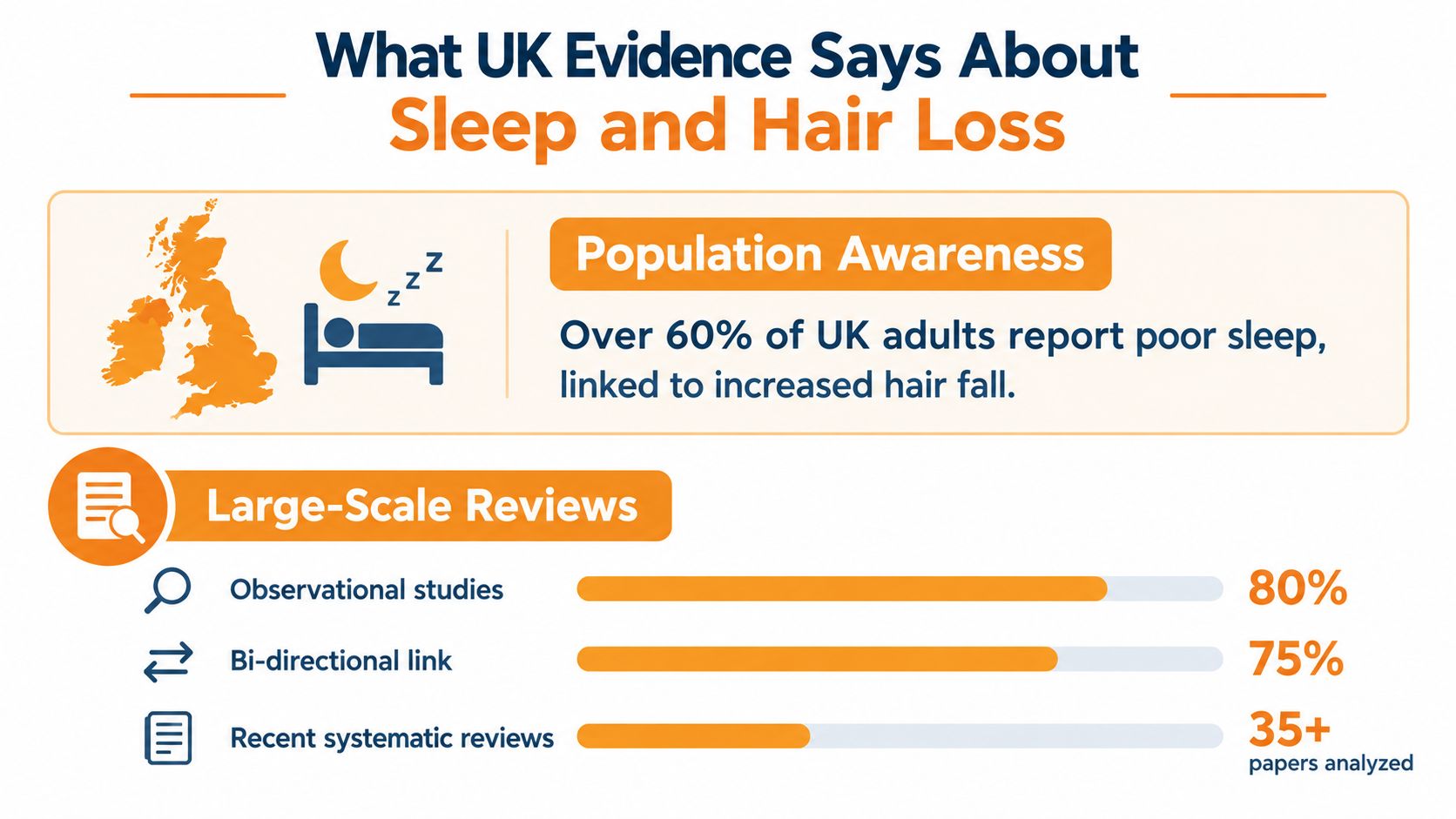
A 2026 systematic review found that most research on sleep and hair loss remains observational. Researchers can identify an association, but this design cannot reliably establish whether poor sleep came first, caused the change, or developed because hair loss was upsetting. The review described bidirectional associations, meaning each problem may affect the other. Its large study groups show that the question has been examined widely, not that sleep explains every case. 1
What the UK figures mean
A UK-focused report found that many people were unaware of a possible connection between sleep quality and hair health. It also reported more hair-thinning complaints among people sleeping for shorter periods. 2
That finding is a prompt to ask better questions, not a diagnostic test. Someone might sleep poorly because anxiety, scalp itching or visible hair loss is keeping them awake. In that situation, the hair problem may be disturbing sleep rather than sleep causing the hair problem.
Timing matters as much as total hours. A person may spend enough time in bed but have irregular shifts, repeated waking or a body clock that is out of step with daily demands. These patterns may affect recovery differently from a short-lived late night. A UK sleep conditions guide explains common sleep problems and treatment options, but improving sleep should sit alongside, not replace, assessment of the hair change.
The review also reported poorer sleep among people with more severe or persistent alopecia areata, and shorter sleep in groups with more severe androgenetic alopecia. These observations support a relationship, while leaving open whether sleep changes severity or reflects the emotional and physical burden of hair loss. They do not show that extra sleep alone reverses inherited or autoimmune hair loss.
Why NHS guidance still matters
The NHS information on hair loss lists recognised causes including stress, cancer treatment and weight loss, but does not identify lack of sleep as a primary cause. For UK readers, the practical interpretation is straightforward: poor sleep may amplify stress or recovery problems, while nutrition, illness, hormones, medicines and inherited patterns still need consideration.
How Poor Sleep Could Affect Hair Growth
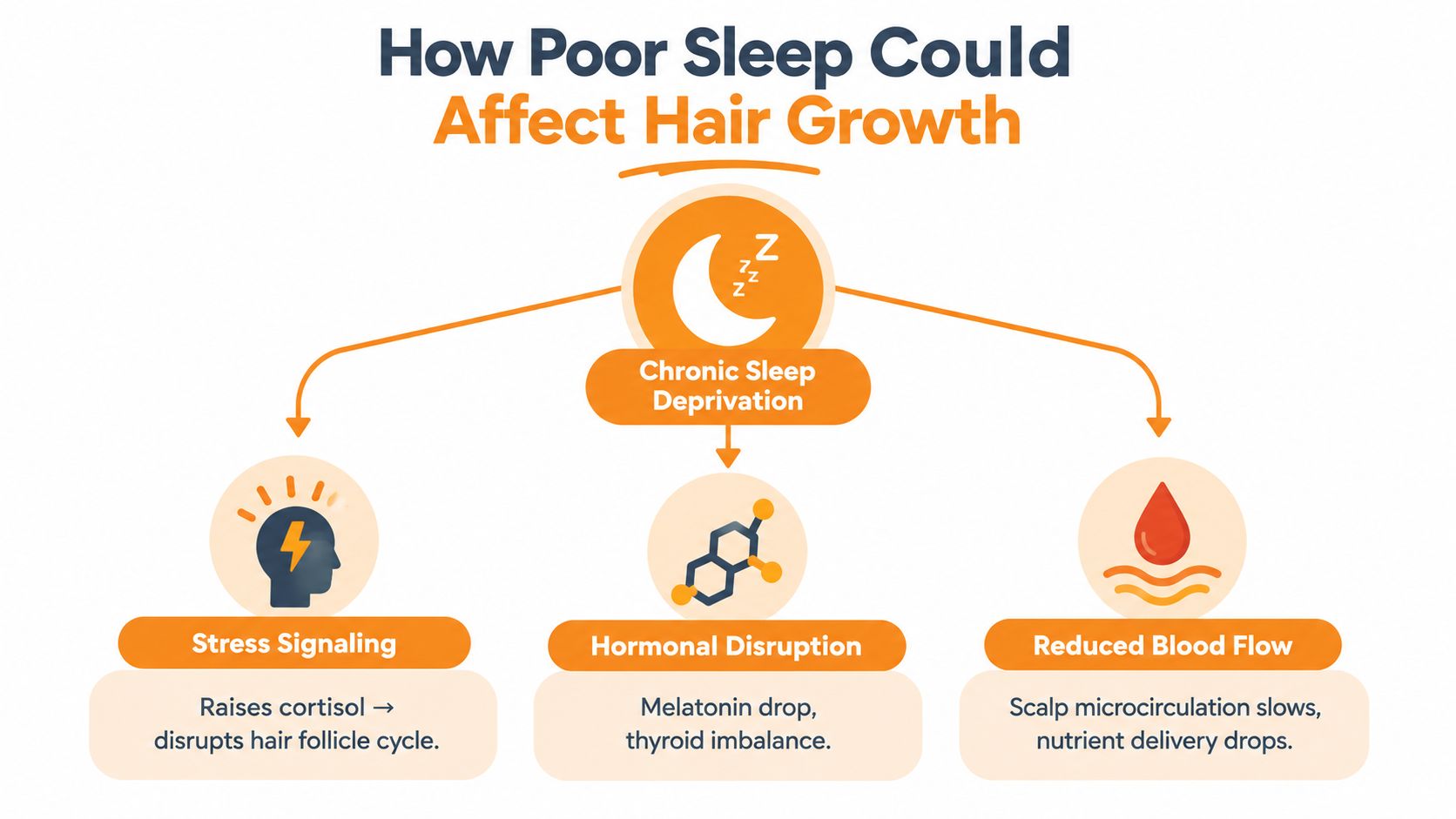
Chronic poor sleep can raise stress signalling, which may encourage more hair follicles to leave the growing phase and enter the resting and shedding phase. This does not make sleep a primary, NHS-recognised cause of hair loss. It is better understood as an indirect amplifier that may add strain when another trigger is present.
Hair growth follows a slow cycle, so the effect is rarely immediate. A short-lived late night is unlikely to change every follicle at once. Repeated sleep disruption, ongoing stress or an irregular body clock may matter more in someone already vulnerable to shedding.
A simple biological chain
The possible pathway is:
- Poor sleep adds pressure. The body has less consistent time for recovery.
- Stress signalling may rise. Ongoing stress can influence hormonal and immune signals.
- Some follicles change phase. More hairs may move from active growth into rest.
- Shedding appears later. The delay can make the original trigger difficult to identify.
A peer-reviewed commentary describes telogen effluvium as related to stress, which could be secondary to poor sleep. 6 UK-facing guidance reports that shedding commonly follows a trigger after a delay of 2–4 months and may improve once the trigger settles. 3
The delayed timing can feel misleading. Hair may start shedding after the stressful period has already ended.
There is no recognised diagnosis called sleep-deprivation-induced alopecia. Using that label could distract from iron deficiency, thyroid disease, inherited pattern loss, recent illness or other explanations. Better sleep may support recovery, but it may not account for the whole condition.
Does sleep timing matter?
Total hours are only part of the picture. A 2025 PubMed-indexed review raised the possibility that late bedtimes could be associated with androgenetic alopecia, reflecting interest in circadian rhythm biology. It raises a question, rather than proving that a late bedtime causes hair loss. 4
This may be relevant to shift workers, students, new parents and people whose routines change frequently. Someone can spend enough time in bed while still experiencing disrupted timing, repeated waking or an unsettled schedule. Persistent insomnia also deserves proper care, and NICE recommends CBT-I as first-line treatment.
For a plain-language explanation of immune pathways sometimes discussed in inflammation, see this overview of T-helper cell shifts. It does not prove that a specific immune change caused your hair loss.
Types of Hair Loss and How to Tell Them Apart
Could the pattern of hair loss tell you more than the amount in your brush? Often, yes. Different causes affect the scalp in different ways, so sleep should be treated as a possible amplifier rather than the main diagnosis.
Common hair loss types compared
| Hair loss type | Typical pattern and timing | Common triggers and notes |
|---|---|---|
| Telogen effluvium | Diffuse shedding across the scalp, often noticed after a delay of around 2–4 months | Stress, illness, weight loss, nutritional problems and possibly poor sleep. It often improves when the trigger settles. |
| Androgenetic alopecia | Gradual thinning in a recognisable pattern | Genetic and hormone-related factors commonly matter. Sleep may be associated with severity, but it is not established as the sole cause. |
| Alopecia areata | Smooth, clearly defined patches can appear | An autoimmune hair-loss type. Poor sleep may occur alongside more severe or longer-lasting disease. |
| Traction or breakage | Short broken hairs or thinning where tension acts | Tight styles, extensions, heat and chemical treatments can damage hair or pull on follicles. |
Telogen effluvium usually causes widespread shedding rather than one sharply defined bald patch. More hair may appear during washing, brushing or on clothing, often after an illness, stressful period, weight loss or nutritional problem. Poor sleep can add to that strain, but it may not be the only explanation.
Androgenetic alopecia develops gradually, with thinning that follows a family or sex-related pattern. Better sleep may support general health, but it cannot remove inherited or hormone-related influences.
Alopecia areata often causes smooth patches. Eyebrows, eyelashes or nails may also be affected. A sudden patch needs medical advice, not a sleep experiment.
Traction or breakage points towards hair-care practices rather than shedding from the root. Look for short broken hairs, tenderness, or thinning exactly where tight styles, extensions, heat or chemicals act.
Persistent or diffuse loss can have more than one cause. A GP may assess iron deficiency, thyroid disease, medication effects, recent illness, hormonal changes and pattern loss. This review of female hair loss explains why identifying the pattern matters, particularly when thinning develops gradually.
Seek urgent medical advice if hair loss comes with severe scalp pain, marked redness, swelling, pus, rapidly spreading patches or signs of a serious underlying illness. These symptoms need assessment beyond routine sleep advice.
Who Is Most at Risk and Real Life Examples
Could poor sleep be the only reason someone loses hair? Usually, it is better treated as a possible amplifier of other pressures, not a primary NHS-recognised cause. The useful question is what else changed around the same time.

A busy parent
A parent in Leeds may wake repeatedly for a young child, miss meals and feel tense for weeks. If shedding appears later, they should record its start date, recent illness, weight change, menstrual changes and whether hair is coming out evenly or in patches. Asking a GP about iron status, thyroid symptoms and other recent health changes may be more useful than focusing on one bad night.
A simple timeline acts like a clinical map. It helps separate a delayed, widespread shed from a sudden patch that needs a different assessment.
A rotating shift worker
A nurse in Manchester may alternate early, late and night shifts. Total time in bed is only part of the picture, because changing sleep and wake times can disturb circadian timing. Research on late bedtimes and pattern hair loss remains emerging, so a shift pattern should be recorded as context rather than treated as a diagnosis.
They could log shift type, sleep timing, caffeine, medicines and when shedding or scalp changes began. A GP can then consider pattern loss, medication effects and other causes alongside sleep.
A gym-goer under combined strain
A regular gym-goer may increase training while eating less and sleeping poorly. The useful clues are a recent change in body weight, training load, food intake, illness and recovery, rather than the gym itself. They should ask a GP or pharmacist whether a restrictive diet, supplement or medicine needs review.
A fitness tracker can show trends in sleep timing and recovery, but it cannot diagnose telogen effluvium or alopecia areata. Use it as a diary prompt, not a verdict.
Practical Steps to Protect Sleep and Reduce Shedding
Could better sleep support hair recovery without treating sleep as the sole cause? Start with changes that improve recovery and reduce avoidable strain, while keeping other possible triggers in view.
Build a steadier sleep pattern
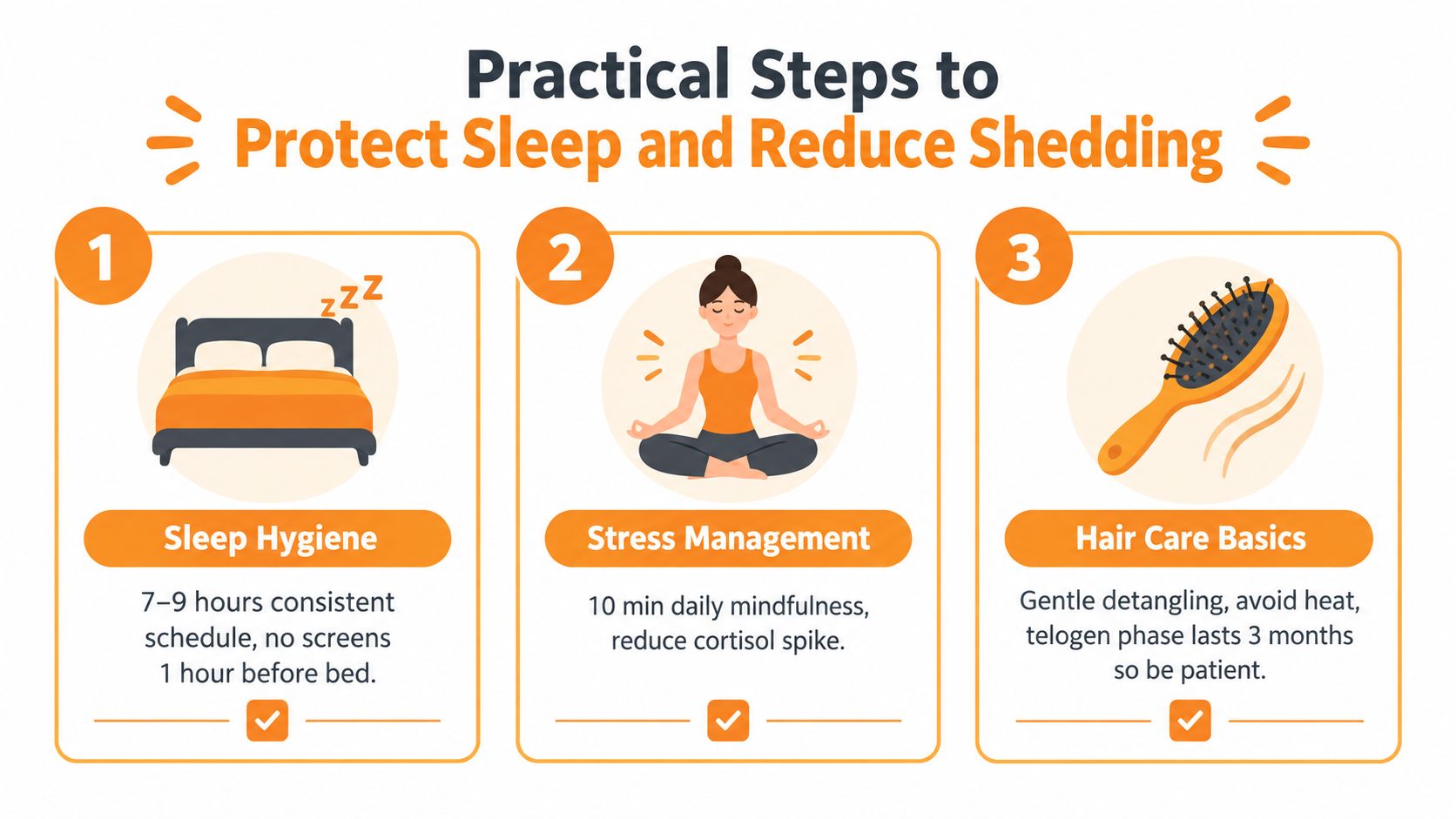
- Keep timing regular: Choose sleep and wake times that fit your life, including weekends where possible.
- Reduce evening stimulation: Dim the lights and put screens aside before bed if they keep your mind active.
- Make the bedroom boring: A cool, dark and quiet room can support sleep.
- Treat insomnia properly: If sleep problems continue, ask about CBT-I rather than repeatedly relying on over-the-counter products.
A regular rhythm matters more than chasing a perfect night. Your sleep target should support recovery, not become another source of worry.
Pharmacist's tip: Check medicines and supplements with a pharmacist if your sleep changed after starting one. Some products can affect alertness, sleep quality or hair concerns.
Reduce the wider stress load
A short wind-down routine can separate bedtime from problem-solving. Gentle stretching, breathing exercises, writing down tomorrow's tasks or listening to quiet audio may help settle an active mind.
Avoid crash diets and sudden training changes. Recent weight loss, illness or a sharp change in exercise can provide more useful context for shedding than sleep alone.
Handle hair gently
- Detangle carefully: Start at the ends and work upwards with a wide-toothed comb.
- Limit tension: Loose styles put less pull on the roots than tight ponytails or extensions.
- Reduce heat: Frequent high heat can increase breakage, which may look like shedding.
- Check the scalp: Itching, scaling, pain or sores need assessment.
Sleep improvement may remove one possible trigger, but hair recovery takes time. One shower or morning on the pillow cannot show the full trend.
Pharmacist's tip: Don't start iron, biotin or other supplements simply because your hair is shedding. Ask about assessment first. Unnecessary supplements can cause problems and may hide the underlying cause.
Melatonin is not a universal answer to poor sleep. Read about melatonin side effects and speak with a pharmacist before using it, particularly if you take other medicines or have a long-term condition.
Pharmacist's tip: Take photos of your parting, temples or patches in similar lighting. A simple record can show gradual change more reliably than memory.
When to Seek Medical Help and Next Steps
Could your sleep pattern be hiding another reason for hair loss? Persistent shedding deserves a wider assessment, because sleep may act as an indirect amplifier rather than a primary cause.
Contact your GP or pharmacist if shedding continues, becomes heavier, forms clear patches or causes significant worry. Arrange advice sooner if hair loss appears with fatigue, unexplained weight change, feeling unusually cold, scalp inflammation or another new symptom. Pain, redness, swelling, pus, marked scaling or sores also need prompt attention.
A clinician will ask about recent illness, emotional or physical stress, diet, weight change, medicines and family history. They will examine the pattern of loss, scalp and hair shafts, rather than treating sleep as the answer by itself. Depending on your symptoms, they may consider checks for iron deficiency or thyroid disease.
The pattern can provide useful clues:
| What you notice | Possible explanation | Why assessment helps |
|---|---|---|
| Hair coming out more evenly across the scalp | Temporary diffuse shedding, including telogen effluvium | A recent illness, stressor, dietary change or medicine may be more relevant than last night's sleep |
| A widening parting or gradual thinning at the temples or crown | Pattern hair loss | Sleep improvement alone may not address an inherited or hormone-sensitive process |
| One or more smooth, defined patches | Alopecia areata or another localised condition | Patchy loss needs a different assessment from general shedding |
| Broken hairs, itching, scaling, pain or sores | Hair-shaft damage or scalp disease | Treatment depends on what is affecting the hair or skin |
Telogen effluvium is associated with stress, and poor sleep may add to that strain. Hair growth follows a cycle, so a trigger can be followed by shedding after a delay. This makes it easy to blame the current sleep routine for an event that happened earlier. There is no recognised diagnosis of sleep-deprivation-induced alopecia, so ongoing loss should be assessed for other explanations.
A useful rule is to treat sleep as one piece of the history. Ask what changed before the shedding began, whether the loss is diffuse or patchy, and whether the scalp looks healthy. That approach reduces the risk of overlooking iron deficiency, thyroid problems, pattern hair loss, immune conditions, illness, weight loss or medicine-related effects.
If you are considering treatment for pattern hair loss, read about how long minoxidil takes to work before expecting quick results. Treatment plans need time and regular use, and minoxidil may not suit every diagnosis or health history. Speak with a pharmacist or clinician before starting or stopping it.
Summary
- The NHS does not list lack of sleep as a primary cause of hair loss.
- Poor sleep may increase stress and inflammatory strain, making shedding more likely in someone who is already vulnerable.
- Temporary diffuse shedding can follow a trigger after a delay.
- Iron deficiency, thyroid disease, illness, medicines, genetic pattern loss and immune conditions can also cause hair loss.
- Late or irregular sleep timing remains an area for further research.
- Improve sleep for general health, while seeking advice for persistent, worsening or patchy loss.
This article is for information only and is not a substitute for personal medical advice.
FAQs
Can lack of sleep cause hair loss directly?
Lack of sleep is not listed by the NHS as a primary direct cause of hair loss. Poor sleep may contribute indirectly through stress and inflammatory strain, particularly when another trigger or underlying condition is present.
How long after poor sleep might hair shedding begin?
Shedding may become noticeable around 2–4 months after a trigger. That delay means the relevant event may be an illness, major stress, dietary change or medicine taken earlier, not the sleep pattern at the time you notice hairs in the brush.
Is hair loss from lack of sleep reversible?
If poor sleep contributes to temporary telogen effluvium, shedding may settle when the wider trigger improves. Recovery is less likely to follow sleep changes alone if pattern hair loss, iron deficiency, thyroid disease or another condition remains untreated.
Is sleeping less than 6 hours linked with hair thinning?
A UK-focused report described an association between sleeping less than 6 hours and reported hair-thinning problems. This type of finding does not prove that short sleep directly causes alopecia. It is better used as a reason to examine sleep alongside other health factors, not as a diagnosis.
Can late bedtimes cause androgenetic alopecia?
Researchers are examining whether late bedtimes may relate to androgenetic alopecia. Current evidence raises a question about sleep timing, but does not show that a late bedtime causes inherited pattern hair loss.
What other conditions can cause hair loss?
Possible causes include iron deficiency, thyroid disease, stress, weight loss, illness, medicines, androgenetic alopecia and alopecia areata. A clinician can compare the pattern, scalp findings and timing with your medical history to decide what needs checking.
Should I take supplements for hair shedding?
Not automatically. Iron, biotin and other supplements are unlikely to help if you do not have a deficiency, and some may cause harm or interfere with testing. Discuss supplements with a pharmacist or GP first.
When should I see a GP about hair loss?
Arrange an appointment for persistent, worsening or patchy loss. Seek prompt advice for scalp pain, redness, swelling, pus, severe scaling, sores or other significant symptoms.
Can a pharmacist help with sleep and hair-loss concerns?
A pharmacist can review medicines, discuss safer self-care and advise whether a GP appointment is appropriate. They cannot diagnose every form of hair loss, so ongoing, unusual or patchy symptoms may need medical assessment.
How this content was created
This guide uses NHS information, research indexed in PubMed, UK-focused clinical information and peer-reviewed commentary. It was written in plain English and checked for cautious interpretation, UK relevance and safety.
Byline: Medical Mojo Editorial Team, UK health education writers.
Clinical review: Content should be reviewed by a UK-registered pharmacist or clinician before publication.
Meta description: Can lack of sleep cause hair loss? Learn what UK evidence says, how stress may contribute to shedding, and when to seek advice for thinning or patches.
Courier Pharmacy can help you discuss sleep problems, medicines and hair-loss treatment options through its online pharmacy service. Visit Courier Pharmacy to complete a confidential health questionnaire and explore whether personalised clinical advice is suitable for you.


