Capsaicin Cream for Pain: A UK Patient's Guide for 2026
Searching for capsaicin cream for pain in the UK? Our complete guide covers how it works for arthritis, its limits for nerve pain, side effects, and costs.
SEO brief
- Primary keyword: capsaicin cream for pain
- Secondary keywords: capsaicin cream UK, capsaicin cream side effects, capsaicin cream for osteoarthritis, capsaicin cream for nerve pain, topical pain relief, capsaicin cream shortage UK
- Search intent: Informational. UK patients want to know if capsaicin cream works, how to use it safely, and what to do if they can't get it.
- Target reader: UK adults with joint or nerve pain, plus carers
- Product/service mention (if any): Courier Pharmacy consultation and supply support in CTA only
- Internal links available: Assumed from Courier Pharmacy pages supplied
Capsaicin cream for pain
If you're reading this with a sore knee, aching hand, or a patch of pain that keeps nagging at you, you're probably wondering if capsaicin cream is worth the bother. Yes, capsaicin cream for pain can help some people, especially for osteoarthritis, but it isn't a cure-all and it isn't a good over-the-counter fix for most nerve pain.
Used properly, it can be a useful topical option. Used for the wrong condition, it can leave you with nothing more than a hot, irritated patch of skin and a tube you regret buying. This guide explains what capsaicin cream does, where it works best, how to apply it safely, what side effects to expect, and what to do if UK stock is hard to find.
Five key takeaways
- Best fit: Low-strength capsaicin cream is most useful for osteoarthritis pain, especially hands and knees.
- Be patient: It usually takes 2 to 4 weeks to start helping, with best results often at 4 to 8 weeks [1].
- Burning is common: Stinging and heat are expected at first, but 90% of patients report no such sensation by 12 weeks of regular use [2].
- Nerve pain caution: Low-concentration capsaicin for neuropathic pain was judged “without meaningful effect” in a Cochrane review [3].
- UK reality: Supply can be patchy, so it helps to ask your pharmacist early about alternatives.
What is Capsaicin Cream and How Does It Work
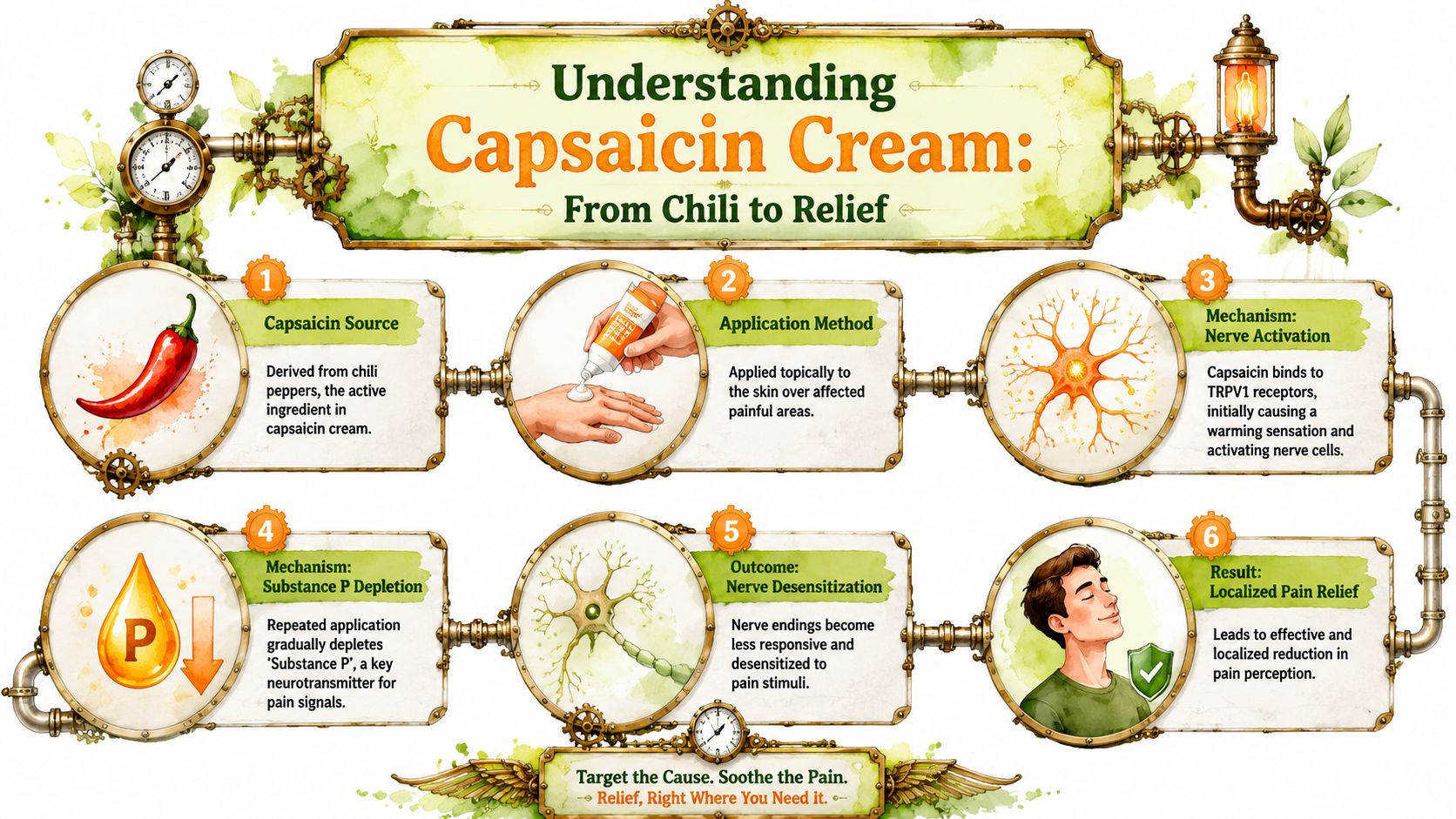
Capsaicin cream is a pain-relieving cream made from the active compound found in chilli peppers. You apply it to the skin over a painful area, usually for joint pain or certain specialist pain plans.
A simple way to think about it
Think of pain nerves like a doorbell that's being pressed too often. Capsaicin presses that bell hard at first. That's why the skin can feel hot or stingy.
Then, with repeated use, those nerve endings become less reactive. A simple way pharmacists explain it is that the pain signal system gets “worn down” locally, so the area becomes less sensitive over time.
Capsaicin acts on pain-sensing nerve endings and is linked to depletion of Substance P, a chemical involved in pain signalling. That's why regular use matters. One-off use doesn't usually do much beyond causing a warm or burning feeling.
Practical rule: Capsaicin works locally. It helps the patch of skin and tissue you treat, not your whole body.
Why it burns before it helps
This catches many people out. They expect soothing relief, but capsaicin often feels more like a chilli-related warning shot on day one.
That early heat doesn't automatically mean damage. It usually reflects the way the cream activates those nerve endings before they settle down. If you've ever used other local pain treatments such as Versatis 700mg lidocaine medicated plaster, the contrast is obvious. Lidocaine tends to numb. Capsaicin tends to irritate first, then calm things later.
Which pain conditions can capsaicin cream treat
Which Pain Conditions Can Capsaicin Cream Treat
Capsaicin cream has a real place in pain relief, but only when the condition matches the product. Many online guides frequently err in this regard.

Where capsaicin cream has a clear role
For osteoarthritis, especially in the hands and knees, capsaicin cream can be a reasonable option. A review cited by Arthritis UK found capsaicin 0.075% cream was four times more effective than placebo for improving osteoarthritis pain and joint tenderness, and it offered pain relief comparable to topical anti-inflammatory gels like diclofenac without the risk of stomach irritation [4].
That matters in day-to-day pharmacy practice. If someone can't tolerate oral anti-inflammatory tablets, wants to avoid stomach upset, or needs something local rather than another tablet, capsaicin becomes a sensible discussion.
Featured answer:
Does capsaicin cream work for arthritis?
Yes, it can help osteoarthritis pain, especially in hands and knees, when used consistently over several weeks [4].
A few situations where it may suit you:
- Hand osteoarthritis: Useful when opening jars, gripping pans, or typing sets off pain.
- Knee osteoarthritis: Can fit alongside exercise, weight management, and simple pain relief.
- NSAID intolerance: Worth discussing if anti-inflammatory tablets upset your stomach.
Where low-strength cream often disappoints
This is the bit many patients never get told. Low-concentration over-the-counter capsaicin is not strongly supported for neuropathic pain.
A 2019 Cochrane Collaboration review concluded there is insufficient data to support meaningful pain relief from low-concentration capsaicin for neuropathic conditions, stating it is “without meaningful effect” in clinical practice and unlikely to be useful [3].
So if you're using a low-strength cream for diabetic nerve pain, post-herpetic neuralgia, or burning nerve symptoms because the box says “nerve pain”, be careful. The stronger 8% capsaicin patch used in specialist settings is a different treatment entirely. It isn't the same as a low-strength cream from the shelf.
If you've got lingering shingles pain, this matters even more. It's better to look at a full treatment plan for post-herpetic neuralgia than assume an over-the-counter capsaicin cream will sort it.
Low-strength capsaicin cream can be a good arthritis tool. It's often a poor self-treatment for nerve pain.
A Practical Guide to Using Capsaicin Cream Safely
The main reason people give up on capsaicin cream isn't that it never had a chance. It's usually because no one explained how to use it properly.
Here's the simple version first.
Featured answer:
How do you use capsaicin cream safely?
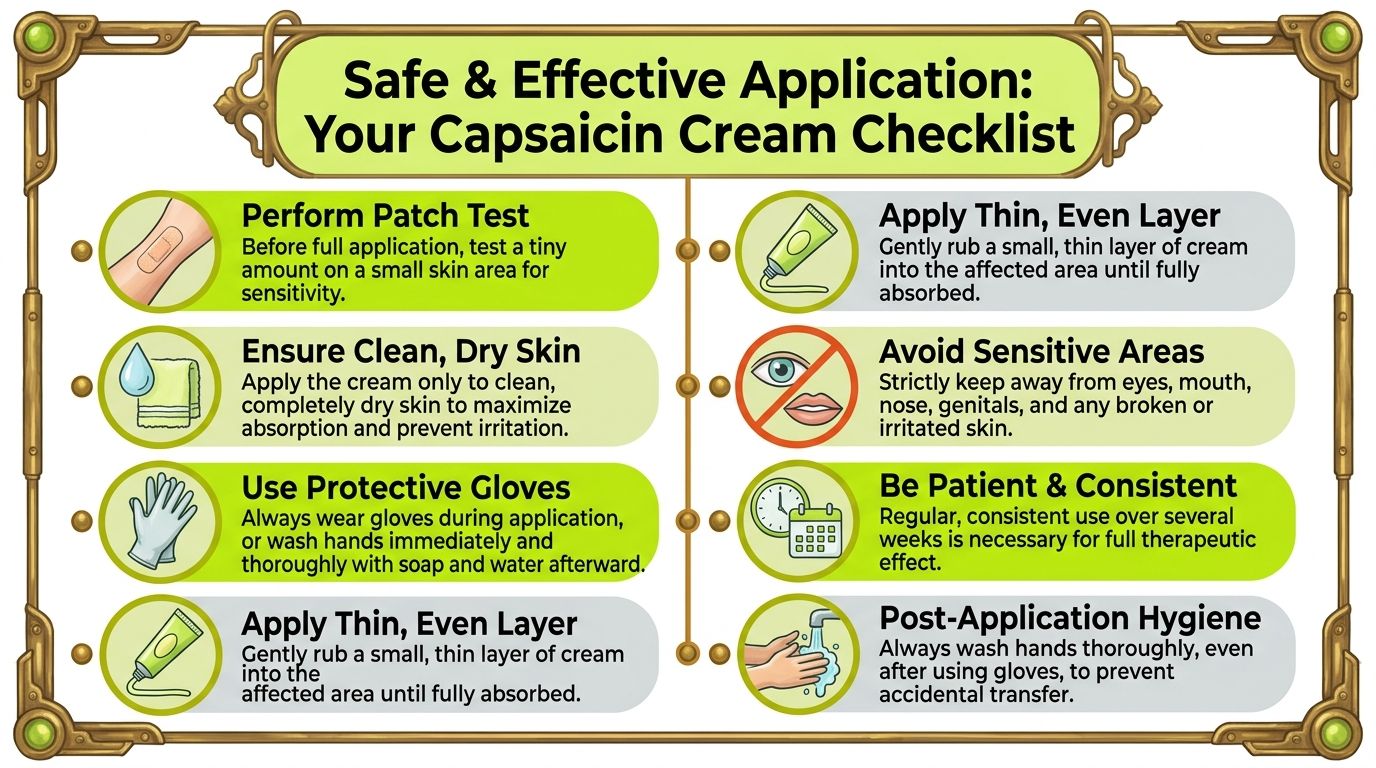
Apply a thin layer to clean, dry skin, avoid eyes and broken skin, wash your hands well after use, and keep going consistently for several weeks.
How to apply it
For low-concentration capsaicin cream in the UK, it's commonly applied 3 to 4 times daily to painful areas. Relief typically starts after 2 to 4 weeks of consistent use, with best benefit often at 4 to 8 weeks [1].
Use it like this:
- Wash and dry the area first. Damp skin can make the sting feel worse.
- Apply a thin layer. More cream doesn't mean better pain relief.
- Rub it in gently. Don't apply it like grout.
- Wash hands well after use. If your hands are the treatment area, ask your pharmacist exactly when to wash.
- Keep it away from eyes, mouth, nose, genitals, and broken skin. This is not the time for bravery.
Pharmacist's tip
Start on a quiet day if you can. The first few applications are often the most noticeable, so don't begin just before the gym, a hot shower, or cooking dinner.
A short visual guide can help with technique:
How long it takes to work
Capsaicin is not a fast comfort cream. If you try it for three days and stop, you haven't really tested it.
Set realistic expectations:
- First week: Heat, stinging, or redness is common.
- Weeks 2 to 4: Some people start noticing less pain [1].
- Weeks 4 to 8: This is when fuller benefit often shows [1].
That timeline is why consistency matters more than enthusiasm.
Pharmacist's tip
Put the tube next to something you never forget, such as your toothbrush or kettle. Capsaicin rewards routine, not guesswork.
Common mistakes that cause problems
A few habits make capsaicin harder to tolerate:
- Applying after a hot bath or shower: Heat can intensify the burn.
- Using too much: A thick layer won't speed things up.
- Touching your face after applying: This is one of the commonest mishaps.
- Stopping too early: Many people quit before the likely benefit window.
If the sting is a barrier, some clinicians use an anaesthetic cream first. If that's needed, your prescriber or pharmacist may discuss products such as EMLA 5% cream.
Managing Potential Side Effects
Capsaicin side effects are usually local and predictable. That doesn't make them pleasant, but it does make them easier to manage.
What's normal at the start
The common early effects are:
- Burning or stinging
- Redness
- Warmth
- Mild skin irritation
These are most noticeable in the first days and first week. According to an NHS patient leaflet, 90% of patients report no such burning or stinging sensation by 12 weeks of regular use [2].
That's encouraging, but only if the skin reaction stays mild and local. If the skin becomes very inflamed, the treatment plan needs checking.
Pharmacist's tip
If the sting is hard to tolerate, apply to completely dry skin, avoid heat around the area, and ask whether an anaesthetic cream before treatment is suitable for you.
If your skin is already irritated, fragile, or eczema-prone, be more cautious. A separate skin problem can muddy the picture, especially if you already use creams for dermatitis. If that sounds familiar, this guide to finding the best cream for dermatitis may help you think about skin barrier issues before starting another topical product.
When to contact your doctor or pharmacist
Seek advice promptly if you get:
- Severe or worsening redness that doesn't settle
- Blistering or broken skin
- Swelling beyond the treated area
- Accidental exposure to eyes, mouth, or genitals with ongoing pain
- Breathing symptoms after use
- No clear benefit after a proper trial and you're using it for the wrong pain type
Featured answer:
Is burning from capsaicin cream normal?
Yes, mild burning or stinging is common at first. It should improve with regular use, not get steadily worse.
Getting Capsaicin Cream in the UK Availability Costs and Alternatives
For many UK patients, the issue isn't just “does it work?” It's “can I get it?”
Why finding it can be awkward
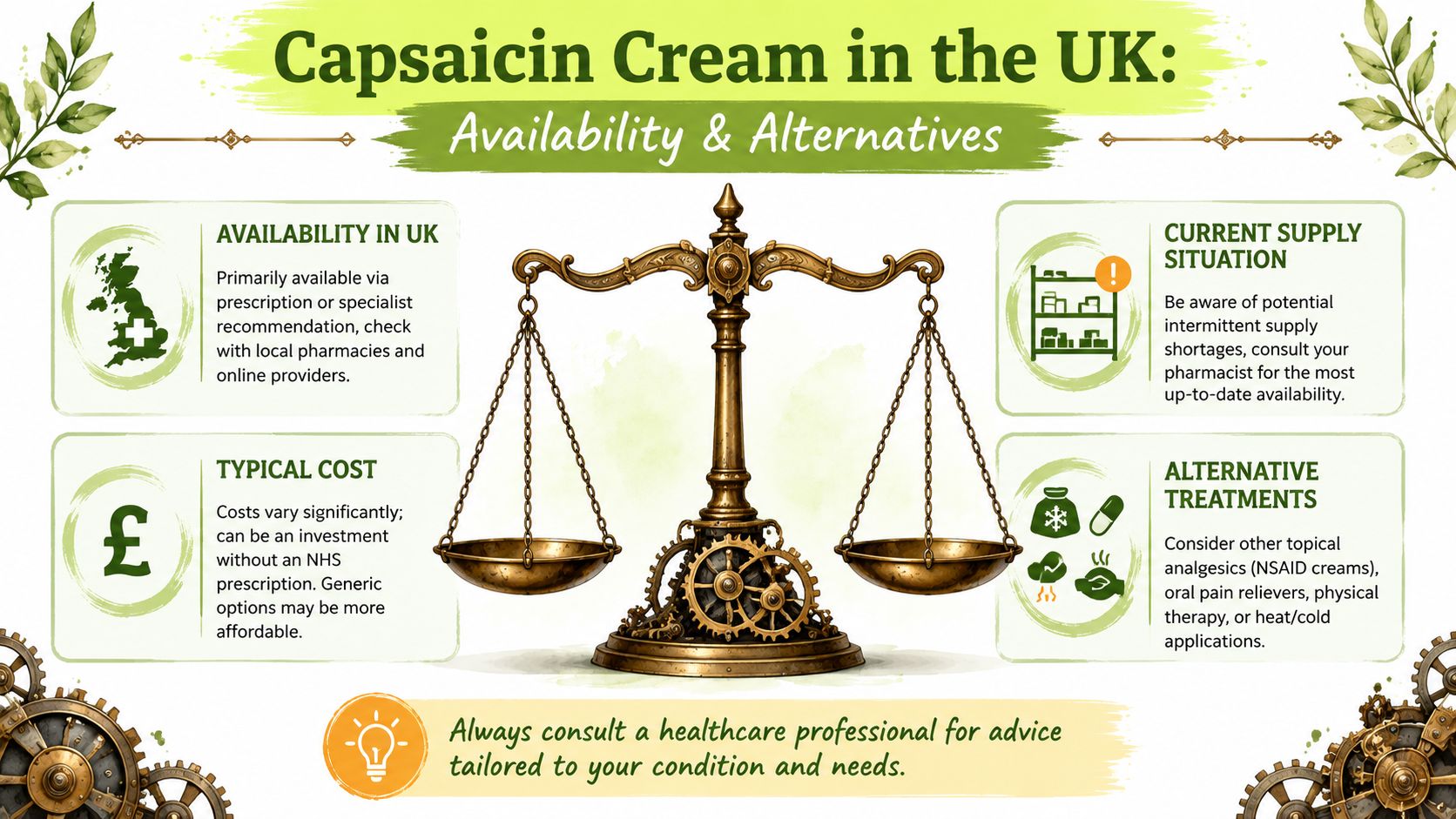
Capsaicin cream has had periods of poor availability in the UK. A UK rheumatologist highlighted a capsaicin cream shortage in a public post, linking the problem to regulatory changes and supply disruption [5].
From a patient point of view, this shows up as a familiar problem. One pharmacy says it's discontinued, another says it's “temporarily unavailable”, and a third can order it but gives no date. If capsaicin is part of your joint pain routine, that uncertainty is frustrating.
Featured answer:
Is capsaicin cream hard to get in the UK?
Sometimes, yes. Stock can be patchy, so ask early and have a backup option ready.
Capsaicin cream compared with topical diclofenac
If stock is poor, or if capsaicin doesn't suit you, topical diclofenac is often the next practical conversation for osteoarthritis.
| Option | Best fit | What to expect | Main drawback | Main plus point |
|---|---|---|---|---|
| Capsaicin cream | Osteoarthritis pain, especially hands and knees | Can help, but needs regular use over weeks | Burning and stinging early on | Useful when you want local treatment and want to avoid stomach irritation from oral NSAIDs |
| Topical diclofenac gel | Osteoarthritis pain and local inflammation | Often familiar and easy to use | Not suitable for everyone, especially depending on skin tolerance and other medicines | A review found capsaicin gave comparable pain relief to diclofenac for osteoarthritis [4] |
For osteoarthritis, capsaicin and diclofenac can sit in the same decision space. The best choice often comes down to skin tolerance, past response, and whether inflammation seems to be a major driver of pain.
If standard products are unavailable or unsuitable, some patients ask specialist pharmacies about individualized options. In the UK, a compounding pharmacy may sometimes help when formulation issues or supply problems complicate treatment.
What to do if it's out of stock
If your usual capsaicin cream isn't available:
- Ask if another brand or formulation is available. The strength and base matter.
- Check whether topical diclofenac is suitable. This is often the most practical arthritis alternative.
- Review the diagnosis. If you're using it for nerve pain, it may be time to rethink the plan anyway.
- Ask about specialist referral for neuropathic pain. High-concentration capsaicin patches are different from OTC creams and are used in specialist settings.
Real-Life Scenarios Making Capsaicin Work for You
Advice lands better when it sounds like real life.
Busy parent with knee osteoarthritis
A woman in her fifties has knee osteoarthritis. She's juggling work, school runs, and the sort of stairs that feel steeper every year. She wants pain relief that stays local and doesn't add another tablet to the day.
She starts capsaicin cream with a routine. Morning after washing, mid-afternoon, evening, and before bed. The first week is irritating rather than impressive, so she nearly bins it. By sticking with it, she gives it a fair trial. The key for her is timing. She avoids putting it on before a hot bath or rushing straight into the kitchen to chop chillies. That would be chaos.
Retired shift worker with post-shingles pain
A retired man has ongoing pain after shingles. He buys a low-strength capsaicin cream because the packaging sounds promising for nerve pain. It stings, but it doesn't meaningfully help.
That outcome fits what we know about low-concentration capsaicin in neuropathic pain. Instead of buying another tube, he speaks to his pharmacist. They review the pain type, the area involved, and whether a GP review or specialist pain clinic discussion makes more sense. That saves time, money, and a lot of avoidable frustration.
Frequently Asked Questions About Capsaicin Cream
Can I use capsaicin cream on my face?
No, that's generally a bad idea unless a specialist has told you otherwise. The skin is more sensitive, and accidental spread into the eyes, nose, or mouth is far more likely.
What happens if I get capsaicin cream in my eyes?
It can cause intense burning and watering. Rinse carefully and seek urgent advice if pain, redness, or vision symptoms continue.
Can I use capsaicin cream with paracetamol?
Often, yes, because capsaicin works locally and paracetamol works systemically. Still, if you take regular pain medicines or have several conditions, check with a pharmacist to make sure the overall plan is sensible.
Can I use capsaicin cream with ibuprofen gel or diclofenac gel?
Don't layer pain gels on the same patch of skin unless a clinician has advised it. Mixing topicals can make skin irritation much worse.
Is capsaicin cream addictive?
No, capsaicin cream is not addictive. If it helps, it does so through local effects on pain nerves, not by causing dependence.
Why can't I wash my hands straight after applying it to hand arthritis?
If your hands are the treatment site, washing immediately may remove the medicine before it has much chance to work. Ask your pharmacist how long to leave it on before washing, based on the product you're using.
Can I use it on broken skin?
No. Capsaicin on cracked, grazed, or inflamed skin can cause major irritation and should be avoided.
What if I miss a dose?
Apply the next dose when you remember, unless it's almost time for the next one. Don't pile on extra cream to catch up.
Does a stronger burning feeling mean it's working better?
No. More burning doesn't reliably mean more benefit. It often just means the skin is more irritated.
When should I stop using capsaicin cream?
Stop and get advice if you develop severe irritation, blistering, or the pain problem clearly isn't the sort capsaicin is likely to help. Also review the plan if you've given it a fair trial and it still isn't doing enough.
In summary, capsaicin cream can be helpful for some types of pain, especially osteoarthritis. It needs correct use, patience, and realistic expectations. It's not the best self-treatment for most nerve pain, despite how it's often marketed. Early burning is common, but it usually settles with regular use. In the UK, supply can be patchy, so it's wise to ask about alternatives rather than waiting until you've run out. This article is for information only and isn't a substitute for personal medical advice.
Meta description
Capsaicin cream for pain explained for UK patients. Learn what it treats, side effects, safe use, nerve pain limits, and UK shortage alternatives.
Suggested internal links for medicalmojo.co.uk
- A guide to osteoarthritis pain relief options
- Topical NSAID gels explained for joint pain
- Post-herpetic neuralgia symptoms and treatment options
- When to see a pharmacist for nerve pain
- How to use medicated creams safely
- Understanding chronic pain self-care in the UK
Visual ideas for the designer
Painterly chilli-to-nerve explainer
Alt text: “Illustration showing chilli-derived capsaicin calming overactive pain nerves in the skin.”UK pharmacy shelf shortage graphic
Alt text: “Capsaicin cream tubes on a nearly empty UK pharmacy shelf with alternative treatments beside them.”Osteoarthritis comparison panel
Alt text: “Comparison image of hand and knee osteoarthritis with capsaicin cream and diclofenac gel options.”Safe application checklist card
Alt text: “Step-by-step capsaicin cream application checklist with gloves, clean skin, and handwashing icons.”
Byline
By Medical Mojo Editorial Team, reviewed by a UK-registered pharmacist
Clinical review line
Clinical review by a GPhC-registered pharmacist
How this content was created
This article was written using peer-reviewed research and UK patient guidance, then checked for clinical accuracy and plain-English readability. The final draft was reviewed with a safety-first focus on practical use, side effects, and UK access issues.
References
[1] DrOracle.ai. What are the recommended dosing and usage guidelines for capsaicin cream? Available at: https://www.droracle.ai/articles/1047611/what-are-the-recommended-dosing-and-usage-guidelines-for
[2] Wrightington, Wigan and Leigh Teaching Hospitals NHS Foundation Trust. Capsaicin 0.075% cream patient leaflet. Available at: https://www.wwl.nhs.uk/media/.leaflets/6183b1ddd74498.98911999.pdf
[3] Derry, S. et al. 2019. Topical capsaicin (low concentration) for chronic neuropathic pain in adults. Cochrane review. Available at: https://pmc.ncbi.nlm.nih.gov/articles/PMC6540838/
[4] Altman, R.D. et al. Capsaicin in osteoarthritis and neuropathic pain. Available at: https://pmc.ncbi.nlm.nih.gov/articles/PMC404499/
[5] Hayes, J. Capsaicin cream shortage leaves UK patients in pain. LinkedIn post. Available at: https://www.linkedin.com/posts/johnhayesjrmd_saw-our-video-on-capsaicin-there-is-a-capsaicin-activity-7327755628171378691-xxbM
If you need help working out whether capsaicin is right for your pain, or what to do if your usual product is out of stock, Courier Pharmacy offers UK-regulated online consultations, prescribing support where appropriate, and access to a wide range of pain and skin-related treatments.


