Common Symptoms of Urinary Tract Infection and When to Act
Learn the common symptoms of urinary tract infection, from burning when passing urine to fever and back pain, and when to get urgent UK medical help.
Does cloudy urine, on its own, mean you need antibiotics? It doesn't. A test strip can't settle that either.
This guide explains the common symptoms of urinary tract infection, and why the mix of signs, plus your age and sex, changes what they mean. You'll see how bladder symptoms differ from kidney symptoms, which combinations raise the chance of infection, and when to get same-day help.
Key takeaways
- Pattern first: two features beat one isolated sign.
- Location matters: fever and side pain suggest the kidneys.
- A dipstick isn't proof: bacteria can sit in urine without illness.
- Higher-risk groups differ: men, pregnancy and older adults need a clinician.
- Act the same day if you feel worse, vomit, or seem confused.
What a urinary tract infection feels like
A urinary tract infection (UTI) is an infection of the urinary system, most often starting in the bladder. Burning when you pass urine is its most common sign.
A lower UTI affects the bladder. People often call this cystitis. An upper UTI reaches the kidneys. Clinicians call that pyelonephritis, and it needs faster care.
One sign rarely settles the question. The pattern matters more than any single complaint. Wondering whether a burning feeling means infection is a fair question.
A typical lower UTI often starts to ease within a few days of proper treatment. Worsening symptoms need prompt advice. Compare signs by location, then combinations, red flags, tests, self-care, prevention, and where to get help today. Ongoing bladder pain without infection is a different problem. Our page on LDN for interstitial cystitis sets out that separate route.
Common Symptoms of Urinary Tract Infection by Location
Where a symptom sits in the body changes what it means. A burning feeling on its own suggests bladder trouble. The same burning plus back pain and fever points higher, towards the kidneys.
| Symptom | Lower UTI (bladder) | Upper UTI (kidney) |
|---|---|---|
| Burning or pain when passing urine | Common | Common |
| Needing to pass urine more often | Common | Common |
| Sudden urgency | Common | Common |
| Cloudy or strong-smelling urine | Common | Common |
| Blood in the urine | Can occur | Can occur |
| Lower abdominal pain | Common | Can occur |
| Pain in the back or side below the ribs | Uncommon | Common |
| Fever, chills or shivering | Uncommon | Common |
| Nausea or vomiting | Uncommon | Common |
| Confusion or unusual drowsiness | Uncommon, mainly in older adults | Possible and more serious |
| Temperature | Usually normal | Can reach about 39.5°C |
Practical rule: The table shows patterns, not a diagnosis. One row never proves infection.
The NHS Somerset primary care infection guidance treats a defined cluster as the usual picture, rather than urine colour on its own. That cluster is pain or burning when you pass urine (dysuria), going more often, new or worse night-time trips (nocturia), urgency, cloudy urine, blood in the urine, low tummy pain, and pain in the back just below the ribs.
What else can show up
Fever, feeling hot and shivery, or feeling cold and shivery can appear too. So can tiredness or weakness. An unusually low temperature can be part of that wider picture, so a thermometer reading that seems normal does not rule infection out by itself. Dark or strong-smelling urine may be noticed, but colour and smell alone are not proof.
nidirect guidance on adult UTIs describes how an upper infection can push a temperature high, which is why the kidney row sits where it does. Burning when you pass urine and needing to go more often each make a UTI more likely. Frequency and urgency can still happen without infection though, so the whole pattern counts.
Age changes how much weight a sign deserves. New confusion or unusual drowsiness in an older adult is a stronger warning than the same change in a younger adult. Itching and a thick discharge point elsewhere entirely, and our page on vaginal thrush covers that look-alike. If side pain, fever or vomiting joins the picture, get medical help the same day.
Symptom Combinations That Point Towards a UTI
A UTI rarely announces itself through one sign on its own. For UK women under 65, combinations of symptoms such as burning when you pass urine, new trips to the toilet at night and urine that looks cloudy raise the likelihood of infection. Each extra urinary symptom adds weight, a bit like separate clues all pointing the same way.
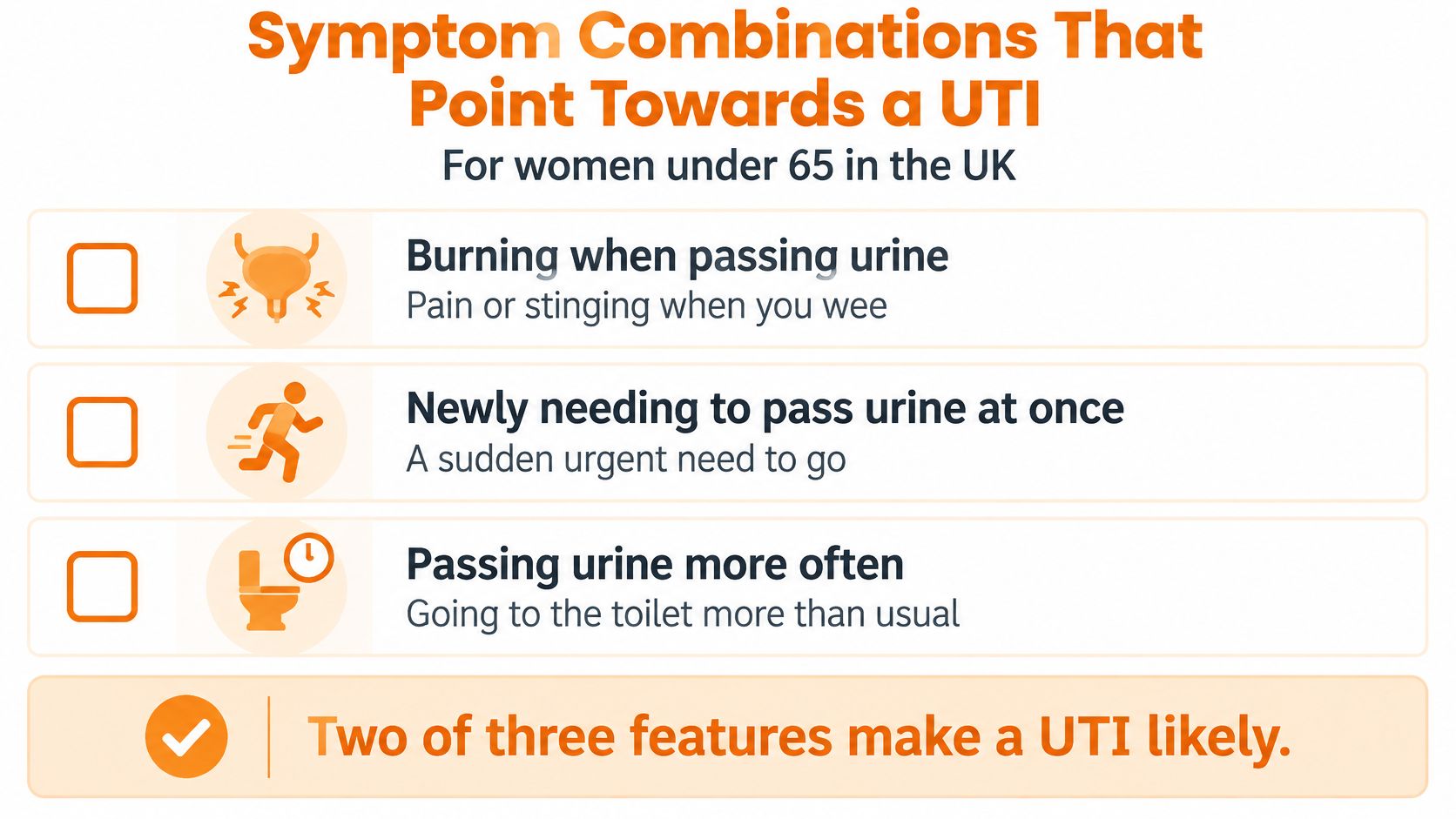
NICE quality statement 1 is clear that no single symptom, and no combination, is completely diagnostic, so a clinician weighs the whole picture rather than reaching straight for antibiotics. Vaginal discharge, urethritis, irritation after sex and menopause-related genital or urinary changes can all mimic part of the picture, so those causes need ruling out. Age and sex change what a symptom means too, which is why this guidance applies specifically to women under 65. Pregnancy, recurrent infection, antibiotic risk and possible complications still shape treatment.
Cloudy or smelly urine alone does not prove infection. Drinks, dehydration and vaginal irritation can change smell and how often you go.
A three-check list
- Two key symptoms, no vaginal discharge: Burning plus new night-time trips, or burning plus cloudy urine, fits the typical pattern. Ask a pharmacist or GP to assess you.
- Low belly pain, no discharge or fever: This can still be cystitis. Get the same check, and say if the pain is new.
- Discharge, genital sores or pelvic pain: Don't assume a UTI. Ask for a sexual health or gynaecology review, since bacterial vaginosis is one reason discharge appears.
Pharmacist's tip: Note when symptoms started, and whether they're getting better or worse. That timeline helps a clinician decide quickly.
Red Flags That Need Urgent Medical Help
Fever, pain in the back or side below the ribs, chills and vomiting suggest the kidneys may be involved. Get prompt assessment. Don't wait to see if these signs pass.
- Fever, or feeling hot and shivery, with urinary pain.
- Severe pain in the back or side below the ribs.
- Vomiting so often you can't keep fluids down.
- Confusion, agitation or unusual sleepiness, especially in older adults.
- Marked weakness, or feeling very unwell.
- Symptoms that worsen, or that fail to settle with self-care.
These signs can point to a kidney infection or to sepsis, a serious reaction to infection.
Call 999 or get same-day advice
Call 999 for collapse, difficulty breathing, or someone who is hard to wake. For the other signs on the list, contact NHS 111 or a GP the same day.
Mild urinary symptoms can still become serious illness. In England in the 2023–2024 financial year, nearly 200,000 patients had a UTI-related primary hospital diagnosis, and those admissions used 1.2 million hospital bed-days, about six bed-days each, according to the UK Health Security Agency. 52.7% of admissions involved people aged over 70.
Early signs in that analysis include frequency, urgency, night-time trips, burning, cloudy urine, new low tummy pain and blood in the urine. Severe kidney or lower-back pain, fever, chills, agitation or confusion may mean kidney infection or sepsis. Older adults and other higher-risk patients should not sit on worsening symptoms.
Urine Dipstick and Culture Tests Explained
Three tests do different jobs. None of them replaces the story of your symptoms.
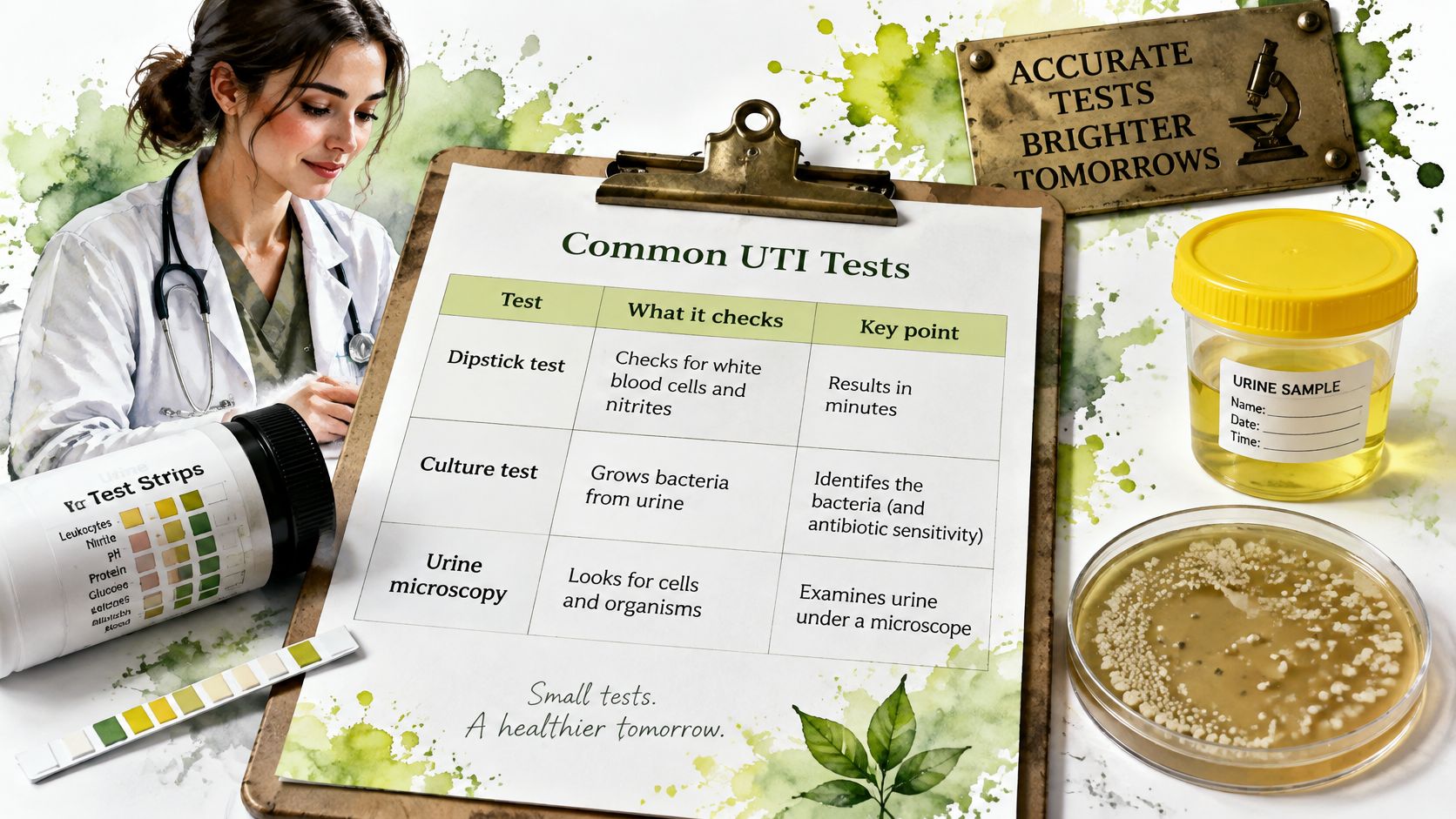
| Test | What it shows | Typical turnaround | When it is used |
|---|---|---|---|
| Urine dipstick | White blood cells and nitrites | Minutes | Quick check for adults under 65 with typical symptoms |
| Urine culture | Type of bacteria and which antibiotics work | Two to three days | Recurrent infection, men, pregnancy, or treatment not working |
| Blood test | Signs the infection may be spreading | Same day in urgent cases | Suspected kidney infection or sepsis |
A urine dipstick checks for white blood cells and nitrites and gives a result in minutes. A urine culture grows the bacteria in a lab and shows which antibiotics work. That usually takes two to three days. A blood test is used when infection may have spread, including suspected kidney infection or sepsis.
What a positive result cannot prove
A positive dipstick does not prove infection on its own. Bacteria can live in urine when you have no urinary symptoms. NHS Cornwall guidance discourages routine dipstick testing in adults over 65, because a positive result can reflect asymptomatic bacteriuria rather than symptomatic infection. The same guidance notes that NHS England estimates around 10% of women experience a UTI each year, which is why a quick test feels tempting. A positive strip still isn't a reason for antibiotics by itself.
Clinicians often request a culture for men, pregnant people, recurrent infection, treatment that isn't working, or before an antibiotic change. They weigh the result with symptoms, age and history.
Pharmacist's tip: For a midstream sample, wash your hands, pass a little urine into the toilet, then catch the middle of the stream in a clean pot. Deliver it promptly, as you were told.
Self-Care and Antibiotics in Real-Life Cases
Say a busy parent notices burning and needs the toilet often. She feels otherwise well. She has no fever and no back pain.

She should speak to a pharmacist or GP, drink fluids, and use pain relief as the label directs. Then she should watch for change. She should not start tablets left from an old illness.
NHS Highland antimicrobial guidance says antibiotics should not be recommended only because bacteria are found in urine when there are no urinary symptoms, except in pregnancy. Asymptomatic bacteriuria generally does not need antibiotic treatment. People with signs and symptoms of UTI do need assessment. For women with mild or limited symptoms and no fever or flank pain, a delayed or back-up antibiotic may be considered in some cases, with pain relief and fluids while you watch for deterioration.
Two more real days
A shift worker's symptoms start on a night shift. They ease a little after two days but don't fully clear. The right step is a pharmacist review, not leftover tablets from an earlier infection. How nitrofurantoin works is useful background once a prescriber has chosen it, not a reason to self-start it.
An older relative seems muddled after the gym-run visit, with no clear burning. Confusion in an older person is not a routine UTI. It needs same-day assessment, because nonspecific change is not proof of infection.
Pharmacist's tip: Keep a list of allergies and past antibiotics ready when you call.
Don't share antibiotics, and don't keep them for later. If we prescribe antibiotics for a water, ear or skin infection, a prescriber gives a free follow-up call to check the infection has resolved.
Prevention tips to lower your risk
Drink fluids through the day, and more in hot weather or when you're active, unless a clinician has set a fluid limit. Go when you feel the urge, and empty your bladder fully when you can.
- Wipe front to back after using the toilet.
- Pass urine soon after sex, and drink a glass of water afterwards.
- Skip harsh soaps, bubble baths and scented intimate sprays.
- Change pads and tampons regularly, and choose loose cotton underwear.
Say a busy parent gets two infections a year. A steady drink habit and a toilet stop around the school run can be part of the plan. It won't suit every bladder, so check limits with a clinician.
If infections keep returning, speak to a GP or pharmacist about options such as vaginal oestrogen after menopause, rather than self-treating each time. Our page on recurrent cystitis outlines that conversation. Prevention lowers risk. It doesn't remove it, so new symptoms still need assessment.
Decide where to get help today
The table below works like a triage chart: the middle column tells you where to go, and the last column tells you how fast. Find the row that fits your situation, then act on it.
| Situation | Where to go | Timing |
|---|---|---|
| Typical symptoms, not pregnant, under 65 | Pharmacist or GP | Same day |
| Symptoms not better after 48 hours of self-care | GP or NHS 111 | Same day |
| Pregnant with UTI symptoms | GP or maternity team | Same day |
| Man with urinary symptoms | GP | Same day |
| Symptoms returning soon after treatment | GP or NHS 111 | Same day |
| Collapse, trouble breathing or hard to wake | 999 or A&E | Immediately |
For typical symptoms in a non-pregnant adult under 65, a pharmacist consultation is often the quickest route. The pharmacist can weigh your symptoms against your other medicines, and refer you to a GP if your picture doesn't fit the simple pattern.
Royal United Hospitals patient guidance says people who receive antibiotics should usually begin to improve within 48 hours, and symptoms commonly last about three days. If self-care brings no improvement within 48 hours, or symptoms return soon after treatment, call a GP or NHS 111 the same day. Keep routine appointments for mild symptoms that are clearly settling. Anything that comes back or gets worse is a same-day call.
Who you are changes what the same symptom means. A man with urinary symptoms sits in a different row because infection is less common, so the cause needs a proper look rather than a self-care trial. Pregnancy moves you into same-day review too. Collapse, trouble breathing, or someone who is hard to wake is an emergency: call 999 or go to A&E immediately.
An online consultation is another route when a GP appointment is hard to get. A clinician reviews your answers before any medicine is considered, so the safety check still happens when the visit takes place on a screen.
Pharmacist's tip: If you're unsure which over-the-counter product suits you, ask the pharmacist to check your other medicines first.
This guide is informational only and is not a substitute for medical advice. Speak to a clinician about your own concerns.
Summary Burning, frequency and urgency are common, and a single sign on its own is never a diagnosis. Two of burning, new night-time trips and cloudy urine make a bladder infection more likely in women under 65. Fever, side pain, vomiting or confusion need same-day care, and collapse needs 999. A dipstick, especially over 65, doesn't prove you need antibiotics. Men, pregnancy and recurrent symptoms need a clinician, so don't self-treat with leftover tablets.
FAQs
What are the common symptoms of urinary tract infection? Burning when you pass urine, needing to go more often, sudden urgency, cloudy urine and low tummy pain are the usual bladder cluster. Blood can appear. Fever and pain below the ribs suggest the kidneys.
Can strong-smelling urine mean a UTI by itself? No. Smell and colour change with drinks and dehydration. Pair them with pain, frequency or new night-time trips before you assume infection.
How long should I wait before I call? If you feel well and have no fever or side pain, ask a pharmacist the same day. Get help today if you feel worse or self-care isn't helping. People on antibiotics usually start to improve within a couple of days.
Do men use the same self-care path? No. Men with urinary symptoms should see a GP the same day. Infection is less common, so the cause needs a proper look.
Should I treat a positive dipstick in an older relative? No. Over 65, a positive dipstick can reflect bacteria without illness. Confusion needs same-day clinical review before any antibiotic is given.
When is a urine culture used? Clinicians often send a culture for men, pregnancy, infections that keep returning, or treatment that isn't working. Results usually take two to three days.
Meta description Common symptoms of urinary tract infection include burning and urgency. See which mixes matter, and when a dipstick isn't enough.
Visual notes for the designer Use bright lime green, pale yellow-green and light grey, with painterly steampunk brass plaques. Alt text: "Brass plaque checklist of burning, night trips and cloudy urine." Alt text: "Split plaque, bladder symptoms beside kidney warning signs." Alt text: "Ornate card showing dipstick versus culture, minutes versus days."
Byline Written by the Courier Pharmacy clinical content team. Clinically reviewed by a UK-registered pharmacist.
How this content was created We drafted this from NHS, NICE and UK hospital guidance, then a pharmacist checked the safety points. It is general information, not a personal diagnosis.
References
- NHS Somerset, Managing common infections, guidance for primary care (2026). Available at: https://nhssomerset.nhs.uk/wp-content/uploads/sites/2/Managing-common-infections-Guidance-for-Primary-Care-March-2026-v2.0.pdf
- nidirect (n.d.) Urinary tract infections in adults. Available at: https://www.nidirect.gov.uk/conditions/urinary-tract-infections-adults
- NICE (2015, updated) QS90, diagnosing urinary tract infections in women under 65. Available at: https://www.nice.org.uk/guidance/QS90/chapter/quality-statement-1-diagnosing-urinary-tract-infections-in-women-under-65
- UK Health Security Agency (2025) UTIs cost NHS hospitals over £600m last year. Available at: https://www.gov.uk/government/news/utis-cost-nhs-hospitals-over-600m-last-year
- NHS Cornwall and Isles of Scilly (n.d.) UTI clinical guidance. Available at: https://doclibrary-rcht.cornwall.nhs.uk/GET/d10346676
- NHS Highland (n.d.) Urinary tract infection antimicrobial guidance. Available at: https://www.rightdecisions.scot.nhs.uk/tam-treatments-and-medicines-nhs-highland/adult-therapeutic-guidelines/antimicrobial-guidance/urinary-tract-uti-antimicrobial/
- Royal United Hospitals Bath (n.d.) UTI in women over 65. Available at: https://ruh.nhs.uk/patients/patient_information/URO052_UTI_Women_over_65.pdf?t=21558.45
If burning, frequency or cloudy urine is worrying you, Courier Pharmacy can arrange a clinician-reviewed cystitis consultation, and customers who receive antibiotics for a water infection also get a free prescriber follow-up call to check the infection has resolved. You can share your symptoms securely and get advice shaped by your own history. Visit Courier Pharmacy to start a consultation or ask a pharmacist what to do next.


