Cough Variant Asthma: Symptoms, Diagnosis, and Treatment
Cough variant asthma explained: symptoms, how it differs from typical asthma, diagnosis, UK treatment options, and when to seek urgent care.
SEO brief
Primary keyword: cough variant asthma
Secondary keywords: dry cough, chronic cough, asthma diagnosis UK, FeNO test, spirometry, inhaled corticosteroids
Search intent: understand symptoms, diagnosis, and treatment in plain English
Target reader: UK adults with a stubborn cough, carers, and health-curious readers
Product/service mention (if any): Courier Pharmacy asthma services and prescription support
Internal links available: asthma, Ventolin inhalers, mast cell activation syndrome, asthma medication side effects, hayfever
Cough variant asthma is a form of asthma where a long-lasting dry cough is the main symptom. It accounts for 25% to 42% of chronic cough cases, so it's a lot more common than many people realise. [1]
That's why a cough that lingers for weeks, especially without wheeze, deserves proper attention. You'll learn what cough variant asthma is, how it differs from typical asthma, what UK tests doctors may use, and how treatment usually works.
- A dry cough can be asthma. No wheeze does not rule it out.
- Chronic cough has many causes. GPs still need to check reflux, post-nasal drip, and medicine side effects.
- Spirometry is only part of the picture. FeNO, peak flow, and a treatment trial may also help.
- Early preventer treatment matters. Inhaled steroids can help control inflammation and may reduce progression risk. [2][3]
- Self-care helps, but it's not a substitute. Trigger control and inhaler technique make a real difference.
- Seek help fast for red flags. Severe breathlessness, chest pain, or coughing blood need urgent review.
What Cough Variant Asthma Actually Is
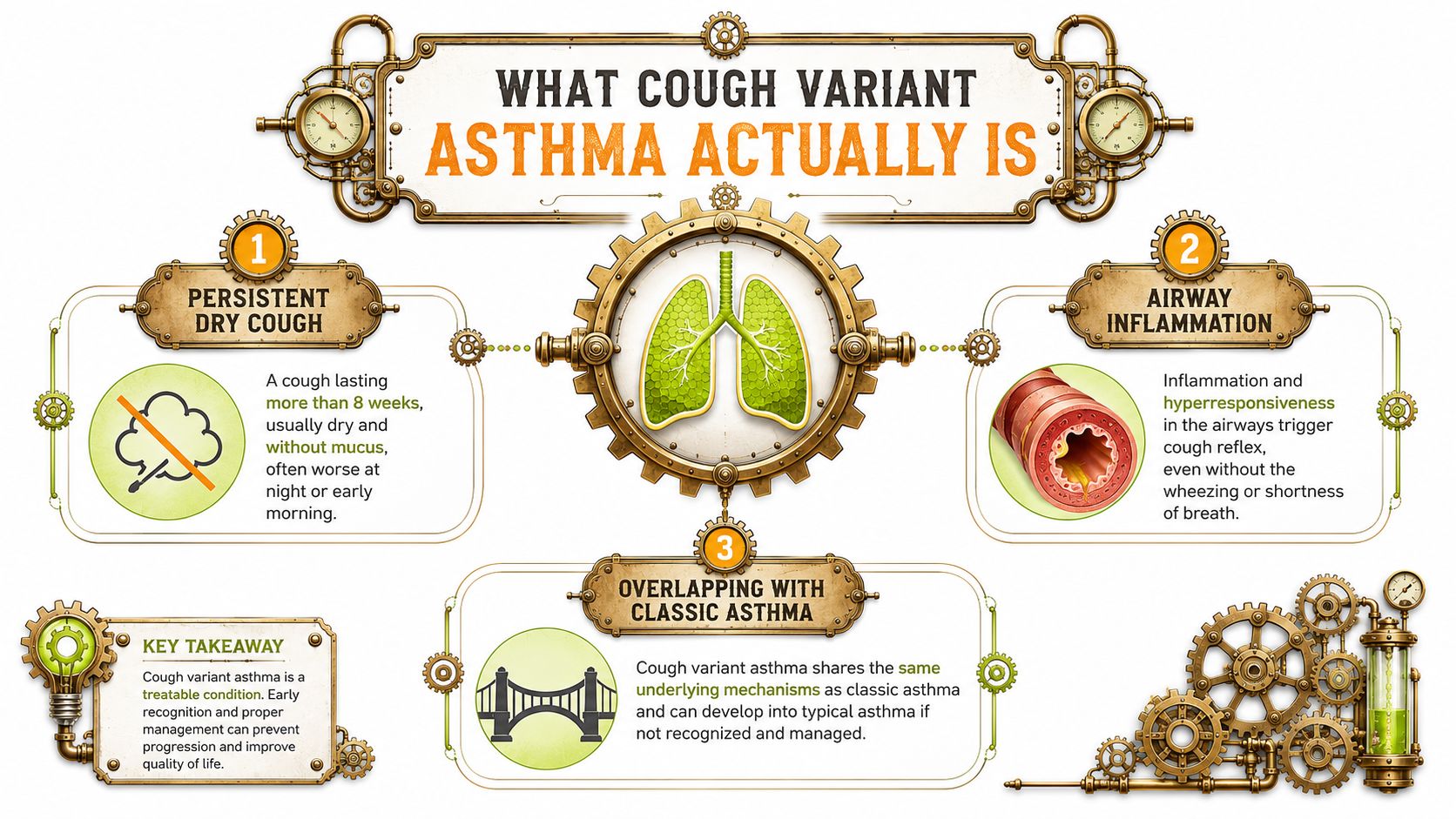
Cough variant asthma is asthma that hides behind one stubborn symptom, a long-lasting dry cough. It's still asthma, but it doesn't always come with the wheeze, chest tightness, or breathlessness people expect. [1]
A helpful way to think about it is this. The airways act a bit like a smoke alarm that's too sensitive, they react to harmless triggers as if there's trouble. That overreaction is linked with airway hyperresponsiveness and eosinophilic inflammation. [1][5]
For someone living with it, the cough can feel baffling. A busy parent may notice it after a cold, then hear it every night for weeks, with no fever and no mucus. That pattern often gets blamed on a lingering virus, but cough variant asthma deserves a proper look, especially because asthma is underdiagnosed in many patients and chronic cough is a common reason people see a GP. [1]
Practical rule: a cough that sticks around and reacts to triggers is worth investigating, even if breathing feels normal between episodes.
This condition has been recognised for decades. Glauser first described it in 1972, and Corrao later refined the concept in 1979. [2] Since then, it's become clear that cough variant asthma is not a minor footnote, it's a real asthma pattern with its own diagnostic journey.
The important part for patients is simple. If the cough is dry, persistent, and keeps coming back, especially at night or with exercise, it should not be dismissed as “just a cough”. A proper asthma assessment can uncover a treatable cause, and early treatment can help prevent the condition from drifting into classic asthma later on. [2][3]
How Cough Variant Asthma Differs From Typical Asthma
Cough variant asthma can be puzzling because it does not always look like the asthma people expect. Typical asthma often makes itself obvious. Cough variant asthma is quieter. The cough is the main clue, while wheeze, chest tightness, and shortness of breath may be absent or so mild that they are easy to overlook. [1][5]
One useful perspective is that the airways behave like an over-sensitive smoke alarm. They react to cold air, exercise, or other triggers as if there is a bigger problem, even when the person feels mostly well between episodes. That is why doctors ask careful questions about timing, triggers, and what tends to make the cough worse. A cough that comes on with cold air, exercise, or at night points more towards asthma-type airways than towards a short-lived infection. Other common causes still need checking, though, especially post-nasal drip, reflux, and ACE inhibitor side effects.
| Condition | Main symptom | Typical triggers | Key clue for diagnosis |
|---|---|---|---|
| Cough variant asthma | Dry, persistent cough | Cold air, exercise, allergens, infections | Cough may improve with asthma treatment and show airway hyperresponsiveness [1][5] |
| Typical asthma | Wheeze, cough, chest tightness, breathlessness | Similar triggers, often more obvious during flare-ups | Clear asthma symptoms plus lung function changes |
| Other chronic cough causes | Cough with another main complaint, such as throat clearing or reflux symptoms | Post-nasal drip, reflux, medicines, irritants | The pattern points away from asthma once the history and tests are reviewed |
The difference also shows up in basic tests. In cough variant asthma, peak flow can be near normal between episodes, so a day that looks fine does not rule it out. That is one reason airway tests and inflammation markers matter more than a quick listen with a stethoscope. In UK primary care, that often means spirometry and FeNO, followed by a trial of inhaled corticosteroid if the history fits. If someone also needs a reliever, a guide to a Ventolin inhaler can help make sense of how it is used alongside other asthma treatment, see this overview of Ventolin inhalers.
Important point: if the cough is the only symptom, the diagnosis can still be asthma.
For readers, the main takeaway is reassurance with realism. You do not need to diagnose yourself, but you do need the right question asked. If your cough has hung around and nothing else explains it, cough variant asthma belongs on the list.
Real Life Scenarios That Bring Cough Variant Asthma to Life
A shift-working nurse may notice the problem first on night duty. She starts coughing on the ward, then again on the bus home, and colleagues joke that she's “picked up another bug”. The cough becomes worse when she laughs, talks for long periods, or steps outside into cold air after a late shift.
She isn't feverish. She isn't bringing up mucus. She just has a dry, irritating cough that keeps returning. Once a GP considers asthma-style airway reactivity, a review of symptoms and testing can make the pattern make sense.
A gym-goer can have a similar story. He's fit, never smoked, and assumes asthma would have shown itself years ago if it were there. Yet every spin class ends with coughing, especially in a chilly room, and he starts dreading workouts that used to feel easy.
Both people may feel annoyed more than unwell. That's part of why cough variant asthma gets missed. The body can look fine on the outside while the airways are acting up underneath.
A cough that's worse at night, after exercise, or in cold air should always raise a question. So should a cough that has no infection signs and keeps coming back after “a lingering cold”.
Pharmacist's tip: if a cough has a clear trigger pattern, write it down for your GP. A short note about nights, exercise, and weather can be more useful than memory alone.
These examples matter because they show how ordinary life gets interrupted. People often wait because they're still working, parenting, commuting, or training. But a cough that keeps showing up in the same situations is not random, and that pattern helps clinicians decide what to test next.
How Cough Variant Asthma Is Diagnosed in the UK
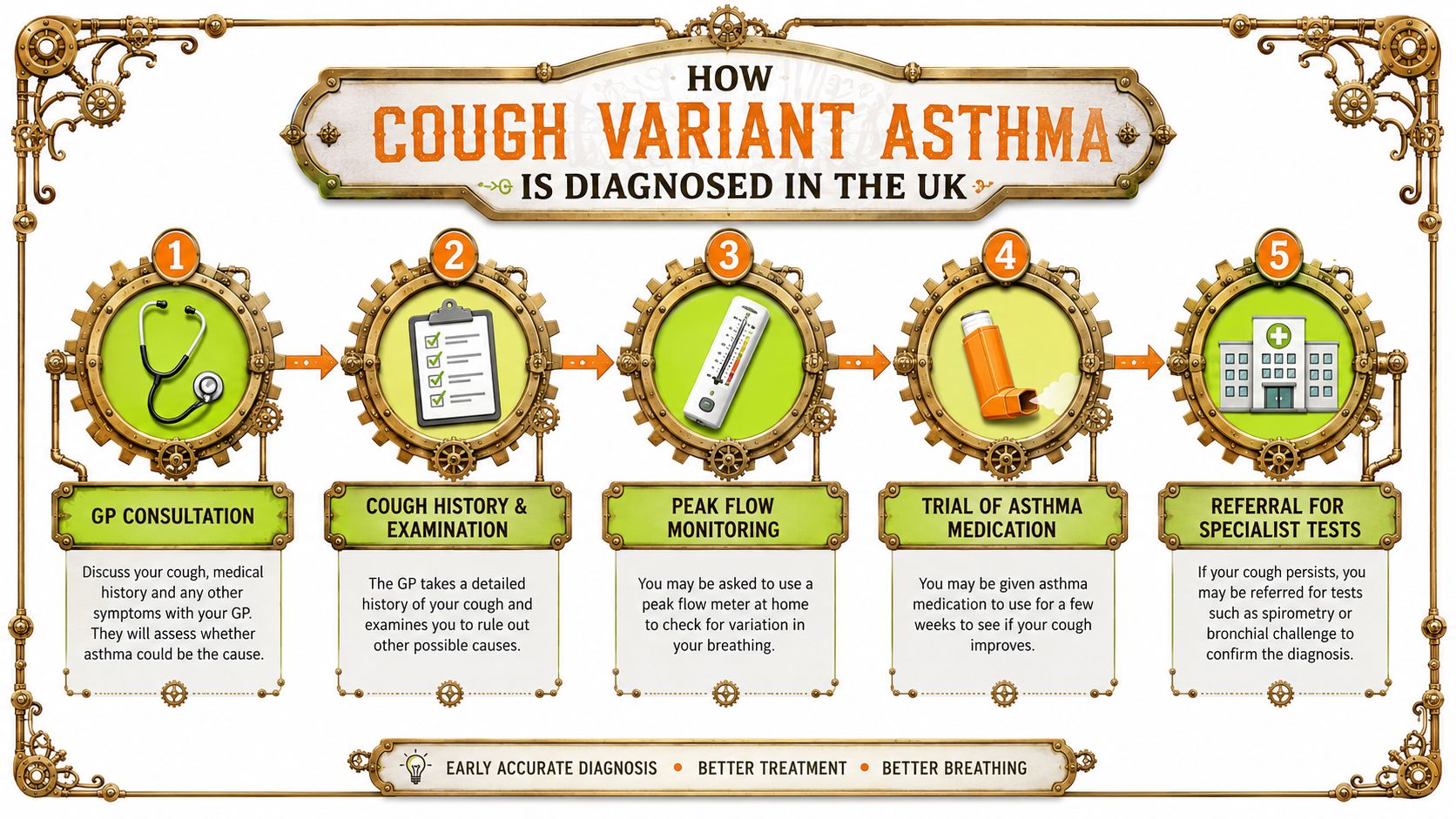
A UK GP usually begins with a careful symptom history. They may ask how long the cough has been going on, when it happens, what seems to bring it on, and whether you have noticed wheeze, breathlessness, reflux, nasal symptoms, or side effects from medicine. That history matters because cough variant asthma rarely gives a clear answer from one single test. [1][5]
From there, the next step is usually objective testing. In practice, that may include peak flow monitoring, spirometry with bronchodilator testing, and FeNO, which looks for eosinophilic inflammation. If the picture is still unclear, a specialist may arrange a methacholine challenge. [1][5]
| Test | What it measures | What an abnormal result suggests |
|---|---|---|
| Spirometry | How well air moves in and out of the lungs | Airflow limitation or reversible narrowing |
| Bronchodilator reversibility | Whether breathing improves after reliever medicine | Asthma-type airway narrowing that improves with treatment |
| FeNO | Nitric oxide in exhaled breath, a marker linked with eosinophilic inflammation | Type 2 airway inflammation that fits asthma patterns |
| Peak flow diary | Day-to-day change in airflow | Variable airways rather than a fixed lung problem |
| Methacholine challenge | How reactive the airways are to a trigger | Airway hyperresponsiveness, a key asthma feature [5] |
A GP or asthma nurse may also suggest a trial of inhaled corticosteroid. If the cough settles over the following weeks, that supports the diagnosis and treats the inflammation at the same time. In one published case series, 23 of 55 chronic-cough patients met cough variant asthma criteria, which shows how easily the condition can hide in plain sight. [5]
A chest examination may still be completely normal, and that can feel baffling. It does not mean nothing is happening. It usually means the problem needs the right kind of test, not just a quick listen with a stethoscope.
If the diagnosis is still uncertain, your GP may refer you for specialist review. For broader context on UK asthma care pathways, this can help you see how cough variant asthma fits into the wider picture of asthma assessment.
Treatment Options and Stepwise Management
Treatment usually aims at two things, calming airway inflammation and keeping the cough under control. In practice, that starts with inhaled corticosteroids, such as beclometasone or budesonide, because cough variant asthma is still asthma at heart. Early anti-inflammatory treatment may help stop symptoms from settling into a longer pattern of cough and airway sensitivity. [3]
The usual asthma approach is stepped care. If symptoms are not controlled, clinicians may add a LABA, which is a long-acting bronchodilator, or consider a leukotriene receptor antagonist such as montelukast under the right clinical guidance. The aim is to build treatment in stages, using the lowest level that keeps the cough under control while watching how the airway inflammation behaves. [3]
Practical rule: a blue inhaler may ease symptoms, but a preventer inhaler treats the underlying inflammation.
| Treatment step | What it means | Why it matters |
|---|---|---|
| Preventer inhaler | Daily inhaled corticosteroid | Reduces airway swelling and sensitivity |
| Reliever inhaler | Short-acting bronchodilator | Helps open the airways quickly during symptoms |
| Add-on therapy | LABA or montelukast, depending on the case | Used when control is still poor |
| Treat related problems | Reflux, rhinitis, or other triggers | Helps when cough stays refractory |
| Specialist care | Referral for more complex cases | Needed if symptoms remain difficult to control |
A spacer can help the medicine reach the lungs properly, and that matters more than many people think. If you have been using inhalers for a while, a pharmacist or asthma nurse can watch your technique and correct small errors. A medicine can only work properly if it reaches the right place, and poor technique can make a strong inhaler behave like a weak one.
Monitoring also matters. Clinicians often look at how often you need a reliever, whether the cough is waking you, and whether symptoms are settling after the inhaled corticosteroid is started or adjusted. If the dose changes, the pattern of response helps show whether the airway inflammation is calming down, which is useful when cough is the only clear symptom.
The internal link on asthma medicine side effects is handy if you want to understand the practical bits of inhaler use. If a person also has persistent allergy symptoms, treating those can help reduce cough triggers too.
Self Care, Triggers, and Pharmacist Tips
Cough variant asthma often flares when the airways get irritated. Common triggers include cold air, viral infections, dust mites, pollen, strong perfumes, indoor pollutants, and exercise in chilly weather. [1][5] You may not be able to avoid every trigger, but you can reduce how often they land a punch.
Small changes help. Keep windows closed on high-pollen days if that suits you, cover your mouth with a scarf in cold weather, and try not to let dust build up in the bedroom. If you smoke, stopping is one of the most useful steps you can take for your lungs.
Pharmacist's tip: rinse your mouth after steroid inhalers. It helps reduce the chance of oral thrush.
Pharmacist's tip: use a spacer if your inhaler type allows it. It often improves medicine delivery and makes technique easier.
Pharmacist's tip: keep inhalers at room temperature, not in a freezing car or a hot windowsill. Extremes can make them harder to use properly.
The internal link on hay fever care is useful because nose and chest symptoms often travel together. A Medicines Use Review with your pharmacist can also be a sensible check-in if you're unsure whether you're using inhalers correctly.
Good self-care supports treatment, but it doesn't replace a diagnosis.
A peak flow diary can help spot patterns, especially if symptoms seem to come and go. It gives your clinician something concrete to look at rather than a vague “it's been on and off”. That can speed up the next decision.
Common Misconceptions About Cough Variant Asthma
One common myth is simple, if you can breathe fine, it can't be asthma. That's not true. People with cough variant asthma can have a normal chest exam and still have reactive airways that only show up on testing. [5]
Another myth is that a months-long cough is just a stubborn virus. Sometimes a viral infection starts the problem, but chronic cough that lingers deserves a wider look. Cough variant asthma is a meaningful cause of chronic cough in adults, so it sits high on the list for a reason. [1]
Some people also think they only need a blue inhaler when they cough. That misses the point of preventer treatment. A reliever can help symptoms, but it does not control the underlying inflammation that keeps the cough coming back. [3]
And no, inhaled steroids aren't “addictive” in the way people sometimes fear. They're a cornerstone of asthma control, and they work because they reduce airway swelling rather than just masking the cough. The goal is steadier breathing, fewer flare-ups, and less need to chase symptoms.
When to Seek Help, Red Flags, and Key Takeaways
| Red flag | Where to seek help |
|---|---|
| Severe breathlessness | Call 999 or go to A&E |
| Wheeze or cough not easing with reliever | NHS 111 or urgent same-day GP advice |
| Blue lips or fingertips | Call 999 immediately |
| Coughing blood | A&E or urgent medical review |
| Chest pain | NHS 111, urgent GP, or A&E if severe |
| Exhaustion from coughing fits | Same-day GP advice or NHS 111 |
| Possible inhaled foreign body | A&E urgently |
Cough variant asthma is a real asthma pattern, not a loose label for “a cough that won't go away”. It often shows up as a dry cough with no wheeze. [1][5]
The diagnosis usually needs more than one clue, such as history, spirometry, FeNO, peak flow, or a treatment trial. Early inhaled steroid treatment can matter, especially when symptoms keep returning. [3]
If your cough has lingered, triggered by exercise or cold air, it's worth a proper review. The right plan can stop the guessing. It can also stop repeated rounds of cough syrup that never really fit the problem.
FAQs
Can cough variant asthma go away?
It can improve well with treatment, but some people need ongoing management. The important part is keeping inflammation under control so the cough doesn't keep cycling back.
Do children get cough variant asthma?
Yes, children can get it too. A cough that keeps returning, especially at night or with exercise, deserves medical review.
Can it be diagnosed without spirometry?
Sometimes, yes, but spirometry is often part of the work-up. Doctors may also use FeNO, peak flow records, or a trial of inhaled corticosteroid.
Is cough variant asthma the same as a normal asthma attack?
No, it often looks milder because the cough is the main symptom. The underlying airway problem can still be very real.
Will a blue inhaler fix it on its own?
Usually not for long-term control. A preventer inhaler treats the inflammation that keeps the cough going.
Should I worry if my cough is the only symptom?
You should take it seriously, especially if it's lasted weeks. A single symptom can still be asthma, and that's worth checking.
Does FeNO always confirm asthma?
No, it doesn't always give a clear answer on its own. It's one piece of the puzzle, not the whole picture.
Can reflux or hay fever make it worse?
Yes, they can add to the irritation and confuse the picture. That's why doctors often check for more than one cause.
If you're living with a cough that keeps coming back, don't keep guessing at it. Courier Pharmacy can support people with asthma medicines and practical online prescribing routes, which may be useful if you already have a diagnosis and need ongoing help. Visit Courier Pharmacy to see the services they offer and speak with a pharmacy team about the next sensible step.
Summary
Cough variant asthma is asthma that mainly shows up as a dry cough.
It can be easy to miss because wheeze may never appear.
UK doctors often use history, spirometry, FeNO, and a treatment trial to help confirm it.
Preventer inhalers matter because they treat the airway inflammation.
Trigger control and good inhaler technique can make daily life easier.
Seek urgent help if breathing becomes hard or red flags appear.
Meta description: Cough variant asthma causes a dry, lasting cough without wheeze. Learn UK diagnosis, tests, treatment, triggers, and when to seek help.
How this content was created
This article was written from verified clinical data, then checked against UK-facing asthma guidance and peer-reviewed review sources. It was edited to keep the language plain, the safety advice clear, and the numbers strictly limited to verified figures.
Byline
Written by Courier Pharmacy Health Content Team, UK patient education writers.
Clinical review by a UK-registered pharmacist or prescribing clinician.
Internal links suggested
- Asthma
- Ventolin inhalers guide
- Mast cell activation syndrome
- Asthma medication side effects
- Hay fever
References
[1] Major review on cough variant asthma and chronic cough prevalence, PMC. https://pmc.ncbi.nlm.nih.gov/articles/PMC12180285/
[2] Bibliometric review and historical description of cough variant asthma, PMC. https://pmc.ncbi.nlm.nih.gov/articles/PMC11162189/
[3] GPnotebook, cough variant asthma. https://gpnotebook.com/en-GB/pages/respiratory-and-chest-medicine/cough-variant-asthma
[4] Review on progression risk and related clinical patterns, PMC. https://pmc.ncbi.nlm.nih.gov/articles/PMC3182093/
[5] PubMed case series on methacholine testing and beclomethasone response. https://pubmed.ncbi.nlm.nih.gov/9656061/


