Delay Period Pill: A Clear UK Guide to Norethisterone
Delay period pill explained for the UK: how norethisterone works, safe dosing, side effects, and how to access it through a regulated online pharmacy.

You've booked the wedding, holiday or big sporting event. Then you check your calendar and spot the problem: your period is due at exactly the wrong time. A delay period pill can postpone bleeding for a short time, but it's a prescription medicine, not a quick over-the-counter fix. In the UK, the main option is norethisterone, usually taken as 5 mg three times daily after a suitability check. This guide explains how it works, when to start it, possible alternatives, safety warning signs and how regulated online access works. It also explains why the right medicine depends on your health, not only your plans.
Five key takeaways
- Main medicine: Norethisterone is the only progestogen licensed in the UK specifically for delaying periods.[1]
- Usual schedule: The standard regimen is one 5 mg tablet three times daily.[1]
- Timing matters: Start at least three days before your expected period.[1]
- It isn't contraception: Use another form of contraception if pregnancy prevention matters.[2]
- Safety comes first: A prescriber must check your medical history, medicines and clot risk.
What the delay period pill is and who it is for
A wedding, long-haul holiday or key sporting event can make period timing feel especially inconvenient. The delay period pill is a short course of prescription medicine, most commonly norethisterone, that temporarily postpones the bleed.
Your womb lining usually sheds when progesterone levels fall at the end of a cycle. Norethisterone acts like progesterone, helping keep that lining in place until you stop the tablets. Bleeding then usually returns after treatment ends.
In the UK, norethisterone is the central clinical reference for period delay because it's specifically licensed for this use. NHS Specialist Pharmacy Service guidance says treatment should start at least three days before the expected period, and it can continue for up to three to four weeks if needed, subject to clinical advice.[1]
Norethisterone suits some adults who aren't pregnant and don't have a medical reason to avoid it. It doesn't suit everyone, however. A clinician needs to consider your health, medicines, cycle dates and pregnancy possibility before prescribing. The UK period-delay treatment information can help you understand the consultation pathway.
Important distinction: Norethisterone delays bleeding, but it doesn't prevent pregnancy and isn't emergency contraception.
It also isn't the same as a combined oral contraceptive. Some people can delay a bleed by taking their combined pill packets back-to-back, but that depends on the pill and their health history. A progestogen-only period delay option isn't usually the same as a standard contraceptive pill.
You'll find practical guidance below on the dose, start date, alternatives, safety checks and regulated UK access. The aim is simple: help you make a safer, informed decision before an important date.
How norethisterone works and how to take it
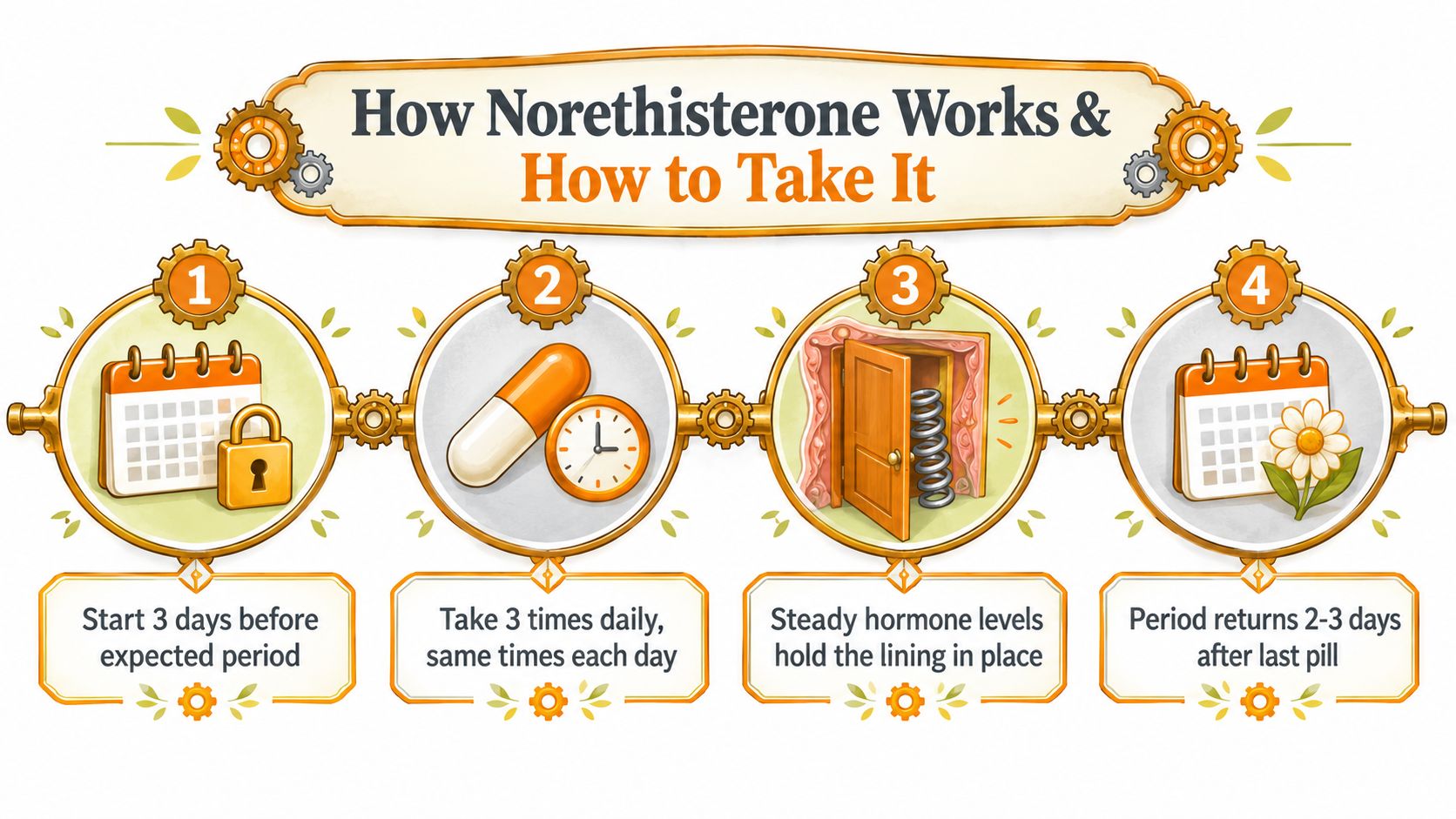
Think of the womb lining as a door. A steady progesterone-like signal acts like a spring holding that door open. When the signal drops, the door closes and the lining sheds. Norethisterone provides that temporary signal, so the bleed usually waits until the course ends.
The standard UK regimen is one 5 mg tablet three times a day, taken at roughly even intervals. Many people find it easier to link doses with breakfast, late afternoon and bedtime, but follow the directions on your prescription. Swallow the tablet whole with water.
The dose doesn't change because someone weighs more or less. Don't increase it, double a missed dose or extend the course without speaking to the prescriber.
Choose the start date carefully
Start norethisterone at least three days before your period is due.[1] For example, if you expect bleeding to begin on Tuesday, starting on the Saturday before gives the medicine the recommended lead-in time. Starting after bleeding has begun may not work as intended.
UK patient information commonly describes postponement for up to 17 days, which means a course lasting about 20 days when treatment starts three days before the expected period.[2] NHS Specialist Pharmacy Service guidance gives a broader possible treatment window of up to three to four weeks when clinically needed, so longer use requires prescriber advice rather than self-management.[1]
After your final tablet, bleeding usually returns within three days, according to NHS guidance and product information.[1][3] Some patient information describes a return within two to four days. Your prescriber can explain what to do if bleeding doesn't return as expected.
For practical product information, see norethisterone 5 mg tablets. Keep your prescription and leaflet nearby, especially if you're travelling.
Pharmacist's tip: Put all three daily doses in your phone calendar before your course begins. A repeating alarm can prevent an evening dose from slipping your mind.
Delay period pill alternatives worth considering
Norethisterone is useful for a one-off planned event, but it isn't the only route. The best alternative depends on whether you already use contraception, need heavy-bleeding treatment or want longer-term cycle control.
| Option | How it delays or affects your period | Best suited for |
|---|---|---|
| Combined oral contraceptive pill | Some users take active pills back-to-back and skip the pill-free or placebo interval | Someone already using, or medically suitable to start, a combined pill |
| Progestogen-only pill | Usually designed for contraception, not planned short-term period delay | Someone seeking contraception rather than event-based delay |
| Hormonal coil | May make periods lighter or stop them over time | Someone wanting longer-term contraception and bleeding reduction |
| Tranexamic acid | Reduces heavy menstrual bleeding but doesn't delay the period | Someone whose main problem is heavy bleeding |
Someone already taking a combined pill may find continuous use practical. It also offers ongoing contraception, unlike norethisterone. However, the exact instructions depend on the pill type, so check with a clinician or pharmacist rather than changing the schedule alone.
The progestogen-only pill generally isn't a reliable tool for delaying one particular period. It can change bleeding patterns, but that unpredictability makes it a poor choice for a wedding or competition date.
A hormonal coil can help over the longer term, but it isn't a quick solution for next month's holiday. It requires a fitting appointment and may take time to settle. Tranexamic acid has a different purpose. It can reduce heavy flow, but it doesn't hold the period back.
If heavy bleeding drives your decision, explore heavy-period treatment options with a clinician. The right choice should balance timing, contraception, convenience and safety, rather than focus only on whether bleeding stops.
Pharmacist's tip: Tell the prescriber what you want to achieve. “I need to avoid bleeding for a wedding” leads to a different discussion from “my periods are too heavy every month.”
Side effects, safety and who should avoid it
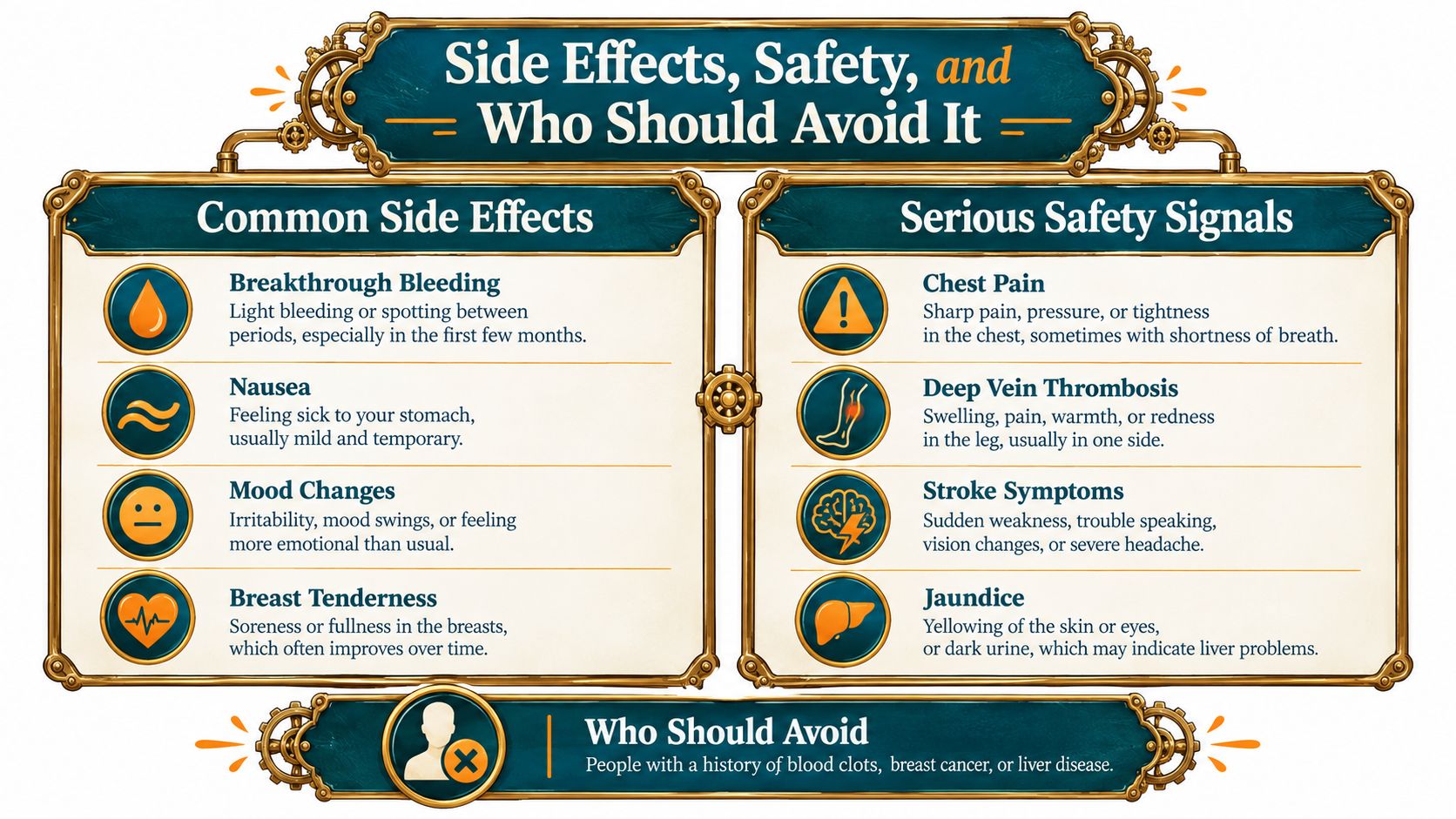
Norethisterone can cause hormone-related effects. Common problems include breakthrough bleeding, bloating, breast tenderness, headache, nausea and mood changes. These effects often settle, but tell your prescriber if they feel severe or continue.
The more important question concerns suitability. A British Journal of Family Planning paper notes that norethisterone doses of 10 mg or more per day may increase venous thromboembolism risk, meaning blood clots in veins. The usual period-delay regimen is 15 mg per day, so a prescriber should take clot risk seriously.[4]
Clot risk needs an individual check
Tell the prescriber if you have any of the following:
- Migraine with aura, including visual or neurological warning symptoms.
- Smoking, particularly if you're over 35.
- BMI above 30, or other factors that raise clot risk.
- A personal or family history of blood clots.
- Thrombophilia, a condition that makes clotting more likely.
- Recent surgery or reduced movement.
- Current or recent use of certain oestrogen-containing contraceptives.
Norethisterone alone has a different and lower clot profile from combined contraceptive pills, but that doesn't make it suitable for everyone. The prescriber should weigh your full history rather than rely on one risk factor in isolation.
Norethisterone may also be unsuitable with pregnancy or suspected pregnancy, unexplained vaginal bleeding, active liver disease, known or past breast cancer, or porphyria. NHS patient information confirms that the medicine isn't suitable for everyone.[5] You can also discuss relevant hormone treatment questions through women's health support, although hormone replacement therapy isn't a substitute for period-delay treatment.
Know the urgent warning signs
Stop taking the tablets and seek same-day medical help if you develop:
- A painful, swollen or unusually warm calf.
- Sudden chest pain or breathlessness.
- A severe headache, migraine with aura or new neurological symptom.
- Sudden changes in vision.
- Yellow skin or yellowing in the whites of your eyes.
Call NHS 111 for urgent advice, or go to A&E for severe chest symptoms, major breathing difficulty or possible stroke symptoms. Routine nausea, bloating or mild spotting usually needs a prescriber discussion rather than emergency care.
Pharmacist's tip: Never hide smoking, migraine, weight, previous clots or family history during an online consultation. Those details help the prescriber choose safely.
Real-life scenarios for using the delay period pill
A planned event makes the timing easier to understand. These examples are illustrations, not personal prescriptions. A clinician must confirm that treatment suits the individual.
A bride planning a Greek honeymoon
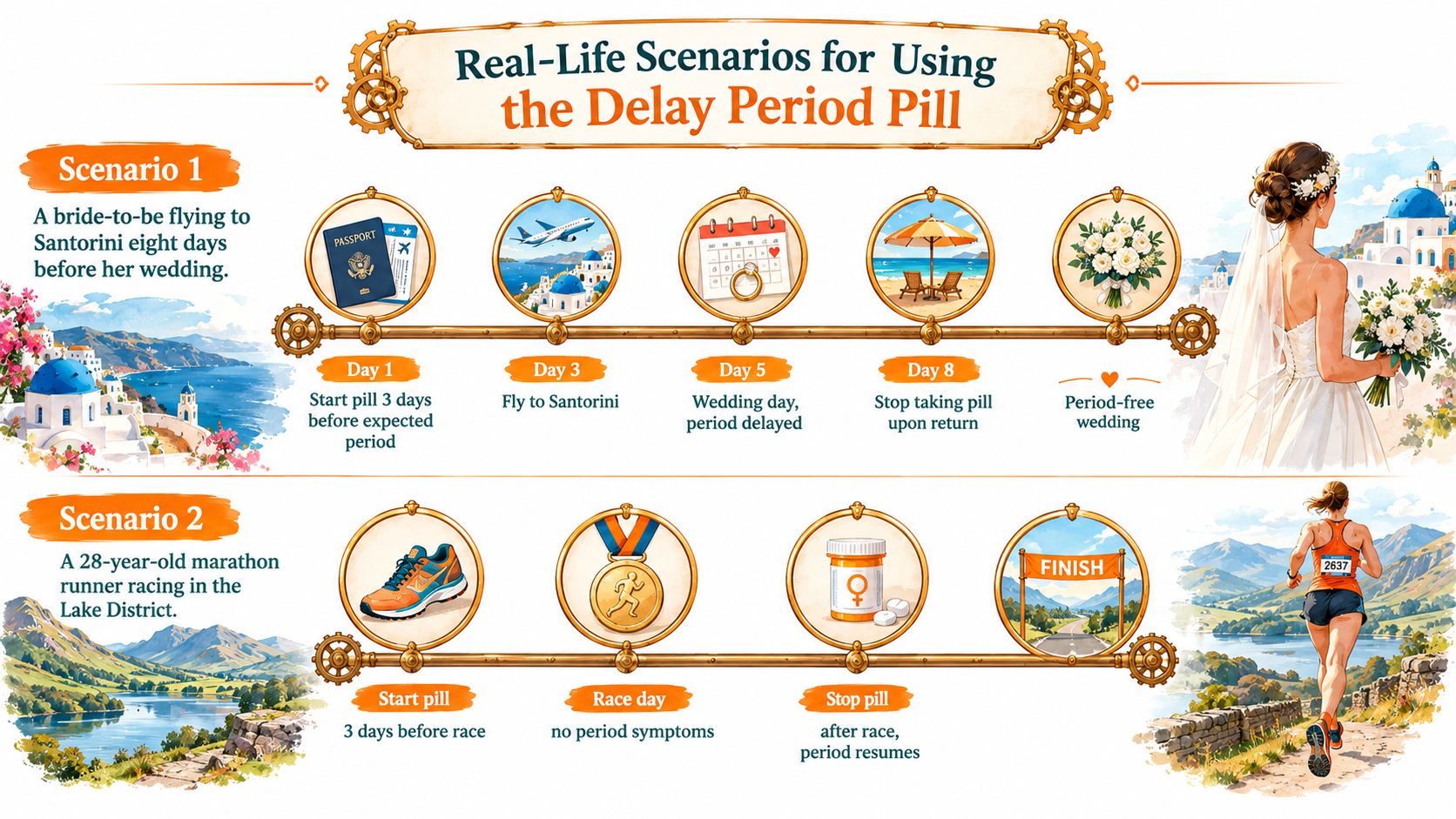
A 32-year-old bride flies to Santorini eight days before her wedding. Her period is due on day two of the honeymoon. After a clinical assessment, she plans to start norethisterone three days before that expected date.
She takes 5 mg three times daily, keeps the tablets in her hand luggage and allows for possible spotting, breast tenderness or cramps. She may ask a pharmacist whether ibuprofen suits her, rather than assuming every painkiller is safe for her health history. She plans to stop after the event, following the prescribed course, with bleeding expected soon afterwards.
Her checklist looks like this:
- Start day: Three days before the expected period.
- Stop day: The date agreed with the prescriber.
- Expected bleed: Usually within a few days after stopping.
- Pack: Tablets, prescription details, water and sanitary products.
- Urgent trigger: Calf swelling, chest pain, breathlessness or vision changes.
A competitive swimmer facing a major event
A 24-year-old competitive swimmer has a championship date that clashes with her expected cycle. She begins the prescribed course three days before the expected period, not on the morning of the event. She keeps her dosing times consistent, drinks normally and prepares for possible breast tenderness or spotting.
She doesn't plan to repeat the course every month. After the event, she speaks with her GP about longer-term options if cycle timing repeatedly affects training or competition.
Her planning list is similar:
- Start: At least three days before the expected bleed.
- During competition: Keep doses at agreed times.
- Afterwards: Stop only as prescribed.
- Pack: Medication, spare period products and the prescriber's advice.
- Escalate: Seek urgent help for clot or severe neurological symptoms.
Accessing the delay period pill through a UK online pharmacy
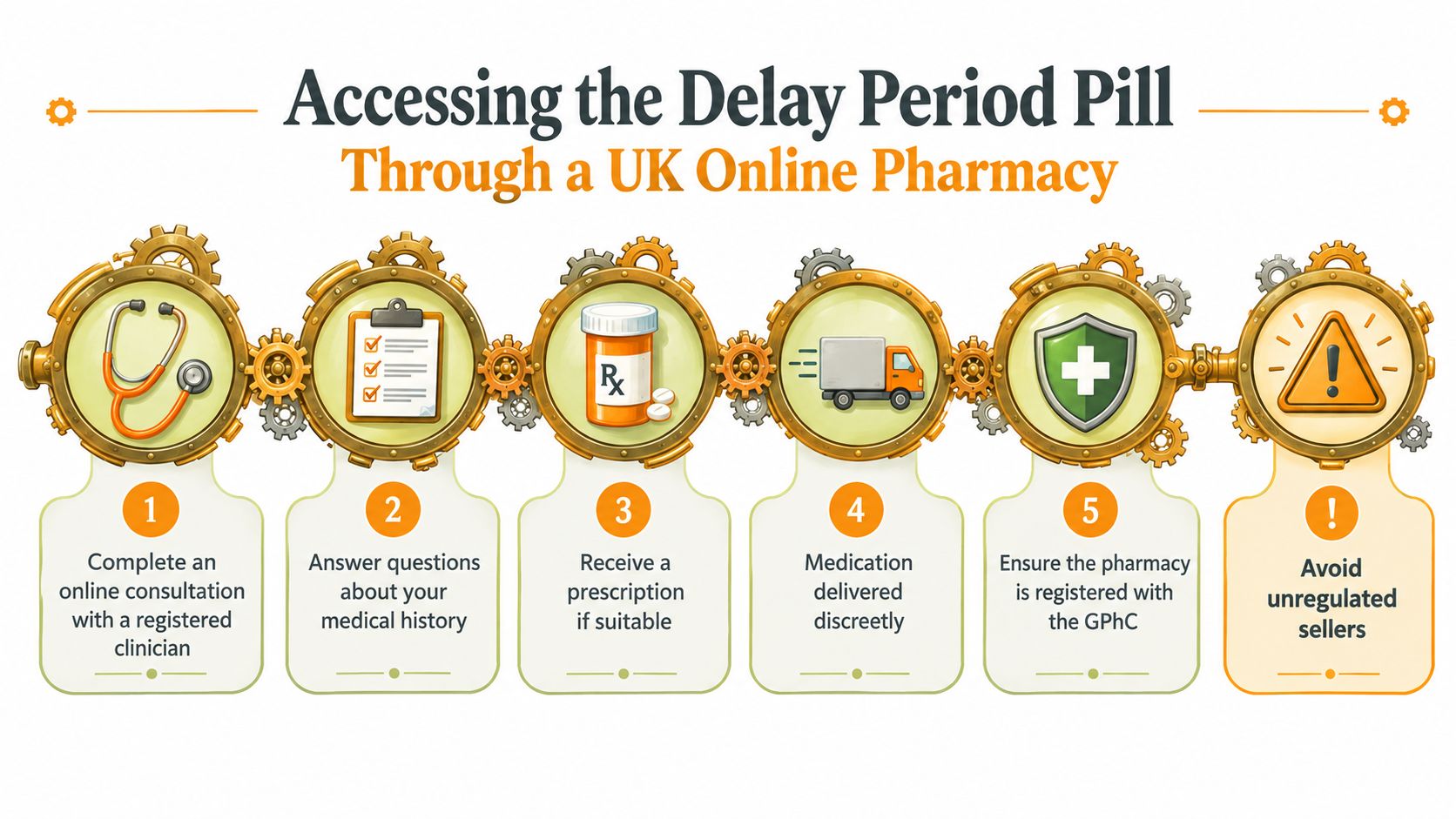
A regulated online pharmacy should treat period delay like any other prescription request. It shouldn't sell tablets without checking whether they're safe for you.
Start by checking the service's credentials. Look for a General Pharmaceutical Council registration, a visible superintendent pharmacist, a UK address and clear contact details. Avoid sellers that offer prescription medicine without questions, prescription review or a way to contact a pharmacist.
The online consultation
A proper consultation may ask about:
- Your age and UK delivery address.
- Your usual cycle pattern and last period date.
- Pregnancy possibility.
- Current contraception.
- Migraine, especially migraine with aura.
- Smoking status and BMI.
- Previous or family blood clots.
- Recent surgery or reduced mobility.
- Current medicines and allergies.
- Liver disease, breast cancer or unexplained bleeding.
Answer every question accurately. The prescriber may ask for clarification by secure message or phone. A UK-registered prescriber then decides whether norethisterone is suitable, whether another option fits better or whether you need face-to-face care.
Ordering and delivery
Check the full price before payment. Prescription-only medicine can't be bought over the counter in the UK, and the total cost may include the consultation, medicine and delivery. Dispatch choices vary between services, so don't leave the request until the day before your period is due.
A legitimate service should explain delivery timing, packaging and signature or identification requirements. Discreet packaging can help protect privacy, but it doesn't replace clinical checks. For more information about the pathway, see how a UK online pharmacy works.
After your order arrives
Read the label and patient leaflet before the first dose. If you miss a dose, follow the leaflet or contact the dispensing pharmacist. Don't take extra tablets to compensate unless a clinician tells you to.
Breakthrough spotting can happen. Contact the prescriber if bleeding becomes worrying, symptoms feel severe or your expected bleed doesn't return as advised. A face-to-face GP review makes sense if your periods are repeatedly irregular, unusually heavy or difficult to predict.
Pharmacist's tip: Check the pharmacy's registration before completing the consultation, then save its contact details. You'll know where to ask about a missed dose or unexpected symptom.
Key takeaways and when to seek help
Keep these five points in mind:
- Norethisterone is the standard UK delay period pill. It's licensed specifically for postponing periods.[1]
- The usual dose is 5 mg three times daily. Take it at consistent times.
- Start at least three days before your period is expected. Late starts may not work.
- Treatment is temporary. UK information commonly describes postponement for up to 17 days, with a course of about 20 days when started three days early.[2]
- Use a regulated access route. A UK prescriber should review your medical history before approval.
Mild effects can include bloating, breast tenderness, mood changes and breakthrough bleeding. These usually call for routine advice, especially if they're troublesome.
Stop the tablets and seek urgent medical help for calf pain or swelling, sudden chest pain, breathlessness, a severe one-sided headache, migraine with aura, vision changes, jaundice or other signs of a blood clot. Use NHS 111 for urgent guidance and A&E for severe breathing or chest symptoms.
Don't use norethisterone without medical advice if you have clot risk factors, unexplained vaginal bleeding, known or suspected pregnancy or active liver disease. The pill delays a period for a short time. It doesn't provide long-term cycle control or contraception.
Courier Pharmacy offers an online consultation for norethisterone 5 mg tablets, with review by a UK-qualified prescriber when appropriate. If you're planning travel, a wedding or a sporting event, visit Courier Pharmacy early enough for a safe suitability review.
Frequently asked questions
What is the delay period pill?
In the UK, the main delay period pill is norethisterone. It's a prescription progestogen used to postpone menstrual bleeding for a short time.
How much norethisterone do you take to delay a period?
The standard UK regimen is one 5 mg tablet three times daily, totalling 15 mg each day.[1] Follow the instructions on your prescription and don't change the dose yourself.
When should I start norethisterone?
Start treatment at least three days before your expected period.[1] Starting later may reduce the chance of successful delay.
Is norethisterone contraception?
No. Norethisterone period-delay treatment isn't contraception, so use another suitable contraceptive method if you could become pregnant.[2]
How soon does bleeding return after stopping?
Bleeding usually returns within about three days after the final tablet, according to NHS guidance and product information.[1][3] Individual timing can vary, so contact your prescriber if you're concerned.
Can I buy norethisterone over the counter?
No. Norethisterone is prescription-only in the UK.[2] You need an assessment and prescription from an appropriate UK prescriber.
Who shouldn't take norethisterone?
It may be unsuitable if you're pregnant or might be pregnant, have unexplained vaginal bleeding, active liver disease, known or past breast cancer, porphyria or clot risk factors. A prescriber must assess your personal history.
What side effects can the delay period pill cause?
Possible effects include nausea, headache, bloating, breast tenderness, mood changes and breakthrough bleeding. Seek urgent help for chest pain, breathlessness, calf swelling, severe headache, visual changes or yellowing skin.
Can I use norethisterone every month?
Don't use it repeatedly without medical supervision. If you often need to delay bleeding, speak with your GP or prescriber about contraception, heavy periods or another longer-term option.
Summary
Norethisterone is the main UK prescription medicine for delaying a period.
The usual dose is one 5 mg tablet three times daily.
Start at least three days before your expected bleed.
It isn't contraception or emergency contraception.
A prescriber must check clot risk, pregnancy possibility and other health factors.
Use NHS 111 or A&E routes for urgent warning signs.
Suggested visuals
- Timeline infographic: A brass-rail timeline showing the start date, three daily doses and bleeding after stopping. Alt text: “Timeline showing how to take norethisterone to delay a period.”
- Safety checklist: A two-column pale yellow-green and light grey board separating common effects from urgent symptoms. Alt text: “Safety checklist for norethisterone side effects and warning signs.”
- Online pharmacy flow: A steampunk-style process from consultation to prescriber review and signed delivery. Alt text: “Steps for obtaining a delay period prescription through a regulated UK online pharmacy.”
Suggested internal links
- Period delay treatment
- Norethisterone 5 mg tablets
- Heavy-period treatment
- Women's health and HRT
- UK online pharmacy services
About this article
Byline: Medical Mojo editorial team, patient-health writers.
Clinical review: Review by a UK-registered prescribing clinician or pharmacist before publication.
How this content was created: We used NHS Specialist Pharmacy Service guidance, NHS patient information, UK product information and peer-reviewed safety material. We checked the dosing, timing, licensing and safety statements against the supplied sources, then shaped the information for clear UK patient use.
Disclaimer: This article is for information only. It isn't a substitute for medical advice, diagnosis or an individual prescription decision.
References
[1] NHS Specialist Pharmacy Service (n.d.) Choosing a medicine to delay periods. Accessed 9 September 2026.
[2] LloydsPharmacy Online Doctor (n.d.) Norethisterone for period delay. Accessed 9 September 2026.
[3] Electronic Medicines Compendium (n.d.) Norethisterone 5 mg tablets patient information leaflet. Accessed 9 September 2026.
[4] British Journal of Family Planning (2016) Norethisterone and venous thromboembolism risk. Accessed 9 September 2026.
[5] NHS (n.d.) Periods. Accessed 9 September 2026.
Meta description
Delay period pill explained for UK adults. Learn about norethisterone timing, dose, safety, alternatives and regulated online pharmacy access.


