Does Naproxen Cause Weight Gain? What the Evidence Says
Does naproxen cause weight gain? Learn how fluid retention differs from fat gain, the warning signs to watch and when to contact your GP or pharmacist.
Naproxen is not a recognised cause of fat gain, and weight gain is not among its common effects on the NHS naproxen page. Fluid retention can still change the scales, and that change needs checking.
So why do people still ask, does naproxen cause weight gain, after a short course? A flat no skips the useful split. Fat builds slowly. Water can show up in days, often with puffy ankles or tight rings.
You'll learn how to tell those two apart, who needs extra care, and which signs mean same-day help. You'll also get a simple home routine and clear questions for your GP or pharmacist.
Does Naproxen Cause Weight Gain? The Short Answer
Does naproxen cause weight gain as extra body fat? No. The NHS naproxen page does not list weight gain among common effects [1]. Naproxen is an NSAID, a painkiller that also eases inflammation. The number on the scales can mean fat, or it can mean fluid.
- Not a typical fat-gain effect: Common NHS effects do not include weight gain.
- Fluid can still move the scales: Ankle, leg, foot or hand swelling is a different problem from fat.
- The class figure is not a naproxen trial rate: It covers NSAIDs as a group.
- Serious fluid problems are rare: Kidney trouble and heart failure need fast advice.
- Check a rise, don't ignore it: Rapid gain with swelling is not "just weight."
| Frequency group | Effects listed | Weight gain listed? |
|---|---|---|
| Common (NHS naproxen page) | Constipation or diarrhoea, dizziness, tiredness, bloating, stomach pain, headache, nausea or vomiting, rash, tinnitus | No |
| Less common (NSAID class leaflet) | Swollen feet or legs, weight gain | Yes, roughly 1 to 10 in 100 users across NSAIDs |
| Rare but serious | Kidney problems, heart failure with fluid retention | Fluid-related rise possible; seek urgent advice |
A South Tees Hospitals NHS leaflet puts swollen feet or legs and weight gain in the less common group, about 1 to 10 people in every 100 NSAID users [2]. That is a class estimate. It does not prove naproxen adds fat, and it is not a naproxen-only trial rate.
The NHS also says serious effects are more likely with higher doses or longer courses. Kidney problems and heart failure sit in the rare but serious group. Fluid from those problems can lift the scales without adding fat.
If you want a plain explanation of the medicine itself, start with what naproxen is. A rise on the scales can happen, usually from fluid, and it deserves a check rather than a shrug.
Pharmacist's tip: Tell your pharmacist about every other painkiller you take. NSAIDs overlap, and stacking them raises stomach and kidney risk.
How Fluid Retention Differs From Fat Gain
Naproxen is not generally linked to extra appetite or direct fat gain. UK product information does recognise fluid retention and oedema (swelling from fluid), especially if you have high blood pressure, a weaker heart, or kidneys that are already under strain [3].
Naproxen blocks prostaglandins, chemicals that help keep blood flowing through the kidneys. With less of that signal, the kidneys can hold more salt and water. Fluid then sits in the tissues. Think of a sponge soaking up water. That is not the same as a storage tank filling with fat.

The UK naproxen Summary of Product Characteristics advises caution and monitoring if you have high blood pressure or heart failure, because fluid retention and oedema have been reported with NSAID treatment [3].
| Feature | Fluid retention | Fat gain |
|---|---|---|
| Speed | Days, often after starting or changing a dose | Weeks to months |
| Where it shows | Ankles, feet, hands, face; rings or shoes feel tight | Spread across the body, often around the waist |
| What helps | Medical review of dose, kidney function and blood pressure | Sustained energy balance through diet and activity |
| Warning sign | Breathlessness, reduced urine, rapid rise with swelling | Gradual change with no swelling or breathlessness |
Say a busy parent starts naproxen for back pain and sees about 2 kg in a week, with tight ankles at bedtime. That pattern points to fluid. Call the GP.
Say a gym-goer starts it for a knee injury and the scales drift up slowly, with no swelling and a stable waist. That is less likely to be fluid. It is still worth a review, because pain and rest days change weight too.
A fast rise with new ankle, foot, hand or face swelling, tighter shoes or rings, or breathlessness needs urgent assessment. It can signal worsening kidneys or heart failure. NHS guidance lists ankle, foot or hand swelling and breathlessness among serious naproxen-related kidney or heart symptoms.
Pharmacist's tip: Weigh at the same time each morning, after the toilet and before food, on the same scale.
Other reasons your weight may change on naproxen
Weight can shift after you start naproxen without the tablet adding any fat. The scales act as a summing point: food eaten, fluid held, movement taken and sleep lost all arrive in the same number. Naproxen is one input among several, and often a small one.
Pain is the loudest input. A bad back or a flare of arthritis cuts how far you walk, and a fortnight of rest days adds up faster than many expect. Sleep goes next. Broken nights tend to pull appetite towards fast, filling food, which is why a pain flare and a change in eating so often travel together.
Medicines taken alongside naproxen matter too. A steroid such as prednisolone commonly raises appetite and holds fluid, so hunger and puffiness can arrive in the same week. Some antidepressants and antipsychotics shift weight more slowly, often over months, which makes the link easy to miss.
Some conditions bring their own swings. People with gout often rest more and eat less regularly during a flare, and our gout treatment page explains why anti-inflammatories are usually the first thing reached for.
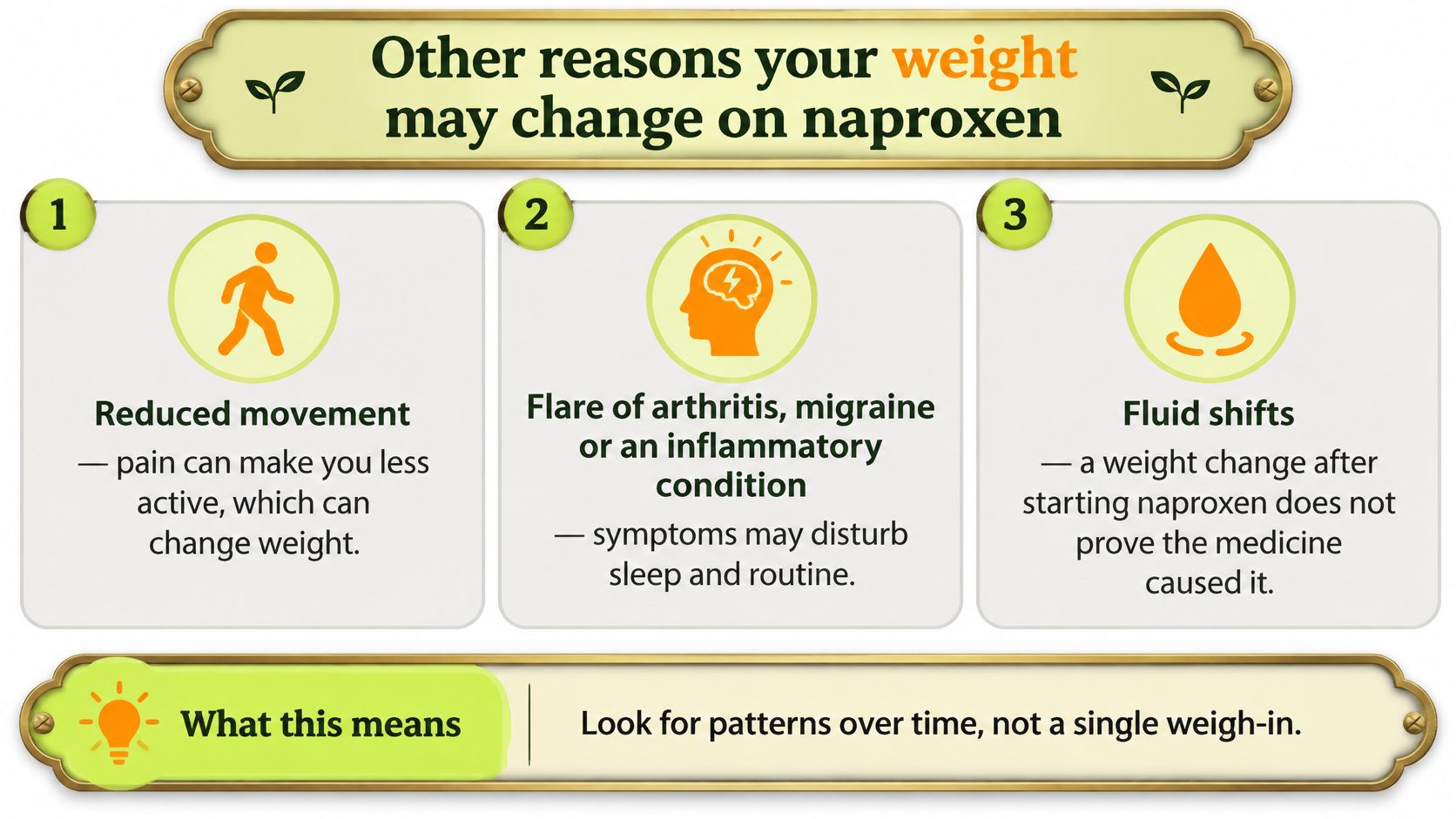
- Reduced activity: pain keeps you off your feet, so daily step counts fall.
- Poor sleep: night shifts, pain and flares all shorten it.
- Appetite changes: steroids and some mental health medicines turn hunger up.
- A pain flare: meals and routine shift for days at a time.
- Swelling from heart, kidney or liver disease: this needs a clinician, not a new diet.
UK product information flags fluid retention and oedema as recognised effects of naproxen and advises caution, with monitoring, for people who have high blood pressure or heart failure [3]. It gives no typical kilogram change, because no reliable figure exists. Both halves of that are useful. The risk is real and worth watching, and the size of it for any one person cannot be read off a leaflet.
Water can also hide real fat loss if you are following a supervised weight plan. Two weeks of flat scales with tighter rings may be fluid rather than stalled progress, and the sensible response is a review rather than a stricter diet. Note what changed each week, including swelling, sleep, appetite and activity, and take that record to your next appointment.
Who Is More Likely to Have Fluid Problems on Naproxen
Risk is not spread evenly. NICE says NSAIDs such as naproxen should be used at the lowest effective dose for the shortest possible time, with regular review [5]. That advice matters most for older adults and for anyone with higher stomach, kidney or heart risk.
What raises your risk
Your chance of fluid or kidney trouble is higher if you have kidney disease, heart failure or high blood pressure, if you have had a stomach ulcer or bleed, or if the course is long or the dose is high. Fluid balance works like a sink with two taps: naproxen can slow the drain, while a weak heart or kidney adds more water. Our page on high blood pressure is a useful backdrop if those tablets are already part of your day.
NICE lists acute kidney failure, congestive heart failure, upper gastrointestinal bleeding, stroke and myocardial infarction (a heart attack) among serious NSAID outcomes [5]. For people who still need an NSAID, NICE names naproxen up to 1,000 mg per day as one of the lower-cardiovascular-risk options. That does not remove the need for your own checks.
| Medicine or condition | Why it matters | What to do |
|---|---|---|
| Diuretics (water tablets) | May reduce their effect and affect kidney function | Ask the prescriber to check kidney function and fluid |
| ACE inhibitors or ARBs (for example ramipril or losartan) | Less effective blood pressure control and higher kidney risk | Report swelling or reduced urine early |
| Heart failure | Naproxen can worsen fluid retention | Discuss naproxen before starting it |
| Kidney disease | Higher risk of kidney injury | Use only if specifically advised |
| Lithium | Can raise lithium levels | Ask about level monitoring |
| Warfarin or other blood thinners | Higher risk of bleeding | Ask whether treatment or monitoring should change |
| Aspirin or other NSAIDs | Adds stomach and kidney risk | Do not combine without advice |
Say you're 70, you take ramipril and a water tablet, and a shoulder flare leads to naproxen. The sensible step is a kidney-function and blood-pressure check before the course runs on. People with a weaker heart may be at greater risk of fluid problems on naproxen, so a clinician should review them before a course starts.
Pharmacist's tip: Bring a full list of prescriptions, shop-bought medicines and herbal products. That list is what makes the interaction check real.
Warning signs that need urgent medical advice
Sort the signs by speed, not by how worried you feel. UK product information treats oedema, high blood pressure and heart failure as recognised NSAID risks [6]. A sudden rise with ankle swelling, breathlessness or less exercise tolerance is not a cosmetic side effect.
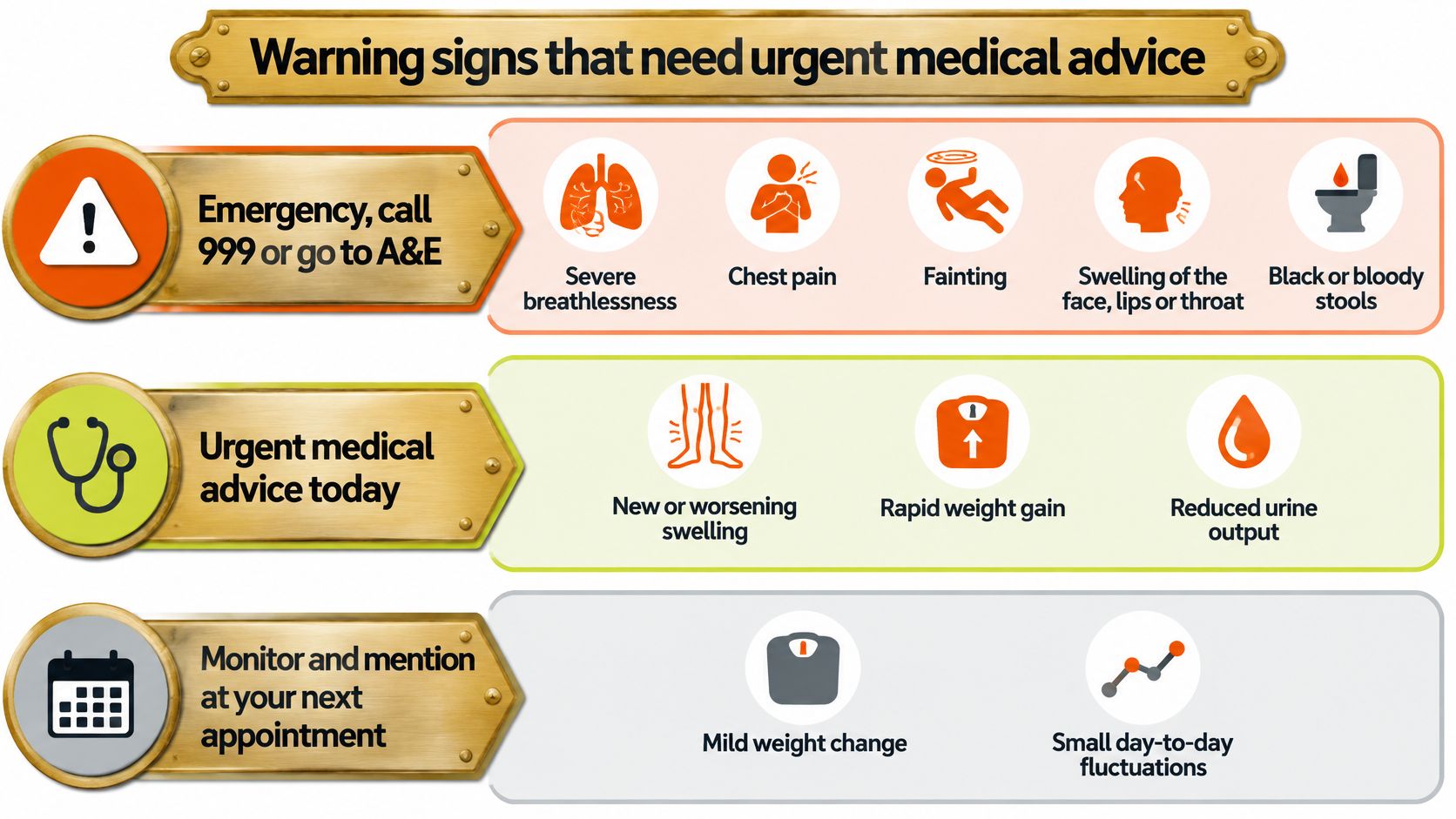
| Urgency | Symptoms | What to do |
|---|---|---|
| Emergency | Severe breathlessness, chest pain, fainting, swelling of face, lips or throat, black or bloody stools, vomiting blood | Call 999 or go to A&E |
| Urgent | Rapid weight gain with swelling of ankles, legs, feet, hands or face; reduced urine; unusual tiredness; breathlessness when lying flat | Contact GP or NHS 111 same day or next day |
| Routine | Slow weight change with no swelling and no breathlessness | Book a GP or pharmacist review |
How to use the three tiers
Emergency means don't wait for a callback. Severe breathlessness, chest pain, fainting, swelling of the face, lips or throat, black or bloody stools, or vomiting blood needs 999 or A&E.
Urgent means same day or next day with a GP or NHS 111. That includes a rapid gain plus swelling of ankles, legs, feet, hands or face, less urine, unusual tiredness, or breathlessness when you lie flat. The naproxen SmPC flags extra care if you have heart failure, high blood pressure, kidney disease, or you take diuretics, ACE inhibitors or ARBs [6].
Routine means a booked review. Slow change, no swelling and no breathlessness is the common pattern. Most weight shifts on naproxen are gradual and not fluid.
Say a retired reader finds both ankles puffy and the scales up by about 3 kg in four days. That is same-day contact, not a wait-and-see week. Don't try to manage a rapid rise with swelling on your own. It can mean oedema or a heart that is holding fluid.
Pharmacist's tip: Write each symptom with the date and time. A clinician can see the pattern in seconds.
Your monitoring routine and questions for your prescriber
Start this today if you're on a course, including for chronic pain.
- Record your baseline weight on the day you start, at the same time each morning.
- Weigh the same way two or three times a week.
- Check ankles, feet, hands and face, and note if rings or shoes feel tight.
- Note breathlessness, urine changes and unusual tiredness, with dates.
- List every medicine, including painkillers, supplements and herbal products.
- Book a GP or pharmacist review and bring the diary.
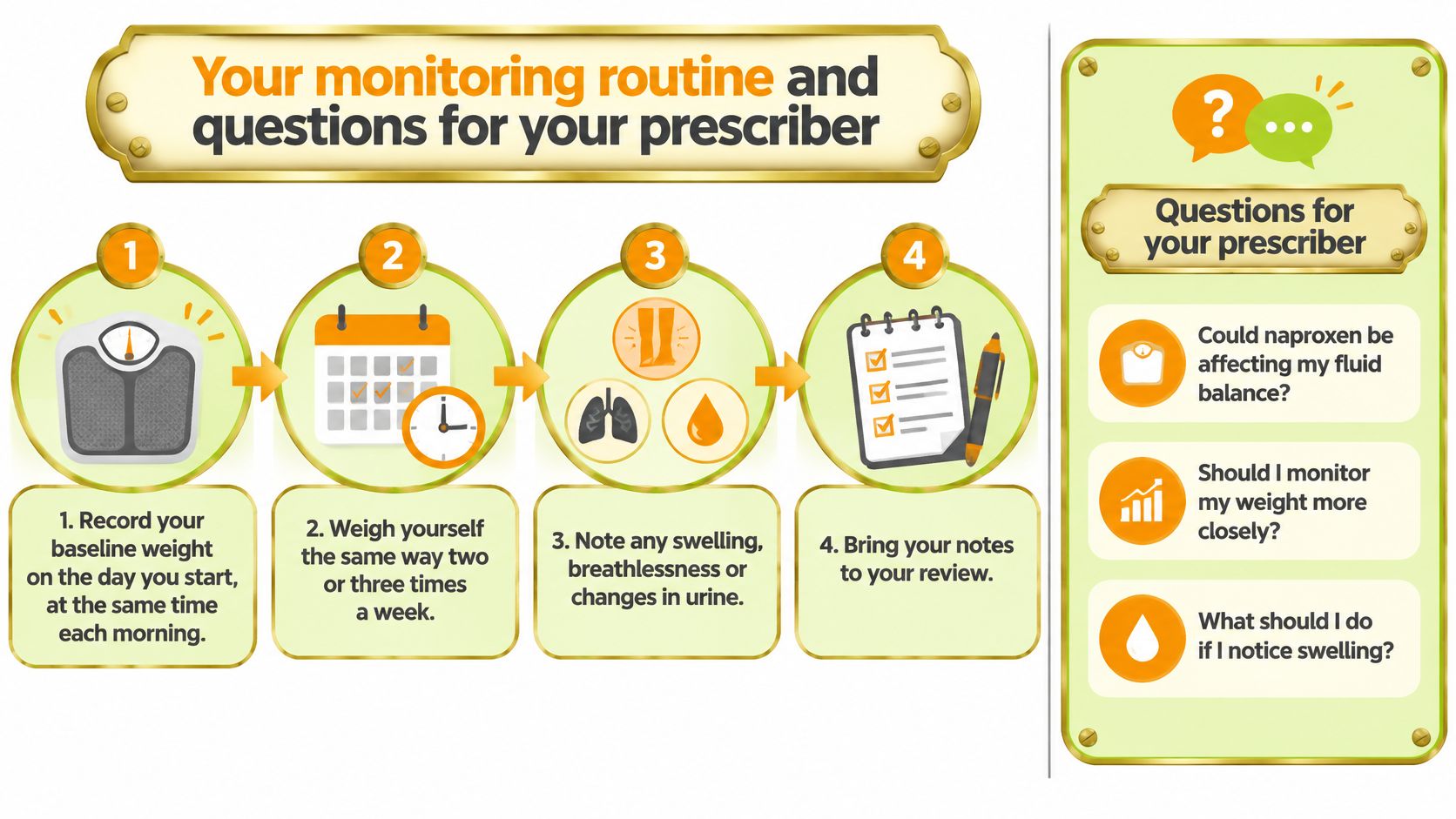
Questions worth asking
- Is naproxen still needed?
- Is this the lowest dose that works?
- Could another treatment suit me better?
- Do my kidney function and blood pressure need a check?
Don't stop or change a long-term prescribed medicine on your own. Pain control can slip, and you still won't know if the gain is fluid, a flare, or another drug. The right move is a review of timing, swelling, breathing, blood pressure, kidneys and other medicines.
Pharmacist's tip: Take the diary and the medicine list to every review, and show the same list when you collect prescriptions.
Summary and frequently asked questions
Naproxen does not directly add body fat. If the scales creep up, the better question is whether the extra weight is fluid. Fluid behaves like water trapped behind a blocked drain: it can pool in the ankles, feet, hands or face and appear quickly, while fat changes slowly over weeks. Swelling, breathlessness, less urine or unusual tiredness turn this from a side-effect question into a same-day medical one. People with heart, kidney or blood-pressure problems need a lower threshold for checking. Higher doses and longer courses carry more risk. Do not stop a long-term prescribed medicine on your own.
Can naproxen make you gain fat?
No. Fat gain is not an established direct effect of naproxen. Weight can still rise for indirect reasons: pain limits movement, sleep suffers, and other medicines or flare-ups change appetite and routine. If the scales move, check for swelling and speed before blaming body fat.
Does naproxen cause water retention?
It can. Naproxen product information lists fluid retention and oedema with NSAID treatment, particularly when the heart, blood pressure or kidneys are already under strain. A fast rise in the first days or weeks is more likely water than fat. Report unexplained gain or new swelling rather than waiting for a routine appointment.
Is a small weight change on naproxen normal?
A slow drift without swelling or breathlessness is common and rarely an emergency. Book a routine review so your prescriber can look at dose, activity, pain control and other medicines. There is no reliable typical kilogram figure for naproxen. Sudden swelling is different and needs faster advice.
Does weight come back down after stopping naproxen?
If the extra weight was fluid, it often settles once the cause is treated and the medicine is reviewed. Do not stop a prescribed course yourself to test that idea. Your prescriber should decide, because pain and the underlying illness still need a plan. Fat gained from less activity will not vanish in the week you stop.
Can naproxen cause bloating?
Yes. Bloating sits on the list of common naproxen effects, along with stomach pain. It can make you feel heavier without adding fat. If bloating comes with black stools, vomiting blood or severe pain, get urgent help. If you are comparing everyday anti-inflammatory options, see ibuprofen 400mg tablets and ask which one fits your circumstances.
When should I call NHS 111 about weight gain on naproxen?
Call NHS 111 or your GP the same day if weight rises quickly with swollen ankles, legs, feet, hands or face, if you pass less urine, or if you feel unusually tired or breathless when you lie flat. Use 999 or A&E for severe breathlessness, chest pain, fainting, face or throat swelling, or blood in vomit or stools.
If swelling, other painkillers or a long course are on your mind, Courier Pharmacy offers a secure online questionnaire reviewed by a human prescriber and supplies prescription or over-the-counter medicines where appropriate. Visit Courier Pharmacy to start that check.


