Your Guide to Using a Dry Powder Inhaler Correctly
Discover how a dry powder inhaler works and master the technique with our UK guide, plus tips on types and everyday respiratory care.

In this article
- Five key takeaways
- How does a dry powder inhaler work?
- DPI vs metered-dose inhaler (MDI)
- What are the different types of DPI?
- Single-dose DPIs
- Multi-dose DPIs
- Which type is right for you?
- How to use your dry powder inhaler
- 1. Prepare your dose
- 2. Inhale the medicine
- 3. Finish and reset
- Common technique problems and how to fix them
- How to care for your inhaler
- Keep your inhaler clean and dry
- Store your inhaler correctly
- Track your doses
- When to seek urgent help
- Getting your repeat prescriptions
- Expert support is available
- Summary
- Frequently asked questions
- Meta description
- Byline
- How this content was created
- References
A dry powder inhaler, also known as a DPI, is a breath-activated device that delivers a fine powder medicine directly to your lungs. It doesn't use any sprays or propellants like traditional aerosol inhalers. Instead, the power comes from your own quick, deep breath, which pulls the medication from the device. This makes it a simpler, more straightforward way to take your respiratory treatment. This guide will walk you through how to use your dry powder inhaler correctly, the different types available, and how to look after it to get the best results from your medicine.
Five key takeaways
- Your breath is the trigger: No need to press and breathe at the same time. A quick, deep breath in is all that’s needed.
- A strong breath is key: To get the full dose deep into your lungs, you must breathe in forcefully and quickly.
- Never shake it: Unlike aerosol 'puffer' inhalers, you should not shake a dry powder inhaler. This can stop it from working correctly.
- Keep it dry: Moisture can make the powder clump together. Store your inhaler in a dry place and never wash it with water.
- Check the dose counter: Most DPIs have a counter. Keep an eye on it to know when you need to order a new one.

How does a dry powder inhaler work?
A dry powder inhaler removes the tricky need to coordinate pressing a canister while breathing in. It works using your own breath.
Think of it like sipping a thick milkshake through a straw. You need a strong, fast pull to get the milkshake up the straw. A DPI works in a similar way. You take a quick, deep breath to pull the fine powder medicine down into your lungs where it can get to work.
This breath-activated design is a big reason why doctors and pharmacists recommend them. In the UK, where over 5.4 million people manage asthma, these devices are very common [1]. Simpler coordination often leads to patients using their inhalers more consistently, which helps them manage their condition better.
DPI vs metered-dose inhaler (MDI)
To understand what makes your DPI special, it helps to compare it to a traditional metered-dose inhaler (MDI). MDIs are the aerosol-based 'puffer' inhalers you might be more familiar with.
| Feature | Dry Powder Inhaler (DPI) | Metered-Dose Inhaler (MDI) |
|---|---|---|
| Activation | Breath-activated | Manual press-and-breathe |
| Technique | Requires a quick, deep breath | Requires slow, steady breath and coordination |
| Propellant | None | Contains a chemical propellant (HFA) |
| Spacers | Not needed | Often used, especially for children |
| Moisture | Must be kept dry | Not sensitive to moisture |
| Dose Counter | Usually built-in | Not always present |
As you can see, the main advantage of a DPI is its simplicity. It makes it easier for many people to get their medicine deep into the lungs.
What are the different types of DPI?
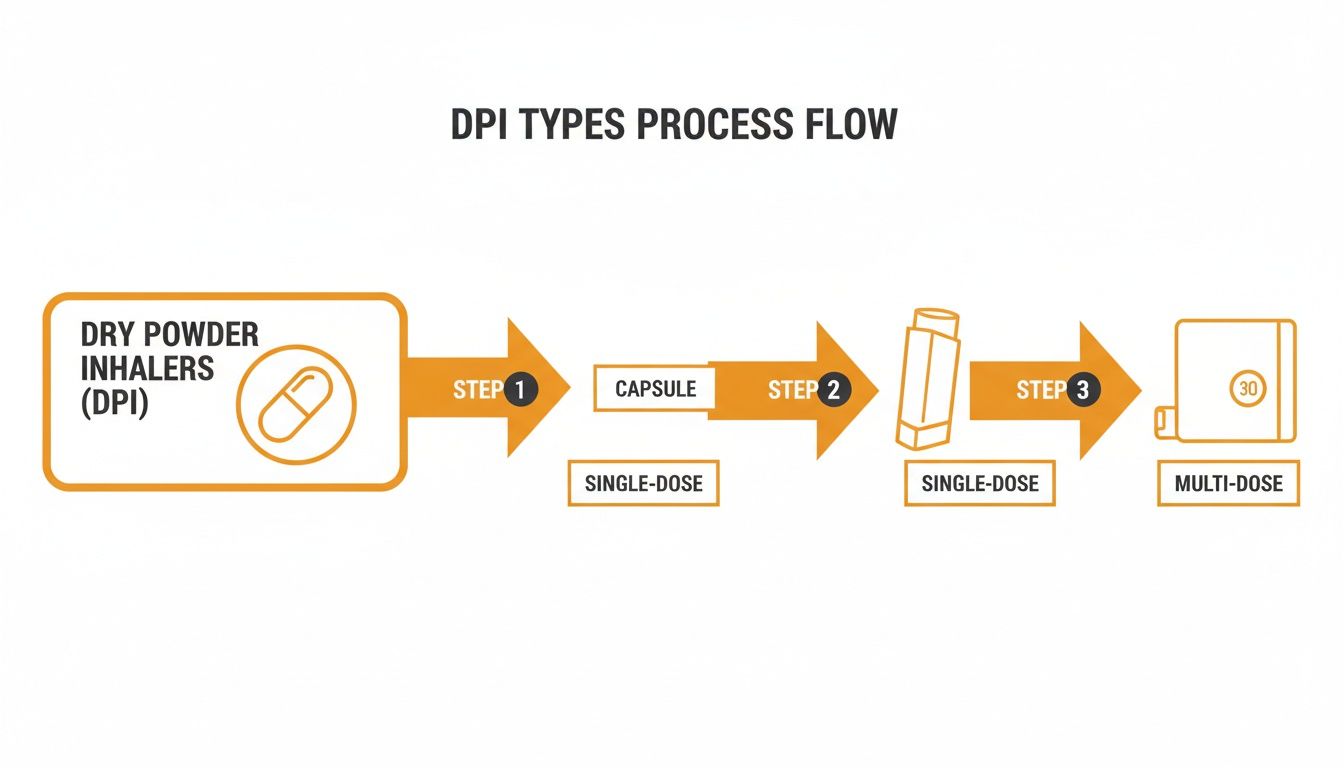
When your GP mentions a dry powder inhaler, it's not a one-size-fits-all device. There are a few different designs, but they fall into two main categories: single-dose and multi-dose inhalers.
Single-dose DPIs
Single-dose devices, like the HandiHaler or Breezhaler, require you to load a small capsule of powder into the inhaler before each use. You then press a button to pierce the capsule, which releases the powder for you to breathe in.
Some people prefer this hands-on method. It provides a clear physical confirmation that the dose is ready. For a patient who finds comfort in a set routine, like a retired person managing their COPD, the ritual of loading a capsule can be a helpful part of their daily treatment.
Multi-dose DPIs
Multi-dose inhalers are designed for convenience. Devices like the Turbohaler, Ellipta, or Diskus come pre-loaded with up to 200 doses. You simply twist a grip or slide a lever to load the next dose. Common examples include the Symbicort 100/6 Turbohaler.
This simplicity is a huge plus for many. These inhalers almost always have a clear dose counter, so you know exactly how much medicine is left. This takes the guesswork out of managing your prescription.
Imagine a busy parent in the UK juggling the school run and work. An Ellipta inhaler could be a real help. They can take their dose quickly without fumbling with capsules, making it easier to stick to their treatment plan. The clear dose counter is perfect for a quick check when they're short on time.
Which type is right for you?
One type isn’t automatically better than another. The best inhaler for you is one that fits your lifestyle and one you can use correctly every single time.
Pharmacist's tip: When you get a new dry powder inhaler, ask your pharmacist for a demonstration. They can show you how to use your specific device and may give you a "dummy" inhaler to practise with at home.
Your healthcare provider will consider a few things when choosing a DPI, including:
- Your dexterity: Can you easily handle small capsules?
- Your lifestyle: Do you need something quick and portable?
- Your preference: Which device do you feel most confident using?
If you find your device tricky to use, speak to your GP or pharmacist. It's also important to know how to handle any potential side effects; you can learn more in our guide to asthma medication side effects.
How to use your dry powder inhaler
Getting your technique right is the most important thing you can do to manage your breathing. Correct technique ensures the medicine gets deep into your lungs where it's needed most. It will become second nature with practice.
The process for any dry powder inhaler has three simple phases: Prepare, Inhale, and Finish.
1. Prepare your dose
First, get the inhaler ready. The exact action depends on your device. It usually involves opening it and loading the dose by twisting a grip, sliding a lever, or putting in a capsule.
Once the dose is loaded, follow these crucial steps.
- Stand or sit upright. This helps open your airways.
- Breathe out gently. Empty your lungs completely. Turn your head away from the inhaler as you do this.
Pharmacist's tip: Never breathe out into your dry powder inhaler. Moisture from your breath can make the powder clump. This might block the device or prevent you from getting the full dose.
2. Inhale the medicine
This is the most important step. Your breath powers the device.
- Seal your lips. Place the mouthpiece between your lips and form a tight seal. Don't block any air vents with your fingers.
- Breathe in deeply and quickly. Take a fast, forceful breath in. This strong inhalation pulls the powder from the device and carries it down into your lungs.
3. Finish and reset
These final steps make sure the medicine settles properly.
- Hold your breath. Take the inhaler from your mouth and hold your breath for about 10 seconds, or as long as is comfortable. This gives the powder time to settle in your airways.
- Breathe out slowly. Gently exhale, turning your head away from the inhaler again.
- Rinse your mouth. If your inhaler contains a steroid (like many preventer inhalers), rinse your mouth with water and spit it out. This helps prevent a sore throat or oral thrush.
- Close the inhaler. Put the cap back on securely to keep it clean and dry.
Common technique problems and how to fix them
It's easy to develop bad habits with your inhaler. Here’s a quick guide to common problems and their solutions.
| Common Problem | Why It Happens | How to Fix It |
|---|---|---|
| Breathing in too slowly | Not enough force to pull the powder deep into the lungs. | Remember to inhale quickly, strongly, and deeply. |
| Breathing out into the inhaler | Moisture from your breath clogs the powder. | Always turn your head away from the mouthpiece before you breathe out. |
| Not holding your breath | Medicine doesn't have time to settle in the airways. | Count to 10 seconds after inhaling. If that's too long, hold for as long as you can. |
| Forgetting to rinse | Can lead to a sore throat or oral thrush after using a steroid inhaler. | Make it part of your routine. Rinse and spit with water right after your dose. |
Pharmacist's tip: It is normal to not taste or feel the powder. The medicine particles are tiny. As long as you follow the steps, trust that the dose was delivered. If your inhaler has a dose counter, check that the number has gone down by one. Never use a spacer device, like an AeroChamber Plus, with a dry powder inhaler. They are only for aerosol inhalers.
How to care for your inhaler
Looking after your dry powder inhaler is a simple but important part of your treatment. A clean, properly stored device works reliably.
Keep your inhaler clean and dry
Moisture is the main enemy of a dry powder inhaler [2]. The fine medication inside can clump if it gets damp. This can block the device or stop you from getting the correct dose.
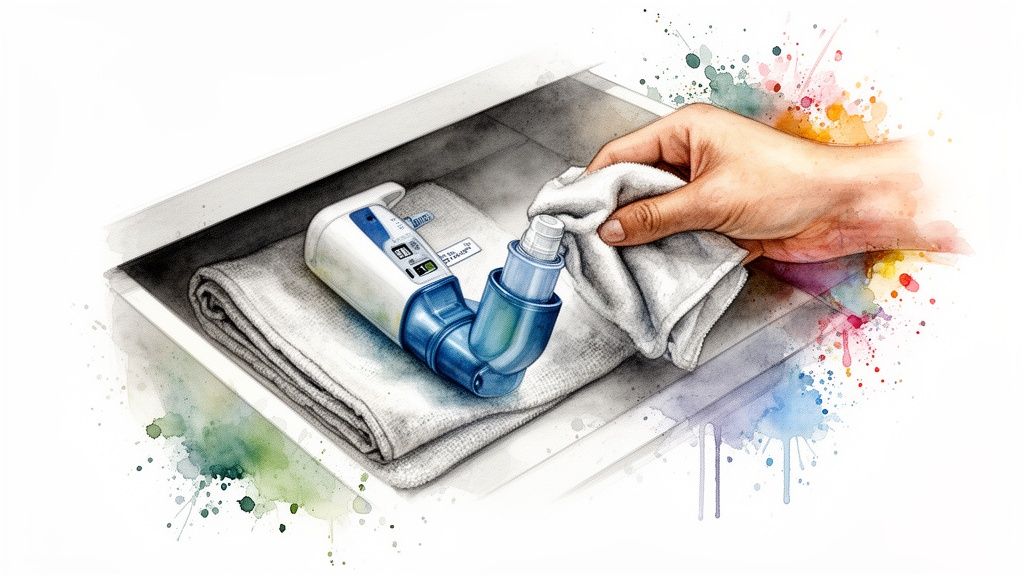
For this reason, you should never wash your inhaler with water. A quick, dry wipe is all it needs. After use, take a clean, dry cloth and gently wipe the mouthpiece. This keeps it clean and free from build-up.
Store your inhaler correctly
Where you keep your inhaler is just as important as how you clean it. The goal is to find a cool, dry place, away from heat and humidity.
- Avoid the bathroom. Steam from showers creates a humid environment.
- Choose a bedroom drawer. A bedside table or drawer is often a perfect spot.
- Keep it out of the sun. Never leave your inhaler on a windowsill or in a hot car.
Track your doses
Most modern DPIs, like the one used for a Clenil 100 inhaler, have a built-in dose counter.
Get into the habit of checking the counter regularly. When the number gets low, for example when it hits 20, it's time to order a repeat prescription. This simple habit helps you avoid running out of your medicine.
When to seek urgent help
A severe asthma attack is a medical emergency. Call 999 for an ambulance immediately if you or someone else has any of these symptoms:
- Your reliever inhaler is not helping.
- Your breathing is getting harder or faster, or you are wheezing constantly.
- You are too breathless to speak, eat, or sleep.
- Your lips or fingernails are turning blue.
Getting your repeat prescriptions
Managing a long-term condition means having a reliable routine for your medicine. At Courier Pharmacy, our service takes the stress out of getting your repeat dry powder inhaler prescription.
We offer a simple, discreet delivery service that brings your medication to your door, anywhere in the UK. This service is a great help for busy parents, shift workers, or anyone who finds it hard to get to a pharmacy. Our goal is to ensure you always have your treatment when you need it.
Expert support is available
Our team of experienced pharmacists is always on hand to offer support and guidance over the phone. If you are unsure about your inhaler technique or have questions about your medication, you can speak directly to a pharmacist. This helps you feel confident and in control of your treatment.
Dealing with repeat prescriptions should be straightforward. We combine reliable delivery, expert advice, and a focus on your health to make managing your condition simpler. You can learn more about how our ordering process works and see how easy it is to get started.
Summary
A dry powder inhaler (DPI) is a breath-activated device for respiratory conditions like asthma and COPD. It requires a quick, deep breath to deliver medicine to your lungs, which removes the need for hand-breath coordination. There are single-dose and multi-dose types, and the best one for you depends on your lifestyle and abilities. Correct technique is vital: prepare the dose, inhale forcefully, and hold your breath for 10 seconds. Always keep your DPI clean and dry, and use the dose counter to track your medicine.
Frequently asked questions
Can I use a spacer with my dry powder inhaler? No, you should never use a spacer with a dry powder inhaler. Spacers are designed only for aerosol-based metered-dose inhalers (MDIs). Using one with a DPI would cause the powder to stick inside the spacer, so the medicine would not reach your lungs.
What if I accidentally breathe out into the inhaler? Breathing out into your DPI can make the powder clump due to moisture, which may block the device. If this happens, wipe the mouthpiece with a dry cloth. To avoid this, always turn your head away from the inhaler before you breathe out to prepare for your dose.
How do I know the dose was delivered correctly? The best way to know is to check the dose counter. If the number has gone down by one, the dose has been delivered. It is normal not to taste or feel the tiny medicine particles, so trust your technique and the counter.
Is it normal to not taste or feel the powder? Yes, this is completely normal. The medicine particles are microscopic, and most are tasteless. As long as you follow the correct steps and the dose counter has moved, you can be confident you have received your medication.
Why does my DPI sometimes make me cough? A small cough can happen, especially when you are new to using a DPI. It is usually a reaction to the powder particles touching the back of your throat. Try sipping some water before your dose. If the cough persists, speak to your pharmacist or GP.
Can I take my inhaler on a plane? Yes, you must take your inhalers in your hand luggage. They are essential medical devices and should not be placed in checked baggage. It's a good idea to carry a copy of your prescription or a doctor's letter to avoid any issues at security.
Disclaimer: This article is for informational purposes only and is not a substitute for professional medical advice, diagnosis, or treatment. Always seek the advice of your doctor or other qualified health provider with any questions you may have regarding a medical condition.
Meta description
Learn how to use your dry powder inhaler (DPI) correctly with our simple UK guide. Master your technique, find tips, and manage your asthma or COPD better.
Byline
Author: Scott McDougall, MPharm Clinical Reviewer: James O'Loan, MPharm
How this content was created
This article was written based on reliable, evidence-based sources, including the NHS, NICE guidelines, and peer-reviewed medical journals. All content has been written and clinically reviewed by qualified UK pharmacists to ensure it is accurate, accessible, and trustworthy for a patient audience. The information is reviewed regularly to reflect the latest clinical guidance.
References
- Asthma + Lung UK. 2022. Asthma facts and statistics. [online] Available at: https://www.asthmaandlung.org.uk/about-us/media-centre/facts-and-statistics [Accessed 20 October 2023].
- Copley, M., 2017. The importance of being dry: dry powder inhalers and moisture. Inhalation, [online] (April). Available at: https://www.inhalationmag.com/2017/04/10/the-importance-of-being-dry-dry-powder-inhalers-and-moisture/ [Accessed 20 October 2023].


