Duraphat 5000 Toothpaste: Who Needs It and How to Use It
Duraphat 5000 toothpaste is a 5,000 ppm prescription paste for high decay risk. Learn safe dosing, risks and how to get it in the UK. Spit it out. Do not rinse.
Could a stronger toothpaste suit everyone? No. Duraphat 5000 is a prescription-only fluoride medicine for people aged 16 and over who are at high risk of tooth decay. A dental professional may prescribe it when ordinary toothpaste is not enough.
The right strength depends on your risk of decay, not on how clean your teeth feel. Higher-strength fluoride needs a clear purpose and regular review. Your dental professional can explain whether it suits you, how to follow your prescription safely, and when a lower-strength paste may be appropriate.
One point can cause confusion: product directions and local NHS advice may give different brushing schedules. For this medicine, follow the instructions on your prescription, and ask your dentist or pharmacist if they conflict with the product leaflet or advice you have received. Stronger is not automatically better, and the prescription helps settle which directions apply to you.
What Duraphat 5000 toothpaste actually is
Duraphat is a medicine for preventing decay, rather than a cosmetic upgrade. The NHS Supply Chain product safety document describes its 1.1% sodium fluoride formulation, equivalent to 5 mg fluoride per gram, and excludes children under 16. [1]
“Parts per million”, usually shortened to ppm, describes fluoride strength. It doesn't tell you how much paste to squeeze onto the brush. The strength and the amount both matter.
Five key takeaways
- Check suitability: This paste is for a named patient with a high risk of decay.
- Measure the ribbon: Product directions specify a 2 cm ribbon, supplying about 3–5 mg fluoride. [1]
- Check the schedule: Product directions say three times daily after meals. [1]
- Spit carefully: Don't swallow the paste.
- Keep it personal: Never share your prescribed tube.
How Duraphat 5000 compares with other toothpastes
The NHS Specialist Pharmacy Service guide places ordinary adult toothpaste at approximately 1,350–1,500 ppm, compared with prescription-strength fluoride toothpaste. [2]
| Paste | Fluoride | Who it is for | How it is supplied |
|---|---|---|---|
| Everyday adult toothpaste | About 1,350 to 1,500 ppm | Routine prevention | Sold in shops |
| High-fluoride 2,800 ppm paste | 2,800 ppm | Supervised raised caries risk | Prescription or authorised dental professional |
| Duraphat 5000 toothpaste | 5,000 ppm, or 5 mg per gram | Age 16 and over at high caries risk | Prescription-only medicine |
The table's high-strength categories describe supervised treatment, not a ladder everyone should climb. Check the fluoride figure on your current tube before assuming it offers too little protection.
Think of everyday paste as a light raincoat. Prescribed high-fluoride paste is storm cover for someone who needs it. Neither choice makes sense without considering the conditions.
Fluoride helps the tooth surface regain minerals and resist acid damage. That process supports prevention, but it doesn't replace cleaning, sensible sugar habits or dental treatment.
Pharmacist's tip: Store the tube with medicines, away from the family brush pot. A familiar brand name doesn't make it a family toothpaste.
Who is prescribed high-fluoride toothpaste
A prescriber looks for a high risk of multiple cavities, not just a wish for stronger toothpaste. The UK Summary of Product Characteristics published by Patient.info identifies adolescents aged 16 years and over and adults at risk of multiple dental caries as the intended group. [3]
“Dental caries” means tooth decay. Your dentist considers where decay occurs, how often it returns and what makes your mouth vulnerable.
Signs that need a closer look
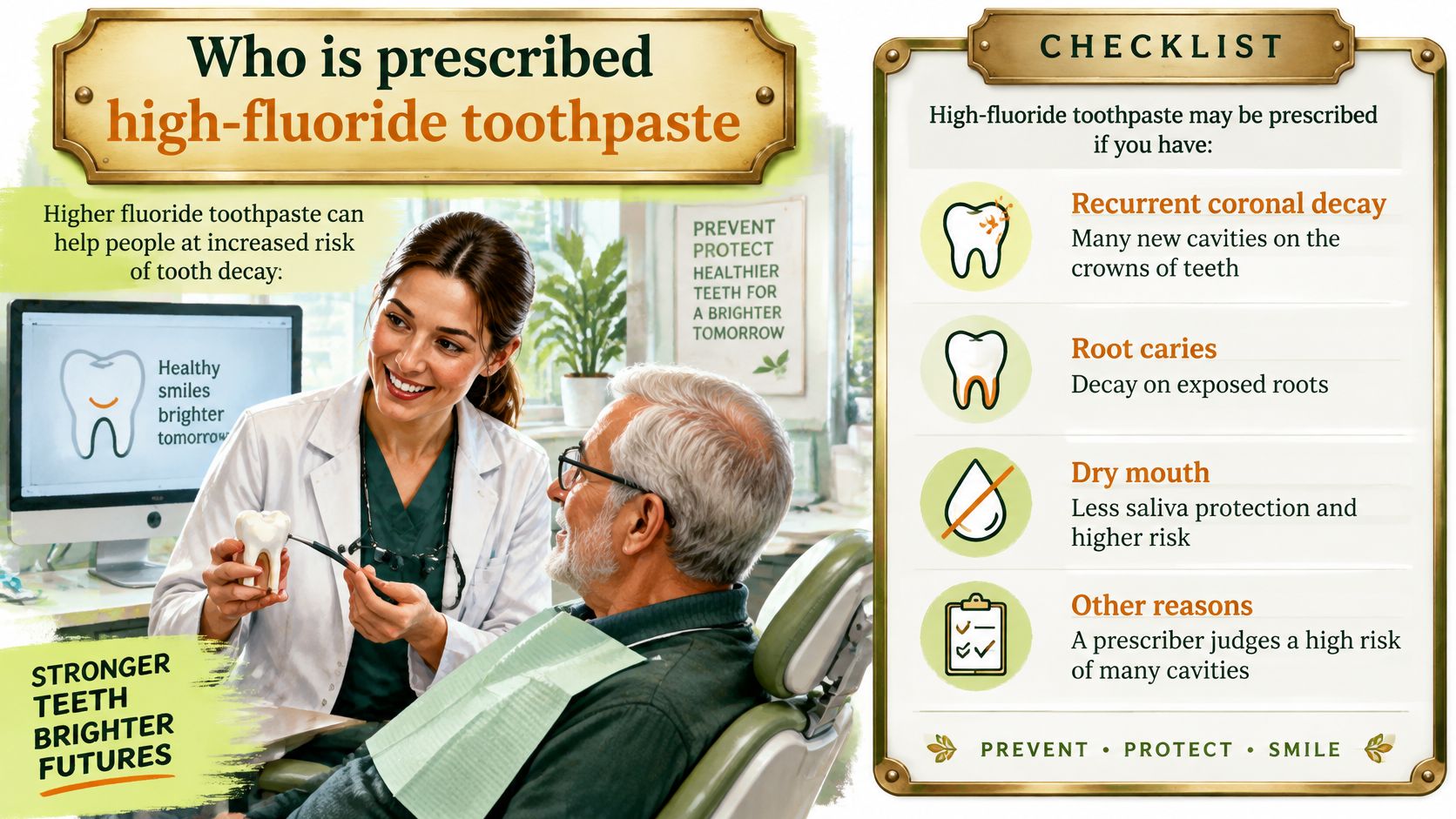
- Recurrent coronal decay: Repeated cavities in the crowns, the visible parts of teeth.
- Root caries: Decay on root surfaces exposed by receding gums.
- Dry mouth: Less saliva to help clear acids and protect teeth.
- Other risk factors: A pattern of damage that calls for more than routine prevention.
An occasional filling doesn't automatically mean you need prescription toothpaste. Your dentist needs to assess the whole pattern.
Root decay deserves particular attention. Gum recession exposes a root surface that doesn't have the same enamel covering as the crown. A person may brush faithfully yet still need extra help protecting those areas.
This consultation visual highlights the main reasons for a dental risk review.
What to bring to your appointment
Take your current toothpaste and mouthwash, or photographs of their labels. Mention recent fluoride varnish and any fluoride tablets, drops or other dental medicines.
Tell the dentist whether you know that your drinking water contains added fluoride. Don't worry if you don't know. Say so rather than guessing.
Pharmacist's tip: Write down all your fluoride products before the visit. Mouthwash and dental treatments are easy to forget when someone asks which medicines you use.
For example, an older adult with receding gums, persistent dry mouth and several recent root fillings may warrant a high-fluoride prescription. A low-risk adult with healthy teeth doesn't need the same tube because it's available.
The decision rests on the reason for treatment. Good brushing technique matters, but it doesn't replace that assessment.
How to get Duraphat 5000 on prescription
Start with a dental assessment, not a search for an unrestricted shop tube. A dentist can assess your decay risk and decide whether to prescribe high-fluoride toothpaste.
UK supply rules also allow appropriately authorised dental professionals to supply certain medicines within defined safeguards. That isn't the same as making prescription toothpaste an ordinary over-the-counter purchase.
A safe route to supply
- Book a dental check-up. Ask what puts you at high risk and what treatment aims to change.
- Discuss your current fluoride use. Include mouthwash, supplements and professional treatments.
- Obtain clear directions. The amount, frequency and review plan should make sense to you.
- Use a legitimate pharmacy. An online questionnaire should support clinical assessment, not bypass it.
Through our UK online pharmacy service, patients complete secure questionnaires that human prescribers review. An assessment doesn't guarantee a prescription or availability of a particular brand.
We offer free, expert advice, discreet packaging and free delivery on orders over £50. Ask our team about the current service and the prescription you hold before placing an order.
Price guide for Duraphat 5000
The Chemist4U product listing supplied these 2026 pack prices. They describe that retailer's listing, not a fixed UK price or a Courier Pharmacy quote. [4]
| Pack size | Price |
|---|---|
| One pack | £10.19 |
| Two packs | £19.29 |
| Three packs | £26.99 |
Check current prices and any delivery or assessment costs before buying. Don't choose a larger quantity without considering your review plan.
Read the leaflet that comes with your actual supply. A September 2023 MHRA medicines-defect notice concerned missing allergen and sodium-benzoate information on certain packs; the MHRA stated that there was no product-quality problem. [5]
That notice is a reminder to use current medicine information, not a reason to assume today's tube is defective.
How to use a 2 cm ribbon safely
Follow your own prescription directions. If the label and leaflet conflict, ask the dispensing pharmacist to resolve the difference before you change your routine.
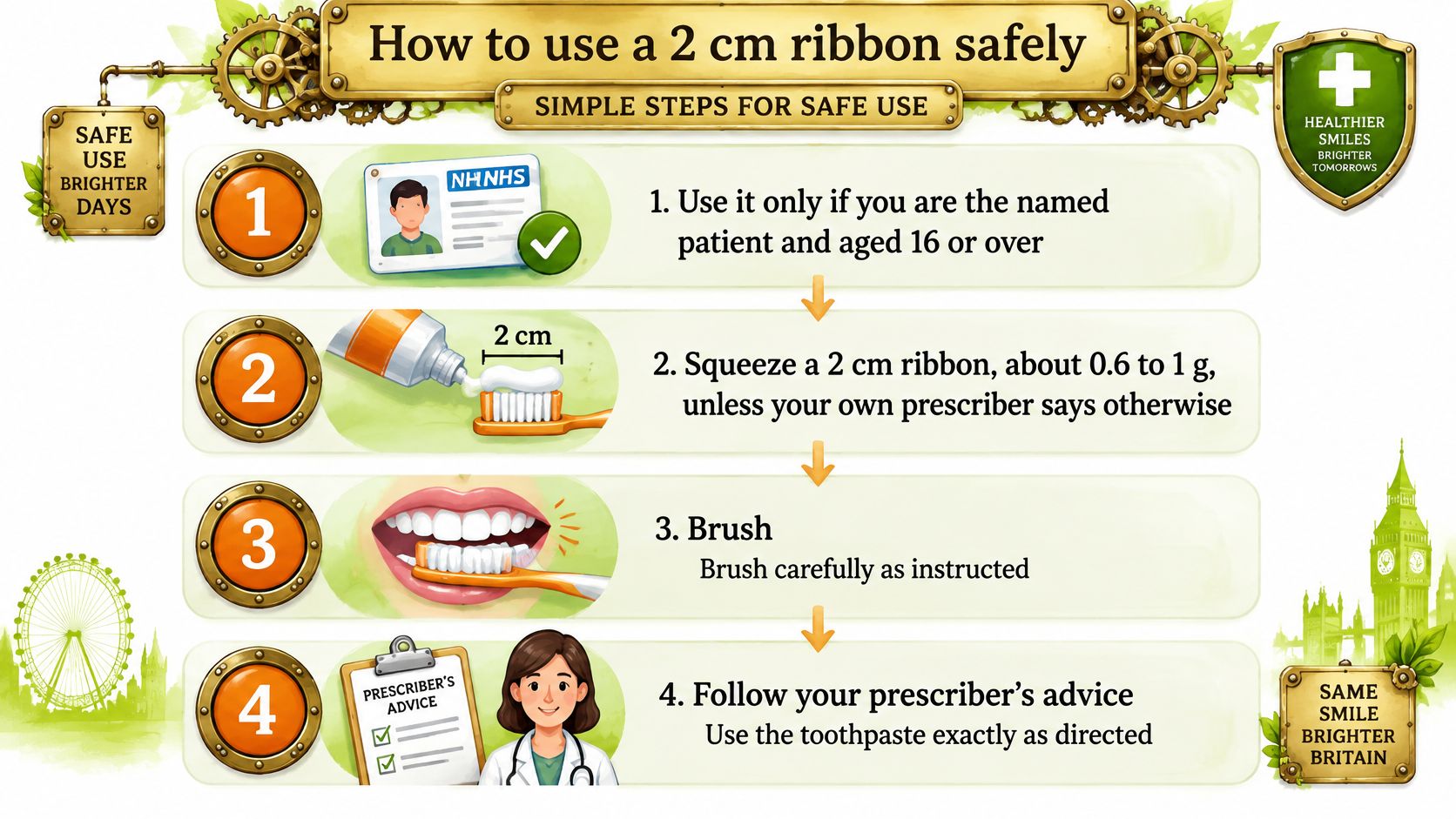
The process visual gives a simple reminder, but it can't replace your individual instructions.
Your brushing routine
- Check the patient name. Use only the tube prescribed or supplied for you.
- Squeeze the amount on your label. Don't cover the whole brush out of habit.
- Brush carefully. Clean the gum line and the surfaces your dentist has highlighted.
- Match your brushing schedule to the prescription. Don't add extra sessions to make up for uncertainty.
- Spit out the paste. Don't swallow it or rinse straight afterwards with water.
- Put the cap back on and store the tube out of children's reach.
The Whittington NHS dental guidance advises a pea-sized amount and a twice-daily routine, while product directions describe a different schedule. [6] This is why copying instructions from someone else's leaflet can cause confusion.
Dose and frequency from different instructions
| Source | Amount | How often | After brushing |
|---|---|---|---|
| UK product information | 2 cm ribbon, about 0.6–1 g and about 3–5 mg fluoride | Three times daily after meals | Spit; don't rinse or swallow |
| Some NHS local dental guidance | Pea-sized amount | Twice daily | Spit; don't rinse |
| What you should follow | The amount on your own label | The frequency your prescriber wrote | Named patient only; store away from children |
The product quantities above come from the product information and NHS pharmacy guidance. [1, 2] They aren't an invitation to pick whichever schedule suits you best.
Practical rule: Your individual prescription sets your routine. An unclear or conflicting label needs a pharmacist's check, not a guess.
How long should a tube last?
The Duraphat patient leaflet describes a 51 g tube. [7] Using the product quantities above, a worked estimate of about a gram at each prescribed after-meal brush gives roughly two to three weeks; a smaller prescribed ribbon lasts longer.
That is an estimate, not a target. Don't squeeze more out because the tube seems to be lasting well, or ration it because you're running low.
Pharmacist's tip: A little residue after spitting is expected. If someone swallows a large amount, especially a child, contact NHS 111 promptly and keep the tube available to identify the product.
Don't invent a food-and-drink waiting time from advice for another dental product. Ask your pharmacist if your own leaflet leaves this unclear.
For a visual brushing reminder, the following video may help. Your prescription still takes priority over general demonstrations.
Check your box and dispensing label before the next brush. If they don't agree, take both to the pharmacist.
Benefits, risks and when to step down
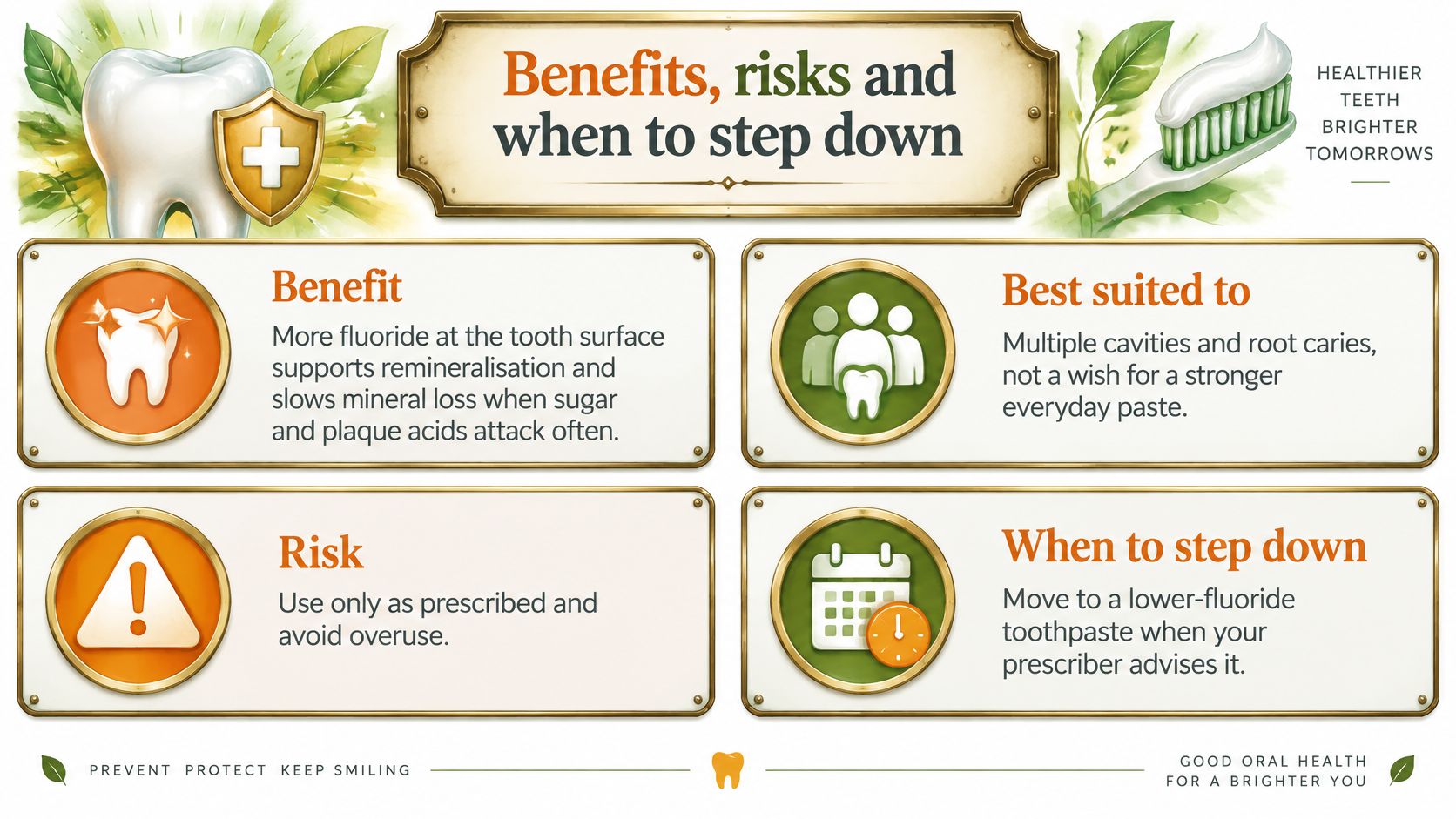
More fluoride at the tooth surface can support mineral repair and reduce mineral loss during acid attacks. That makes high-fluoride toothpaste useful for selected patients with repeated cavities or root decay. It isn't a whitening treatment.
The UK patient leaflet for Duraphat links its use to increased caries risk and advises a dental specialist's opinion because of the high fluoride content. [8] The benefit comes from matching treatment to risk, not from choosing the strongest tube.
Balance protection with total exposure
Fluoride can come from more than toothpaste. Drinking water, mouthwash, supplements and professional treatments all need consideration.
The leaflet advises assessing other fluoride sources and avoiding additional fluoride tablets, drops, gum, gels, varnishes and fluoridated salt during treatment. [8] Don't add these yourself. If a dental professional proposes another fluoride treatment, tell them which paste you use so they can judge the combination.
Pharmacist's tip: Mention your prescription paste before a hygienist applies fluoride varnish. Don't assume every clinician can see your current medicines.
A medicine review should cover:
- Your home routine: Which toothpaste and mouthwash you use.
- Other sources: Supplements, fluoridated salt and drinking water.
- Dental treatment: Planned varnish, gels or other preventive care.
- Swallowing concerns: Any difficulty spitting or using the right amount.
This visual summarises why protection and exposure need to stay in balance.
Does treatment have to be permanent?
Not necessarily. Treatment should last while the assessed risk justifies it. There isn't one fixed course that suits every patient.
Some people need extra protection during a period of increased risk. Others have lasting problems, such as persistent dry mouth or vulnerable exposed roots, that call for longer treatment.
Don't treat an improving mouth as proof that the paste is no longer needed. Improvement may partly reflect the treatment working. Your dentist needs to judge whether the underlying risk has changed.
| Findings at review | What they may mean |
|---|---|
| No new decay and a stable daily routine | A lower-strength paste may now be suitable |
| Improved saliva flow and fewer acid challenges | The original need may have reduced |
| Repeated new cavities | Further prevention and treatment review are needed |
| Exposed roots that continue to decay | Extra protection may still be justified |
| Persistent dry mouth | The risk factor still needs management |
These are discussion points, not a self-prescribing checklist. A dentist also considers the pattern of past decay and how well you can maintain your routine.
What stepping down involves
A lower-strength prescription paste or ordinary adult toothpaste may be an option. Your prescriber should choose the strength and explain what to watch for after the change.
Ask for a clear plan rather than stopping when the tube runs out. Keep dental reviews, daily cleaning and sugar advice in place. A change in paste doesn't remove the need to manage the cause of decay.
Stronger isn't automatically better. The right treatment is the least intensive option that still meets your dental needs.
Adult teeth don't face the same developmental fluorosis concern as teeth still forming in childhood. However, that doesn't make swallowing concentrated fluoride harmless. Swallowed paste can cause stomach upset, and suspected substantial ingestion needs prompt advice.
When to seek urgent help
Call emergency services for breathing trouble or swelling of the lips, tongue or throat. Stop using the paste if you suspect an allergic reaction.
For a substantial swallowed amount, especially involving a child, contact NHS 111 urgently. Don't induce vomiting or try a home remedy. Keep the packaging so the clinician can assess the product and likely amount.
A mint taste alone isn't an emergency. New staining also doesn't usually need emergency care, but ask a dentist to assess an unexplained change rather than assuming the paste caused it.
At review, ask: “Do I still have the high-risk reason for this medicine, or can we step down?”
Three UK days with a high-fluoride tube
These are hypothetical everyday situations. Each shows how a sound prescription can go wrong through habit, not lack of effort.
A busy parent's shared bathroom
A parent leaves their prescribed tube beside the family's everyday paste. A teenager grabs whichever tube sits closest to the sink.
The mistake is relying on everyone to recognise the difference. The fix is a labelled medicines container, separate from the shared brush pot and out of younger children's reach.
Pharmacist's tip: If a child copies an adult and swallows the paste, call for advice. Don't use a home remedy or wait for symptoms after a substantial amount.
The useful habit is a quick name-and-label check before brushing. It keeps the medicine with the person it was supplied for.
A night worker's changing mealtimes
A shift worker tries to fit brushing around breakfast, lunch and dinner on a daytime timetable. On night shifts, those meals don't match when they eat.
Instead of skipping or adding sessions, they ask the pharmacist how their prescribed after-meal routine fits their working day. A meal before work may be their main meal, even when everyone else calls it evening.
If their dentist prescribed a less frequent routine, they follow that prescription. They don't adopt a different schedule from a colleague's tube.
The correction is to plan around actual meals and written directions, not the clock on a generic leaflet.
A gym-goer's dry mouth
A gym-goer notices a dry mouth after long sessions and new sensitivity near the gums. They consider swapping their prescribed paste for a whitening product.
The mistake is treating a new symptom as a shopping problem. They keep to the prescribed routine, sip water and arrange a dental check.
Dry mouth and sensitivity deserve assessment. Neither proves that more fluoride is needed, and neither should prompt an unplanned switch.
- Parent's priority: Prevent accidental sharing.
- Shift worker's priority: Make the prescribed routine practical.
- Gym-goer's priority: Report a change rather than self-treat it.
For each person, the useful review question stays the same: is the high-risk reason still present?
Frequently asked questions
Can children use Duraphat 5000?
No, children below the licensed age should not use this product. A dentist can recommend an age-appropriate alternative. If a child uses or swallows someone else's paste, seek advice about the amount involved.
Can I share the tube with someone else?
No. Prescription toothpaste belongs to the named patient, even if another family member has fillings or dry mouth. Keep it separate from shared bathroom products.
How long does a tube last?
At the full product-directed amount and frequency, expect roughly a few weeks. A smaller individually prescribed amount lasts longer. Use your label to guide dosing, not an expected finish date.
Is Duraphat Protify 5000 the same product?
Don't assume that similar names mean identical packaging or directions. The Duraphat Protify patient leaflet states that its marketing authorisation was first granted on 28 January 2025. [9] Ask the pharmacist to check the exact supplied product if its name differs from your prescription.
What if I swallow a large amount?
Contact NHS 111 promptly, particularly if a child is involved. Keep the tube and describe roughly how much may be missing. Don't induce vomiting or use home remedies; breathing problems need emergency help.
Can I use it during pregnancy?
Ask your prescriber or pharmacist before starting or continuing treatment. They should check the exact product information and your dental needs. Don't assume that every toothpaste has the same advice because it goes on a toothbrush.
Summary and references
Duraphat 5000 is a targeted prescription medicine, not a routine strength upgrade. Use the amount and frequency on your prescription label. The product directions may differ from NHS advice, so follow the instructions your prescriber gave you rather than choosing a schedule yourself.
Keep the tube separate from family toothpaste, and tell dental professionals about other fluoride products you use. Review whether your original tooth-decay risk still calls for high-fluoride treatment. If it has changed, ask your prescriber whether you can step down to a lower strength.
Disclaimer: This information is not a substitute for personal medical or dental advice.
References
The numbered references correspond to the documents linked in the article.
- NHS Supply Chain (n.d.) Duraphat 5000 toothpaste safety documentation.
- NHS Specialist Pharmacy Service (n.d.) Considering fluoride and accidental ingestion of toothpaste.
- Patient.info (2024) Duraphat 5000 ppm fluoride toothpaste: Summary of Product Characteristics.
- Chemist4U (2026) Duraphat product and price listing.
- Medicines and Healthcare products Regulatory Agency (2023) Class 4 medicines defect information: Duraphat 5000 ppm fluoride toothpaste.
- Whittington Health NHS (n.d.) Dental guidance on high-fluoride toothpaste.
- Patient.info (2024) Duraphat 5000 ppm fluoride toothpaste: patient leaflet.
- Patient.info (n.d.) Duraphat 5000 ppm fluoride toothpaste: patient information.
- Patient.info (2025) Duraphat Protify 5000 ppm toothpaste: patient leaflet.
Courier Pharmacy offers free, expert advice and secure online assessments reviewed by human prescribers. If you are unsure how to follow your prescription toothpaste label, visit Courier Pharmacy to discuss your next step with the team.


