Dutasteride Hair Loss Dose: Your 2026 UK Guide
Searching for the right dutasteride hair loss dose? Our 2026 UK guide covers the 0.5mg daily dose, efficacy, side effects, and how to get it safely.
In this article
- Dutasteride hair loss dose
- Introduction
- How dutasteride works to stop hair loss
- The problem starts in the follicle
- Dutasteride lowers the signal driving miniaturisation
- What happens when DHT drops
- Why people often get confused about this
- What is the correct dutasteride hair loss dose
- Why 0.5 mg daily became the standard
- What about taking it less often
- Who might hear about non-daily dosing
- When results usually start
- Dutasteride vs finasteride which is better for you
- Dutasteride vs Finasteride at a Glance
- What these differences mean in real life
- Where dutasteride may have an edge
- So which is better for you
- A simple decision frame
- Understanding the side effects and safety profile
- What side effects do people worry about most
- Long-term safety and monitoring
- Who should avoid it or ask for extra review
- When to seek urgent help
- Practical tips for taking dutasteride in real life
- Real-life example one
- Real-life example two
- Real-life example three
- What to do if you miss a dose
- Be patient with the mirror
- How to get dutasteride safely in the UK
- What a safe UK pathway looks like
- What to avoid
- Questions a prescriber may ask
- Summary
- Frequently Asked Questions (FAQs)
- How long does dutasteride take to work for hair loss?
- What happens if I stop taking dutasteride?
- Can women use dutasteride for hair loss?
- Can I drink alcohol while taking dutasteride?
- Does dutasteride cause permanent side effects?
- Do I need a blood test before starting dutasteride?
- Is dutasteride licensed for hair loss in the UK?
- Is daily dosing always necessary?
- References
SEO brief
- Primary keyword: dutasteride hair loss dose
- Secondary keywords: dutasteride 0.5mg, dutasteride vs finasteride, dutasteride for hair loss UK, dutasteride side effects, off-label hair loss treatment UK
- Search intent: Informational with practical UK treatment guidance
- Target reader: UK adults with male pattern hair loss who want a clear, safe explanation of dosing and access
- Product/service mention (if any): UK-regulated online prescribing pathway for dutasteride
- Internal links available: Assumed from provided URLs in the brief
Dutasteride hair loss dose
The standard dutasteride hair loss dose in UK off-label practice is 0.5 mg once daily. That’s the dose with the clearest clinical backing for male pattern hair loss, and it’s usually the starting point a prescriber considers if dutasteride is appropriate.
If you’re reading this, there’s a fair chance you’ve noticed more scalp under the bathroom light, more hairs on the pillow, or a thinning crown in photos you didn’t ask anyone to take. Then you search online and get buried under forums, conflicting advice, and home-brew dosing plans. It’s a lot.
I’ll keep this simple. You’ll learn what dutasteride does, why 0.5 mg matters, how it compares with finasteride, what side effects to watch for, and how to get it safely in the UK through a regulated route such as hair loss treatment via online consultation.
Five key takeaways
- Standard dose: For hair loss, the usual off-label dose is 0.5 mg once daily.[1]
- Why it works: Dutasteride lowers DHT, the hormone that drives male pattern hair loss in susceptible follicles.
- Stronger DHT reduction: It can reduce DHT by up to 98%, compared with 71% for finasteride.[3]
- Some clinics vary dosing: Because it stays in the body for a long time, some specialists use 0.5 mg twice weekly off-label.[3]
- Safety still comes first: It isn’t an over-the-counter hair pill. A prescriber should check if it suits you.
Introduction
Hair loss often starts gradually, then suddenly feels impossible to ignore. One month your hair looks fine. The next, your hairline seems to have shifted and every mirror in the house feels rude.
That’s where dosing matters. If you’re considering dutasteride, the first thing to know is that 0.5 mg once daily is the evidence-based dose most often used in UK off-label prescribing for male pattern hair loss.[1]
People often get stuck on the wrong question. They ask, “What’s the strongest dose?” when the better question is, “What dose has the best evidence and a sensible safety balance?” For dutasteride, that answer is usually the same.
Practical rule: Start with the dose that has real clinical support, not the one that sounds most aggressive.
How dutasteride works to stop hair loss
The problem starts in the follicle
Hair loss from androgenetic alopecia starts below the surface, inside the follicle itself. In men who are genetically prone to male pattern hair loss, the follicles are unusually sensitive to DHT, a hormone made from testosterone.
With repeated exposure to DHT, those follicles gradually shrink. This process is called miniaturisation. The hairs become finer, grow for less time, and eventually may stop breaking through the scalp in a visible way. That is why the change often shows up first as a thinner crown or a hairline that slowly recedes.
Dutasteride lowers the signal driving miniaturisation
A practical way to understand dutasteride is to focus on the step it blocks. Your body uses an enzyme called 5-alpha reductase to convert testosterone into DHT. Dutasteride blocks both type I and type II 5-alpha reductase, so less DHT is produced.[3]
That matters because DHT is the main hormonal trigger behind male pattern hair loss in susceptible follicles. If you reduce that trigger, you reduce the ongoing pressure that pushes follicles to shrink.
This is also why dutasteride is described as more potent than finasteride. Finasteride blocks only one of the main enzyme types, while dutasteride blocks two. For some patients, especially those who have not done well enough on finasteride, that difference is clinically relevant and worth discussing with a prescriber.
What happens when DHT drops
Lower DHT does not revive every dormant follicle, and it does not work overnight. Hair grows slowly, and follicles need time to move through their growth cycle.
What dutasteride can do is help protect follicles that are still active but struggling. In simple terms, it gives them a better environment to keep producing thicker, longer-lasting hairs instead of progressively weaker ones. That is why the goal is usually stabilisation first, then visible improvement over time.
Other biological signals can also influence scalp hair behaviour. If you want a broader picture beyond DHT alone, this explanation of prostaglandin D2, mast cells, and male pattern baldness helps show why hair loss is not always a one-pathway problem.
Why people often get confused about this
A common misunderstanding is that testosterone itself is the direct cause of male pattern baldness. The better way to say it is that certain follicles react badly to the conversion of testosterone into DHT.
That distinction matters in real life. It explains why surface treatments such as shampoos usually have limited benefit on their own for true androgenetic alopecia, while a prescription tablet can make a more meaningful difference if a clinician decides it is appropriate.
In the UK, that decision should be made carefully because dutasteride for hair loss is off-label. A regulated online pharmacy should use a prescriber-led assessment to check that your pattern of hair loss fits the treatment, screen for safety issues, and arrange follow-up if treatment goes ahead. That makes the science relevant to the patient journey, not just the theory.
Featured snippet answer
What does dutasteride do for hair loss?
Dutasteride lowers DHT by blocking both type I and type II 5-alpha reductase. Lower DHT reduces the hormonal pressure that drives follicle miniaturisation in male pattern hair loss.
What is the correct dutasteride hair loss dose
The common answer is simple. The standard dutasteride hair loss dose is 0.5 mg once daily.[1]
That isn’t a random internet favourite. It comes from a key randomised double-blind phase III trial in 153 men aged 18 to 49 with male pattern hair loss. At 6 months, men taking dutasteride had a mean hair count increase of 12.2 hairs/cm², compared with 4.7 hairs/cm² in the placebo group (P=0.0319), with better self-assessment and photographic review as well.[1]
Why 0.5 mg daily became the standard
Prescribers like doses that answer two questions. First, does this dose work? Second, can people stay on it safely if it suits them?
For dutasteride, 0.5 mg daily is the dose with the strongest direct evidence for efficacy in male pattern hair loss.[1] It’s also the strength used in Avodart 0.5 mg capsules, which is why UK prescribing for hair loss often builds around that capsule size even though hair loss use is off-label.
If you’re looking at treatment options online, you may see dutasteride 0.5 mg capsules listed through regulated services that use a prescriber review before supply. That review matters because the right dose on paper still needs to be the right dose for you.
What about taking it less often
Many readers are confused by this point. A long half-life means a medicine stays in the body for a long time. Dutasteride’s half-life is about 5 weeks, so it doesn’t vanish quickly if you miss one capsule or if your prescriber uses a lower-frequency plan.[3]
Because of that, many UK hair restoration specialists use 0.5 mg twice weekly off-label to maintain efficacy while limiting cumulative exposure.[3] That doesn’t replace the standard evidence-based daily dose. It reflects how some specialists tailor treatment in real life.
Here’s a plain way to look at it:
| Dosing approach | What it means in practice | Key point |
|---|---|---|
| 0.5 mg once daily | Most evidence-backed starting dose | Best-supported clinical dose for hair loss[1] |
| 0.5 mg twice weekly | Used by some specialists off-label | Often chosen because dutasteride lasts a long time in the body[3] |
| Micro-dosing | Sometimes considered for sensitive patients | Needs prescriber oversight and individual judgement |
Who might hear about non-daily dosing
A few common examples:
- Someone worried about side effects: A specialist may discuss a lower-frequency plan because the drug lingers in the body.
- Someone who has already reacted badly to another 5-alpha reductase inhibitor: A prescriber might prefer a slower, cautious approach.
- Someone who struggles with routine tablets: Less frequent dosing may sound easier, though consistency still matters.
That said, don’t invent your own plan based on forum posts. Dutasteride is not the sort of medicine to freestyle.
Taking more than the standard dose isn’t the clever shortcut many people think it is. More drug doesn’t automatically mean better hair.
When results usually start
People want a timeline as much as a dose. The short answer is that hair treatment is slow. Some readers may notice early changes by around 3 months, while fuller assessment usually takes longer. Hair grows in cycles, so progress often looks subtle before it looks obvious.
A mirror can be a terrible judge of progress. Photos in the same lighting each month are much better.
Pharmacist's tip
Take dutasteride on a consistent schedule. If your prescriber has chosen daily dosing, try to take it at the same time each day. Consistency won’t make it work overnight, but it does reduce confusion and missed doses.
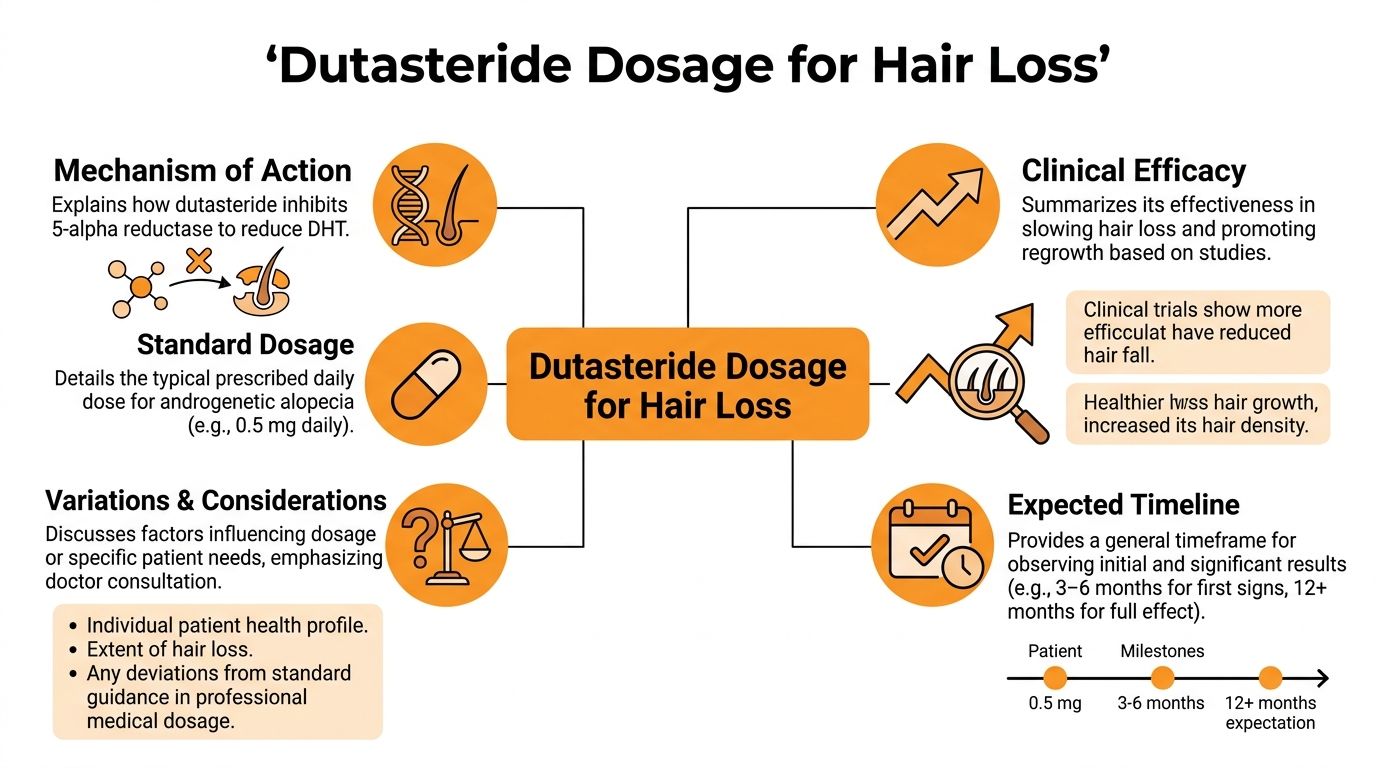
A useful visual summary can help if you’re comparing timelines and dosing options:
Featured snippet answer
What is the normal dutasteride dose for hair loss?
The standard off-label dose for male pattern hair loss is 0.5 mg once daily.[1]
Dutasteride vs finasteride which is better for you
This isn’t really a “good medicine versus bad medicine” choice. It’s a “which option fits your goals, risk tolerance, and prescribing plan” choice.
For some men, finasteride is the usual first conversation. For others, dutasteride becomes the more suitable option because it lowers DHT more strongly and may produce better hair outcomes.
Dutasteride vs Finasteride at a Glance
| Feature | Dutasteride (Avodart) | Finasteride (Propecia) |
|---|---|---|
| Main action | Blocks type I and type II 5-alpha reductase[3] | Blocks type II 5-alpha reductase[3] |
| DHT suppression | Up to 98%[3] | 71%[3] |
| Evidence for hair growth | Supported by RCT data and strong hair count improvement vs placebo[1] | Established option, but less potent in DHT lowering |
| Half-life | About 5 weeks[3] | Shorter than dutasteride |
| Dosing style | Often 0.5 mg daily, sometimes specialist twice-weekly use[3] | Usually daily use in hair loss practice |
| How people often use it | Considered when stronger DHT reduction is needed | Common first-line discussion point |
What these differences mean in real life
The key practical difference is strength. Dutasteride suppresses DHT much more than finasteride, and that stronger hormone reduction is why it often gets attention in tougher or more advanced cases.[3]
That doesn’t mean everyone should skip straight to dutasteride. Some men prefer to begin with the more familiar option, especially if they want to see how they tolerate this class of medicine first. If you’re comparing options, finasteride 1 mg tablets are often the product people know by name.
Where dutasteride may have an edge
UK clinical evidence discussed in a review source reports 10 to 11.5% hair density increase over 6 months with dutasteride 0.5 mg daily, and describes it as superior to finasteride over that period, with a low side effect profile and 0.4% incidence after four years of use.[2]
That’s useful if you’re deciding whether a stronger option may justify the extra discussion around safety and off-label prescribing.
So which is better for you
That depends on what matters most.
- If you want the strongest DHT suppression, dutasteride stands out.
- If you want a more familiar starting point, finasteride may be the easier first conversation.
- If you’ve had limited results already, dutasteride may be worth asking about.
- If you’re anxious about side effects, a prescriber may talk through pacing, monitoring, and whether either option makes sense at all.
A simple decision frame
A busy parent in his thirties might choose the option with the clearest one-capsule routine and stronger efficacy data. A cautious first-time user might prefer to start with the better-known medicine and only step up later if needed.
Neither approach is silly. The best choice is the one you can take consistently, monitor sensibly, and continue only if benefits outweigh drawbacks.
The “better” medicine is the one that fits your health history, not the one that wins arguments on hair-loss forums.
Featured snippet answer
Is dutasteride better than finasteride for hair loss?
Dutasteride lowers DHT more strongly and may produce better hair outcomes for some men. Whether it’s better for you depends on your history, side effect concerns, and prescriber advice.
Understanding the side effects and safety profile
Side effects deserve a calm, honest discussion. Individuals inquiring about dutasteride don’t want a sugar-coated answer. They want to know what can happen, how often it happens, and when to stop and ask for help.

What side effects do people worry about most
The side effects people ask about first are usually sexual side effects. According to ISHRS-referenced information, specialist use of 0.5 mg twice weekly is sometimes chosen to minimise cumulative exposure, with sexual dysfunction noted as less than 5% incidence, comparable to placebo in the referenced summary.[3]
That doesn’t mean side effects never happen. It means the overall picture is more nuanced than online horror stories suggest.
Other concerns that often come up in clinical discussions include:
- Sexual changes: reduced libido, erection changes, or changes in ejaculation
- Breast changes: tenderness or swelling should always be reported
- Mood concerns: low mood or unusual psychological symptoms need medical review
- Fertility questions: discuss these with your prescriber if relevant to your plans
Long-term safety and monitoring
A long half-life cuts both ways. It allows some specialists to use less frequent dosing, but it also means side effects may not disappear instantly if they occur.
Some patients also need extra thought around blood tests. Dutasteride can affect PSA readings, which are used in prostate assessment. If another clinician orders a PSA test, tell them you take dutasteride.
Pharmacist's tip
Always mention dutasteride before a PSA blood test. It can change the result and your clinician needs that context to interpret it properly.
Who should avoid it or ask for extra review
Dutasteride isn’t suitable for everyone. It needs careful review if you have certain medical issues or if another medicine could complicate things.
It should also be handled with care around pregnancy. Women who are pregnant, may become pregnant, or are trying to conceive should not handle leaking capsules, because dutasteride can affect male fetal development. For a hair loss article aimed at UK adult men, this still matters in households where medicines may be shared, stored badly, or handled by others.
When to seek urgent help
Seek urgent medical help if you develop signs of an allergic reaction such as swelling of the face, lips, tongue, or throat, trouble breathing, or a widespread rash.
You should also seek prompt medical advice if you notice:
- Breast lumps or nipple discharge
- Severe mood changes or suicidal thoughts
- A side effect that feels significant or persistent
- Anything that makes you feel unsafe continuing treatment
Pharmacist's tip
Don’t stop or restart dutasteride repeatedly without advice. If side effects appear, speak to the prescriber who issued it. A clear plan is better than guesswork.
Featured snippet answer
Are dutasteride side effects permanent?
They aren’t usually described that way in routine prescribing discussions, but any persistent or troubling symptom needs review. Don’t ignore ongoing side effects or try to “push through” them without advice.
Practical tips for taking dutasteride in real life
Hair treatment sounds simple until real life gets involved. School runs, night shifts, gym bags, missed alarms, holidays, and that drawer where half of Britain keeps unopened medication all play a part.

Real-life example one
A busy parent takes his capsule when he brushes his teeth before bed. He doesn’t rely on memory. He ties the dose to something he already does every night.
That works well because routines beat motivation. If you already take vitamin D, use a pill organiser. If you don’t, a phone reminder is perfectly fine. Hair follicles won’t judge your methods.
Real-life example two
A shift worker can’t take medicines at the same clock time every day because work patterns move around. In that case, anchoring the dose to one part of the day often helps, such as “after my first meal” or “before I sleep”, depending on the regimen your prescriber has set.
If your shift pattern is chaotic, write the days down. A medicine diary sounds old-fashioned, but it stops the classic problem of staring at a capsule packet and thinking, “Did I take that already?”
Real-life example three
A gym-goer often worries that dutasteride will somehow derail training. Most of the practical issue is not the gym itself. It’s remembering to mention the medicine if you ever have blood tests or medical reviews, especially if a PSA test is involved.
Some people also look into combination treatment. If your prescriber thinks it suits you, there’s growing patient interest in approaches discussed in dutasteride and minoxidil combination guidance.
What to do if you miss a dose
If you miss a dose, don’t panic and don’t double up unless your prescriber has specifically told you to. Take the next dose as advised on your plan.
The long half-life means one forgotten capsule doesn’t wipe out your progress. Repeated missed doses are the bigger problem.
Pharmacist's tip
Missed one dose? Get back on schedule. Don’t take extra to “catch up”.
Be patient with the mirror
One reason people quit too soon is that hair changes move slowly. The review source in the evidence set reports 10 to 11.5% hair density increase over 6 months with dutasteride 0.5 mg daily, alongside a low side effect profile and 0.4% incidence after four years of use.[2]
That doesn’t mean your own result will match a headline number. It does mean this treatment needs time. Monthly photos in the same light are more useful than checking your hairline every morning after a bad night’s sleep.
Pharmacist's tip
Take baseline photos before you start. Use the same angle, same room, and same lighting each month. Otherwise it’s very easy to miss steady progress.
Featured snippet answer
How long does dutasteride take to work for hair loss?
Some people notice early changes by around 3 months. A fairer assessment usually takes several months because hair grows in cycles.
How to get dutasteride safely in the UK
Dutasteride for hair loss sits in an important category. It’s used off-label for male pattern hair loss in the UK. That means a prescriber can use it when they judge it appropriate, even though the product isn’t licensed specifically for hair loss.
That matters because it’s not something you should buy casually from an unknown seller. A proper route includes identity checks, a medical questionnaire, review of your suitability, and a way to follow up if you develop problems or have questions.
What a safe UK pathway looks like
A safe route usually includes:
- Clinical assessment: you complete a health questionnaire accurately
- Human review: a qualified prescriber checks your answers
- Medicine quality: supply comes through regulated UK channels
- Follow-up: you know who to contact if treatment needs review
Courier Pharmacy is one example of this model. It is a UK-regulated, GPhC-registered online pharmacy that uses secure questionnaires reviewed by human prescribers, with medicines sourced through MHRA-registered wholesalers according to the publisher brief.
What to avoid
Be cautious if a website:
- Sells prescription-only treatment with no prescriber review
- Offers dramatic promises about regrowth
- Has no clear UK pharmacy registration details
- Makes it hard to contact a real clinician or pharmacy team
A legitimate service should ask questions you might find slightly annoying. That’s a good sign. The goal is to check whether dutasteride is suitable, not merely to process a basket.
Questions a prescriber may ask
Expect questions about your hair loss pattern, medical history, current medicines, past side effects, and whether you’ve used finasteride or minoxidil before.
They may also ask about blood tests or monitoring if it’s relevant to your wider health picture. This is especially important if you have prostate-related assessments or other ongoing care.
If an online service asks nothing meaningful before selling dutasteride, that’s a reason to leave, not a reason to feel lucky.
Summary
The usual dutasteride hair loss dose is 0.5 mg once daily, and that’s the dose with the strongest clinical support for male pattern hair loss.[1] Dutasteride works by lowering DHT, the hormone that drives follicle miniaturisation in susceptible men. It’s generally more potent than finasteride, which is why some patients discuss it when they want a stronger option. Side effects can happen, so treatment should always start with a proper medical review. Results take time, often months rather than weeks. In the UK, the safest route is an off-label prescription through a regulated pharmacy with prescriber oversight.
Frequently Asked Questions (FAQs)
How long does dutasteride take to work for hair loss?
Hair treatment takes patience. Some people notice early changes by around 3 months, but proper judgement usually needs several months of steady use because hair grows slowly and in cycles.
What happens if I stop taking dutasteride?
If you stop, the DHT-lowering effect wears off over time. That means hair loss may gradually resume if DHT-sensitive follicles are still active in the pattern that caused the problem in the first place.
Can women use dutasteride for hair loss?
This article focuses on male pattern hair loss in UK adult men. Dutasteride needs careful specialist review in women, and it is especially important to avoid exposure during pregnancy or where pregnancy is possible.
Can I drink alcohol while taking dutasteride?
Alcohol isn’t usually the main issue people need to think about with dutasteride. The bigger concerns are suitability, side effects, and making sure other clinicians know you take it if relevant blood tests are arranged.
Does dutasteride cause permanent side effects?
Most routine discussions don’t frame side effects as permanent, but persistent symptoms should never be brushed aside. If a side effect worries you or doesn’t settle, speak to your prescriber promptly.
Do I need a blood test before starting dutasteride?
Not everyone will need one before treatment. It depends on your age, medical history, symptoms, and whether your prescriber thinks monitoring would help.
Is dutasteride licensed for hair loss in the UK?
It’s generally used off-label for hair loss in the UK. That means a prescriber may issue it when they believe it is appropriate and safe for your circumstances.
Is daily dosing always necessary?
Not always. While 0.5 mg once daily has the strongest evidence base, some specialists use 0.5 mg twice weekly off-label because dutasteride has a long half-life.[3]
If you’re considering dutasteride and want a regulated UK route, Courier Pharmacy offers online prescribing with prescriber review for suitable patients. It’s worth using a service that checks your history properly, explains off-label use clearly, and gives you a way to ask follow-up questions if anything changes.
Meta description
Dutasteride hair loss dose explained for UK patients. Learn why 0.5 mg daily is standard, how it compares with finasteride, and how to use it safely.
Suggested internal links for medicalmojo.co.uk
- Hair loss treatment guide for men
- Finasteride vs dutasteride comparison
- Minoxidil for male pattern hair loss
- Online pharmacy safety checklist
- Understanding off-label prescribing in the UK
Byline
Written by Medical Mojo Editorial Team
Clinical review
Clinically reviewed by a UK-registered pharmacist
How this content was created
This article was written using the verified evidence supplied in the brief, including a peer-reviewed clinical trial and named professional hair restoration resources. The content was then structured in plain English for UK patients and checked for safety, tone, and factual consistency.
References
[1] Olsen, E.A. et al. (2010) ‘A randomized clinical trial of dutasteride versus placebo in the treatment of androgenetic alopecia in men’, Journal reference via PubMed. Available at: https://pubmed.ncbi.nlm.nih.gov/20605255/
[2] Perfect Hair Health (n.d.) ‘Oral dutasteride for hair loss results side effects dosing how it compares to finasteride’. Available at: https://perfecthairhealth.com/oral-dutasteride-for-hair-loss-results-side-effects-dosing-how-it-compares-to-finasteride/
[3] International Society of Hair Restoration Surgery (n.d.) ‘Dutasteride’. Available at: https://ishrs.org/patients/treatments-for-hair-loss/medications/dutasteride/
Disclaimer
This article is for information only and isn’t a substitute for personal medical advice. Always speak to a qualified prescriber or pharmacist before starting, stopping, or changing treatment.


