Dutasteride versus Finasteride: Which is Better for UK Men?
Dutasteride versus finasteride: compare effectiveness, safety, and cost in our UK guide to help you choose the right hair loss treatment.
In this article
- Five Key Takeaways
- A head-to-head comparison
- Key differences at a glance
- How these treatments halt hair thinning
- The DHT-blocking mechanism
- Type I vs Type II inhibition: the key difference
- Finasteride: a targeted blocker
- Dutasteride: a dual-action blocker
- Comparing real-world efficacy and results
- What the clinical studies suggest
- Real-life scenarios and outcomes
- Finasteride as the first step
- Understanding the respective side effect profiles
- Addressing sexual side effects
- The MHRA and post-finasteride syndrome
- Potential impact on mood
- Comparing the risk profiles
- Navigating UK licensing, cost, and access
- What does ‘off-label’ mean?
- Comparing costs for a private prescription
- Safe access through a regulated online pharmacy
- Summary
- FAQs about Dutasteride versus Finasteride
- Is it okay to switch from finasteride to dutasteride?
- How long before I actually see a difference?
- Do I really have to take this for the rest of my life?
- What if I forget to take a pill?
- Is dutasteride safer than finasteride?
- Can I buy dutasteride over the counter in the UK?
- Disclaimer
When you’re weighing up dutasteride versus finasteride for hair loss, the main difference is power. Both drugs effectively block DHT, the hormone behind male pattern baldness, but dutasteride is stronger. However, finasteride is the standard, UK-licensed treatment with a much longer safety record. This guide breaks down everything you need to know to have an informed chat with your doctor. We’ll explore how they work, compare their real-world results, and look at side effects and costs, helping you understand which might be right for you.
Five Key Takeaways
- Dutasteride is More Potent: It blocks over 90% of DHT, while finasteride blocks about 70%.
- Finasteride is UK-Licensed: Finasteride 1mg is officially approved for male pattern hair loss in the UK. Dutasteride is used ‘off-label’.
- A Doctor's First Choice: Clinicians usually recommend finasteride first due to its established safety profile.
- Switching is an Option: If finasteride isn't giving you the results you want after a year, a doctor might suggest switching to dutasteride.
- Long-Term Commitment: Both treatments only work for as long as you take them.
A head-to-head comparison
Choosing a hair loss treatment can feel overwhelming. Understanding the key differences between dutasteride and finasteride makes the conversation with your doctor much easier. Both medicines belong to a group called 5-alpha reductase inhibitors. Their job is to reduce the amount of Dihydrotestosterone (DHT) in your body, which is the hormone that shrinks hair follicles.
This chart quickly breaks down the core differences in potency, use, and UK licensing for each treatment.
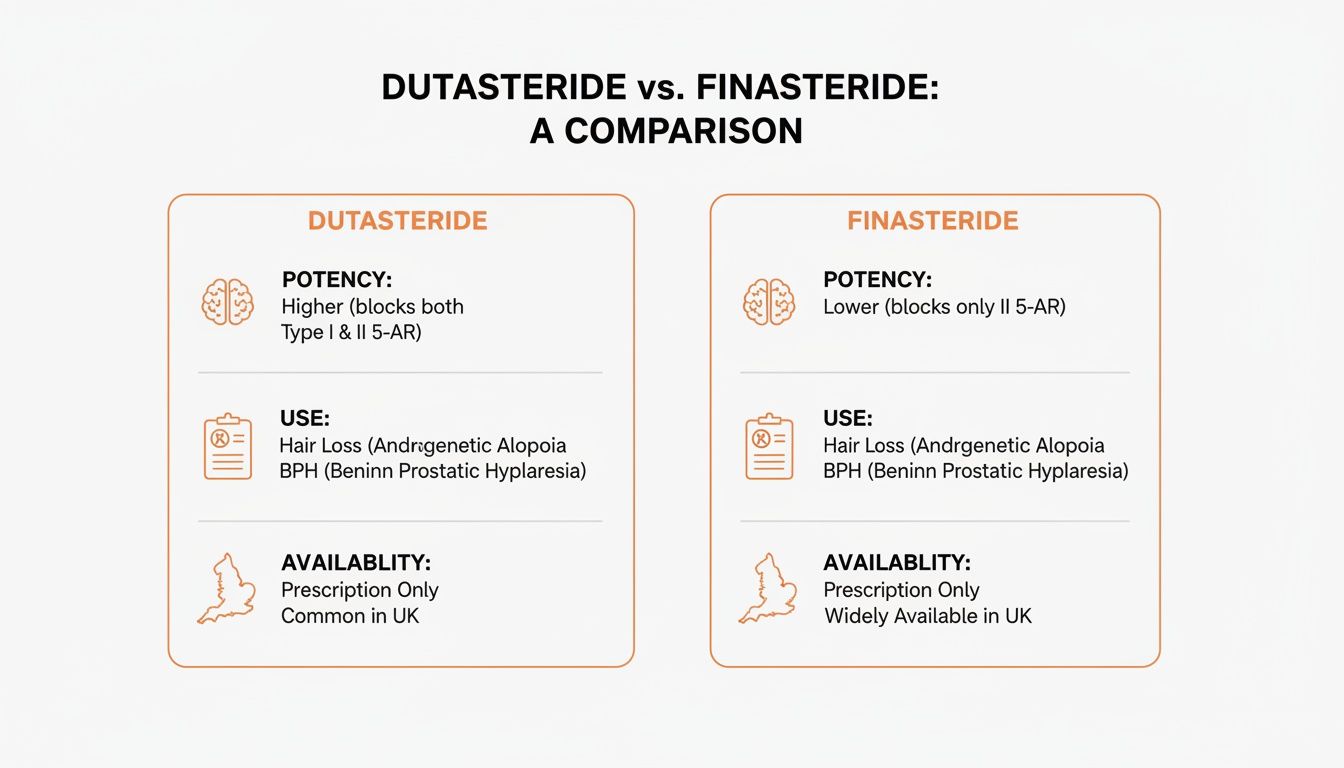
As you can see, dutasteride's higher potency often means it's prescribed 'off-label' for hair loss. In contrast, finasteride is the standard, licensed treatment.
The Bottom Line: The main trade-off is between finasteride's established UK licence and safety record for hair loss, versus dutasteride's greater potency. A doctor may suggest the latter if finasteride hasn't delivered the results you were hoping for.
Key differences at a glance
Here is a quick summary table to give you an immediate understanding of how these two treatments stack up. This can help you prepare for an informed discussion with a healthcare professional about the various hair loss treatments available in the UK.
| Feature | Dutasteride | Finasteride |
|---|---|---|
| Primary Mechanism | Blocks Type I & II 5-alpha reductase | Primarily blocks Type II 5-alpha reductase |
| DHT Reduction | Reduces serum DHT by over 90% | Reduces serum DHT by around 70% |
| UK Licensing | Licensed for enlarged prostate (BPH) | Licensed for male pattern baldness |
| Use for Hair Loss | 'Off-label' but supported by evidence | Standard, first-line treatment |
| Half-Life | Long (around 5 weeks) | Short (around 6–8 hours) |
Understanding these key differences is the first step toward figuring out which path is right for you.
How these treatments halt hair thinning
Before we can really get into the dutasteride versus finasteride debate, we need to talk about the main culprit behind male pattern baldness. It's a powerful hormone called Dihydrotestosterone (DHT).
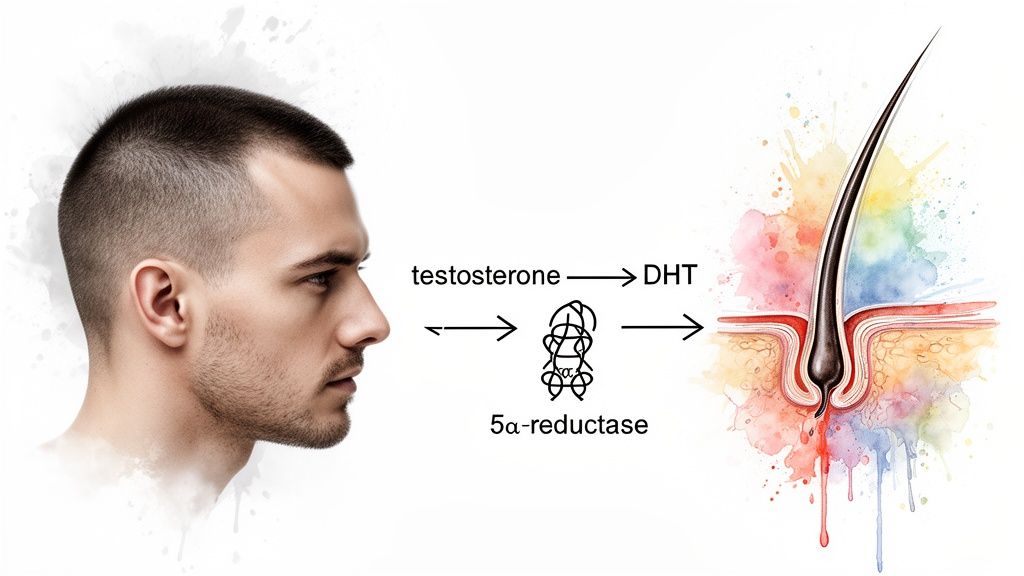
DHT is a natural, more potent version of testosterone. An enzyme in your body called 5-alpha reductase converts a small amount of testosterone into DHT. For men with a genetic tendency for hair loss, this is where the trouble begins. DHT attaches to hair follicles, causing them to shrink over time. This process, called miniaturisation, leads to thinner, weaker hairs until the follicle eventually stops producing hair.
The DHT-blocking mechanism
Finasteride and dutasteride step in to stop this process. They are 5-alpha reductase inhibitors, which means their job is simple: to shut down DHT production. By blocking the 5-alpha reductase enzyme, they dramatically cut the amount of testosterone converting into scalp-damaging DHT. This not only helps stop hair loss but can often allow miniaturised follicles to recover and grow healthier hair again.
Type I vs Type II inhibition: the key difference
Here is where we find the crucial distinction between the two medications. The 5-alpha reductase enzyme comes in two main forms: Type I and Type II.
- Type I 5-alpha reductase is found mainly in the skin, scalp, and liver.
- Type II 5-alpha reductase is located mostly in the prostate gland and, importantly, the hair follicles.
While both types contribute to DHT production, the Type II enzyme is the primary driver of male pattern baldness.
Pharmacist's tip: Understanding these enzyme types is key. Since Type II is the main cause of hair follicle shrinkage, blocking it is essential. The fact that dutasteride blocks both types gives it a more comprehensive action.
Finasteride: a targeted blocker
Finasteride works by selectively blocking the Type II form of the 5-alpha reductase enzyme. This targeted approach is very effective. By focusing on the main enzyme causing hair loss, finasteride reduces DHT levels in the scalp and blood by around 70%. For many men, this is enough to halt thinning and even stimulate some regrowth.
Dutasteride: a dual-action blocker
Dutasteride takes a broader approach. It is a dual inhibitor, which means it blocks both Type I and Type II forms of the 5-alpha reductase enzyme. Because it shuts down both pathways of DHT production, it is a significantly more powerful inhibitor.
Studies show dutasteride can slash DHT levels in the blood by over 90% [1]. This near-total suppression of DHT provides a more robust defence for your hair follicles. It's the main reason doctors often consider dutasteride for men who haven't seen the results they hoped for with finasteride. While DHT is the main hormonal trigger, other factors can affect hair health; you can learn more about the link between prostaglandin D2, mast cells, and male pattern baldness in our detailed guide.
Comparing real-world efficacy and results
So, which one actually works better? The clinical data often suggests dutasteride has the upper hand in sheer power. Both are brilliant at what they do, but dutasteride’s broader DHT blockade can lead to more significant hair regrowth for some men.
However, "more powerful" does not automatically mean "better for everyone." Finasteride is still the officially licensed, first-line treatment for male pattern baldness in the UK. It delivers reliable results for the vast majority of men who try it.
What the clinical studies suggest
Several head-to-head studies have put these two treatments to the test. A key finding is that dutasteride tends to produce a higher hair count and improve hair thickness more effectively than finasteride over the same time [2].
For instance, one major study found that men taking 0.5mg of dutasteride daily experienced a greater increase in total hair count after 24 weeks compared to those on 1mg of finasteride. This supports the idea that its comprehensive, dual-enzyme action leads to more visible regrowth.
Key Insight: Both drugs are excellent at stopping hair loss. However, clinical studies consistently suggest dutasteride is often superior for promoting new growth and increasing hair thickness, thanks to its more profound suppression of DHT.
The UK market reflects finasteride's established role. In 2024, the market for finasteride was valued at USD 6.31 million, with the 1mg dose being the standard choice for the more than 8 million UK men dealing with androgenetic alopecia [3]. Even so, the clinical evidence for dutasteride's potential keeps growing. You can delve deeper into the numbers with the European finasteride market report on cognitivemarketresearch.com.
Real-life scenarios and outcomes
Clinical trials are one thing, but what really matters is how these medications perform for real people. Everyone responds differently, and a "successful" outcome depends on your personal goals.
Let's walk through a couple of common UK scenarios.
Example 1: James, the gym-goer
- Scenario: James is a 35-year-old marketing manager who loves the gym. He started noticing thinning at his crown and began taking finasteride. After a year, his hair loss stopped, but he was disappointed not to see much regrowth.
- Outcome: James spoke with a specialist about his options. They agreed to switch him to dutasteride. Within six months, James noticed his hair felt substantially thicker, and fine new hairs were filling in the thinning patch. For him, the extra power of dutasteride made all the difference.
Example 2: Mark, the busy parent
- Scenario: Mark, a 42-year-old teacher with two young kids, was worried about his receding hairline. His main goal was simple: to keep the hair he had and stop it from getting worse.
- Outcome: Mark’s doctor prescribed finasteride. He found it easy to take the daily tablet and was thrilled that his hairline stayed put over the next few years. For Mark, who wasn't chasing dramatic regrowth, finasteride provided the steady maintenance he wanted.
Finasteride as the first step
For most men starting their hair loss treatment journey, finasteride is the recommended first choice. It holds the UK licence for this specific use, which means it has a long and well-documented record of safety and effectiveness.
Many men, like Mark, get fantastic results with finasteride. They never feel the need to look for a more potent alternative. A switch to dutasteride usually comes into the picture only when results don't meet expectations. It's also worth remembering that combining finasteride with other treatments can boost results, a topic we cover in our ultimate UK guide to minoxidil and finasteride.
Understanding the respective side effect profiles
The possibility of side effects is a major factor when deciding on any medication. It's vital to have a clear and balanced view when it comes to dutasteride versus finasteride. While both are generally well-tolerated, knowing the potential issues helps you and your doctor make the safest choice.
The good news is that for most men, side effects are uncommon and often temporary. Many find they resolve as the body gets used to the medication. Still, it's crucial to be aware of what to look for.
Addressing sexual side effects
Concerns about sexual side effects are common, so let's tackle them head-on. Because both drugs lower DHT, a small percentage of men might experience:
- Decreased libido (a reduced sex drive)
- Erectile dysfunction (difficulty getting or keeping an erection)
- Reduced ejaculate volume
It's important to put this into perspective. Clinical studies show these effects happen in a small minority of users, typically between 1% and 4% [4]. For many who experience them, these issues often fade over time or stop completely if they stop the medication.
Do finasteride side effects go away? For most men, side effects from finasteride are mild and often resolve within the first few months as the body adjusts.
The MHRA and post-finasteride syndrome
The UK’s Medicines and Healthcare products Regulatory Agency (MHRA) has thoroughly reviewed the safety of these medications. They have noted rare reports of sexual dysfunction that continued even after someone stopped taking the treatment [5]. This is known as Post-Finasteride Syndrome (PFS).
PFS is a recognised but rare condition, and its exact cause is still being researched. Millions of men have used these medications safely, but you should always report any persistent or worrying side effects to your doctor. This is why starting with a UK-licensed product like our Finasteride 1mg tablets, under proper medical supervision, is so important.
Potential impact on mood
Beyond sexual health, there is growing awareness of a potential link to mental health. Some men have reported mood changes, including feelings of depression or anxiety, while taking 5-alpha reductase inhibitors.
Finasteride has been a key treatment in the UK since 1999. The MHRA reviewed safety data and noted a higher relative risk for depression associated with dutasteride. In contrast, finasteride did not show a similar increase [5].
Pharmacist's tip: Always tell your doctor about your full medical history, including any past or present mental health conditions. If you notice any changes in your mood after starting treatment, speak to your prescriber straight away.
Comparing the risk profiles
So, does one carry a higher risk than the other? Because dutasteride is a more powerful DHT blocker, some studies suggest it may have a slightly higher rate of side effects, particularly sexual ones, compared to finasteride [6]. The difference is generally small, but it can be a deciding factor for some men.
Here’s a practical look at how the risks stack up:
| Side Effect Concern | Dutasteride | Finasteride |
|---|---|---|
| Sexual Side Effects | Slightly higher incidence reported in some studies due to greater potency. | Lower incidence reported, well-established profile from long-term use. |
| Mood-Related Changes | Some data suggests a higher relative risk for depression. | No significant increased risk for depression noted in the same MHRA data. |
| Persistent Effects | Rare reports exist, similar to finasteride. | Known as Post-Finasteride Syndrome (PFS), considered rare but possible. |
| Half-Life Impact | Long half-life (5 weeks) means side effects can take longer to clear. | Short half-life (6-8 hours) means side effects resolve much faster. |
This table helps show why finasteride is often recommended as the first-line treatment. Its much shorter half-life means that if you experience side effects, they will clear from your system far more quickly once you stop the medication.
Pharmacist's tip: Don't stop taking your medication suddenly without consulting your doctor. They can provide guidance on how to stop safely and discuss alternative options if needed.
Navigating UK licensing, cost, and access
When considering dutasteride and finasteride, practical matters like cost and getting a prescription are just as crucial as the science. The path to accessing these treatments in the UK is quite different for each.
The main difference is their official UK licensing status. Finasteride 1mg (brand name Propecia) is officially licensed by the MHRA for treating male pattern hair loss. This means it has passed strict checks for this exact purpose.
Dutasteride, on the other hand, is licensed in the UK for treating an enlarged prostate. Its use for hair loss is therefore considered ‘off-label’.
What does ‘off-label’ mean?
The term ‘off-label’ can sound worrying, but it is a standard and legal practice in UK medicine. It simply means a clinician is prescribing a medication for a condition other than the one it was originally licensed for.
This happens when a wealth of clinical evidence shows the drug is safe and effective for another purpose. With dutasteride for hair loss, many studies highlight its superior DHT-blocking power. This has led many specialists to prescribe it confidently, especially when finasteride has not delivered the results a patient was hoping for.
Comparing costs for a private prescription
Neither finasteride nor dutasteride for hair loss is usually available on the NHS, so you will need a private prescription. The good news is that generic versions of both are available, which makes them much more affordable.
- Generic Finasteride (1mg): This is generally the more budget-friendly choice. A monthly supply typically costs between £15 and £30.
- Generic Dutasteride (0.5mg): Because it is prescribed off-label and is a more potent drug, dutasteride can be pricier. Expect to pay around £25 to £45 per month.
These prices can vary, but this gives you a realistic idea of the monthly cost.
Safe access through a regulated online pharmacy
Getting treatment today is easier than ever, but doing it safely is vital. Unregulated websites selling counterfeit medicines are a real risk. These fake pills could contain anything from the wrong ingredient to harmful substances.
The safest way to get a prescription is through a regulated service. A legitimate online pharmacy in the UK will always be registered with the General Pharmaceutical Council (GPhC). This registration guarantees that a qualified, UK-based prescriber will review your case properly.
The process is usually straightforward:
- You fill out a secure online consultation form.
- A registered clinician reviews your information to ensure the treatment is safe for you.
- If approved, a private prescription is issued.
- The pharmacy dispenses the medication and ships it to you discreetly.
Pharmacist's tip: Always look for a GPhC logo and registration number on any online pharmacy website. This is your assurance that you're dealing with a legitimate healthcare provider who puts your safety first.
Summary
In the dutasteride versus finasteride debate, there isn't one "best" answer for everyone. Finasteride is the standard, UK-licensed first choice for most men starting their hair loss treatment. It has a long safety record and is effective for the majority of users. Dutasteride is a more powerful, dual-action DHT blocker. A doctor may prescribe it off-label if finasteride hasn't worked well enough after a year. The right choice depends on your specific hair loss, your medical history, and a detailed discussion with a healthcare professional.
FAQs about Dutasteride versus Finasteride
Is it okay to switch from finasteride to dutasteride?
Yes, switching from finasteride to dutasteride is a common strategy. A doctor might suggest this if your progress with finasteride has stalled after at least a year. Because dutasteride is more powerful, it can often kickstart new growth. This change should always be done with your prescriber's guidance.
How long before I actually see a difference?
Patience is key with either treatment. You should start to see the first signs—like less shedding—within three to six months of daily use. For the most noticeable results, you should expect to wait between 12 and 24 months.
Do I really have to take this for the rest of my life?
Yes, to maintain the results, you need to take the medication long-term. Male pattern baldness is an ongoing genetic condition. These drugs work by constantly suppressing DHT. If you stop, your DHT levels will rise again, and the hair you kept or regrew will likely be lost within a year.
What if I forget to take a pill?
If you miss a single dose, don't worry. Just take your next tablet at the usual time. Never take two doses at once to make up for a missed one. Consistency is important, but one missed pill won't undo your progress.
Is dutasteride safer than finasteride?
Both are considered safe for most men, but finasteride has a longer and more established safety record specifically for hair loss. Because dutasteride is more potent and has a much longer half-life, some studies suggest a slightly higher risk of side effects. This is why finasteride is typically the first choice.
Can I buy dutasteride over the counter in the UK?
No, you cannot buy dutasteride or finasteride over the counter in the UK. Both are prescription-only medications. You must have a consultation with a registered clinician, either in person or through a regulated online pharmacy, to get a prescription.
Disclaimer
This article is for informational purposes only and does not constitute medical advice. The information contained herein is not a substitute for and should never be relied upon for professional medical advice. Always talk to your doctor about the risks and benefits of any treatment.
At Courier Pharmacy, our UK-based prescribers are ready to support you at every stage of your hair loss treatment. From the first consultation to ongoing follow-ups, we're here to help you choose the right path, handle any side effects, and make sure you feel in control. Start your free online consultation today at courierpharmacy.co.uk.
**Meta Description** Dutasteride versus finasteride: which is better for hair loss in the UK? Our expert guide compares potency, side effects, costs, and results to help you decide.
**Internal Link Suggestions** * /conditions/hair-loss/ * /minoxidil-and-finasteride-your-ultimate-uk-guide/ * /product/finasteride-1mg-tablets/ * /the-link-between-protaglandin-d2-mast-cells-and-male-pattern-baldness/ * /online-pharmacy-uk/
**Byline:** Medically written by Scott McDougall, MPharm. **Clinical Review:** Clinically reviewed by Dr. Chun Tang, MRCGP.
**How This Content Was Created** This article was medically written by a UK pharmacist and clinically reviewed by a UK GP. All information is based on reliable, evidence-based sources, including the NHS, NICE, the MHRA, and peer-reviewed scientific journals. We aim to provide information that is accurate, accessible, and practical for a UK audience.
**References**
- Clark, R.V., Hermann, D.J., Cunningham, G.R., Wilson, T.H., Morrill, B.B. and Hobbs, S. (2004). Marked suppression of dihydrotestosterone in men with benign prostatic hyperplasia by dutasteride, a dual 5alpha-reductase inhibitor. The Journal of Clinical Endocrinology and Metabolism, 89(5), pp.2179–2184. Available at: https://doi.org/10.1210/jc.2003-030330
- Shanshan, W., Daili, X., Shiyan, Z. and Zhifeng, Z. (2022). The Efficacy and Safety of Dutasteride Compared with Finasteride in Treating Male Androgenetic Alopecia: A Systematic Review and Meta-Analysis. Clinical, Cosmetic and Investigational Dermatology, [online] Volume 15, pp.2705–2713. Available at: https://doi.org/10.2147/ccid.s392817
- Cognitive Market Research (2024). Europe Finasteride Market Report 2024. [online] cognitivemarketresearch.com. Available at: https://www.cognitivemarketresearch.com/regional-analysis/europe-finasteride-market-report
- Mysore, V. (2012). Finasteride and sexual side effects. Indian Dermatology Online Journal, 3(1), p.62. Available at: https://doi.org/10.4103/2229-5178.93496
- MHRA (2024). Public Assessment Report: Finasteride: risk of sexual dysfunction and psychiatric disorders (mood alterations and depression) – (5 mg and 1 mg). [online] GOV.UK. Available at: https://assets.publishing.service.gov.uk/media/6825bc05a4c1a40fde4e63e7/Finasteride_PAR_Accessible_1206.pdf
- Hirshburg, J.M., Kelsey, P.A., Therrien, C.A., Gavino, A.C. and Reichenberg, J.S. (2016). Adverse Effects and Safety of 5-alpha Reductase Inhibitors (Finasteride and Dutasteride): A Systematic Review. The Journal of Clinical and Aesthetic Dermatology, [online] 9(7), pp.56–62. Available at: https://www.ncbi.nlm.nih.gov/pmc/articles/PMC5023004/


