Understanding a Full Blood Count Borderline Result
Confused by a full blood count borderline result? This guide explains what it means for your health, common causes, and your next steps in the UK.
In this article
- What does a borderline FBC result actually mean?
- Why context is everything
- Making sense of your full blood count results
- The key markers in your blood
- Common borderline FBC results and what they could mean
- Common causes behind a borderline full blood count
- Lifestyle and temporary factors
- Underlying health and medications
- Your action plan after a borderline result
- The 'watch and wait' approach
- Next steps and further investigations
- When you should seek urgent medical advice
- Red flag symptoms to act on
- Summary
- Frequently asked questions
- Can stress or anxiety affect my full blood count?
- How long should I wait before retesting a borderline result?
- Can my diet really make a difference to my FBC?
- Are home blood tests accurate for an FBC?
- What if only one marker is borderline?
- Will I need medication for a borderline result?
Getting a full blood count borderline result can be confusing. A borderline finding means one of your blood markers is just outside the normal range, but it's not a red flag for a major problem. Think of it like an amber traffic light: it’s a sign to pay attention, not to panic. This guide explains what the result means, what might cause it, and what your next steps should be.
Here are five key takeaways:
- It's a starting point, not a diagnosis. A borderline result is a prompt for a conversation with your doctor, not a final answer.
- Context is everything. Your doctor will consider your symptoms, lifestyle, and overall health, not just one number.
- Temporary factors are common culprits. Dehydration, a recent cold, or even a hard workout can cause a temporary blip.
- 'Watch and wait' is often the first step. Repeating the test in a few weeks is a standard way to see if the result was a one-off.
- Don't ignore new symptoms. While the result itself isn't an emergency, you should contact your GP if you feel unwell or have new red flag symptoms.
What does a borderline FBC result actually mean?

When a lab processes your blood, it compares your results to a ‘reference range’. This range shows the typical values for healthy people. A borderline result falls at the very top or bottom edge of this range. It’s not quite abnormal, but it’s not sitting comfortably in the middle either.
Often, these small changes are caused by temporary things. You might be feeling a bit under the weather or be slightly dehydrated. Your body might be trying to tell you something, but it’s more of a whisper than a shout.
What is a borderline blood test result? A borderline blood test result is a value that sits on the very edge of the normal reference range, but is not yet considered abnormal.
Why context is everything
A single number on a lab report rarely tells the whole story. A good clinician looks at your results as part of a bigger picture. They connect the dots with other information, including:
- How you’re feeling: Do you have new symptoms, or do you feel perfectly fine?
- Your wider health: Do you have long-term conditions like diabetes that could have an effect?
- Your lifestyle: Your diet, recent exercise, and stress levels can all nudge blood markers.
Real-life example: The busy parent
Sarah, a busy mum, has been feeling more drained than usual. Her blood test shows borderline low haemoglobin (the protein carrying oxygen in red blood cells). On its own, this isn't alarming. Her GP knows she’s been juggling a lot and probably not eating as well as she'd like. They decide to re-test in six weeks and suggest an iron-rich diet. This avoids unnecessary anxiety while making sure any real issue is picked up if it continues.
Making sense of your full blood count results
Receiving your Full Blood Count (FBC) results can feel a little intimidating. You face a page of unfamiliar abbreviations and numbers. It’s natural to wonder what it all means, especially when a result is flagged as ‘borderline’.
Your GP or pharmacist sees these results as part of a much bigger picture. They use the FBC as a starting point to understand your health, investigate symptoms, or monitor how you're doing. It’s a dynamic tool, not a one-time judgement.
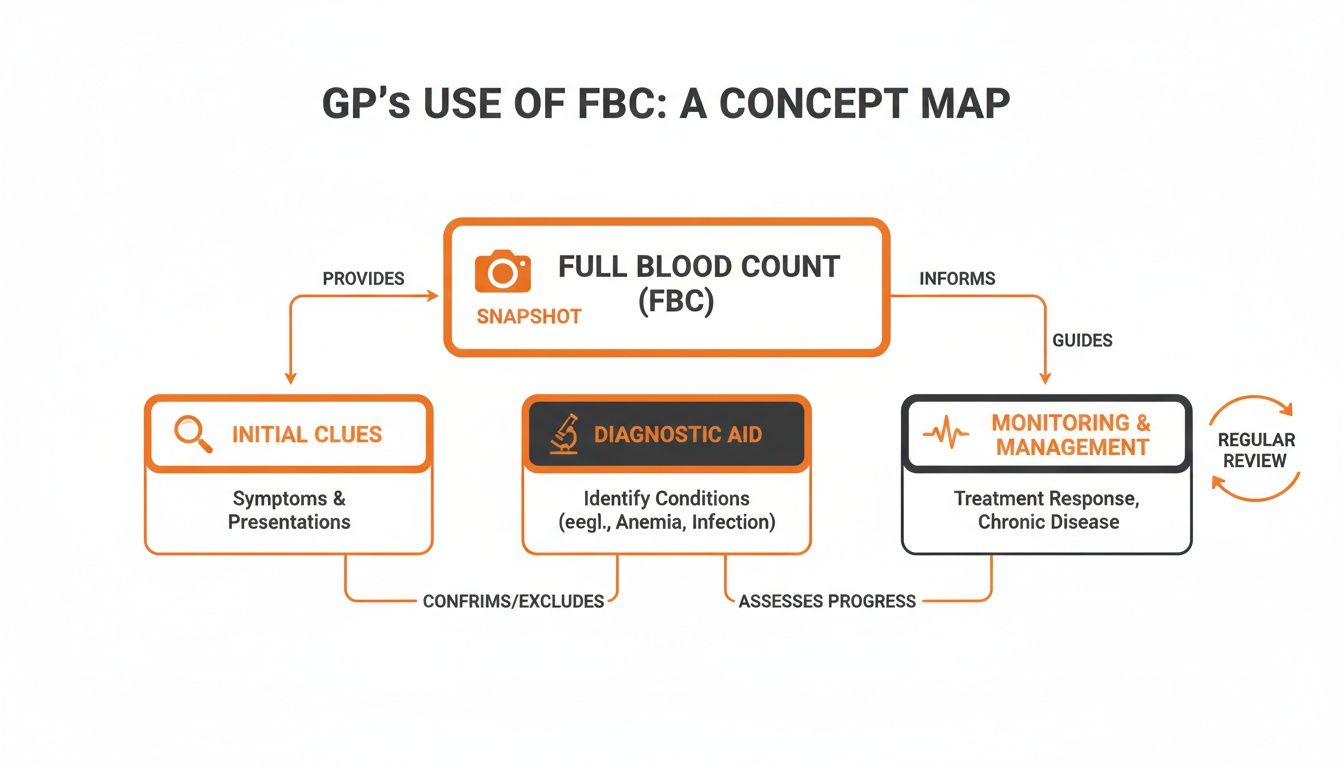
This process shows an initial borderline result is often just the beginning of a conversation about your health, not the end of one.
The key markers in your blood
To get to grips with your results, it helps to know the main players. Each has a specific job. For more detail, our Your Guide to Understanding the Full Blood Count Test is an excellent resource.
Here’s a quick rundown:
The Red Blood Cell family These are the body’s oxygen delivery drivers.
- Haemoglobin (Hb): Carries oxygen to your tissues. Low levels are a classic sign of anaemia.
- Mean Corpuscular Volume (MCV): Shows the average size of your red blood cells. It gives clues about why you might be anaemic.
- Red Cell Distribution Width (RDW): Measures how much your red cells vary in size. A high RDW can be an early hint of a nutrient deficiency.
The White Blood Cell team These are your immune system’s first responders.
- White Blood Cell (WBC) Count: An FBC measures your total WBC count. A 'differential' breaks this down into types like neutrophils (fight bacteria) and lymphocytes (tackle viruses). A slightly raised count might just mean you're fighting a cold.
Platelets (Plt) These tiny cells are your body's emergency repair crew.
- Platelets spring into action to form clots and stop bleeding. A count just outside the normal range can link to many things, from inflammation to a minor infection.
Common borderline FBC results and what they could mean
A borderline result simply means a measurement has fallen at the edge of the standard reference range. It's normal for people to sit slightly outside this range without it meaning anything serious.
The table below outlines common borderline findings and what they might suggest. Remember, these are just possibilities to discuss with a clinician, not a diagnosis.
| FBC Parameter | What It Measures | Common Reasons for a Borderline Result |
|---|---|---|
| Haemoglobin (Hb) | Oxygen-carrying protein in red blood cells. | Mild dehydration, early iron deficiency, minor chronic inflammation. |
| White Blood Cell (WBC) Count | Total number of immune cells. | Fighting a mild cold, physical or emotional stress, reaction to some medications. |
| Platelets (Plt) | Number of cells for blood clotting. | A recent minor infection, slight inflammation, effect of vigorous exercise. |
| Mean Corpuscular Volume (MCV) | Average size of red blood cells. | Early signs of B12/folate deficiency (high MCV) or iron deficiency (low MCV). |
| Neutrophils | White blood cells that fight bacteria. | Early stage of a bacterial infection or the tail-end of recovery. |
| Lymphocytes | White blood cells that fight viruses. | A recent or current viral illness (like the flu), or normal daily changes. |
| Red Cell Distribution Width (RDW) | Variation in red blood cell size. | An early warning sign of a nutrient deficiency. |
Pharmacist's tip: Your lab report is only one piece of the puzzle. A clinician will always interpret these numbers in the context of you as a whole person—your symptoms, medical history, and lifestyle. A follow-up test is often the most sensible next step to see if the result was temporary or part of a trend.
Common causes behind a borderline full blood count
Getting a full blood count borderline result can be unsettling, but the reason is often less dramatic than you think. More often than not, it’s just a temporary blip caused by everyday life.
Your body constantly adjusts to your environment and activities. A blood test is just a snapshot of one moment. These small fluctuations are usually nothing to worry about. They're a sign your body is responding to normal, daily demands.
Lifestyle and temporary factors
Many borderline results trace back to something simple you did the day before your test. Think of it as your body's short-term reaction to recent events.
Some of the most common culprits include:
- Minor dehydration: Not drinking enough water makes your blood more concentrated. This can temporarily push up readings like haemoglobin.
- Intense exercise: A tough workout triggers a natural inflammatory response. This can cause a short-term rise in your white blood cell count.
- Stress and poor sleep: Both physical and emotional stress can put your immune system on alert. This sometimes elevates your white blood cell count.
- Your diet: A diet consistently low in iron or B vitamins can cause reserves to dwindle, leading to borderline results.
Real-life example: The gym-goer
David, a keen weightlifter, had a routine blood test showing a borderline high white blood cell count. He felt perfectly well. His GP noted he’d had a heavy training session the evening before. The GP advised him to rehydrate, rest for a few days, and repeat the test. The second time, his results were squarely in the normal range.
Underlying health and medications
Sometimes, a borderline result is a quiet signal that your body is dealing with something in the background. It might be the first clue that a low-grade issue needs a closer look.
For instance, your body could be fighting a mild virus you don’t fully feel yet. This is a very common reason for a temporary spike in white blood cells. Many common medicines and supplements can also nudge your blood count. It's also wise to monitor other areas, perhaps with a liver function home blood test, to build a complete health picture.
Pharmacist's tip: Always give your doctor or pharmacist a complete list of everything you take. This includes prescription medicines, over-the-counter remedies, vitamins, and herbal supplements. Some can directly affect your FBC results, and this information provides essential context.
Your action plan after a borderline result
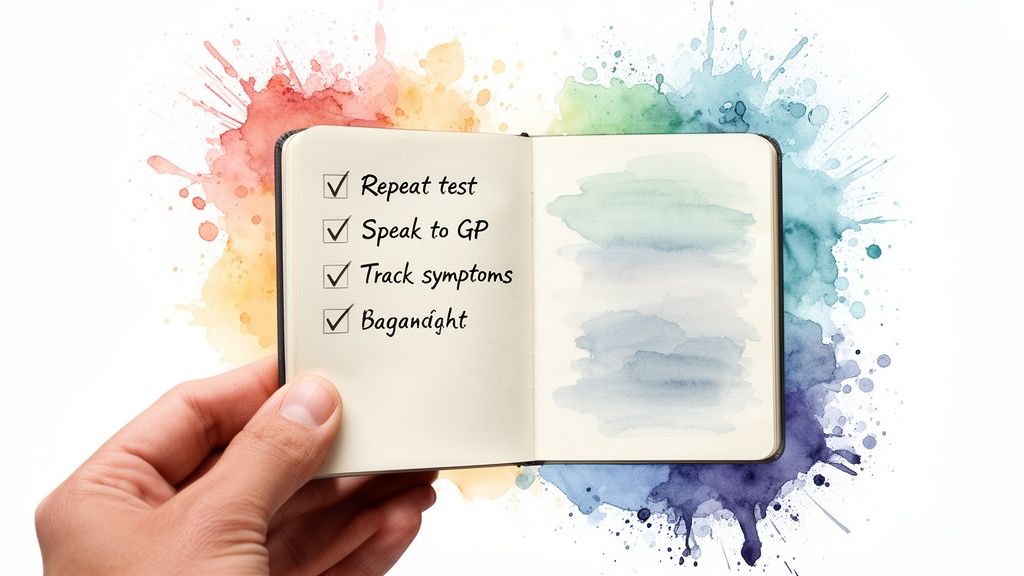
A full blood count borderline result is an amber light. It’s not a red light telling you to panic, but a signal to pause and pay attention. The most important thing is to take a calm, practical approach.
Before you jump to conclusions, discuss the results with a healthcare professional. A GP or qualified pharmacist can interpret what those numbers mean for you. They will consider your symptoms, medical history, and lifestyle. They’ll help you see the bigger picture.
The 'watch and wait' approach
Often, the best response to a one-off borderline reading is to wait and re-test. Doctors call this strategy 'watchful waiting'.
Your clinician will likely suggest repeating the test in a few weeks or months. Many factors can cause a temporary blip, like a minor cold or stress. A second test helps show if the result was a fluke or part of a pattern that needs a closer look.
Pharmacist's tip: In the time before your next test, try keeping a simple health diary. Jot down notes on your energy levels, any new symptoms, your diet, and how you feel. This gives your doctor valuable context that can help them connect the dots.
Next steps and further investigations
If the borderline result shows up again, or if you have specific symptoms, your GP might recommend more tests. This is a standard part of the process to rule out conditions or pinpoint a cause.
Common follow-up tests include:
- Iron Studies: If your haemoglobin is on the line, checking your ferritin (iron storage) is a logical next step.
- Vitamin B12 and Folate Tests: These are vital for making healthy red blood cells. A test is often ordered if your cells are larger than normal (high MCV).
- Inflammatory Markers: A C-Reactive Protein (CRP) test can reveal underlying inflammation, which can impact your blood count.
For anyone using home testing, knowing how to collect a good sample is key. Our guide on how to use a home blood test kit in the UK provides great practical advice.
When you should seek urgent medical advice
While a full blood count borderline result isn’t usually a reason to panic, you shouldn't ignore it. Think of it as an early warning flare. The key is to understand what else your body might be telling you through new or worsening symptoms.
It’s the combination of a borderline result and certain physical signs that creates a picture needing a professional eye. If you're feeling unwell, it's crucial not to dismiss it or wait for a routine appointment.
Red flag symptoms to act on
If your borderline blood test is accompanied by any of the symptoms below, you must contact your GP or call NHS 111 for urgent medical advice. These can sometimes point to more significant conditions that need to be caught early.
- Severe shortness of breath: Finding it hard to breathe when resting.
- Unexplained and significant weight loss: Seeing the number on the scales drop without trying.
- Drenching night sweats: Waking up with your pyjamas and bedding soaked through.
- Persistent or severe fever: A high temperature that won’t go away.
- Unusual bleeding or bruising: Frequent nosebleeds, bleeding gums, or large, dark bruises you can't explain. Learn more about the causes of bruising in our helpful guide.
- Extreme fatigue or exhaustion: Overwhelming tiredness that stops you from doing daily tasks.
- Bone pain: A persistent, deep ache in your bones.
Summary
A full blood count borderline result means a blood marker is on the edge of the normal range. In most cases, it is not a cause for alarm. The result is often due to temporary factors like mild dehydration, stress, or a minor infection. It is a starting point for a discussion with your doctor, not a final diagnosis. Your clinician will look at the bigger picture, including your symptoms and lifestyle. The most common next step is 'watchful waiting', which involves repeating the test after a few weeks to see if the result was a one-off. While the result itself isn't an emergency, you should always seek urgent advice if you have any 'red flag' symptoms.
Frequently asked questions
Can stress or anxiety affect my full blood count?
Yes, they can. Significant physical or emotional stress can trigger a "fight or flight" response. This can cause a temporary spike in your white blood cell count, especially neutrophils. This is your body's natural defence mechanism and usually settles down once the stress passes.
How long should I wait before retesting a borderline result?
Your doctor will advise you, but a typical wait is from a few weeks to three months. This gives your body time to resolve any short-term issues, like a minor infection. Testing again too soon might not give a true picture of what is happening.
Can my diet really make a difference to my FBC?
Without a doubt. Your diet provides raw materials like iron, vitamin B12, and folate to make healthy blood cells. If your diet is low in these nutrients, it can lead to anaemia. This often first appears as a borderline result, such as slightly low haemoglobin.
Are home blood tests accurate for an FBC?
Modern home blood test kits are very reliable when used correctly. They use the same accredited labs that the NHS uses for analysis. The key to an accurate result is collecting a good quality sample, so follow the instructions carefully.
What if only one marker is borderline?
If just one blood marker is borderline and everything else is normal, it’s often not a major concern. Clinicians look for patterns across the entire FBC. A single, isolated borderline reading without any symptoms is often just a minor blip that resolves on its own.
Will I need medication for a borderline result?
It's very unlikely, at least not straight away. The first step is usually 'watchful waiting' to see if the result normalises on its own. Your doctor might also suggest simple lifestyle tweaks. Medication is generally only considered if follow-up tests confirm an underlying condition.
Meta description: Confused by a full blood count borderline result? Our patient-friendly guide explains what it means, the common causes, and your next steps with your GP.
Byline: Written by Scott McDougall, MPharm (Pharmacist) Clinically reviewed by Dr. Chun Tang, MRCGP (GP)
How this content was created: This article was written by a qualified UK pharmacist based on reliable sources like the NHS and NICE guidelines. The content was then reviewed by a practising GP to ensure it is accurate, up-to-date, and easy for patients to understand. Our goal is to provide trustworthy health information to help you have better conversations with your healthcare team.
Disclaimer: This article is for informational purposes only and should not be used as a substitute for professional medical advice, diagnosis, or treatment. Always seek the advice of your GP or other qualified health provider with any questions you may have regarding a medical condition.
References: [1] Watson, J., Round, A., and Hamilton, W., 2022. The full blood count for cancer diagnosis in primary care: a cohort study of 939,000 patients. British Journal of General Practice, 72(716), pp.e162-e170. Available at: https://pubmed.ncbi.nlm.nih.gov/37056715/


