Genital Warts Treatment UK: Options & Costs 2026
Our expert guide to genital warts treatment uk covers NHS & private options, including creams, cryotherapy, costs, and where to get help in 2026.
SEO brief
- Primary keyword: genital warts treatment uk
- Secondary keywords: genital warts treatment, HPV treatment UK, genital wart cream UK, sexual health clinic UK, imiquimod, podophyllotoxin
- Search intent: Informational with practical next-step guidance
- Target reader: UK adults who want clear, discreet, realistic treatment advice
- Product/service mention (if any): Courier Pharmacy CTA only, per brief
- Internal links available: Assumed from supplied URLs in the brief
Genital warts are a common, treatable skin condition caused by HPV, and the UK recorded an estimated 220,875 cases in 2012 with total management costs of £58.44 million, showing how often clinicians deal with this problem in everyday practice. Numerous effective treatments are available in the UK, from clinic procedures to creams you can use at home.
If you've just noticed a small bump, a cluster of fleshy spots, or a change in the skin around your genitals or anus, it's very normal to feel worried. It's natural to immediately seek answers: What is it, what works, and where do I go now?
This guide gives you the practical version. You'll learn what genital warts are, how treatment choices differ, where people in the UK usually get help, what to expect if warts come back, and how prevention fits in.
- Get assessed first: Genital warts are often diagnosed by sight, but other skin conditions can look similar.
- Home treatments can work well: Self-applied options such as imiquimod and podophyllotoxin suit many people.
- Clinic treatment is useful for some cases: Freezing, acid treatment, or minor procedures may suit larger or stubborn warts.
- Recurrence is common: If warts return, it doesn't mean you've done anything wrong.
- Access matters: NHS clinics, GPs, and regulated online services each suit different lifestyles.
Introduction
Genital warts are one of the most common viral sexually transmitted infections seen in UK practice. They happen because of human papillomavirus (HPV), usually low-risk types that affect the skin rather than causing cancer changes.
People often describe them as tiny bumps, soft tags, or little cauliflower-like clusters. They may appear on the penis, vulva, around the anus, or nearby skin. Some itch. Some don't cause any physical discomfort at all.
What matters most at the start is this. There are several good treatment routes in the UK, and the right one depends on where the warts are, how many there are, how easy self-treatment feels, and how private or convenient you need the process to be.
What Are Genital Warts and Why Are They So Common
Genital warts are skin growths caused by HPV, usually types 6 and 11 in 90% of cases [1]. In practice, that matters because these are the low-risk wart-causing types, not the types people usually mean when they worry about HPV and cancer.
In the UK, genital warts are common enough to be a routine part of sexual health care. One UK analysis estimated 220,875 cases in 2012, with a total management cost of £58.44 million and an average of £265 per patient [1]. That doesn't make them pleasant, but it should reassure you that you're not dealing with something rare or unusual.
What they are
Think of genital warts as a skin reaction to a very common virus. They are not caused by poor hygiene, and they aren't a sign that someone has been reckless. HPV spreads through close skin-to-skin sexual contact, and many people never know exactly when they picked it up.
Practical rule: Don't try to diagnose every genital bump yourself. Skin tags, molluscum, irritation, and other conditions can look similar.
If you're also dealing with other skin worries, broad guidance on common skin infections and related skin conditions can help you understand why proper assessment matters.
Why they feel sudden
One of the hardest parts is timing. People often notice a wart long after the original HPV contact. That delay can trigger panic about recent partners when the answer may be far less clear-cut.
This is one reason genital warts create so much anxiety. The appearance feels sudden, but the infection may have been sitting dormant in the skin for some time.
What they can look like
They may appear as:
- Small fleshy bumps: Single or scattered
- Clustered growths: Sometimes with a cauliflower-like surface
- Flat or raised areas: Especially on moist skin
- Skin changes around the anus or genitals: Not always sore, not always itchy
A clinician should assess any new genital lesion if:
- You're unsure what it is
- It bleeds
- It becomes painful
- It's spreading
- You're pregnant
- You have a weakened immune system
Your Genital Warts Treatment Options A Detailed Comparison
Individuals experiencing genital warts don't need one "best" treatment. They need the most practical treatment for their situation. A shift worker with a few small external warts may prefer self-applied treatment at home. Someone with larger, awkwardly placed, or persistent warts may do better with clinic treatment.
UK guidance gives a clear starting point. BASHH prioritises imiquimod 5% cream as a first-line self-applied therapy, used thinly 3 times weekly before sleep and washed off after 6 to 10 hours. Podophyllotoxin 0.5% solution is another self-applied option, usually twice daily for 3 days on, 4 days off [2].
Self-applied treatments
Imiquimod 5% cream helps your immune system react to the affected skin. I often describe it to patients as a "nudge" rather than a burn treatment. It doesn't just strip the surface. It tries to help your body recognise and clear infected skin cells.
That makes it useful for people who want to manage treatment privately at home. The trade-off is that it can irritate the skin, and it needs patient, steady use.
Podophyllotoxin 0.5% solution works differently. It damages wart tissue directly, which helps the wart shrink and peel away. It's often practical for small, external, non-keratinised warts, especially when someone wants a shorter cycle-based routine [2].
A few practical differences matter:
- Imiquimod: Often suits people happy with a slower, immune-based approach
- Podophyllotoxin: Often suits small external warts and people who prefer a clear on-off cycle
- Neither is a DIY diagnosis tool: They should only be used when the lesion has been properly assessed as a wart
If a cream causes marked soreness, ulceration, or raw skin, pause and get advice. More treatment is not always better treatment.
A realistic example helps here. A busy professional with a long commute may choose imiquimod because they can apply it at home overnight and avoid daytime clinic appointments. By contrast, a gym-goer with friction in the area may find self-treatment uncomfortable and prefer a clinic route so the skin settles between appointments.
Clinic-applied treatments
Clinic treatment usually means the wart is treated by a healthcare professional rather than by the patient at home.
Cryotherapy freezes the wart. It can work well, especially when a clinician wants direct control over treatment. The downside is simple. You have to attend, and some people find it sore, especially on sensitive skin.
Trichloroacetic acid (TCA) is another clinician-applied option. It works by chemically destroying wart tissue. It can be useful for small warts, but it isn't a casual treatment. Placement matters, and the skin can become very irritated if it's used in the wrong place.
These treatments are often chosen when:
- The wart position is awkward
- The diagnosis needs confirmation
- Self-applied treatment isn't suitable
- The person wants face-to-face support
- The warts haven't responded to a home-applied option
Minor procedures for stubborn cases
Some warts need a procedural approach. That may include surgical removal, cautery, or laser-based treatment in specialist settings. This tends to come into the picture when warts are persistent, bulky, or repeatedly returning in the same site.
This route sounds dramatic, but in practice it can be very sensible. If someone has already tried repeated topical treatment with little success, a minor procedure may be the more efficient and less frustrating option.
A rural resident is a good example. If travelling for repeat clinic visits is difficult, self-treatment may be the first try. But if the wart persists and needs multiple reassessments, one procedural appointment can sometimes become the more practical choice.
UK Genital Wart Treatment Comparison
| Treatment | How It Works | Where to Get It | Typical Timeframe | Common Side Effects |
|---|---|---|---|---|
| Imiquimod 5% cream | Helps the immune system react to wart tissue | Sexual health clinic, GP, or regulated prescribing route | Used over weeks | Redness, soreness, irritation |
| Podophyllotoxin 0.5% solution | Breaks down wart tissue directly | Sexual health clinic, GP, or regulated prescribing route | Cycle-based use over weeks | Burning, stinging, local irritation |
| Cryotherapy | Freezes wart tissue | Sexual health clinic or specialist service | Repeat visits may be needed | Pain, blistering, soreness |
| TCA | Chemically destroys wart tissue | Clinic only | Often repeated in clinic | Burning, ulceration, irritation |
| Minor surgery or cautery | Physically removes or destroys wart tissue | Specialist clinic or hospital setting | Usually arranged after assessment | Pain, wound care needs, scarring risk |
For treatment access routes and prescribing pathways, some patients also look at online treatment options through regulated UK pharmacy services, but the key point is always the same. The wart needs proper assessment before treatment starts.
How to Get Genital Warts Treatment in the UK
Treatment access in the UK usually follows one of three paths. A sexual health clinic. Your GP. Or a private or online route after a proper consultation.
In England, GUM clinics manage 73% of genital wart cases exclusively, while GPs handle 5% independently and 22% of patients see a GP before GUM referral. The same analysis estimated an average cost per episode of £113, with GUM services driving 80% of expenditures [3].
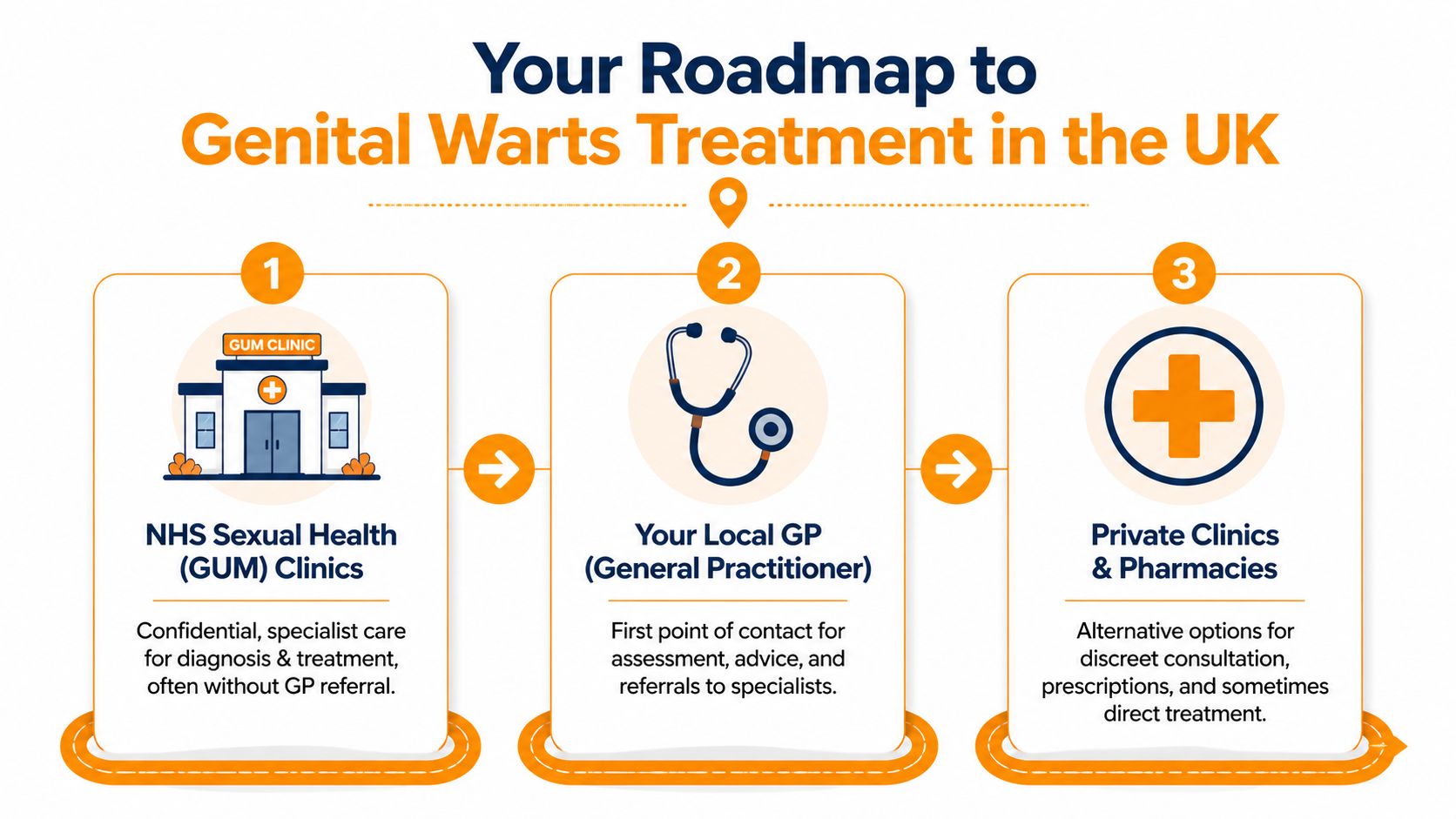
NHS sexual health clinics
This is often the most direct route. You usually don't need a GP referral, and sexual health clinicians see genital warts regularly. That matters because diagnosis by sight is common, and an experienced examiner can often sort out quickly whether you're dealing with warts or something else.
A student who wants confidentiality may prefer this route. Sexual health clinics are used to sensitive concerns, and they can assess, discuss STI testing if needed, and offer clinic-based treatment or prescribe home-applied treatment.
Pros:
- Specialist experience
- Confidential service
- Access to both diagnosis and treatment
- Useful for complex or uncertain cases
Trade-offs:
- Appointment availability varies
- You may need to travel
- Repeat visits can be awkward if you work shifts or live rurally
Pharmacist's tip: If the bumps are inside the vagina, around the anus, or hard to see clearly yourself, clinic assessment is often the safest first step.
Your GP
A GP can still be a good starting point, especially if sexual health clinic access is poor in your area or you want broad advice on other health issues at the same time.
A busy parent might choose the GP because it fits around school runs and other prescriptions. Your GP can examine visible lesions, discuss likely diagnosis, and refer on if the location or appearance needs specialist review.
Pros:
- Familiar setting
- Good if you already need another appointment
- Can coordinate referrals
Trade-offs:
- Some GPs see fewer genital wart cases than sexual health teams
- Referral may add an extra step
- Procedures often still happen elsewhere
Pharmacist's tip: Take a short note of when you first noticed the lesions, whether they itch or bleed, and whether you've used any creams already. That saves time and helps avoid the wrong treatment.
Private and online routes
For some people, privacy and convenience drive the decision. If the wart is external, the diagnosis is straightforward after assessment, and you prefer treatment without waiting in clinic, a regulated online route can be practical.
This often suits a shift worker or someone in a smaller town who doesn't want repeated travel. The safe version of this route involves a proper medical questionnaire, clinician review, and a real pharmacy regulated in the UK.
You can see one example of how a regulated service explains its prescribing process in this guide to how online treatment ordering and reviews work.
Pros:
- Convenience
- Privacy
- Home delivery
- Useful for self-applied treatments
Trade-offs:
- Not suitable for every wart
- A photo or in-person check may still be needed
- You still need follow-up if treatment irritates the skin or doesn't work
Pharmacist's tip: Before using any online service, check that the pharmacy is GPhC-registered and that prescribers review treatment requests individually. Avoid any website that sells prescription treatments like a simple retail item with no clinical assessment.
The best access route is the one that gets you a correct diagnosis and a treatment plan you can actually stick to.
Managing Treatment and What to Do If Warts Come Back
Recurrence is the part most leaflets underplay. People often think treatment has "failed" if a wart returns. In reality, visible wart removal and viral activity in the skin are not exactly the same thing.
Some UK guidance notes that recurrence is a key challenge, with 30% to 50% of cases in some BASHH audits recurring within 3 months, and recurrence can be higher in people with a weakened immune system [4]. That isn't a sign of poor hygiene, weak character, or doing treatment "wrong". It's part of how HPV behaves in skin.
What treatment usually feels like
Most genital wart treatments cause some local skin reaction. That's expected. The trick is knowing the difference between a manageable reaction and a treatment that has become too harsh.
Common experiences include:
- Mild redness
- Stinging
- Tenderness
- Peeling or inflamed skin around the wart
Simple care helps:
- Keep the area clean and dry
- Avoid harsh soaps
- Pause sex if friction worsens soreness
- Follow the exact treatment schedule rather than adding extra doses
Why warts can come back
The visible wart may clear while HPV remains active in nearby skin. That is why recurrence happens. Some people also have skin that becomes more irritated with treatment, which makes persistence more frustrating.
People with allergies, intolerances, or immune issues may need follow-up better suited to their particular circumstances. That might mean checking whether the diagnosis is still correct, changing treatment type, or reviewing whether self-applied treatment is practical enough.
Returning warts need review, not blame.
This short video gives a plain-English overview of the condition and why treatment may need more than one step.
When to ask for review
Ask for a review if:
- The wart hasn't improved after a fair treatment trial
- The skin becomes very sore, raw, or ulcerated
- New lesions keep appearing
- The wart is in a difficult area
- You're pregnant
- You have reduced immunity or ongoing skin problems
If warts keep returning, don't keep repeating the same failed routine forever. That's when a different treatment route, or a fresh look at the diagnosis, often helps most.
Prevention The HPV Vaccine and Safer Sex Practices
Prevention doesn't erase the stress of finding a wart today, but it does matter for your future health and for partners.
The strongest prevention tool is the HPV vaccine. In the UK, the national programme launched in 2008, and by 2013 genital wart diagnoses in 15 to 19-year-old females had fallen by 28% from pre-vaccination peaks [5]. That's one of the clearest examples in sexual health of prevention changing what clinicians see in everyday practice.
Why the vaccine matters
The wart-causing HPV types are common, and vaccination reduces the chance of the skin ever dealing with them in the first place. If you're eligible, it's well worth discussing vaccine access rather than assuming you've "missed your chance".
The vaccine doesn't treat existing visible genital warts. It works as prevention, not as a cure. That's an important distinction.
Safer sex still helps
Condoms reduce HPV spread, but they don't remove the risk fully because HPV spreads through skin-to-skin contact, not just fluids.
Useful habits include:
- Use condoms consistently
- Avoid sex if treatment is causing broken or inflamed skin
- Don't share sex toys without cleaning them and using barrier protection
- Attend review if you're unsure whether lesions have cleared
If you or a partner are also dealing with other intimate health symptoms, separate assessment matters because not every genital symptom is HPV-related. For example, some people seek care for bacterial vaginosis treatment and vaginal symptoms at the same time, but these are different conditions and need different treatment.
Summary Your Key Takeaways
Genital warts are common, caused by HPV, and usually manageable with the right treatment plan.
UK treatment options include self-applied creams and clinician-led procedures.
Imiquimod and podophyllotoxin are important home-use options when the wart is suitable for self-treatment.
Sexual health clinics remain the main NHS route, but GPs and regulated online services can also help.
Recurrence is common and doesn't mean you've failed.
If a treatment isn't working, ask for review rather than pushing on blindly.
Vaccination and safer sex reduce future risk and are worth discussing.
Frequently Asked Questions (FAQs)
Are genital warts cancerous
Usually, no. The wart-causing HPV types are typically low-risk types, and types 6 and 11 cause 90% of cases [1]. They are different from the HPV types more often linked with cancer changes.
Can genital warts go away on their own
Yes, they can. Some warts do settle without treatment, but many people still choose treatment because of symptoms, anxiety, spread, or the location of the wart. Assessment still matters so you know what you're dealing with.
What is the best genital warts treatment in the UK
There isn't one best treatment for every person. Small external warts may suit self-applied treatments such as imiquimod or podophyllotoxin, while larger or stubborn warts may need clinic treatment. The best option is the one that fits the wart type, location, and your ability to use it safely.
Do I need to tell my partner
In practice, it's sensible to have an open conversation. HPV is common, and partners may have shared exposure already even if they have no symptoms. A sexual health clinician can help with advice if you're unsure how to approach it.
Can I have sex while treating genital warts
It's usually better to avoid sex if the area is sore, inflamed, or actively being treated. Friction can worsen irritation, and skin contact may still spread HPV. Wait until the skin has healed and follow the advice given with your treatment.
Are home remedies a good idea
Usually not. Internet remedies can burn delicate skin, delay proper treatment, and make diagnosis harder. If something is sold as a wart cure but skips proper genital safety advice, avoid it.
Is treatment safe in pregnancy
Some treatments are not suitable in pregnancy, so proper review is important. If you're pregnant or trying to conceive, tell the clinician before starting anything. Clinic-led treatment is often preferred when there are any doubts.
When should I get urgent help
Get prompt medical advice if you have severe pain, heavy bleeding, trouble passing urine, rapidly worsening skin damage, or if you're not sure the lesion is a wart at all. Urgent review also makes sense if you are immunocompromised and lesions are changing quickly.
Can an online pharmacy help with genital warts
A regulated UK online pharmacy may be able to help when the wart is suitable for remote assessment and self-applied treatment. The key is proper prescribing, not convenience alone. If you want to check whether a provider is legitimate, start with a trusted UK online pharmacy service and verify its registration details before ordering.
If you'd like discreet, UK-regulated support, Courier Pharmacy offers confidential online consultations reviewed by real prescribers, with treatment supplied only when appropriate and delivered in discreet packaging.
Meta description: Genital warts treatment UK explained clearly. Learn symptoms, treatment options, access routes, recurrence, and prevention in a practical UK guide.
Suggested internal links for medicalmojo.co.uk
- A guide to HPV and common misconceptions
- How online prescribing works in the UK
- Sexual health conditions that can look similar
- When to choose a GP, clinic, or online pharmacy
- Understanding common side effects of topical skin treatments
Byline: Medical Mojo Editorial Team
Clinical review: Reviewed by a UK-registered pharmacist
How this content was created
This article was written using the verified source material supplied in the brief, with emphasis on UK sexual health guidance, peer-reviewed literature, and practical pharmacy counselling principles. The draft was then clinically sense-checked for safety, tone, and accuracy, with unsupported claims removed.
Disclaimer: This article is for information only and isn't a substitute for personal medical advice, diagnosis, or treatment.
References
[1] Desai, S., Wetten, S., Woodhall, S.C. and Peters, L. (2015) ‘Genital warts and cost of care in England’, Sexually Transmitted Infections. Available at: https://pubmed.ncbi.nlm.nih.gov/25681263/
[2] Wilson, J.D. and BASHH guideline authors (2024) ‘UK national guideline for the management of anogenital warts’, International Journal of STD & AIDS. Available at: https://journals.sagepub.com/doi/10.1177/09564624241233338
[3] Patel, H., Wagner, M., Singhal, P. and Kothari, S. (2013) ‘Systematic review of the incidence and prevalence of genital warts’, BMC Infectious Diseases / PMC record with England care pathway details. Available at: https://pmc.ncbi.nlm.nih.gov/articles/PMC3253068/
[4] NHS Borders Clinical Guidelines (n.d.) ‘Warts and other anogenital lumps’. Available at: https://www.rightdecisions.scot.nhs.uk/nhs-borders-clinical-guidelines/sexual-health/warts-and-other-anogenital-lumps/
[5] Public Health England (2014) ‘Decline in genital warts diagnoses in young women following the national HPV immunisation programme’, Health Protection Report. Available at: https://assets.publishing.service.gov.uk/media/5a7e1ecee5274a2e87dafada/hpr2414.pdf


