Glycerol and Fatty Acid Explained for UK Patients
Learn what glycerol and fatty acid are, how they work together, and why they matter in moisturisers, allergies and UK food safety guidance.
SEO brief
- Primary keyword: Glycerol and fatty acid
- Secondary keywords: glycerol in skincare, fatty acids in moisturiser, E422 glycerol, slush ice glycerol UK, triglyceride digestion, sensitive skin ingredients
- Search intent: Informational. The reader wants a plain-English explanation of what glycerol and fatty acids are, where they appear, and what UK safety rules matter.
- Target reader: UK adults, carers, and curious patients reading food or skincare labels
- Product/service mention (if any): One factual mention of a relevant pharmacy product option
- Internal links available: Assumed from Courier Pharmacy educational and product pages provided
Glycerol and fatty acid explained for UK patients
You're probably here because you've picked up a moisturiser, spotted words like glycerin, stearic acid, or E422, and wondered if they're helpful, harmful, or just chemistry jargon. The short answer is simple. Glycerol and fatty acid are two different types of molecules that often work together in food, skin products, and body fat.
This guide explains what each one does, how they join together in triglycerides, why they both show up in creams, and what UK safety advice matters, especially for slush-ice drinks and sensitive skin. I'll keep it practical and pharmacy-friendly.
Five key takeaways
- Glycerol holds water: It helps keep skin and some foods moist.
- Fatty acids add structure: They help form fats and can support the skin barrier.
- They join to make triglycerides: One glycerol molecule plus three fatty acids makes a triglyceride [1][2].
- UK food rules matter: Glycerol is an authorised food additive called E422 in the UK [3].
- Young children need extra care with slush ice drinks: UK guidance warns that excess glycerol intake can cause serious side effects [4].
What glycerol and fatty acid really mean
You might spot these words on two very different labels on the same day. One is a moisturiser for dry hands. The other is a brightly coloured slush drink for a child. The useful link between them is that both labels can include ingredients from the same bit of everyday chemistry.
Glycerol is a clear, syrupy liquid that mixes well with water. On ingredient lists, it may appear as glycerol, glycerine, or glycerin. In food, it can also appear as E422 [3]. A simple way to understand it is that glycerol works a bit like a sponge. It helps hold on to water. In a cream, that can help the top layer of skin feel less dry. In a food or drink, it can help with moisture and texture.
A clear example is a hand cream. If glycerol is high on the ingredients list, it is usually there because it helps the skin keep hold of water.
Fatty acids are different. They are oily building blocks found in fats and oils, and you may see names such as stearic acid, palmitic acid, or oleic acid on skincare labels. The word acid often sounds alarming, but in this setting it usually does not mean something harsh or stinging. In a moisturiser, a fatty acid often helps give the product body, helps it spread well, and supports the skin barrier by adding an oily part that slows water escaping.
A helpful comparison is this. Glycerol is the part that likes water. Fatty acids are the part that likes oil. Put those ideas side by side, and many labels start to make more sense.
That is why these two words show up in both the food story and the skin story. In a slush drink, glycerol may be there as E422. In a moisturiser, glycerol and fatty-acid-based ingredients can help the product feel smooth and help dry skin feel more comfortable. Same chemistry words. Different jobs.
If you are choosing products for rough or flaky skin, a practical guide to dry skin treatment options can help.
Common label names to recognise
- Glycerol: glycerine, glycerin, E422
- Fatty acids: stearic acid, palmitic acid, oleic acid
- Related words: triglyceride, monoacylglycerol, ester
How glycerol and fatty acids join up in the body
A patient might see glycerol listed as E422 in a slush drink warning, then spot glycerine and stearic acid on a moisturiser and wonder if these are somehow the same thing. The link is real, but the job is different. Inside the body, glycerol and fatty acids often join together to make a storage form of fat called a triglyceride [2].
A triglyceride is made from one glycerol molecule and three fatty acid molecules [2]. Glycerol works like a small central backbone. The fatty acids attach to it, rather like three tails fixed onto one hub. The links holding them together are called ester bonds.
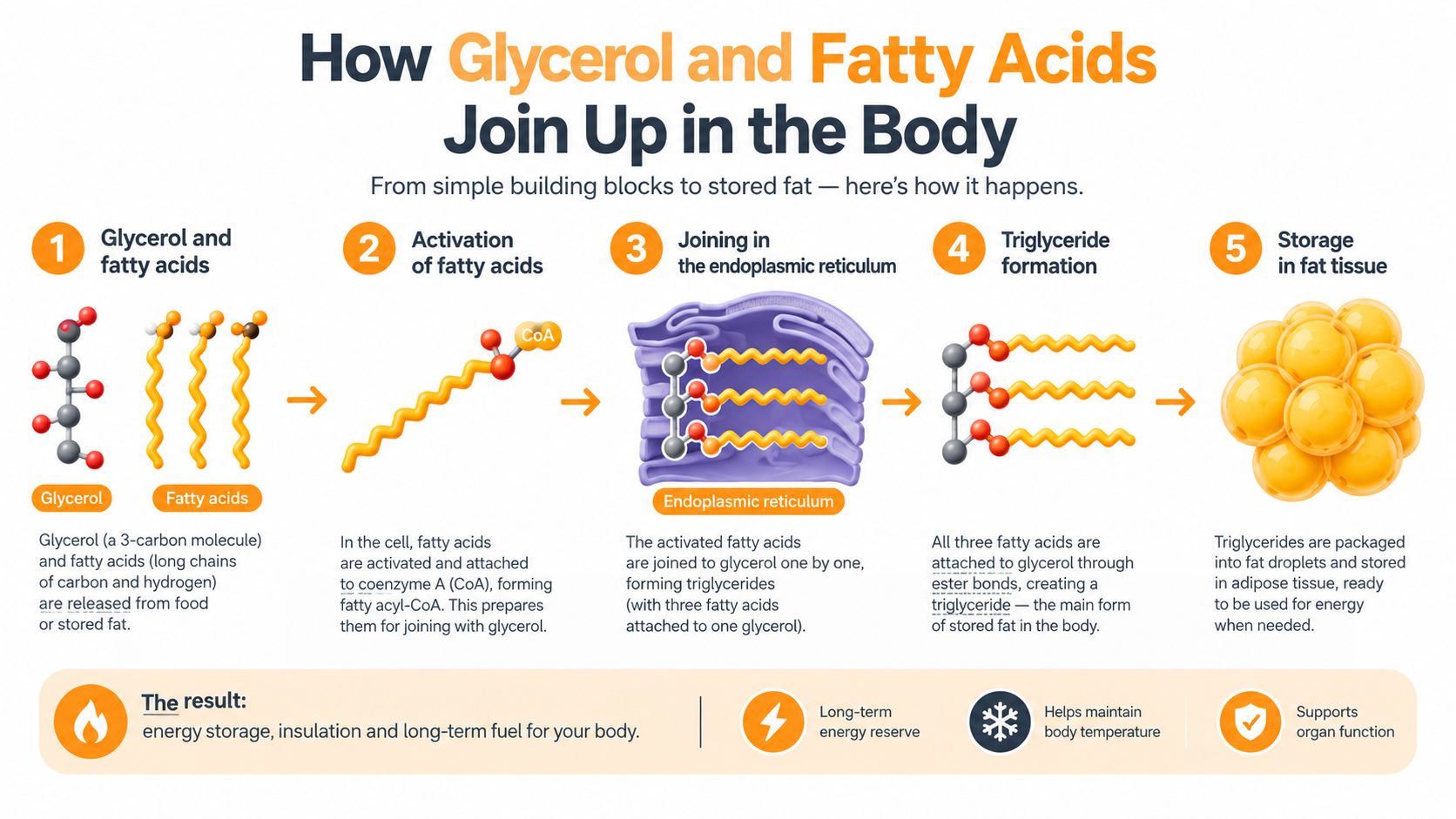
That joined-up form matters because it is a tidy way for the body to pack away energy.
What happens when you eat fat
When you eat foods containing triglycerides, your gut needs to split them into smaller parts before absorption. Digestive enzymes called lipases do that job. NHS laboratory guidance explains that triglycerides are broken down in the gut by lipases into fatty acids and glycerol [1].
There is one detail that often clears up label confusion. In the small intestine, pancreatic lipase removes fatty acids from the sn-1 and sn-3 positions of triacylglycerols, producing 2-monoacylglycerol and free fatty acids as the main absorbed products [5]. So if you come across the words glycerol, fatty acids, and monoacylglycerol in the same article or product discussion, they are related parts of the same process.
A simple everyday comparison helps. Butter on toast arrives as joined-up fat. Your digestive system cuts that larger package into smaller pieces that the gut can take in, then the body can build some of those pieces back into stored fat later.
That same basic chemistry helps explain why these words turn up in very different places. In food, glycerol may appear as E422 for a technical purpose. In the body, glycerol can be part of triglycerides. In skincare, glycerol and fatty-acid-based ingredients are used for texture, barrier support, and moisture balance. The names overlap, but the role depends on the setting.
If you want a plain-English explanation of how the body handles fat signals and storage, this guide to PPARs and the body's metabolic switch gives useful background.
A quick visual can make that easier to picture:
Mini answer
Are glycerol and fatty acids the same thing?
No. Glycerol is a small water-friendly molecule. Fatty acids are oily chains. They can join together to form triglycerides [2].
Pharmacist's tip
If a blood test, food label, and moisturiser label use similar fat-related words, check the context first. In one place the term may be about digestion, in another about food formulation, and in another about how a cream feels on the skin.
The chemistry that matters in a moisturiser
You can see the same bit of chemistry in two very different places. Glycerol may appear on a food label as E422, and it may also appear in a moisturiser. The setting changes, but the useful property is similar. It mixes well with water and helps hold on to it.
On skin, that matters because dry skin usually needs two jobs done at once. It needs more water in the top layer, and it needs help stopping that water from escaping too quickly.
Glycerol mainly helps with the first job. It acts as a humectant, which means it draws water into the outer layer of skin and helps keep it there. Regulatory descriptions also list glycerol as a solvent and plasticiser [6]. In plain English, it helps a product stay evenly mixed, flexible, and pleasant to spread.
Fatty acids and fatty-acid-based ingredients help more with the second job. They are more oil-like, so they can soften the skin surface, make a cream feel richer, and support the barrier that slows water loss. In a formula, some also help thicken the cream or keep oil and water from separating.
A simple way to picture it is this. Glycerol works like a small water magnet. A fatty ingredient works more like a light coat over the skin. One helps bring in or hold water. The other helps keep that comfort in place.
That is why many moisturisers use both.
For example, a hand cream for someone with sore, dry knuckles after repeated washing may contain glycerol to improve water content in the outer skin layer and stearic acid to give the cream body and a more protective feel. The result is often a cream that feels less runny, less greasy than a pure ointment, and more comforting than a watery lotion alone.
Glycerol vs fatty acids in topical formulations
| Property | Glycerol | Fatty acid (e.g. stearic) |
|---|---|---|
| Main character | Water-loving | Oil-loving |
| Main job in a cream | Helps retain moisture | Helps with barrier feel and texture |
| Feel on skin | Often light, slightly tacky in some formulas | Often richer, creamier, more coating |
| Formulation role | Humectant, solvent, plasticiser [6] | Emollient or structural lipid-style role |
| Best simple analogy | A sponge for water | A waxy or oily coat |
Labels can still be confusing. You may not always see a plain fatty acid listed on its own. You might see related ingredients such as esters or fatty alcohols instead. They sit in the same broad family of skin-conditioning ingredients, but they do not all behave in exactly the same way.
For eczema-prone or reactive skin, the feel of the product matters as much as the ingredient list. A practical guide to choosing a cream for dermatitis can help you compare lighter creams with richer emollients.
Pharmacist's tip
If a cream stings, check the whole formula. Fragrance, preservatives, acids, or broken skin are often more likely causes than glycerol itself.
Where you meet them in real products
You might meet both ingredients on the same day without noticing. A child sees glycerol discussed in news stories about slush drinks, while a parent sees glycerol and fatty ingredients on the back of a hand cream. Same word. Different job.
On shop shelves and pharmacy labels, the easiest clue is the product's purpose. Is it meant to hold water, soften skin, thicken a cream, or leave a protective layer behind? That usually tells you why glycerol and fatty-acid-related ingredients are there.
A basic moisturiser
A simple daily moisturiser often lists glycerin/glycerol fairly high up the ingredient list. In plain English, that usually means it is there to help hold water in the outer skin.
You may also spot names linked to fatty chemistry, such as stearic acid, palmitic acid, cetyl alcohol, or stearyl alcohol. These ingredients often help a cream feel smoother, less runny, and more comforting on dry skin. Glycerol is doing the water job. The fatty ingredient is helping with feel and structure.
Example: someone washing up several times a day may choose a basic hand cream with glycerol for moisture and stearic-acid-related ingredients for a creamier finish that stays put a bit better.
A leave-on emollient
Products for eczema or very dry skin often combine a water-holding ingredient with something more oily or coating. That mix makes sense in practice. Dry skin usually needs both moisture and a layer that helps reduce water loss from the surface.
A practical UK example is Doublebase Gel for dry skin and eczema, which contains glycerol alongside isopropyl myristate, a fatty-acid-related ester. It shows how real pharmacy products often pair these two sides of chemistry in one formula.
A simpler personalised formula
An allergy-prone patient may need a shorter ingredient list. In that case, a prescriber or compounding pharmacist may choose a formula with glycerol for moisture support, one carefully chosen fatty ingredient for skin feel, and fewer extras that commonly cause problems.
That can help when fragranced creams, wool-fat derivatives, or longer ingredient lists seem to trigger irritation. The aim is practical. Keep the useful jobs in the formula, and cut avoidable extras.
Glycerol and fatty acid ingredients in three UK product types
| Product type | Glycerol role / INCI name | Fatty acid role / INCI name | Other supporting ingredients |
|---|---|---|---|
| Basic moisturiser | Glycerin or glycerol as humectant | Stearic acid or palmitic acid for texture | Water, emulsifiers, preservatives |
| Leave-on emollient | Glycerol for water retention | Fatty esters or related emollients for softness | Paraffin or other barrier ingredients |
| Simple personalised formula | Glycerol in a short ingredient list | One selected fatty ingredient or ester | Minimal preservatives |
Mini answer
Why do I see both glycerol and oily ingredients in one cream?
Because they do different jobs. Glycerol helps with water. Fatty ingredients help with softness, thickness, and the protective feel on the skin.
UK safety rules you should know
A parent might see glycerol on a slush-ice label, then spot glycerin in a moisturiser at home and wonder if it is the same thing. The name is closely related, but the safety question depends on how it is being used. Drinking it in a frozen sweet drink is one situation. Putting it on the skin in a cream is another.
Glycerol as E422 in food
In UK food law, glycerol is an authorised additive called E422 [3]. It is used for jobs such as helping with texture and sweetness.
The point that matters most in day-to-day life is slush ice. UK safety advice has highlighted a concern with glycerol-containing slush-ice drinks for younger children [4][7]. The concern is not that every sip is harmful. It is that a child can take in too much glycerol quite quickly from a cold, sweet drink, especially if the portion is large or drunk fast.
The Food Standards Agency has issued practical advice for these products, including caution for children under seven and concern about effects such as nausea, headaches, low blood sugar, shock, and in serious cases loss of consciousness [4][7]. So the same chemical name that looks harmless on a cream label deserves more care in a drink sold to children.
Glycerol in skin products and fatty acids in testing
On skin, glycerol has a much more familiar pharmacy role. It is used in topical products as an excipient that helps hold water in the outer layer of the skin [6]. In plain English, it works a bit like a sponge that helps the skin hang on to moisture.
Fatty acids sit in the same wider story, but they are not the same substance. In lab medicine, glycerol and non-esterified fatty acids are measured separately because they tell clinicians different things [8]. That is a useful reminder for readers. These words often appear together in chemistry, food, and skincare, but they still refer to different parts of the picture.
If you want help checking ingredients in a medicine or skin product, UK online pharmacy support can help you discuss tolerability, allergies, and suitable formulations with a pharmacist or prescriber.
Pharmacist's tip
A helpful rule is this. The route matters. Glycerol in a moisturiser is judged in the context of skin use. Glycerol as E422 in a slush drink is judged in the context of swallowing it, portion size, and the age of the child.
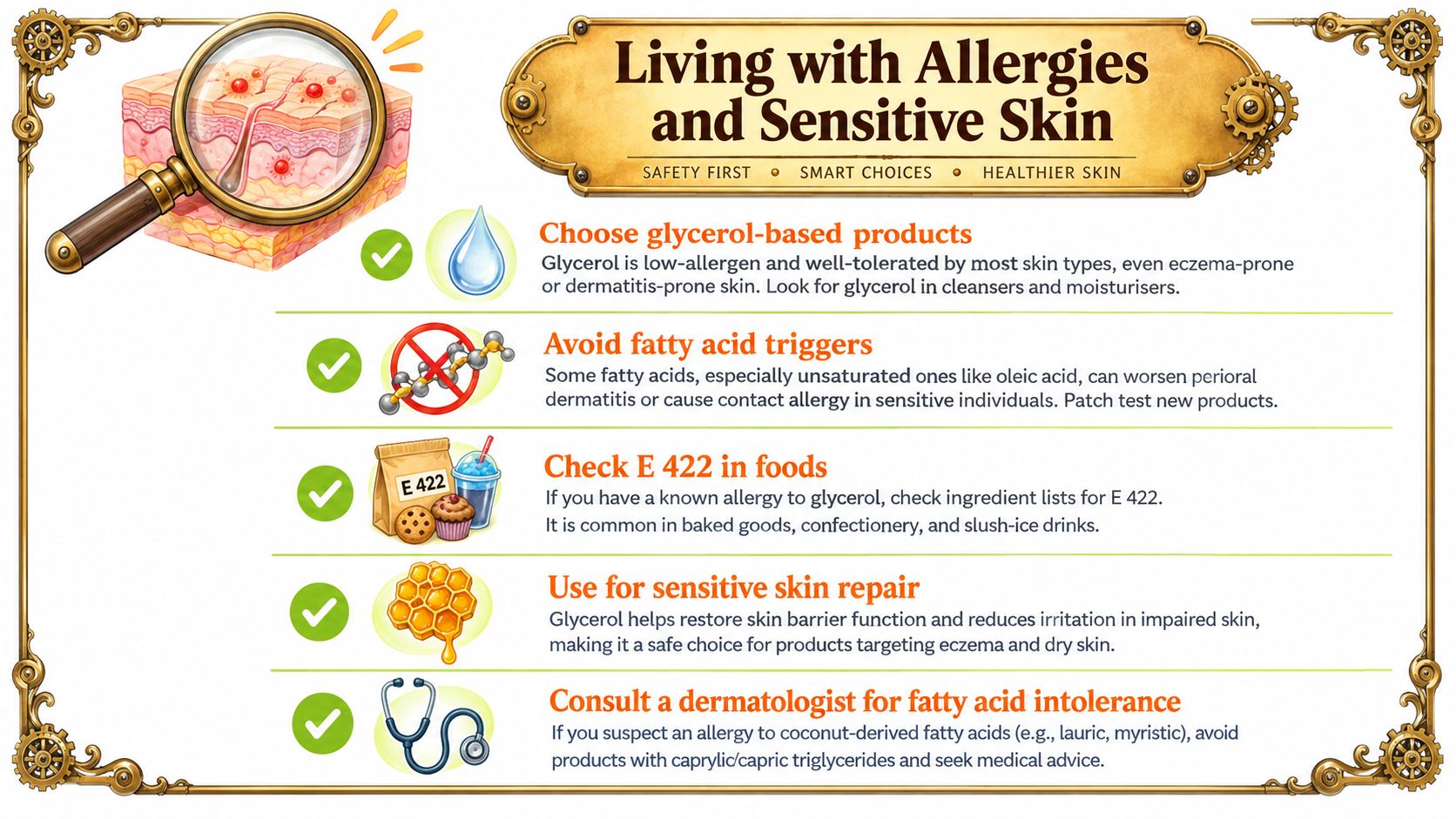
Living with allergies and sensitive skin
You buy a new moisturiser because the front says “gentle”, then your skin stings within minutes. Later the same week, your child asks for a bright slush drink and you notice glycerol on the ingredients list. Those two moments can feel unrelated, but the same chemistry words often turn up in both places. The route is different, though. One is going on the skin, the other is being swallowed.
If you have eczema, dermatitis, or easily irritated skin, glycerol is often not the main problem. In many creams, glycerol works like a water-holding sponge in the top layer of skin. Reactions are more often linked to the full recipe around it, such as fragrance, preservatives, lanolin, or a particular fatty ingredient.
Fatty acids can add another layer of confusion because they are a large family, not one single substance. Some help give a cream body and slip. A simple example is stearic acid, which helps make a cream feel thicker and more stable. That does not make it “bad”. It just means that if your skin is reactive, you may need to look at the whole ingredient list rather than focus on one familiar word.
A simple label-reading checklist
- Check the glycerol name: Look for glycerol, glycerine, or glycerin.
- Spot common fatty acid names: Stearic acid, palmitic acid, and oleic acid are examples.
- Notice the rest of the formula: Fragrance, essential oils, preservatives, lanolin, esters, and fatty alcohols can all affect tolerability.
- Patch test leave-on products: Try a small amount on one area first, especially if your skin is flaring.
- Choose simple packaging when you can: Pumps can be easier for sensitive skin because they reduce repeated dipping into jars.
If a product burns on broken or very inflamed skin, stop using it and ask a pharmacist or GP what to try next.
One real-life switch
A person with hand eczema may find that a rich cream keeps stinging around the wrists. A pharmacist might suggest a simpler emollient with glycerol but without lanolin or added fragrance, then ask them to use only that for a short trial. That kind of swap helps narrow the possibilities. It does not prove which ingredient caused the problem, but it gives the skin a fairer test.

The food side needs the same calm, label-based approach. If a child has felt unwell after a slush drink, the issue is not “skin allergy from glycerol”. The question is whether the glycerol content in a swallowed product may have been too much for their age or size. That is a safety and exposure question, not the same as a moisturiser reaction.
When to ask for help
Ask a pharmacist, GP, or skin specialist if:
- Your rash keeps coming back
- A moisturiser stings every time you use it
- You think you may have contact allergy
- Your child felt unwell after a slush drink
- You need a simpler product and are not sure what to choose
You can also report suspected side effects or reactions to medicines through the MHRA Yellow Card Scheme.
Pharmacist's tip
Bring the product, or a clear photo of the ingredient list, when you ask for advice. It helps us compare names, spot repeats, and separate a skin reaction from a food safety concern more quickly.
Key things to remember
A useful way to keep these two terms straight is to picture one product doing two jobs. A slush drink may use glycerol as E422 [3]. A moisturiser may use glycerol to help the skin hold water, while fatty acids help give the cream body and a softer, more protective feel.
So the quick summary is simple. Glycerol attracts water. Fatty acids are oily building blocks. When they join together, they can form triglycerides, which is why the same chemistry turns up in food, body fat, and skincare.
If labels tend to blur together, these five points usually help:
- Glycerol, glycerine, and glycerin usually point to the same ingredient name family
- Fatty acids often appear under names such as stearic acid, palmitic acid, or oleic acid
- Joined together, glycerol and fatty acids form fats called triglycerides
- In moisturisers, glycerol helps with water retention, while fatty acids help with texture and barrier feel
- In food products such as some slush drinks, glycerol raises a different question. Safe amount for the child, rather than skin suitability [4][7]
That last point is where people often get muddled. A child feeling unwell after a glycerol-containing slush drink is a food exposure and safety issue. A cream that stings or triggers a rash is a skin tolerance issue. Same chemical name, different setting, different question.

One everyday example helps. If you pick up a plain moisturising cream, glycerol may be there to pull in and hold water, a bit like a sponge. A fatty acid such as stearic acid may be there to help give the cream structure and leave the skin feeling smoother after it is applied.
Once you separate those jobs in your mind, ingredient lists become much easier to read.
Frequently asked questions
A lot of label confusion starts in ordinary life. You might hear that glycerol is used in some slush drinks, then spot glycerine in a moisturiser and wonder if it is the same thing and whether it is a problem. The short answer is yes, it is the same ingredient family, but the safety question depends on where you meet it. In a drink, the concern is how much is swallowed. On skin, the concern is whether the whole formula suits you.
What is glycerol in plain English?
Glycerol is a clear, syrupy liquid that holds on to water. In a cream, it works a bit like a sponge in the top layer of skin. In food, it can also be used as the additive E422 in the UK [3].
What is a fatty acid in plain English?
A fatty acid is one of the oily building blocks found in fats and oils. In skincare, a fatty acid can help a product feel richer or smoother. One common example is stearic acid, which is often used to help give a cream body.
Are fatty acids and triglycerides the same thing?
They are linked, but they are not the same. A triglyceride is the finished joined structure made from one glycerol molecule and three fatty acid molecules [2]. If it helps, fatty acids are the separate pieces, and the triglyceride is the full item once the pieces are attached.
Why does glycerol show up in both food and skincare?
Because it can do useful jobs in both. In food, glycerol can help with texture or sweetness. In skincare, it helps pull water into the outer skin layer and slows that water from escaping too quickly.
Why is glycerol used in moisturisers for dry or sensitive skin?
Dry skin often needs help holding water. Glycerol does that job well, which is why pharmacists often see it in creams, lotions and gels [6]. A simple example is a basic hand cream for frequent handwashing. The glycerol helps reduce that tight, dry feeling after you apply it.
Which fatty acids show up most often in moisturisers?
Names you may notice include stearic acid, palmitic acid and oleic acid. They can help with thickness, slip and the soft protective feel left on the skin after application.
Why is glycerol a bigger concern in slush-ice drinks for young children?
The issue is the amount taken in over a short time. UK safety guidance warns that glycerol-containing slush drinks can cause serious side effects in young children, including nausea, headaches, low blood sugar, shock and loss of consciousness [4][7]. That is very different from using a small amount on the skin in a moisturiser.
Is glycerol a common cause of skin allergy?
Usually, no. Many people tolerate glycerol well. If a product stings or causes a rash, the problem is often the full formula, such as fragrance, preservatives, acids, or already-inflamed skin, rather than glycerol by itself.
Can fatty ingredients cause spots, stinging or rashes?
They can in some people. One oily ingredient may feel comfortable on one person's skin and too heavy or irritating on another person's. If a product causes the same problem each time you use it, stop and ask a pharmacist or GP to help work out which ingredient is the likely trigger.
Do blood tests ever measure glycerol and fatty acids separately?
Yes. They can be measured separately in some medical settings. UK NHS guidance includes glycerol and non-esterified fatty acids as separate analytes, and glycerol testing may help in certain rare metabolic conditions [8].
What is the simplest way to read a product label if I have sensitive skin?
Start with the job of the ingredient. Glycerol usually points to water-holding support. Fatty acids or related oily ingredients usually point to texture, softness or barrier support. Then look at your own pattern. If slush-ice safety is the question, focus on age and amount swallowed. If skin comfort is the question, focus on the whole formula and your own past reactions.
If ingredient labels leave you stuck, Courier Pharmacy can help you make sense of creams, emollients, and formulations for sensitive skin or allergy concerns. You can explore treatment options and pharmacy support at Courier Pharmacy.
Summary
Glycerol and fatty acid are different, but they often work as a pair.
Glycerol attracts water. Fatty acids add oily structure and help form fats.
Together, they make triglycerides, which matter in digestion and body fat [1][2].
In skincare, the pair often supports hydration and barrier comfort.
In food, glycerol is authorised in the UK as E422 [3].
For children, glycerol-containing slush drinks need extra caution because of UK safety warnings [4][7].
If your skin is reactive, patch test new products and ask for help if labels are confusing.
Meta description
Glycerol and fatty acid explained in plain English for UK patients. Learn how they work in skin, food, digestion, and UK slush ice safety.
Suggested internal links
- Dry skin advice
- What are the PPARs
- Finding the best cream for dermatitis
- Doublebase Gel
- Online pharmacy UK
Visual guidance
Infographic idea 1: “Glycerol vs fatty acid at a glance”
Alt text: Comparison graphic showing glycerol as water-attracting and fatty acids as oily barrier-building ingredients.Infographic idea 2: “How triglycerides are built and broken down”
Alt text: Diagram showing one glycerol molecule joining three fatty acids to form a triglyceride, then being digested by lipase.Infographic idea 3: “UK slush ice safety with glycerol E422”
Alt text: Child-safety checklist about glycerol-containing slush drinks and why young children need extra caution.Infographic idea 4: “Sensitive skin label-reading guide”
Alt text: Skincare label guide highlighting glycerol, stearic acid, palmitic acid, and common emollient ingredients.
Byline
Author: Medical Mojo editorial team, UK health writers
Clinical review: Reviewed by a UK-registered pharmacist
How this content was created
This article was written using UK government and NHS reference material, plus educational biochemistry sources for core structure and digestion points. A clinician reviewed the content for plain-English accuracy, safety, and UK relevance. This content is for information only and isn't a substitute for personal medical advice.
References
[1] Liverpool Clinical Laboratories. Triglycerides. Available at: https://pathlabs.rlbuht.nhs.uk/triglycerides.pdf
[2] University of Delaware. Triglycerides and fats educational PDF. Available at: https://www1.udel.edu/UMS/itv/2007J/ntdt200-podcast/pdf/ntdt200-6c.pdf
[3] UK Government. Approved additives and E numbers. Available at: https://www.gov.uk/government/publications/approved-additives-and-e-numbers/approved-additives-and-e-numbers
[4] UK Government. Glycerol. Available at: https://www.gov.uk/government/publications/glycerol
[5] LibreTexts. Triglycerides. Available at: https://chem.libretexts.org/Bookshelves/Biological_Chemistry/Supplemental_Modules_(Biological_Chemistry)/Lipids/Glycerides/Triglycerides/Lipids/Glycerides/Triglycerides)
[6] University of Hertfordshire Pesticide Properties DataBase entry. Glycerol regulatory and formulation profile. Available at: https://sitem.herts.ac.uk/aeru/bpdb/Reports/4143.htm
[7] Food Standards Agency. Science performance report 2025 to 2026, FSA business committee. Available at: https://www.gov.uk/government/publications/food-standards-agency-business-committee-meeting-september-2026/science-performance-report-20252026-fsa-business-committee
[8] Great Ormond Street Hospital. Organic acids and glycerol. Available at: https://www.gosh.nhs.uk/wards-and-departments/departments/laboratory-medicine/laboratory-database/organic-acids-glycerol/
[9] UK Government. SACN statement on expressing energy, fat and carbohydrate intakes and recommendations. Available at: https://www.gov.uk/government/publications/sacn-statement-on-expressing-fat-and-carbohydrate-recommendations/sacn-statement-on-expressing-energy-fat-and-carbohydrate-intakes-and-recommendations
[10] University of Reading. Specifications for glycerol esters of fatty acids. Available at: https://centaur.reading.ac.uk/75235/


