Hashimoto's Symptoms: What to Watch for and When to Test
Hashimoto's symptoms in the UK include fatigue, cold intolerance and low mood. Learn how they overlap with other causes and when to get tested.
Can your thyroid blood tests look nearly normal while you still feel exhausted, cold, and foggy? That gap catches many people out. Hashimoto's symptoms often creep in slowly, and they can overlap with tiredness, low mood, or menopause. This guide walks through what the symptoms feel like, why early signs get missed, which other conditions share them, and what each blood test answers.
Common Hashimoto's symptoms at a glance
Hashimoto's thyroiditis is an autoimmune condition. Your immune system makes antibodies that slowly damage the thyroid and cut hormone output. The underactive thyroid that follows is hypothyroidism, and that hormone shortfall is what produces the symptoms.
NICE guidance on thyroid disease describes this as chronic autoimmune inflammation that presents as primary hypothyroidism. Symptoms can include fatigue, cold intolerance, weight gain, constipation, dry skin, hair changes, menstrual disturbance, slower thinking, and low mood. NICE also stresses that these symptoms are non-specific, and that any single symptom rarely predicts thyroid dysfunction.
| Symptom | What it can feel like | Why it happens |
|---|---|---|
| Fatigue | Tiredness that rest does not fix | Lower hormone levels slow the body's energy use |
| Cold sensitivity | Feeling cold when others are comfortable | Less heat is produced by the body |
| Weight gain | Gradual gain without eating more | Slower metabolism changes how the body uses energy |
| Constipation | Fewer bowel movements and harder stools | Digestion slows down |
| Poor concentration | Brain fog, trouble focusing or remembering | Thyroid hormones support normal brain function |
| Low mood | Persistent low mood or feeling flat | Hormone changes can affect mood |
| Dry skin | Rough, flaky or tight skin | Skin becomes less moist |
| Dry or thinning hair | Brittle hair, more shedding | Hormone changes affect the hair growth cycle |
| Hoarseness | A deeper or husky voice | Tissues around the voice box can thicken |
| Irregular or heavy periods | Cycle changes or heavier bleeding | Hormones affect the menstrual cycle |
A goitre, or a sense of fullness at the front of the neck, can appear when inflammation enlarges the gland. Swelling alone does not confirm the diagnosis.
Hypothyroidism affects approximately 2% of the UK population and more than 5% of people aged over 60, with women affected around 5–10 times more often than men, according to that same NICE context chapter. Clusters of symptoms, plus risk factors, should trigger a blood test. They should not lead you to self-diagnose. Our hypothyroidism guide sets out how an underactive thyroid is recognised in everyday care.
Practical rule: If three or more of these symptoms have lasted several weeks, book a GP appointment. Many people with this pattern have another cause, but the pattern still deserves a proper test.
Early Hashimoto's Symptoms Often Go Unnoticed
Symptoms alone cannot confirm Hashimoto's, and the early phase is easy to shrug off. The British Thyroid Association hypothyroidism statement, hosted by an NHS trust, identifies Hashimoto's as the main cause of an underactive thyroid in the UK. The immune system attacks thyroid tissue and gradually reduces hormone production. Symptoms commonly develop slowly and may start mild, which delays recognition.
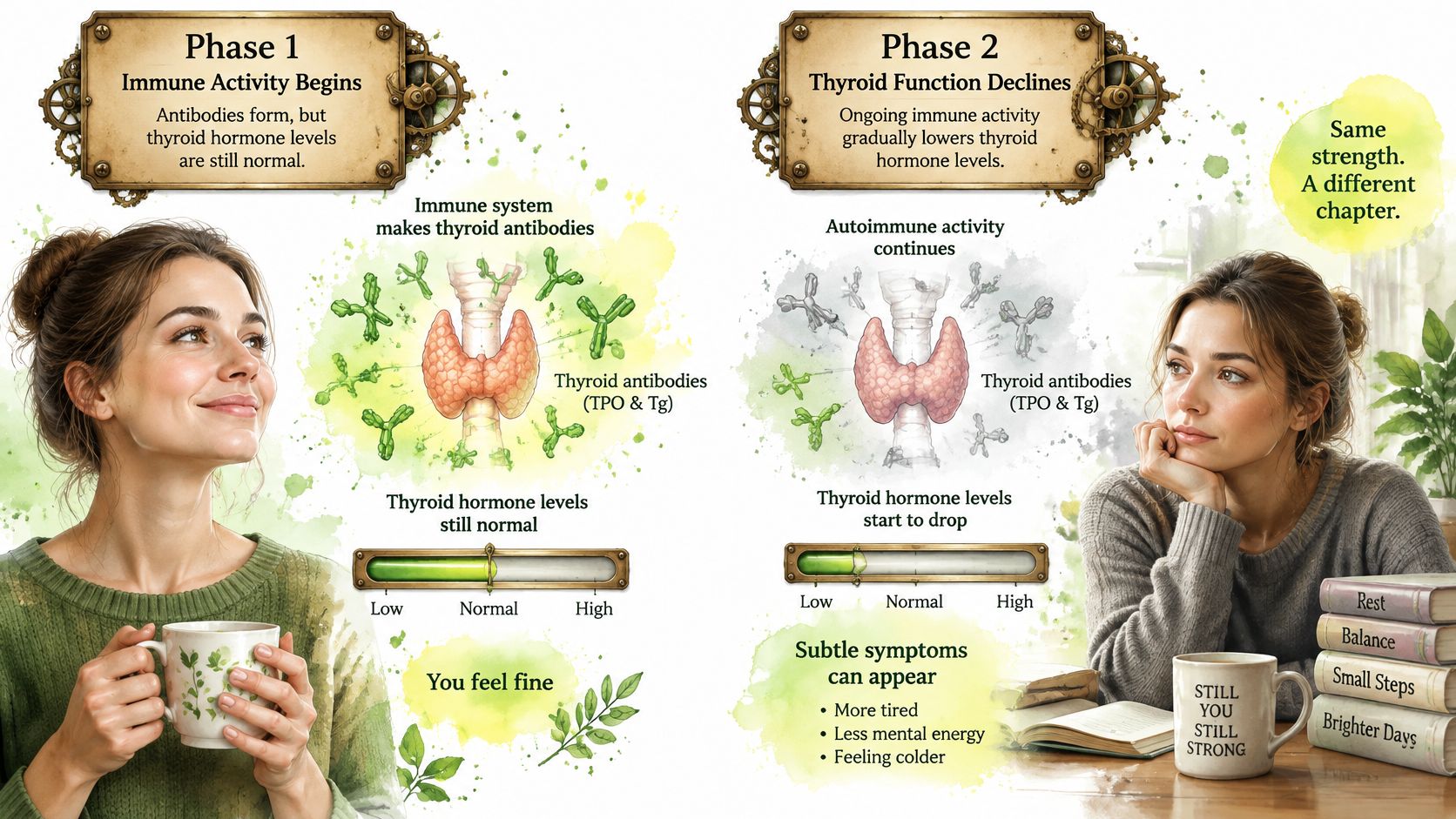
Two phases, one slow leak
Think of a slow puncture in a car tyre. You still drive for weeks. The warning light comes on later.
Phase one is antibody activity. The immune system targets the gland, yet hormone levels may still sit in the reference range. Many people feel nothing at all.
Phase two is falling hormone output. Tiredness, cold, and brain fog arrive in small steps, not overnight.
The same statement notes that Hashimoto's most commonly begins between ages 30 and 50 and is more frequent in women. At population level, the British Thyroid Association reports that spontaneous hypothyroidism affects approximately 1%–2% of people in the UK and is ten times more common in women than men. Those figures describe spontaneous hypothyroidism, not laboratory-confirmed Hashimoto's alone. They still show the scale of the condition in which Hashimoto's is the leading cause.
Three clues people miss
Slightly slower days: Tasks that used to feel easy now take longer.
Tiredness after a normal night: Eight hours in bed, and you still wake heavy.
Colder than colleagues: You reach for a jumper while the office feels fine to everyone else.
A visible swelling at the front of the neck can appear when the gland enlarges. It does not confirm the diagnosis on its own. Note when symptoms started and how they change over three months, then take that timeline to your appointment.
A short film on how an underactive thyroid shows up day to day can help you spot the slow pattern:
Symptoms That Overlap With Other Conditions
Tiredness, low mood, slowed thinking, weight change, and feeling cold also appear in conditions that have nothing to do with the thyroid. Cleveland Clinic's overview of Hashimoto's disease notes that many people have no symptoms at first, while later symptoms are broad and nonspecific. A normal, borderline, or only mildly abnormal TSH and free T4 does not close the question. It changes which question you ask next.
TSH and free T4 measure how the gland is working. Thyroid peroxidase antibodies point to autoimmunity. A positive antibody result shows autoimmune activity. It does not prove that every symptom comes from the thyroid.
| Possible cause | Overlapping symptoms | Usual check |
|---|---|---|
| Iron-deficiency anaemia | Tiredness, breathlessness, pale skin, hair loss | Full blood count and ferritin test |
| Vitamin B12 or vitamin D deficiency | Tiredness, low mood, pins and needles (B12) | Blood tests for B12 and vitamin D |
| Sleep apnoea | Daytime tiredness, poor concentration | Sleep assessment referral |
| Depression | Low mood, tiredness, poor concentration, appetite change | GP mental health assessment |
| Menopause | Irregular periods, low mood, sleep problems | Clinical assessment and hormone tests if advised |
| Medicine side effects | Tiredness, weight change, low mood | Medicine review with GP or pharmacist |
A normal TSH that still needed context
Say a reader in her forties feels flat and exhausted. Her TSH sits in the reference range. Ferritin is low. Her GP treats iron deficiency first. Over several months the fog lifts. The thyroid was not the driver. Guessing would have sent her down the wrong path. Persistent tiredness can also sit with chronic fatigue syndrome, which needs its own assessment.
Keep a four-week diary of symptoms and medicines, then share it with your GP. Side effects are often missed because nobody lines them up against the calendar.
Pharmacist's tip: List every tablet, including iron, calcium, and antacids. Bring the box, not just the name. A medicine review often explains a symptom that a thyroid test cannot.
If symptoms carry on after the obvious causes are checked, ask for a fresh look at thyroid function rather than assuming the first normal result is the last word.
Tests that confirm or rule out Hashimoto's
Blood tests answer specific questions. They do not grade how unwell you feel.
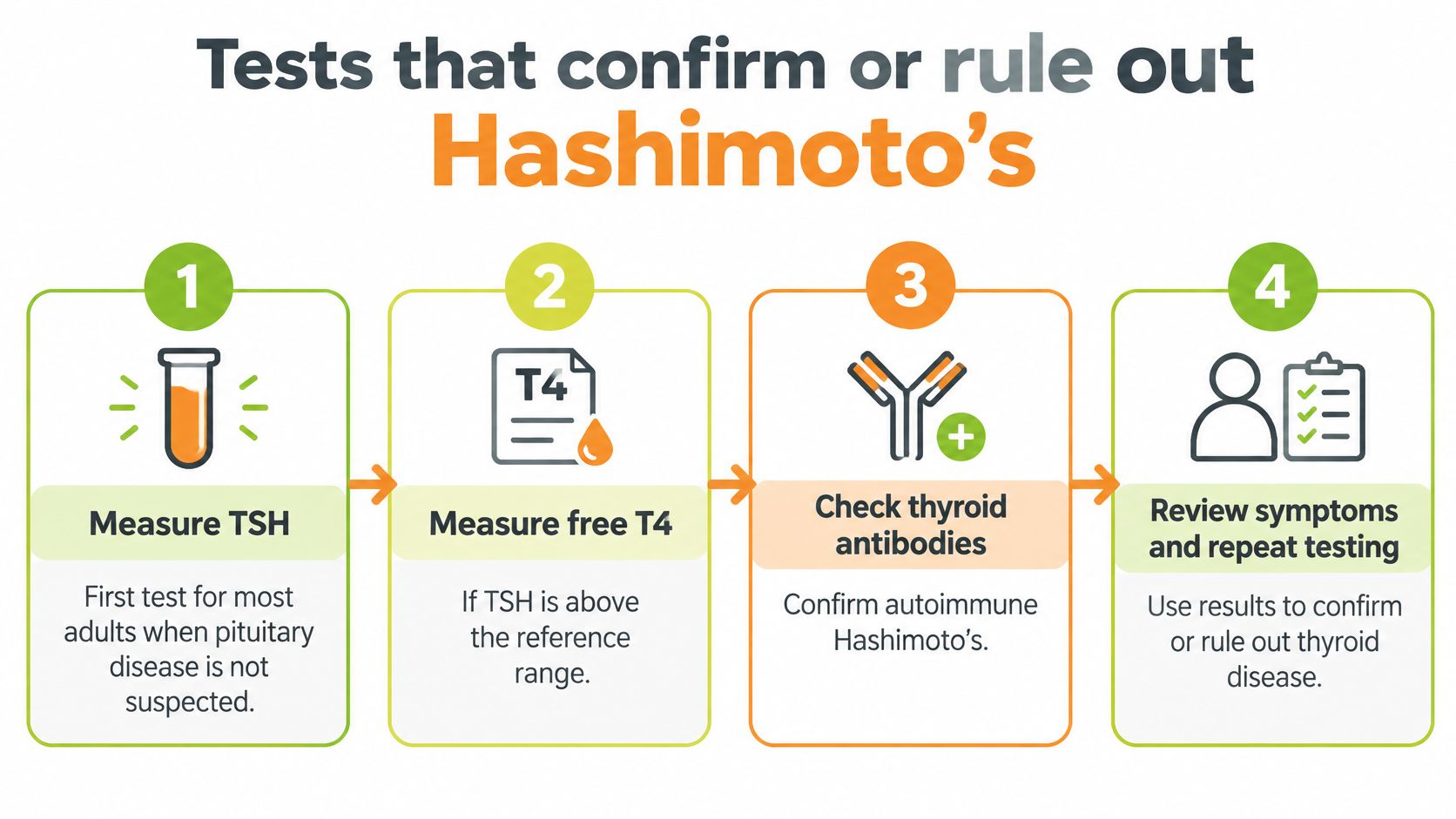
The order UK clinicians usually follow
NICE's draft thyroid guideline sets a clear sequence for adults when pituitary disease is not suspected.
- Measure TSH first. Thyroid-stimulating hormone is the starting test for most adults.
- Add free T4 if TSH is high. If TSH sits above the laboratory reference range, free thyroxine (FT4) is measured on the same sample.
- Add free T4 and free T3 if TSH is low. A low TSH points toward a different pattern, so both free hormones are checked.
- Consider thyroid peroxidase antibodies when TSH is raised. A positive result supports autoimmune thyroid disease. In subclinical hypothyroidism it is linked with a higher chance of moving to overt hypothyroidism.
- Do not repeat antibodies for routine monitoring. Repeat them only if a clinician has a new question.
What the TSH number usually means
| TSH level (mIU/L) | What it usually means | Next step |
|---|---|---|
| Reference range | Each laboratory prints its own range | Check the range printed on your report |
| 5 to 10 | May return to the reference range without treatment in about half of people | Clinician decides on repeat testing and antibodies |
| Above 10 | Less likely to normalise and more often linked with symptoms | Clinical review and a treatment discussion |
A TSH of 5–10 mIU/L may return to the reference range without treatment in around half of people. A TSH above 10 mIU/L is less likely to normalise and is more often associated with symptoms, as that NICE draft sets out.
A normal TSH with positive antibodies shows autoimmune activity. It does not explain every ache or low day. Ask your GP how often to recheck.
Home blood tests can support diagnosis but do not replace a clinical assessment. Take any result, including an advanced thyroid home test kit, to your GP.
Three actions before you leave the appointment:
- Ask for TSH and free T4 as the minimum pair when thyroid disease is suspected.
- Ask whether antibodies are needed if TSH is above the range.
- Read the reference range on your own report, not a number you saw online.
Living With Hashimoto's Symptoms Day to Day
A mother of two in Manchester is spent by 3pm, even after eight hours in bed. School runs, packed lunches, and a part-time shift leave no spare energy. She moves the hardest jobs to the morning, takes a ten-minute sit-down after lunch, and asks a neighbour to share one school run. None of that fixes the thyroid. It stops the day from collapsing.
A nurse on night rotas hits a different wall. Broken sleep makes poor concentration worse on the drive home. A steady wake time on days off, a dark cool bedroom, and a short note to the rota lead about health needs make the week more predictable. Shift work will not suit a perfect routine. It can still have one anchor.
Small fixes for the symptoms you feel most
Constipation: Drink water through the day and add fibre slowly, so your gut can adjust.
Cold sensitivity: Layer clothes and keep a warm drink within reach, rather than turning the heating up for the whole house.
Low mood days: Step outside or take a short walk. Movement is a support, not a cure.
Pacing: Pick two or three priority tasks. A long list turns a manageable day into a failed one.
Pharmacist's tip: If low mood lasts more than two weeks, or thoughts of self-harm appear, speak to a GP straight away. Do not wait for thyroid results. In a crisis, call 999 or go to A&E.
Lifestyle changes support recovery. They do not replace a clinical plan, a dose review, or a check for anaemia and poor sleep.
How Treatment Changes Symptoms and Monitoring
Treatment for an underactive thyroid is usually levothyroxine, a replacement hormone. A clinician prescribes it and adjusts the dose. The part that confuses people most is the lag: blood results and symptoms do not move at the same speed. TSH works like a slow thermostat, drifting gradually after each dose change rather than jumping to its new reading.
How monitoring usually runs
- Repeat thyroid blood tests several weeks after a treatment start or dose change, at the timing your clinician advises. Testing too early catches a number that is still settling, which can tempt a dose change the body does not need.
- Once the dose is stable, testing moves to intervals your clinician sets, unless symptoms return or they want bloods sooner. Some local protocols ask for the sample before the morning dose.
- If results stay abnormal, ask about absorption. An NHS hospital protocol for a levothyroxine absorption test uses a supervised single oral dose with water, then free T4 blood tests at 60, 90, 120, and 180 minutes, with TSH and free T4 at 240 minutes. That helps separate poor absorption from other reasons the numbers will not settle.
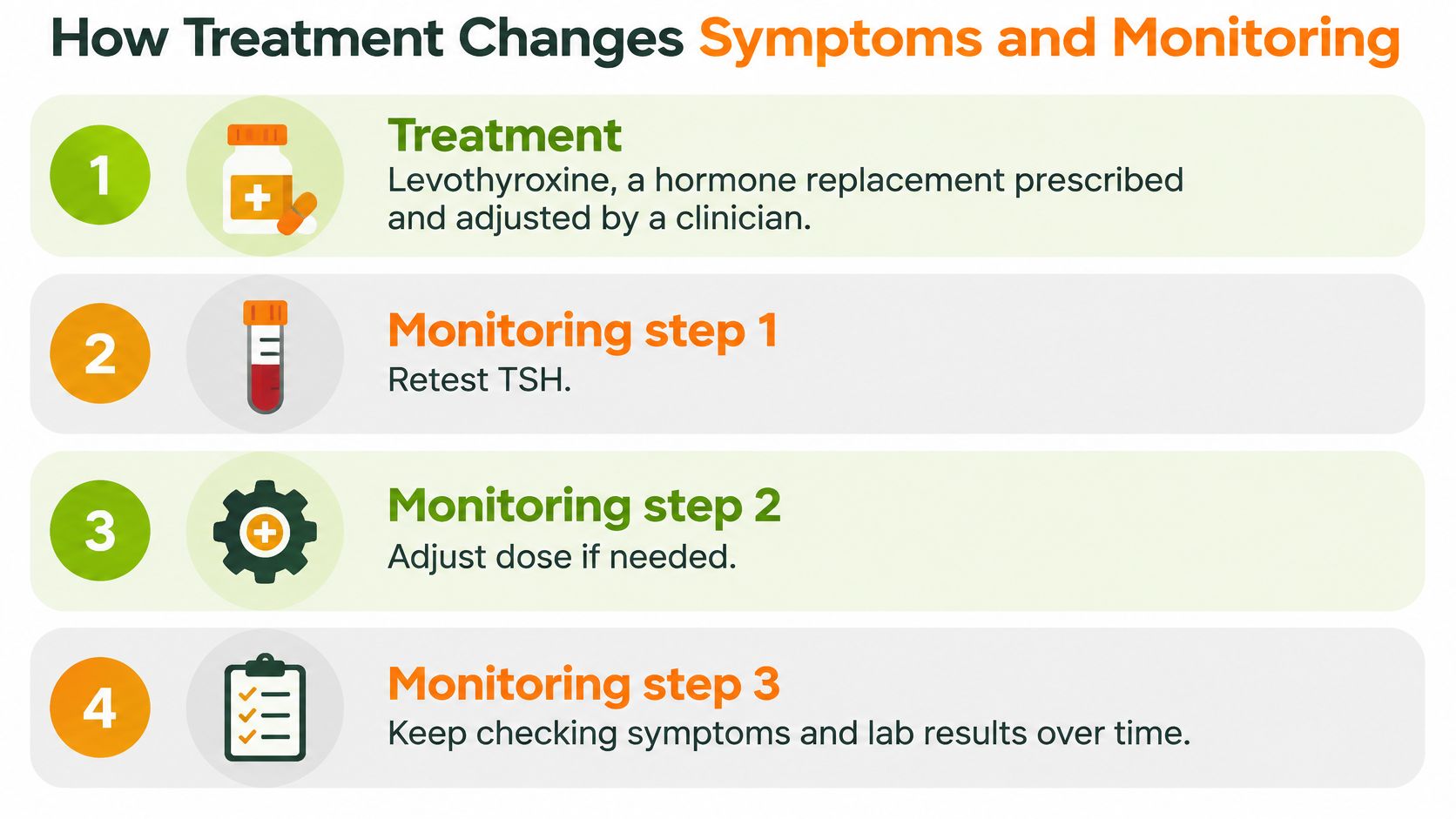
A settled TSH does not guarantee settled symptoms. Tiredness can take weeks to lift even after the dose looks right on paper, so ongoing fatigue alongside a normal result is worth reporting rather than dismissing. The reverse happens too: feeling better quickly does not mean the bloods have caught up, which is why the retest still matters.
People also ask how other medicines sit alongside replacement. Our guide on how Mounjaro and levothyroxine can be used together gives a starting point for that conversation with a clinician, not a reason to change either medicine yourself.
Pharmacist's tip: Take levothyroxine on an empty stomach with water, usually 30 to 60 minutes before breakfast. Leave about four hours between it and iron, calcium, or antacids, which can block uptake.
Never adjust the dose on your own, even when symptoms feel resolved.
When to ask your GP for a thyroid test
Book a GP appointment if symptoms have lasted several weeks, if they arrive together, or if you notice a neck swelling or have a family history of thyroid disease. Tiredness plus cold intolerance plus constipation is a stronger prompt than one vague bad week.
Ask for TSH and free T4 at a minimum. Bring a symptom timeline, a full medicine list, and any previous thyroid results. A guide to using a home blood test in the UK explains how to handle a finger-prick sample if you already have one, then take those numbers to the appointment rather than interpreting them alone.
If you are pregnant or planning pregnancy and you suspect thyroid disease, contact your GP or midwife promptly. Treatment in pregnancy needs a clinician's review, not a self-adjusted dose.
Call 999 or go to A&E for severe drowsiness or confusion, slow or laboured breathing, collapse, or a very low body temperature. Use NHS 111 for urgent advice when the surgery is closed and you are unsure.
A clear answer is usually reachable once the right tests sit next to a clinician's review. You do not have to decide the cause on your own.
This information is general. It is not a substitute for medical advice from your own GP or specialist.
Courier Pharmacy supports people who want a clearer picture of thyroid function alongside GP care, including home testing options that still need a clinical review. If Hashimoto's symptoms are on your mind, you can read our thyroid resources and speak to the team before you order anything. Visit Courier Pharmacy to see how a UK-registered pharmacy can help you prepare for that GP conversation.


