Home PSA Test Kit UK: Expert Guide 2026
Considering a home PSA test kit in the UK? Get our 2026 expert guide on how they work, accuracy, interpreting results, and safe buying. Learn more.
SEO brief
Primary keyword: Home PSA test kit
Secondary keywords: PSA home test UK, prostate blood test at home, finger-prick PSA test, lab-based PSA test, rapid PSA test, prostate test kit UK
Search intent: Informational, safety-focused, comparison and buying guidance
Target reader: UK adults considering a home prostate blood test, plus partners and carers
Product/service mention: Courier Pharmacy home blood testing options
Internal links available: Assumed from Courier Pharmacy testing, online pharmacy, and related home test education pages
It's often the same moment. You've noticed a home PSA test kit online late at night, you're trying not to overthink it, and you want a straight answer before you buy anything. That's sensible.
The short answer is this. A home PSA test kit can be useful for monitoring, but it's only safe if you choose the right kind of test and you follow up properly. The big difference is not just “home versus GP”. It's lab-analysed versus rapid self-read, and that difference matters.
In this guide, I'll explain what a home PSA test measures, who might consider one, which test types are safer, how to use them well, what your result may mean, and how to avoid false reassurance.
- PSA tests measure a blood marker, not cancer itself.
- Rapid self-read PSA kits have serious reliability concerns [1].
- Lab-analysed home kits are the safer home option because a laboratory measures the sample.
- A raised result needs professional follow-up, not panic.
- A normal result is reassuring, but it doesn't rule everything out [2].
What is a home PSA test and who should consider one
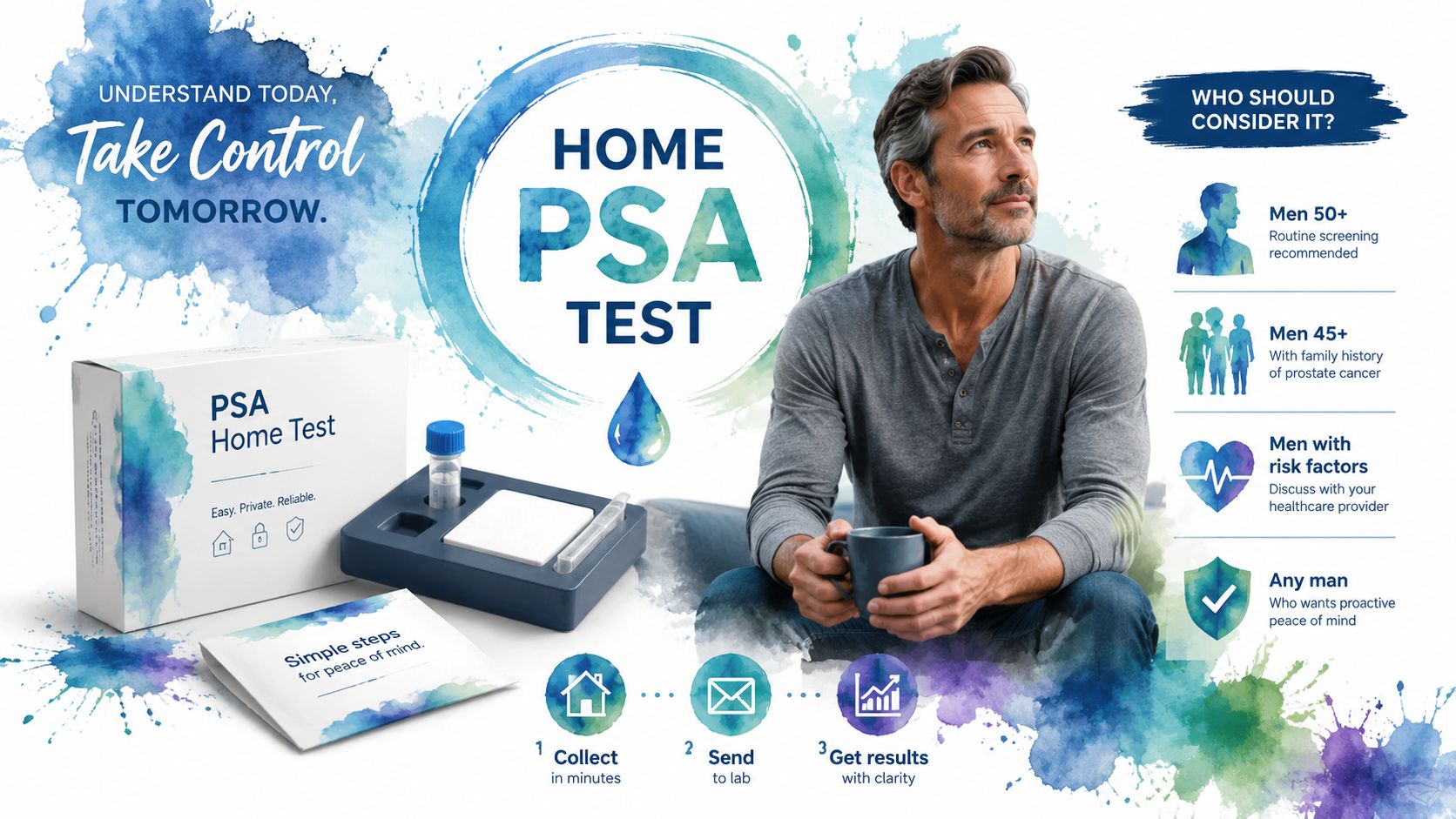
A home PSA test kit measures prostate-specific antigen (PSA) in a blood sample. PSA is a protein made by the prostate. The test doesn't diagnose prostate cancer on its own. It measures a marker that can help flag whether you need a fuller medical assessment.
What PSA means in plain English
Think of PSA as a clue, not a verdict. Your prostate naturally makes it, and a blood test checks how much is present. A higher level can happen for several reasons, and cancer is only one of them.
That's why I always frame PSA as a monitoring tool. It sits in the same broad family as checking blood pressure or cholesterol. It gives useful information, but someone still needs to interpret it in context.
Practical rule: Use a PSA result to guide your next step, not to label yourself as “fine” or “definitely ill”.
A home kit can appeal if you want privacy, convenience, or a first step before booking a GP appointment. For many men, that's the main draw. It fits around life.
Who may want to consider testing
A few common examples:
- Busy parent in his early 50s: He keeps putting off routine health checks because work and family come first.
- Shift worker: He struggles to get to the GP during normal hours and wants to test at a time that suits him.
- Man with family history: His father or brother had prostate problems, so he wants to stay aware.
- Health-conscious gym-goer: He likes tracking health markers and wants a practical baseline.
There's also a wider public health angle. In England, the rate of PSA testing increased more than fivefold between 2000 and 2018, but testing rates were more than twice as high in the least deprived socioeconomic groups compared with the most deprived, which points to real inequality in access to prostate health monitoring [3]. For some people, home testing may help close a convenience gap, especially when appointments are hard to arrange.
If you're new to home sampling generally, this guide to using a home blood test in the UK gives a helpful overview of what the process usually involves.
Featured snippet answer
What is a home PSA test?
It's a home blood test that measures prostate-specific antigen. It helps monitor prostate health, but it cannot diagnose or rule out prostate cancer on its own.
How home PSA tests work and your options
Not all home PSA tests work in the same way. This is the part many people miss. Two boxes may both say “home PSA test”, but what happens after you collect the sample can be very different.
The main test types
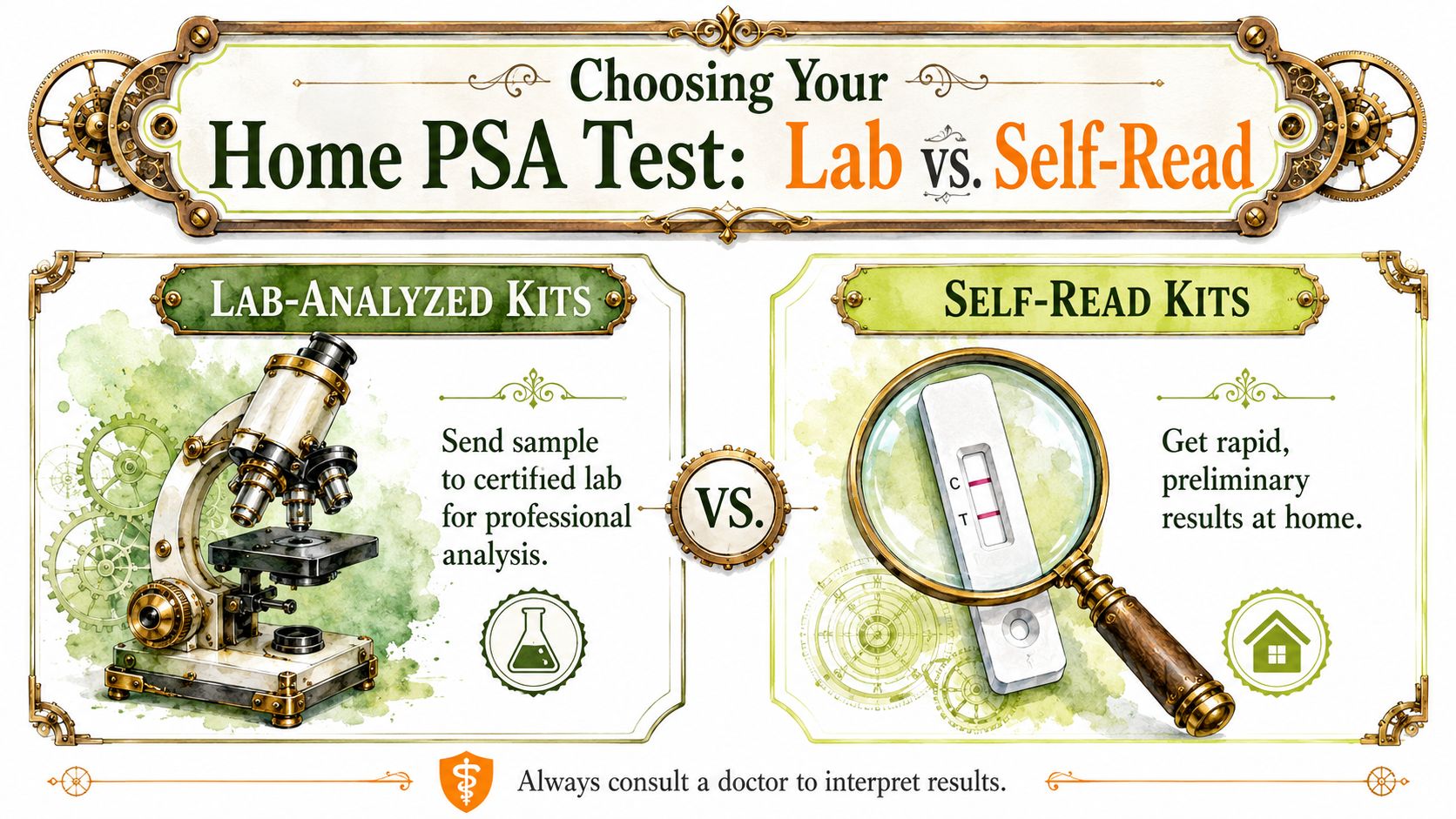
There are two broad categories.
- Lab-analysed kits: You collect a blood sample at home, post it to a lab, and receive a measured result.
- Rapid self-read kits: You apply blood to a cassette at home and interpret the result yourself.
That difference changes everything. A lab-based service gives you a proper measured result and a formal report. A rapid kit aims to give a quick answer on the spot, but convenience doesn't always equal reliability.
A good rule is simple:
- Choose lab analysis if you want a result you can act on
- Avoid treating a rapid result as reassurance
- Expect follow-up to matter as much as the test itself
Finger-prick versus Tasso collection
The next difference is how you collect the blood.
A standard finger-prick kit uses a lancet to produce a few drops of blood. This is the familiar approach commonly associated with such tests. It works well for many users, but some people find it fiddly, especially if they struggle to get enough blood.
A Tasso device collects blood from the upper arm rather than relying on repeated squeezing from a fingertip. In practice, many people prefer it because it feels simpler and less unpleasant. It can also help when someone has cold hands, poor confidence with finger-prick sampling, or previous trouble filling small collection tubes.
Here's the practical comparison:
| Collection method | How it works | Best for | Main trade-off |
|---|---|---|---|
| Finger-prick | Small lancet on fingertip, drops into sample tube | People comfortable with basic home blood sampling | Can be awkward if blood flow is slow |
| Tasso device | Upper-arm collection device gathers blood into a container | People who want an easier, less painful collection method | Availability depends on provider |
For a general overview of what home testing services can include, see these home blood test kits.
The safest home route is the one that gives you a result a clinician can interpret properly.
Featured snippet answer
Which home PSA test is better, lab-based or rapid?
A lab-based home PSA test is the better option. A laboratory measures the sample, which makes the result more useful for proper clinical follow-up.
The crucial question of accuracy and limitations
This is often the first question asked, and rightly so. If a result may affect your next medical step, the test itself has to be trustworthy.
Why rapid kits are the weak link
The strongest concern sits with rapid at-home PSA kits. According to a BBC investigation, using the same blood sample, one test failed, three gave false negatives, and one gave a false positive. The MHRA says these kits are “not a reliable indicator of prostate cancer” [1].
That's not a small technical quirk. It means a man could get a false all-clear and delay seeing a doctor, or get a worrying result that turns out not to be meaningful.
The wider concern isn't only accuracy. It's also interpretation. A self-read test gives you very little context, and PSA was never meant to be used as a solo yes-or-no cancer verdict.
If you'd like background on why blood test interpretation often needs context, this guide to understanding the full blood count test shows the same principle in another common test.
Comparing your PSA testing options
| Feature | GP blood test | Lab-based home kit | Rapid ‘instant' home kit |
|---|---|---|---|
| Where sample is analysed | Clinical laboratory | Clinical laboratory | At home by the user |
| Result type | Measured lab result | Measured lab result | Self-read result |
| Professional involvement | Built in | Varies by provider, often after result | Usually minimal |
| Convenience | Lower than home testing | High | High |
| Best use | Symptoms, follow-up, routine clinical care | Convenient monitoring with proper analysis | Not a safe standalone basis for decision-making |
What every PSA test can and cannot tell you
Even a well-analysed PSA blood test has limits. It does not diagnose cancer by itself, and it does not rule cancer out by itself.
The BBC report highlights this clearly. It notes that about 15% of men with prostate cancer do not have a raised PSA level, and three out of four men with a raised PSA do not have prostate cancer [1]. That's why a number always needs context.
A PSA result may be affected by prostate size, inflammation, infection, and other non-cancer causes. Age and personal risk also matter. One isolated number is rarely the full story.
A good PSA test answers one question only: do you need a proper clinical conversation next?
Real-life example
A busy warehouse shift worker orders a rapid test because he wants a same-day answer. The result looks normal, so he leaves it there. That's the risky path.
A safer version is different. He uses a lab-based home PSA test, gets a measured result, and then speaks to a clinician if anything looks raised or out of keeping with his risk factors.
Featured snippet answer
Are home PSA test kits accurate?
Rapid self-read kits have serious reliability concerns [1]. Lab-analysed home kits are more useful because a laboratory measures the blood sample, but PSA still needs clinical interpretation.
A step-by-step guide to using your home test kit
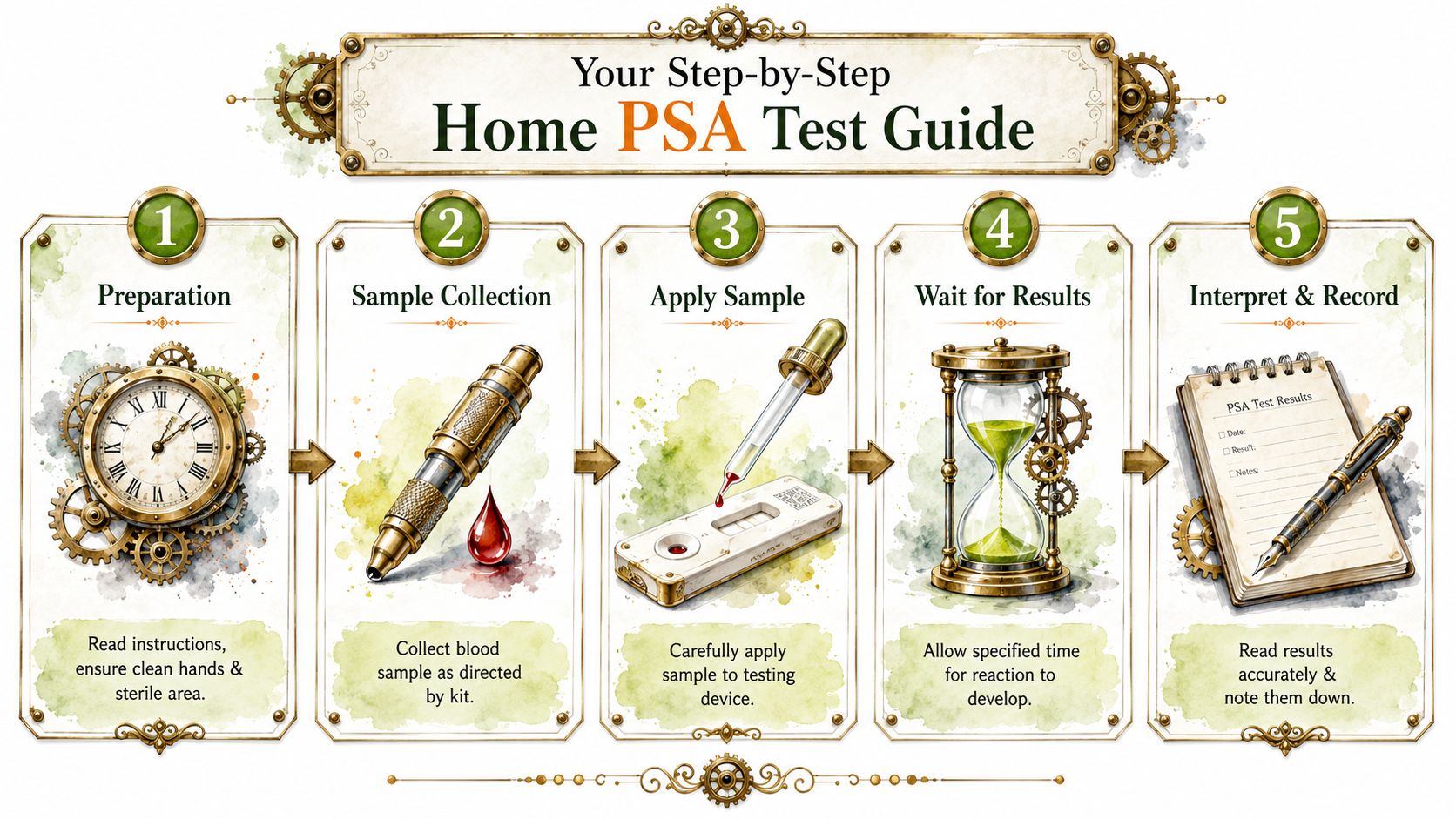
Using a home PSA test kit is usually straightforward once you've seen the flow. Most problems happen when people rush, skip the instructions, or try to collect a sample with cold hands and no preparation.
Before you collect your sample
Read the instructions first.
Open everything and check what goes where before you start. This lowers stress and helps you avoid wasting a kit.Choose a calm time.
Don't start when you're heading out the door. A quiet ten-minute window makes the process much easier.Wash and warm your hands.
Warm hands usually make blood collection easier with finger-prick kits.
Pharmacist's tip: If you're using a finger-prick kit, run your hands under warm water first and let your arm hang down for a minute before collecting the sample.
A busy NHS night-shift worker might do this after waking in the afternoon, rather than trying to manage it after a long shift. That tends to go better.
How to take the sample and send it off
Collect the blood sample exactly as the kit instructs.
For finger-prick kits, use the lancet on the side of the fingertip rather than the pad, which is often more comfortable. For a Tasso device, follow the placement instructions carefully and let it collect the sample without fussing with it too much.Label the sample if required.
Don't assume this step is optional. Labs need the right identifiers.Package it properly and post it promptly.
Delays can affect sample quality, depending on the provider's process.
Here's a useful walkthrough if you'd like to see a home testing process in action:
- Pharmacist's tip: Hydrate normally beforehand. You don't need to overdo it, but being well hydrated can make collection easier.
- Pharmacist's tip: Don't milk or squeeze your finger aggressively. Gentle pressure is better and less messy.
- Pharmacist's tip: If the first attempt goes badly, stop and re-read the instructions rather than improvising.
If you've used other self-sampling kits before, such as an advanced thyroid home test kit, you'll recognise the same basic principles: preparation, correct sample collection, careful labelling, and prompt return.
Featured snippet answer
How do you use a home PSA test kit?
You collect a blood sample at home, usually by finger-prick or a device such as Tasso, then either post it to a laboratory or read it yourself if it's a rapid kit.
Understanding your results and next steps
Upon receiving a result in your inbox or portal, anxiety often spikes, and the number suddenly feels bigger than it is. The key is to respond calmly and sensibly.

What the number means
PSA is usually reported in ng/mL. In UK guidance, men without prostate symptoms should be referred for further investigation if their PSA level is 3.0 ng/mL or above, but a PSA test alone cannot diagnose or rule out prostate cancer [2].
That threshold helps, but it isn't the whole story. Age, symptoms, family history, and previous results all matter. A clinician looks at the full picture, not just one line on a report.
Pharmacist's tip: Keep a copy of your result. Trends over time often matter more than one isolated reading.
What to do next after a normal or raised result
If your result is below the referral threshold, that can be reassuring. It does not mean “ignore your prostate forever”. It means there's no obvious signal from this test alone, at this moment.
If your result is raised, don't jump straight to the worst conclusion. It means you need proper follow-up. The next step is usually to speak to a GP or the clinical team linked to the testing service.
A simple action plan helps:
- Normal result, no symptoms: Keep the result, note the date, and discuss future monitoring if you have risk factors.
- Raised result, no symptoms: Contact your GP or the provider's clinical follow-up service promptly.
- Any result plus symptoms: Book a medical review rather than relying on the test alone.
Real-life example
A gym-goer in his late 40s orders a lab-based test because his father had prostate trouble. His result comes back within range. That's reassuring, but the sensible next step is still to keep the report and ask a clinician when to re-check.
A self-employed driver in his 50s gets a raised result from a lab-based test. He doesn't panic, but he doesn't sit on it either. He books a GP review with the report in hand and gets a proper plan.
Featured snippet answer
What PSA level should prompt follow-up in the UK?
For men without symptoms, UK guidance says a PSA level of 3.0 ng/mL or above should prompt referral for further investigation [2]. A PSA test alone still cannot diagnose or exclude cancer.
How to buy a home PSA test kit safely in the UK
Buying safely matters as much as testing safely. A polished website doesn't guarantee a sensible clinical pathway.
What to check before you order
Look for these basics:
- Regulated seller: Buy from a UK-regulated provider, ideally a GPhC-registered online pharmacy.
- Clear test type: Make sure the provider states whether the test is lab-analysed or rapid self-read.
- Follow-up pathway: Check what happens if your result is raised.
- Transparent instructions: The process should be clear before you pay.
- Proper product marking: Look for appropriate regulatory marking and regulated sourcing.
The MHRA position matters here. Over-the-counter PSA tests are not reliable for diagnosing prostate cancer, although they may be marketed as tools to “screen for” or “assess risk” when bought from a regulated source [4]. That wording should make you cautious, not complacent.
For example, using a regulated provider such as an online pharmacy in the UK gives you a better chance of getting a proper service rather than just a box through the post.
When a home test is not the right first step
Sometimes a home PSA test kit isn't the best starting point.
Choose direct medical assessment first if you have:
- Urinary symptoms
- New bone pain
- Unexplained weight loss
- Blood in urine or semen
- Ongoing worry despite a normal home result
Those situations need a clinician, not a gadget.
Featured snippet answer
How do I buy a home PSA test kit safely in the UK?
Choose a regulated UK provider, prefer a lab-analysed service, and make sure there's a clear plan for follow-up if your result is raised.
If you want a regulated route to home blood testing, Courier Pharmacy offers UK pharmacy-led testing services with home blood test options, including standard finger-prick kits and the Tasso device, alongside clinical review and follow-up support where appropriate.
Summary
A home PSA test kit can be a sensible option if convenience helps you take action.
The safest choice is usually a lab-analysed home test, not a rapid self-read kit.
Rapid kits have reliability concerns and can give false reassurance or needless worry [1].
A PSA result is only one piece of the picture, even when the laboratory result is sound [2].
If your result is raised, get professional advice promptly.
If it's normal, keep the report and think about future monitoring if you have risk factors.
Use the test as part of a proper health journey, not as a verdict.
FAQs
Is a home PSA test kit the same as a GP PSA test?
Not exactly. A lab-analysed home kit can be similar in purpose because a laboratory measures the sample, but the key difference is what support you get around the result. A GP test comes with direct clinical follow-up built in.
Are rapid home PSA tests reliable?
There are strong concerns about them. A BBC investigation found major inconsistency, and the MHRA says these kits are not a reliable indicator of prostate cancer [1].
Can a home PSA test diagnose prostate cancer?
No. A PSA test cannot diagnose prostate cancer on its own. It can only help flag whether you may need more assessment [2].
What does a raised PSA mean?
A raised PSA means you need proper interpretation and often further review. It does not automatically mean cancer, because PSA can rise for non-cancer reasons too [1][2].
What PSA level is considered raised in the UK?
For men without prostate symptoms, UK guidance says 3.0 ng/mL or above should trigger referral for further investigation [2]. That result still needs clinical context.
Is a normal PSA result enough to rule out prostate cancer?
No. The BBC report notes that about 15% of men with prostate cancer do not have a raised PSA level [1]. A normal result is reassuring, but it isn't a guarantee.
Is finger-prick or Tasso better for home sampling?
That depends on the person. Finger-prick kits are familiar and widely used, while Tasso devices may feel easier and less uncomfortable for people who dislike fingertip sampling or struggle to collect enough blood.
When should I skip a home test and speak to a GP first?
If you have urinary symptoms, blood in urine or semen, unexplained pain, weight loss, or persistent concern, speak to a GP first. In those situations, a home test shouldn't delay proper assessment.
Meta description
Considering a home PSA test kit in the UK? Get our 2026 expert guide on how they work, accuracy, interpreting results, and safe buying. Learn more.
Suggested internal links
Remove this section from the published article.
The links listed here repeat URLs already used elsewhere in the piece, which can create avoidable duplication. For editorial use, keep internal link planning in the draft or CMS notes rather than in the live article body.
Visual ideas
Infographic idea 1: “Lab-based vs rapid PSA tests” in bright lime green, pale yellow-green, and light grey, with ornate brass labels.
Alt text: Comparison infographic showing lab-analysed home PSA tests versus rapid self-read PSA kits.Infographic idea 2: “How to collect a home blood sample” with painterly step icons and subtle steampunk brass details.
Alt text: Step-by-step graphic showing home blood collection for a PSA test kit.Image idea 3: Calm UK home setting with test kit, prepaid envelope, and printed result sheet.
Alt text: Home PSA test kit laid out on a table with sample pack and results paperwork.
Disclaimer
This article is for information only and isn't a substitute for personal medical advice. If you have symptoms or you're worried about your prostate health, speak to a GP or another qualified clinician.
Byline and clinical review
Written by: Medical Mojo Editorial Team
Credentials: UK health content writers with pharmacy-led editorial input
Clinical review: Clinical review by a UK-registered pharmacist
How this content was created
This article was written using verified UK sources, including peer-reviewed research, MHRA-related reporting, and prostate health guidance. A pharmacist-style editorial review checked the content for clinical safety, readability, and UK relevance.
References
[1] BBC News. (2025) Concern over accuracy of at-home prostate cancer tests. Available at: https://www.bbc.com/news/articles/cgl00gn15y8o (Accessed: 28 June 2026).
[2] Prostate Cancer UK. (2024) The pros and cons of PSA self-test kits for prostate cancer. Available at: https://prostatecanceruk.org/about-us/news-and-views/2024/12/the-pros-and-cons-of-psa-self-test-kits-for-prostate-cancer (Accessed: 28 June 2026).
[3] National Library of Medicine. (2025) Patterns of PSA testing in England. Available at: https://pmc.ncbi.nlm.nih.gov/articles/PMC12505835/ (Accessed: 28 June 2026).
[4] EMJ. (2025) Concerns raised over accuracy of at-home prostate cancer tests. Available at: https://www.emjreviews.com/general-healthcare/news/concerns-raised-over-accuracy-of-at-home-prostate-cancer-tests/ (Accessed: 28 June 2026).


