Hormone Replacement Therapy: A UK Patient's Guide for 2026
Considering hormone replacement therapy (HRT) for menopause? Our UK guide explains the types, benefits, risks, and how to get started safely. Read more.
SEO brief
- Primary keyword: hormone replacement therapy
- Secondary keywords: HRT UK, menopause treatment, types of HRT, HRT risks and benefits, starting HRT, menopause symptoms
- Search intent: Informational. The reader wants a clear UK guide to what HRT is, whether it's safe, and how to get started.
- Target reader: UK adults with menopause symptoms, plus partners and carers
- Product/service mention (if any): Courier Pharmacy mentioned only in final CTA
- Internal links available: Assumed from brief and used as provided
Hormone replacement therapy (HRT) is a treatment used to relieve symptoms of the menopause by replacing hormones that are at a lower level. In modern UK practice, HRT is usually most favourable when started before age 60 or within 10 years of menopause, and treatment often begins at a low dose, such as transdermal estradiol 0.025 mg/day or oral estradiol 0.5 mg/day, then adjusts to symptoms and risk profile [1][2].
If you're reading this at 2am after another sweaty, broken night, you're not alone. Many women reach HRT after months or years of hot flushes, poor sleep, mood changes, brain fog, and that nagging feeling that nobody has properly joined the dots. The good news is that menopause care has moved on. Today, the conversation is less about blanket fear and more about choosing the right treatment, the right route, and the right follow-up for you.
Introduction to Hormone Replacement Therapy
Hormone replacement therapy is one of the main treatments used for menopause symptoms. It isn't one medicine and it isn't one fixed plan. It's a group of treatments using oestrogen, and often a progestogen too, chosen to match your symptoms, your medical history, and whether you still have your womb [2].
For many women, the hardest part is not the medicine. It's getting a clear answer. Some have heard old warnings and assume HRT is unsafe. Others think they've left it too late. Current UK guidance is much more personalised than that, which is why a proper assessment matters [3].
If you want a wider look at how hormone treatments have developed over time, this timeline of testosterone replacement therapy gives useful context on how hormone prescribing has become more individualized.
Five key takeaways
- HRT works best for many menopause symptoms. It's the most effective treatment for moderate to severe hot flushes and night sweats [2].
- Route matters. Oral and transdermal HRT don't carry the same clot risk [1].
- Timing matters too. Starting under 60 or within 10 years of menopause often gives a more favourable balance of benefit and risk [1].
- You usually start low and adjust. HRT is titrated, not guessed [2].
- It's not all or nothing. If one product doesn't suit you, another route or a non-hormonal option may still help [4].
What is menopause and what symptoms can HRT help with?
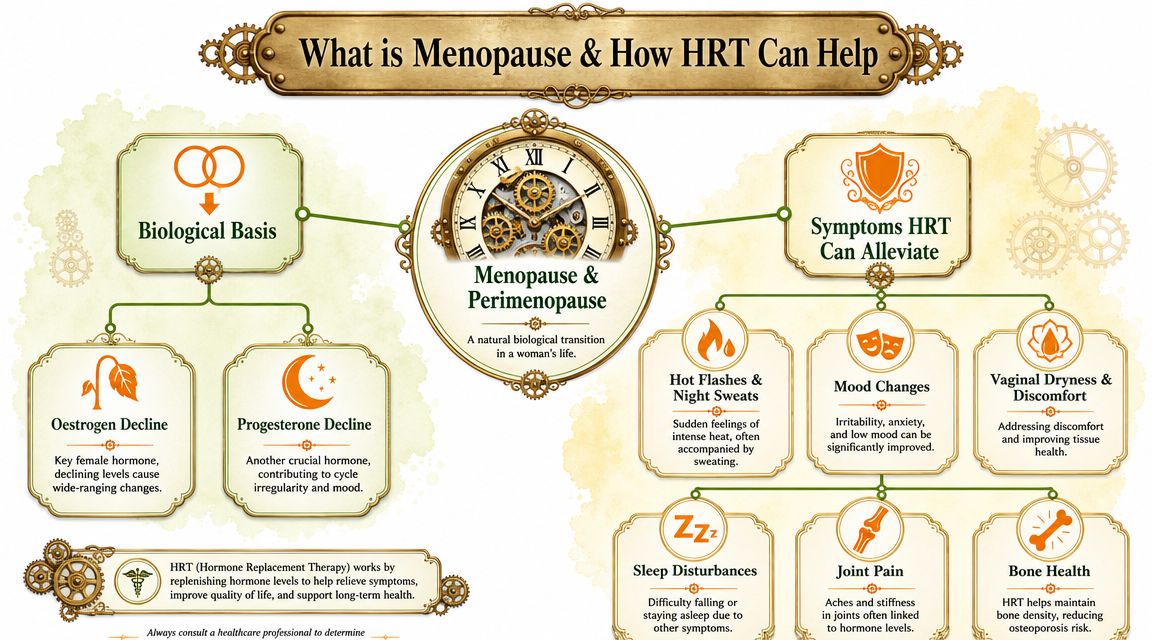
Menopause happens when ovarian hormone levels fall and periods stop for good. Perimenopause is the lead-in. That's when hormone levels swing up and down and symptoms often start before periods fully stop.
Why symptoms can feel so wide-ranging
Falling oestrogen can affect temperature control, sleep, vaginal tissues, and day-to-day comfort. Falling progesterone can contribute to irregular bleeding patterns in the perimenopause and can also affect how steady things feel from one cycle to the next.
That's why menopause doesn't look the same for everyone. One woman gets hot flushes and sleeps badly. Another mainly notices vaginal dryness and pain during sex. Another feels flat, irritable, foggy, and unlike herself.
The symptoms HRT is most clearly used for
UK-facing guidance is strongest on vasomotor symptoms, which means hot flushes and night sweats. HRT is described as the most effective treatment for moderate-to-severe vasomotor symptoms, and it's commonly used in low starting doses that are adjusted over time [2].
Symptoms that may improve with the right HRT plan include:
- Hot flushes and night sweats that interrupt work, sleep, or confidence
- Sleep disruption when flushes or sweats keep waking you
- Vaginal dryness and discomfort
- Urinary and genital symptoms, especially where local vaginal treatment is considered
- Mood and concentration changes in some women, particularly when driven by poor sleep and fluctuating hormones
Good menopause prescribing starts with the symptom pattern, not a trend on social media.
A practical point often missed in online discussions is that HRT comes in several forms. A foundational hormone use survey found 44% of postmenopausal women reported ever using hormone therapy. Among users, 93% used pills, 15% used patches, 26% used vaginal creams, injections or suppositories, and 31% used more than one form [5]. These figures are not UK-only, but they show how varied real-world hormone treatment can be.
Real-life example 1
A busy parent in her late forties might have regular work deadlines, school runs, and broken sleep from night sweats. She may not need a complex treatment plan. She may need a simple one that targets flushes and is easy to remember.
Real-life example 2
A shift worker may cope fine in the day but struggle badly with sleep and vaginal symptoms. In practice, she may need symptom-specific treatment rather than assuming one product should fix everything at once.
Exploring the different types and forms of HRT
Not all HRT does the same job. The first big question is whether you need oestrogen alone or oestrogen with a progestogen.
Which type of HRT might be used
If you've had a hysterectomy, you may be offered oestrogen-only HRT. If you still have your womb, you'll usually need a progestogen alongside oestrogen because unopposed oestrogen can stimulate the womb lining [2].
In day-to-day prescribing, you may hear terms like:
- Sequential or cyclical HRT. Oestrogen is taken regularly and progestogen is added for part of the cycle. This may suit some women in perimenopause or earlier after menopause.
- Continuous combined HRT. Oestrogen and progestogen are taken continuously. This often aims to avoid monthly bleeds.
- Local vaginal oestrogen. This treats vaginal or urinary symptoms locally rather than acting as a full-body treatment.
For some women, the route is just as important as the hormone itself. A gym-goer who sweats heavily may dislike patches in summer. Someone with a chaotic routine may find a twice-weekly patch easier than remembering tablets every day.
If you're curious about personalised formulations more broadly, this guide to personalised medicine in the UK explains why one size rarely fits all.
Comparing HRT formulations
| Formulation | How it works | Pros | Cons |
|---|---|---|---|
| Oral tablets | Hormones are swallowed and absorbed through the gut | Familiar, simple, often easy to use | Oral oestrogen carries more clot risk than transdermal treatment in modern guidance [1] |
| Transdermal patches | Hormones absorb through the skin | Useful when clot risk matters, steady delivery, convenient for some women [1] | Can irritate skin, may peel off, visible |
| Transdermal gel or spray | Hormones absorb through the skin after application | Flexible dosing, avoids oral route | Needs consistent daily use and correct application |
| Vaginal oestrogen | Works mainly in local tissues | Helpful for dryness and discomfort, targeted approach | Doesn't act like full systemic HRT for hot flushes |
| Combined regimens with progestogen | Adds womb protection where needed | Essential if you have a womb and use systemic oestrogen [2] | Can affect bleeding pattern and tolerability in some women |
A few practical truths matter more than brand names.
- Simple wins: If a treatment doesn't fit your routine, you're less likely to stick with it.
- Skin route has advantages: UK menopause guidance often prefers transdermal estradiol in women with higher clot risk or migraine [1].
- Local symptoms need local thinking: Vaginal dryness often needs direct treatment rather than hoping systemic HRT will sort everything.
Pharmacist's tip
If you still have your womb, don't treat the progestogen as an optional extra. It's there to protect the womb lining when you use systemic oestrogen [2].
Weighing the modern benefits and risks of HRT
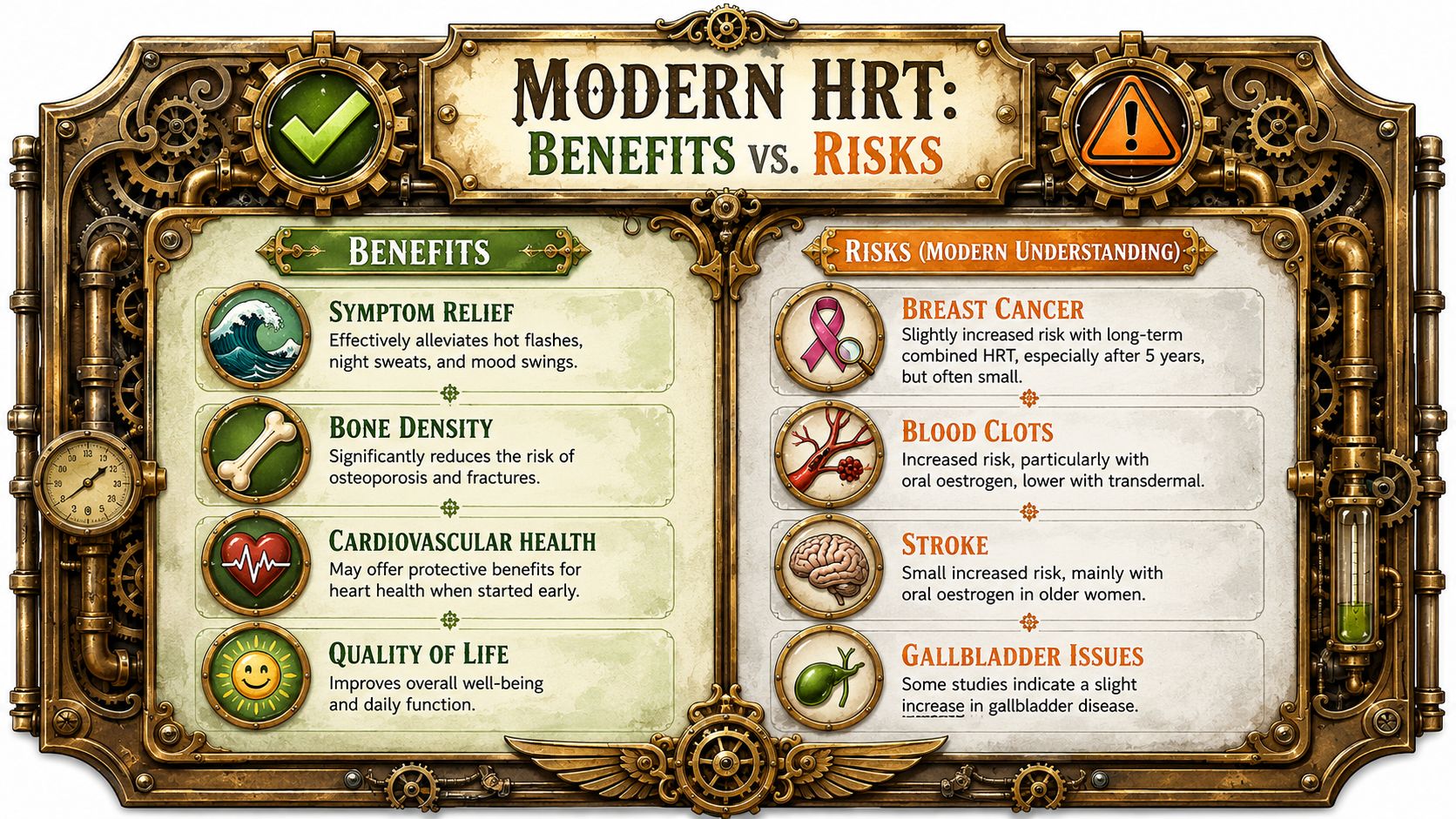
This is the part most women ask about first, and fairly so. HRT has a complicated public history. Much of the fear dates back to the 2002 Women's Health Initiative findings, which triggered a sharp drop in HRT use after reports of increased risks such as breast cancer, heart disease, and stroke [6].
Why people still worry about HRT
Those headlines left a deep mark. They changed prescribing and made many women feel that HRT was broadly unsafe. That caution spread internationally, including in UK practice, even though later guidance became more nuanced [6].
A Yale review notes that HRT had been widely adopted in the 1990s, with nearly 15 million women in the US using it, before practice changed after 2002 [6]. The important point now isn't that the old concerns never mattered. It's that today's prescribing focuses much more closely on who benefits, when treatment starts, and which route is used.
What modern UK practice does differently
The key modern idea is the window of opportunity. The British Menopause Society and Women's Health Concern state that starting HRT in women under 60 or within 10 years of the final menstrual period usually gives a more favourable balance of benefits and risks [1].
That changes the conversation in three useful ways:
- Timing is part of safety. Starting earlier after menopause is not the same as starting much later [1].
- Route changes risk. Oral therapy carries more thrombotic risk than transdermal therapy [1].
- Selection matters. Women with raised VTE risk or migraine often suit transdermal estradiol better, while oral oestrogen is avoided in women with prior VTE [1].
This is why modern HRT isn't a yes-or-no question. It's a matching exercise.
A woman with severe flushes, no clot history, and no migraine may have several reasonable options. A woman with migraine or past clot concerns may still be treated, but route and regimen become more important.
For some people, wider testing can be part of a broader health picture, though not a shortcut around proper menopause assessment. This guide to genomic testing in the UK explains what these tests can and can't add.
Practical rule: Fear based on old headlines is understandable. Decisions should still be made on current guidance, your history, and the form of HRT being considered.
When to seek urgent help
Seek urgent medical help if you develop symptoms that could suggest a serious problem, such as:
- Chest pain
- Sudden shortness of breath
- One-sided leg swelling or pain
- Sudden weakness, facial droop, or trouble speaking
- A severe new headache unlike your usual pattern
These symptoms don't automatically mean HRT caused them. They do need urgent assessment.
How to get started with HRT in the UK
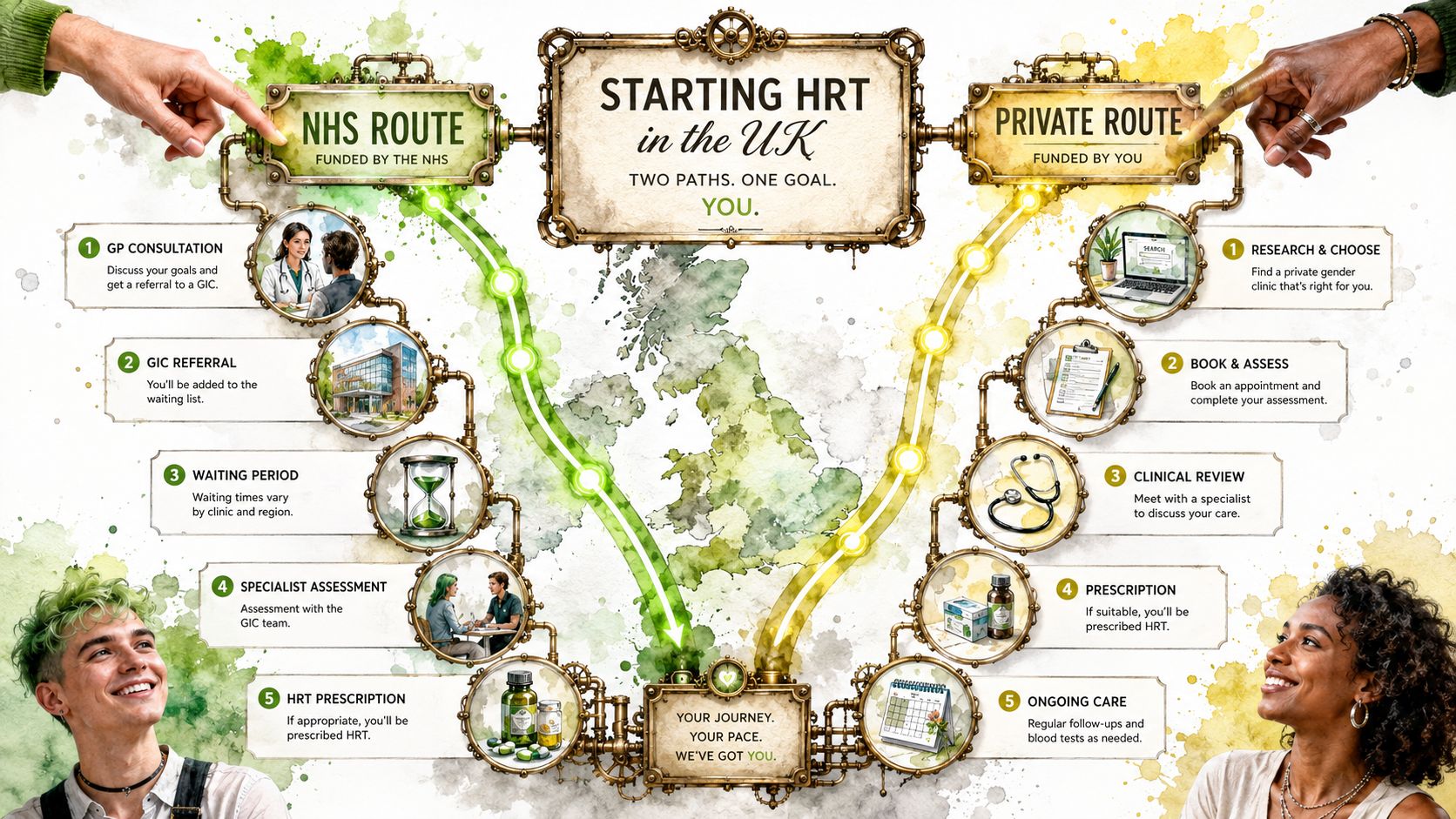
Starting HRT in the UK usually means choosing between an NHS route and a private route. The best option often depends on waiting times, how quickly you need help, and how straightforward your case is.
A key reassurance first. There isn't an automatic age cut-off for starting HRT. UK guidance supports an individual risk-benefit discussion, even when a woman feels she may be “too late” [3].
The NHS route
Most women start by booking a GP appointment. A good consultation goes better if you arrive with a clear symptom list.
Bring notes on:
- Your symptoms and which ones bother you most
- Your periods if you're still having them
- Migraine, clot, stroke, breast, or womb history
- Current medicines
- What you want help with first, such as sleep, flushes, or vaginal discomfort
If your symptoms are classic and your history is straightforward, the GP may discuss options there and then. If things are more complex, you may need follow-up or referral.
The private route
Some women choose private care because the process is faster or easier to fit around work and family life. A busy parent may not be able to wait weeks for a routine review. A woman working nights may prefer an online pathway she can complete after a shift rather than taking time off.
That doesn't mean “private” should mean rushed. Safe care still needs proper screening, a medication history, and clear follow-up. This overview of an online pharmacy in the UK shows how digital prescribing should still involve real clinical review.
Here's a useful explainer on what menopause consultations can involve:
What to expect in a consultation
Most first consultations focus on three decisions:
- Are your symptoms likely to be menopausal?
- Is HRT suitable for you?
- Which route best fits your risks and your routine?
Expect questions about your womb status, migraine, blood clot history, bleeding pattern, and whether you need symptom relief across the whole body or mainly in the vagina and bladder area.
Pharmacist's tip
Don't say “I just want HRT.” Say what's happening to you. “I'm waking drenched, I can't focus at work, sex is painful, and I'm snappy all the time” gives a clinician something useful to treat.
Your first few months on HRT what to expect
The first few months are often about adjustment, not instant perfection. HRT usually starts low and then changes if needed. Examples from patient guidance include transdermal estradiol starting at 0.025 mg/day and oral estradiol at 0.5 mg/day [2].
What usually happens first
Some women notice improvement in flushes and sleep fairly quickly. Others need dose changes, a different progestogen, or a different route before things settle. That doesn't mean HRT has “failed”. It often means the first plan wasn't the best fit.
If you still have your womb, the progestogen part is not optional. It protects the womb lining when systemic oestrogen is used [2].
A review appointment matters because HRT is a treatment you fine-tune. If you like tracking things, a simple symptom diary can help. This guide to using a home blood test kit in the UK is useful for understanding home monitoring generally, though symptom tracking is often just as important as lab numbers in menopause care.
Common early niggles and practical fixes
Early side effects can happen. They may include things like breast tenderness, mild nausea, patch irritation, or unexpected bleeding changes, depending on the regimen. These need context, not panic.
Useful habits include:
- Take it consistently: HRT works best when you use it as prescribed.
- Apply skin products properly: Rotate patch sites and apply gel to clean, dry skin.
- Report bleeding changes: Unexpected or persistent bleeding needs review.
- Ask early if it's not suiting you: Another formulation may work better.
Pharmacist's tip
If a patch keeps lifting, check where you place it. Friction from waistbands, gym leggings, or sweaty skin causes half the trouble.
Many women give up too early because the first product isn't quite right. A route change can make all the difference.
Pharmacist's tip
Don't judge HRT by one bad week in the perimenopause. Hormones can fluctuate wildly on their own, which can muddy the picture early on.
Summary and Frequently Asked Questions
Hormone replacement therapy is a practical, evidence-based option for many women with menopause symptoms. It isn't one treatment for everyone. The best plan depends on your symptoms, whether you still have your womb, your age and timing since menopause, and your personal risk factors [1][2]. Modern UK care looks at route as well as dose, which matters because oral and transdermal treatments don't have the same risk profile [1]. There also isn't a hard age cut-off, so “too late” isn't always the end of the conversation [3]. If one product doesn't suit you, another route, a dose change, or a non-hormonal option may still help [4].
Frequently asked questions
What is hormone replacement therapy in simple terms?
Hormone replacement therapy replaces hormones that fall during menopause, mainly oestrogen and sometimes a progestogen too. It's used to reduce symptoms such as hot flushes, night sweats, and vaginal dryness [2].
Is HRT safe?
For many women, HRT can be used safely after an individual review. Modern guidance is more favourable when treatment starts under 60 or within 10 years of menopause, and route selection matters because transdermal therapy carries less thrombotic risk than oral therapy [1].
Can I start HRT if I'm older?
Possibly, yes. There isn't an automatic age cut-off. The discussion becomes more individual as age increases and as more time passes since menopause [3].
What if I still have periods?
You may still be in perimenopause. In practice, clinicians often focus on your symptom pattern and bleeding history when deciding whether HRT is appropriate and what type fits best.
Do I need progesterone with HRT?
If you still have your womb and use systemic oestrogen, you'll usually need a progestogen to protect the womb lining [2]. If you've had a hysterectomy, the plan may be different.
Are patches better than tablets?
Not always better, but often better for specific risk profiles. UK guidance commonly prefers transdermal estradiol when clot risk is higher or migraine is part of the picture [1].
What if standard HRT doesn't work or I can't get it?
That's a real issue. The UK has faced repeated supply shortages, including Serious Shortage Protocols. Options may include switching route, adjusting dose, or considering non-hormonal alternatives such as certain antidepressants or clonidine depending on symptoms and suitability [4].
Can vaginal symptoms be treated without full HRT?
Yes. Local vaginal treatment may help when dryness or discomfort is the main problem. It's a targeted option and doesn't work in the same way as full-body HRT.
Do I need follow-up once I've started?
Yes. Follow-up helps check symptom response, side effects, bleeding changes, and whether the dose is still right. HRT works best as a reviewed treatment, not a one-off prescription.
Is this article medical advice?
No. This guide is for information only and isn't a substitute for personal medical advice. A clinician should review your symptoms, history, and medicines before prescribing.
Meta description
Hormone replacement therapy explained for UK patients. Learn HRT benefits, risks, types, and how to start treatment safely in the UK.
Suggested internal links for medicalmojo.co.uk
- Menopause symptoms guide
- Vaginal dryness treatment options
- Migraine and hormones in women
- Understanding blood clot risk with medicines
- How online prescribing works in the UK
Byline
Written by: Medical Mojo Editorial Team, UK pharmacy content writers
Clinical review
Clinically reviewed by: UK-registered pharmacist, GPhC-registered reviewer
How this content was created
This article was written using patient-facing and clinician-facing menopause guidance, with facts checked against the cited sources and reviewed for clinical accuracy, clarity, and UK relevance before publication.
Suggested visual ideas for designer
Steampunk symptom map
Alt text: “Menopause symptom map in lime green and brass style showing hot flushes, sleep problems, mood changes and vaginal dryness.”Decision tree for HRT routes
Alt text: “Decision tree showing oral, transdermal and vaginal hormone replacement therapy options for UK patients.”Consultation checklist card
Alt text: “UK menopause consultation checklist with symptom diary, bleeding history, migraine history and medicine list.”
References
[1] British Menopause Society, Women's Health Concern (2020) BMS & WHC's 2020 recommendations on hormone replacement therapy in menopausal women. Available at: https://thebms.org.uk/publications/consensus-statements/bms-whcs-2020-recommendations-on-hormone-replacement-therapy-in-menopausal-women/ (Accessed: 23 May 2026).
[2] The Menopause Society (n.d.) Hormone therapy. Available at: https://menopause.org/patient-education/menopause-topics/hormone-therapy (Accessed: 23 May 2026).
[3] National Library of Medicine (2025) Menopausal hormone therapy and the window of opportunity. Available at: https://pmc.ncbi.nlm.nih.gov/articles/PMC12575872/ (Accessed: 23 May 2026).
[4] Solici (2023) Flashing a spotlight on the hot topic of menopause. Available at: https://solici.com/news/flashing-a-spotlight-on-the-hot-topic-of-menopause/ (Accessed: 23 May 2026).
[5] Centers for Disease Control and Prevention (n.d.) Hormone replacement therapy. Available at: https://www.cdc.gov/nchs/data/misc/hrt_booklet.pdf (Accessed: 23 May 2026).
[6] Yale School of Medicine (2024) After decades of misunderstanding, menopause is finally having its moment. Available at: https://medicine.yale.edu/news-article/after-decades-of-misunderstanding-menopause-is-finally-having-its-moment/ (Accessed: 23 May 2026).
If you want a convenient UK route to regulated menopause treatment, Courier Pharmacy offers online prescribing with clinician review, discreet delivery, and follow-up support where appropriate. It can be a practical option if you need a private pathway, have trouble accessing appointments, or want a more flexible process that still puts safety first.


