How Does Mounjaro Work For Weight Loss? A UK Patient Guide
Discover how does Mounjaro work for weight loss with its unique dual-action formula. This guide explains its mechanism, results, and safety in the UK.
In this article
- Five key takeaways on how Mounjaro works
- How Mounjaro helps you manage weight
- The power of two hormones
- Mounjaro's three-pronged attack on weight
- Your Mounjaro journey: a realistic UK timeline
- The first few weeks: starting low and slow
- Months one to three: building momentum
- Six months and beyond: the long-term view
- Comparing Mounjaro and Wegovy
- Mounjaro (Tirzepatide) vs. Wegovy (Semaglutide)
- Weighing the options in real life
- Understanding Mounjaro's side effects and safety
- Common and manageable side effects
- Serious risks and when to seek help
- Who should not take Mounjaro
- Summary
- Frequently Asked Questions (FAQs)
Mounjaro helps you lose weight by mimicking two natural gut hormones, GIP and GLP-1, which powerfully reduce your appetite and slow down digestion. This makes you feel fuller for longer from smaller meals, helping you eat less without a constant feeling of hunger. By tackling both the physical and psychological sides of appetite, Mounjaro supports significant and sustainable weight loss when combined with a healthy lifestyle.
This guide will explain exactly how Mounjaro works in your body. We will cover the science in simple terms, what to expect on your treatment journey, and how it compares to other options.
Five key takeaways on how Mounjaro works
- It’s a unique 'twincretin' medication. Mounjaro is the first treatment to copy two gut hormones: GIP and GLP-1. This dual action sends stronger signals to your brain to reduce appetite and help you feel satisfied.
- The results can be life-changing. In studies, people using Mounjaro with lifestyle changes achieved major weight loss. It is one of the most effective medical options available for weight management today.
- It’s a powerful tool, not a magic fix. Mounjaro brilliantly manages hunger and cravings. This makes it much easier to stick to a healthier diet and exercise plan. It supports you in building positive, long-term habits.
- It differs from Wegovy and Ozempic. Other injections like Wegovy only target the GLP-1 hormone. Mounjaro's dual-hormone action gives it a more comprehensive effect on your body's metabolic controls.
- Sourcing it safely is essential. Only get Mounjaro from a regulated UK source, like a GPhC-registered pharmacy. This ensures you receive genuine, safe medication with proper clinical supervision.
How Mounjaro helps you manage weight
So, what actually happens inside your body when you take Mounjaro? At its core, the medication taps into your body's natural communication systems but makes the conversation louder. It’s the first treatment of its kind, making it a real step forward in weight management.
Mounjaro contains the active ingredient tirzepatide. We call it a 'dual-action' or 'twincretin' treatment. This means it cleverly mimics two different hormones your gut naturally releases after you eat a meal: GLP-1 and GIP.
The power of two hormones
Think of these hormones—GLP-1 and GIP—as messengers. After a meal, they travel from your gut to your brain and other body parts. They send crucial signals about fullness and blood sugar.
While other weight loss injections like Wegovy work by copying just the GLP-1 hormone, Mounjaro goes a step further. It activates the receptors for both GLP-1 and GIP. This double-pronged approach gives Mounjaro its powerful effect on appetite and metabolism.
Here’s a breakdown of how Mounjaro’s dual hormone action supports weight loss.
| Hormone Action | What It Does In Your Body | How It Helps With Weight Loss |
|---|---|---|
| GLP-1 Mimicry | Slows down how quickly your stomach empties. It also signals fullness to your brain's appetite centre. | You feel fuller for longer after eating and have fewer cravings. This makes sticking to smaller portions much easier. |
| GIP Mimicry | Works with GLP-1 to enhance appetite control. It also improves how your body handles sugar and stores fat. | This contributes to you eating fewer calories and may improve your metabolic health, further supporting fat loss. |
By targeting both pathways, Mounjaro creates a stronger effect than just targeting GLP-1 alone. This gives you a more robust tool for managing your weight.
Mounjaro's three-pronged attack on weight
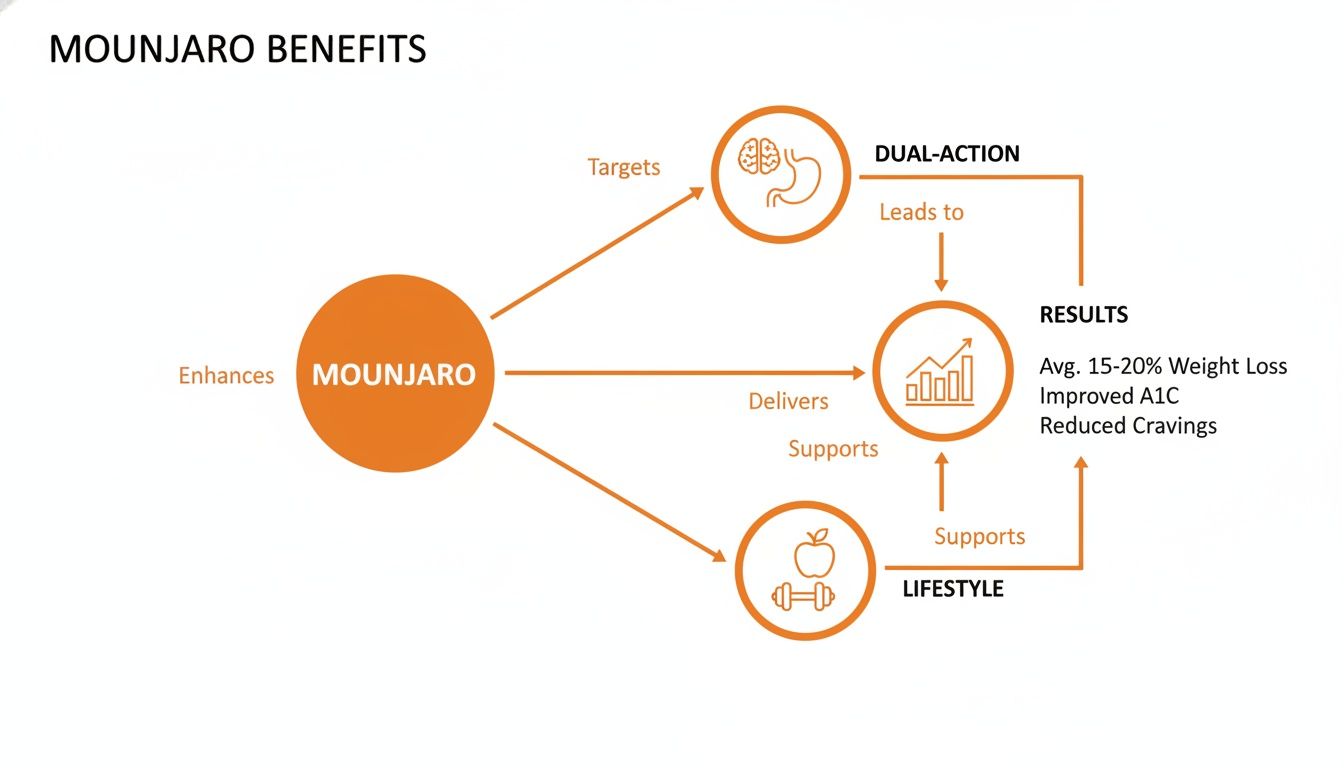
The combination of GIP and GLP-1 action creates a powerful trio of effects. These work together to help you lose weight.
- Turns down appetite and 'food noise'. By acting on your brain, Mounjaro sends strong "I'm full" signals. This reduces physical hunger and quiets the constant, intrusive thoughts about food.
- Slows stomach emptying. The medication slows down how quickly your stomach empties food. This means food stays in your stomach for longer, which is a major reason you feel satisfied after meals.
- Improves how your body uses energy. The dual-hormone action helps your body control blood sugar levels more effectively. It can also improve how it stores and uses fat for energy.
Pharmacist's tip: The slowed digestion is great for appetite control, but it's also why some people feel bloated or constipated. Staying well-hydrated by drinking plenty of water throughout the day is a simple but effective way to help ease these side effects.
This synergy of effects is what makes Mounjaro so effective. The infographic below shows how these actions come together.
It’s easy to see how this translates into real-world results. Imagine leaving a busy shift without feeling ravenous, or sitting down to a meal and feeling satisfied with a smaller portion. That's the control Mounjaro helps to restore.
By tackling both the psychological side of hunger (food noise) and the physical feelings of fullness, Mounjaro provides a solid foundation for building healthier habits. The medication works best when paired with a healthy lifestyle. For more guidance, check out our ultimate Mounjaro diet guide for practical tips on nutrition.
Your Mounjaro journey: a realistic UK timeline
When you start a new treatment like Mounjaro, a big question is, "How quickly will I see results?". It's natural to want to know what to expect. While everyone's journey is unique, clinical trials give us a clear picture of a typical timeline.
Let's walk through what you can realistically expect, from your first injection to six months down the line.

The first few weeks: starting low and slow
Your journey with Mounjaro begins on a low starting dose, usually 2.5 mg once a week. This is not a dose for weight loss. Its purpose is to let your body gently get used to the medication. This 'getting to know you' phase is key to minimising side effects like nausea.
Even on this low dose, you might notice subtle changes. Many people report feeling full faster during meals. They also describe a quieting of the "food noise"—that constant chatter in your head about what to eat next. You might not see a big drop on the scales yet, but these early shifts are great signs the medication is working.
How long does it take for Mounjaro to start working? You may feel Mounjaro reducing your appetite within the first one to two weeks, even on the starting 2.5mg dose.
Months one to three: building momentum
After a month, your prescriber will typically increase your dose to 5 mg. This is where most people start to see more noticeable weight loss. As your body gets used to the higher dose, the appetite-suppressing effects become much more consistent.
This is the phase where building new habits feels less like a battle. Because you're not fighting constant hunger, choosing healthier foods and managing portions feels achievable. You’re working with your body, not against it.
Real-world UK data is promising. Some platforms report an average loss of about 15.3 pounds over six weeks. This works out to roughly 3.6 pounds per week for some people. Of course, this varies and depends heavily on your starting weight and lifestyle changes. You can see more UK Mounjaro statistics to get a better sense of the trends.
Six months and beyond: the long-term view
By the six-month mark, you will likely be on a stable maintenance dose. This is where the long-term benefits shine. Results from major clinical trials, like the SURMOUNT-1 study, are incredibly encouraging. It found that people on the highest dose (15 mg) lost an average of 22.5% of their starting body weight over 72 weeks [1].
At this stage, the healthy habits you've built start to feel like second nature. It's normal for the rate of weight loss to slow down. This isn't a sign of failure; it’s your body settling into its new, healthier normal.
Putting it all together: a real-life example Let's look at Sarah, a 42-year-old nurse from Manchester. Juggling busy 12-hour shifts and family life, she struggled with intense post-shift cravings.
- Weeks 1-4: Sarah began with the 2.5 mg dose. She had mild nausea but found eating smaller, frequent meals helped. The biggest change? She stopped grabbing unhealthy snacks on her way home.
- Months 2-3: Her dose was increased to 5 mg, and she lost around 9 pounds. The 'food noise' vanished, making it easier to cook healthy meals and have a smaller portion.
- Month 6: Now on a 10 mg dose, Sarah has lost over two stone. She has the energy for bike rides with her kids and has started a weekly parkrun—something she never thought possible. Mounjaro gave her the support she needed to build sustainable habits.
Comparing Mounjaro and Wegovy
It’s natural to wonder how Mounjaro stacks up against other weight loss injections, especially Wegovy. Understanding the key differences can help you have a productive chat with your prescriber.
The biggest difference is how they work. Wegovy (semaglutide) is a great treatment that mimics one gut hormone, GLP-1. Mounjaro (tirzepatide), on the other hand, targets both GLP-1 and another hormone receptor, GIP. This two-pronged attack gives it a powerful way of influencing appetite and metabolism.

Mounjaro (Tirzepatide) vs. Wegovy (Semaglutide)
While both are effective tools, their different approaches can lead to different outcomes. This is especially true for average weight loss and side effect profiles. Here’s a quick breakdown to help you compare.
| Feature | Mounjaro (Tirzepatide) | Wegovy (Semaglutide) |
|---|---|---|
| How It Works | Dual-Action: Mimics two gut hormones (GLP-1 and GIP) for strong appetite control. | Single-Action: Mimics one gut hormone (GLP-1) to reduce appetite and slow digestion. |
| Average Weight Loss | Up to 22.5% of body weight over 72 weeks at the highest dose in clinical trials [1]. | Up to 15% of body weight over 68 weeks at the highest dose in clinical trials [2]. |
| Common Side Effects | Nausea, diarrhoea, decreased appetite, vomiting, and constipation are most common. | Similar to Mounjaro, with nausea, diarrhoea, vomiting, and constipation most frequently reported. |
| Administration | A once-weekly self-injection using the KwikPen device. | A once-weekly self-injection using the FlexTouch pen device. |
As you can see, Mounjaro’s dual-hormone action has been linked to higher average weight loss in clinical trials. But remember, the "best" medication is what is most suitable and safe for you.
Weighing the options in real life
Let’s imagine Alex, a 35-year-old from London. He’s active but finds that intense hunger after a gym session often undoes his hard work. During a consultation, his prescriber explains that both medications have similar side effects, which usually improve as the body adjusts. After weighing everything up, Alex decides to start Mounjaro. The dual action on both GIP and GLP-1 seems like a promising strategy for tackling his powerful hunger signals.
If you are currently on one treatment and considering a change, our guide on switching from Mounjaro to Wegovy provides essential information.
Pharmacist's tip: It's never about which drug is "better," but which is the better fit for you. A qualified prescriber will look at your medical history and goals. Never switch between these medications without direct medical supervision.
Understanding Mounjaro's side effects and safety
When starting a new medication, it’s natural to have questions about side effects. Your safety is our top priority. Let’s take an honest look at what you can expect with Mounjaro.
Like any effective medicine, Mounjaro can have side effects. The good news is that most are mild and fade as your body gets used to the treatment. Since how Mounjaro works for weight loss involves slowing your digestion, the most common issues are gut-related.
Common and manageable side effects
When you first begin your treatment, you might notice some of these effects. They are usually temporary.
The most frequently reported side effects include:
- Nausea: Feeling a bit queasy is the most common one.
- Diarrhoea: Some people find they have looser stools.
- Constipation: Slowed digestion can sometimes lead to this.
- Vomiting: This is less common but can happen.
- Decreased appetite: This is key to its effect but can sometimes feel pronounced.
Pharmacist's tip: Simple, practical adjustments can help you manage these initial side effects. Try eating smaller, more frequent meals. It also helps to avoid rich, greasy, or very sugary foods. If you feel nauseous, stick to blander options like toast or plain rice until it passes.
Serious risks and when to seek help
It’s important to know the more serious, though much less common, risks. Knowing the warning signs means you can get help quickly.
You must seek urgent medical attention if you experience:
- Severe abdominal pain: This could signal pancreatitis (inflammation of the pancreas). The pain is often sharp and may spread to your back.
- Symptoms of a severe allergic reaction: Look for swelling of the face, lips, or throat; difficulty breathing; a bad rash; or a very fast heartbeat.
- A lump or swelling in your neck: This could be linked to thyroid tumours, including a rare cancer called medullary thyroid carcinoma (MTC).
Your clinical team will go over these risks with you. For a complete list, our guide covers all potential Mounjaro side effects in greater depth.
Who should not take Mounjaro
This treatment isn’t right for everyone. There are specific situations, known as contraindications, where Mounjaro should not be used.
You should not take Mounjaro if you:
- Have a personal or family history of medullary thyroid carcinoma (MTC).
- Suffer from a rare condition called Multiple Endocrine Neoplasia syndrome type 2 (MEN 2).
- Are pregnant, trying to become pregnant, or are breastfeeding.
- Have had a serious allergic reaction to tirzepatide.
Pharmacist's tip: It is vital that you are open and thorough when filling out your medical questionnaire. Share your full medical history and all medications you take. This is the only way your prescriber can make a safe decision on whether Mounjaro is right for you.
Summary
In summary, Mounjaro (tirzepatide) works for weight loss by mimicking two key gut hormones, GIP and GLP-1. This dual action powerfully reduces your appetite, slows down digestion, and improves how your body handles sugar and fat. You feel fuller for longer on smaller meals, which makes it easier to reduce your calorie intake. Mounjaro is not a magic fix; it is a powerful tool to support a healthy diet and exercise. By tackling both the physical and psychological drivers of hunger, it provides an effective foundation for achieving significant and lasting weight loss.
Disclaimer: This article is for informational purposes only and does not constitute medical advice. Always consult with a qualified healthcare professional before starting any new treatment. The information provided is not a substitute for a face-to-face consultation with a doctor or other healthcare provider.
Frequently Asked Questions (FAQs)
1. How does Mounjaro make you feel? Initially, you may feel some mild side effects like nausea or a more pronounced sense of fullness as your body adjusts. Most people find these feelings fade within a few weeks. The main ongoing feeling is reduced appetite and a lack of 'food noise', which helps you feel more in control of your eating habits.
2. Is Mounjaro more effective than Wegovy for weight loss? Clinical trials have shown that, on average, Mounjaro leads to a higher percentage of weight loss than Wegovy [1, 2]. Mounjaro's dual-action on both GIP and GLP-1 hormone receptors gives it a more powerful effect on appetite and metabolism. However, the "best" medication always depends on an individual's health profile and response to treatment.
3. Do you have to diet and exercise on Mounjaro? Yes. Mounjaro is most effective when used as a tool to support lifestyle changes. It makes sticking to a healthy diet and regular exercise much easier by controlling hunger and cravings. It is designed to work with these efforts, not replace them.
4. How long do you stay on Mounjaro for weight loss? Mounjaro is intended for long-term weight management. The duration of treatment is a decision made between you and your prescriber based on your progress and health goals. Many people continue using it to maintain their weight loss after reaching their target.
5. How fast do you lose weight on Mounjaro? Weight loss can start within the first few weeks, but it typically becomes more noticeable after the first month once you move to a therapeutic dose (5mg or higher). The rate of loss varies, but many UK users report losing between 2-4 pounds per week initially.
6. What foods should I avoid on Mounjaro? To minimise side effects and maximise results, it's best to avoid very greasy, fatty, and sugary foods. These can worsen nausea and other digestive issues. Focusing on lean protein, fibre, and whole foods will help you feel your best while on the medication.
7. Can you just stop taking Mounjaro? You should always speak to your prescriber before stopping Mounjaro. If you stop the medication, the hormonal effects that suppress your appetite will wear off. This often leads to a return of hunger and potential weight regain if healthy lifestyle habits are not firmly established.
Meta Description Learn how Mounjaro works for weight loss in our simple UK guide. Discover how it reduces appetite, its timeline for results, and how it compares to Wegovy.
Internal Links to Suggest
- /the-ultimate-mounjaro-diet-guide/
- /mounjaro-side-effects-2/
- /switching-from-mounjaro-to-wegovy-what-you-need-to-know/
- /online-pharmacy-uk/
- /what-are-the-ppars-a-guide-to-your-bodys-metabolic-switch/
Byline: Medically reviewed by Scott McDougall, MPharm (Pharmacist Prescriber) Authored by: The Medical Mojo Editorial Team
How this content was created: This article was written by our in-house editorial team using information from reputable sources such as the NHS, NICE, and peer-reviewed medical journals. All clinical information was verified and reviewed for accuracy by our team of GPhC-registered pharmacists to ensure it is safe, evidence-based, and patient-focused.
References [1] Jastreboff, A.M. et al. (2022) 'Tirzepatide Once Weekly for the Treatment of Obesity', New England Journal of Medicine, 387(3), pp. 205–216. Available at: https://www.nejm.org/doi/full/10.1056/NEJMoa2206038 [2] Wilding, J.P.H. et al. (2021) 'Once-Weekly Semaglutide in Adults with Overweight or Obesity', New England Journal of Medicine, 384(11), pp. 989–1002. Available at: https://www.nejm.org/doi/full/10.1056/NEJMoa2032183


