How Long Do Painkillers Take to Work? UK Guide 2026
Discover how long do painkillers take to work in the UK, including ibuprofen, paracetamol, and opioids, with safety tips and timing guidance.
SEO brief
Primary keyword: how long do painkillers take to work Secondary keywords: painkiller onset time, ibuprofen timing, paracetamol timing, peak effect, duration of pain relief Search intent: UK adults want a clear, practical answer on when painkillers start working, how long they last, and when to ask for help Target reader: UK adults, carers, and health-curious readers Product/service mention (if any): Courier Pharmacy, mentioned once as an option for medicine access and advice Internal links available: Included inline where relevant, plus suggested internal links at the end
Most common oral painkillers such as paracetamol and ibuprofen usually begin to ease pain within 30 to 60 minutes, with peak relief around 1 to 2 hours. Exact timing depends on the drug, the formulation, and the route. If you've ever wondered whether “nothing's happened yet” means a tablet has failed, you're asking the right question.
How long do painkillers take to work? Usually, the first relief starts within minutes to an hour, but the full effect can take longer. The useful bit is knowing the difference between onset, peak effect, and duration, so you don't redose too early or give up too soon.
Five key takeaways
- Most common tablets are not instant, even when they work well.
- Onset is when you first feel relief, peak is the strongest effect, and duration is how long it lasts.
- Ibuprofen and paracetamol often start within 30 to 60 minutes.
- Food, formulation, and route can speed things up or slow them down.
- If pain is still unchanged after the expected window, pause before taking more and ask a pharmacist.
How Long Different Painkillers Take to Start Working
Most common oral painkillers, including paracetamol and ibuprofen, usually begin to ease pain in about 30 to 60 minutes, and peak relief often comes around 1 to 2 hours. That timing can shift depending on the medicine, the formulation, and whether it's taken by mouth, rectally, or by injection [1][2].
If you are standing at the counter or checking a pack at home, that is usually the first number people ask about. A better question is whether the medicine has had enough time to reach its full effect, because the first sign of relief is not the same as the point where it should be doing the most work. A tablet that starts helping after half an hour may still be building, so it has not necessarily failed.
That distinction matters for headaches, toothache, period pain, and muscular aches. Some painkillers creep up steadily before they settle the pain properly, so judging them too early can make a medicine look weaker than it really is. For plain explanations of common pain types and how they are usually treated, see our pain management guide.
Practical rule: do not judge a painkiller only by the first 30 minutes. Wait for the expected peak, then decide whether it has actually helped.
A simple way to use the timing is to watch the full window, not just the first hint of change. Paracetamol and ibuprofen are both commonly used for everyday pain, but the exact pattern depends on how the medicine is made and how it enters the body [1][3].
If you have waited 2 hours past the expected peak with no change, pause before taking more and speak to a pharmacist. That is often the point where you should stop waiting and reassess, rather than redose on autopilot.
If you want a plain medicine page for reference, the paracetamol tablets page is a useful place to start.
Onset, Peak, and Duration Explained
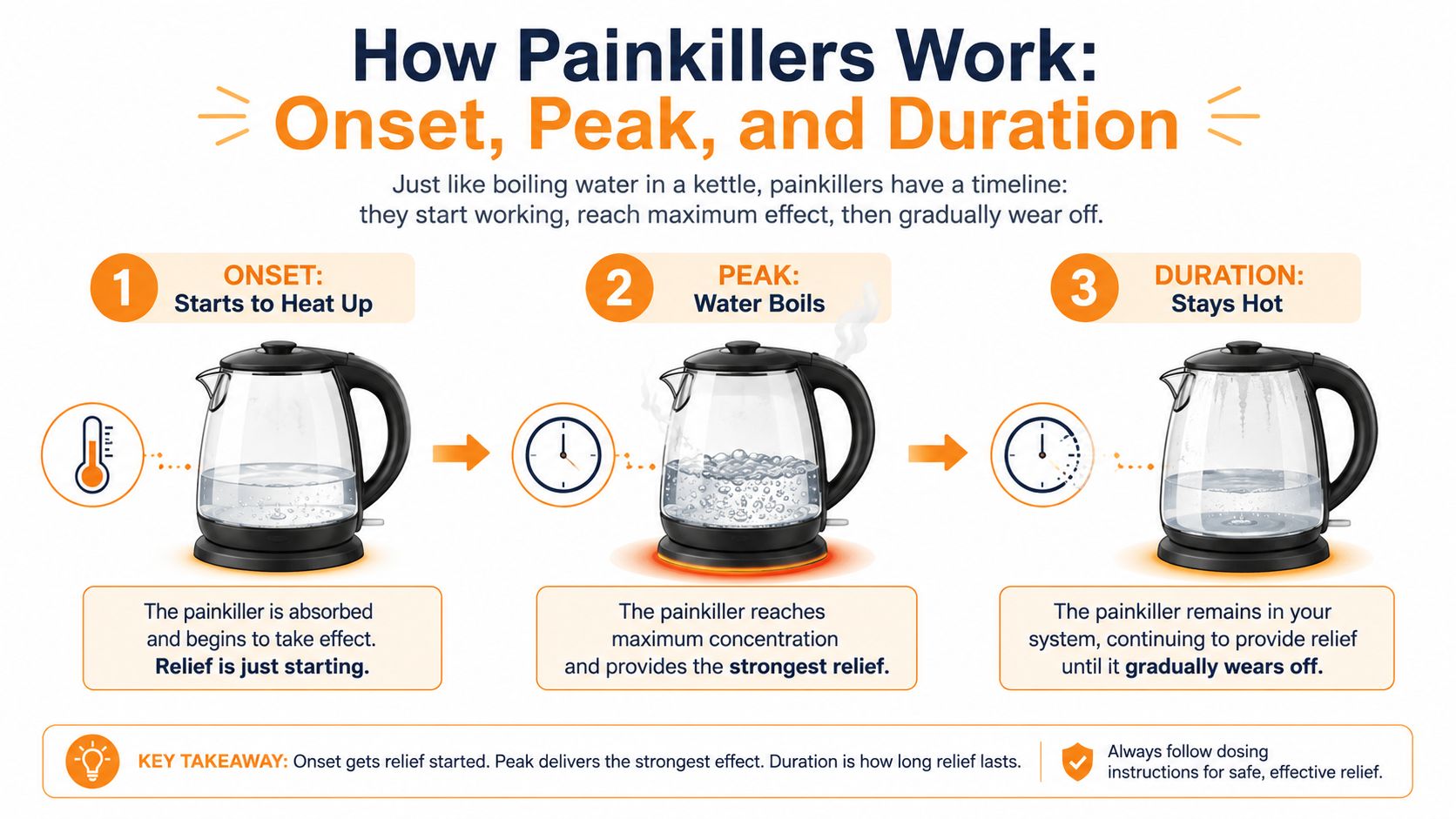
Onset means the time from taking the medicine to first feeling relief. Peak effect means the medicine is working at its strongest. Duration means how long that relief lasts before it starts wearing off.
A kettle is a better model than a light switch. It doesn't go from cold to boiling instantly. It warms first, then reaches the boil, then stays hot for a while. Painkillers behave in a similar way.
Featured-snippet answer: Onset is when you first feel relief, peak is when it works best, and duration is how long it keeps helping.
That matters because a medicine can have a quick onset but wear off sooner, or start more slowly and last longer. If you only watch for the first sign of relief, you can misread a drug that's still doing its job [2][3].
Take toothache as an example. A tablet may start dulling the ache, then settle it down more clearly over the next hour or two. Back pain can be trickier, because you might feel a small shift early on but still need repeated doses or a different option for steady relief [1][3].
That's why the timing label matters. It helps you decide whether the medicine is still in its usual window, or whether you should ask a pharmacist for a different approach.
Simple check: if the pain is easing, the medicine may be working even if it's not perfect yet.
Typical Timing for Common UK Painkillers
The table below gives a quick view of how the main oral options usually behave. Timing varies, so treat these as typical patterns rather than promises.
| Painkiller | Typical onset | Peak effect | Typical duration |
|---|---|---|---|
| Paracetamol | 30 to 60 minutes | 1 to 2 hours | A few hours [1][3] |
| Ibuprofen | 30 to 60 minutes | 1 to 2 hours | A few hours [1][3] |
| Naproxen | Usually within 1 hour | About 2 to 4 hours | Often longer-lasting than ibuprofen [1][3] |
| Aspirin | Usually within 30 to 60 minutes | About 1 to 2 hours | A few hours [1][3] |
| Codeine-based co-codamol | Often within 30 to 60 minutes | About 1 to 2 hours | A few hours. Prescription-only use needs clinician guidance [4] |
| Tramadol | Often within 1 hour | About 2 to 3 hours | A few hours. Prescription-only use needs clinician guidance [4] |
For everyday symptoms like a mild headache, paracetamol is often the first medicine people think about because it is straightforward and commonly used [1]. If you are comparing it with other simple oral options, a plain paracetamol tablets page such as paracetamol tablets shows how widely it is used as a basic first-line choice. For strains, sprains, and period pain, ibuprofen often makes more sense because it also helps with inflammation, not just pain [3].
The bigger lesson is that not every painkiller sits in the same timing lane. Some start fairly quickly and wear off sooner, while others take a little longer to peak but last longer once they do. Prescription-only options like codeine and tramadol should be used only with clinician guidance, because timing, dose, and the reason for taking them all matter [4].
If you want a plain medicine reference, the co-codamol page is a useful example of a stronger combined painkiller listing: co-codamol 8/500mg tablets.
What Speeds Up or Slows Down Ibuprofen
Ibuprofen is a good worked example because it shows how much timing can change from one situation to another. The same active ingredient can feel quicker, slower, or steadier depending on what's in the stomach, the form it comes in, and what else the person is taking [1][3].
The main timing factors
- Empty stomach: absorption is often faster.
- Food: it may slow absorption a little, but it can protect the stomach.
- Formulation: liquid and dispersible forms usually act sooner because they break down faster.
- Age and other medicines: older adults and people taking other treatments can respond differently.
- Hydration and routine: if you're unwell, dehydrated, or taking several medicines, timing can be less predictable [2][3].
The food question comes up all the time. Taking ibuprofen with food can delay absorption a little, but that trade-off is often worth it if your stomach is sensitive. The delay is usually small, around 10 to 20 minutes, and many people prefer the comfort of taking it after a meal [3].
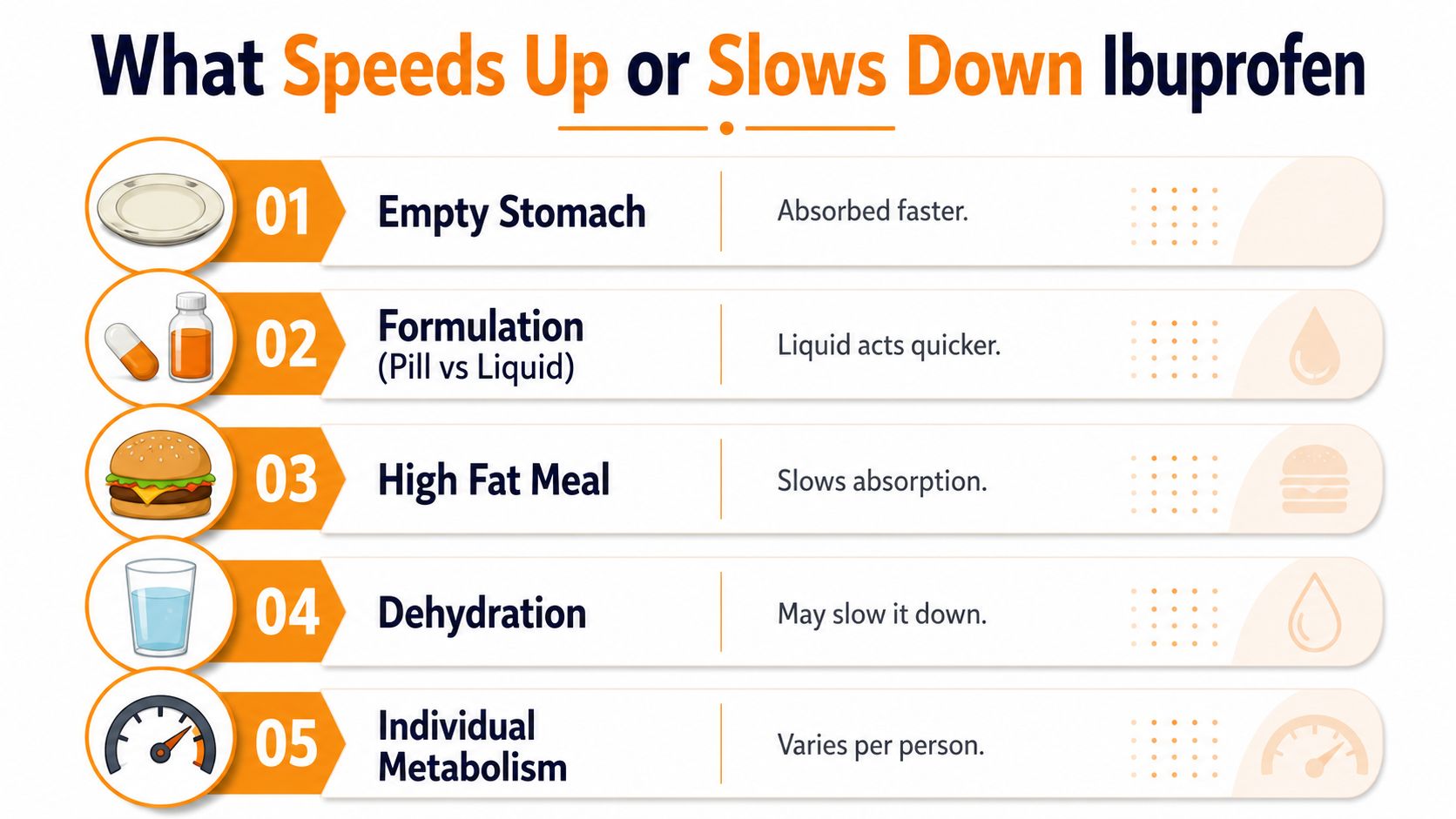
A liquid or dispersible form can be a sensible choice when speed matters, because it doesn't need as much time to fall apart before absorption. That's one reason pharmacists often ask what form you've got, not just what drug [3].
If your pain medicine seems slower than usual, the issue may be the preparation rather than the ingredient itself. That's a good moment to ask whether your tablets, caplets, liquid, or dispersible form is the right fit for you.
Pharmacist's tip: if you need ibuprofen quickly but your stomach is sensitive, ask whether a different form or a different painkiller is more suitable.
For a basic ibuprofen product reference, this page can help: ibuprofen 400mg tablets.
Real Life Timing Scenarios in the UK
A busy parent with a tension headache usually wants one thing, fast enough relief to get through the school run. In that sort of situation, a soluble or dispersible paracetamol taken with water may start to help within about 20 to 30 minutes, which can matter when the morning is already on the edge [1]. The practical move is simple, take it early rather than waiting until the pain is severe.
A gym-goer with a strained calf faces a different problem. The aim is not only to dull pain, but also to reduce inflammation. Ibuprofen with food may suit that pattern, and a topical NSAID gel can add local relief on the skin side while the oral medicine works more broadly.
Real-world point: one medicine can help the surface pain, while another works deeper in the joint or muscle area.
A shift worker with period pain has another timing issue. Pain often arrives when sleep, meals, and medication times are all off. In that case, regular dosing at the stated interval is usually more useful than waiting for the pain to flare badly and then chasing it.
That same framework works in all three cases. Think about when the pain starts, how quickly you need relief, and whether the medicine needs to be taken regularly to keep symptoms steady. If you're unsure, a pharmacist can help you match the timing to the task [1][3].
This is also where a migraine advice page can be useful, because the timing of treatment matters more when a headache is not like your usual one: migraine guidance.
Routes, Formulations, and Stronger Pain Medicines
The route matters almost as much as the ingredient. A medicine swallowed as a tablet has to pass through the gut, while an injection goes straight into the bloodstream, so the timing can be very different [2].
How route changes speed
- Intravenous morphine can relieve pain in 5 to 10 minutes [2].
- Intramuscular injections may work in 10 to 30 minutes [2].
- Oral opioids usually take about 30 minutes [2].
- Rectal acetaminophen can take 35 to 45 minutes [2].
That spread explains why people in urgent care often get injections rather than tablets. It's not about preference, it's about how quickly the body can use the medicine when pain is severe [2].
There's also a big difference between medicines used for immediate symptom relief and those used for longer-term nerve pain. Gabapentin and pregabalin can take days or weeks, and some antidepressant pain relievers may need 6 to 8 weeks before doctors can judge whether they're helping [2]. Slower onset doesn't mean failure. It usually means the medicine works on a different pain pathway.
A topical gel for a knee or ankle is another useful option because it targets local pain without relying on the same whole-body route as a tablet. If swallowing is difficult, rectal forms can also be practical, especially when someone is unwell or vomiting.
For people who need a stronger combined painkiller discussion, a pharmacist or prescriber can talk through whether a prescription medicine is suitable. In a UK online pharmacy setting, the key issue is always matching the medicine to the pain, not just reaching for something stronger.
Pharmacist Tips, Red Flags, and Quick Answers
Pharmacist's tip: if the pain is unchanged after the expected peak, treat that as a review point, not an automatic redose. For paracetamol or ibuprofen, that often means waiting to see whether the medicine has reached its usual window before taking more [1][3].
Pharmacist's tip: don't double up on the same active ingredient. Two different packets can both contain paracetamol or ibuprofen, and that's easy to miss when the box names look different.
Pharmacist's tip: for ongoing pain such as period pain or a sprain, regular dosing at the labelled interval often works better than waiting for severe pain. That steadier approach can stop the pain from building in the first place.
Get urgent help if you have chest pain, breathlessness, a sudden severe headache, stomach pain with fever, or pain after a serious fall. Those symptoms need proper assessment, not just another dose.
Does it matter whether I take painkillers before or after food?
Yes, sometimes it does. Food can slow absorption a little, but it may protect your stomach, especially with ibuprofen. If your stomach is sensitive, taking the medicine with food is often the better trade-off.
Can I combine painkillers?
Sometimes, but not always. You should only combine medicines if you know the active ingredients and the doses. A pharmacist can help you avoid accidental duplication, especially with paracetamol-containing products.
When can children have painkillers?
Children can have some painkillers, but the medicine and dose depend on age and weight. Don't guess from an adult pack. Use the child-specific directions or ask a pharmacist first.
Is alcohol safe with painkillers?
It depends on the medicine and how much alcohol you've had. Alcohol can add risks, especially with medicines that affect the liver, stomach, or alertness. If you're unsure, check with a pharmacist before mixing them.
If you're still unsure which painkiller fits your symptoms, speak to a UK pharmacist before taking another dose. Courier Pharmacy can help with medicine advice, prescription checks, and the right product choice for your situation, so you're not left guessing at the kitchen counter.


