How Long Does Mounjaro Take to Work
How long does Mounjaro take to work? Realistic UK timelines for appetite, blood sugar and weight loss on tirzepatide, plus what affects your results.
Appetite effects can begin within 24 to 48 hours of the first Mounjaro injection, but meaningful weight loss usually builds over 8 to 20 weeks and is judged at the 72-week mark in the UK evidence base. Expect a long arc rather than a quick fix.
You may be standing in the kitchen, looking at the scales, and wondering whether your first injection has done anything at all. Perhaps your appetite feels quieter, but your weight hasn't changed. Or perhaps nausea arrived before any clear benefit. Both experiences can happen.
The answer to how long Mounjaro takes to work depends on what you mean by “work”. Appetite, blood sugar, body weight and NHS access each follow a different clock. This guide explains those clocks, the UK dosing schedule, common side effects, follow-up rules and when to ask for help.
Five key takeaways
- Appetite may change first: Some people notice less hunger within 24 to 48 hours of the first injection. UK-facing timeline guidance
- The starter dose is gentle by design: You usually take 2.5 mg weekly for four weeks before moving to 5 mg. MHRA guidance
- Weight loss takes longer: Noticeable changes often build from around weeks 4 to 6, with stronger progress during later titration. UK patient timeline
- The strongest evidence covers 72 weeks: NICE reports mean body-weight changes of -15.0% with 5 mg, -19.5% with 10 mg and -20.9% with 15 mg at week 72. NICE clinical-effectiveness evidence
- A slow first month doesn't mean failure: Your prescriber judges response after titration, not from the first few injections.
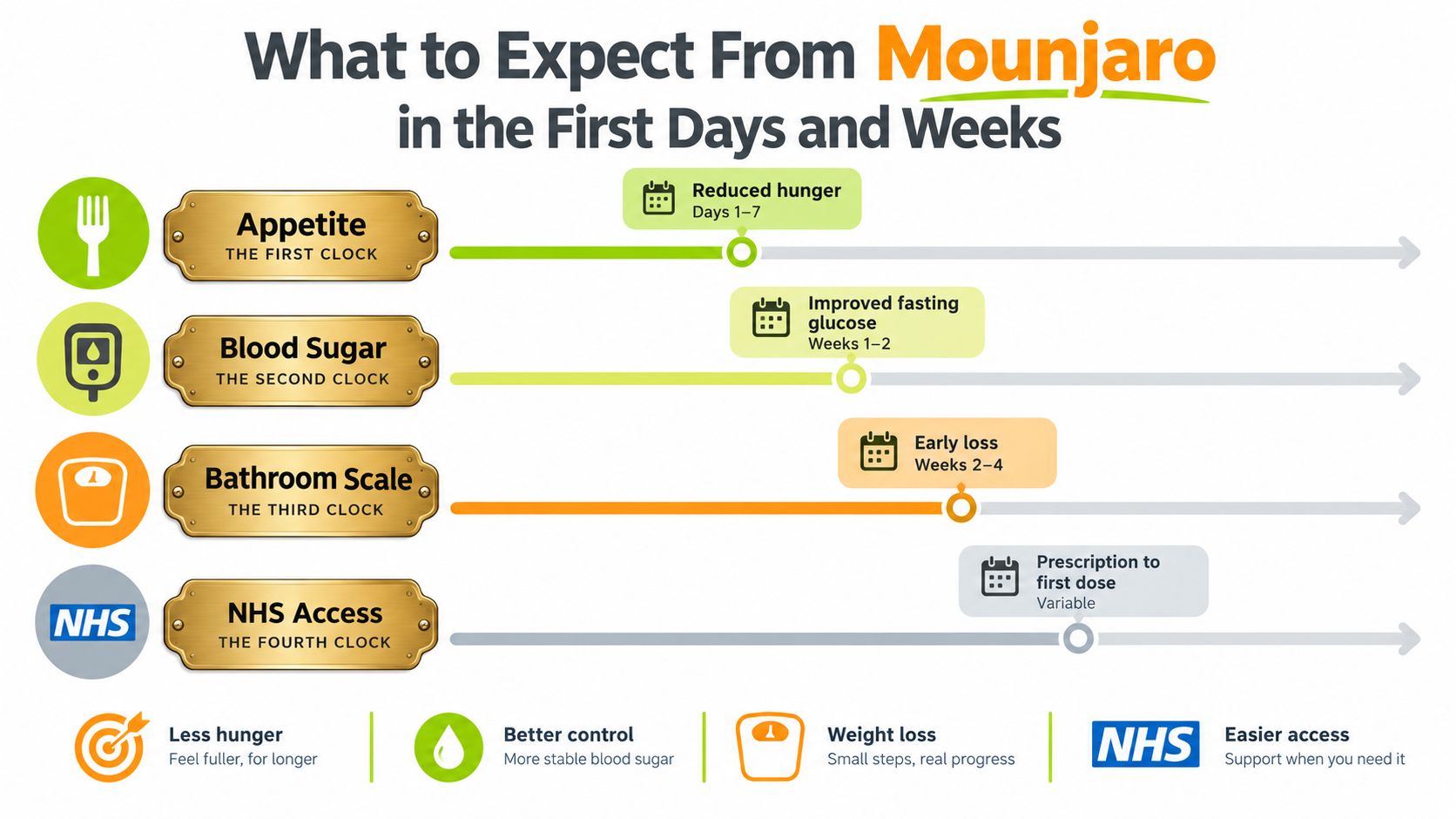
What to Expect From Mounjaro in the First Days and Weeks
A quiet bathroom scale after your first injection is common. Mounjaro has four different clocks, so “working” may mean less hunger, improved blood sugar, a changing weight trend, or progress through NHS access and assessment.
Tirzepatide acts on GIP and GLP-1 receptors, helping regulate appetite and blood sugar. It can also slow stomach emptying, which may make food feel more filling. Some people notice less interest in food within 24 to 48 hours, while others feel little difference initially. UK-facing Mounjaro timeline
Early fullness is an appetite and digestion effect, not proof that a large amount of body fat has already gone. During the first weeks, cravings may soften, portions may become smaller and meals may feel more satisfying. Weight can still fluctuate or remain unchanged because hydration, food intake and bowel movements affect the scale.
The initial 2.5 mg phase is mainly for tolerability. Cambridge University Hospitals notes that appetite and weight changes may take several weeks or months as the dose is increased. Cambridge University Hospitals patient information
Pharmacist's tip: Judge the first month by tolerance, hydration and routine, rather than the scales alone.
Use the technique supplied by your prescriber or pharmacist. The Mounjaro injection guide explains the practical steps for administering an injection.
The Mounjaro Dosing Schedule and Why It Moves Slowly
A person starting Mounjaro may expect the scale to respond immediately. The UK schedule is deliberately slower. It begins with 2.5 mg once weekly for four weeks, then moves to 5 mg once weekly. If suitable, later increases happen in 2.5 mg steps, with at least four weeks at each dose. This staged approach follows MHRA product guidance.
| Week range | Weekly dose | Purpose |
|---|---|---|
| Weeks 1 to 4 | 2.5 mg | Starter phase and tolerance |
| Weeks 5 to 8 | 5 mg | First regular treatment dose |
| Weeks 9 to 12 | 7.5 mg | Further adjustment if suitable |
| Weeks 13 to 16 | 10 mg | Higher treatment dose |
| Weeks 17 to 20 | 12.5 mg | Further step if prescribed |
| Week 21 onwards | 15 mg | Highest available dose, if suitable |
Your prescriber may keep you at one dose for longer, or reduce it if nausea, vomiting or other problems become troublesome. Never increase Mounjaro yourself. The pen delivers a set dose, so do not try to alter it.
The gradual schedule gives your gut and brain time to adjust. It can also make side effects easier to manage, helping you continue treatment safely. The starter dose is an introduction, not a test you pass or fail.
The full sequence takes months. NHS guidance explains that reaching 15 mg takes 20 weeks, so the dose clock is separate from the appetite, blood sugar and weight clocks you may be watching. NHS England information on obesity medicines
For practical questions about the pen, including what may happen around the fifth dose, read this guide to the Mounjaro fifth dose. Follow your own prescription rather than copying someone else's online schedule.
Blood Sugar Changes Versus Weight Loss on the Timeline
Mounjaro runs on several clocks, and they do not move together. Blood sugar may respond before your clothes fit differently or the scales show a clear trend. Tirzepatide supports insulin release and improves the body's response to insulin, which can help glucose readings change earlier.
If you have diabetes, your clinician checks blood glucose readings and blood tests to assess control. Do not stop insulin or another diabetes medicine because one home reading improves. Tirzepatide changes the balance between medicines, food and activity, so your diabetes team should guide any adjustment.
The appetite clock may move next. Feeling less hungry can reduce food intake, but changes in body fat build over repeated weeks. Sleep, movement, meal patterns and how well you tolerate the dose all affect the scale, so a quiet week does not automatically mean the treatment is failing.
The clearest weight outcomes in the NICE evidence base were reported at 72 weeks. At that point, mean body-weight change was -15.0% with 5 mg, -19.5% with 10 mg and -20.9% with 15 mg. These are trial averages, not a prediction for one person. NICE clinical-effectiveness evidence
What the UK stopping rule means
NICE guidance says treatment should be reconsidered or stopped if weight loss remains less than 5% of starting weight after six months on the highest tolerated dose. This is a UK prescribing and continuation rule, not a judgement on the first few weeks. NHS regional prescribing guidance
Use blood results to follow blood sugar and a longer trend to assess weight. Comparing week-two scales with someone else's later treatment result can create unnecessary worry. For practical meal ideas as appetite changes, see this Mounjaro diet guide.
Two Realistic UK Scenarios a Busy Parent and a Shift Worker
Aisha, a 42-year-old NHS administrator in Birmingham, gives her first injection on a Sunday evening. She wants to notice any early effects before the school run and a busy office week begin.
By Tuesday, food feels less urgent. She still eats, but snacks occupy less of her attention. After four weeks, the scale shows a modest change, and she moves to the next prescribed dose. Her appetite clock has moved before her scale clock, which is a common reason early progress can feel different from what online posts suggest.
Her routine gives her regular meal times. She packs a simple lunch, drinks regularly and records nausea after each injection. Her weight does not fall in a perfectly straight line. Comparing each week with her own starting point gives a clearer picture than comparing it with someone else's later result.
Mark, 46, works as an HGV driver in Leeds. He chooses a Friday rest day for his injection so he can monitor side effects before a long shift. When nausea becomes more troublesome during one mid-shift period, he contacts his prescriber instead of changing the dose himself.
Clinical advice leads him to adjust the injection day. His rota then changes again, so timing becomes harder to keep consistent. His scale moves more slowly than Aisha's, despite following the agreed schedule. Long shifts, irregular meals, tiredness and limited food choices all influence what he can manage from day to day.
Different routines can produce different experiences. The same prescribed schedule does not feel identical in every household.
Neither example predicts your response. A parent may have more regular meals but less sleep. A shift worker may find timing difficult before settling into a workable routine. At review, look at your dose, side effects, blood sugar or other health measures, and the longer weight trend. These are four separate clocks, and they do not always move together.
What Can Speed Up or Slow Down Your Response
A faster response is not always a better response. Mounjaro works through gradual dose increases, and trying to rush that process can worsen nausea without producing better long-term results.
Your four clocks may move at different speeds. Appetite can change before the scales do, while blood sugar readings may improve on their own timeline. NHS access and dose reviews add a separate practical clock, so online comparisons rarely show the whole picture.
Several factors affect how treatment feels and progresses:
- Starting body size: People begin at different weights, with different health conditions and energy needs. The same percentage change can look different in kilograms.
- Dose reached: Responses may change as the prescribed dose increases, but move up only when your prescriber says it is suitable.
- Missed injections: Irregular dosing can interrupt the treatment pattern. Ask a pharmacist what to do after a missed dose.
- Food quality: Smaller meals may feel easier. Include nourishing foods, protein, fibre and fluids where you can.
- Muscle-preserving movement: Walking supports general fitness. Resistance exercise may help maintain muscle during weight loss, if your health allows it.
- Sleep and stress: Poor sleep and high stress can make hunger and meal planning harder.
- Other medicines or health issues: Insulin, steroids, thyroid conditions and perimenopause can affect glucose, appetite or weight. Discuss these with your clinician rather than guessing.
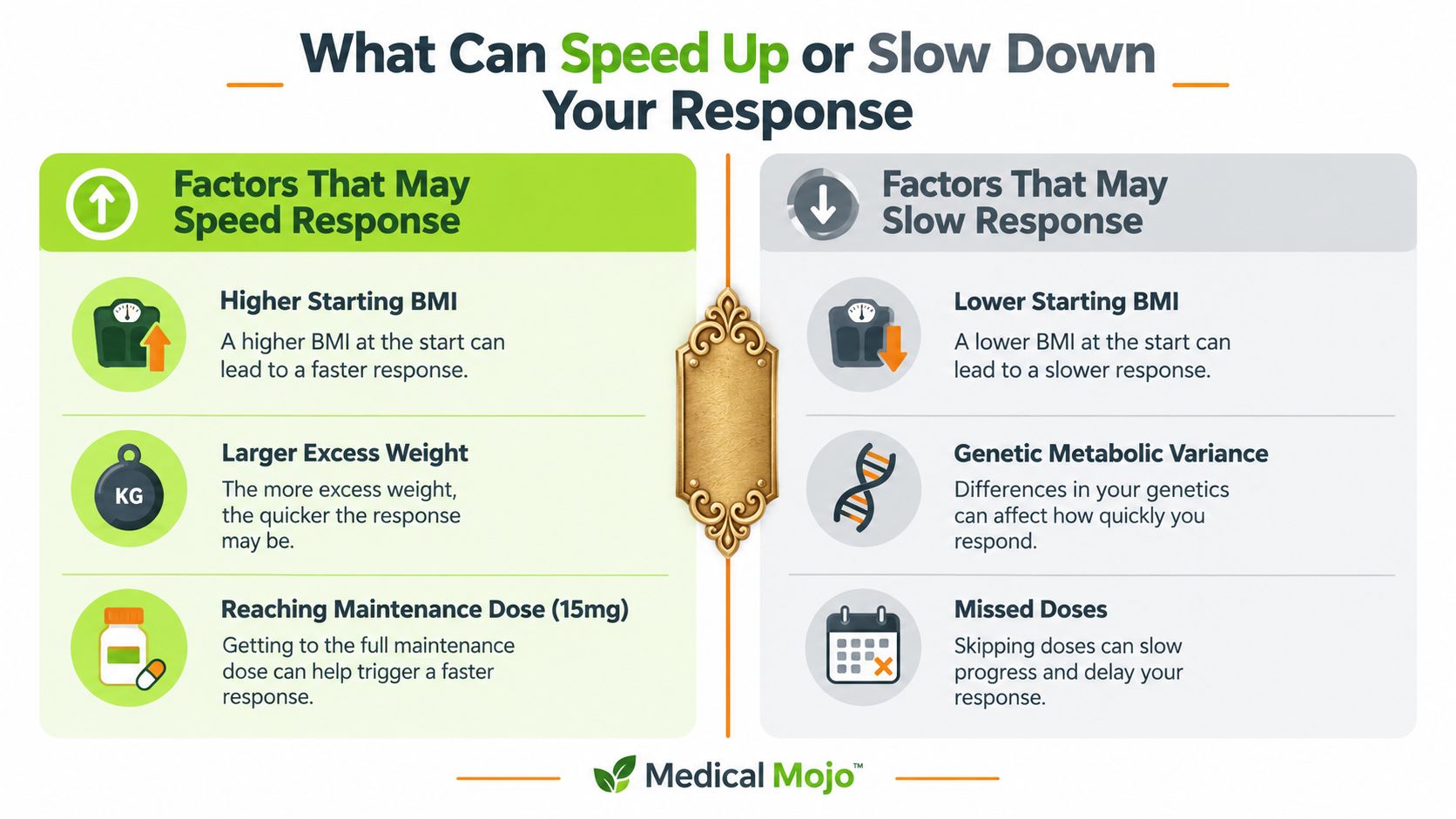
A higher starting weight may mean a larger change in kilograms, but it does not set a fair target for someone else. Your prescriber may keep the dose unchanged if side effects outweigh the benefit. If you take levothyroxine, discuss timing and monitoring with your clinician. The guidance on Mounjaro and levothyroxine can help you prepare questions.
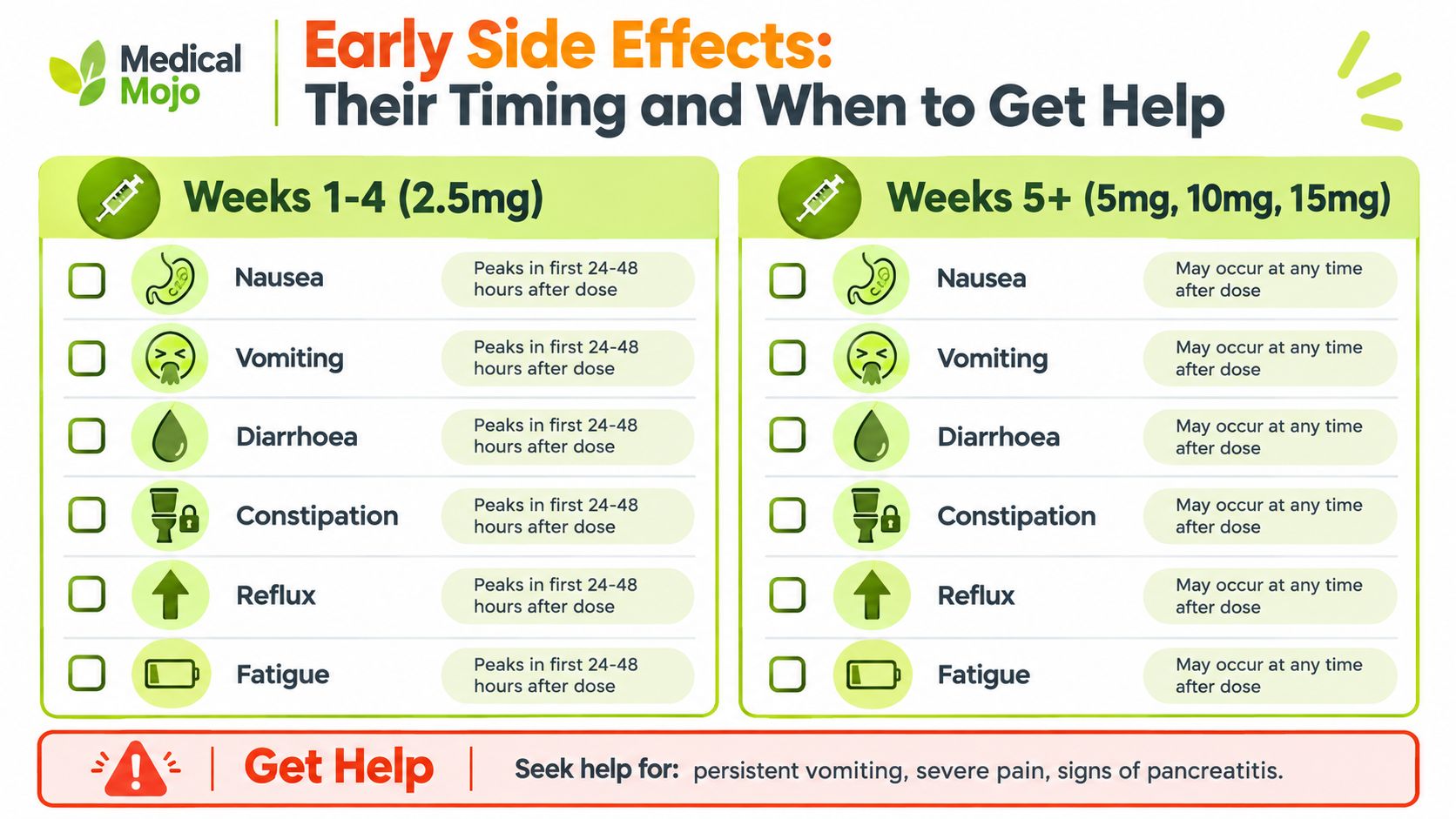
Early Side Effects Their Timing and When to Get Help
Nausea, vomiting, diarrhoea, constipation, reflux and tiredness can appear during the first days or weeks. They may also return after a dose increase, as your body adjusts to a stronger effect. Digestive symptoms are important to monitor during treatment, particularly if they affect food, fluids or daily activities.
Symptoms may begin around injection day or during the days that follow. Some people notice them later, while others have few or none. If side effects make it difficult to eat, drink or work, your prescriber may keep the dose unchanged for longer rather than increasing it automatically.
Practical steps for mild symptoms
Try these measures:
- Eat smaller meals: Stop when you feel comfortably full.
- Slow the pace: Eating quickly can worsen fullness and reflux.
- Choose plain food: Porridge, soup, toast or rice may feel easier during a rough spell.
- Drink steadily: Small, regular sips can help reduce the risk of dehydration.
- Avoid rich meals: Fatty or very large meals may be harder to digest.
- Track the pattern: Note the injection day, symptoms, food and fluids.
Ginger helps some people with nausea, but check with a pharmacist first if you take other medicines or have a condition that affects its use. Do not take anti-sickness medicine without checking with a pharmacist or prescriber.
When to seek urgent help
Contact your prescriber or NHS 111 urgently if you have:
- Severe, persistent abdominal pain: Pain spreading through to the back needs prompt assessment.
- Ongoing vomiting: Repeated vomiting can cause dehydration and may signal a serious problem.
- Dehydration signs: Very dark urine, faintness, confusion or being unable to keep fluids down require medical advice.
- Allergic reaction: Swelling of the face or throat, breathing difficulty or widespread hives needs emergency help.
- Sudden vision changes: Report sudden changes promptly, especially if you have diabetes.
Severe abdominal pain and persistent vomiting can indicate pancreatitis or gallbladder problems. They differ from mild, short-lived queasiness. For further practical guidance, read this advice on Mounjaro side effects.
Building Realistic Expectations and Following Up Safely
A quiet set of scales does not show the whole Mounjaro timeline. Appetite, blood sugar, body weight and NHS access each run on a different clock. A weekly plan helps you follow the right one rather than compare your progress with isolated online results.
A simple phase-by-phase guide
Weeks 1 to 4, the starter phase: Take 2.5 mg as prescribed. Learn the injection routine, eat slowly, drink enough and record symptoms. Feeling fuller is possible, while a large change on the scales may take longer.
Weeks 5 to 12, the building phase: Your prescriber may raise the dose at four-week intervals. Appetite and weight changes can become clearer, although symptoms may briefly return after an increase.
Week 13 onwards, the steadier phase: Your treatment team reviews the dose you tolerate, health measures and progress. Some people stay on a lower dose; others continue upwards under supervision.
Track more than weight
Record appetite, cravings, energy, clothing fit and waist comfort. If you have diabetes, record the glucose readings your diabetes team has asked you to check. One weigh-in is only a snapshot.
Take these notes to each review:
- Current dose: Include how long you have taken it.
- Side-effect diary: Note timing, severity, food and fluids.
- Food and movement notes: Keep them brief and honest.
- Other medicines: Mention recent changes.
- Questions: Write them down before the appointment.
Safe follow-up rule: Do not increase, reduce or stop Mounjaro because the scales seem unchanged. Speak with the prescriber managing your treatment.
A slow week can still fit a gradual response. Your clinician may review the dose, side effects, diabetes medicines or another health condition. The aim is a treatment plan you can use safely and assess properly, rather than the fastest possible result.
UK-Specific Questions About Access and Long-Term Results
There are four separate clocks to track: appetite, blood sugar, body weight and NHS access. The NHS clock can delay the first injection, even though tirzepatide starts acting after treatment begins. NHS England describes a phased approach through primary care and specialist services, with local guidance identifying priority groups. NHS England interim commissioning guidance
NICE planned for patients already using specialist weight management services to start within 90 days of final guidance publication, with people outside those services who had the highest clinical priority starting after 180 days. These timings describe NHS rollout, not how quickly Mounjaro changes appetite, blood sugar or weight. NICE local formulary information
Who may receive it through the NHS
Tirzepatide may be prescribed through different NHS routes, depending on whether it is being used for type 2 diabetes or weight management, and on local arrangements. Access may involve specialist weight management services, primary care or shared-care arrangements where these have been commissioned. Online popularity does not determine eligibility.
Private prescribing has its own assessment and monitoring process. A private pharmacy should review your medical history, current medicines, dose and suitability before supplying treatment. Avoid unregulated injections sold through social media or unknown websites, where the product and storage conditions may be uncertain.
What happens after the evidence window
NICE's weight-management evidence reports outcomes at 72 weeks. That gives clinicians a useful long-term trial window, but it cannot predict every person's lifelong response. Your prescriber should review benefit, side effects, health goals and whether continuing or stopping treatment is appropriate.
If you suspect a side effect, ask a healthcare professional about reporting it through the MHRA Yellow Card scheme. Do not stop prescribed diabetes treatment without medical advice.
For access or prescription questions, speak with your GP, specialist team or pharmacist. The answer depends on your diagnosis, local eligibility, other medicines and response, rather than another person's result online.
Courier Pharmacy offers online Mounjaro consultations. A pharmacist can review your health information, medicines and treatment options before prescribing. Visit Courier Pharmacy for a clinical assessment and follow-up support.
Summary
- Appetite may change within 24 to 48 hours, but weight loss usually takes longer.
- The first 2.5 mg dose mainly helps your body adjust.
- UK titration increases the dose every four weeks when suitable.
- Blood sugar and weight follow separate timelines.
- NICE reports the main weight evidence at 72 weeks.
- Don't change your dose without your prescriber.
- Seek urgent help for severe pain, ongoing vomiting, dehydration, allergy symptoms or sudden vision changes.
Frequently asked questions
How long does Mounjaro take to work for appetite?
Some people notice less hunger or earlier fullness within 24 to 48 hours of the first injection. Others need several weeks, especially while taking the starter dose. Early appetite change doesn't guarantee immediate weight loss.
How long does Mounjaro take to work for weight loss?
Noticeable weight loss often starts around weeks 4 to 6, while stronger results commonly build during later titration. NICE's evidence base measures mean weight change at 72 weeks, not after the first injection. NICE evidence
Is it normal not to lose weight during the first month?
Yes. The first four weeks usually use 2.5 mg, a starter dose intended to improve tolerance. A quiet scale during this phase doesn't usually mean the medicine has failed.
How long does Mounjaro take to work on blood sugar?
Blood sugar can improve before weight becomes obvious, but the timing varies. If you have diabetes, use the checks and blood tests agreed with your diabetes team. Don't change insulin or other diabetes medicines alone.
Can I stay on 2.5 mg?
Your prescriber decides how long you remain on each dose. UK guidance uses 2.5 mg as the starting dose, followed by increases in 2.5 mg steps after at least four weeks when suitable. Some people need a slower plan because of side effects.
What if Mounjaro causes nausea?
Try smaller, slower and plainer meals, with regular fluids. Rich food may feel worse around injection day. Speak with your prescriber if nausea persists, affects drinking or prevents normal activity.
When should I contact my prescriber about slow progress?
Contact them if you're worried, if side effects continue or if you can't follow the planned titration. UK guidance uses a later benchmark, less than 5% of starting weight after six months on the highest tolerated dose, when treatment may need reconsideration. UK prescribing guidance
Can I make Mounjaro work faster?
Don't increase the dose early or use supplements to chase faster results. Follow the prescribed schedule, eat nourishing meals, stay active if able and attend reviews. Faster weight loss isn't automatically safer or better.
What should I do if I have severe stomach pain?
Seek urgent medical advice for severe or persistent abdominal pain, particularly if it spreads to your back. Repeated vomiting, dehydration, allergic symptoms or sudden vision changes also need prompt help. These symptoms can signal a serious problem rather than routine adjustment.
Suggested Medical Mojo visuals
- Four-clock timeline: Use bright lime green, pale yellow-green, light grey and ornate brass plaques to show appetite, blood sugar, weight and NHS access. Alt text: “Four-track timeline showing how appetite, blood sugar, weight and NHS access can change during Mounjaro treatment.”
- Dose staircase: Show the weekly dose steps from 2.5 mg to 15 mg, with a brass plaque explaining the four-week pauses. Alt text: “Illustrated Mounjaro dose staircase showing gradual weekly titration.”
- Side-effect checklist: Use a lime and pale yellow-green checklist for mild symptoms, with a contrasting urgent-help plaque. Alt text: “Mounjaro side-effect checklist separating common symptoms from urgent warning signs.”
Internal links for related content
- How to inject Mounjaro
- The Mounjaro fifth dose
- The ultimate Mounjaro diet guide
- Mounjaro and levothyroxine
- Mounjaro side effects
Disclaimer
This article is for information only and isn't a substitute for medical advice. Speak with your GP, diabetes team, specialist prescriber or pharmacist before starting, changing or stopping Mounjaro.
How this content was created
This article used UK guidance from NICE, NHS England, MHRA and Cambridge University Hospitals, alongside the verified UK treatment timelines supplied for this topic. The content was organised for patient readability and checked to separate appetite, blood sugar, weight and access timelines. A qualified UK healthcare professional should review the final published version before clinical use.
References
- Cambridge University Hospitals. (n.d.) Your obesity treatment, tirzepatide, Mounjaro. Available online
- MHRA. (n.d.) Four-dose Mounjaro KwikPen approved by MHRA for diabetes and weight management. Available online
- NICE. (n.d.) Tirzepatide local formulary information, clinical effectiveness. Available online
- NHS England. (n.d.) Interim commissioning guidance for tirzepatide for the management of obesity. Available online
- FormBlends. (n.d.) How long does it take to lose weight with Mounjaro? Available online
- North West Knowledge Now. (2025) Tirzepatide prescribing guidance. Available online
- MHRA. (n.d.) Yellow Card scheme. Available online
Byline: Medical Mojo editorial team, patient education writers.
Clinical review: To be reviewed by a UK-registered pharmacist or prescriber before publication.


