How Quickly Does Laxido Work and What to Expect
Find out how quickly does Laxido work for constipation and faecal impaction, typical onset times, dosing tips, and when to contact your GP or NHS 111.

Laxido typically takes 1 to 2 days to work for constipation, although some people may need 2 to 3 days, and faecal impaction regimens can take up to 3 days. If you've taken a sachet and nothing has happened after 24 hours, that doesn't automatically mean the treatment has failed.
You may be checking the clock after every trip to the bathroom, especially if constipation has left you uncomfortable, bloated, or worried. Laxido works gradually, so understanding the expected timeline can help you avoid taking extra doses too soon or switching treatment without advice.
What to expect in the first few days of Laxido treatment
You have taken Laxido for constipation, but the next day brings no bowel movement. That can still be within the expected timeframe. Laxido contains macrogol 3350 with electrolytes, an osmotic laxative used in the UK for constipation and faecal impaction. NHS guidance says macrogol medicines usually take 2 to 3 days to work, while some UK hospital advice expects an effect within 1 to 2 days. Your response may be earlier or later within that range. The NHS explains how laxatives work and when to expect results.
For routine constipation, the medicine works gradually rather than directly making the bowel muscles contract. The stool becomes softer over time, so no result after 24 hours does not automatically mean treatment has failed.
A useful guide is:
- Expect a gradual effect: Laxido commonly works within 1 to 2 days, although 2 to 3 days may be needed.
- Separate the conditions: Routine constipation and faecal impaction have different treatment plans and timelines.
- Drink enough fluid: Macrogol uses water to soften stool and help it pass.
- Follow the prescribed dose: Use the instructions from your prescriber, pharmacist, or product leaflet. Do not add extra sachets because the first day has passed.
- Ask for advice when needed: Contact a GP or NHS 111 if you have not passed a normal stool within the advised timeframe.
Practical rule: No result after 24 hours can be normal. Severe pain, vomiting, or bleeding needs medical attention rather than more waiting or extra laxatives.
Your prescribed dose also affects the plan. UK formulary guidance commonly uses 1 to 3 sachets daily in divided doses for chronic constipation, usually for up to 2 weeks. A maintenance dose is often 1 to 2 sachets daily. The NHS Highland formulary provides this dosing framework.
For information about symptoms and treatment choices, read this guide to constipation treatment and support.
How Laxido works inside your bowel
You take Laxido in the morning, then wonder by lunchtime why nothing has happened. That can be normal. Laxido works gradually by drawing water into the bowel. Its active ingredient, macrogol, stays in the bowel and holds on to that water, increasing the water content of the stool so it becomes softer and easier to pass.
The process works like a dry sponge. Adding water slowly makes it softer and more flexible. Macrogol produces a similar change in hard stool, but the water needs time to mix through the bowel contents.

Why the effect isn't immediate
Senna and bisacodyl are stimulant laxatives. They encourage bowel muscle contractions. Laxido takes a different route, softening the contents first so the bowel can move them along more easily.
That is why Laxido may feel slow when you want quick relief. Its expected one to three-day timeframe reflects the way macrogol works, not treatment failure. UK hospital guidance explains the expected timing for Movicol and Laxido.
Each sachet also contains electrolytes, which help maintain normal sodium, potassium, and water levels while macrogol draws water into the bowel. Dissolve the sachet in water as directed. Do not swallow the powder dry.
Fybogel works through fibre rather than macrogol. Read about Fybogel plain sachets before changing your treatment.
Constipation versus faecal impaction timelines
You have taken Laxido for a day and still have not opened your bowels. That can be normal for routine constipation. It does not automatically mean the treatment has failed. The expected timeframe differs when hard stool has collected and caused faecal impaction.
With ordinary or chronic constipation, the aim is gradual softening. UK guidance commonly uses 1 to 3 sachets daily, divided into doses, for up to 2 weeks. The official leaflet advises medical review if chronic constipation has not improved after 14 days. The Laxido patient leaflet sets out these safety-netting points.
Faecal impaction needs a separate, higher-dose regimen. The usual adult course in the UK product leaflet is 8 sachets daily, taken within a 6-hour period, for up to 3 days. This intensive plan should only be used when prescribed or advised by a healthcare professional. Do not copy it for routine constipation.
Laxido timelines for constipation and impaction
| Scenario | Usual dose | Expected onset | Review point |
|---|---|---|---|
| Chronic constipation | 1 to 3 sachets daily, in divided doses | Usually 1 to 3 days, depending on response | Review if not improved after 14 days |
| Faecal impaction | 8 sachets daily within 6 hours | Intensive treatment over up to 3 days | Seek review if there's no improvement after 3 days |
The difference is the amount and location of stool being treated. Routine constipation may ease as stool gradually softens. Impaction can require an intensive, supervised course before the hard mass starts to clear, so “no result after 24 hours” is not necessarily unexpected.
Sachet counts are not a useful way to compare treatments. Someone taking eight sachets may be managing impaction, not ordinary constipation. If stool feels stuck low in the rectum, ask a pharmacist whether Micralax micro-enema is suitable rather than adding it yourself.
Real life examples of how Laxido works
A busy parent might start Laxido during a hectic school week. Skipped meals, limited drinks, and long periods in the car can all contribute to constipation. They take the prescribed sachet, dissolve it as directed, and keep suitable drinks nearby instead of waiting until the evening.
Relief within a couple of days can fit the usual pattern for routine constipation. Laxido needs time to draw water into the bowel and soften stool, so no bowel movement after the first day does not necessarily mean it has failed.
A shift worker may have a different routine. Night shifts can alter meals, sleep, and toilet access. They may delay going when the urge appears, then take Laxido at different times on different days.
A consistent schedule can make the treatment easier to follow. Taking each dose at the agreed time, drinking regularly during the shift, and allowing enough privacy for a toilet visit may help. These steps support treatment, but they cannot guarantee an immediate result, particularly where faecal impaction is involved.

What these examples show
People respond differently. Fluid intake, mobility, diet, other medicines, daily routine, and the type of constipation can all change how quickly relief is noticed. Someone with ordinary constipation may improve gradually, while impaction needs the treatment plan already discussed.
Do not increase your dose because another person improved sooner. Ask a pharmacist before adding a stimulant laxative, such as Dulcolax bisacodyl tablets.
Pharmacist tips to help Laxido work effectively
Pharmacist's tip one, make fluids part of the treatment
Laxido works by drawing water into the bowel, so regular fluids support the softening process. NHS safety-netting advice recommends an additional 1 litre of fluid daily while taking Movicol or Laxido, unless a clinician has told you to restrict fluids. This NHS-linked safety guidance explains the fluid advice and review point.
Spread drinks across the day. Water, squash, and other suitable drinks can count. Drinking the whole amount quickly is unlikely to make Laxido work sooner and may leave you feeling uncomfortable.
Pharmacist's tip two, keep your dosing routine simple
Take each sachet at the time shown on your label or treatment plan. A steady routine makes missed doses less likely and gives you a fair chance to judge the result, especially because routine constipation and faecal impaction do not follow the same timetable.
If bloating or discomfort follows a dose, ask a pharmacist whether the timing or dose needs checking. Do not change the schedule because you have not opened your bowels after one day.
Pharmacist's tip three, do not stack laxatives without advice
Taking extra Laxido is not a reliable shortcut. It can increase diarrhoea, bloating, or fluid problems. Avoid adding senna, bisacodyl, suppositories, or enemas unless a pharmacist or clinician has advised you. If another laxative has been prescribed, follow that plan rather than building your own combination.

Review your other medicines with a pharmacist, since some can contribute to constipation. If you are considering a stool-softening option, ask about Dioctyl docusate sodium capsules rather than starting them yourself.
When to seek help if Laxido is not working
No bowel movement after 24 hours does not show that Laxido has failed. Macrogol often needs several days to work, and NHS guidance on laxatives explains that macrogol may take several days. The expected timetable depends on the problem being treated.
For routine constipation, contact your GP or NHS 111 if you have not passed a normal stool within 3 days, especially if symptoms are getting worse. Do not take extra sachets while waiting for advice.
Different problems need different review points
Faecal impaction follows a different plan. Take the intensive dose only as directed by your clinician, and seek medical review if it has not improved after 3 days, as advised in the Laxido leaflet.
For chronic constipation, arrange a review if there is no improvement after 14 days. Your clinician may check whether the diagnosis, medicines, dose, fluid intake, or another cause needs attention.
Get urgent help: Severe abdominal pain, vomiting, a swollen abdomen, or rectal bleeding needs prompt medical assessment. Call NHS 111 for urgent advice, or call 999 for a life-threatening emergency.
Do not use Laxido to postpone assessment if symptoms could indicate a blockage or another serious problem. A pharmacist can help with mild constipation, while severe or unusual symptoms need clinical review.
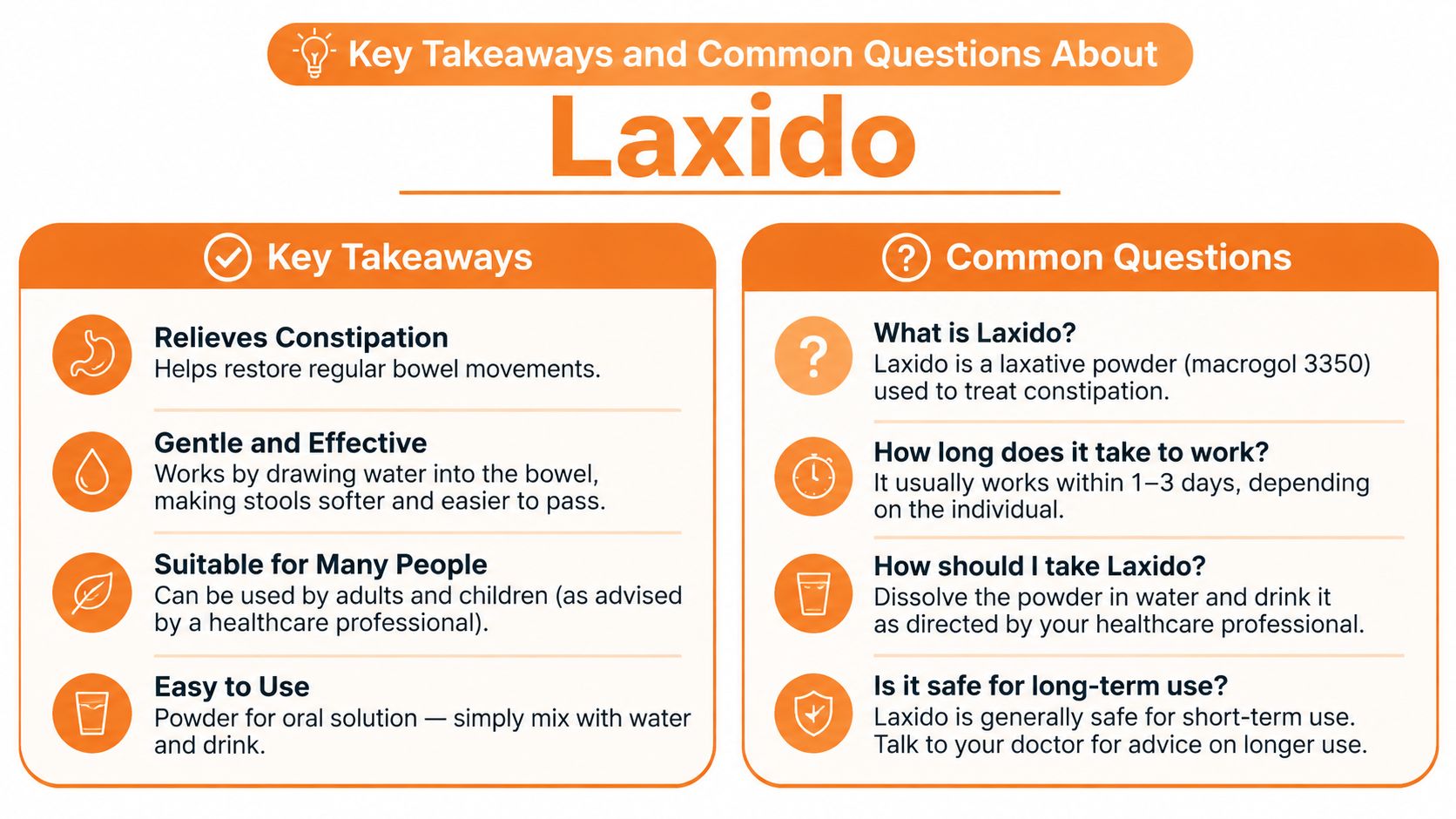
Key takeaways and common questions about Laxido
You take Laxido in the evening, hoping for a bowel movement by morning, but nothing happens. That can still be expected. Laxido usually works gradually over 1 to 2 days, although some people need 2 to 3 days. The timing depends on whether you are treating routine constipation or faecal impaction.
Laxido contains macrogol, which draws water into the bowel and softens hard stool. It works more like adding moisture to dried clay than triggering a sudden squeeze, so a result after 24 hours is not guaranteed.
Routine constipation and faecal impaction need different doses, instructions, and review points. Take only the amount recommended for your situation, drink the advised extra fluid unless you have a fluid restriction, and follow the instructions on your label or patient leaflet.
Does Laxido work overnight?
It can, but do not plan around an overnight bowel movement. Laxido may work during the day or night because its effect builds gradually. If you have routine constipation, no result after the first night does not automatically mean the treatment has failed.
Faecal impaction is different. It involves a larger amount of stool that has become stuck, so the treatment plan may use a higher, intensive dose under clinical direction. Do not copy an impaction schedule for ordinary constipation.
Is Laxido suitable for long-term use?
Some people use macrogol as part of a longer constipation plan. The right dose and duration depend on the cause of constipation, your medicines, and your general health. Arrange a review if constipation continues or Laxido stops helping, rather than increasing the dose yourself.
Is Laxido faster than stimulant laxatives?
Laxido usually acts more gradually because it softens stool by bringing water into the bowel. Stimulant laxatives work in a different way and may suit some situations, but a pharmacist can help you choose an option based on your symptoms and when you need relief.
Does Laxido cause cramps?
Bloating, wind, or loose stools can happen. These effects may be more noticeable if the dose is higher than needed. Severe or worsening abdominal pain is different from mild wind or bloating and needs medical advice.
What should I do if I miss a dose?
Check your label or patient leaflet for instructions. Take the next dose as advised, and do not double it unless a healthcare professional specifically tells you to.
Can I take Laxido with other laxatives?
Do not combine laxatives without checking first. Different products may be used together in selected circumstances, but the combination, dose, and timing should match the problem being treated. A pharmacist or prescriber can check this safely.
Seek help promptly for severe abdominal pain, vomiting, a swollen abdomen, or rectal bleeding. If Laxido has not helped within the timeframe given for your treatment, contact your GP, pharmacist, or NHS 111 rather than taking extra sachets without advice.
Disclaimer: This article is for information only. It is not a substitute for personalised medical advice, diagnosis, or treatment.
Suggested visuals for the designer:
- A five-step bowel process diagram using bright lime green, pale yellow-green, light grey, and ornate brass plaque overlays. Alt text: “Five-step diagram showing how macrogol draws water into stool.”
- A painterly kitchen scene showing a person preparing a Laxido drink beside a glass of water. Alt text: “Person preparing dissolved Laxido with water.”
- A steampunk-inspired pharmacist tips panel with brass icons for fluids, timing, dosing, and safety. Alt text: “Pharmacist tips for using Laxido safely and effectively.”
- A pale yellow-green summary card comparing routine constipation with faecal impaction. Alt text: “Laxido timeline comparison for constipation and faecal impaction.”
Meta description: How quickly does Laxido work? Learn when to expect relief, how constipation differs from impaction, fluid advice, and when to seek NHS help.
Byline: Written by the Medical Mojo editorial team, patient health education writers.
Clinical review: Clinically reviewed by a UK-registered pharmacist.
How this content was created: We checked the timing, dosing, fluid advice, and safety-netting information against NHS guidance, UK hospital guidance, the NHS Highland formulary, and the official Laxido patient leaflet. The article was then reviewed for clear UK patient language and safe signposting.


