How to Delay Your Period Safely and Effectively in the UK
Discover how to delay period for a holiday or event. Learn about UK-approved methods like Norethisterone and the combined pill, with safe advice.
In this article
- Five Key Takeaways
- How do period delay tablets work?
- Using Norethisterone 5mg tablets
- Using your combined contraceptive pill
- What are my period delay options?
- Is it safe to delay my period?
- When to avoid period delay medication
- Other health conditions to consider
- What to expect when delaying your period
- Common side effects
- What about breakthrough bleeding?
- When will my period come back?
- How to get period delay treatment in the UK
- The modern alternative: using an online pharmacy
- How to stay safe when ordering online
- Summary
- FAQs about delaying your period
You can safely delay your period with prescription-only medication, such as Norethisterone tablets, or by using your combined contraceptive pill back-to-back. This is a common and straightforward choice for managing your cycle around holidays, special events, or for personal convenience. The best method depends on whether you are already using hormonal contraception. This guide explains how each option works, the potential side effects, and how to get treatment safely in the UK, so you can make an informed decision with your healthcare provider.
Five Key Takeaways
- Two Main Methods: You can delay your period with Norethisterone tablets (if not on the pill) or by taking combined contraceptive pill packs back-to-back.
- Prescription is Essential: Both methods require a prescription after a healthcare professional assesses your medical history to ensure it's safe for you.
- Timing is Crucial: For Norethisterone to work, you must start taking it three days before your period is due.
- Norethisterone is NOT a Contraceptive: You must continue to use other forms of contraception, like condoms, to prevent pregnancy while taking it.
- Safety First Online: When ordering online, always use a regulated UK pharmacy. Look for the GPhC green cross logo to verify its legitimacy.
How do period delay tablets work?

Choosing to postpone your period is a decision many people make for all sorts of reasons. You might have a religious festival, a sporting event, or a long-awaited holiday coming up. The process is safe for most people, but the right method for you depends on your current contraception.
The two main prescription methods work by managing your body's hormones. They keep your progesterone levels high, which stops your womb lining (the endometrium) from shedding. This tricks your body into thinking it isn't time for a period.
Using Norethisterone 5mg tablets
If you don't use a combined contraceptive pill, a prescriber may recommend a medication called Norethisterone. This is a man-made version of the hormone progesterone.
Normally, your progesterone levels drop just before your period, signalling your womb lining to break down. Norethisterone keeps these levels artificially high, which stops your period from starting. You must start taking one 5mg tablet three times a day, three days before your period is expected.
Featured Snippet Answer: Norethisterone is a prescription-only tablet that works by keeping your progesterone levels high, which prevents your womb lining from shedding and thus delays your period.
Pharmacist's tip: "Timing is everything with Norethisterone. If you start it a day or two before your period is due, it's often too late to work. I always advise people to set a calendar reminder so they don't forget to start on the correct day."
You can take the tablets for up to 17 days, which gives you a total delay of around 20 days. Once you stop taking them, your period should arrive two to three days later.
Real-life example: A busy parent we helped was dreading her period clashing with a family holiday. She got a prescription for Norethisterone, started the tablets three days before her trip, and enjoyed a week on the beach without cramps. Her period returned a couple of days after she got home.
Using your combined contraceptive pill
If you are already on a combined contraceptive pill, delaying your period is much simpler. Instead of taking the usual seven-day break (or dummy pills), you just continue taking the active pills. This keeps your hormone levels steady, preventing the "withdrawal bleed" that happens during the break.
How you do this depends on your pill type:
- Monophasic 21-day pills: Finish one pack and start the next one the very next day, with no break.
- Phasic 21-day pills: These have different hormone doses in each pill. Talk to a pharmacist about the best way to run these packs together.
- Everyday (ED) pills: These packs have 21 active pills and 7 inactive (placebo) ones. Simply skip the placebo pills and start the active pills in your new pack.
Real-life example: A university student had final exams that clashed with her period. She knew from experience that painful cramps would be a huge distraction. Since she was on a monophasic combined pill, we advised her to start her next pack immediately. This allowed her to focus on her exams without period worries.
What are my period delay options?
To help you get a clear picture, here's a quick look at the two primary options. This table breaks down the essential differences. If you're considering ordering online, our guide on how ordering treatment works at Medical Mojo can help you feel confident.
| Feature | Norethisterone (Period Delay Tablets) | Combined Contraceptive Pill |
|---|---|---|
| Who it's for | People not using hormonal contraception. | People already taking a combined pill. |
| How it works | Keeps progesterone high to prevent womb lining shedding. | Prevents the hormone drop that triggers a withdrawal bleed. |
| How you take it | One tablet three times a day. | Take two pill packets back-to-back without a break. |
| When to start | Start 3 days before your period is due. | Start the new pack the day after you finish your current one. |
| Contraception? | No, it does not act as a contraceptive. | Yes, you remain protected against pregnancy. |
| Common side effects | Bloating, mood changes, breast tenderness. | Possible breakthrough bleeding or spotting. |
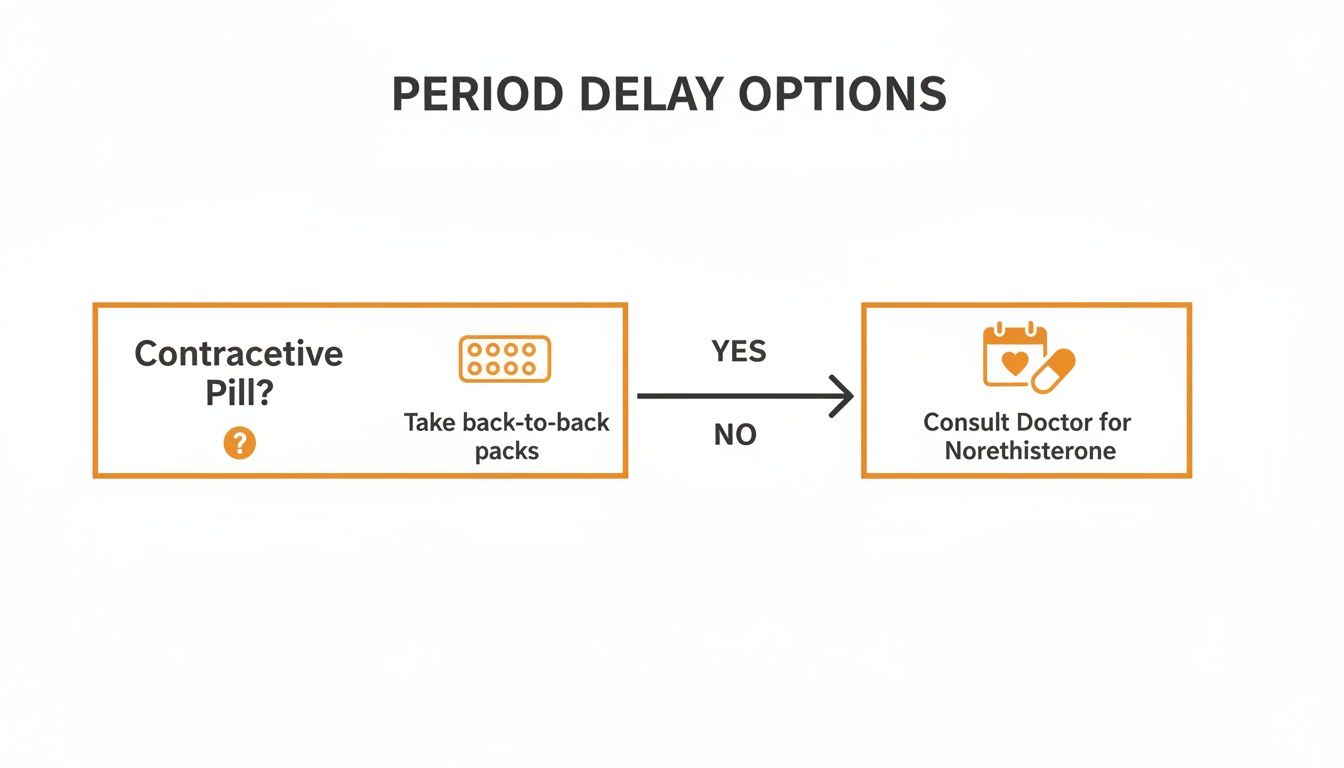
As the flowchart shows, your current contraception is the starting point for figuring out the safest method for you. For those not on hormonal contraception, exploring Norethisterone 5mg tablets with a healthcare professional is an excellent first step.
Crucial Safety Point: Norethisterone is not a contraceptive. If you are sexually active, you must use another form of contraception, such as condoms, to prevent pregnancy.
Is it safe to delay my period?
For many people, delaying a period is a safe and effective choice. However, your safety always comes first. These medications are not a one-size-fits-all solution, which is why a consultation with a prescriber is essential. A clinician must review your full medical history to ensure the treatment is safe for you.
When to avoid period delay medication
Certain health conditions are reasons not to take period delay medication like Norethisterone. A prescriber cannot give you a prescription if you have a personal or family history of specific issues.
These include a history of:
- Blood clots (e.g., DVT in your leg or pulmonary embolism in your lung)
- Hormone-sensitive cancers (e.g., breast cancer)
- Active or severe liver disease
- Unexplained vaginal bleeding (this needs investigating first)
These conditions mean the medication could be dangerous for your health. For example, the hormones in period delay tablets can slightly increase your risk of blood clots. This is a serious concern if you are already at high risk.
Other health conditions to consider
You must tell your doctor or pharmacist about any other ongoing health issues. For example, Norethisterone is generally not recommended if you are breastfeeding.
If you have diabetes, high blood pressure, or migraines, a prescriber will need to weigh the pros and cons carefully. It is also important to mention if you have a history of depression, as hormonal changes can sometimes affect your mood.
Pharmacist's tip: "Be completely honest on your medical questionnaire. We ask these questions for your safety. Something that seems minor to you, like a family member having a blood clot years ago, is critical information for us to make the safest decision for you."
What to expect when delaying your period
So, what does delaying your period actually feel like? Knowing what to expect can make the experience smoother. For most people, any side effects are minor and worth the convenience.
Common side effects
Whether you take Norethisterone or run your pill packs together, you are keeping your hormone levels elevated. This can sometimes cause temporary side effects.
With Norethisterone, you might notice:
- Bloating or water retention
- Breast tenderness
- Slight mood changes
- Minor skin breakouts or acne
- Mild nausea
These symptoms are usually mild and settle down as your body adjusts. They are similar to side effects from other progestogen tablets, like Provera. You can read more about Provera 10mg tablets to understand its uses.
Featured Snippet Answer: Side effects of period delay tablets can include bloating, breast tenderness, mood changes, and nausea, but these are typically mild and temporary.
What about breakthrough bleeding?
If you use your combined contraceptive pill to skip a period, you might get breakthrough bleeding or spotting. This is more likely if you run several packs together. It's usually very light bleeding and is not a cause for concern.
When will my period come back?
This is a very common question. After you stop taking Norethisterone, your period should arrive within two to three days. Your first period might be slightly different, but your cycle should quickly return to its regular pattern.
How to get period delay treatment in the UK
Getting the right treatment in the UK is straightforward. You can either visit your GP or use a regulated online pharmacy like Medical Mojo.
Booking a GP appointment can be tricky around work and other commitments. When you need to delay a period for a specific date, this can add extra pressure.
The modern alternative: using an online pharmacy
For many, a regulated digital pharmacy is a more discreet, efficient, and often faster way to get treatment. The process is safe and simple.
You fill out a confidential online questionnaire covering your medical history. A qualified UK-based clinician reviews your answers to check the treatment is safe for you. If approved, the medication is posted directly to you in plain packaging.
Real-life example: Sarah, a nurse working unpredictable night shifts, realised her period was due during a planned city break. Getting a GP appointment around her rota was impossible. She used our online service, completed the questionnaire after a shift, and her prescription for Norethisterone was approved the next morning. The medication arrived two days later.
How to stay safe when ordering online
When buying any medication online, you must ensure the service is legitimate.
Pharmacist's tip: "Always check an online pharmacy’s credentials. Look for the green GPhC (General Pharmaceutical Council) logo on their website. Clicking it should take you to the official GPhC register to verify the pharmacy's registration. This guarantees you are dealing with a regulated UK healthcare provider."
Choosing a trusted service like medicalmojo.co.uk means you get convenient digital access without compromising on safety or quality of care.
Summary
In summary, you can safely and effectively delay your period in the UK using prescription medication. The two main methods are taking Norethisterone tablets or running combined contraceptive pill packs together. Norethisterone is for those not on hormonal contraception and must be started three days before a period is due. Importantly, it is not a contraceptive. Running pill packs back-to-back is a simple option for those already on the combined pill. A consultation with a healthcare professional is essential to ensure the chosen method is safe for your personal medical history. You can get a prescription from your GP or a regulated online pharmacy.
FAQs about delaying your period
1. How long can I safely delay my period for? With Norethisterone 5mg tablets, you can safely delay your period for up to 17 days. This gives you a total of 20 days of cover, as you start taking it three days before your period is due. If using the combined pill, you can often run packs together for two or three months, but check with your prescriber.
2. Can you delay your period every month? It is not recommended to use Norethisterone every month, as it can disrupt your natural cycle. If you need to manage your periods regularly, speak to a doctor about long-term options like the combined contraceptive pill, which can be taken back-to-back more frequently.
3. Does Norethisterone affect fertility? No, there is no evidence that short-term use of Norethisterone for period delay has any long-term effect on your fertility. Your cycle and fertility should return to normal soon after you stop taking the tablets. Remember, it is not a contraceptive.
4. What if my period starts while taking the tablets? If you get light spotting, you can continue taking the tablets. If you start a full, heavy bleed, the medication is unlikely to work. In this case, it is best to stop the tablets and let your period happen. This is more likely if you miss a dose or start the tablets too late.
5. Is it safe to delay my period on holiday? Yes, it is safe for most people. For long-haul flights, it is important to reduce the small increased risk of blood clots (DVT). Stay hydrated, move around the plane, do leg exercises, and consider flight socks. Mention your travel plans to your prescriber.
6. What happens if I miss a dose of Norethisterone? If you remember within a few hours, take the missed tablet immediately and your next one at the usual time. If it is nearly time for your next dose, skip the missed one and continue as normal. Do not take a double dose. Missing a tablet can make it less effective.
Disclaimer: This article is for informational purposes only and should not be considered a substitute for professional medical advice, diagnosis, or treatment. Always seek the advice of your doctor or another qualified health provider with any questions you may have regarding a medical condition.
About the author Dr. Sarah Jarvis MBE, FRCGP is a General Practitioner and Medical Writer. She is the Clinical Director of Patient.info and a familiar face to many as the resident doctor on The One Show and Good Morning Britain.
Clinically reviewed by Scott McDougall, MPharm, is the Co-founder and Clinical Lead at Medical Mojo. With over a decade of experience as a pharmacist, he is passionate about making healthcare accessible and understandable for everyone.
How we create our content The medical content at Medical Mojo is written and reviewed by qualified UK healthcare professionals. We use reliable sources like the NHS, NICE, and peer-reviewed journals to ensure our information is accurate, evidence-based, and patient-friendly. You can learn more about our content creation process here.
References [1] NHS (2022). How can I delay my period? [online] nhs.uk. Available at: https://www.nhs.uk/common-health-questions/womens-health/how-can-i-delay-my-period/ [2] National Institute for Health and Care Excellence (2023). Norethisterone. [online] NICE. Available at: https://bnf.nice.org.uk/drugs/norethisterone/ [3] Faculty of Sexual and Reproductive Healthcare (2019). FSRH Guideline: Combined Hormonal Contraception. [online] FSRH. Available at: https://www.fsrh.org/standards-and-guidance/documents/combined-hormonal-contraception-guideline-2019/
Meta description Thinking about how to delay your period for a holiday or event? Learn about safe and effective UK options like Norethisterone and the combined pill.


