How to Get Tested for Herpes A UK Guide
Confused about how to get tested for herpes in the UK? Our guide covers NHS, private, and home tests, explaining window periods, costs, and how to read results.
SEO brief
- Primary keyword: how to get tested for herpes
- Secondary keywords: herpes test UK, herpes swab test, private herpes testing, home herpes test, NHS sexual health clinic
- Search intent: Informational with practical decision-making for UK patients choosing between NHS and private testing
- Target reader: UK adult who may have symptoms, recent partner exposure, or wants to understand testing options
- Product/service mention (if any): Assumed neutral educational article with a light, end-only mention of Courier Pharmacy
- Internal links available: Assumed from brief and included where required
If you've got sores or blisters, the best way to get tested for herpes in the UK is to go to an NHS sexual health clinic for a swab test, ideally within 48 hours because PCR swabs have over 95% sensitivity when taken early [1]. If you don't have symptoms, a blood test may be considered after a partner exposure, but routine screening without symptoms usually isn't advised because blood tests can give false positives [1].
Finding a possible herpes symptom can make your stomach drop. It's common to want the same things straight away. A clear answer, a private route, and a plan that doesn't waste time. The good news is that testing is usually simple once you know which test fits your situation.
This guide explains how to get tested for herpes in the UK, what type of test works best, where to go, what happens at the appointment, and how to weigh up free NHS care against faster private options. The aim is simple. Help you act quickly and avoid the common mistakes that lead to unhelpful results.
H1 How to Get Tested for Herpes A Complete UK Guide
Herpes is common, and you're not unusual for needing a test. In the UK, genital herpes affects around 1 in 7 people aged 16 to 44 [1]. Testing matters most when you have blisters, sores, ulcers, or a fresh outbreak that can be swabbed.
Five key takeaways:
- Act early: A fresh sore is the best chance to get a useful swab result [1].
- Choose the right test: PCR swabs are for symptoms. IgG blood tests are for selected cases without symptoms [1][2].
- Don't rely on routine screening: UK guidance doesn't usually advise it if you have no symptoms [1].
- Free vs fast matters: NHS clinics are free and confidential. Private routes may be quicker, but timing still matters more than speed alone [4].
- A negative test isn't always final: If timing was poor or the lesion had already healed, you may need clinical advice about whether to repeat testing [3].
When and why should you get tested for herpes
The main reasons to get checked
Get tested if you have new blisters, sores, ulcers, or a painful rash around the genitals, buttocks, or nearby skin. The same applies if you notice tingling or irritation and then a sore appears soon after. A fresh lesion gives the lab the best chance to find the virus [1].
Another common reason is partner disclosure. If a current or recent partner tells you they have herpes, that doesn't mean you've definitely caught it. It does mean it's worth getting advice about the best test and the right timing.
Practical rule: If you can see a new sore, don't wait for it to crust over before asking for help.
In the UK, genital herpes affects approximately 1 in 7 people aged 16 to 44, so this is a very common reason for attending sexual health services, not something unusual or shameful [1].
Why routine screening is not standard
People often assume they should ask for "the full STI screen" including herpes. That sounds sensible, but herpes is different. The NHS and BASHH mainly recommend testing for people with symptoms because the most reliable test is a PCR swab from a lesion [1].
Routine testing without symptoms isn't usually advised because blood tests can be inaccurate in low-prevalence settings, including false positives that may cause unnecessary worry [1]. If you've seen an online panel that offers a herpes blood test for everyone, that's a point to pause and ask whether it fits your situation.
Here's a simple explanation:
- You have a sore now: swab it.
- You have no sore, but a partner has herpes: ask a clinician whether a blood test is appropriate later on.
- You have no symptoms and no specific exposure: routine herpes screening usually isn't the best use of testing.
A few situations where testing is more urgent
Some people should seek help sooner rather than later.
- Painful first outbreak: New symptoms can feel intense and treatment works best when started promptly.
- Pregnancy concerns: Speak to your midwife, GP, or sexual health clinic for individual advice.
- Weakened immune system: Get assessed promptly if you develop suspicious sores.
- Trouble passing urine or severe pain: Ask for urgent medical help.
Pharmacist's tip: Don't self-treat a possible herpes outbreak for days with random creams while waiting to "see what happens". If the lesion changes quickly or starts healing, you can lose the best testing window.
Featured answer
Should I get tested for herpes if I have no symptoms?
Usually not as a routine screen in the UK. If you have a known partner exposure, ask a clinician whether a type-specific IgG blood test is appropriate later on [1].
Understanding the different types of herpes tests
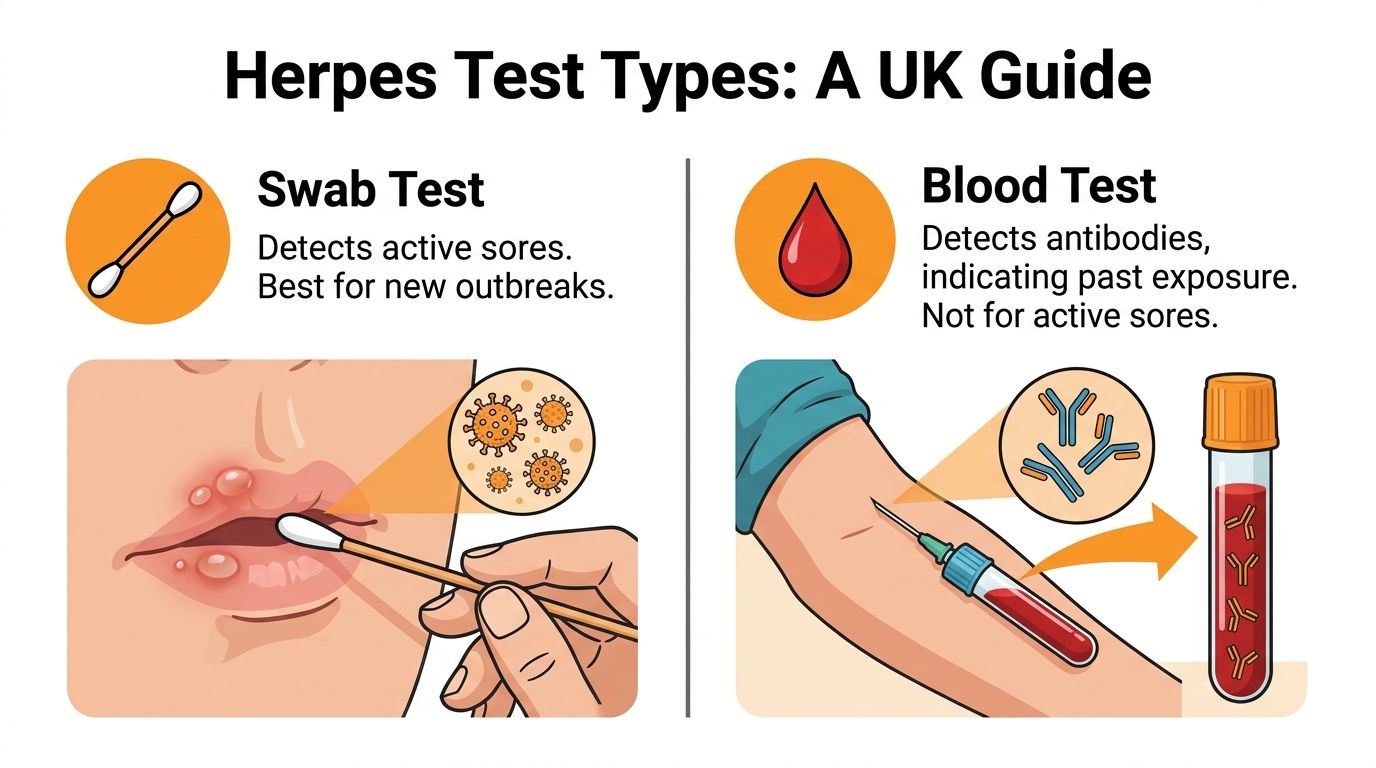
The main choice is between a swab test and a blood test. They answer different questions. One looks for the virus in a sore. The other looks for your body's antibodies after exposure.
PCR swab tests
A PCR swab is the best test when you have an active lesion. The sample is taken from a fresh blister or ulcer. PCR testing detects viral DNA directly and has over 95% sensitivity when the swab is taken early [2].
Modern PCR swabs replaced older culture methods as the mainstay of accurate diagnosis after their introduction around 1990, and they perform far better than older viral culture approaches [2].
The timing matters as much as the test itself. A swab works best when the lesion is fresh. If the sore has dried, crusted, or healed, the chance of a false negative rises sharply.
IgG blood tests
A type-specific IgG blood test looks for antibodies rather than the virus itself. That means it isn't the right test for a new visible sore. It may help in some people without symptoms, especially after a known partner exposure, but it has limits [2].
Type-specific IgG tests have specificity of 81% to 99% in the validated UK data cited in the brief [2]. That sounds reassuring, but in real practice it still means some people get false positive or indeterminate results, which is one reason routine use is avoided [1][2].
The other issue is timing. Antibodies take time to appear. The verified data states that testing is generally deferred until 12 to 16 weeks post-exposure for more reliable seroconversion [1].
A blood test can tell you about past exposure. It can't tell you whether a current sore is herpes if there is something there to swab.
Herpes test comparison PCR Swab vs IgG Blood Test
| Feature | Swab Test (PCR/NAAT) | Blood Test (Type-Specific IgG) |
|---|---|---|
| Best used for | Active sores or blisters | No visible symptoms, selected cases after exposure |
| What it detects | HSV DNA from the lesion | Antibodies made by your immune system |
| Best timing | Ideally within 48 hours of symptom onset [3] | Usually after the antibody window period [1] |
| Main strength | Most accurate way to confirm an active outbreak [1][2] | Can help when there are no lesions to swab |
| Main limitation | Less useful once lesions crust or heal [3] | False positives and indeterminate results can happen [1][2] |
| Routine screening use | Yes, if symptoms are present | No, not usually for asymptomatic people [1] |
What works and what does not
What works:
- Fresh lesion plus prompt swab
- A clinic review when you're not sure what the rash is
- Waiting for the right blood test window after exposure
What doesn't work well:
- Swabbing a healed lesion
- Buying a random online antibody test too early
- Assuming every STI panel is useful just because it is broad
Pharmacist's tip: Be cautious with online tests that promote IgM herpes testing. UK practice focuses on type-specific IgG where blood testing is used. If a provider doesn't make that distinction clear, I would be wary.
For people comparing private diagnostics more broadly, this guide to genomic testing in the UK and NHS versus private routes shows the wider trade-off between convenience, speed, and choosing a regulated service.
Your UK testing options where to get a test
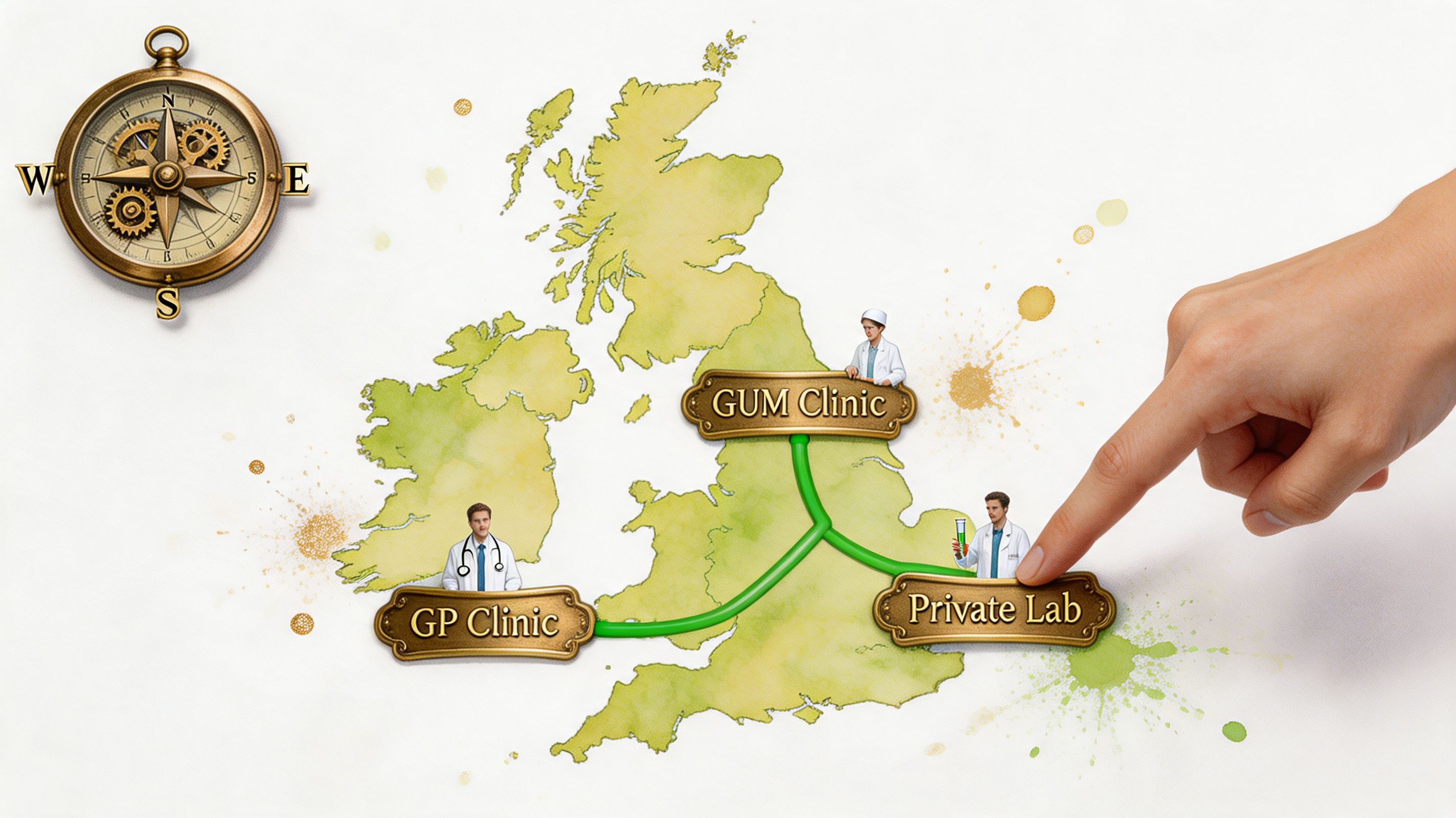
You have four realistic routes in the UK. The best one depends on whether you have symptoms now, how quickly you need an answer, and how private you want the process to feel.
NHS sexual health clinics
For individuals experiencing symptoms, an NHS sexual health clinic is the best first step. These clinics are free and confidential, and the verified data notes there are over 200 sites nationwide [1]. Staff see genital symptoms every day, so you're unlikely to shock anyone.
If you have a fresh sore, this route usually gives you the most appropriate assessment. It also means you can discuss treatment and other STI testing in one visit if needed.
GP private clinic or home test
A GP can help, especially if you aren't sure whether the sore is herpes or something else. Some GPs will assess and advise, while others may refer you to sexual health services for the actual testing.
A private clinic may suit you if you want a faster appointment or cannot get to an NHS clinic easily. The trade-off is cost, and the brief does not provide verified UK price data, so it's best to check directly with the provider.
A home test can be useful for privacy and convenience, especially for blood sampling when there are no lesions to swab. Some regulated services also offer home blood collection options. If you're comparing options, home blood test kits in the UK are one example of how private testing is set up.
The big practical point is this. Private is only better if it gets the right sample at the right time. The verified data highlights that swabbing a crusted lesion can lead to false negatives in 70% to 80% of cases [4].
Speed helps. Correct timing helps more.
Two real-life examples
Sarah, a busy parent
Sarah notices a painful sore on a Saturday morning and wants to avoid sitting in a waiting room with her toddler. Her best move is still to seek same-day or next-day clinical help while the sore is fresh. If she can get an NHS sexual health appointment quickly, that's ideal. If not, a private clinic may be worth it because the testing window matters.
Tom, a shift worker
Tom's former partner messages to say they have herpes. He has no symptoms. He books a confidential sexual health appointment to talk through whether testing makes sense now or later. In his case, the smart choice may be advice first, rather than rushing into a blood test too early.
How to choose the route that fits you
- You have a fresh lesion today: Prioritise the fastest route to a proper swab.
- You have no symptoms but known exposure: Seek advice before ordering any test.
- You want privacy: Home sampling may feel easier, but make sure the provider is regulated.
- You want the lowest cost: NHS services are free.
Pharmacist's tip: If you use an online pharmacy or private testing service, check that it is GPhC-registered and clear about who reviews results. A regulated provider should explain what the test can and cannot tell you.
The testing process what to expect
The unknown often causes more worry than the test itself. Once you know the steps, it usually feels far less intimidating.
What happens in a clinic
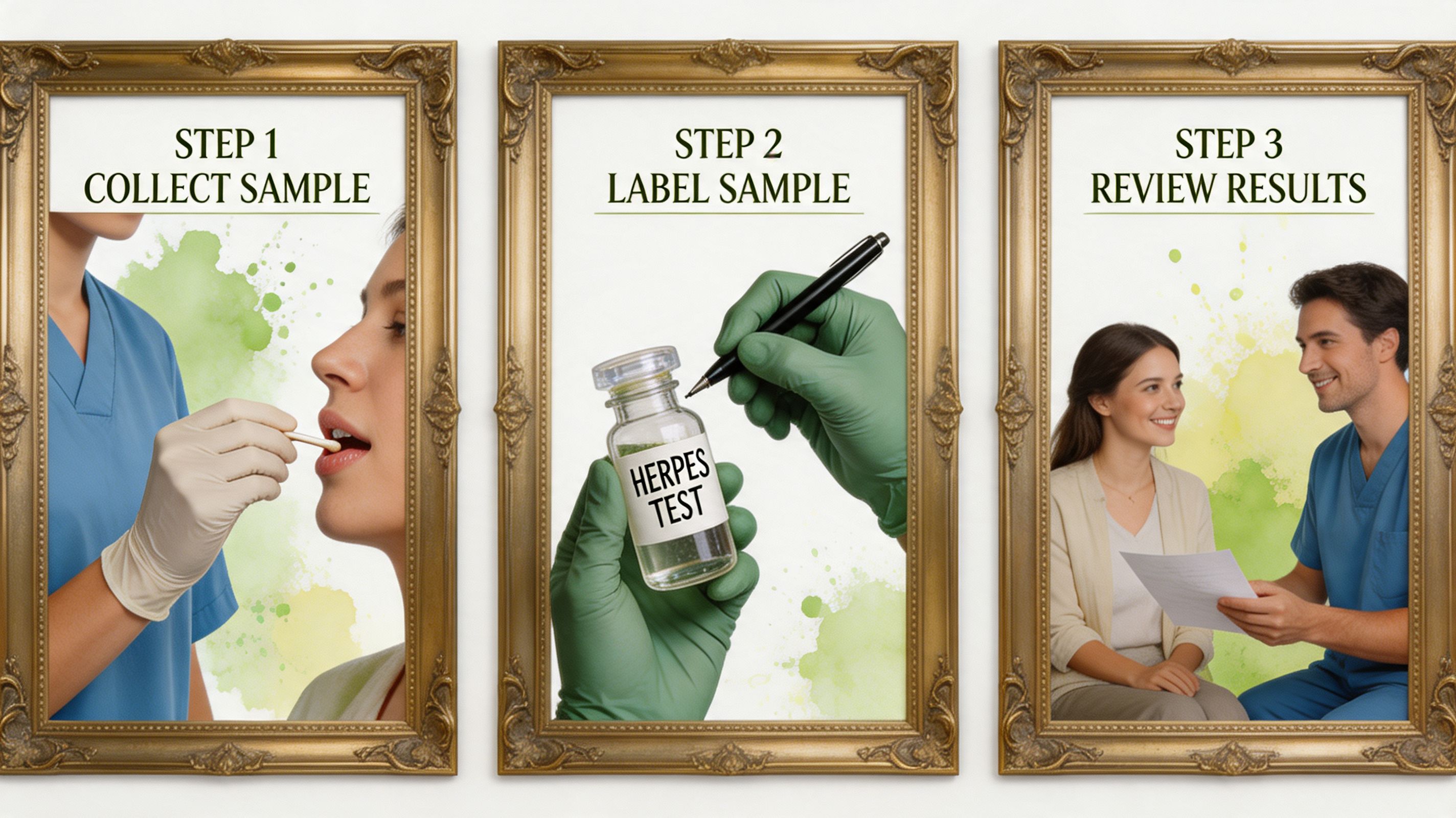
You check in, then speak to a nurse or doctor in a private room. They'll ask about your symptoms, when they started, whether the area is painful, and whether a partner has disclosed herpes. This part is usually brief and direct.
If there is a fresh lesion, the clinician takes a swab from it. Verified guidance states that the best method is to unroof a fresh vesicle or swab the base of an ulcer, ideally within 48 hours of symptoms starting, then place the sample in transport medium [3].
The swab is quick. It can sting or feel uncomfortable for a moment, especially if the area is sore already, but it doesn't usually take long.
Does a herpes swab test hurt?
It can be briefly uncomfortable because the sore is tender, but the swab itself is quick and usually over within moments.
Why timing changes the result
A lot of test frustration comes from late sampling. The same verified source notes that PCR positivity drops to below 30% after 5 days, and healed lesions often give false negatives [3].
That means a poor result does not always mean "definitely no herpes". Sometimes it means "the sample was taken too late" or "there wasn't enough active virus left to detect".
Here is a useful walk-through if you're using a private service and want to understand the basics of collection and return: a practical guide to using a home blood test kit in the UK.
A short visual guide can also make the process feel less clinical:
What happens with a home test
The home process depends on the test type. For a blood test, you usually order the kit, read the instructions, collect the sample, label it, and send it to the lab. Some services use a finger-prick sample. Others use a device-based or venous route.
For herpes, home blood testing is mainly relevant when there are no lesions to swab and blood testing is appropriate. If you have a visible sore, a home blood test is usually not the best first step.
Pharmacist's tip: Read the sample instructions before you open anything. Most failed home tests happen because people rush the collection, label poorly, or send the sample later than instructed.
Interpreting your results and taking the next steps
Results often bring as many questions as answers. The next move depends on whether the result is positive, negative, or unclear, and whether the test matched the timing of your symptoms.
If your result is positive
A positive PCR swab from a lesion confirms herpes and helps identify the type. That gives you something useful to act on. It means you can discuss treatment, symptom control, and how to reduce passing it on.
The verified data states that antivirals such as aciclovir can reduce outbreak duration by 1 to 2 days in 80% of cases, and suppressive therapy can reduce transmission risk by 50% [1]. Those numbers matter because they show that diagnosis is not just a label. It changes what you can do next.
Practical next steps include:
- Start treatment promptly: Follow the prescribing advice you receive.
- Avoid sexual contact during an outbreak: Especially while sores are present.
- Tell current partners: Keep it calm and factual.
- Learn your pattern: Some people notice warning signs before an outbreak.
If you're using an online prescribing service for treatment, this guide to how ordering treatment works at Courier Pharmacy explains how clinician review usually works in a digital setting.
If your result is negative or unclear
A negative swab can mean there was no detectable herpes in the sample. It can also mean the lesion was swabbed too late or the sample quality was poor. This is why a negative result has to be read alongside the timing and appearance of the sore.
An unclear, equivocal, or borderline blood test needs proper interpretation. The brief makes clear that UK-specific guidance on borderline results is a known information gap, so it is better to state this plainly than pretend there is one simple national rule. If you get a result like that, ask the clinician or provider what follow-up they recommend based on your exposure history and test type.
A test result only makes sense when you pair it with the timing, symptoms, and the sample that was taken.
Talking to a partner
This part feels hard, but short and honest works best.
You could say:
- "I had symptoms and got tested."
- "The result shows herpes, so I wanted to tell you directly."
- "I'm getting advice on treatment and how to reduce the risk of passing it on."
You don't need a speech. You need a clear sentence and a plan.
Looking after yourself after the result
A herpes diagnosis can bring embarrassment, anger, relief, or all three in one afternoon. That's normal. Most of the distress comes from stigma and uncertainty, not from the test result itself.
Useful self-care steps:
- Get your facts from sexual health professionals
- Take treatment exactly as advised
- Avoid internet rabbit holes
- Write down questions before your follow-up
Pharmacist's tip: Don't assume one result defines your sex life or relationships. In practice, people usually feel better once they understand what the result means and how to manage future outbreaks.
Summary and key advice
If you have a new sore or blister, the best test is usually a PCR swab taken as early as possible at an NHS sexual health clinic. If you don't have symptoms, a blood test may be useful in selected cases, but it isn't a routine screen for everyone. NHS care is free and confidential. Private routes can be quicker or more convenient, especially for people who want home sampling or faster appointments. The biggest mistake is choosing the wrong test at the wrong time. If you're unsure, ask for advice before you order anything. Getting tested is a practical step, not a judgement.
Frequently asked questions
Can I get tested for herpes at my GP?
Yes, a GP can assess symptoms and advise you. In some cases they may test, and in others they may direct you to a sexual health clinic, which is often the most suitable route for genital symptoms.
Is an NHS herpes test free?
Yes. NHS sexual health clinics offer confidential care and testing without charge for appropriate cases.
What is the best herpes test if I have a sore?
A PCR swab from a fresh lesion is the best option. It works best when taken early in the outbreak [1][3].
Can I do a home herpes test?
Sometimes, yes. Home blood tests exist, but they are not the right first choice for a visible sore. If you have symptoms, try to get a lesion assessed and swabbed.
How soon after exposure can a blood test work?
The verified data says blood testing is generally deferred until 12 to 16 weeks after exposure for more reliable antibody detection [1].
Can a herpes test be wrong?
Yes. A late swab from a healed or crusted lesion can miss infection, and blood tests can give false positives in some settings [1][3][4].
Should I get tested if my partner has herpes but I feel fine?
You may need advice, but not always an immediate test. A clinician can help you decide whether to wait, monitor for symptoms, or consider a later blood test.
How do I know if an online test provider is legitimate?
Check for a GPhC-registered pharmacy or a clearly regulated provider with proper clinical oversight. If you want a starting point, the Courier Pharmacy online pharmacy page shows what a UK online pharmacy service looks like.
Disclaimers and References
Byline: Medical Mojo editorial team, written with a UK pharmacist voice
Clinical review: Clinically reviewed by a UK-registered pharmacist
Disclaimer: This article is for information only. It doesn't replace medical advice, diagnosis, or treatment from your GP, sexual health clinic, pharmacist, or another qualified clinician.
How this content was created: This article was written using the verified evidence supplied in the brief, with emphasis on UK practice, NHS and BASHH-aligned testing pathways, and patient-safe language. It was edited for readability and reviewed for factual accuracy against the approved source set only.
Suggested internal links for medicalmojo.co.uk
- A guide to sexual health clinic appointments
- Understanding STI window periods
- What antiviral treatment for herpes does
- Home blood tests explained
- When to see a pharmacist versus a GP
References
[1] CDC. Screening for Genital Herpes. Available at: https://www.cdc.gov/herpes/testing/index.html
[2] ARUP Consult. Herpes Simplex Virus. Available at: https://arupconsult.com/content/herpes-simplex-virus
[3] Herpes Cure Advocacy. Testing for Herpes Step by Step Guide. Available at: https://herpescureadvocacy.com/2022/07/14/testing-for-herpes-step-by-step-guide/
[4] WebMD. Herpes Tests What You Should Know. Available at: https://www.webmd.com/genital-herpes/herpes-tests-what-you-should-know
Meta description: How to get tested for herpes in the UK. Learn when to use a swab or blood test, where to go, and how to choose NHS or private care.
Visual ideas for the designer
Decision flow infographic: “Do I need a swab or blood test?” in Medical Mojo colours with ornate brass signposts.
Alt text: Flowchart showing how UK patients choose between herpes swab testing and blood testing.Clinic versus home comparison panel: NHS clinic route on one side, private home testing route on the other.
Alt text: Side-by-side illustration comparing NHS sexual health clinic herpes testing with private home testing.Testing timeline graphic: Fresh lesion, ideal swab window, later blood test window after exposure.
Alt text: Timeline showing when herpes swab tests and blood tests are most useful.
If you'd prefer a discreet online route for testing support or treatment review, Courier Pharmacy offers a UK-regulated service with clinician-reviewed questionnaires, home testing options, and private follow-up designed around convenience and confidentiality.


