How to Treat Skin Infections: A UK Guide
Unsure how to treat skin infections? Our UK guide covers bacterial, fungal, and viral types, OTC options, and when to see a doctor. Get clear, practical advice.

SEO brief
- Primary keyword: how to treat skin infections
- Secondary keywords: skin infection treatment UK, cellulitis treatment, impetigo treatment, abscess treatment, online pharmacy for skin infections
- Search intent: informational with clear UK triage and treatment guidance
- Target reader: UK adults worried about a possible skin infection and unsure whether to self-care, ask a pharmacist, use an online prescriber, or seek urgent help
- Product/service mention (if any): regulated UK online pharmacy assessment for suitable skin conditions
- Internal links available: Assumed from brief and included where required
How to treat skin infections
You notice a red patch, a sore that looks angry, or a rash that suddenly feels hot, tender, or weepy. The immediate question is: How do I treat this, and how quickly do I need help?
The short answer is this. How to treat skin infections depends on what type it is, how severe it is, and whether there is pus, spreading redness, or warning signs that need urgent care. Some mild problems can start with simple self-care or pharmacy advice. Others need drainage, prescription treatment, or same-day assessment.
This guide gives you a practical UK pathway. You'll learn what to do first, how to spot common patterns, which treatments usually help, when online care can work well, and when you shouldn't wait.
Five key takeaways
- Clean first, don't squeeze. A gentle wash is safer than poking, popping, or layering random creams.
- Pus changes the plan. Abscesses often need drainage, not antibiotics alone.[1]
- Not every rash needs antibiotics. Fungal and viral problems need different treatment.
- Cellulitis needs respect. It can worsen quickly and may need urgent review if symptoms spread.[4]
- Use the right route. Self-care, pharmacy, online GP, urgent care, and A&E all have different roles.
First Steps What to Do When You Spot a Skin Infection
A lot of skin infections look worse before you know what they are. Stay calm. Your first job is to protect the skin, reduce irritation, and avoid doing anything that makes diagnosis harder.

Start with simple first aid
Follow these steps in order:
- Wash your hands first. This lowers the chance of spreading germs to the area or to someone else.
- Gently clean the skin. Use lukewarm water and a mild cleanser. Pat dry with a clean towel or gauze.
- Keep the area uncovered or lightly covered. If it's weeping, rubbing on clothes, or likely to get dirty, use a clean non-stick dressing.
- Take a clear photo. That gives you a useful record if the area spreads or changes later.
- Check for warning signs. Look for heat, swelling, pus, increasing pain, fever, or fast-spreading redness.
Practical rule: If a painful lump feels full of pus, don't assume tablets alone will sort it. Drainage is often the key step for a true abscess.[1]
Pharmacist's tip: A simple saline wash can help clean a small sore or crusted patch without stinging as much as stronger antiseptics. You can make this by dissolving salt in cooled boiled water, then using fresh solution each time.
What not to do
The mistakes are often the bit that turns a small problem into a bigger one.
- Don't squeeze boils or spots. You can push infection deeper into the skin.
- Don't pick crusts. That slows healing and raises the risk of spread.
- Don't use steroid cream on an unknown infected rash. Steroids can mask what's going on and sometimes make infections worse.
- Don't share towels, razors, or flannels. That matters for contagious infections such as impetigo, fungal infections, and some viral rashes.
- Don't start leftover antibiotics. The wrong antibiotic, or the wrong length of treatment, can muddy the picture and may not work.
If the area is mild, localised, and you feel well, self-care while you seek advice is reasonable. If it is painful, rapidly changing, or near the eye, don't sit on it.
Identifying Common Skin Infections A Visual Guide
The hardest part is often determining if it's an infection. Many rashes are inflammatory, fungal, viral, or irritated. That matters because the treatment changes completely.
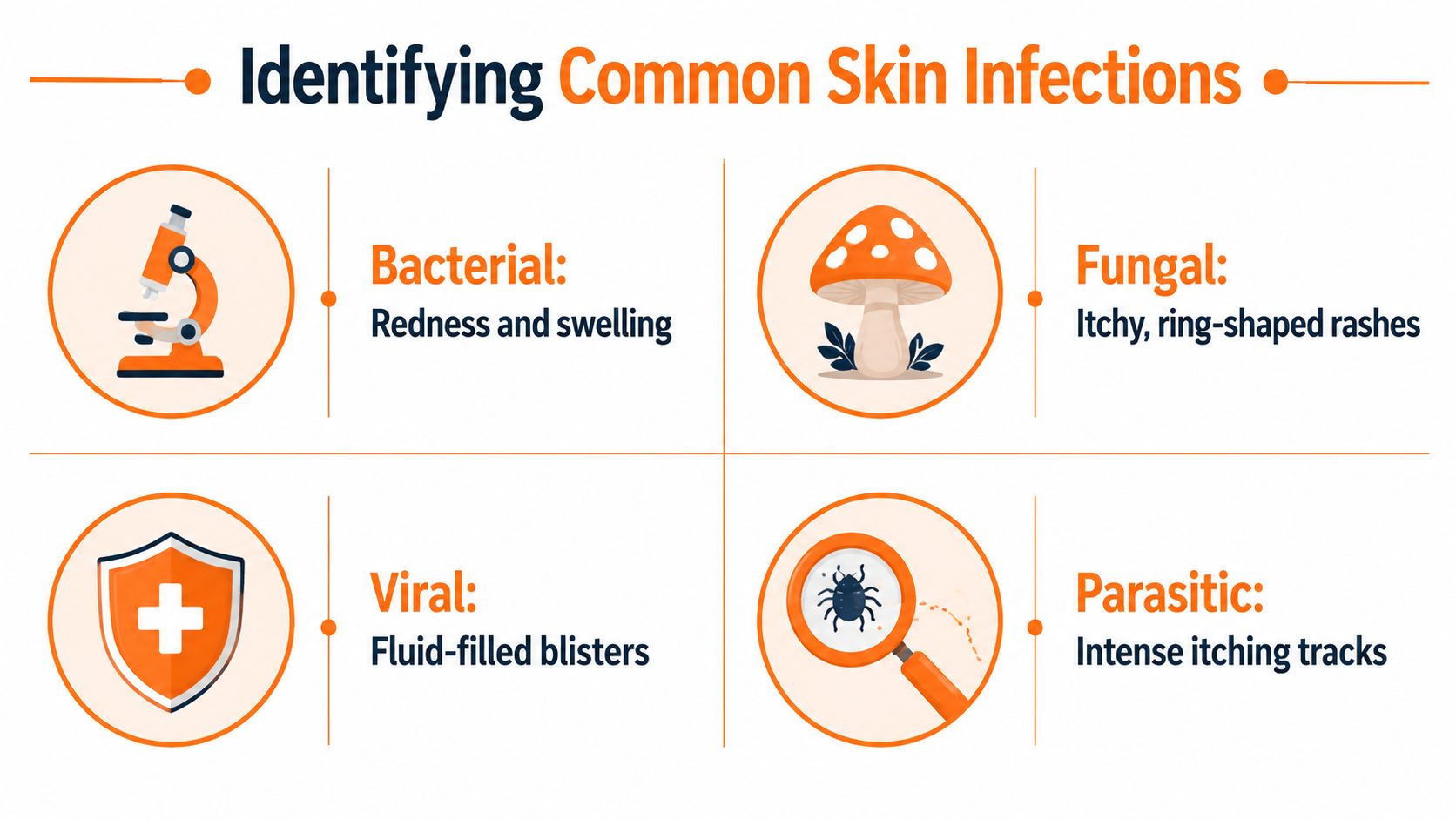
A quick way to sort the problem
A practical first step is to decide whether the area is purulent or non-purulent. Purulent means there is pus, such as in an abscess. Non-purulent usually means inflamed, red skin without obvious pus, such as cellulitis. In purulent infections, incision and drainage is often the main treatment. In non-purulent infections, antibiotics are more likely to be used when bacterial infection is suspected.[1]
That simple split helps, but it doesn't tell the whole story. Fungal infections, viral infections, and scabies can all be mistaken for bacterial disease.
Common skin infections at a glance
| Infection Type | Typical Appearance | Common Examples | Feels Like |
|---|---|---|---|
| Bacterial | Red, swollen, hot, tender skin. May crust, ooze, or form a boil with pus | Cellulitis, impetigo, abscess | Sore, warm, tender, sometimes throbbing |
| Fungal | Itchy, scaly, well-defined patches. Sometimes ring-shaped. Often worse in moist areas | Athlete's foot, ringworm, jock itch | Itchy, irritated, flaky |
| Viral | Blisters or grouped fluid-filled spots. May sting or burn | Cold sores, shingles, chickenpox-style viral rashes | Tingling, burning, sore |
| Parasitic | Small bumps, scratch marks, and burrow-like lines | Scabies | Very itchy, often worse at night |
A few clues help in real life:
- Bacterial infections often look angry and tender.
- Fungal infections usually itch more than they hurt.
- Viral infections often blister.
- Scabies tends to make people scratch like mad, especially in bed.
If a rash is itchy, ring-shaped, and sits in a sweaty area, antibiotics usually won't help. An antifungal is often the more logical treatment.
For people dealing with a suspicious scaly rash, this guide on ringworm treatment and diagnosis can help you compare the pattern.
Real-life example for a gym-goer
A gym-goer notices peeling skin between the toes and itch that flares after a long shift in work boots. There's no heat, deep pain, or spreading redness. That pattern fits a fungal infection far more than cellulitis.
The first move is usually to keep the feet dry, change socks often, and use an antifungal treatment rather than an antibiotic. If the skin becomes very cracked, swollen, or suddenly painful, then the plan changes because bacteria can move in through broken skin.
Real-life example for a busy parent
A busy parent spots red sores around a child's nose with a sticky yellow-brown crust. The child seems well, but the rash is spreading across a small area of the face.
That pattern is often seen with impetigo. In UK guidance, topical antibiotic treatment is preferred for localised impetigo, while oral antibiotics are used when it is widespread or severe.[2] Good hygiene also matters because impetigo spreads easily through hands, towels, and close contact.
Pharmacist's tip: If you're unsure whether a rash is infected or inflamed, take photos over a day or two. The pace of change often tells you a lot. Fast spread, more pain, and more heat push infection higher up the list.
Your Treatment Options From Self-Care to Prescription
When people ask me about how to treat skin infections, I usually sort the answer into levels. What can you safely try yourself? What should a pharmacist assess? And what needs a prescriber?
What you can try yourself
Self-care works best for mild, obvious problems.
- For small superficial cuts or grazes: wash, dry, and protect the skin.
- For likely fungal rashes: use an antifungal cream or spray and keep the area dry.
- For crusted or irritated skin: gentle cleansing and avoiding friction helps.
- For discomfort: simple pain relief may help, if it's suitable for you.
Self-care is not the same as guesswork. If the rash is painful, spreading, producing pus, or making you feel unwell, move up a level quickly.
What a pharmacist can help with
Community pharmacists are good at spotting the difference between something minor and something that needs escalation. We can also flag when a rash may not be bacterial at all.
A pharmacist may help you with:
- Likely fungal infections that suit over-the-counter treatment
- Mild localised skin problems where self-care needs adjusting
- Advice on dressings and wound cleaning
- Triage to GP, urgent care, or an online prescriber if it looks beyond OTC treatment
Quick answer: Can a pharmacist treat a skin infection?
A pharmacist can advise on mild problems and may recommend treatment or referral, but many bacterial skin infections still need a prescriber.
Pharmacist's tip: The right diagnosis matters more than the strongest cream. An antifungal won't treat cellulitis, and an antibiotic won't clear athlete's foot.
What usually needs a prescription
Some infections need prescription treatment because they are deeper, wider, or more likely to cause complications.
For common bacterial infections like cellulitis, NHS guidance recommends an oral antibiotic such as flucloxacillin for 5 to 7 days, with hospital escalation if symptoms worsen or fail to improve within 48 hours.[2] For localised impetigo, topical treatment is preferred, with oral antibiotics used when disease is more widespread.[2]
If you've been prescribed it, this example of flucloxacillin 500mg capsules shows the sort of medicine commonly used for suitable bacterial skin infections in the UK.
Prescription treatment may include:
- Oral antibiotics for cellulitis and wider bacterial infection
- Topical antibiotics for localised impetigo
- Antivirals for certain viral skin infections
- Stronger antifungals when fungal infection is extensive, recurrent, or not improving
A drainable abscess is the classic trap. People expect antibiotics to fix it, but source control matters. If there is a pocket of pus, drainage is often what makes the difference.[1]
Red Flags When to Seek Urgent Medical Help
Some skin infections can turn quickly. This is the point where you stop browsing, stop comparing creams, and get assessed.

Signs that need same-day assessment
NICE-style urgent warning signs include:
- Rapidly spreading redness
- Fever
- Vomiting
- Severe pain
- Infection near the eyes or nose[4]
Cellulitis can deteriorate quickly, so those signs need urgent medical assessment.[4] This also matters because antibiotic resistance is a public health problem. UK reports estimated 58,224 serious antibiotic-resistant infections and 2,202 deaths in 2021.[4] That's one reason why guessing with leftover antibiotics is such a poor plan.
Other reasons to seek urgent help include:
- You feel faint, confused, or very unwell
- The pain is far worse than the skin looks
- There is rapid swelling of the face
- You have a weak immune system and a new infection
- A boil or abscess sits on the face, near the eye, or in the groin and is worsening
Who to contact in the UK
- Same-day GP or urgent treatment centre: spreading redness, significant pain, or worsening infection without severe collapse
- NHS 111: if you're unsure where to go and symptoms are escalating
- A&E: severe pain, very fast spread, facial involvement around the eye, or if you feel seriously ill
If you need a direct route for help or follow-up, you can use the Courier Pharmacy contact page for service-related support, but urgent red flags still need NHS urgent care.
A short explainer can help you recognise when time matters:
Pharmacist's tip: If the redness is expanding, draw a line around the edge with a washable pen and note the time. If it moves beyond that line, that's useful information for the clinician assessing you.
Using Online Prescription Services Safely for Skin Conditions
Online care can be a sensible option when the problem looks suitable for remote assessment and you don't have urgent warning signs. It can work well for mild to moderate conditions with clear photos and a good history.
When online care can work well
Online prescribing is often most useful when:
- The rash is localised and you feel well
- You can upload clear photos
- The symptoms are not near the eyes
- You need advice on whether the condition is bacterial, fungal, or likely something else
- You need timely access and can't easily get a GP appointment
A regulated provider should still triage you out if the problem sounds unsafe for remote care. That's a good sign, not an inconvenience.
One UK option is the Courier Pharmacy online pharmacy service, where patients complete a secure questionnaire reviewed by a human prescriber. That model can suit appropriate skin conditions, but it should never replace urgent in-person assessment when red flags are present.
How to use an online prescriber safely
Use a simple checklist:
- Check regulation. Make sure the pharmacy is GPhC-registered and the medicines come through proper UK channels.
- Be honest on the form. Mention allergies, pregnancy, current medicines, fever, and how fast the rash is changing.
- Upload good photos. Include one close-up and one wider photo that shows location.
- Answer the awkward questions properly. “It's probably fine” is not useful if you feel unwell.
- Follow the safety advice you're given. If the service says you need face-to-face care, take that seriously.
Quick answer: Is an online pharmacy safe for skin infections?
It can be, if the service is UK-regulated, uses qualified prescribers, and clearly tells you when remote treatment isn't appropriate.
Follow-Up Care and Preventing Future Skin Infections
Improvement is not the same thing as cure. Skin often looks calmer before the infection has fully settled.
After treatment starts
Keep the routine simple.
- Take medicines exactly as prescribed
- Keep the skin clean and dry
- Change dressings as advised
- Watch for worsening pain, spread, or new pus
- Seek review if the diagnosis seems wrong or treatment isn't helping
If an abscess keeps coming back, repeated blind antibiotic courses are rarely the full answer. For recurrent abscesses, guidance recommends drainage, culture, then a 5 to 10-day targeted antibiotic course where needed. For recurrent S. aureus infection, a 5-day decolonisation routine with intranasal mupirocin, daily chlorhexidine washes, and decontamination of towels, sheets, and clothes is advised.[3]
How to lower the chance of it coming back
Prevention depends on the cause.
- For fungal infections: dry skin folds and feet well, change sweaty clothing promptly, and don't share footwear.
- For bacterial infections: protect cracked skin, treat eczema properly, and clean cuts early.
- For recurrent boils: ask whether you need a swab, culture, or decolonisation plan.
- For uncertain rashes: get the diagnosis checked before using repeated courses of cream.
If damaged or inflamed skin is part of the problem, this guide on choosing a cream for dermatitis in the UK may help you support the skin barrier and reduce flare-driven breaks in the skin.
If you need treatment advice for a possible skin infection, Courier Pharmacy offers UK-regulated online assessment for suitable conditions, alongside pharmacy guidance on when you should seek in-person care instead.
Summary
Skin infections don't all need the same treatment.
The safest first step is gentle cleaning, avoiding squeezing, and checking for red flags.
Pus often points towards drainage, while cellulitis and wider bacterial infection may need prescription antibiotics.
Fungal and viral skin problems need different treatment, so guessing can waste time.
Use a pharmacy or online prescriber for suitable mild cases, but seek urgent help for rapid spread, fever, severe pain, vomiting, or infection near the eyes or nose.
Getting the diagnosis right early usually saves time, discomfort, and repeat treatment.
FAQs
Can I treat a skin infection at home?
Sometimes, yes. Mild and localised problems may improve with gentle cleansing, keeping the skin dry, and the right over-the-counter treatment if the cause is clear. If the area is painful, spreading, full of pus, or you feel unwell, get medical advice.
Do all skin infections need antibiotics?
No. Bacterial infections may need antibiotics, but fungal infections need antifungals and some abscesses need drainage first.[1] Using the wrong treatment can delay recovery.
What's the best treatment for cellulitis in the UK?
For common bacterial cellulitis, NHS-linked guidance recommends an oral antibiotic such as flucloxacillin for 5 to 7 days, with reassessment and escalation if there's no improvement within 48 hours.[2] The exact choice depends on the person, allergy history, and severity.
Can I use antibiotic cream on any rash?
No. That's a common mistake. Some rashes are fungal, viral, or inflammatory, and antibiotic cream won't help. If the diagnosis is unclear, ask a pharmacist or prescriber before starting treatment.
When does an abscess need more than tablets?
If there is a true pocket of pus, drainage is often the key treatment rather than antibiotics alone.[1] Tablets may be added in moderate or severe cases, but source control matters.
Is impetigo treated with tablets or cream?
For localised impetigo, topical antibiotic treatment is preferred. Oral antibiotics are usually used when the infection is widespread or severe.[2]
When should I worry about a skin infection?
Seek urgent medical assessment if you have rapidly spreading redness, fever, vomiting, severe pain, or infection near the eyes or nose.[4] Those signs can mean the infection needs prompt treatment.
Can an online pharmacy prescribe treatment for skin infections?
Sometimes, yes. A regulated online prescriber can assess suitable cases using a questionnaire and photos. It's most useful when symptoms are mild to moderate and there are no urgent warning signs.
Why do some skin infections keep coming back?
Repeat infections can happen when the original cause isn't fully dealt with. That may mean broken skin from eczema, ongoing fungal infection, poor source control of an abscess, or a need for culture and decolonisation in recurrent boils.[3]
Meta description
How to treat skin infections in the UK. Learn self-care, pharmacy and prescription options, plus urgent warning signs and safe online treatment routes.
Suggested internal links
- Ringworm treatment and diagnosis
- Flucloxacillin 500mg capsules
- Online pharmacy UK service
- Dermatitis cream guide
- Contact Courier Pharmacy
Byline
Author: Medical Mojo Editorial Team, UK health writers
Clinical review: Reviewed by a UK-registered pharmacist
How this content was created
This article was written using UK-relevant clinical guidance and peer-reviewed review articles on skin and soft tissue infections, then checked for clarity, safety, and consistency with a pharmacist-led patient information style. It is for general information only and isn't a substitute for personal medical advice.
References
[1] Giacometti, A., Cirioni, O., Schimizzi, A.M. and Del Prete, M.S. et al. (2021) ‘From diagnosis to treatment of skin and soft tissue infections: An evidence-based review', Infection and Drug Resistance. Available at: https://pmc.ncbi.nlm.nih.gov/articles/PMC7931029/
[2] Boffa, M.J., Chalmers, J.R. and Hay, R.J. et al. (2023) ‘Management of common skin infections in primary care', Clinical Medicine. Available at: https://pmc.ncbi.nlm.nih.gov/articles/PMC10496455/
[3] Stevens, D.L., Bisno, A.L., Chambers, H.F. et al. (Infectious Diseases Society of America) ‘Practice guideline for the diagnosis and management of skin and soft tissue infections'. Available at: https://www.idsociety.org/practice-guideline/skin-and-soft-tissue-infections/
[4] Aspen Mountain Dermatology (citing NICE and UK antibiotic resistance figures) ‘Skin infections'. Available at: https://www.aspenmountaindermatology.com/skin-infections/
Visual guidance for designer
Infographic idea 1: UK triage ladder showing Self-care, Pharmacy, Online prescriber, GP urgent, A&E in bright lime green, pale yellow-green, and light grey with ornate brass plaque labels.
Alt text: UK skin infection triage pathway from self-care to urgent medical help.Infographic idea 2: Comparison chart of bacterial, fungal, viral, and parasitic skin infections with painterly icons and steampunk borders.
Alt text: Visual comparison of common skin infection types and how they usually look.Infographic idea 3: Step-by-step first aid panel showing wash, dry, cover, photograph, and monitor.
Alt text: First steps to take when you spot a possible skin infection.Infographic idea 4: Online pharmacy safety checklist with phone screen, GPhC badge, and checklist icons.
Alt text: How to check whether an online pharmacy for skin treatment is legitimate and safe.


