Hydrogen Breath Test UK: SIBO and Lactose Testing Guide 2026
Considering a hydrogen breath test uk? Our 2026 guide covers SIBO & lactose intolerance testing, prep, results, and NHS & home kit options. Find your answers.

Hydrogen breath testing in the UK can help diagnose SIBO and lactose intolerance, and the key gap many patients miss is this: dual hydrogen and methane testing is now standard for accurate SIBO and IMO differentiation, yet 78% of UK providers still offer hydrogen-only protocols [1]. A hydrogen breath test is a simple, non-invasive way to check for conditions like SIBO or lactose intolerance by measuring gases in your breath.
If you're reading this with ongoing bloating, unpredictable bowels, or a stomach that seems to react to everything, you're not overthinking it. This test often sounds more technical than it really is. Once you know what it measures, how to prepare, and what the results can and can't tell you, it becomes much easier to decide what to do next.
Bloating after meals, ongoing wind, diarrhoea, or constipation can all be valid reasons to ask whether a breath test might help.
SEO brief
- Primary keyword: Hydrogen breath test UK
- Secondary keywords: SIBO test UK, lactose intolerance test UK, methane breath test, home SIBO test UK, hydrogen breath test preparation
- Search intent: Informational with practical next-step guidance
- Target reader: UK adults with bloating, bowel symptoms, suspected SIBO, lactose intolerance, or constipation
- Product/service mention (if any): Home and clinic-based testing options in the UK
- Internal links available: Sensible assumption based on the provided Courier Pharmacy pages
What a hydrogen breath test is and why you might need one
A hydrogen breath test is a non-invasive test used in the UK to check for two main problems: lactose intolerance and small intestinal bacterial overgrowth (SIBO) [2]. In plain English, it helps show whether food is being broken down properly, or whether bacteria in the small bowel are fermenting it too early.

How the test works in simple terms
Think of your gut like a kitchen fermentation jar. If food reaches the wrong place, or isn't digested well, bacteria can ferment it and produce gas. Some of that gas moves into your blood, then into your lungs, and finally out in your breath.
That's why a breath sample can give clues about what's happening deeper in the gut. It sounds odd at first, but it's a well-established way to investigate symptoms such as bloating, discomfort, wind, and diarrhoea.
The two main reasons doctors use it
The test is most often used for:
- SIBO: Bacteria build up in the small bowel and ferment sugars too early. This can lead to bloating, diarrhoea, and abdominal discomfort [2].
- Lactose intolerance: Your body doesn't break down lactose well, so it reaches the bowel and gets fermented instead [2].
Some symptoms overlap with other conditions. For example, people with irritable bowel syndrome symptoms may wonder whether the issue is IBS alone, or whether SIBO or lactose intolerance is also playing a part.
Practical rule: A breath test doesn't diagnose every cause of bloating. It helps answer a specific question about fermentation and gas production.
Featured mini answer
What is a hydrogen breath test?
It's a simple breathing test that measures gas after you drink a test sugar solution, helping assess SIBO or lactose intolerance.
Real-life example
A gym-goer might notice that protein shakes, yoghurt, or “healthy” snack bars trigger bloating within hours. A lactose breath test can help show whether dairy sugar is the issue rather than the protein itself.
Another common example is a shift worker with morning bloating and loose stools who assumes stress is the whole story. A SIBO-focused breath test may give a clearer answer.
The different types of breath tests explained
Breath tests vary in two main ways. The sugar you drink changes where fermentation is likely to happen, and the gases measured change what the test can detect.
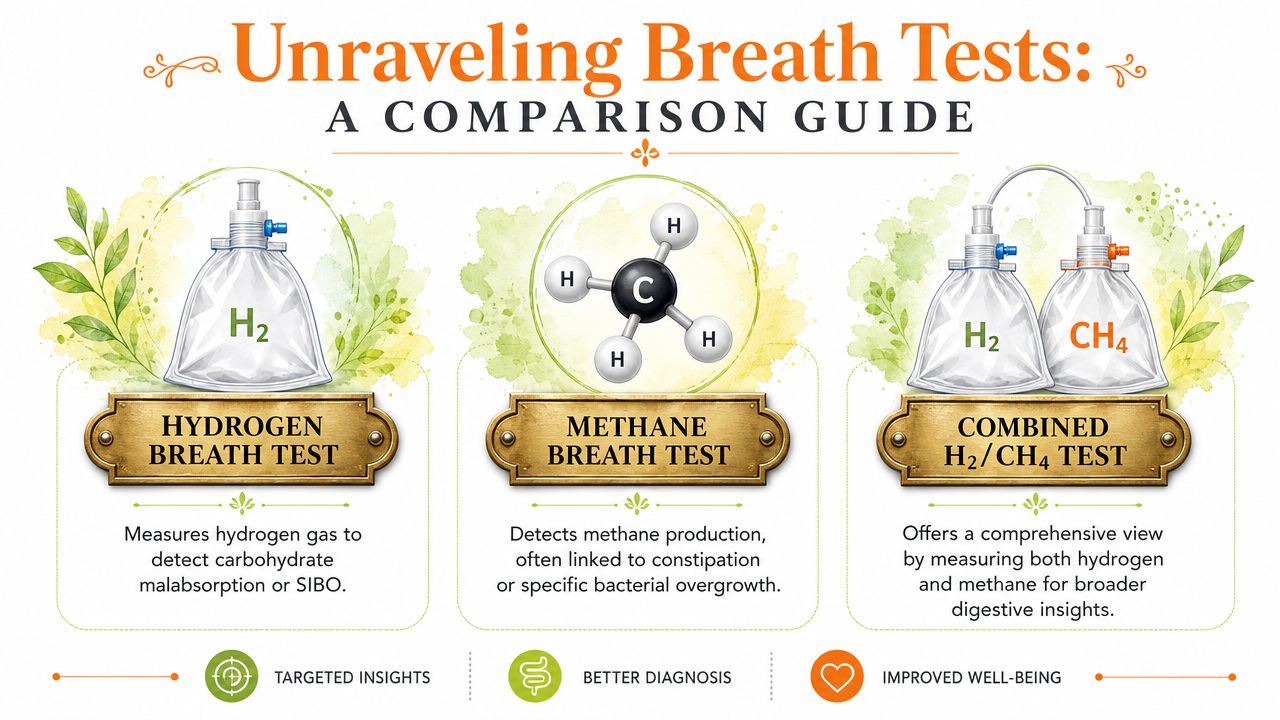
A simple way to picture it is this. The sugar acts a bit like a tracer, while the gas reading is the clue left behind. If either part is poorly matched to your symptoms, the result can be less helpful.
Glucose and lactulose tests
A glucose breath test and a lactulose breath test can both be used to investigate fermentation in the gut, but they behave differently once swallowed.
| Test type | What it tends to assess | Practical point |
|---|---|---|
| Glucose | Fermentation after glucose is absorbed | Often gives more information about the upper part of the small bowel |
| Lactulose | Fermentation as lactulose moves through the bowel | Commonly used in SIBO testing, but timing of gas rises matters |
Glucose is absorbed earlier in the gut. Lactulose keeps travelling. That is why the same person could get slightly different information depending on which test sugar is used.
You do not need to learn the science in detail. The useful question is, “Why have you chosen this sugar for my symptoms?”
Hydrogen-only and dual hydrogen-methane tests
This is the part many people in the UK are not told clearly enough. Some providers measure hydrogen only. Others measure both hydrogen and methane.
That difference can change the whole value of the test.
Hydrogen-only testing may be reasonable in some cases, but it has a blind spot. Some people produce more methane than hydrogen, particularly if their symptoms lean towards constipation, sluggish bowels, and heavy bloating. If methane is not measured, part of the picture can be missed.
A dual test is often more informative because it looks for both gases rather than assuming hydrogen is the only one that matters. In practice, that helps distinguish a more classic hydrogen pattern from IMO, which stands for intestinal methanogen overgrowth.
Practical rule: If constipation is one of your main symptoms, ask specifically whether the test includes methane.
Featured mini answer
Can a hydrogen-only test miss something important?
Yes. If your gut produces methane rather than a clear hydrogen rise, a hydrogen-only test may look less revealing even when symptoms strongly suggest a fermentation problem.
Real-life example
A busy parent with years of constipation pays for a private “SIBO breath test” and gets a result that seems inconclusive. Later, they find out the kit measured hydrogen only. The problem was not always the test itself. It was the limited gas panel.
A night-shift nurse chooses between a home kit and a clinic appointment and assumes the clinic option must be more accurate. Sometimes that is true, especially if sample timing is tightly supervised. But the bigger question is often what the test measures. A well-run home kit that checks hydrogen and methane can be more useful than a clinic test that checks hydrogen alone.
If you are comparing different types of at-home diagnostics, this guide to home blood test kits in the UK is helpful for understanding how sample handling, timing, and instructions can affect result quality.
How to prepare for your hydrogen breath test
You can do everything right on test day and still get a muddy result if the preparation is off. A hydrogen breath test works a bit like checking the air in a room for a specific smell. If other things are drifting around first, the reading becomes harder to trust.
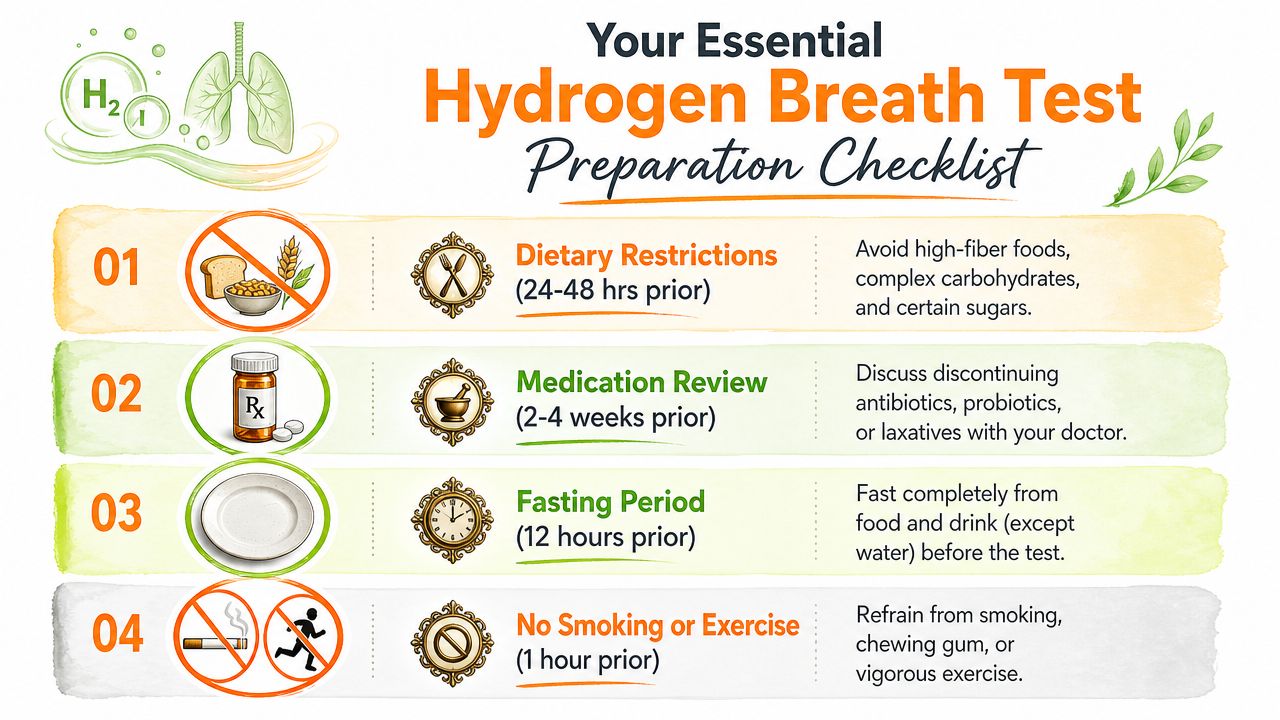
Your practical prep checklist
Your provider's instructions come first, because timing and diet can vary slightly between lactulose, glucose, and home kit protocols. That matters even more with home testing, where good preparation and accurate timing do a lot of the work that clinic supervision would usually cover.
In general, the aim is simple. Start with your gut as quiet and predictable as possible so any rise in hydrogen or methane is easier to interpret.
- Follow the food list exactly: Providers often ask for a low-residue or low-fermentation diet beforehand so leftover fermentation does not blur the baseline.
- Fast for the full time advised: Even a small snack, milky tea, or coffee can shift the starting reading.
- Check medicines before stopping anything: Antibiotics, probiotics, laxatives, and some other medicines may affect the test, but prescribed treatment should only be changed with proper advice.
- Avoid smoking and strenuous exercise near the test: Both can interfere with breath sampling.
- Skip chewing gum, mints, and sweets: They can stimulate digestion or introduce extra sugars.
Pharmacist's tip: If a leaflet says to review medicines, read that as "ask first", not "stop everything".
People often get confused here because the prep can feel stricter than the test itself. That is normal. The test is simple. The preparation is what helps the result mean something.
If you have regular upper gut symptoms, mention them before your appointment or before starting a home kit. Ongoing treatment for acid reflux and indigestion may affect what advice you are given about fasting, antacids, or symptom control.
This short video can help make the prep feel more manageable:
A real-life example for a busy parent
A busy parent preparing for a morning breath test often runs into the same problem. Family routines carry on as usual, but their own routine suddenly needs to change for a day.
The easiest plan is to decide meals in advance, keep allowed foods visible in the fridge, and set reminders for the fasting start time. If you are using a home dual hydrogen-methane kit, lay out the tubes, labels, and timer the night before. That lowers the risk of small mistakes that can make home results less reliable than they need to be.
One practical trick helps a lot. Save the instructions to your phone and tick off each step as you go. Test-day errors usually happen because details get forgotten in the middle of normal life, not because someone has ignored the advice.
What to expect on the day of your test
The test day is usually more boring than scary. Individuals spend the time sitting, watching the clock, and repeating a simple breathing step.
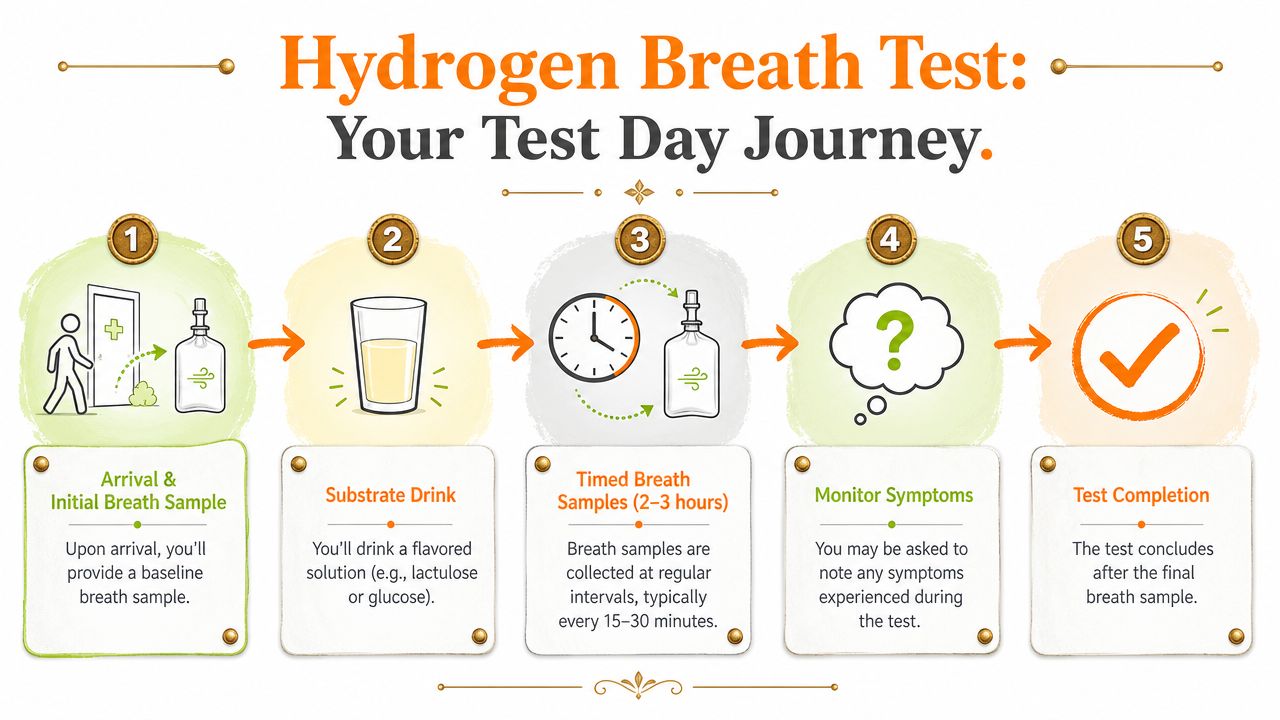
What happens first
A typical protocol involves collecting end-expiratory breath samples every 15 to 30 minutes over 2 to 4 hours, with the average of 3 to 4 initial fasting samples used as the baseline [3]. In simple terms, you give a few starting samples, drink the test solution, then keep giving samples at set times.
The solution is often sweet. Some people notice a brief return of their usual symptoms during the test, especially bloating or gurgling. That can be unpleasant, but it can also help the clinician match symptoms with the readings.
Clinic and home kit experiences
In a clinic, you'll usually sit in a waiting area between samples. The staff tell you when to blow, and the process stays fairly structured.
At home, you need to be more organised. You set timers, collect samples carefully, and follow the kit directions exactly. That's convenient, but it does leave more room for timing errors or sample delays.
Featured mini answer
How long does a hydrogen breath test take?
It usually takes 2 to 4 hours, with breath samples collected at intervals during that time [3].
Real-life example
A shift worker may prefer a home kit because clinic appointments clash with sleep after nights. That can work well if they can collect each sample on time and return it exactly as instructed.
A retired carer may prefer a clinic because they don't want the stress of managing timers and packaging at home. Neither choice is “better” for everyone. The best fit is the one you can complete properly.
Pharmacist's tip: Wear comfortable clothes, bring water if your provider allows it, and plan a quiet morning. Don't book a gym session or a rushed commute straight after.
Understanding your hydrogen breath test results
Results usually look more technical than they are. The main question is whether your breath gases rise in a pattern that fits the condition being tested.
What a positive result usually means
For SIBO, a commonly used UK threshold is a rise in breath hydrogen of 20 ppm above basal levels within 90 minutes after taking the test sugar [4]. For lactose intolerance, a similar 20 ppm above basal rise after lactose ingestion supports the diagnosis [4].
Here is a simple explanation:
| Result feature | What it may suggest |
|---|---|
| Early hydrogen rise | Can fit SIBO when it meets the timing threshold [4] |
| Rise after lactose | Can support lactose intolerance [4] |
| Flat or unclear pattern | May need clinical context, repeat testing, or another explanation |
Featured mini answer
What does ppm mean on a breath test?
It means parts per million. It's the unit used to show how much gas is present in your breath sample.
A simplified graph often shows a low starting line, followed by a clear spike after the drink. That's the basic pattern clinicians look for. But the graph alone doesn't tell the whole story.
Why results need context
Symptoms still matter. Someone with a borderline rise and no matching symptoms during the test may need a different interpretation from someone whose symptoms fit strongly.
That's one reason clinicians don't use breath tests in isolation. They combine the result with your history, bowel pattern, diet triggers, and other possible causes. Some conditions can overlap, including gut disorders such as inflammatory bowel disease, which need a different work-up.
A positive graph doesn't replace a proper clinical review. It gives one piece of the puzzle.
Pharmacist's tip: Don't self-diagnose from a screenshot of your graph. Ask the clinician what the result means for your symptoms, not just whether a line went up.
Getting tested in the UK and your next steps
You have ongoing bloating, wind, or constipation, and now you are trying to work out where to get tested. For many people in the UK, the main question is not merely, "Can I get a breath test?" It is, "Can I get the right breath test, and will the result prove useful?"
That matters because UK services vary quite a bit. Some only measure hydrogen. Some measure both hydrogen and methane. That difference can change what gets picked up, especially if constipation is one of your main symptoms.
NHS, private clinic, or home kit
There are three common routes in the UK: NHS testing, private clinic testing, and home test kits.
The NHS route can work well if you are already being assessed by your GP or a gastroenterology team. The advantage is continuity. Your result can be interpreted alongside your symptoms, medicines, blood tests, and any other investigations already underway. The downside is that access and test type can depend on local referral pathways, and some NHS services may not offer methane measurement.
A private clinic often gives faster access and sometimes a wider choice of tests. In such cases, it helps to ask very specific questions. Do they test for hydrogen only, or hydrogen and methane? Is the test aimed at lactose intolerance, SIBO, or both? A quick booking is less useful if the wrong gas is being measured.
A home kit is often the easiest option for people balancing work, childcare, travel, or fatigue. Home testing can still be helpful, but the practical details matter more than many people realise. Breath gases are not like a blood pressure reading you can take and forget. Sample timing, storage, and transport can affect how reliable the result is, particularly if samples are posted away for analysis. That is why home kits and clinic-based systems are not always directly equivalent.
| Route | Main advantage | Main point to check |
|---|---|---|
| NHS | Connected to your wider medical care | Whether methane testing is available |
| Private clinic | Faster access and more choice | Exactly which gases and sugars are tested |
| Home kit | Convenient and discreet | How samples are collected, stored, and processed |
Featured mini answer
Are home hydrogen breath tests accurate?
They can be useful, but accuracy depends heavily on the kit design and how samples are handled. If you are comparing options, ask whether the provider measures methane as well as hydrogen and how they reduce problems caused by delayed or poorly stored samples.
If you want support around treatment and follow-up after testing, an online pharmacy in the UK may also be useful for practical advice and prescription services where appropriate.
The question many UK patients are not told to ask
Ask whether the test is hydrogen-only or dual hydrogen-methane.
This is one of the biggest gaps in UK testing. A hydrogen-only test can miss part of the picture in some people, particularly those with constipation-predominant symptoms. Methane is linked with a different pattern of gut fermentation and slower bowel movement in some cases, so a test that ignores methane may give an incomplete answer.
A simple way to picture it is this. Testing hydrogen alone is like checking only one side of a thermostat when the whole heating system is acting up. You may still find a problem, but you may also miss the reason the symptoms look the way they do.
What to do after you get a result
The next step should match both the test result and your symptoms.
If the result supports lactose intolerance, management often centres on diet. That may involve reducing lactose-containing foods, switching to lactose-free alternatives, or discussing whether a lactose enzyme supplement is suitable.
If the result supports SIBO, or if methane is raised and your symptoms fit, treatment may involve prescription therapy and a plan to reduce the chance of symptoms returning. A clinician may also look at constipation, gut motility, underlying digestive conditions, and medicines that can affect the bowel.
Ask one practical question before you book any test: Who will explain the result and discuss treatment options afterwards?
A test is most useful when it leads to a clear plan.
Pharmacist's tip: If constipation is a major symptom, ask about methane before you pay for the test. It is one of the simplest ways to avoid choosing a test that leaves an important gap.
Summary
A hydrogen breath test is a simple, non-invasive way to investigate SIBO and lactose intolerance. In the UK, the biggest gap is that many providers still use hydrogen-only testing, even though methane can matter a lot for constipation-heavy symptoms. Preparation is vital. Small mistakes can make the result harder to trust. The test itself is usually straightforward and takes a few hours. Results need careful interpretation alongside your symptoms and medical history. If you're choosing a home kit, ask about sample handling and whether methane is included. This article is for information only and doesn't replace medical advice.
FAQs
What is a hydrogen breath test used for in the UK?
It is mainly used to help diagnose SIBO and lactose intolerance [2]. The test measures gases in your breath after you drink a specific sugar solution.
Is a hydrogen breath test painful?
No. It's considered non-invasive [2]. You breathe into a collection device, then repeat this over a few hours.
How do I know if I need methane testing too?
If you have marked bloating with constipation, it is worth asking whether methane is being measured. Hydrogen-only testing can miss IMO in some people [1].
How long does the test take?
The full test usually lasts 2 to 4 hours [3]. Samples are usually taken every 15 to 30 minutes during that period [3].
What counts as a positive SIBO result?
A commonly used threshold is a 20 ppm rise above basal hydrogen within 90 minutes after the test sugar [4]. A clinician should still interpret that result in context.
What counts as a positive lactose intolerance result?
A 20 ppm rise above basal hydrogen after lactose ingestion supports lactose intolerance [4]. Your symptoms and timing still matter when the result is reviewed.
Can I do a hydrogen breath test at home?
Yes, home kits are available in the UK. They can be convenient, but delayed processing may reduce hydrogen detection accuracy in some kits [5].
Can a hydrogen breath test diagnose every cause of bloating?
No. It helps answer a specific question about gas production and fermentation. Other gut conditions may need different tests or a broader assessment.
Should I stop my medicines before the test?
Only if your clinician or provider tells you to. Some medicines can affect results, but you should not stop prescribed treatment without checking first.
Meta description
Hydrogen breath test UK guide for SIBO and lactose intolerance. Learn prep, results, methane testing, home kit accuracy, and what to expect.
Internal links to add
- Irritable bowel syndrome symptoms and support
- Home blood test kits in the UK
- Acid reflux and indigestion advice
- Inflammatory bowel disease overview
- Online pharmacy UK services
Byline and clinical review
Written by: Medical Mojo Editorial Team, patient education writers
Clinical review: UK-registered Pharmacist, GPhC-registered reviewer
How this content was created
This article was written using UK patient information, peer-reviewed literature, and clinically reviewed educational sources. A pharmacist reviewed the draft for clarity, safety, tone, and UK relevance before publication.
References
[1] HCA Healthcare UK. Hydrogen breath test [online]. Available at: https://www.hcahealthcare.co.uk/tests-and-scans/hydrogen-breath-test [Accessed 9 July 2026].
[2] Gateshead Health NHS Foundation Trust. Hydrogen breath test [online]. Available at: https://www.gatesheadhealth.nhs.uk/resources/hydrogen-breath-test/ [Accessed 9 July 2026].
[3] Cleveland Clinic. Hydrogen breath test [online]. Available at: https://my.clevelandclinic.org/health/diagnostics/12360-hydrogen-breath-test [Accessed 9 July 2026].
[4] Ghoshal, U.C. et al. How to interpret hydrogen breath tests [online]. Available at: https://pmc.ncbi.nlm.nih.gov/articles/PMC3155069/ [Accessed 9 July 2026].
[5] Hull University Teaching Hospitals NHS Trust. Hydrogen breath test patient leaflet [online]. Available at: https://www.hey.nhs.uk/patient-leaflet/hydrogen-breath-test/ [Accessed 9 July 2026].
If you'd like a convenient next step, Courier Pharmacy offers UK-regulated online support, including testing and follow-up care. If you're comparing options, look for clear preparation guidance, a sensible pathway after results, and, where relevant, a test that considers both hydrogen and methane rather than hydrogen alone.


