Inflammatory Bowel Disease Management: A UK Patient's Guide
Your complete UK guide to inflammatory bowel disease management. Understand Crohn's vs colitis, treatments, flare management, and how to navigate care.
SEO brief
- Primary keyword: inflammatory bowel disease management
- Secondary keywords: IBD treatment, Crohn's disease management, ulcerative colitis treatment, IBD flare management, IBD diet UK, IBD monitoring
- Search intent: Informational. Newly diagnosed UK patients want a clear, practical guide to how IBD is managed day to day.
- Target reader: UK adults with Crohn's disease or ulcerative colitis, plus carers
- Product/service mention (if any): One factual mention of Courier Pharmacy as an example of a complementary service
- Internal links available: Assumed from the provided list
Inflammatory bowel disease management is a partnership between you and your healthcare team, using medication, monitoring, and lifestyle changes to get symptoms under control (induce remission), keep them away (maintain remission), and prevent long-term complications. If you've just been told you have Crohn's disease or ulcerative colitis, that probably sounds like a lot. It is. But it becomes much more manageable once you understand what each part of the plan is trying to do, what to expect during flares, and where you can make life easier for yourself.
A new diagnosis often lands in the middle of ordinary life. You may be juggling work, school runs, night shifts, travel plans, or trying to get through the week without another urgent dash to the loo. This guide explains how inflammatory bowel disease management works in the UK, what the main treatments do, how monitoring fits in, and how modern tools such as remote reviews, home blood testing, and individualized formulations can support NHS care.
- Remission matters: Treatment usually has two jobs. Calm a flare, then keep you stable.
- Steroids are short term: In Crohn's disease, UK guidelines limit conventional steroids to a maximum of 8 weeks for induction and ban them for maintenance [3].
- Monitoring is not optional: Symptoms alone don't tell the full story, so blood tests, stool tests, scans, and endoscopy all have a role [4].
- Food support counts: Malnutrition is common in acute Crohn's disease, and dietetic input can make a real difference [5].
- You should know the pathway: If your GP suspects IBD, NICE says you should get a specialist assessment within 4 weeks of referral [6].
Understanding your inflammatory bowel disease diagnosis
Getting an IBD diagnosis can feel oddly split. Part of you feels relieved that the symptoms finally have a name. Another part immediately worries about medication, work, food, the future, and whether life will now revolve around hospital letters.
What IBD means in plain English
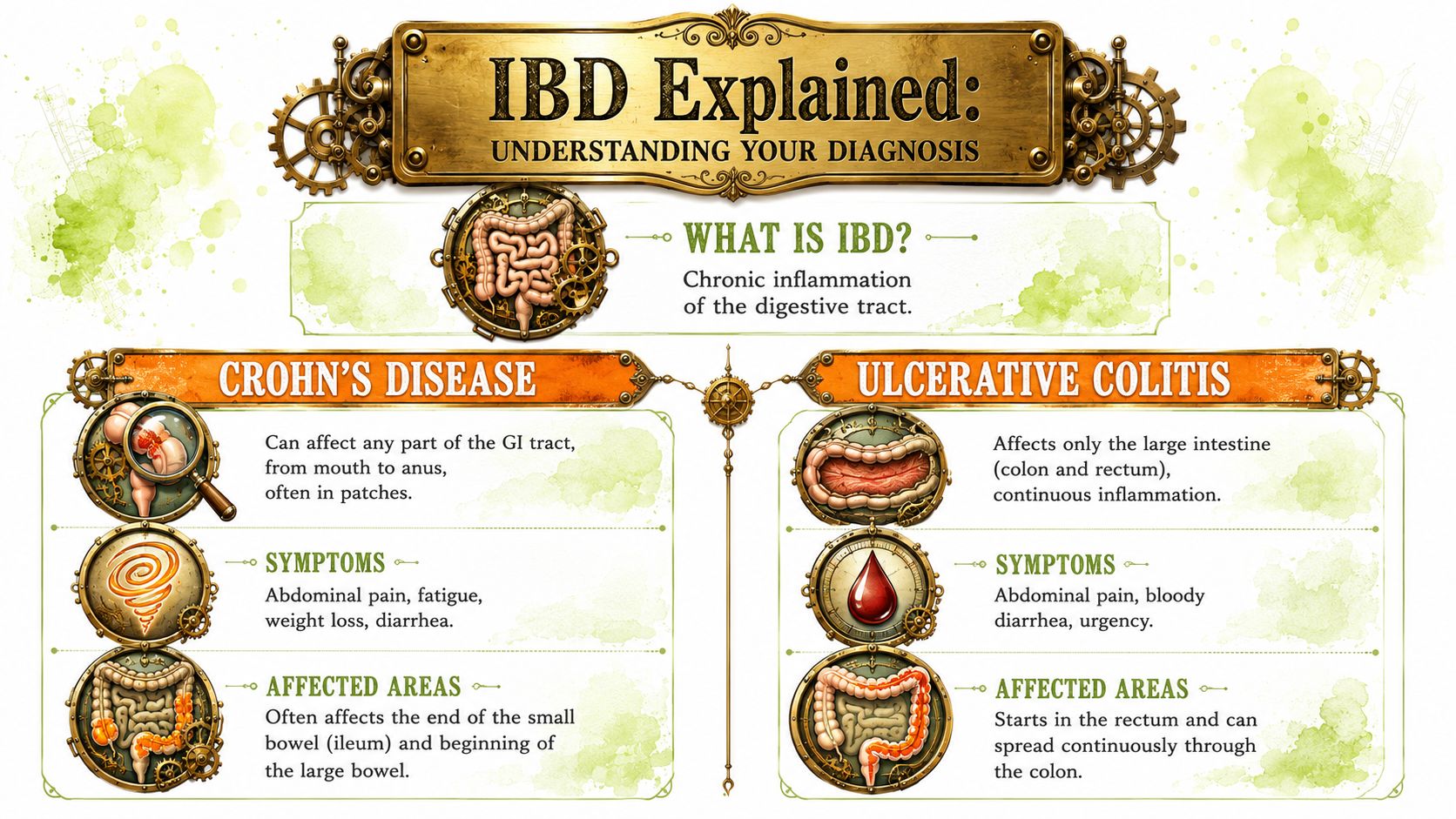
Inflammatory bowel disease, or IBD, is a long-term condition where the digestive tract becomes inflamed. The two main types are Crohn's disease and ulcerative colitis. They are related, but they don't behave in exactly the same way.
A featured-snippet answer first.
What is the difference between Crohn's disease and ulcerative colitis?
Crohn's disease can affect any part of the gut and often appears in patches. Ulcerative colitis affects the large bowel and rectum, with continuous inflammation.
Newer UK research shows over half a million people, or 1 in every 123 of the UK population, are living with Crohn's disease or colitis. In people aged over 70, prevalence rises to 1 in every 67. That's nearly double earlier estimates [1]. So if you feel isolated right now, you're not alone.
If you want a simple background explainer on possible causes, this guide on what causes inflammatory bowel disease is a helpful companion read.
Crohn's disease and ulcerative colitis at a glance
| Feature | Crohn's Disease | Ulcerative Colitis |
|---|---|---|
| Where it affects | Can affect anywhere from mouth to anus | Affects the colon and rectum |
| Pattern | Often patchy | Usually continuous |
| Common symptoms | Belly pain, diarrhoea, fatigue, weight loss | Bloody diarrhoea, urgency, belly pain |
| Depth of inflammation | Can involve deeper layers of the bowel wall | Affects the inner lining of the bowel |
| Nutrition issues | Can be more prominent, especially with small bowel involvement | Still important, but pattern differs |
| Treatment approach | Often needs medicines that reach deeper or wider areas | Treatment often depends on how much of the colon is affected |
This table won't replace your clinic letters, but it gives you a map. Once you know which type you have, the treatment choices start to make more sense.
Real-life example: A busy parent with newly diagnosed ulcerative colitis may focus first on urgency, bleeding, and timing medicines around childcare. A gym-goer with Crohn's disease affecting the end of the small bowel may need more support with fatigue, food tolerance, and staying well nourished.
The three main goals of your IBD treatment plan
IBD treatment works best when you understand what each medicine is trying to achieve. Most plans come back to three goals. If you know these, clinic discussions feel less random.
Induce remission
This means settling active inflammation during a flare. In plain terms, the aim is to stop diarrhoea, bleeding, pain, urgency, poor appetite, and the exhaustion that can come with them.
Some medicines work quickly. Others take longer. That's why your team may use one treatment to put out the fire and a different one to stop it coming back.
Maintain remission
Once symptoms improve, the next job is to keep them away. Many people feel tempted to relax too early at this stage. If you stop maintenance treatment because you feel well, you may be stopping the medicine that's keeping you well.
Staying in remission is usually less disruptive than treating repeated flares.
Your treatment plan may include regular tablets, injections, infusions, or a combination. The detail depends on your diagnosis, where the inflammation sits, and how active it has been. Some of the immune pathways involved are discussed in broader terms in this overview of the Th1, Th2 and Th17 T-helper cell shift, though your own treatment plan should stay individualized and practical.
Prevent complications
This is the long game. Good inflammatory bowel disease management aims to reduce hospital admissions, urgent steroid courses, bowel damage, and surgery risk. It also aims to protect your day-to-day life. Work, family routines, travel, exercise, sex, sleep, and confidence all matter.
A useful way to think about it is this:
- Short term: Get control.
- Medium term: Stay stable.
- Long term: Protect the bowel and protect your life around it.
That's why your team cares about symptom diaries, blood tests, prescriptions, scan results, and whether you manage to take the treatment. It's all part of the same plan.
Your IBD medication toolkit explained
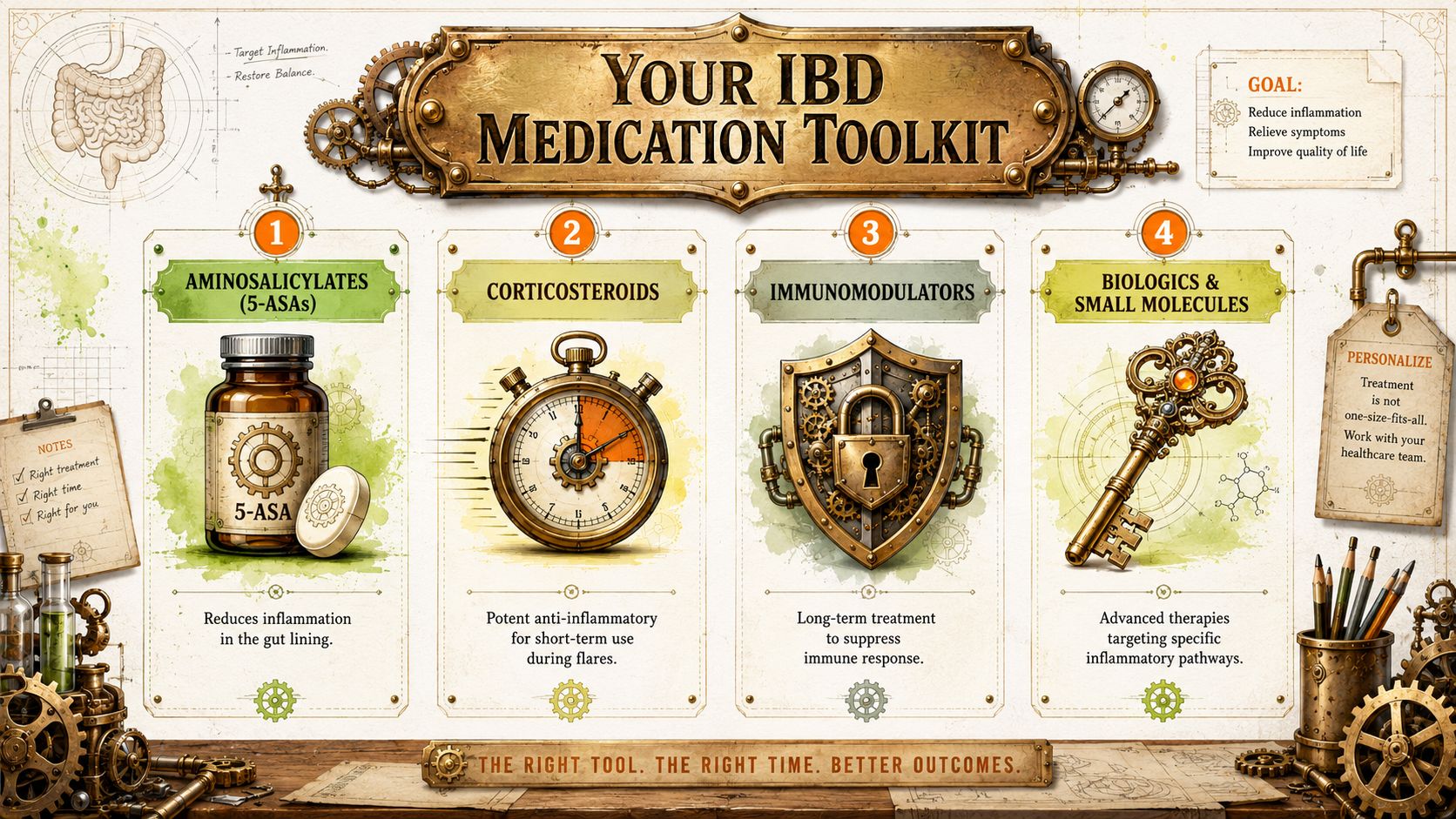
Medicines for IBD aren't one-size-fits-all. They're more like a toolkit. Different tools suit different jobs, and your plan may change over time.
5-ASAs such as mesalazine
These medicines are often used in ulcerative colitis. They help reduce inflammation in the gut lining. Depending on where the inflammation sits, they may come as tablets, granules, suppositories, or enemas.
They can work very well when the right formulation reaches the right area. What often doesn't work is taking an oral medicine but skipping the rectal treatment because it feels inconvenient. If the rectum is inflamed, local treatment can be a key part of the plan.
Pharmacist's tip: If you use mesalazine regularly, build it into a routine you already have. Breakfast, brushing your teeth, or setting up the coffee machine all work better than relying on memory.
A UK study highlighted how adherence can be a real problem. In one central England study, only 42% of ulcerative colitis patients taking 5-aminosalicylates showed good adherence, and only 65% had been prescribed these medicines in the previous 6 months if they had not had surgery [2].
Corticosteroids
Steroids are powerful anti-inflammatory medicines. They can be very effective during flares. But they are not a good long-term plan.
UK guidance is clear. In moderate-to-severe Crohn's disease, conventional corticosteroids should be limited to a maximum of 8 weeks for induction, and they should not be used for maintenance [3]. In other words, they help you get out of trouble. They are not the medicine you should stay on to keep things stable.
What tends not to work is repeated short steroid courses without a proper maintenance strategy. That often leads to a frustrating cycle of feeling better, flaring again, and starting over.
Pharmacist's tip: If you've been prescribed steroids, ask two questions early. “What is the stop date?” and “What is the maintenance plan after this?”
Immunomodulators such as azathioprine
These medicines help calm the immune response over time. They don't usually kick in quickly, so they aren't a rescue treatment for sudden severe symptoms. They are more often used to support longer-term control.
They need monitoring. Your team will usually check blood tests because these medicines can affect blood counts and liver results. That isn't a sign the medicine is unsafe by default. It's how we use it safely.
Real-life example: A shift worker on azathioprine may struggle to attend weekday phlebotomy clinics. In practice, that often means missed monitoring, delayed dose changes, and unnecessary stress. Flexible blood testing options can make adherence to the whole plan much easier.
Biologics such as adalimumab
Biologics target specific parts of the inflammatory process. They are often used when disease is more active, when other options haven't controlled it well enough, or when the pattern of disease suggests you need a stronger maintenance plan.
For Crohn's disease, UK guidance recommends anti-TNF treatment such as adalimumab, including biosimilars, and supports combining it with a purine analogue such as azathioprine to improve efficacy and reduce immunogenicity, which means the body is less likely to react against the medicine and make it less effective over time [3].
Practical rule: If a biologic is working, don't tweak the schedule yourself. Late doses and “I felt fine so I skipped it” decisions are a common route to loss of control.
Small molecules
You may also hear about small molecules, including JAK inhibitors. These are targeted medicines taken by mouth rather than injection or infusion. They can be very useful in the right patient, but they still need proper review and safety checks.
The key point is simple. A tablet isn't automatically “lighter” than a biologic. Route of administration and treatment strength are not the same thing.
If you've come across broader alternative discussions online, keep a sensible filter on. For example, some patients ask about low-dose naltrexone. That may come up in wider chronic condition conversations, but your IBD treatment should stay anchored to specialist advice, clear monitoring, and proven remission goals.
What works and what does not
- Works well: Taking maintenance treatment consistently, reporting side effects early, and keeping up with monitoring.
- Works less well: Stopping medicines the moment you feel better.
- Works well: Matching the drug to the disease pattern and severity.
- Works less well: Comparing your plan with someone else's and assuming yours is wrong because it looks different.
- Works well: Having one up-to-date medicine list and sharing it with every clinician and pharmacist.
- Works less well: Forgetting to mention supplements, painkillers, or medicines bought online.
Pharmacist's tip: Keep a note on your phone with your IBD medicines, dose, last blood test, allergies, and IBD team contact details. It saves time in urgent care and during hospital visits.
Managing flares and monitoring your condition
Why monitoring matters
Many people assume good inflammatory bowel disease management is just about symptoms. It isn't. Symptoms matter, but they don't tell the whole story.
A 2024 UK study found IBD was suboptimally controlled in 52.4% of people with Crohn's disease and 45.3% of people with ulcerative colitis. That poor control impaired quality of life and more than doubled healthcare resource use [4]. This is why your team checks more than “How are your bowels?”
Monitoring may include:
- Blood tests: These can help flag inflammation, anaemia, low protein, or medicine effects. If you're unsure what some of the basics mean, this plain-English guide to the full blood count test is useful.
- Faecal calprotectin: A stool test that helps show whether bowel inflammation is active.
- Scans: MRI or CT may help assess parts of the bowel that aren't easy to see directly.
- Endoscopy: This lets the team look at the bowel lining and check how much healing has happened.
A practical flare action plan
When symptoms start creeping back, speed matters. Don't wait until things are unbearable.
- Spot the change early: More urgency, bleeding, looser stools, abdominal pain, poor appetite, night symptoms, or unusual fatigue all count.
- Contact the right team: Your IBD nurse, gastroenterology team, GP, or urgent service depending on severity.
- Check your medicines: Missed doses are common during busy weeks, travel, or prescription delays.
- Keep food simple: Eat what you tolerate best. During a flare, this is often about reducing stress on the gut rather than chasing a perfect diet.
- Stay hydrated: Diarrhoea can catch up with you quickly.
- Don't self-start leftover steroids: Old rescue packs can muddy the picture and delay proper review.
Real-life example: A busy parent with Crohn's disease notices rising pain and loose stools but blames stress and carries on for a week. By the time they call, they're exhausted, dehydrated, and behind on work. The better move would have been a call at the first clear step change.
When to seek urgent help
Seek urgent medical help if you have severe worsening symptoms, signs of dehydration, heavy bleeding, severe abdominal pain, fever, or you feel acutely unwell.
In acute severe ulcerative colitis, guideline-based care includes immediate intravenous corticosteroids and prophylactic blood thinners [4]. That is hospital treatment, not a wait-and-see situation.
If your symptoms feel dramatically worse than usual, or you can't keep up with fluids, get urgent help the same day.
Beyond the prescription diet, lifestyle and mental wellbeing
Medication is central, but it isn't the whole story. Food, sleep, stress, work patterns, and confidence all shape how manageable IBD feels in real life.

Food should support you, not frighten you
There isn't one universal IBD diet that suits everyone. Some people tolerate fibre well in remission and struggle during a flare. Others notice issues with spicy foods, alcohol, large meals, or high-fat takeaways. The useful question is not “What food is banned?” It's “What happens in my body when I eat this, and does that change during a flare?”
UK guidance highlights an important gap here. Malnutrition is common in acute Crohn's disease and links with poorer outcomes, yet patient information often doesn't explain how to assess nutritional status or get dedicated dietetic support [5].
That matters because under-eating can look “healthy” from the outside. It often isn't. If eating has become stressful, painful, or inconsistent, ask directly for dietetic input.
- Keep a simple food-symptom diary: Short notes beat obsessive tracking.
- Think tolerance, not perfection: “Safe enough today” is often more realistic than “ideal forever.”
- Ask for support early: If you're losing confidence with food, bring it up at review.
Exercise, work, and ordinary life
A gym-goer in remission may train much as usual, then need to scale back sharply during a flare. That isn't failure. It's sensible pacing. Lower-intensity sessions, walking, gentle resistance work, or resting for a short period can be the right move.
A shift worker has different challenges. Meal timing can be erratic, hydration slips, and medication reminders are harder when no day looks the same as the last one. Pre-packing tolerated snacks and keeping medicines in a visible place often works better than aiming for a perfect routine that never happens.
Here's a short explainer that some people find useful while thinking about lifestyle and symptoms:
The mind-gut link is real
IBD can be mentally draining even when you “look fine.” The uncertainty is often the hardest bit. You may worry about toilets, travel, meetings, eating out, dating, or whether a good week means the flare has really gone.
UK guidance also notes that socioeconomic disparities can lead to diagnostic delays and worse quality of life [5]. That's worth saying plainly, because struggling to access care isn't a personal failure. If transport, work hours, language barriers, or caring duties are making care harder, say so. Services can only adapt if they know what the obstacle is.
You do not need to be at crisis point before asking for practical or emotional support.
Simple supports can help. A toilet access card, an honest conversation with your employer, a calmer training plan, or regular check-ins with a trusted person all reduce the mental load.
How to navigate your IBD care in the UK
The NHS should remain the backbone of your care. Your GP, gastroenterology team, IBD nurse, endoscopy service, radiology team, and pharmacist all have a part to play.
What the NHS pathway should look like
If a GP suspects IBD, NICE says you should receive a specialist assessment within 4 weeks of referral [6]. That target matters because earlier assessment can speed up diagnosis and treatment decisions.
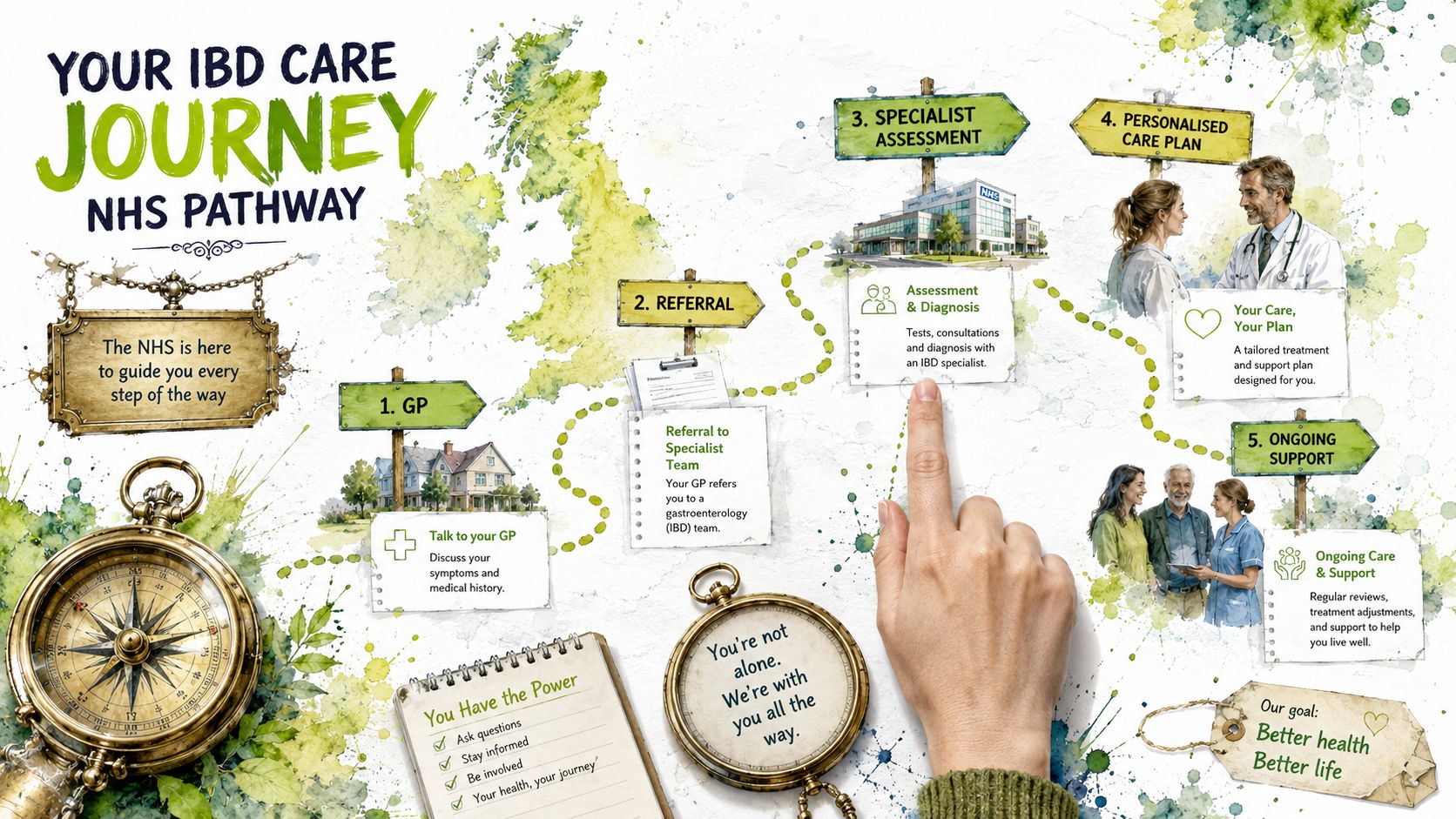
A typical pathway often includes:
- GP review: First discussion, initial bloods or stool tests, then referral if needed.
- Specialist clinic: Assessment, diagnosis, and a treatment plan.
- Monitoring: Regular blood tests, stool tests, scans, or endoscopy.
- Medication review: Adjusting treatment based on symptoms and results.
- Support between appointments: Often through an IBD nurse, GP, or pharmacy team.
If that hasn't been your experience, it's reasonable to ask what happens next and who is coordinating your care.
How modern tools can make care easier
Standard care works best when patients can fit it into life. That's where modern services can help. Not as a replacement for specialist teams, but as practical support around them.
Examples include:
- Remote consultations: Useful when you need a quick medication review, side-effect check, or follow-up without taking half a day off work.
- Home blood testing: This can help when getting to phlebotomy is the main barrier. Some services now offer the Tasso device, which many patients find less stressful than traditional finger-prick sampling.
- Personalised compounding: Helpful if you have allergies, intolerances, or struggle with a standard formulation.
- SIBO breath testing: Sometimes useful when bloating, wind, or bowel symptoms don't fully match the IBD picture and another cause may be overlapping.
- Repeat supply support: Important for people who are stable on maintenance treatment and want fewer delays.
One example is Courier Pharmacy's online pharmacy service, which offers online prescribing support, home and venous blood testing, SIBO breath testing, and specialist compounding. Used properly, services like this can make follow-up more convenient while your NHS IBD team remains responsible for core specialist care.
Questions worth asking at your next review
- What is this medicine for right now? Induction, maintenance, or both?
- How will we know it's working? Symptoms, bloods, stool test, scan, or scope?
- What side effects matter most for me?
- Who do I contact if symptoms flare between appointments?
- Do I need dietetic support or easier access to blood tests?
Those questions often matter more than trying to memorise every lab result.
Frequently asked questions
Can I live a normal life with IBD?
Yes, many people do. The goal of inflammatory bowel disease management is to help you work, study, exercise, travel, and enjoy life with as few interruptions as possible.
Will I always need medicine?
Many people do need long-term treatment to stay well. Feeling better usually means the plan is working, not that the condition has disappeared.
Are steroids a long-term answer?
No. They can help during flares, but they are not a maintenance strategy in Crohn's disease [3].
What if my symptoms come back suddenly?
Contact your IBD team, GP, or urgent care depending on severity. Don't rely on guesswork or leftover medicines.
Can diet alone control IBD?
Diet matters, but it usually supports medical treatment rather than replacing it. If food has become difficult, ask for dietetic support.
Should I keep having tests if I feel fine?
Usually, yes. Symptoms and inflammation don't always match, so monitoring helps catch problems early.
Is stress the cause of IBD?
No. Stress can worsen symptoms and make flares harder to manage, but it doesn't by itself explain the disease.
Do I need to tell my pharmacist about all my medicines?
Yes. Include prescription medicines, over-the-counter products, supplements, and anything bought online.
For people who want a more convenient way to organise repeat medicines, testing, or personalised formulations alongside their usual care, Courier Pharmacy offers UK-regulated online pharmacy services that can support parts of the IBD treatment journey. It isn't a replacement for your NHS gastroenterology team, but it can be a practical option when access, timing, or formulation issues are getting in the way.
Summary
IBD management works best when you see it as an ongoing plan, not a one-off prescription. The main jobs are to calm flares, keep you in remission, and prevent complications. Medicines each have a role, but they only work well when they fit your disease pattern and you can stick to them. Monitoring matters because symptoms don't always tell the whole story. Diet, mental wellbeing, and practical access to care are not extras. They are part of living well with IBD. This article is for information only and isn't a substitute for personal medical advice.
Meta description
Inflammatory bowel disease management explained for UK patients. Learn about IBD treatment, flares, monitoring, diet, and how to access care.
Suggested internal links for medicalmojo.co.uk
- A guide to faecal calprotectin testing
- Understanding biologics and biosimilars in IBD
- Steroid side effects and safer long-term plans
- How home blood testing works in the UK
- Ulcerative colitis symptoms and when to seek help
Byline
By Medical Mojo Editorial Team, written in the voice of a specialist IBD pharmacist
Clinical review
Clinically reviewed by a UK-registered pharmacist
How this content was created
This article was written using UK guideline material and peer-reviewed evidence listed below, then edited for patient readability and checked for factual consistency against the cited sources. It is intended to support, not replace, advice from your own GP, IBD nurse, gastroenterologist, or pharmacist.
Visual ideas for the designer
- NHS IBD journey infographic
Alt text: “Steampunk-style five-step journey showing GP referral, specialist assessment, treatment, monitoring, and support for IBD care in the UK.” - Medication toolbox visual
Alt text: “Painterly medication toolkit showing 5-ASAs, steroids, immunomodulators, and biologics for inflammatory bowel disease management.” - Flare action checklist card
Alt text: “Simple flare action plan for IBD with warning signs, contact steps, hydration advice, and urgent red flags.” - Food and wellbeing support visual
Alt text: “Healthy meals, movement, and calm routines shown as part of holistic inflammatory bowel disease management.”
References
[1] NICE (2015) Inflammatory bowel disease briefing paper, including updated prevalence summary. Available at: https://www.nice.org.uk/guidance/qs81/documents/inflammatory-bowel-disease-briefing-paper2
[2] Bodger, K. et al. (2024) Real-world burden of suboptimal control in UK inflammatory bowel disease care (PODCAST-IBD). Current Medical Research and Opinion. Available at: https://www.tandfonline.com/doi/full/10.1080/03007995.2024.2410928
[3] British Society of Gastroenterology (2025) Guideline on the management of Crohn's disease in adults. Available at: https://discovery.dundee.ac.uk/ws/portalfiles/portal/152431047/s1.full.pdf
[4] British Society of Gastroenterology (2025) Guidelines on inflammatory bowel disease, including acute severe ulcerative colitis management. Available at: https://www.pure.ed.ac.uk/ws/portalfiles/portal/95276527/BSG_IBD_Guidelines_Accepted_Version.pdf
[5] Getting It Right First Time (2026) GIRFT IBD handbook. Available at: https://gettingitrightfirsttime.co.uk/wp-content/uploads/2026/04/GIRFT-IBD-Handbook-FINAL-updated-April-2026.pdf
[6] NICE (2015) Quality statement 1. Specialist assessment for suspected inflammatory bowel disease. Available at: https://www.nice.org.uk/guidance/qs81/chapter/quality-statement-1-specialist-assessment


