Lipid Profile Testing: A Complete UK Patient Guide
Lipid profile testing explained for UK patients. Learn what results mean, fasting rules, who needs one, and how to book a convenient home test.
You've booked a cholesterol check between the school run and a video call. Then the form asks whether you're fasting, the kit mentions a finger-prick sample, and the results arrive filled with unfamiliar terms. Lipid profile testing is usually straightforward, but the guidance can feel less clear than it should.
In the UK, routine testing commonly uses a non-fasting full lipid profile. It looks at several markers together, rather than relying on one cholesterol number. This guide explains what the test measures, how samples are collected, when fasting may matter, and what to do with your results.
Five key takeaways
- Routine fasting usually isn't needed for a standard UK lipid profile.
- A full panel can include total cholesterol, HDL-C, triglycerides, non-HDL-C, LDL-C and the total cholesterol/HDL-C ratio.
- Fasting may still matter when triglycerides are very high or certain inherited conditions are suspected.
- One unusual result isn't a diagnosis. Clinicians consider your overall cardiovascular risk.
- Ask how your sample should be collected, what preparation applies, and who will review the result.
What Lipid Profile Testing Actually Measures
You book a cholesterol test, then pause at the word “fasting”. The kit may mention a finger-prick sample, while the report lists several unfamiliar results. The test is usually straightforward, but its purpose needs explaining: a lipid profile helps assess cardiovascular risk rather than diagnosing one condition on its own.
It measures fats and cholesterol-related particles circulating in your blood. For an initial assessment, the NHS England lipid management pathway recommends a non-fasting full lipid profile. This includes total cholesterol, HDL-C, non-HDL-C and triglycerides.
A panel, not just one cholesterol number
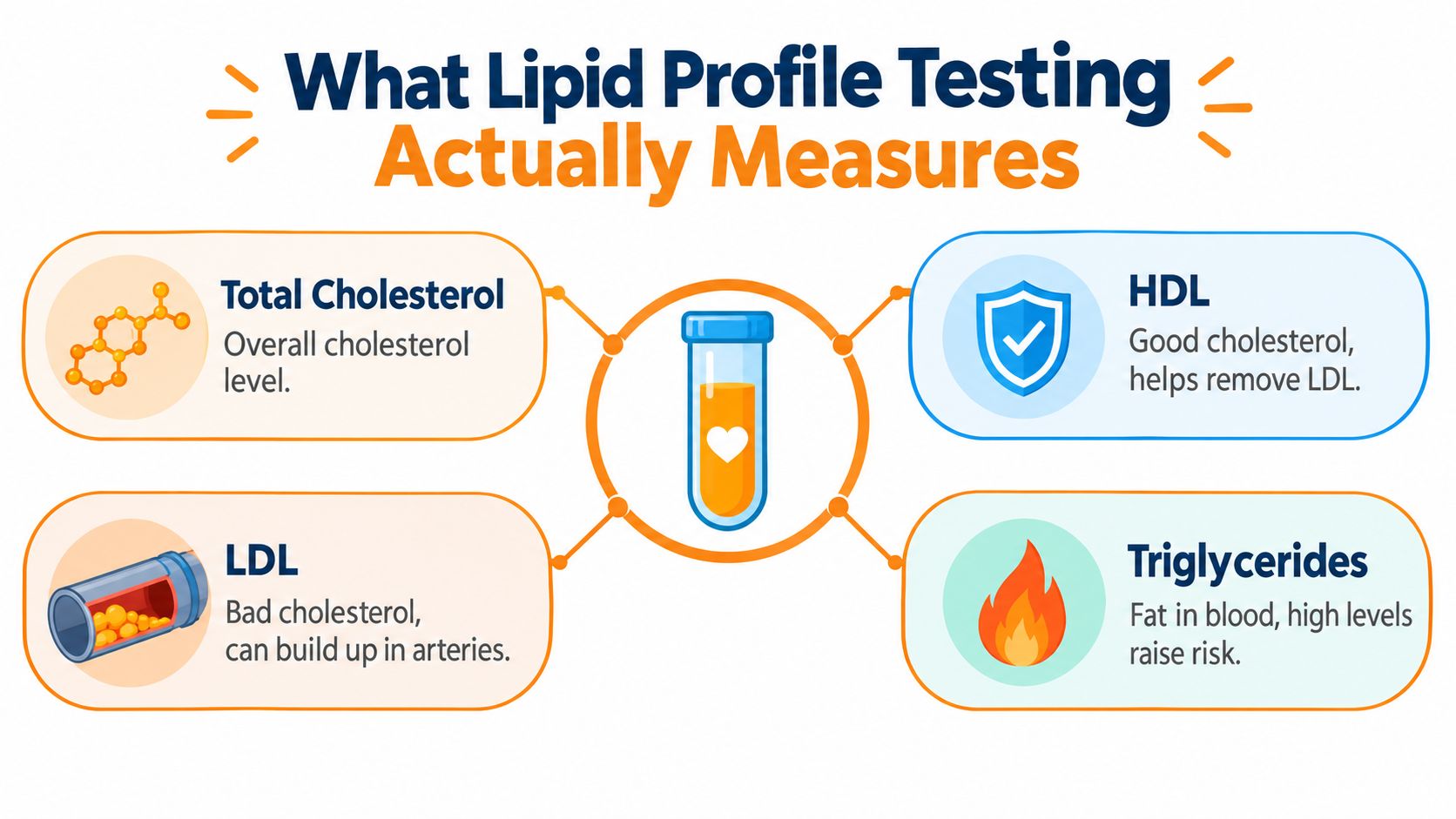
A single cholesterol result may show only total cholesterol. A full panel works more like a dashboard, showing several connected readings:
- Total cholesterol, the combined cholesterol measured.
- LDL-C, cholesterol carried in particles associated with artery-wall build-up.
- HDL-C, involved in carrying surplus cholesterol towards the liver.
- Triglycerides, another type of blood fat.
- Non-HDL-C and ratios, which add context about cholesterol carried by potentially harmful particles.
The HEART UK and Association for Laboratory Medicine consensus statement describes a standard profile containing total cholesterol, HDL-C, triglycerides, calculated non-HDL-C, calculated LDL-C and the total cholesterol/HDL-C ratio.
The blood collection itself usually takes only a few minutes. Interpretation takes more care. Your clinician may consider age, blood pressure, smoking, family history, diabetes, kidney disease, and existing heart or circulation problems. This guide to understanding a cholesterol blood test explains the wider process in plain language.
The Key Markers Explained in Plain English
A cholesterol report can look like a collection of unrelated figures. Each marker answers a different question, so the overall result works more like a dashboard than a single pass-or-fail score.
The four core markers
Total cholesterol combines several forms of cholesterol. It offers a broad overview, but it cannot show which particles are contributing to the result.
LDL-C is often called “bad cholesterol”. It works like delivery vans carrying cholesterol around the body. Excess LDL-C can contribute to cholesterol build-up in artery walls.
HDL-C, sometimes called “good cholesterol”, helps move surplus cholesterol towards the liver, where the body can process it. A higher HDL-C result provides useful context, though it does not remove other risk factors.
Triglycerides are blood fats used to store energy. Recent food, alcohol, weight and metabolic health can affect the reading. A raised result from a non-fasting sample may therefore need careful clinical interpretation.
Non-HDL-C covers cholesterol carried by several particles that may contribute to artery disease. Clinicians may also request ApoB or lipoprotein(a) when a more detailed risk assessment is appropriate. The total cholesterol to HDL-C ratio may be listed as well.
| Marker | Role in the body | Plain-English analogy |
|---|---|---|
| Total cholesterol | Overall cholesterol measurement | A broad dashboard reading |
| LDL-C | Carries cholesterol around the body | Delivery vans on the road |
| HDL-C | Helps move surplus cholesterol towards the liver | A clean-up crew |
| Triglycerides | Stores and transports energy | Fuel reserves |
The guide to PPARs and metabolic switches explains how body systems can influence fats and cholesterol.
UK reports usually show results in mmol/L. US reports may use mg/dL, so the figures cannot be compared directly without conversion.
A useful rule: read the marker name, unit and laboratory range together.
Sample Types and Collection Methods Compared
A lipid profile can begin with a clinic appointment, a fingertip prick at home, or a capillary sample collected from the upper arm. The best option depends on the reason for testing, the tests requested, and how comfortable you are collecting blood yourself.
Venous blood draw
A trained practitioner takes blood from a vein, usually in your arm. This familiar clinic method provides enough blood for a broad set of tests and may be preferred when several investigations are being carried out together.
It can also suit anyone who feels uneasy about collecting their own sample. The trade-off is arranging an appointment, travelling to a surgery or clinic, and waiting for an available collection slot.
Capillary finger-prick
A finger-prick kit collects a small sample from the fingertip. It may suit a busy parent, someone living far from a clinic, or anyone who values testing at home.
Collection technique affects whether the sample can be processed. Warm hands, following the instructions carefully, and filling the device properly all matter. An incomplete or poorly collected sample may need repeating, so home testing is convenient only when the process is followed closely.
For practical preparation and collection advice, read this UK home blood test kit guide.
Tasso OnDemand collection
The Tasso OnDemand device collects capillary blood from the upper arm into a sealed cartridge. It offers another option for people who dislike fingertip collection or find finger-prick sampling difficult.
You still need to follow the provider's collection, labelling and return instructions. Check which tests the service supports and whether collection takes place at home or at a participating location. Availability can vary between providers.
| Method | Accuracy | Comfort | Convenience | Best for |
|---|---|---|---|---|
| Venous draw | Suitable for broad clinical testing | Brief needle discomfort | Requires an appointment | People wanting a traditional clinic collection |
| Finger-prick | Useful for screening when collected correctly | Small fingertip prick | Can be completed at home | People who value privacy and flexibility |
| Tasso OnDemand | Provides a sealed upper-arm capillary sample | Designed to reduce collection discomfort | Depends on local availability | People who dislike finger-pricks |
| Fasting venous sample | Useful when triglycerides need closer assessment | Standard blood draw | Requires careful preparation | Marked hypertriglyceridaemia or selected lipid disorders |
Do you need to fast?
Routine UK lipid profile testing usually does not require fasting. NHS England supports a non-fasting full profile, and the UK laboratory consensus statement says patients should not routinely be required to fast. This reflects the wider UK shift towards non-fasting testing, while still allowing clinicians to request a different sample when the results need closer assessment.
Fasting may be requested if triglycerides are markedly raised, if the result could make LDL reporting less reliable, or if clinicians are investigating conditions such as familial hypercholesterolaemia. Northern England lipid guidance advises repeating a full fasting profile and checking ApoB when triglycerides are 4.5 mmol/L or above, within 5 to 14 days.
If your provider asks you to fast, follow its specific instructions rather than assuming that every laboratory uses the same timing. University Hospitals Sussex lipid profile guidance describes fasting collection as 12 to 14 hours in some settings, with water allowed. Gloucestershire Hospitals lipid guidance describes water only for 12 hours.
Pharmacist's tip: Don't guess. Ask, “Is this routine non-fasting testing, or do you need a fasting sample because of my triglycerides or medical history?”
How to Read Your Lipid Profile Results
A lipid report is easier to read if you separate the marker, result, unit and reference range. Then assess the pattern as a whole rather than focusing only on the highest figure.
These UK reference points are general guides, not personal treatment targets. People with greater cardiovascular risk may have a lower LDL-C goal.
| Marker | Desirable general reference | High-risk target or reference | Concerning context |
|---|---|---|---|
| Total cholesterol | Below 5 mmol/L | Interpreted with overall risk | Higher results need clinical context |
| LDL-C | Below 3 mmol/L | Below 1.8 mmol/L may apply to high-risk patients | Persistent elevation or inherited pattern |
| HDL-C | Above 1 mmol/L for men, 1.2 mmol/L for women | No single treatment target | Lower values may add to overall risk |
| Triglycerides | Below 1.7 mmol/L fasting | Non-fasting interpretation differs | High or rising results need review |
Triglycerides need particular care because the reference range depends on how the sample was collected. A UK pathology reference lists fasting levels below 1.7 mmol/L and non-fasting levels below 2.0 mmol/L for people over two years old UK triglyceride reference guidance.
A raised result does not identify one cause by itself. Your clinician may consider family patterns, diabetes, an underactive thyroid, alcohol, medicines, weight and recent food intake. A single result does not confirm familial hypercholesterolaemia or another diagnosis.
Take the report, medicine list and relevant family history to your appointment. Note whether you fasted, felt unwell, or had difficulty collecting a finger-prick sample, as these details can help explain an unexpected result.
Who Should Be Tested and How Often
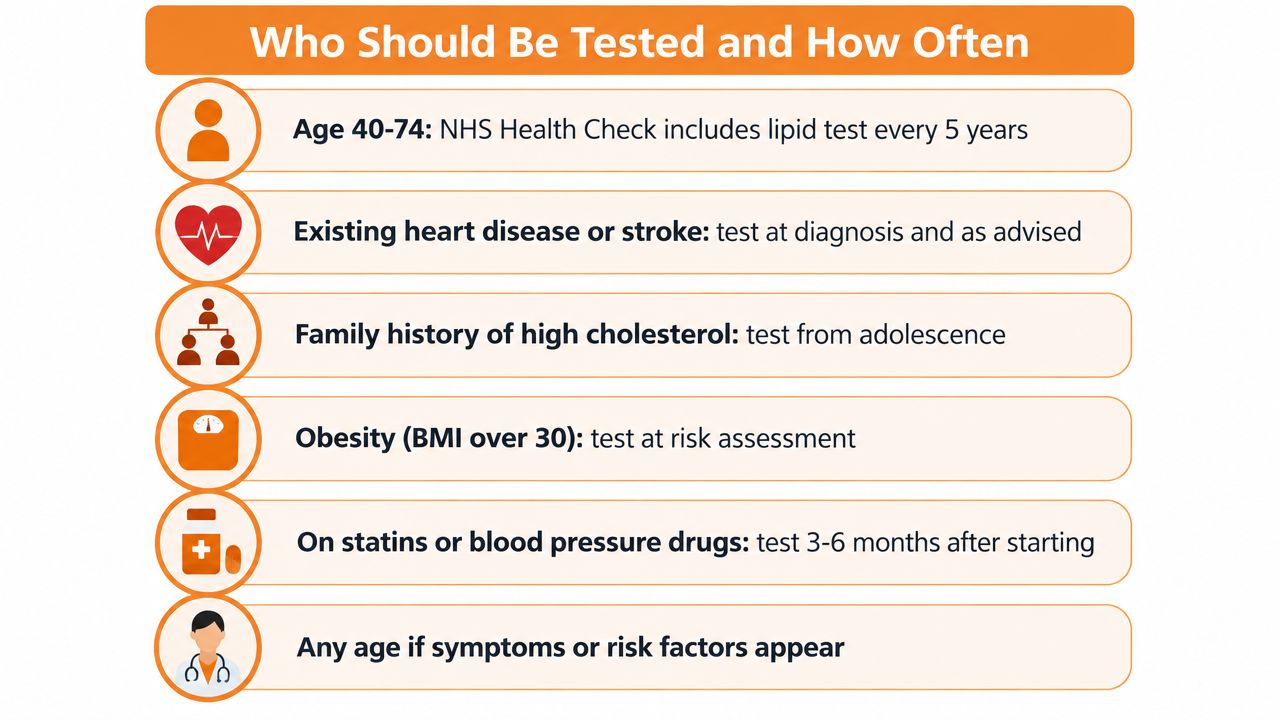
The NHS Health Check covers adults aged 40 to 74 and includes cardiovascular risk assessment. Lipid testing may also be appropriate when someone has relevant risk factors, an existing condition, or treatment that needs monitoring.
A healthy adult may have testing as part of routine prevention. If you take lipid-lowering medicine, follow-up follows a different timetable. UK guidance describes repeat testing typically within three months of starting treatment, followed by annual review, with closer checks for severe hypertriglyceridaemia, as noted in the NHS England lipid management pathway.
Ask about earlier review if you have:
- A strong family history, particularly early heart disease or inherited high cholesterol.
- Diabetes, high blood pressure or chronic kidney disease.
- A previous abnormal lipid profile.
- Treatment changes, side effects or concerns about statins.
- Possible familial hypercholesterolaemia, based on family results or markedly raised cholesterol.
Fitness does not remove inherited risk. A gym-goer with a strong family history should still discuss testing. Shift workers should mention meal timing and alcohol patterns, especially when triglycerides are raised. Food and alcohol can affect some results, while current UK practice increasingly uses non-fasting samples, so fasting is not automatically required. Finger-prick kits can provide a useful screening result, but unexpected or markedly abnormal findings may need confirmation through clinical testing.
An adult over 40 can ask about an NHS Health Check rather than waiting for a private appointment.
What Your Results Mean for Your Heart Risk and Next Steps
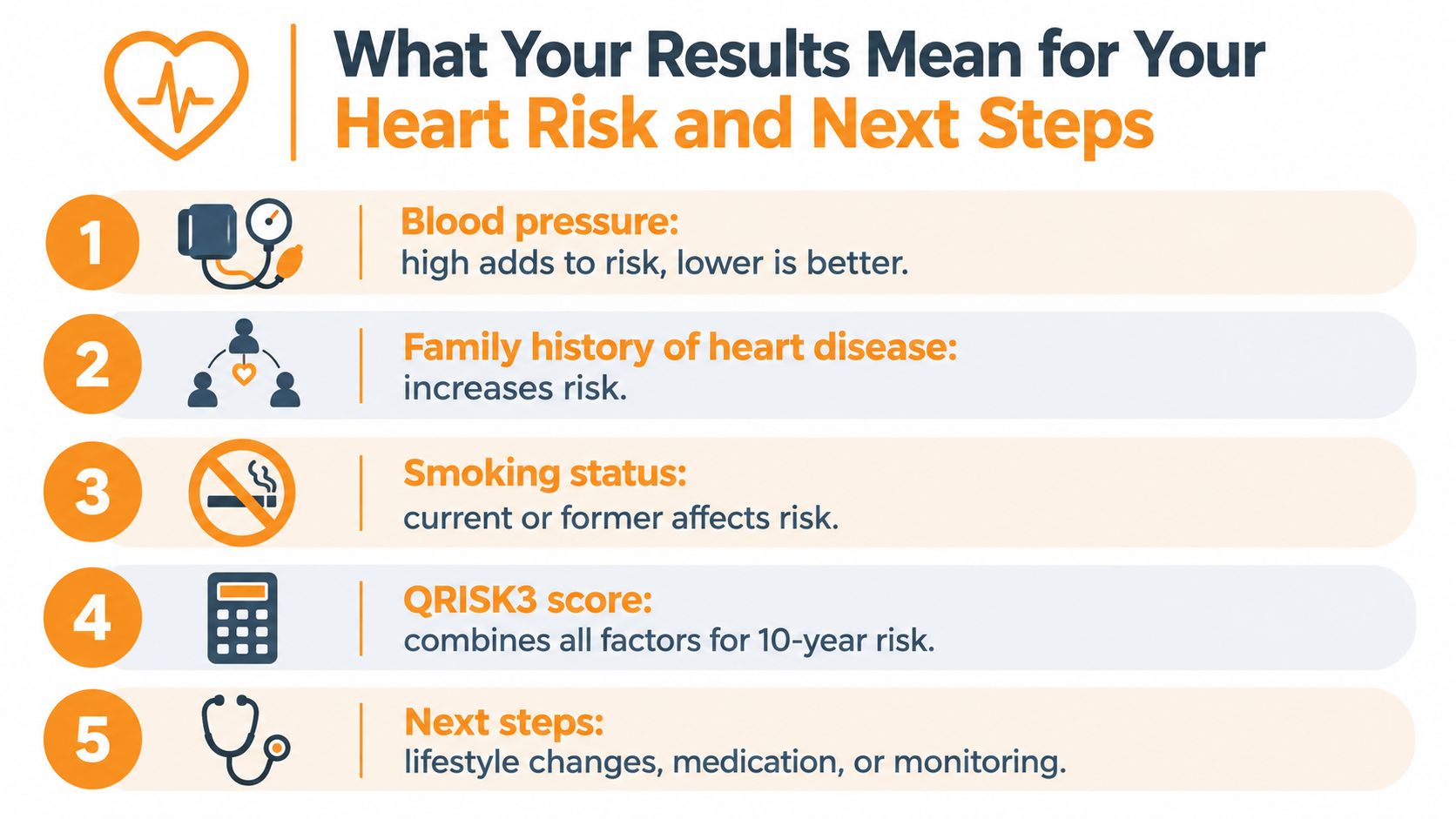
A lipid profile is one part of your heart-risk assessment. Your GP may also consider blood pressure, smoking, family history, diabetes, kidney health and your QRISK3 score. One cholesterol number is a clue, not a verdict.
A borderline result may lead to practical changes and a follow-up discussion. These could include replacing some saturated fats with unsaturated choices, eating more soluble fibre such as oats and pulses, increasing activity, and working towards a healthier weight. Your clinician can help you choose steps that fit your routine.
When results need closer review
Clearly raised cholesterol or triglycerides warrant a clinical review. Your GP may check medicines, diabetes and thyroid problems, ask about alcohol, and consider whether an inherited condition explains the pattern. Because UK practice increasingly uses non-fasting samples, fasting is not automatically needed, although food and alcohol can affect some results. Record whether you fasted and whether the sample came from a finger-prick or venous draw.
Very high triglycerides, suspected familial hypercholesterolaemia, or difficulty tolerating statins may require specialist advice. Do not start, stop or alter prescribed treatment without speaking to the prescriber.
Pharmacist's tip: Prepare questions before your appointment. “What is my QRISK3 score?”, “Do I need a repeat fasting test?”, and “Could another condition or medicine affect this result?” are useful starting points.
For the next fortnight, keep the plan manageable:
- List medicines, supplements and relevant family history.
- Choose one food change and one activity change.
- Arrange review if your report flags an abnormal result.
- Seek urgent help for chest pain, sudden weakness, severe breathlessness or other emergency symptoms. A lipid result itself rarely causes immediate symptoms.
If you are considering supplements or have concerns about statin side effects, discuss them with a qualified clinician. This UK guide to CoQ10 benefits and safety may help you prepare questions, but it does not replace a medication review.
How Courier Pharmacy's Lipid Profile Testing Fits In
A rural patient may want a home collection option, while someone uneasy about needles may prefer an upper-arm sample. Another patient may want the familiarity of a standard venous draw at a clinic. Courier Pharmacy provides these routes alongside NHS care, including a postal finger-prick kit, Tasso OnDemand collection at participating pharmacy branches, and venous blood draws through partner clinics.
The usual process is straightforward: order online, collect the sample at home or attend an appointment, then return it by post or leave it at the specified location. The service states that samples are analysed by a UKAS-accredited laboratory, with results provided within 2 to 3 working days and a pharmacist review call to discuss the report.
A home kit can be a practical starting point, particularly when travelling to a clinic is difficult. It still requires careful collection and prompt return, so follow the instructions closely. If the result needs attention, the service can advise you to share the report with your GP.
That report supports NHS follow-up rather than replacing it. Your GP may review your QRISK3 assessment, arrange further testing, or discuss treatment. Private testing should not delay urgent care or an NHS assessment where one is needed.
You can review the Courier Pharmacy cholesterol home blood test kit before ordering, including the current collection and pharmacist review details.
Common Questions About Lipid Profile Testing
Do I need to fast for lipid profile testing?
Usually, no. UK guidance now supports non-fasting samples for routine lipid assessment. Fasting may still be requested when triglycerides are markedly raised, a calculated LDL result could be affected, or a particular lipid disorder needs investigation. Follow the instructions from the clinician or testing service, rather than fasting because the report is called a lipid profile.
Are NHS lipid tests free?
NHS testing is generally available without a separate charge when a clinician considers it clinically indicated. Access depends on your health needs, the local pathway and your GP's assessment. A private home kit follows a different route and does not replace NHS follow-up.
Are home lipid tests reliable?
A correctly collected sample sent to a suitable laboratory can provide useful results. Finger-prick collection is more vulnerable to an under-filled device, contamination or delay in posting, so read the instructions before starting and return the sample promptly. An unusable sample may need repeating.
Does one high result mean familial hypercholesterolaemia?
No. One raised result does not establish an inherited condition. A clinician may review repeat results, family history, examination findings and other possible causes before deciding whether specialist assessment or family testing is appropriate.
Can children have lipid profile testing?
Yes. Testing may be arranged when there is a relevant family history or another clinical reason. Children's results must be interpreted using age-appropriate reference ranges, not adult ranges.
Do supplements lower cholesterol safely?
Bergamot and red yeast rice can affect medicines and may cause safety problems. Speak with a pharmacist or GP before using them, especially if you already take lipid-lowering treatment. Do not assume that a product labelled “natural” is risk-free.
Can one low-fat meal change the result?
One meal can influence triglycerides more than a lasting change in diet. Routine non-fasting testing remains acceptable, although you should follow specific fasting instructions if your clinician gives them.
What should I do with an abnormal report?
Arrange a review with the clinician or pharmacist who ordered the test. Take the report, medicine list, family history and details of whether you had eaten. Do not change prescription treatment on your own.
Courier Pharmacy offers finger-prick, Tasso and venous collection routes, depending on availability. This information is educational and does not replace medical advice.


