Loperamide HCl 2mg: Dosing, Safety and When to Seek Help
Loperamide HCl 2mg explained: UK adult and child dosing, daily limits, cardiac and opioid warnings, and when diarrhoea needs a GP or NHS 111 call today.

It's the middle of the night, your stomach is unsettled, and the wording on the box suddenly seems confusing. Loperamide HCl 2mg means each tablet or capsule contains 2 mg of medicine. It is not an instruction to take a dose at fixed times.
For adults with short-term diarrhoea, the NHS loperamide dosing guide gives a starting dose of two 2 mg units (4 mg), then one unit (2 mg) after each further loose stool. The shop-bought maximum is 12 mg (six units) in 24 hours, and self-treatment should not continue beyond 48 hours without medical advice.
The dosing rules work like a tally. The first loose stool starts the count with two units, each later loose stool adds one, and six units bring you to the 24-hour ceiling. Once that ceiling is reached, there is no room for another dose. If symptoms continue for 48 hours, stop self-treating and ask for medical advice.
Five key takeaways
- Count the whole total: The first two units and every later unit all count towards the 24-hour ceiling.
- Follow your exact pack: Age limits and licensed instructions can differ.
- Stop when symptoms settle: You do not need to finish the packet.
- Replace lost fluids: Fewer toilet trips do not prove you are well hydrated.
- Recognise warning signs: Blood, fever, severe pain or swelling need medical advice.
Loperamide HCl 2mg dosing at a glance
The usual adult starting dose is two units, followed by one after each further loose stool. A unit means one tablet or capsule containing the stated strength.
The NHS loperamide dosing guide gives adults aged 18 and over a starting dose of 4 mg, then 2 mg after each loose stool, with a shop-bought maximum of 12 mg in 24 hours [1]. Its prescribed maximum is generally 16 mg in 24 hours, and self-treatment should not continue beyond 48 hours without medical advice [1].
Loperamide HCl 2mg doses and limits in the UK
| Situation | Dose | Limit in 24 hours |
|---|---|---|
| Acute diarrhoea, first dose, adults and children 12+ where the pack permits | 4 mg, two 2 mg units | Shop or pharmacy maximum: 12 mg, six units |
| Each further loose stool | 2 mg, one unit | Shop or pharmacy maximum: 12 mg, six units |
| Usual daily amount for acute diarrhoea | 6–8 mg, three or four units | Stop when symptoms settle, this isn't a target |
| Prescribed use | As directed by your prescriber | Generally 16 mg, eight units |
| IBS diarrhoea, adults 18+ with a confirmed diagnosis | 4 mg first, then 2 mg per loose stool | Same shop-bought limit as acute diarrhoea, unless prescribed otherwise |
| Self-treatment without medical advice | Not beyond 48 hours | Ask a doctor if symptoms continue |
| Children under 12 | Not for self-treatment, seek professional advice | No self-treatment dose given here |
Table guidance draws on NHS advice and UK product information [1–3].
Understand the ceiling, not just the dose
The first dose counts. The daily maximum isn't an extra allowance after the starting dose, and midnight isn't permission to start counting from zero.
NHS adult guidance and individual product licences use different age ranges. Some packs cover younger teenagers, but a parent shouldn't assume that adult advice applies unchanged. Check the leaflet and ask a pharmacist about any uncertainty.
Pharmacist's tip: Keep the packet beside a written dose record. Count tablets and capsules together if you've used different packs containing loperamide.
Many patients need treatment for only one or two days, according to NHS advice [1]. Remember the ceiling, but stop sooner if symptoms settle.
What loperamide does and does not do
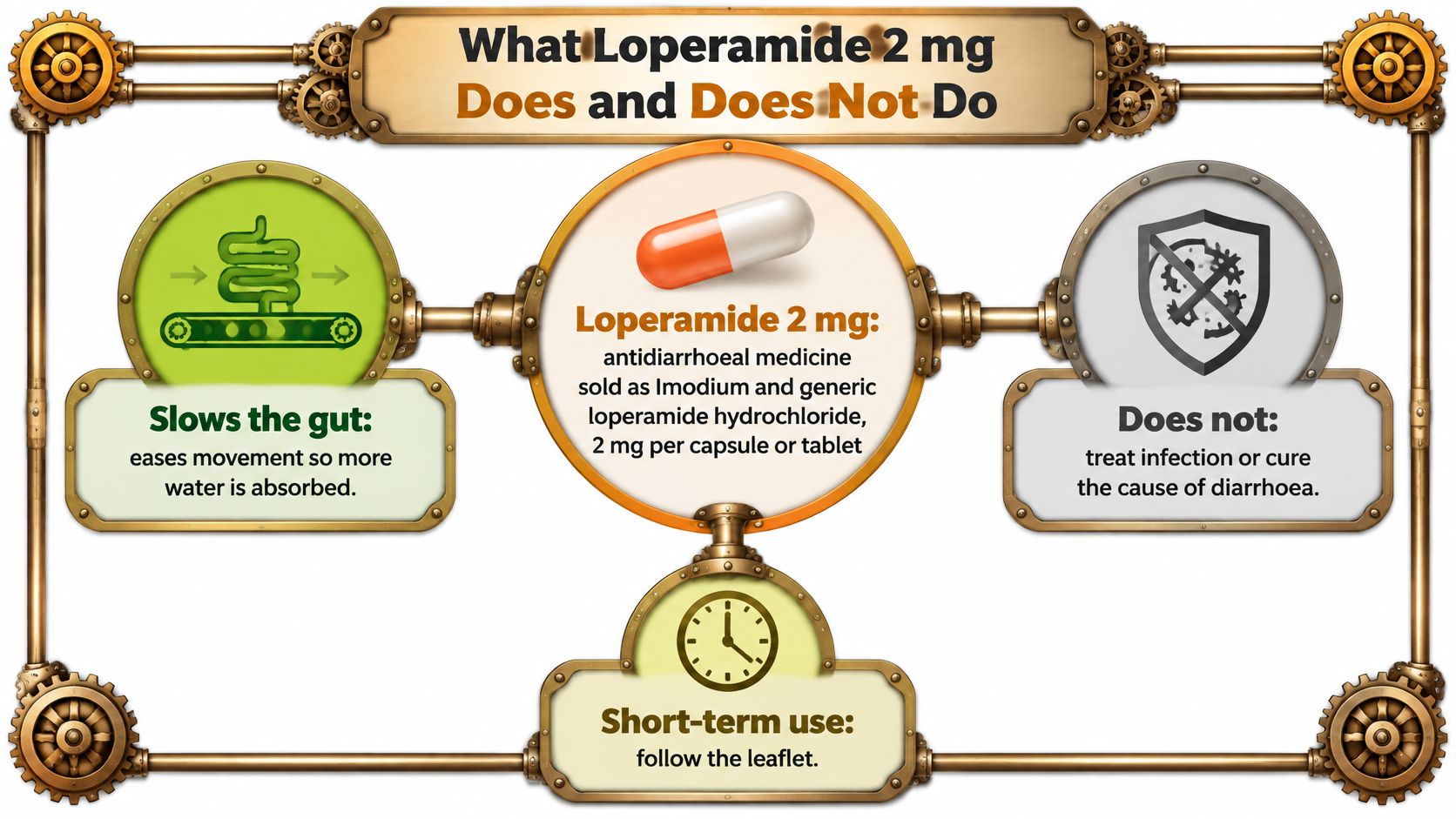
Loperamide is an antidiarrhoeal medicine. HCl means hydrochloride, the form of the active ingredient used in the medicine. Imodium is a brand name, while other packs use the generic name loperamide.
The UK product information for loperamide capsules describes capsules containing 2 mg and explains that loperamide slows gut movement, allowing more time to absorb water and salts [2].
Think of your gut as a conveyor belt. When it moves too quickly, stool can remain loose and watery. Loperamide slows that movement, which can make stools firmer and reduce urgent toilet trips.
The diagram illustrates the difference between symptom relief and treating the cause.
Relief isn't a diagnosis
Loperamide acts on opioid receptors in the gut wall. At normal doses, its main useful action is in the bowel, not the brain.
It doesn't kill germs or cure every cause of diarrhoea. Ongoing symptoms may need assessment for infection, bowel inflammation or another condition [2].
A doctor-confirmed diagnosis also matters when treating irritable bowel syndrome. Don't assume that a new pattern of diarrhoea is IBS just because loperamide helps.
- Symptom relief: Fewer loose stools can make daily life easier.
- Cause assessment: Persistent or unusual symptoms still need checking.
How to take loperamide 2mg
Start by checking that the strength and age range on your box match what you intend to take. These instructions apply to single-ingredient loperamide products, not combination products that mix it with other active ingredients.
The dosing rule is a simple count. You take a starting amount, then add a smaller amount only when another loose stool happens, and you stop when you hit the daily ceiling. The UK capsule prescribing information specifies 4 mg initially, then 2 mg after each further loose stool, with a maximum of 12 mg in 24 hours, and lists 6–8 mg as a usual daily amount rather than a target everyone must reach [3].
Follow the daily limit printed on your own pack, because some products set a lower maximum than the general guidance. When two limits differ, the lower one wins.
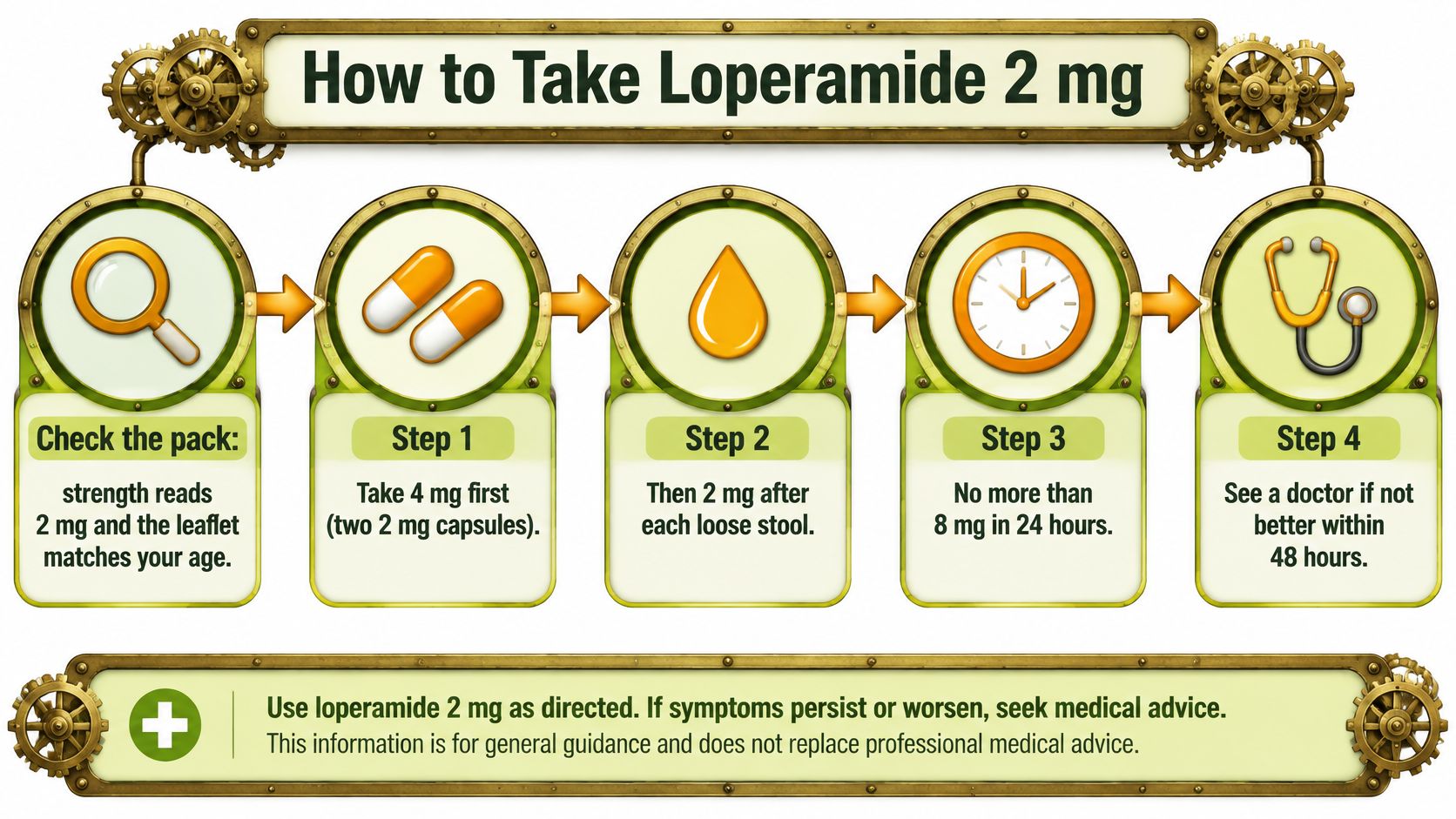
Counting your doses, step by step
- Check the label and leaflet. Confirm the strength, formulation and permitted age on your pack.
- Take the starting dose. Swallow standard capsules with water; follow the pack directions for tablets that dissolve on the tongue.
- Wait for another loose stool. A repeat dose is triggered by a stool, not by the clock.
- Write down the time and amount. Include the starting dose in your running total, because it counts toward the ceiling.
- Stop when stools settle. There is no course to finish, so a quiet afternoon means no more doses.
- Stop at your pack's daily ceiling. If diarrhoea is still going at that point, ask NHS 111 or a clinician what to do next rather than continuing on your own.
- Seek review if you are not improving. Do not stretch self-treatment past the stated limit.
Worked through as counting: the starting dose is two capsules. Each loose stool after that adds one capsule. You keep adding only while loose stools keep coming, and the day ends whenever you reach the ceiling, whichever comes first.
Slips that break the count
Common mistakes include mixing up milligrams with capsule counts, doubling up after a gap to "make up" for a missed dose, and treating repeat doses like scheduled medicine taken at set times. There is no catch-up dose. If you lost track of how much you have taken, stop counting from memory and ask a pharmacist before taking more.
Fluids are part of treatment
Loperamide slows the loss, but it does not replace what your body has already lost. Drink fluids and ask a pharmacist about oral rehydration salts, which replace salts as well as water.
Pharmacist's tip: Log each dose in your phone's notes the moment you take it. If you set a reminder, let it prompt you to check the record, not to take another dose automatically.
If you watch the video below, check any dosing advice in it against your current UK pack, since instructions vary between products and countries.
Who should not self-treat with loperamide
Self-treatment means choosing and taking a medicine without a clinician assessing your current illness. A medicine being available without a prescription doesn't mean it suits every bout of diarrhoea.
The UK product safety information says loperamide should not be used when slowing the bowel could cause harm [4]. It also identifies bloody diarrhoea with a raised temperature, bowel blockage, and certain inflammatory or antibiotic-related illnesses as important concerns [4].
Ask before taking it
- Children: Don't self-treat young children. Ask a pharmacist or GP to check suitability for a teenager.
- Pregnancy or breastfeeding: Ask a pharmacist or GP before use.
- Liver problems: Get advice because your body may handle the medicine differently.
- Ulcerative colitis: Don't use it to suppress a possible flare without clinical advice.
- Diarrhoea after antibiotics: Speak to a clinician rather than assuming it's a minor side effect.
- Blood with a high temperature: Seek medical assessment instead of taking it to stop the stools.
People with inflammatory bowel disease need to distinguish their usual agreed treatment plan from new symptoms. Don't change that plan just because a medicine is easy to buy.
Stop if your bowel seems blocked
Constipation, a swollen abdomen or suspected blockage are reasons to stop. Ileus means the bowel has stopped moving properly, even without a physical blockage.
Slowing the gut further can retain stool and worsen some bowel conditions [4]. Severe pain or marked swelling needs urgent assessment, not another dose.
Older adults who take several medicines, or have kidney or liver problems, should ask a pharmacist to check their situation. These conditions don't automatically mean everyone needs a lower dose, but they do make an individual check sensible.
If you're unsure whether you fit any of these groups, ask before the first dose.
Worked examples for busy UK lives
The following are hypothetical situations, not individual treatment plans. Each shows a different reason to pause rather than keep dosing.
A parent counting overnight
Sarah's teenage son wakes with sickness and diarrhoea. She checks his pack, then asks a pharmacist whether it's suitable for his age and symptoms.
If a pharmacist confirms use, she records the starting dose and every repeat. In a worked example using the shop-bought regimen, two units initially plus one after each of four further loose stools equals six units. That reaches the ceiling, so another loose stool means seeking advice, not giving another capsule [1–3].
A shift worker who needs to drive
Dan develops diarrhoea during a night shift. He checks his medicine, takes it only if suitable, and records the dose rather than relying on memory while tired.
He feels dizzy later. Whether the illness, dehydration or medicine caused it, he tells his supervisor and doesn't drive or use machinery. Feeling unsafe to work is a stop point, not something to push through.
A gym-goer after a hot session
Aisha has diarrhoea after training in hot weather. Her first concern is fluid loss, so she drinks and considers oral rehydration salts.
She checks for fever, blood and severe pain before considering medicine. She won't use loperamide repeatedly to get through training or a race without finding out why the symptoms keep returning.
A traveller keeping the leaflet
Tom packs the original UK box and leaflet rather than loose capsules in a toiletry bag. He also saves details of local medical services.
If he becomes ill, he checks his symptoms and records what he takes. Blood, fever, worsening dehydration or reaching the pack limit prompts medical advice rather than buying more tablets.
Keep the medicine record with you when asking for help. It's easier to assess risk when the clinician knows what you took and when.
Heart risks and opioid interactions to know about
Taking too much loperamide can cause serious heart rhythm problems. Don't increase the dose because the diarrhoea feels severe, and don't use it to manage opioid withdrawal.
The QT interval describes part of the heart's electrical reset. Some medicines can prolong it, increasing the risk of a dangerous irregular rhythm. High loperamide exposure is a concern, especially with overdose or interacting medicines.
This illustration shows the part of the heartbeat involved.

Why another medicine can matter
The liver uses enzymes, including CYP3A4, to process loperamide. A transport protein called P-glycoprotein also helps control its movement through the body.
Some medicines affect these systems and can increase loperamide exposure. Others add constipation, dizziness or sedation. These aren't all the same interaction, so a pharmacist needs the exact medicine names.
Loperamide interactions and what to do about them
| Medicine type | Examples | Why it matters | What to do |
|---|---|---|---|
| Strong CYP3A4 or P-glycoprotein inhibitors | Ritonavir, clarithromycin, itraconazole | May raise loperamide levels, especially concerning with excessive dosing | Ask a pharmacist or prescriber before use |
| Opioid painkillers | Codeine, morphine | Can add constipation and drowsiness; opioids themselves can suppress breathing | Avoid combining unless a clinician advises it |
| Sedatives and sleep medicines | Benzodiazepines | Sedation can make illness or medicine-related dizziness harder to manage | Check with a pharmacist first |
| Antiarrhythmic medicines | Quinidine | Can affect loperamide exposure and heart rhythm | Don't combine without professional advice |
| Alcohol | Alcoholic drinks | Can worsen dizziness and drowsiness | Avoid alcohol while unwell |
| Heart rhythm conditions or QT-prolonging medicines | Personal or family history of arrhythmia | May affect whether treatment is suitable | Get advice before the first dose |
These are checks to discuss, not proof that a dangerous reaction will happen. Don't stop a prescribed medicine yourself to make room for loperamide.
Combination painkillers matter too. For example, Nurofen Plus tablets contain codeine, so include them when telling the pharmacist what you take.
- Bring the full list: Include prescriptions, pharmacy medicines, supplements and herbal products.
- Mention heart history: Include unexplained fainting or known rhythm problems.
- Report excess dosing promptly: Don't wait for symptoms before seeking urgent advice.
The list isn't complete. If you can't identify an ingredient, show the pharmacist a photograph of the box.
Symptoms that need medical help now
Call 999 for extreme drowsiness, slow breathing, collapse or serious heart symptoms. For other concerning symptoms, seek same-day advice through NHS 111 or your GP.
Mild, short-lived symptoms without warning signs may suit pharmacy advice. If someone looks seriously unwell, don't delay emergency help while checking a leaflet.
Symptoms during loperamide treatment and the action to take
| Symptom | Action | Who to contact |
|---|---|---|
| Extreme drowsiness, slow or shallow breathing | Call for emergency help immediately | 999 |
| Fainting, chest pain, racing or irregular heartbeat | Seek emergency assessment, don't drive yourself | 999 or A&E |
| Severe belly pain or swelling | Get urgent assessment today, or emergency help if severe or worsening | NHS 111, urgent GP or A&E |
| Blood or mucus in stools | Seek same-day advice; don't self-treat with loperamide | GP or NHS 111 |
| Fever with diarrhoea | Get same-day medical advice | GP or NHS 111 |
| Very dark urine, dizziness or dry mouth | Drink fluids if able and get advice today | GP or NHS 111 |
| Constipation or swollen tummy while taking loperamide | Stop taking it and seek advice | GP or pharmacist, urgently if painful |
| No better after 48 hours | Arrange medical review rather than continuing self-treatment | GP or pharmacist |
If you've taken too much
Seek urgent advice even if you feel well. Keep the packet and dose record available, and tell the clinician about other medicines.
Don't induce vomiting or take another medicine to counteract the dose. If the person becomes hard to wake or has abnormal breathing, call an ambulance.
Practical rule: When the pack ceiling is reached, the next step is advice, not another dose.
Children and older adults can become unwell from dehydration more quickly. Seek help sooner if they can't keep fluids down or seem unusually weak or sleepy.
Buying loperamide 2mg safely online
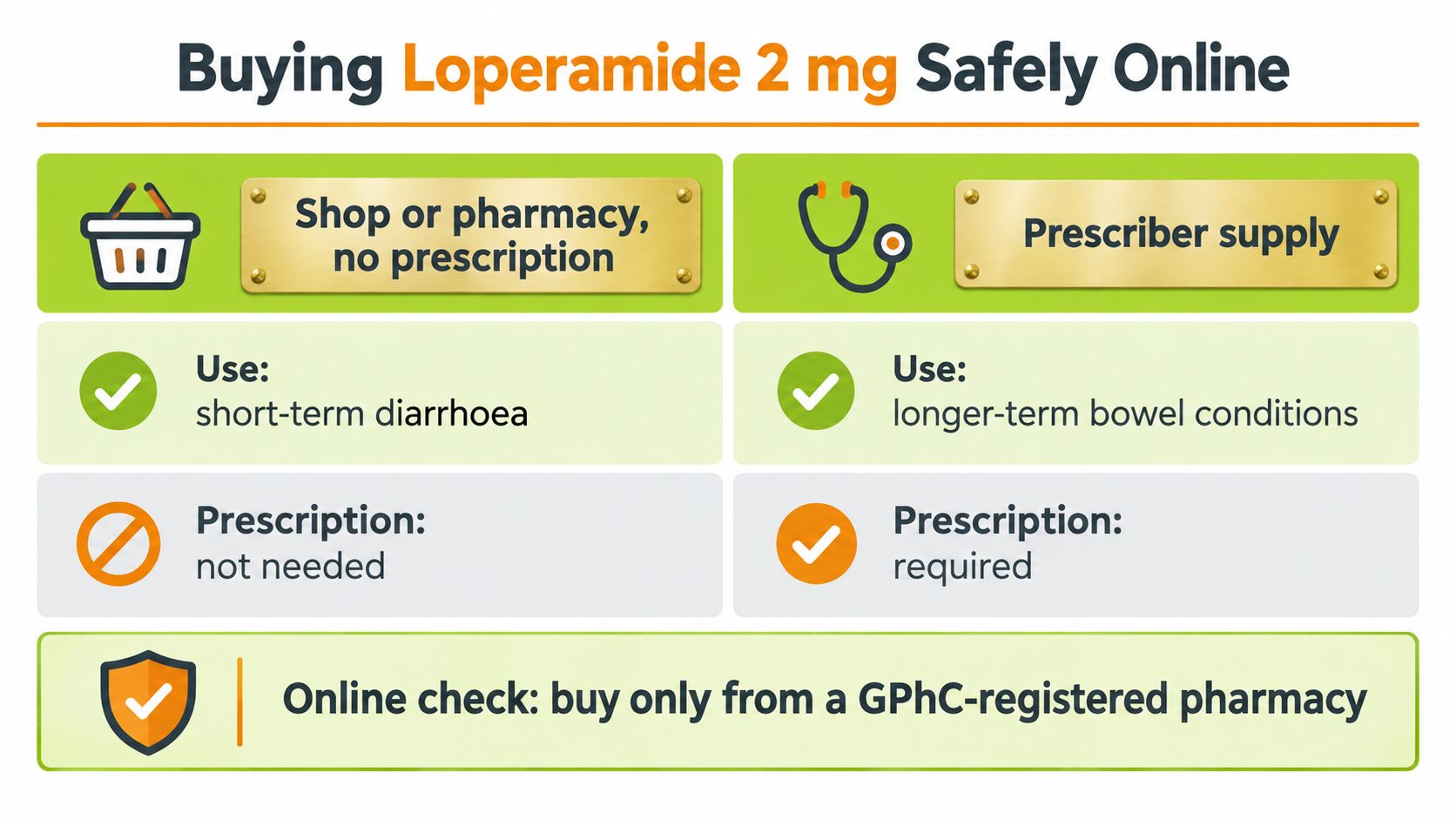
Loperamide is available without a prescription for suitable short-term diarrhoea. A prescriber may also use it for longer-term bowel conditions.
The supply route doesn't replace a suitability check. A larger pack or a prescription-style website doesn't give you permission to increase the dose.
Over-the-counter and prescription loperamide compared
| Feature | Over the counter | On prescription |
|---|---|---|
| Supply | Shops and pharmacies without a prescription | Issued by a prescriber after assessment |
| Who checks suitability | You, using the leaflet and pharmacist advice | Your prescriber sets the treatment plan |
| Typical use | Short-term, mild acute diarrhoea | Longer-term bowel conditions or specific needs |
| Online route | Expect appropriate suitability questions and access to pharmacy advice | Prescriber review before dispensing |
| Self-treatment limit | 48 hours without medical advice | Set by the prescriber |
Checks before ordering
- Verify registration: Check the pharmacy's entry on the GPhC register yourself.
- Confirm UK regulation and ask about supply through MHRA-registered wholesalers.
- Expect health questions: A responsible service should check symptoms, other medicines and relevant conditions.
- Inspect the sealed pack and ensure the leaflet matches the medicine and strength.
- Report suspected side effects: Use the MHRA Yellow Card scheme and seek medical advice when needed.
This visual summarises the different supply routes.
Pharmacist's tip: If a questionnaire asks about heart problems or medicines you don't recognise, ask for help before dispatch. Don't guess to get through the form.
Compare any UK online pharmacy service against these checks. Buy for self-treatment only when symptoms are short-lived, mild, and suitable for the product; otherwise, speak to a clinician first.
In summary
Count doses, not just toilet visits.
Include the starting dose in your total.
Stop when symptoms settle.
Keep replacing lost fluids.
Ask for help at the pack limit or if symptoms persist.
Seek urgent care for serious warning signs.
Editorial and clinical transparency
Byline: Medical education article; no named author or credentials supplied.
Clinical review: No named clinician or completed clinical review has been confirmed.
How this content was created: This article uses NHS dosing guidance and UK product information listed below. It distinguishes general guidance from product-specific instructions; a registered pharmacist should check the final text and visual assets before publication.
Disclaimer: This is general information, not a substitute for personal medical advice.
Meta description: Loperamide HCl 2mg explained for UK adults. Learn how to count doses, follow daily limits, replace lost fluids and know when to seek medical help safely.
Suggested Medical Mojo internal pages: Link to existing pages about diarrhoea, oral rehydration salts, IBS and medicine side effects. Confirm the actual page addresses before adding links.
Designer guidance: Use bright lime green, pale yellow-green and light grey with painterly details and ornate brass overlays. Prioritise legible safety information over decorative elements.
- Dose-counter visual: Show a starting dose included in a running total. Alt text: “Loperamide dose record showing the starting dose counted towards the daily maximum.”
- Hydration visual: Show water, oral rehydration sachets and a symptom checklist. Alt text: “Fluids and oral rehydration salts beside a diarrhoea warning-sign checklist.”
References
[1] NHS (n.d.) How and when to take loperamide. Linked in the dosing section.
[2] Electronic Medicines Compendium (n.d.) Loperamide hydrochloride capsule product information, product entry 14912. Linked in the medicine explanation section.
[3] Electronic Medicines Compendium (n.d.) Loperamide hydrochloride capsule product information, product entry 13499. Linked in the administration section.
[4] Electronic Medicines Compendium (n.d.) Loperamide product information, product entry 10420. Linked in the self-treatment safety section.
Frequently asked questions about loperamide 2mg
How many units can I take in a day?
The general shop-bought maximum is six units, while prescribed treatment may allow eight, as summarised in NHS guidance [1]. Follow your exact pack or prescription, including any lower limit.
How long does loperamide take to work?
It may start helping within a few hours, but the response varies. Don't take extra doses to force a faster effect, and don't mistake reduced stool frequency for full recovery.
Can children take loperamide?
Don't self-treat children under 12. Some products cover ages 12 and over, but ask a pharmacist or GP to check suitability and dosing for anyone under 18 [1–3].
Can I drive while taking it?
Don't drive if you feel dizzy, drowsy or less alert. Diarrhoea and dehydration can also affect your ability to drive safely.
Does loperamide cure a stomach bug?
No. It can reduce loose stools, but it doesn't kill the germs causing an infection. Blood, fever or persistent symptoms need assessment rather than symptom suppression.
Is Imodium the same as loperamide?
Imodium is a brand name; loperamide is the active ingredient in its loperamide products. Check the box because formulations and additional ingredients can differ.
Can I take it with other medicines?
Ask a pharmacist, especially if you use opioid painkillers, sedatives or heart medicines. If you develop constipation or a swollen tummy, stop loperamide and get advice rather than adding another bowel medicine yourself.
Courier Pharmacy offers online medicine assessments and pharmacy support to help patients check whether treatment suits their symptoms and other medicines. Visit Courier Pharmacy to ask about suitable diarrhoea treatment, with your current medicine list and any doses already taken ready to share.


