Low Dose Naltrexone and Alcohol: Safety Guide
Is low dose naltrexone and alcohol safe? Learn the key differences from standard treatment, liver risks, efficacy evidence and practical UK guidance.
People often treat a missing warning as a green light. If you're asking about low dose naltrexone and alcohol, there is no known direct toxic interaction, but that does not mean drinking is safe or advisable. Alcohol may work against the benefits you hope to get from LDN, and both can affect your liver.
The evidence for standard naltrexone does not automatically apply to LDN. Standard oral naltrexone, usually taken at 50 mg a day for alcohol dependence, is a different dose and treatment context from low dose naltrexone. UK guidance on standard-dose treatment cannot establish that LDN reduces drinking or is safe to combine with alcohol.
A lack of a known direct interaction is not proof that alcohol is harmless while taking LDN. The rest of the guide explains how alcohol may affect side effects and treatment benefits, what liver monitoring involves, and when to seek medical advice. Read our guide to whether LDN is safe before deciding what is appropriate for you.
Can you drink alcohol on low dose naltrexone
A drink on LDN is unlikely to cause a sudden toxic reaction. It can still work against your treatment, and it can mask how drunk you feel.
LDN isn't an approved UK treatment for alcohol dependence. The medicine used for that job is standard oral naltrexone, usually built up to 50 mg a day.
Five things to keep in mind:
- No acute poison mix: One drink is unlikely to cause a sudden toxic hit, but it can cut how well LDN works.
- Liver checks still matter: The medicine and alcohol both load the liver, so blood tests stay part of safe care.
- No UK proof that LDN cuts drinking: Don't treat a low dose as a tool to drink less.
- Never combine it with opioids: Naltrexone blocks opioid pain relief and can trigger severe withdrawal.
- Ask before you mix: Speak to the prescriber who started LDN before regular drinking becomes a habit.
"No known clash" isn't the same as "recommended". The rest of this guide covers liver health, side effect changes, and real UK situations, including a shift worker and a busy parent.
Read our notes on whether LDN is safe before you decide how strict to be.
Low dose versus standard naltrexone for alcohol
The evidence for standard-dose naltrexone does not establish that low dose naltrexone (LDN) reduces drinking. The doses and treatment aims differ, so the findings should not be transferred from one to the other.
| Feature | Low-dose naltrexone (LDN) | Standard naltrexone |
|---|---|---|
| Typical daily dose | A lower dose than standard naltrexone; the dose depends on the prescribed treatment | NICE advises starting at 25 mg and increasing to 50 mg daily |
| Evidence for alcohol dependence | Evidence at LDN doses is not established by the standard-dose trials described below | NICE guidance supports considering oral naltrexone alongside psychological treatment in specified circumstances |
| Evidence for reducing drinking | The standard-dose findings do not show whether LDN reduces drinking | Trials found a possible reduction in the amount drunk and longer time to relapse; effects on drinking frequency were mixed |
| Proposed role | Used off-label for conditions other than alcohol dependence; its role in alcohol treatment is not established here | Acts on opioid receptors and may reduce alcohol's rewarding effect |
What UK guidance supports
NICE guideline CG115 says clinicians can consider oral naltrexone alongside an individual psychological treatment for harmful drinking or mild dependence when talking therapy alone has not worked, or when a person asks for medication. NICE advises starting at 25 mg and increasing to 50 mg daily, usually for up to 6 months, with longer treatment considered if it is helping and the person wants to continue.
That guidance concerns standard oral naltrexone. It does not establish LDN as a treatment for alcohol dependence. NHS-linked prescribing guidance also recommends reviewing treatment at least monthly during the first six months and stopping if drinking continues after four to six weeks, as described in the Essex Partnership alcohol prescribing section.
What the trials measured
Trials of oral naltrexone at 50 mg daily, given with psychosocial support, compared it with placebo alongside the same support in adults who were still drinking and had alcohol dependence. The results suggest it may reduce the amount drunk and lengthen the time to relapse, while effects on how often people drink are mixed.
At 3 months, the risk of drinking any alcohol was similar between groups: risk ratio 0.94 (95% confidence interval 0.84 to 1.05). The estimate corresponds to about 21 fewer cases per 1,000, with a range from 55 fewer to 17 more. Standard-dose naltrexone is not a guaranteed route to abstinence.
The practical distinction is clear: evidence for oral naltrexone at 50 mg does not prove that LDN reduces drinking. Naltrexone blocks opioid receptors, which may weaken alcohol's rewarding effect. LDN's proposed effects are not established as an alcohol treatment. For information about targeted standard-dose treatment, see this guide to the Sinclair Method in the UK.
How alcohol may affect LDN side effects and benefits
NHS Highland formulary guidance states there are no known direct interactions between naltrexone and alcohol. That line is easy to over-read. Intoxication, poor judgement, liver injury, and worsening dependence can still happen.
The graphic below sets out three day-to-day effects.
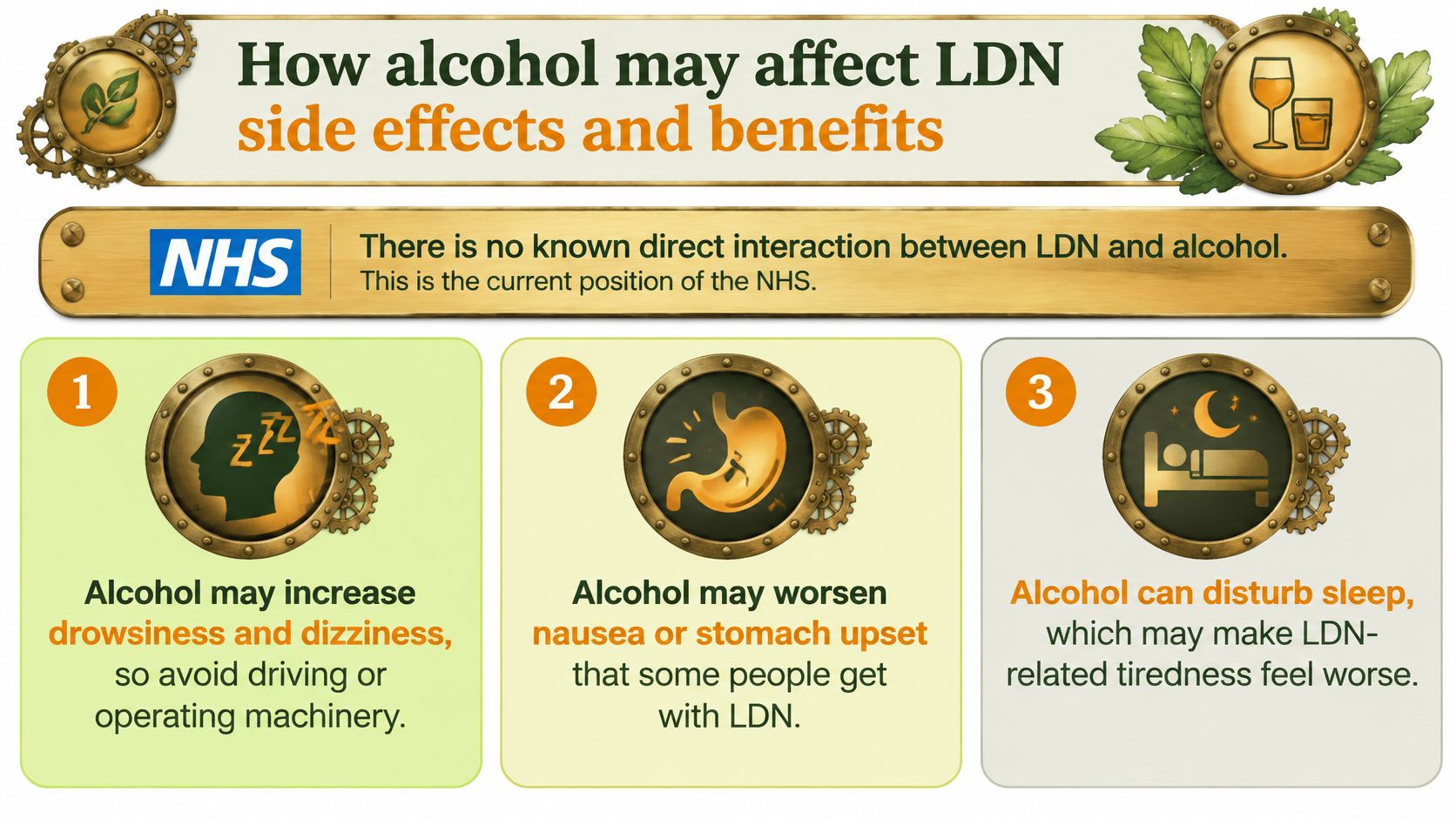
Three effects you'll notice at home
Benefits may slip, and not in a steady way. Alcohol may weaken what you're taking LDN for. Nobody can tell you the drop will be the same after every night out. Don't assume Tuesday feels like Saturday.
Tiredness stacks. LDN itself causes little drowsiness for many people. Alcohol adds fatigue and slows your reactions. Don't drive or use machinery until you know your own response.
Your stomach may complain. Nausea and upset can feel worse when you combine both. Our LDN side effects guide covers the usual pattern without alcohol in the mix.
Say you're a shift worker on LDN for pain. Weekend drinks leave you heavier and slower, and Monday's early start feels unsafe on the road. Or you're a parent with fibromyalgia. After wine at a birthday, pain and fatigue flare, and the school run is harder than the party was.
Pharmacist's tip: Keep your dosing time the same each day. Ask your pharmacist how to space that dose around a planned drink, rather than guessing on the night.
A short explainer on how prescribers think about naltrexone and drinking sits below. It isn't a personal plan.
Liver health when combining LDN and alcohol
Liver function tests (LFTs) are blood tests that show how well your liver is working. Naltrexone can injure the liver, so prescribers still watch LFTs on a low dose. Alcohol adds its own strain, separate from the tablet or capsule.
Heavier or more frequent drinking is a reason to test more often. Your prescriber sets the final schedule. General information can't judge your personal liver risk.
A simple test timeline
| When | What to do |
|---|---|
| Before starting | Baseline liver function test |
| 1 to 3 months | Repeat the test |
| Every 3 to 6 months | Repeat if results stay stable |
| Any time | Contact your GP the same day if red-flag symptoms appear |
If a clinician adds a licensed medicine beside your compounded capsule, we source licensed stock from MHRA-registered wholesalers, including AAH and Alliance Healthcare. A home liver function blood test can help you arrive at a review with recent numbers. It doesn't replace the prescriber's own checks.
Red flags that need a GP the same day
- Unexplained tiredness: Fatigue that isn't just a bad night's sleep.
- Dark urine: Tea-coloured urine without a clear cause.
- Yellow skin or eyes: Jaundice needs prompt review.
- Upper right tummy pain: Pain under the right ribs can signal liver trouble.
Be honest about units. A monitoring plan built on a low guess is the wrong plan.
Pharmacist's tip: Write down what you drank that week before the blood test. Accurate numbers matter more than a tidy story.
When to seek medical advice and next steps
Get help at the right level for your symptoms. Some problems need emergency care; others need prompt contact with your GP.
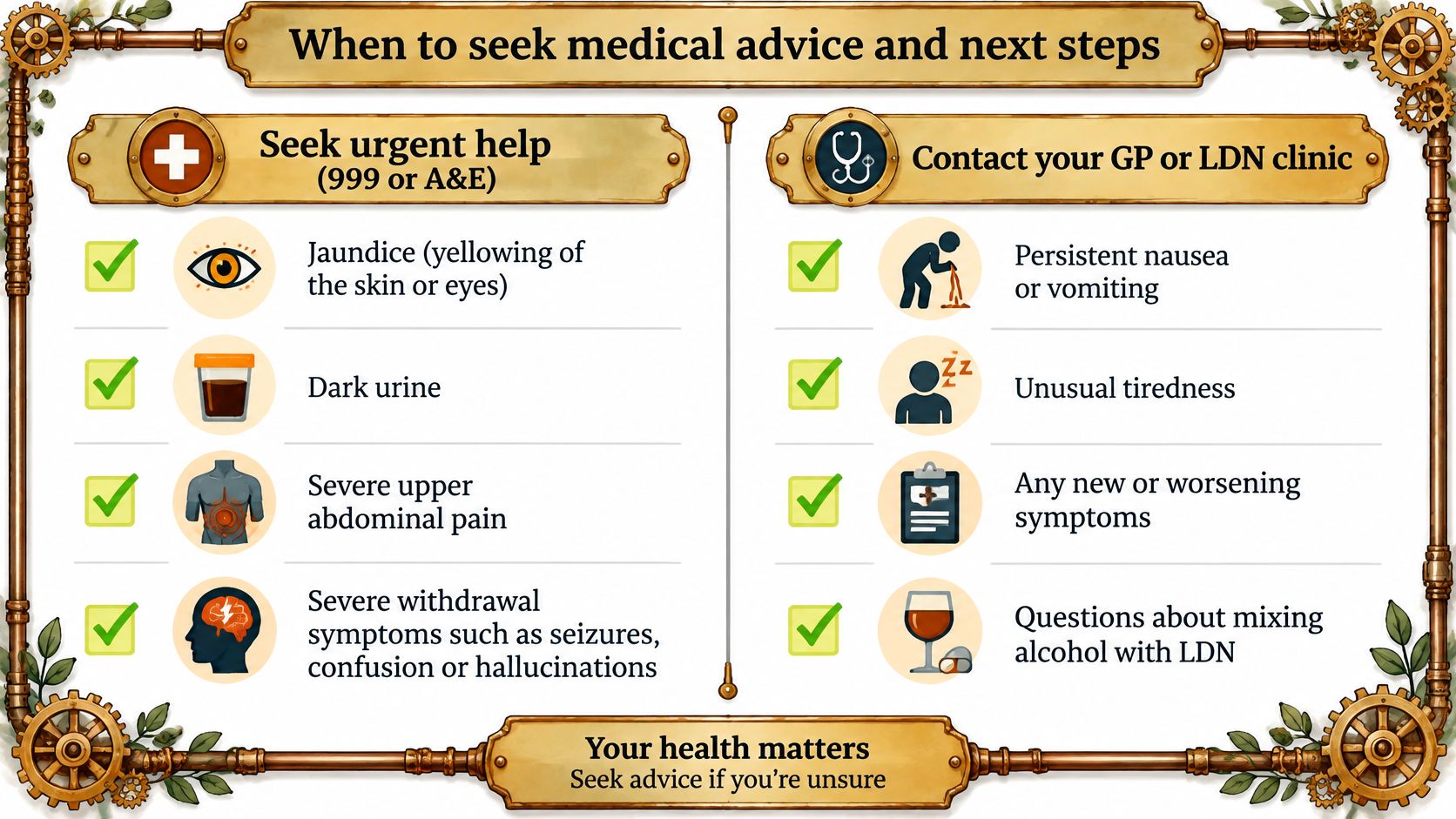
Call 999 or go to A&E
Call 999 or go to A&E for severe jaundice, severe upper abdominal pain, or severe alcohol withdrawal symptoms such as seizures, confusion or hallucinations. Stopping heavy drinking suddenly can be dangerous and may require medically assisted withdrawal. LDN is not a substitute for withdrawal treatment.
Check opioids before any new pain plan
UK government alcohol-treatment guidance says naltrexone should not be prescribed to people taking opioid medicines, using non-prescribed opioids, or likely to need opioid pain relief. Naltrexone can block opioid pain relief and may precipitate withdrawal. Tell your prescriber about planned opioid treatment, including for surgery or dental work. Read the guide to who should avoid naltrexone before discussing treatment.
Book a routine review
Arrange a review if you are drinking beyond your planned limits, notice less benefit from LDN after drinking, experience mood changes, or hoped LDN would help you cut down. A prescriber can discuss whether a different dose or service is appropriate. Courier Pharmacy offers LDN and consultations for conditions including fibromyalgia, long COVID, migraine and pain relief.
Pharmacist's tip: Keep a diary of drinks and symptoms for two weeks before your appointment. Bring it with you so you can give your prescriber a clear account.
In short: There is no known direct toxic interaction, but alcohol may reduce LDN's benefits. LDN is not licensed for alcohol dependence. Tell your clinician how much you drink, and do not change your dose without advice.
This article is for information only and does not replace advice from your clinician.
References
- National Institute for Health and Care Excellence (2011) Alcohol-use disorders: diagnosis, assessment and management of harmful drinking and alcohol dependence, CG115. NICE.
- National Institute for Health and Care Excellence (2014) Nalmefene for reducing alcohol consumption in people with alcohol dependence, TA325 evidence resources. NICE.
- Essex Partnership University NHS Foundation Trust (2025) Management of alcohol, opioid and benzodiazepine dependence. EPUT.
- NHS Highland (formulary) Alcohol dependence, Central Nervous System. Right Decisions.
- Office for Health Improvement and Disparities, Clinical guidelines for alcohol treatment: 10 pharmacological interventions. GOV.UK.
Byline: Written by a UK pharmacist at Courier Pharmacy. Clinical review: pharmacist prescriber, GPhC-registered pharmacy team.
Frequently asked questions about LDN and alcohol
Can I take LDN the morning after drinking?
Yes, you can usually take your usual dose, unless you feel very unwell. Ask your pharmacist about timing if nausea is strong. Tell your prescriber if sickness keeps returning after drinks. Don't double the next dose to "catch up".
Does LDN reduce cravings like standard naltrexone?
No strong UK evidence says LDN cuts cravings the way 50 mg treatment can. Don't rely on a low dose for that job. If cutting down is the goal, ask about licensed treatment and support.
Is it safe to drink socially if I have an autoimmune condition?
There's no single answer for every person. Ask the prescriber who knows your condition and your other medicines. A gym-goer with stable symptoms may get different advice from someone in a flare.
Does LDN stop me getting drunk?
No. It doesn't reliably block alcohol's effects. You can still be impaired, and you should still limit your intake. Don't use LDN as a reason to drink more.
What if I drink more than I planned?
Tell your prescriber at the next contact, and sooner if you feel unwell. Don't change the dose on your own. Note what you drank and how you felt the next day.
Can I start LDN straight after stopping heavy drinking?
Usually not. Heavy drinking often needs medically assisted withdrawal first, and your doctor decides when any naltrexone starts. Coming off a large daily intake on your own can be unsafe.
Courier Pharmacy offers prescriber-reviewed low dose naltrexone consultations and compounded LDN for suitable adults, with clear advice on alcohol, liver checks, and medicines you must not mix. If you want that plan matched to your own drinking pattern, start with a secure consultation at Courier Pharmacy. A clinician reviews your answers before any supply.


