Low Dose Naltrexone Prescription: UK Guide 2026
Need a low dose naltrexone prescription in the UK? Our 2026 guide covers how to obtain it, what to expect, and key considerations.
You've read about low dose naltrexone (LDN), found mixed advice online, and now you're wondering whether a GP can prescribe it, whether private care is needed, and where a safe formulation comes from. A low dose naltrexone prescription is possible in the UK, but LDN remains an off-label option rather than a standard NHS treatment for many conditions. This guide explains how assessment works, what prescribers check, how NHS and private routes differ, why compounding matters, and how monitoring should continue after treatment starts.
- LDN is different from standard naltrexone. The dose and prescribing purpose aren't the same.
- NHS access remains limited. A GP may decline because LDN isn't licensed for the condition.
- A proper review matters. Your medicines, health history and opioid use all affect safety.
- Compounding gives dosing flexibility. Capsules and liquids can suit very low doses.
- Monitoring beats speed. Track symptoms and side effects with the prescriber's help.
Why Getting a Low Dose Naltrexone Prescription Feels Hard in the UK
You may have spent an evening comparing patient forums, charity pages and private clinic websites. One source describes LDN as a promising option for chronic symptoms. Another says the evidence remains uncertain. Your GP may know naltrexone as an addiction medicine, but not feel comfortable prescribing a much smaller, unlicensed dose.
That confusion has a clear cause. Standard naltrexone and LDN use different dosing and regulatory assumptions. Naltrexone has been available through the NHS since the 1980s for alcohol and opioid dependence. LDN also dates back to the 1980s in UK patient guidance, but its use for conditions such as multiple sclerosis remains off-label and isn't widely recommended within the NHS. Action for M.E. explains the UK position on low dose naltrexone.

The route matters as much as the medicine
A sensible pathway starts with a clinical review. The prescriber needs to decide whether LDN could be safe and potentially useful for your situation. They also need to explain the limits of the evidence, agree how to judge benefit, and choose a workable formulation.
That may involve your GP, a relevant specialist, a private prescriber, or a specialist pharmacy. An online route can feel convenient, but it still needs a proper human review. Read how online treatment ordering and clinician contact can work before you submit health information.
You'll find practical detail here on:
- Suitability: what information a prescriber needs.
- Access: why NHS, private and pharmacy routes differ.
- Formulation: when capsules, liquids or other options may help.
- Titration: how clinicians may introduce a very low dose.
- Follow-up: how to decide whether treatment helps or needs changing.
What Low Dose Naltrexone Is and What It Targets
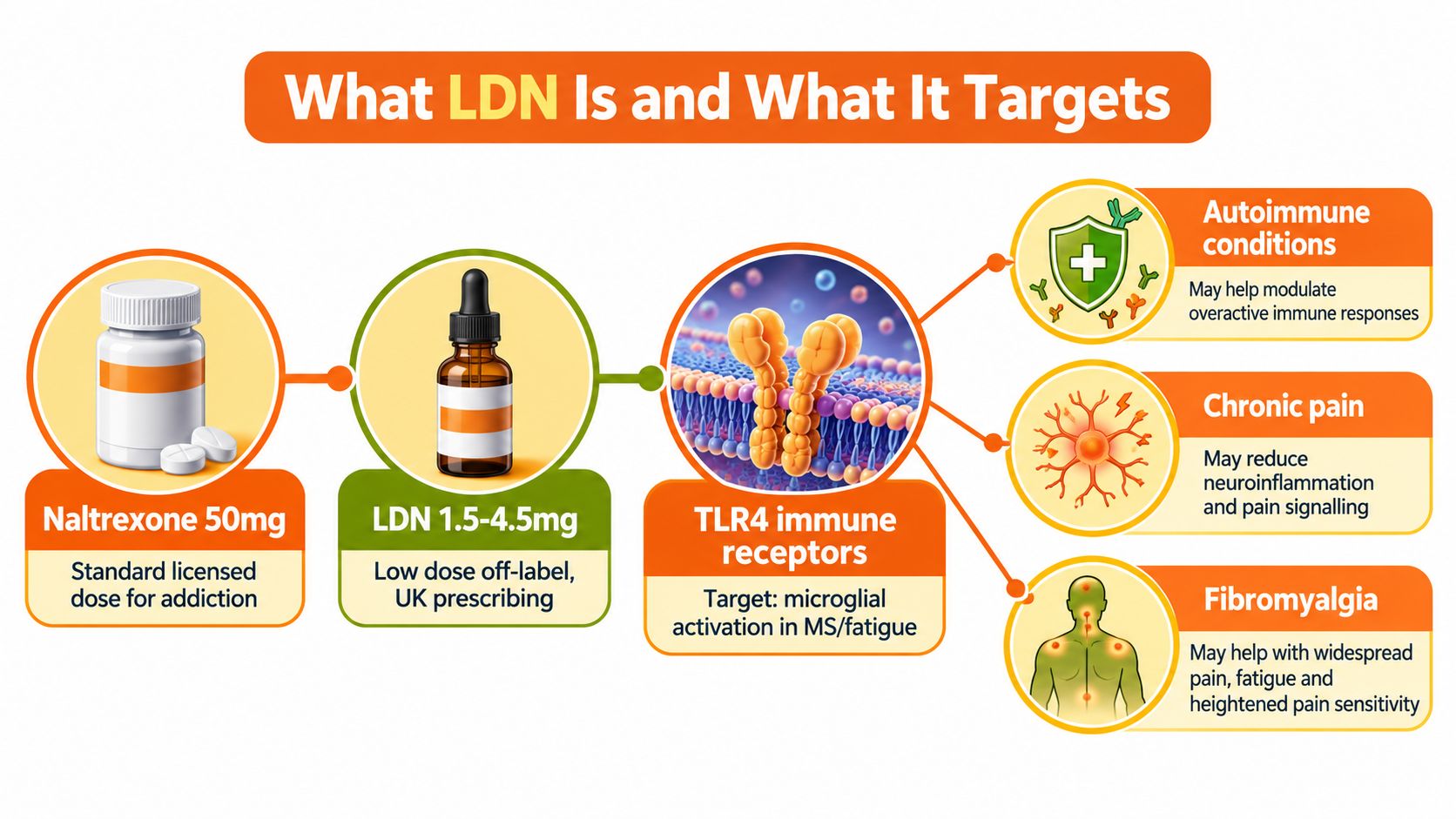
Low dose naltrexone is naltrexone prescribed at a much lower dose than its licensed formulations. In the UK, the licensed medicine is associated with alcohol and opioid dependence. LDN uses a different dose range and is usually considered off-label for chronic conditions.
People commonly ask about LDN in relation to multiple sclerosis, persistent pain, fibromyalgia, fatigue and inflammatory or immune-related conditions. That interest doesn't prove that LDN works for every condition. UK evidence summaries stress that well-conducted trials remain lacking for several chronic illnesses, and NICE-linked reviews haven't recommended LDN for ME/CFS or routine NHS symptom control in MS. The MS Trust summarises the evidence and prescribing position.
Why the off-label label matters
“Off-label” means a prescriber uses a licensed medicine outside the condition, dose or age group stated in its product licence. That practice can be appropriate, but the prescriber must take responsibility for the decision. They need to be satisfied that the medicine is safe and could be effective for the individual patient.
The target often discussed in LDN explanations involves opioid receptors and immune signalling. You don't need to master receptor biology to make a safe decision. The practical point is that LDN isn't a universal anti-inflammatory treatment, and a theory about how it may work isn't the same as proof of benefit.
What LDN isn't
LDN is not just a smaller version of a routine 50 mg addiction-treatment prescription. It also isn't a guaranteed treatment for pain, fatigue or autoimmune symptoms. A careful clinician will set a clear outcome, such as improved sleep, fewer pain flares or better daily function, rather than promising a cure.
For a plain-language explanation of the proposed action and treatment process, see how LDN may work.
Practical rule: Treat LDN as an individual trial with uncertain benefit, not as a standard NHS therapy.
Assessment and Suitability Before You Ask for a Prescription
A responsible prescriber won't decide from a diagnosis alone. They'll want to understand your symptoms, previous treatments, other health problems and current medicines. That protects you from avoidable interactions and helps the clinician decide whether LDN has a reasonable place in your care.
Start by preparing a concise health summary. Include the condition being treated, your main symptoms, treatments you've tried, allergies, and any recent changes in health. Bring the names and doses of every medicine, supplement and painkiller you use.
The checks that usually matter
Your prescriber may ask about:
- Opioid medicines: Naltrexone can block opioid medicines and create serious treatment problems. This includes prescribed pain relief and some cough or diarrhoea products.
- Recent opioid use: The timing matters. Don't start LDN while opioids remain a concern without direct medical advice.
- Liver health: Tell the prescriber about liver disease, abnormal liver tests or heavy alcohol use. They'll decide whether tests or extra caution are needed.
- Pregnancy and breastfeeding: Share your plans or current status before treatment. The clinician will weigh possible benefits and risks.
- Mental and physical symptoms: Describe sleep, mood, pain, fatigue and function clearly. A symptom diary can make changes easier to judge.
- Other treatment plans: Tell the prescriber about planned surgery, procedures or specialist treatment.
Some doctors decline because LDN isn't licensed for the condition, local policy doesn't support it, or they don't feel able to monitor an off-label trial. That doesn't automatically mean the medicine is unsafe. It means the prescriber isn't willing to accept responsibility in that setting.
Make the consultation useful
Write down what you hope will improve and how you'll measure it. “I want to feel better” matters, but “I want to manage a normal morning routine with fewer symptom interruptions” gives the review more direction.
Use a specialist opinion where your condition needs one. If you're considering an online consultation, choose a service that asks about your medical history rather than offering a prescription with little clinical questioning. This UK safety guide explains who may need to avoid naltrexone.
NHS Versus Private and Compounded Options
The NHS and private sector don't offer identical routes to an LDN prescription. NHS doctors may consider off-label prescribing, but many won't prescribe LDN for MS, ME/CFS or other chronic conditions because it lacks a licensed indication and the evidence remains limited.
UK uptake also remains modest. A University of Manchester review reported around 1,400 NHS prescriptions for LDN each year, while more than 12,000 people received a private prescription over the previous 10 years. The review also noted that standard naltrexone is prescribed to less than 0.5% of people eligible for alcohol-treatment use, showing how limited overall UK use remains even where licensed indications exist. The University of Manchester review discusses UK naltrexone prescribing.
Choosing a route
| Pathway | Likelihood of approval | Formulation flexibility | Typical monitoring |
|---|---|---|---|
| NHS GP or specialist | Variable and often limited for off-label use | Usually limited by local prescribing and available products | Structured when the clinician accepts responsibility |
| Private GP or specialist | Depends on clinical assessment and the prescriber's view | Often more flexible | Agreed directly with the prescriber |
| Private compounding pathway | Depends on prescriber approval | Capsules or liquid may be possible when suitable | Should include prescriber review and pharmacy support |
An NHS pathway may suit someone whose specialist already supports an off-label trial. A private consultation may suit someone who needs a clinician with experience in individualised prescribing, but you still need to check the service's follow-up process and total cost.
Standard medicine or compounded preparation
Standard naltrexone tablets follow licensed prescribing pathways. They aren't automatically suitable for an LDN plan because the target dose sits far below usual tablet strengths. Splitting tablets can create dose variation and may not provide the precise dose or formulation your prescriber intends.
Compounding allows a pharmacy to prepare a prescribed strength or liquid. It may also help people who struggle to swallow capsules or need to avoid a particular excipient. Learn how specialist compounding pharmacies work in the UK.
Consultation, Prescribing and Titration in Practice
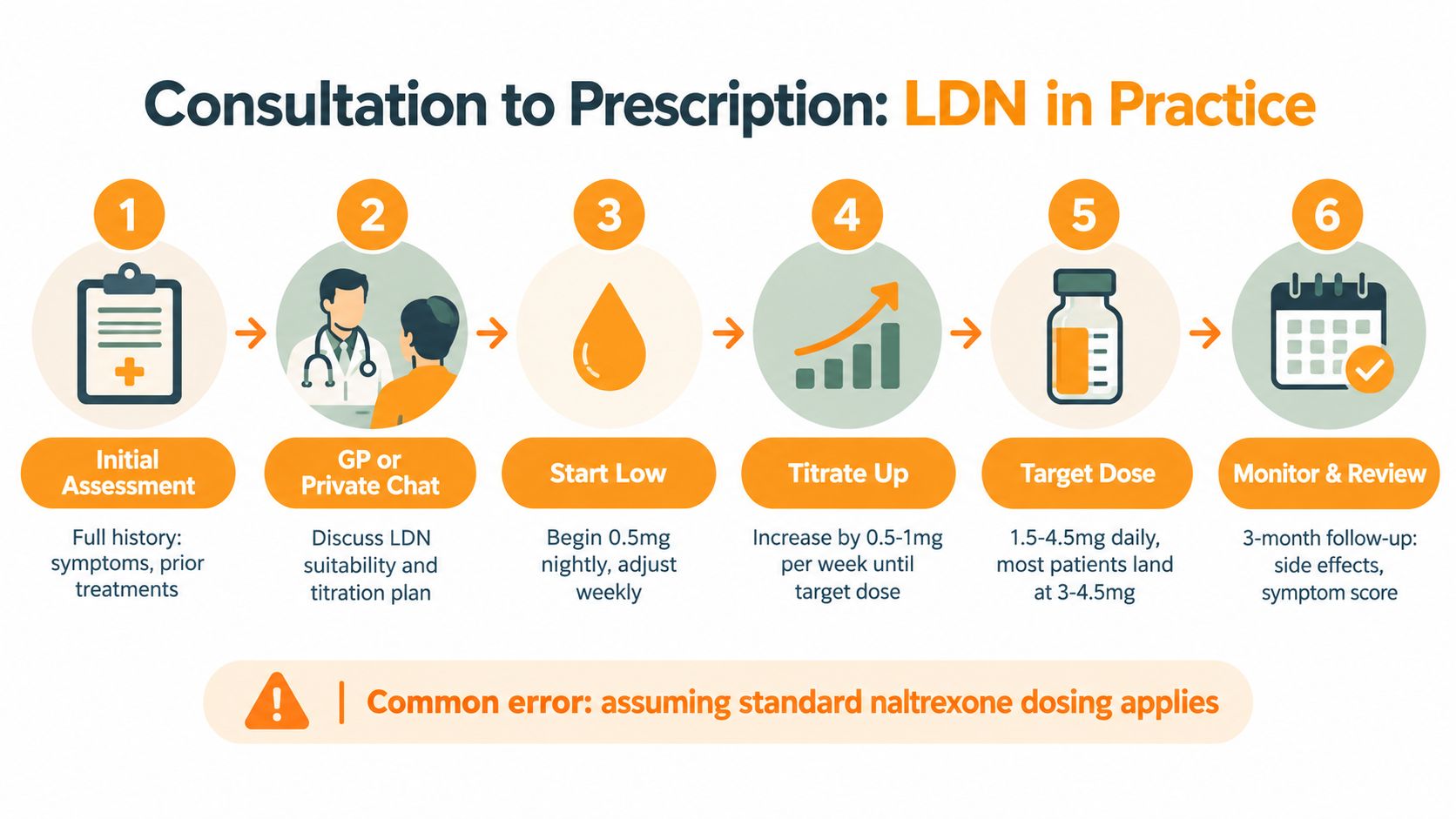
The most common dosing mistake is simple. Patients see a standard naltrexone schedule and assume it applies to LDN. It doesn't.
NICE guidance for opioid dependence uses 25 mg on day 1, followed by 50 mg daily, initially for 3 months. NICE sets out this standard naltrexone schedule. That protocol belongs to a licensed addiction-treatment pathway, not to a typical LDN titration plan.
What the prescription needs to clarify
A good prescription should state the formulation, strength, directions, quantity and any titration instructions. It should also identify the patient and give the pharmacy enough detail to prepare the medicine consistently.
Common UK LDN approaches use a liquid at 1 mg/mL, or a capsule prepared at a prescribed strength. Some clinicians start at 0.5 mg and increase by 0.5 mg each week, working towards 3 mg to 4.5 mg daily if tolerated. These figures come from UK patient guidance on LDN preparation and titration, not from the standard 25 mg and 50 mg naltrexone schedule. The MS-UK choices booklet describes common LDN formulations and titration.
Your own prescriber may choose a different plan. Dose changes should follow the written instructions, not advice from an online forum.
A realistic start
A shift worker may prefer a liquid because small dose changes are easier around irregular sleep. A busy parent may prefer capsules because they're simpler to carry. Neither option is automatically better. The right choice depends on swallowing, sensitivities, dose precision, storage and the prescriber's plan.
Keep a brief record of:
- Dose and timing: Note when you take it and when changes occur.
- Symptoms: Use simple ratings for pain, fatigue, sleep or function.
- Side effects: Record new sleep changes, headaches, stomach symptoms or mood changes.
- Other medicines: Add any new prescription, over-the-counter medicine or opioid pain relief.
Some NHS shared-care guidance for standard naltrexone uses a 25 mg test dose, then 50 mg daily, with review at least monthly during the first 6 months and every 6 months after that when treatment continues. That monitoring framework shouldn't be copied blindly into LDN care, but it shows why follow-up needs a clear owner. This NHS shared-care document outlines standard naltrexone monitoring.
Pharmacist's tip: Keep the original pharmacy label with your medicine. It prevents confusion between standard naltrexone and compounded LDN if another clinician needs your medication list.
Sourcing, Quality Checks and Ongoing Monitoring
A prescription is only one part of safe LDN care. The pharmacy must prepare the medicine accurately, label it clearly and supply directions that match the prescriber's order. Compounded medicine needs particular care because the preparation may not come as a standard retail product.
Ask practical questions before ordering:
- Who prepares it? Check that a registered pharmacy handles the prescription.
- What strength is supplied? Confirm the unit, such as milligrams per capsule or milligrams per millilitre.
- Which form will you receive? Capsules and liquids suit different needs.
- How should you measure it? A liquid needs a suitable oral syringe or measuring device.
- What is the expiry and storage advice? Follow the pharmacy label rather than relying on general internet advice.
- Who answers questions? You need a clear route back to the prescriber or pharmacy.
A certificate of analysis can provide information about the pharmaceutical ingredient and batch testing. It doesn't replace a clinical review, and it doesn't prove that LDN will help your condition. It's one part of a broader quality process.
What good supply looks like
Avoid unverified sellers, loose tablets and products with unclear ingredients. A low price doesn't tell you whether the dose is accurate, stable or suitable for your health needs. Don't buy naltrexone online without a valid prescription and proper clinical oversight.
An NHS pathway may use a standard tablet and local shared-care process. A specialist pharmacy may prepare a liquid or capsule when the clinician needs a lower or adjustable dose. UK NHS prescribing documents increasingly describe flexible naltrexone pathways, but standard tablet instructions still shouldn't be treated as an LDN recipe. The NHS shared-care guidance illustrates how standard naltrexone pathways are organised.
Monitoring after the first supply
Agree the review plan before you start. Decide which symptoms matter, when you'll review them, and what would count as enough benefit to continue. If symptoms don't change, side effects persist, or the formulation creates problems, contact the prescriber rather than changing the dose yourself.
Seek urgent medical help for severe breathing difficulty, swelling of the face or throat, collapse, severe confusion, or thoughts of harming yourself. Contact a clinician promptly if you need opioid pain relief, face surgery or an urgent procedure, because naltrexone can affect opioid treatment.
Pharmacist's tip: Tell every healthcare professional that you take naltrexone, especially before emergency care. Keep the strength and formulation on your phone as well as on the medicine label.
Pharmacist's tip: Ask for written instructions if your dose changes. Verbal advice can become unclear when a liquid, capsule and tablet use different units.
For patients who need an online route, UK online pharmacy services should still combine secure health questions, human prescriber review, prescription handling and a way to request follow-up. Convenience should shorten admin, not remove clinical judgement.
Medical Mojo's palette could support the following visuals:
- Patient pathway infographic: Bright lime green and pale yellow-green steps, with light grey background panels and ornate brass plaque overlays. Alt text: “UK pathway from LDN assessment to prescription, compounding and follow-up.”
- Formulation comparison graphic: Painterly capsules, a measured liquid and a pharmacy label, using brass details and lime accents. Alt text: “Comparison of compounded LDN capsules and liquid formulation.”
- Safety checklist illustration: A brass plaque beside a medicines list, liver check and opioid warning symbol. Alt text: “Safety checks before starting a low dose naltrexone prescription.”
- Monitoring diary visual: A light grey symptom diary with lime check marks and pale yellow-green highlights. Alt text: “Patient symptom diary for monitoring LDN response and side effects.”
Courier Pharmacy offers online LDN consultations, human prescriber review and compounded options such as capsules or a 1 mg/mL solution where clinically appropriate. Visit Courier Pharmacy to review the consultation pathway and discuss whether a low dose naltrexone prescription suits your needs.
Summary
LDN is a much lower-dose, off-label use of naltrexone.
The NHS may not prescribe it for many chronic conditions.
A proper review checks medicines, opioid use, liver health and pregnancy considerations.
Compounding can provide accurate low-dose capsules or liquid.
Start only with a prescriber's written plan.
Track symptoms, side effects and daily function after starting.
LDN has uncertain benefits, so review the trial carefully.
FAQs
Can my GP prescribe low dose naltrexone?
A GP can consider an off-label prescription, but they don't have to agree. Many NHS doctors remain reluctant because LDN isn't licensed for conditions such as MS or ME/CFS. Ask whether your GP can explain the reason for declining and whether a specialist or private review is appropriate.
Is LDN available on the NHS?
LDN isn't a routine NHS indication for many conditions discussed online. Naltrexone itself has been available on the NHS for alcohol and opioid dependence, but that doesn't mean the NHS routinely supplies LDN for chronic pain, fatigue or MS symptoms. Local policy and prescriber judgement affect access.
Do I need a private prescription for LDN?
Not always. An NHS GP or specialist may prescribe it when they accept responsibility for off-label treatment. However, many patients explore private care because NHS access remains limited.
What dose does LDN usually start at?
Some UK guidance describes starting at 0.5 mg and increasing by 0.5 mg weekly, often using a liquid or compounded capsule. The prescriber may choose another schedule based on your health and tolerance. Don't use the standard 25 mg first-day naltrexone schedule as an LDN plan.
Is a liquid better than LDN capsules?
Neither is automatically better. A liquid can make small dose changes easier, while capsules may suit people who want a simple routine. Your prescriber and pharmacist should match the formulation to your dose, swallowing needs and sensitivities.
Can I take LDN with opioid painkillers?
You must discuss opioid medicines with the prescriber before starting LDN. Naltrexone can block opioid treatment and complicate pain control. Tell emergency clinicians that you take naltrexone.
How long should I try LDN?
There isn't one universal trial length for every condition. Agree a review point and a clear measure of benefit with your prescriber. Continuing without improvement or review can create false expectations.
What should I tell my pharmacist?
Give the pharmacist the exact formulation, strength and directions. Mention allergies, swallowing problems and any new medicines. Also ask how to measure a liquid and how to store it.
When should I seek urgent help?
Seek urgent help for breathing difficulty, facial or throat swelling, collapse, severe confusion or thoughts of self-harm. Contact a clinician promptly if you need emergency pain relief or a procedure. Always disclose that you take naltrexone.
Disclaimer: This article provides general information for UK readers. It isn't a substitute for advice from your GP, specialist, prescriber or pharmacist.
Meta description: Low dose naltrexone prescription UK guide. Learn NHS and private routes, safety checks, compounding, titration, monitoring and practical patient tips.
Internal links to consider: Link relevant supporting pages about LDN consultations, compounded medicines, online pharmacy services, blood testing and chronic condition support on medicalmojo.co.uk.
Byline: Medical Mojo Editorial Team, UK health and medicines writers.
Clinical review: Reviewed by a UK-registered pharmacist, credentials to be confirmed by the publisher before publication.
How this content was created: We reviewed the cited UK patient guidance, NHS prescribing documents, NICE material and University of Manchester review, then checked the practical advice for clarity, safety and consistency with off-label prescribing principles.
References
Action for M.E. (n.d.) Low-dose naltrexone. Available at: https://www.actionforme.org.uk/resource/low-dose-naltrexone/ (Accessed: 29 September 2026).
Manchester University (n.d.) Fears over life-saving drug unfounded, finds review. Available at: https://www.manchester.ac.uk/about/news/fears-over-life-saving-drug-unfounded-finds-review/ (Accessed: 29 September 2026).
MS-UK (n.d.) Low-dose naltrexone and multiple sclerosis choices booklet. Available at: https://ms-uk.org/low-dose-naltrexone-multiple-sclerosis-choices-booklet/ (Accessed: 29 September 2026).
MS Trust (n.d.) Low-dose naltrexone. Available at: https://mstrust.org.uk/a-z/low-dose-naltrexone-ldn (Accessed: 29 September 2026).
National Institute for Health and Care Excellence (NICE) (n.d.) Naltrexone for the management of opioid dependence. Available at: https://www.nice.org.uk/guidance/ta115/resources/naltrexone-for-the-management-of-opioid-dependence-pdf-82598074558405 (Accessed: 29 September 2026).
North West Knowledge and Intelligence Service (2025) Shared care agreement for naltrexone. Available at: https://nwknowledgenow.nhs.uk/wp-content/uploads/2025/08/SCA-Naltrexone-v6.0-July-2025.pdf (Accessed: 29 September 2026).
North West Knowledge and Intelligence Service (2025) Shared care prescribing guidance for naltrexone. Available at: https://nwknowledgenow.nhs.uk/wp-content/uploads/2024/03/SCANaltrexone_PPMO_CNS_01032025.pdf (Accessed: 29 September 2026).


