How to Use a Mask for Blackheads Safely and Effectively
Discover which mask for blackheads works best, how to use it safely, and when to seek professional advice. Practical tips for clear, healthy skin.

SEO brief
Primary keyword: mask for blackheads
Secondary keywords: blackhead mask, clay mask, salicylic acid mask, charcoal mask, blackhead treatment, comedonal acne
Search intent: Informational, practical skincare guidance for UK adults
Target reader: UK adults with blackheads, oily or combination skin, or acne-prone skin
Product/service mention: Courier Pharmacy acne treatment services
Internal links available: acne, azelaic acid cream, dry skin, Differin, hyperpigmentation, Courier Pharmacy home page
A mask for blackheads can help, but it won't solve every clog on its own. If you've just looked in the mirror after a gym session, a night shift, or a quick school run and noticed those tiny dark dots on your nose, you're not alone. The useful bit is this, the right mask can reduce surface oil and loosen pore debris, while proven acne treatments do the heavier lifting for persistent blackheads [1][2].
Five key takeaways
- Blackheads are comedones, so they usually need ongoing care, not one-off fixing.
- Clay and charcoal masks mainly absorb oil and lift surface debris.
- Salicylic acid masks get closer to the clog inside the pore.
- Too much masking can irritate skin, so frequency matters.
- Persistent blackheads may need acne treatment, not just a cosmetic mask.
Introduction to Masks for Blackheads
You've got a busy morning, and the mirror shows the same stubborn spots on your nose again. A mask for blackheads can be useful here, but only if you know what it can realistically do. In the UK, blackheads are usually treated as comedonal acne, which means the pore is blocked by oil and dead skin, not dirt alone [1]. For a broader acne overview, see the NHS-style acne advice in Courier Pharmacy's acne guide.
The big mistake is expecting one peel-off or clay treatment to keep pores clear for good. Masks can help with the surface problem, especially if your skin feels oily or congested, but ongoing blackheads often need a steadier routine.
Practical rule: if your blackheads keep returning, think “supportive step”, not “final fix”.
This guide keeps things simple. You'll learn how different masks work, which ingredients suit different skin types, how often to use them, and when it makes more sense to ask a pharmacist or prescriber for acne treatment.
How Masks Work to Remove Blackheads
Oil absorption and chemical exfoliation
Blackheads form when a follicle gets blocked and the top opens to air, which makes the plug look dark. That's why a mask can change the appearance of blackheads without necessarily changing the whole acne process. Clay-type masks mainly pull off surface oil, while acid-based masks work more like a slow, targeted clean inside the pore [1][4].
A 2023 clinical study of a clay mask showed measurable improvement in both open comedones and closed comedones over time. Open comedones fell by 4.81% immediately, then 25.38% at week 1, 47.12% at week 2, and 65.77% at week 4. Closed comedones dropped by 5.06% immediately, then 25.75%, 32.18%, and 46.44% at the same time points [1]. The same study also reported improvements in sebum, skin evenness, and transepidermal water loss, which matters because oil build-up and barrier disruption often go hand in hand [1].
That said, not every mask works the same way. Salicylic acid masks are more relevant to blackheads because they are comedolytic, which means they help clear the clogged plug inside the follicle [4][6]. Clay masks are better thought of as oil absorbers that can make pores look cleaner for a while, rather than a cure.
| What the mask is doing | What that means for blackheads | How long the effect lasts |
|---|---|---|
| Clay absorbs oil | Less surface shine and less debris feeding new clogs | Temporary |
| Salicylic acid penetrates oil | Better fit for comedonal acne | More sustained with regular use |
| Charcoal lifts surface material | Visible change, mostly on the surface | Temporary |
Types of Masks and Key Ingredients
Different masks do different jobs, and that's where people get tripped up. A mask marketed for “deep cleansing” might just strip surface oil, while a mask with a real exfoliating active can help reduce comedones more directly. If you're comparing options, the ingredient list matters more than the packaging.
| Mask Type | Mechanism | Key Ingredients | Best For |
|---|---|---|---|
| Clay mask | Absorbs surface oil | Kaolin, bentonite | Oily or combination skin |
| Charcoal mask | Mechanical exfoliation and superficial debris lift | Activated charcoal, peel-off film bases | People wanting a short-term visual clean |
| Salicylic acid mask | Penetrates oil in the pore | Salicylic acid | Blackhead-prone, oily skin |
| Glycolic acid mask | Surface exfoliation | Glycolic acid | Dull, congested skin that tolerates acids |
| Enzyme mask | Gentle exfoliation | Fruit enzymes such as papain or bromelain | Sensitive skin that can't tolerate harsher scrubs |
Charcoal deserves a reality check. A review-style source states there's no credible evidence that topical charcoal can penetrate the skin to bind toxins. Instead, it works mainly as a physical exfoliant and a superficial sebum collector [2]. So if a product promises “detox”, treat that as marketing language, not a medical mechanism.
For blackhead-prone skin, UK-facing dermatology advice tends to point towards salicylic acid, glycolic acid, or similar chemical exfoliants rather than relying on peel-off cleansing alone [3]. If you also use prescription-style acne products, such as a retinoid, it's smart to keep your routine simple and avoid stacking too many actives. A practical place to compare acne treatment options is Courier Pharmacy's azelaic acid cream page.
Pharmacist's tip: if a mask stings, burns, or leaves your skin tight for hours, that's a sign to back off, not push through.
Step by Step Usage Guidance
A good mask routine starts before the mask goes on. Clean skin gives the product a fair chance to do its job, and it also helps you spot how your skin really reacts. Masks are usually applied wet and removed dry, and their visible effect is temporary because pores can refill after removal [5].
A simple routine that protects your skin
- Cleanse first. Use a mild cleanser and pat the skin dry. Skip harsh scrubs beforehand, because that just adds irritation.
- Apply a thin layer. Cover the blackhead-prone areas evenly, usually the nose, chin, or T-zone.
- Follow the timing exactly. Don't leave it on longer because “longer must be better”. That often backfires.
- Remove gently. Rinse with lukewarm water or peel carefully, depending on the product.
- Finish with a light moisturiser. Skin that feels calm usually behaves better.
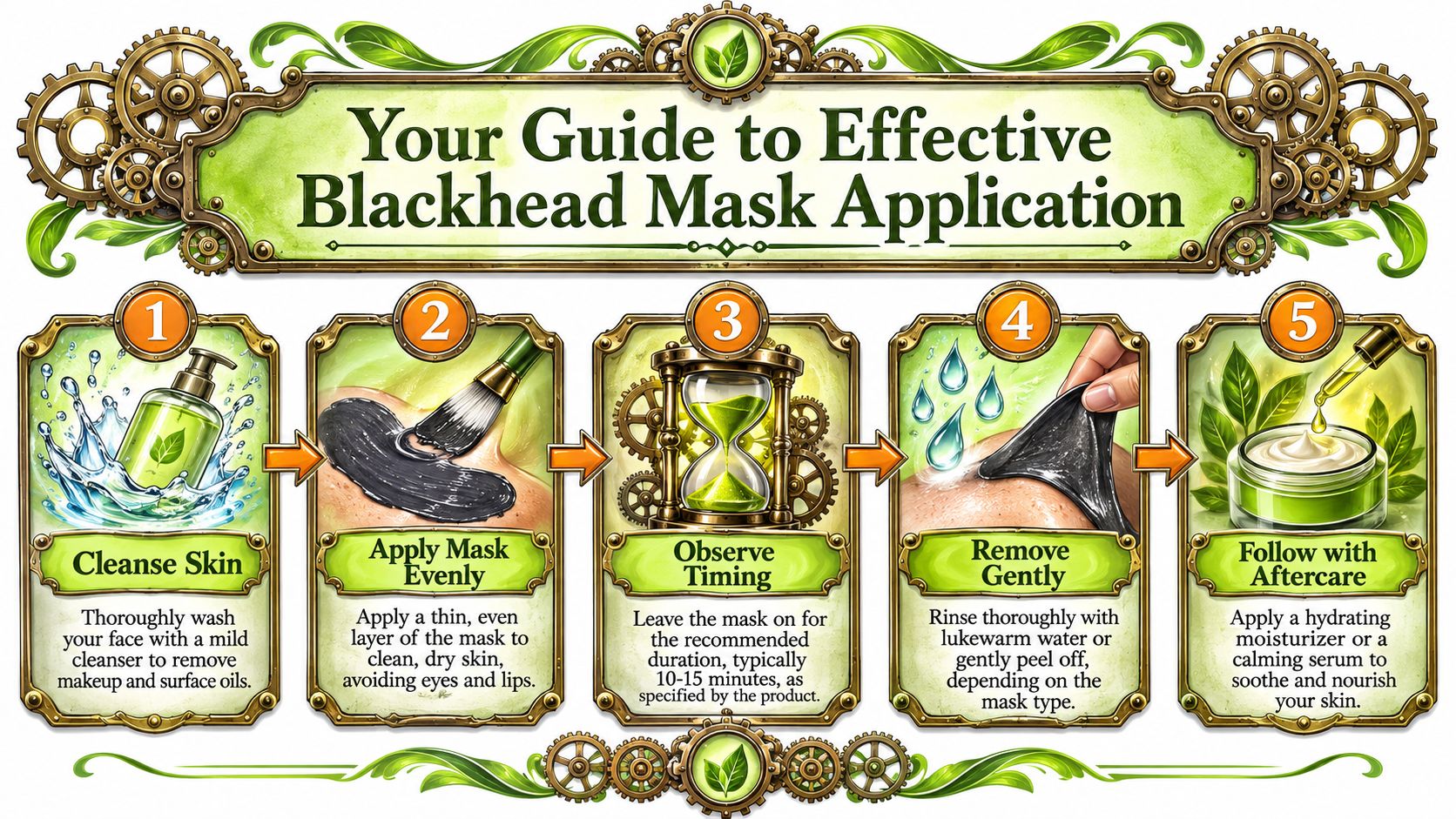
A consumer dermatology source recommends limiting masks to once or twice a week at most to avoid barrier damage [5]. That's the main safety rule. More use does not mean better results, especially if your skin already feels dry or reactive.
Pharmacist's tip: don't combine a mask with a scrub on the same day. If your skin is already under strain, piling on extra friction won't help the pores.
Choosing Masks by Skin Type and Frequency
What suits an oily nose may annoy a dry cheek. That's why the same mask can feel brilliant for one person and awful for another. If you're trying to find the right pace, think about how much oil your skin makes, how easily it flakes, and whether it gets red after washing.
Oily or combination skin usually copes best with clay or salicylic acid masks. These can help reduce the look of congestion without needing a harsh routine every day. Sensitive skin often does better with gentler enzyme masks, or with very occasional clay use.
Dry skin needs extra caution, because blackhead control can worsen tightness if you overdo exfoliation. If that sounds familiar, the dry-skin advice at Courier Pharmacy's dry skin page may help you think about barrier support alongside spot control.
Salicylic acid and glycolic acid masks are commonly recommended 2 to 3 times per week for gradual reduction of blackheads rather than immediate elimination [3]. This frequency is a practical guideline for developing a consistent routine, and it reflects that blackheads do not vanish in one go.
Pharmacist's tip: if you need a mask for blackheads and your face is also flaky, start with the least aggressive option and use it less often than the packet suggests.
If you're tempted to increase the frequency because results feel slow, don't. More frequent masking can irritate the skin barrier and make you feel even oilier later. That cycle is common, and it's one reason simple routines often work better than “deep clean” marathons.
Integrating Masks with Other Treatments and When to Consult a Professional
Masks don't live in isolation. Many people already use a cleanser, a serum, or a prescription acne product, and that's where things get messy if you're not careful. The goal is to avoid doubling up on irritation while still treating the clogged pores properly.
A 16-week randomised controlled trial found 2% salicylic acid gel reduced facial comedones by 73% compared with 22% with placebo, and the benefit held for 8 weeks after stopping [6]. That makes a clear point. If your blackheads keep coming back, a mask may help at the surface, but a treatment with proven comedonal action often does more for longer-term control [6].

When to separate products
- Topical retinoids: use on alternate nights if your skin gets dry or sore.
- Benzoyl peroxide: don't pile a mask on straight after it if your skin is sensitive.
- Oral acne treatments: masks can sit alongside them, but tell your clinician what else you use.
- Persistent blackheads or inflamed spots: ask a pharmacist or dermatologist for advice.
The practical question is simple. Is the mask just helping your pores look cleaner for a short time, or is it part of a plan that controls comedones? If the answer is the first one, that's fine for a cosmetic boost. If the answer is no, it's time to look at acne treatment more directly. One prescription-style option to discuss is Courier Pharmacy's Differin page.
Pharmacist's tip: seek help sooner if your skin becomes sore, very red, or more bumpy after trying several products. That usually means your routine needs simplifying, not strengthening.
Real Life Scenarios with Pharmacist Tips
A busy parent with combination skin might use a clay mask on the T-zone once a week and keep the rest of the routine plain. That helps with shine without turning the cheeks dry. A shift worker with recurring maskne may do better with a gentle acid-based approach and fewer layers overall, because tired skin often reacts badly to over-treatment. For a related skin concern that often overlaps with acne care, see Courier Pharmacy's hyperpigmentation page.
Pharmacist's tip: patch test any new mask on a small area first, especially if you've had redness before.
Pharmacist's tip: keep actives separate when your skin feels fragile. One good treatment beats three irritating ones.
Pharmacist's tip: if you travel often, choose one simple product you can use consistently rather than packing a full shelf.
Summary and FAQs
A mask for blackheads can help lift excess oil, loosen surface debris, and make pores look clearer for a short time. Clay and charcoal masks mostly work at the surface, while salicylic acid can reach closer to the blocked pore itself [1][2][4]. Used sensibly, masks can be part of a simple routine, but persistent blackheads usually need an acne treatment plan rather than masking on its own [5][6].
FAQs
Can a mask remove blackheads completely?
Usually not for long. A mask can improve the look of blackheads and reduce oil, but pores can refill after the mask is washed off [5]. If blackheads keep coming back, a treatment plan is usually a better fit.
Is charcoal good for blackheads?
Charcoal may help remove surface debris, but there is no strong evidence that it goes deep into the skin to bind toxins [2]. It can change how the skin looks, but it does not address the root cause in the same way as comedolytic acne products.
How often should I use a blackhead mask?
For many masks, a cautious approach is once or twice a week [5]. Salicylic acid and glycolic acid masks are often used 2 to 3 times per week if the skin tolerates them [3].
Can I use a mask with a retinoid?
Yes, but it helps to keep them apart if your skin becomes dry or irritated. Using both on the same night can feel too strong for sensitive skin, rather like putting two strong cleaners on the same surface at once.
What if my skin goes red after a mask?
Stop using the mask for now and switch to a gentle cleanser and moisturiser only. If the redness keeps returning, ask a pharmacist or dermatologist for advice.
When should I get professional help?
If blackheads keep returning, become inflamed, or do not improve after a simple routine, it is time to ask for help. That can point you towards a better acne treatment plan instead of trying more masks. If you are already using prescription acne treatment, especially a retinoid or other active product, professional advice helps you avoid over-drying or irritating the skin.
Do masks work better on the nose or chin?
They often seem to work better there because those areas collect more oil. That does not mean the problem is solved, only that the surface can look cleaner for a while.
Can I use a mask if I have dry skin?
Yes, but choose carefully and use it less often. Dry skin usually needs more barrier support, so a strong clay or acid mask can feel too harsh [5]. A gentler routine, along with Dry skin support, may suit better than frequent masking.
Can I combine a blackhead mask with acne treatments?
Sometimes, yes, but the order and frequency matter. A clay or charcoal mask may fit a simple routine, while active acne products such as Acne treatment options are often better for ongoing blocked pores. If you use prescription or pharmacy acne treatments, it can help to keep mask use separate from stronger actives, and to review the plan if your skin starts stinging, peeling, or looking more inflamed.
Which ingredients are more useful than charcoal alone?
Salicylic acid tends to be more useful for blackheads because it works inside the pore rather than only on the surface [4]. For people who also want help with post-acne marks or uneven tone, options such as Azelaic acid and niacinamide cream may be discussed with a clinician, depending on the rest of the routine. Some people using Differin for acne care also need to keep masks simple so the skin barrier does not become overloaded.
Can blackhead masks help with dark marks after spots?
They may make the surface look clearer, but they are not designed to treat pigmentation itself. If dark marks are the main concern, a focused treatment approach is usually better, and Hyperpigmentation and treatment overview gives more detail on that topic.
References
- Clinical study on clay masks and comedones. Available at: PMC article
- Review of charcoal mask detox claims and mechanism. Available at: Alibaba product insights article
- Dermatology guidance on blackhead masks and usage frequency. Available at: DermApproved article
- Evidence-based comparison of charcoal and salicylic acid for blackheads. Available at: Alibaba product insights article
- Consumer dermatology guidance on mask use and barrier care. Available at: Curology article


