Mebeverine Hydrochloride 135mg: Your Complete UK Guide
Discover how mebeverine hydrochloride 135mg works for IBS. Learn dosing, side effects, and pharmacist tips from UK experts. Get clear answers today.

Mebeverine hydrochloride 135mg is a standard antispasmodic tablet used in the UK for IBS symptoms, especially abdominal pain and cramping. The usual adult dose is 1 tablet three times a day, taken 20 minutes before meals.
SEO brief
- Primary keyword: Mebeverine hydrochloride 135mg
- Secondary keywords: mebeverine 135mg tablets, IBS treatment UK, antispasmodic tablets, mebeverine dose, IBS cramps relief
- Search intent: Informational, with practical guidance for safe everyday use in the UK
- Target reader: UK adults with IBS, carers, and people considering pharmacy treatment options
- Product/service mention (if any): Courier Pharmacy online IBS treatment access
- Internal links available: Assumed from the pages provided below
Mebeverine Hydrochloride 135mg Your Complete UK Guide
If you're reading this with a hot water bottle on your stomach, wondering whether your IBS is about to ruin another meal, you're not alone. Mebeverine hydrochloride 135mg is one of the standard UK options used to ease bowel spasm symptoms, and many people take it as part of their day-to-day IBS plan [1].
This guide keeps things simple. You'll learn what mebeverine is, how to take it properly, when people often get stuck, and what to do if it only partly helps. I'll also cover the life bits leaflets often rush past, such as how a shift worker can time doses and when it may make sense to reduce the dose after a good spell.
Five key takeaways
- Standard UK dose: Adults usually take 1 tablet three times a day, about 20 minutes before meals [1].
- Take it the right way: Swallow the tablet whole with water rather than crushing or chewing it [3].
- Missed dose rule: Skip the missed tablet and take the next one as normal. Don't double up [8].
- Dose reduction may happen: After several weeks, if symptoms settle, the dose may be gradually reduced [4].
- Not for under-18s: UK product information says it isn't recommended for children and adolescents under 18 because there isn't enough safety and efficacy data [4].
What Is Mebeverine Hydrochloride 135mg and Who Is It For
You get halfway through a work shift or the school run, your stomach tightens, and then the worry starts. Will lunch set it off again. Will you need to know where the nearest toilet is. That is the kind of real-life pattern many people with IBS describe.
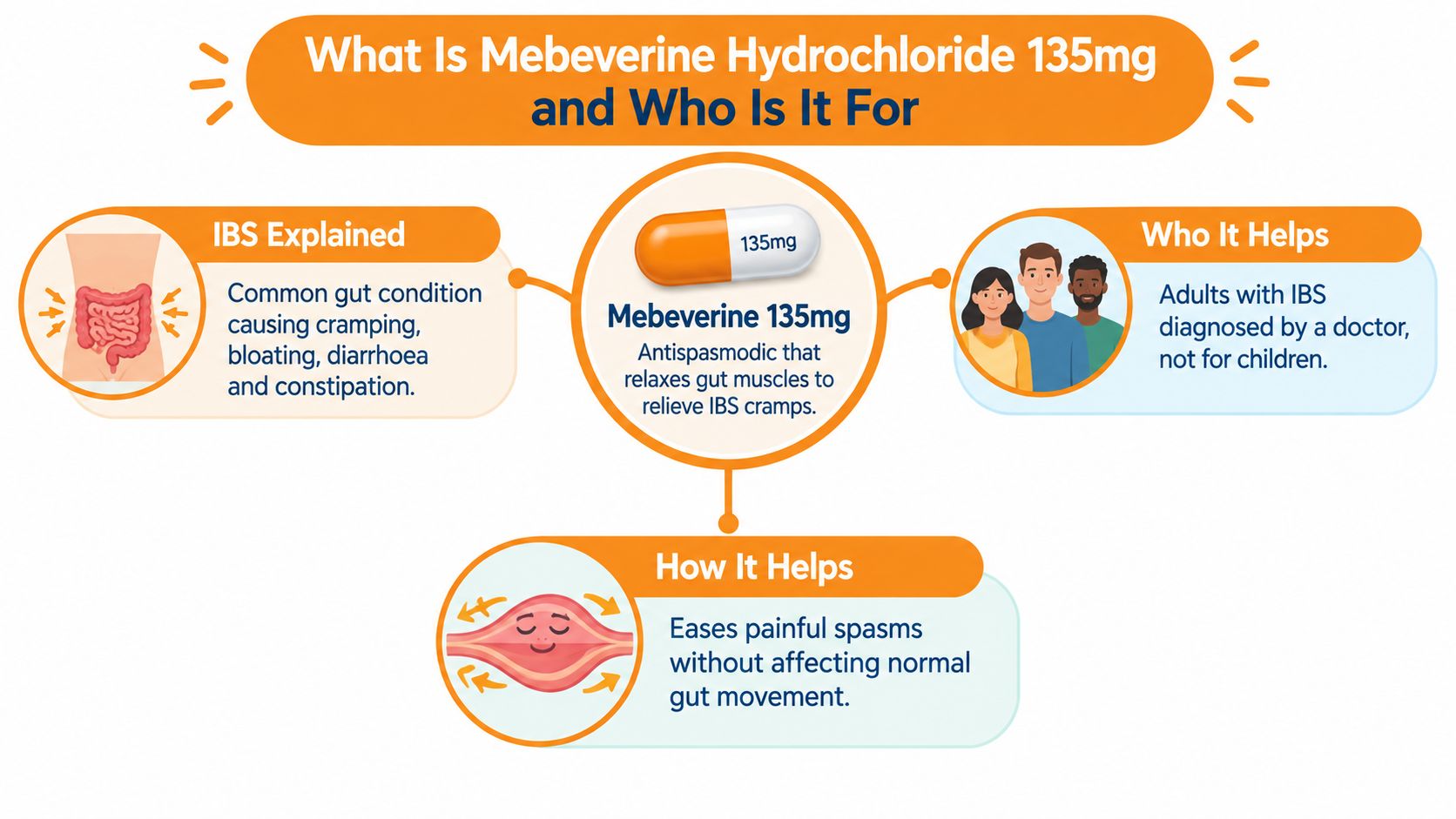
Mebeverine hydrochloride 135mg is a medicine used in the UK to ease bowel spasms linked to IBS and similar spastic bowel problems [1][3]. The short version is simple. It is taken to calm the gut when cramping and pain are the symptoms causing the most trouble. UK leaflets also mention related older terms such as chronic irritable colon, spastic constipation, mucous colitis and spastic colitis [7].
Which symptoms does it help most
Mebeverine is usually considered when pain, cramping, and that gripping spasm feeling are the main problem. Some people also find that once the cramping settles, eating feels less stressful and bloating is easier to handle. If you want a plain-English overview of the condition itself, this guide to irritable bowel syndrome explains the basics.
A helpful way to picture it is this. If IBS makes the bowel squeeze too hard at the wrong time, mebeverine is used to help those squeezes settle down.
Who is it for in day-to-day UK practice
In practice, this medicine tends to suit adults with IBS symptoms that come and go around meals, stress, commuting, shift work, or busy family routines. Pharmacists often see it used by people who can predict their bad moments quite clearly. For example, cramps after breakfast before an early shift, pain that starts during the afternoon school pickup, or spasms that reliably hit after eating on a rushed lunch break.
It is also a medicine people often ask about when they do not need a laxative or diarrhoea treatment as their main answer. Their main issue is the cramp itself.
Who might benefit most
A patient is more likely to ask about mebeverine when they say things like:
- “The cramping is the worst part.”
- “Eating seems to set it off.”
- “My bowel symptoms flare when my routine changes.”
- “I need something that may help me function at work or when looking after the kids.”
That does not mean it is right for every person with IBS. If constipation or diarrhoea is the main issue, or symptoms have changed suddenly, a clinician may want to look at the wider picture first.
A practical UK point that leaflets often gloss over
Many NHS-style summaries explain what the medicine is, but they do not always spell out the next decision patients ask in real life. Do I stay on the full dose forever if I start feeling better? Often, no. In UK practice, some people are advised to reduce the dose gradually once symptoms are well controlled [4]. That is less about the medicine “wearing off” and more about finding the lowest amount that still keeps symptoms manageable.
This matters for real routines. A shift worker may only notice symptoms around two meals on working days. A parent may find school-holiday stress changes their flare pattern. Those are the sorts of practical details worth discussing with a pharmacist or prescriber, because the best plan is not always the same as the most rigid plan.
Featured mini answer
What is mebeverine hydrochloride 135mg?
It is a UK antispasmodic tablet used to relieve IBS-related bowel cramps and pain [1][3].
How to Take Mebeverine Correctly for Best Results
You are halfway through a work shift, your stomach starts gripping, and lunch is still in the microwave. This is the moment many people realise that how they take mebeverine matters almost as much as having it in the first place.
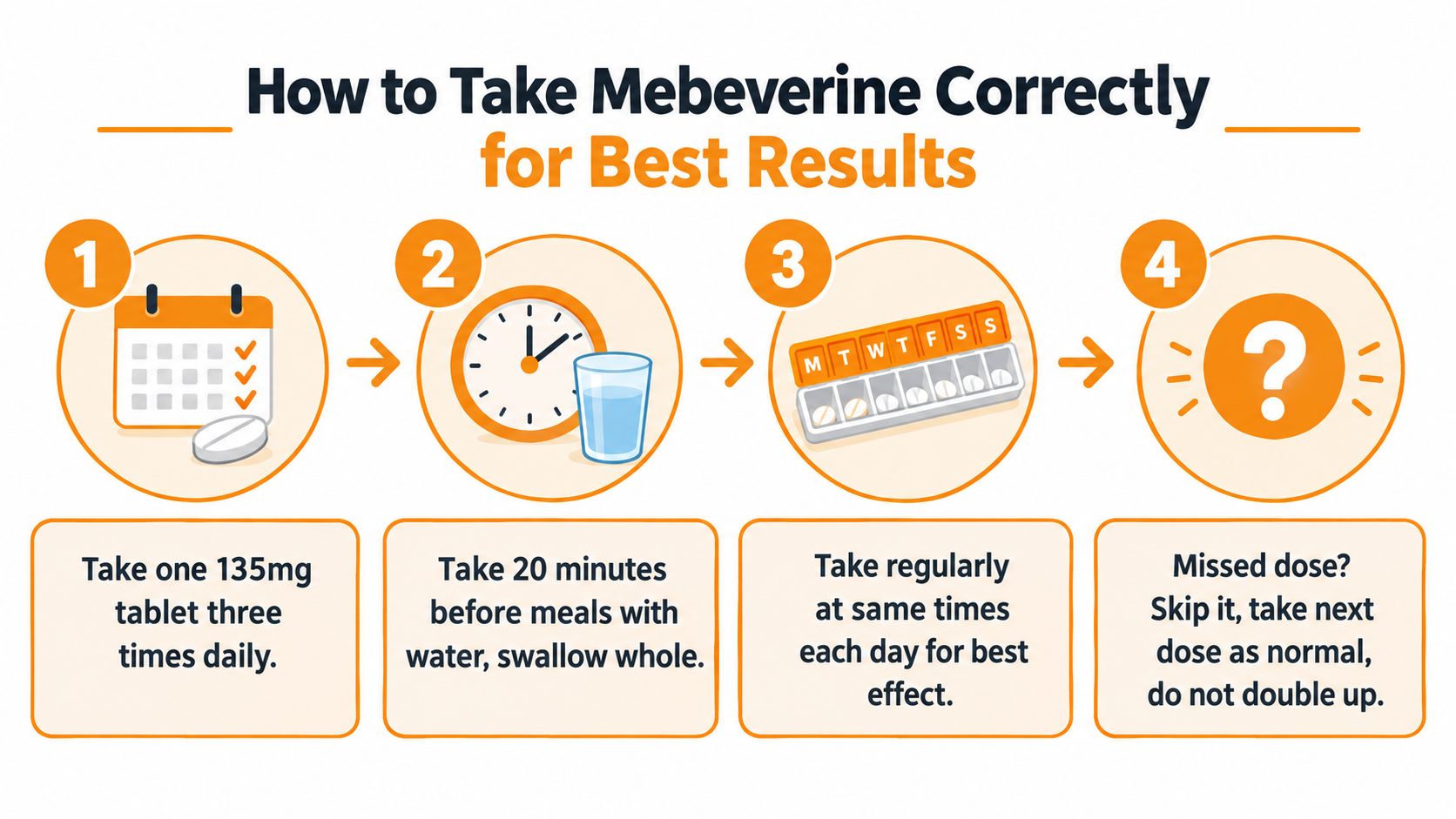
For adults, the usual dose is 1 tablet three times a day, taken about 20 minutes before meals [1][3]. The goal is to have the medicine on board before your bowel reacts to food.
Start with the standard routine
A simple pattern works well for many people:
- Before breakfast: Take 1 tablet
- Before lunch: Take 1 tablet
- Before your evening meal: Take 1 tablet
Swallow each tablet whole with water [3][8]. Do not chew, crush, or split it unless a prescriber has told you to.
Why the timing matters
Many IBS symptoms flare around meals because the bowel naturally becomes more active when food arrives. Taking mebeverine before eating gives it a better chance to calm that cramping response in time.
An umbrella works best before the rain starts. Mebeverine often works in a similar way for meal-related spasms.
If your routine is messy, match doses to meals
Real life in the UK matters. Plenty of people do not eat at tidy times.
If you work nights, your “breakfast” may be at 6pm. If you are parenting small children, lunch may happen in short bursts while standing in the kitchen. In both cases, the practical rule is the same. Take the tablet before the meal you are about to eat, rather than forcing it into standard daytime hours.
That approach helps shift workers, drivers, carers, teachers, and busy parents stick to the plan without overthinking the clock.
What to do if you miss a dose
Skip the missed dose and take your next tablet at the usual time [8]. Do not take two together.
If you forgot the lunchtime dose because a meeting overran or the school run turned chaotic, just restart with the next meal-time dose. One missed tablet does not mean the whole day is ruined.
When to reduce the dose
This is a question people often ask after a good week or two. If symptoms are well controlled, some people in UK practice are advised to reduce the dose gradually rather than stay on the full three-times-daily schedule long term [4].
A pharmacist or prescriber may suggest this step-by-step approach:
- reduce from three times daily to twice daily
- stay there and see if symptoms remain settled
- if still stable, review again rather than stopping suddenly on your own
The aim is to find the lowest dose that still keeps cramps manageable. That is especially useful if your flare pattern is linked to certain meals, certain shifts, or stressful periods such as school holidays.
Practical set-ups that help people remember
Small habit changes often work better than phone alarms alone.
For office workers: keep a strip in your work bag and another at home.
For shift workers: keep tablets with the meal you take to work, not only in the bathroom cabinet.
For parents: store them somewhere tied to breakfast and evening meals, such as near mugs or cereal, but safely away from children.
For people who skip meals: do not take a dose just because the clock says so. If there is no meal, follow the advice given by your prescriber and pharmacist, and ask for guidance specific to your situation if your eating pattern changes a lot.
Quick reference
| Situation | What to do |
|---|---|
| Usual adult dose | Take 1 tablet three times a day before meals [1] |
| Best timing | Take it about 20 minutes before eating [1][3] |
| How to take it | Swallow the tablet whole with water [3][8] |
| Missed dose | Skip it and take the next dose at the normal time [8] |
| Feeling better | Ask whether you can reduce the dose gradually [4] |
Pharmacist's tip
Tie each dose to a meal, not a specific hour. That is often easier to keep up than chasing exact times every day.
If you use an online pharmacy and want to know what happens after you request treatment, this guide to how the ordering and follow-up process works explains the usual steps clearly.
How Mebeverine Works and What Side Effects to Expect
You eat dinner, then half an hour later your stomach starts gripping and twisting. That is the kind of IBS pain mebeverine is usually used for. It targets bowel spasm, so it is most helpful when the gut muscle is squeezing too tightly and causing crampy pain.

What it is doing inside the bowel
Your bowel wall contains muscle. In IBS, that muscle can sometimes contract in a disorganised, painful way, a bit like a calf cramp happening in the gut. Mebeverine helps relax that spasm so the bowel is less tense and painful.
This explains two common points of confusion.
First, mebeverine does not treat every IBS symptom equally well. It is mainly used for cramping and spasm-type discomfort.
Second, it does not treat bowel inflammation. IBS and inflammatory bowel disease are different conditions, and the treatment plan can be very different if inflammation is involved. If you are unsure about the difference, this guide on what causes inflammatory bowel disease explains it in plain language.
What improvement should feel like
A good response usually means the cramps feel less intense, come less often, or pass more quickly. Some people notice that pain linked to meals becomes more manageable. Others find the change is modest but still useful enough to keep taking it.
It is also normal to ask, “If it helps, do I stay on the full dose forever?” In real UK practice, many prescribers advise people to review the dose once symptoms settle. Some patients stay on the usual dose during a bad spell, then reduce it gradually with advice from their GP or pharmacist when things are calmer. NHS leaflets often mention the standard dose, but they do not always explain this day-to-day decision clearly.
Side effects to watch for
Many people take mebeverine without significant problems, but side effects can happen. The safest approach is to separate mild concerns from warning signs.
Speak to a pharmacist or prescriber soon if:
- you feel unwell after starting it and are not sure if the tablets are the cause
- your stomach symptoms are changing rather than settling
- the pain is becoming more frequent, stronger, or less like your usual IBS pattern
Get urgent medical help if you notice signs of an allergic reaction, such as:
- swelling of the face, lips, tongue, or throat
- trouble breathing
- sudden severe reaction soon after taking a dose
A simple rule helps here. Familiar IBS pain often follows your usual pattern. New pain, constant pain, or pain with other worrying symptoms needs a proper check.
When side effects may not be the medicine
Pharmacists see this often. Someone starts mebeverine during a rough IBS flare, then every symptom that follows gets blamed on the tablet.
Sometimes the problem is not the medicine at all. It may be a stomach bug, constipation building up, a food trigger, or symptoms that need a different diagnosis. If something feels off, do not force yourself to “push through” for days. Ask for advice early, especially if you are juggling shifts, childcare, or irregular meals and it is hard to tell what is causing what.
A short video can also help if you prefer listening rather than reading:
Featured mini answer
Does mebeverine cure IBS?
No. It is used to ease IBS symptoms such as cramping and bowel spasm, rather than cure the condition [1][3].
Mebeverine Compared to Other IBS Antispasmodics in the UK
You are standing in a UK pharmacy aisle, looking at IBS products, and the boxes all seem to promise relief for cramping. The confusing part is that they do not all suit the same person in the same way. Mebeverine is one common option, but it is not the automatic best choice for everyone.
Where mebeverine fits
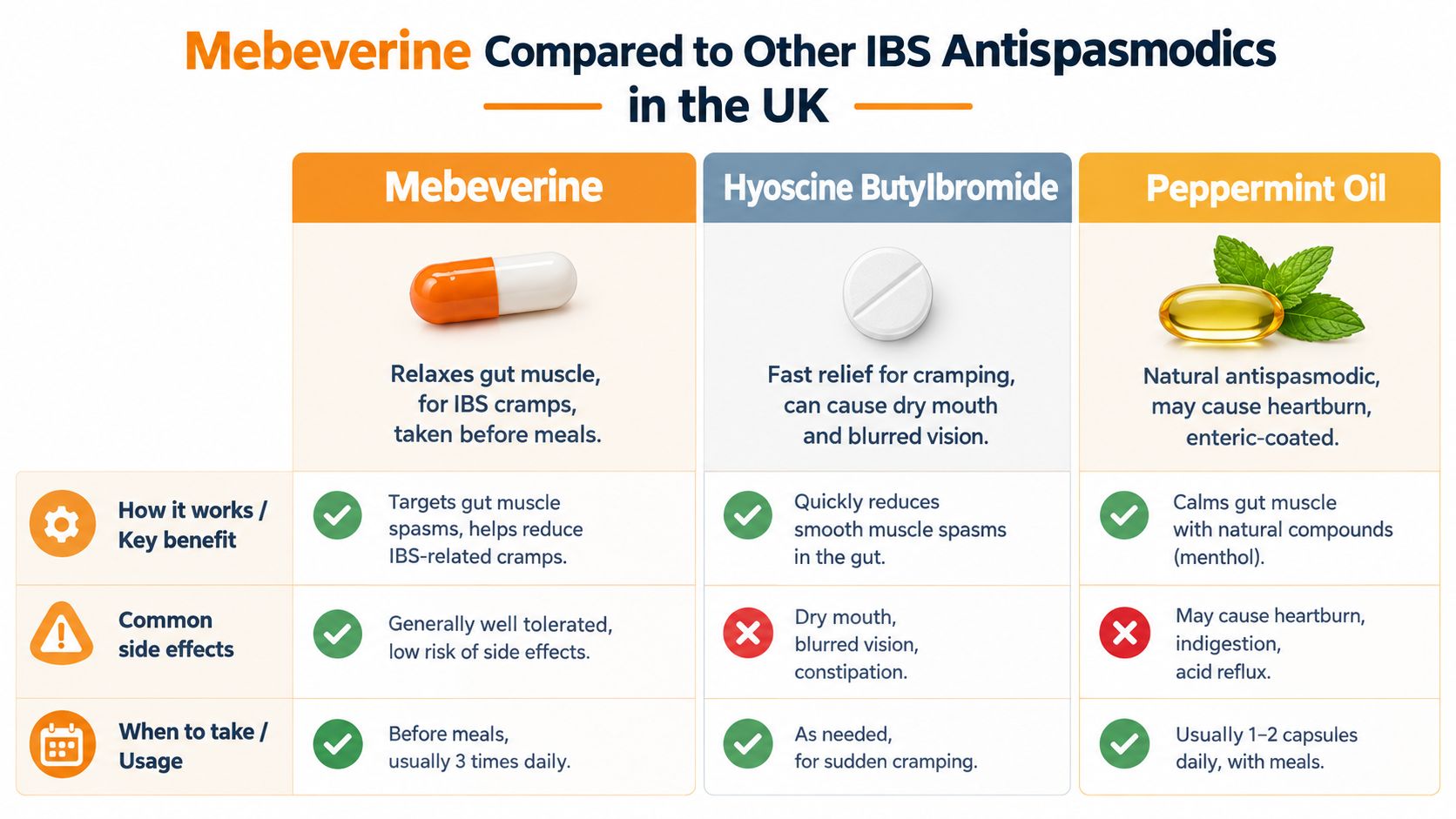
UK guidance places antispasmodics among the treatment options for IBS pain and spasm. That group can include mebeverine, alverine, hyoscine butylbromide, and peppermint oil [5]. In practice, mebeverine often comes up when cramping seems linked to eating or when someone wants a regular before-meal tablet rather than a more occasional option.
That still leaves a real-life question NHS leaflets often do not answer clearly. What do you do if the medicine helps, but only partly, or if your week does not run on tidy meal times?
A simple comparison patients usually find helpful
| Option | Often considered when | Practical difference |
|---|---|---|
| Mebeverine | Cramping follows a fairly regular pattern, especially around meals | Usually taken before food as a planned routine [1][3] |
| Hyoscine butylbromide | You want another antispasmodic option for IBS pain | Often discussed as an alternative in UK pathways and pharmacy advice [2] |
| Peppermint oil | You prefer a different type of antispasmodic | Also listed as an option for pain or spasm in UK formulary material [5] |
The choice is often about pattern, not strength
Patients often ask which one is strongest. A better question is which one matches your symptom pattern.
If your cramps build around meals, mebeverine can fit well because it is usually timed before eating. If your symptoms are less predictable, another option may suit your routine better. A parent grabbing toast while packing school bags may need a very simple plan. A nurse on rotating shifts may need treatment that works around changing breaks, not standard clock times.
This is also where dose decisions become more practical than the leaflet suggests. If mebeverine has settled symptoms well for a while, some people ask their GP or pharmacist whether they can reduce how often they take it rather than stay on a full routine indefinitely. That decision depends on how stable symptoms are, how often flares return, and whether missed doses make a difference. It is a useful review point, not a sign you have failed treatment.
Questions worth asking a pharmacist or GP
- Is cramping the main problem, or is bloating, constipation, or diarrhoea causing more trouble?
- Do symptoms predictably flare after meals?
- Do you need a medicine for regular prevention, or something that fits occasional bad spells better?
- Have you had partial relief that suggests the dose, timing, or medicine choice needs reviewing?
- If symptoms are improving, is it reasonable to try reducing treatment gradually with advice?
Another recognised antispasmodic used in UK pharmacy practice is Buscopan IBS relief tablets. That can be part of the discussion if mebeverine is not a good fit or has not helped enough.
Featured mini answer
Is mebeverine better than other IBS antispasmodics?
It depends on your symptom pattern and your daily routine. UK guidance supports mebeverine as one option, but another antispasmodic may suit you better if your symptoms, meal pattern, or response to treatment point in that direction [2][5].
Practical Tips for Different UK Lifestyles and Situations
It is 6:45am. One child cannot find a shoe, the toast is burning, and you are trying to remember whether you were meant to take mebeverine before breakfast or just at some point in the morning. That kind of real life problem is rarely covered well in an NHS leaflet.
Mebeverine usually works best when it fits around your meals and your normal week, not an ideal routine that never happens. The goal is simple. Make it easy enough to remember that you can tell whether it is helping.
Busy parent
Parents often do better with visual reminders than with good intentions. Keep your tablets somewhere linked to the first meal of the day, as long as that spot is safe and out of children's reach. A kitchen cupboard near the cereal, or beside the mug shelf, is often more useful than a bathroom cabinet you only remember after eating.
If mornings are chaos, focus on getting one anchor point right first. Breakfast is usually the easiest place to start. Once that feels automatic, the later doses are easier to build in.
Pharmacist's tip: If dinner time shifts a lot because of clubs, homework, or bath time, set a phone reminder that says “before evening meal” rather than a fixed clock time.
Shift worker
Shift work can make standard medicine advice feel written for somebody else. If your meals move, your tablet times can move with them. What matters is the gap before eating, not whether the clock says morning or night.
For night shifts, label alarms by meal, not by hour. “Before first meal after waking” is clearer than “8am.” That small change prevents the common mistake of taking tablets according to daytime habits on a completely different schedule.
Keep a strip in the bag you take to work. Not the one you mean to pack.
If you commute or eat on the go
This is common in the UK. A rushed sandwich at your desk, breakfast on the train, or grabbing food between appointments can make timing awkward.
Try pairing the dose with the moment you buy, pack, or plate the meal, rather than the moment you start eating. That gives you a better chance of taking it at the right time. If you regularly skip meals, speak to a pharmacist. A medicine routine built around three tidy meal breaks may need adjusting to fit how your day really works.
If you want convenient access to treatment advice, repeat supply options, or general support, online pharmacy services in the UK can be a practical starting point.
Gym-goer
Exercise can blur the routine as well, especially if you eat quickly before training and then rush out the door. Keep the plan simple. Store a strip in your gym bag or work bag so you are not relying on memory alone.
If you miss a dose, do not take extra later to catch up. Instead, notice the pattern. If cramps tend to show up after a fast pre-gym meal or after protein bars, that is useful information for your next review.
When symptoms are only partly better
Many adults feel unsure. The medicine may be helping, but not enough to make life feel normal again.
Ask yourself practical questions. Are school runs, work meetings, or shopping trips easier than they were a few weeks ago? Are cramps shorter, even if they have not gone completely? Are you still planning your day around toilet access or worrying about meals?
Those answers matter because they help you and your pharmacist decide what to do next. Sometimes the issue is timing. Sometimes it is that cramping is only one part of the problem, and bloating, constipation, or diarrhoea need separate attention.
When to think about reducing the dose
Some adults do not need the full routine forever. If symptoms have been settled for several weeks, it may be reasonable to ask a pharmacist or prescriber whether you can gradually reduce how often you take it. The key word is gradually.
A good rule is to review after a stable spell, not after one unusually good day. If symptoms return when doses are missed, that tells you something useful. If they stay settled, a step-down plan may make sense.
A short symptom note on your phone can help here. Record meals, cramps, and missed doses for a couple of weeks. It gives you a clearer picture than memory alone.
When Not to Take Mebeverine and Safety Considerations
There are a few points that matter more than any “life hack”.
Who should avoid it
UK product information says mebeverine is not recommended for children and adolescents under 18 because there's insufficient safety and efficacy data [4].
If you've ever had an allergic reaction to mebeverine or any tablet ingredient, don't take it again without medical advice.
When to review the dose
The UK SmPC states that after several weeks of treatment, once the desired effect is achieved, the dose may be gradually reduced [4]. That's useful because many adults assume the starting dose must stay the same forever.
Pharmacist's tip: Don't cut back just because you had one good day. Think in terms of a stable improvement over several weeks, then speak to your prescriber or pharmacist about stepping down safely.
When to ask for medical advice
Get advice before taking it if you're pregnant, breastfeeding, have other medical conditions, or you're not sure your symptoms really fit IBS. Also get checked if symptoms change, worsen, or feel different from your usual flare.
Seek urgent help if you have:
- Swelling of the face, lips, tongue or throat
- Breathing difficulty
- Severe or unusual abdominal pain
- Blood in the stool
- Any sudden change that doesn't feel like your normal IBS
This article is for information only and isn't a substitute for personal medical advice.
If you'd like treatment access online, Courier Pharmacy offers UK pharmacy services that include IBS-related options after an appropriate assessment. That can be useful if you already know your diagnosis and want a straightforward way to discuss treatment, dosing questions, or whether mebeverine is a sensible fit for your symptoms.
Summary
Mebeverine hydrochloride 135mg is a standard UK antispasmodic used for IBS cramps and abdominal pain.
Adults usually take 1 tablet three times a day, about 20 minutes before meals [1].
Swallow the tablets whole, and skip rather than double a missed dose [3][8].
If symptoms settle after several weeks, the dose may be reduced gradually with advice [4].
It isn't recommended for under-18s [4].
If symptoms change, worsen, or don't feel like your usual IBS, get medical advice rather than guessing.
FAQs
What is mebeverine hydrochloride 135mg used for?
It's used for the symptomatic treatment of IBS and related spastic bowel conditions in the UK [1][3]. People usually take it to ease bowel cramps and abdominal pain.
How many mebeverine 135mg tablets can I take in a day?
The usual adult dose for standard tablets is 1 tablet three times a day [1]. UK patient information also says not to exceed 3 tablets per day [6].
When should I take mebeverine before food?
Take it about 20 minutes before meals [1][3]. Many adults take it before breakfast, lunch and the evening meal [8].
Do I swallow mebeverine whole?
Yes. UK guidance says to swallow the tablet whole with water [3][8]. Don't crush or chew it unless a clinician tells you to.
What should I do if I miss a dose?
Skip the missed dose and take the next one at the usual time [8]. Don't take two together to catch up.
Can I reduce the dose if I feel better?
Possibly. UK product information says that after several weeks of treatment, once the desired effect is achieved, the dose may be gradually reduced [4]. It's best to check with your prescriber or pharmacist before changing your routine.
Is mebeverine available in the UK without a prescription?
NHS guidance says mebeverine can be prescribed, and for diagnosed IBS it may also be bought from a pharmacy without a prescription [2]. That doesn't mean it suits every type of abdominal pain, so ask if you're unsure.
Is mebeverine suitable for children?
No, not routinely. The UK SmPC says it isn't recommended for children and adolescents under 18 because there isn't enough safety and efficacy data [4].
Does mebeverine help every IBS symptom?
Not necessarily. It's mainly used when pain and spasm are the main problem [5]. If diarrhoea, constipation, or bloating are your biggest issues, you may need a broader IBS plan.
Meta description
Mebeverine hydrochloride 135mg explained for UK patients. Learn dose, timing, missed doses, safety, and practical IBS tips in plain English.
Internal links to add
- Irritable bowel syndrome guide
- How ordering treatment works
- What causes inflammatory bowel disease
- Buscopan IBS relief tablets
- Online pharmacy UK
Byline
Author: Medical Mojo Editorial Team
Credentials: Patient education writers
Clinical review: Reviewed by a UK-registered pharmacist
Credentials: GPhC-registered pharmacist
How this content was created
This article was written using UK patient and prescribing information from the NHS, NICE-hosted BNF, and UK medicines product information, then edited for plain-English readability and safety-focused patient education.
References
[1] NHS. (n.d.) How and when to take mebeverine. Available at: https://www.nhs.uk/medicines/mebeverine/
[2] NICE BNF. (n.d.) Mebeverine hydrochloride. Available at: https://bnf.nice.org.uk/drugs/mebeverine-hydrochloride/
[3] Electronic Medicines Compendium. (n.d.) Mebeverine hydrochloride 135 mg tablets SmPC. Available at: https://www.medicines.org.uk/emc/product/2315/smpc
[4] Electronic Medicines Compendium. (n.d.) Mebeverine 135 mg tablets SmPC. Available at: https://www.medicines.org.uk/emc/product/9751/smpc
[5] Kent and Medway ICB. (n.d.) Position statement on antispasmodics. Available at: https://www.dgsdvhformulary.nhs.uk/media/1177/kent-and-medway-icb-position-statement-dicycloverine-proprantheline.pdf
[6] Electronic Medicines Compendium. (n.d.) Patient leaflet for mebeverine 135 mg tablets. Available at: https://www.medicines.org.uk/emc/files/pil.9751.pdf
[7] Electronic Medicines Compendium. (n.d.) Mebeverine hydrochloride 135mg tablets patient leaflet. Available at: https://www.medicines.org.uk/emc/product/2315/pil
[8] Electronic Medicines Compendium. (n.d.) Mebeverine 135mg tablets patient leaflet. Available at: https://www.medicines.org.uk/emc/product/9751/pil


