Medication Expiration Dates Explained
Discover what medication expiration dates mean, UK storage rules, safety tips, and disposal steps to avoid risks with expired meds.
SEO brief
Primary keyword: medication expiration dates
Secondary keywords: expired medicine UK, medicine expiry date, opened medicine expiry, safe disposal of medicines, UK pharmacy advice
Search intent: informational, safety-focused
Target reader: UK adults, carers, and patients checking medicines at home
Product/service mention: Courier Pharmacy disposal and replacement support assumed from provided brief
Internal links available: Assumed from supplied URLs
You open the kitchen drawer, hear that familiar rattle, and spot an old box of tablets at the back. The date looks close. Or maybe already gone. You pause and wonder, are medication expiration dates a hard stop, or just a guide?
Short answer: medication expiration dates matter, and you should treat them seriously. The printed date tells you how long the maker guarantees the medicine's quality when it's unopened and stored properly [1]. After opening, mixing, or repackaging, many medicines have much shorter time limits [2][3].
This guide breaks the rules down in plain English. You'll learn what expiry dates really mean, why storage matters, which medicines have special rules, how UK labels work, and what to do if you find expired medicines at home.
Introduction and Key Takeaways
A dusty bottle in a drawer doesn't look dramatic, but this is how expiry questions usually start. Not in a hospital. At home, when you have a headache, a child with a temperature, or a repeat medicine you forgot you still had.
That moment matters because many people skip this check. A 2024 survey found that 50% of UK adults admit they rarely check expiry dates before taking medicines according to reporting on the Asda Pharmacy survey in the Express [4]. If you want more practical patient guides, the Courier Pharmacy blog has similar everyday health advice.
Some expired medicines mainly lose strength. Others can become less reliable much sooner once opened, mixed, or removed from their original pack. That's where people often get caught out.
Here are the main points to keep in mind:
- Check before you take: Always read the date on the pack, bottle, or label before using a medicine.
- Know the difference: A printed expiry date usually applies to an unopened product, not one you opened weeks ago.
- Be extra careful with liquids and eye drops: These often expire much sooner after opening.
- Store medicines properly: Heat, steam, and sunlight can shorten how long medicines stay stable.
- If in doubt, ask a pharmacist: Don't guess with insulin, antibiotics, inhalers, injectables, or anything for an emergency.
Understanding what expiration dates mean
A medicine expiry date is not a random guess. It's the point up to which the manufacturer promises the medicine will still meet its quality standard if it stays unopened and stored the right way [1][5].
Under UK guidance, stability testing requires that at least 90% of the active pharmaceutical ingredient remains present at the expiry date [5]. That doesn't mean every medicine suddenly becomes useless the next day. It means the manufacturer no longer guarantees its full quality beyond that point.
What the date covers
Just as with a sealed food packet, the date applies to the pack as it left the manufacturer. Once you open it, transfer it, or mix it, the clock can change.
Practical rule: The printed expiry date is the maker's promise for an unopened medicine stored as directed.
UK date wording also trips people up. The MHRA definition used in UK guidance says an expiry date means the product should not be used after the end of the month shown, while “Use by” means you should dispose of it before the end of the previous month [1].
Why this catches people out
That sounds small, but it changes real decisions. If a box says EXP 12/2025, the medicine is valid until the end of December 2025 under the UK definition [1]. If a label says Use by 06/2025, the practical instruction is tighter. You should not keep using it into June [1].
This is one reason expiry dates deserve a proper look before each use. The wording matters, not just the numbers.
Featured mini answer
Do medication expiration dates mean a medicine becomes dangerous the very next day?
Not always. But after the date, the manufacturer no longer guarantees the medicine's quality, strength, or stability, so you shouldn't rely on it [1][5].
How storage and stability affect expiry
You can have an in-date medicine that still isn't in good condition if you store it badly. Heat, moisture, and light all speed up breakdown.
Why storage can change the real-life shelf life
Manufacturers set dates using controlled testing. Under UK Good Manufacturing Practice, the medicine must still contain at least 90% of its active ingredient at the expiry date [5]. UK guidance also notes that some solid-dose forms stored under optimal conditions may retain potency for up to 5 years post-expiry [5]. That does not mean you should self-decide to use expired tablets. It shows how much storage conditions matter.
A good analogy is a battery. Leave it somewhere cool and dry, and it holds charge better. Leave it in a hot car or damp room, and performance drops faster.
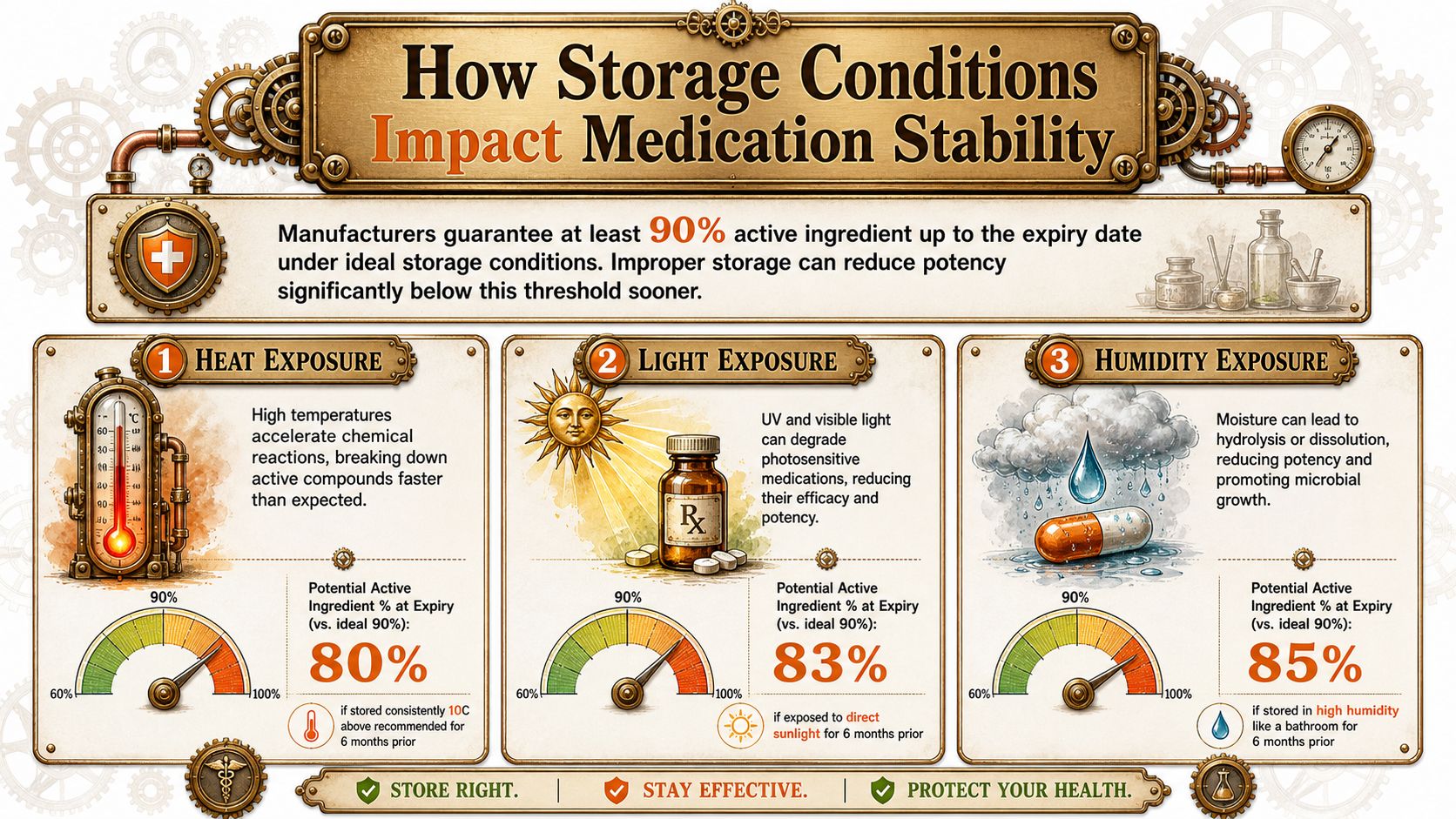
For example, people often keep tablets in the bathroom cabinet because it feels convenient. Bathrooms are usually warm and steamy, which isn't ideal for many medicines. If you use inhalers, this matters too, because storage advice affects reliability. A useful patient guide is this Ventolin inhaler guide.
Medicines like cool, dry, boring places. Bathrooms and sunny windowsills are the opposite.
Simple storage habits that protect your medicines
Use these habits to give your medicine the best chance of staying stable up to its labelled date:
- Keep it in the original pack: The pack protects the medicine and keeps the date and instructions attached.
- Avoid heat and steam: Don't store medicines near kettles, radiators, cookers, or in bathrooms.
- Protect from sunlight: A bright window ledge may look tidy, but it's a poor medicine cupboard.
- Close containers properly: Lids matter, especially for liquids, creams, and eye drops.
- Follow fridge instructions exactly: Only refrigerate medicines where instructions indicate refrigeration.
Pharmacist's tip: If the tablets look crumbly, sticky, faded, or different from usual, don't use them even if the printed date hasn't passed.
Exceptions for certain medication types
Not all medicines age in the same way. A sealed tablet, an opened cream, and a mixed antibiotic liquid all follow different rules.
Why tablets and liquids follow different rules
Once a medicine is opened, mixed, or repackaged, the original manufacturer's date may stop being the most useful one. NHS guidance shows that loose tablets or capsules dispensed without a printed date should be used within 6 months, blister packs within 8 weeks, and reconstituted antibiotics expire 7 to 14 days after preparation [2].
That's a big difference. It explains why an antibiotic mixture made for a child's ear infection can't sit in the fridge for future use, while some tablets may still have a longer in-use period after dispensing.
Compounded medicines also need careful attention. They follow the same logic. Once a pharmacist prepares a customized cream, spray, or liquid, its practical lifespan depends on the formulation, packaging, and storage instructions rather than only a distant manufacturer date. If you're not familiar with this type of medicine, this explainer on what a compounding pharmacy is gives useful background.
In-use expiry limits by medication type
| Medication Type | Expiry After Opening or Dispensing |
|---|---|
| Loose tablets or capsules dispensed without a printed date | Use within 6 months [2] |
| Monitored Dosage System or blister pack | Use within 8 weeks [2] |
| Reconstituted antibiotics | Expire in 7 to 14 days after preparation [2] |
| Liquid medicines in original bottles | Generally 6 months once opened unless the manufacturer advises otherwise [2] |
| Creams in tubes | 3 months after opening [2] |
| Eye drops | 1 month after opening [2] |
There are also stricter examples in NHS guidance for some opened products. Some liquid and topical medicines must be discarded within periods ranging from 28 days to 6 months, depending on the formulation [3].
A medicine can be in date on the box and still be out of date in practice once you've opened it.
Pharmacist's tip: Write the opening date on bottles, creams, and eye drops with a permanent marker. It saves guesswork later.
Reading expiry dates under UK regulations
Labels often look simple until you're trying to decode them quickly when you feel unwell. UK expiry labels make more sense when you know which line matters.
How to read the label correctly
Start with the words beside the date.
- EXP MM/YYYY usually means the product can be used until the end of that month if it remains unopened and correctly stored.
- Use by MM/YYYY is stricter and should be followed exactly as written under UK guidance [1].
- Opened on: If you've written this yourself, that date may matter more for liquids, creams, or eye preparations than the printed manufacturer date.
Some pharmacy labels also carry storage instructions such as keeping the medicine below room temperature or protecting it from light. Read those every time you start a new item, not just the first time you ever used that medicine.
Featured mini answers
Does opening a medicine change its expiry?
Yes, it can. NHS guidance says some opened liquid and topical medicines need discarding within 28 days to 6 months, depending on the formulation [3].
Does the fridge always make medicine last longer?
No. Only refrigerate medicines that are meant to be refrigerated. Wrong storage can still damage them.
A common UK example is insulin. NHS guidance notes that some products, including insulin pens and vials, have strict in-use periods once opened or taken out of refrigeration [3]. If you order regular medicines online, it helps to use a pharmacy with clear labelling and advice, such as a UK online pharmacy service.
Pharmacist's tip: If you can't find the date, or the label has rubbed off, don't guess. Ask a pharmacist before using it.
Steps to take when you find expired medications
Finding expired medicines doesn't mean you've done anything wrong. Most homes collect part-used boxes over time. The important bit is what you do next.
Near the start of this guide, we noted that 50% of UK adults say they rarely check expiry dates before taking medicines [4]. A simple home routine can lower that risk.
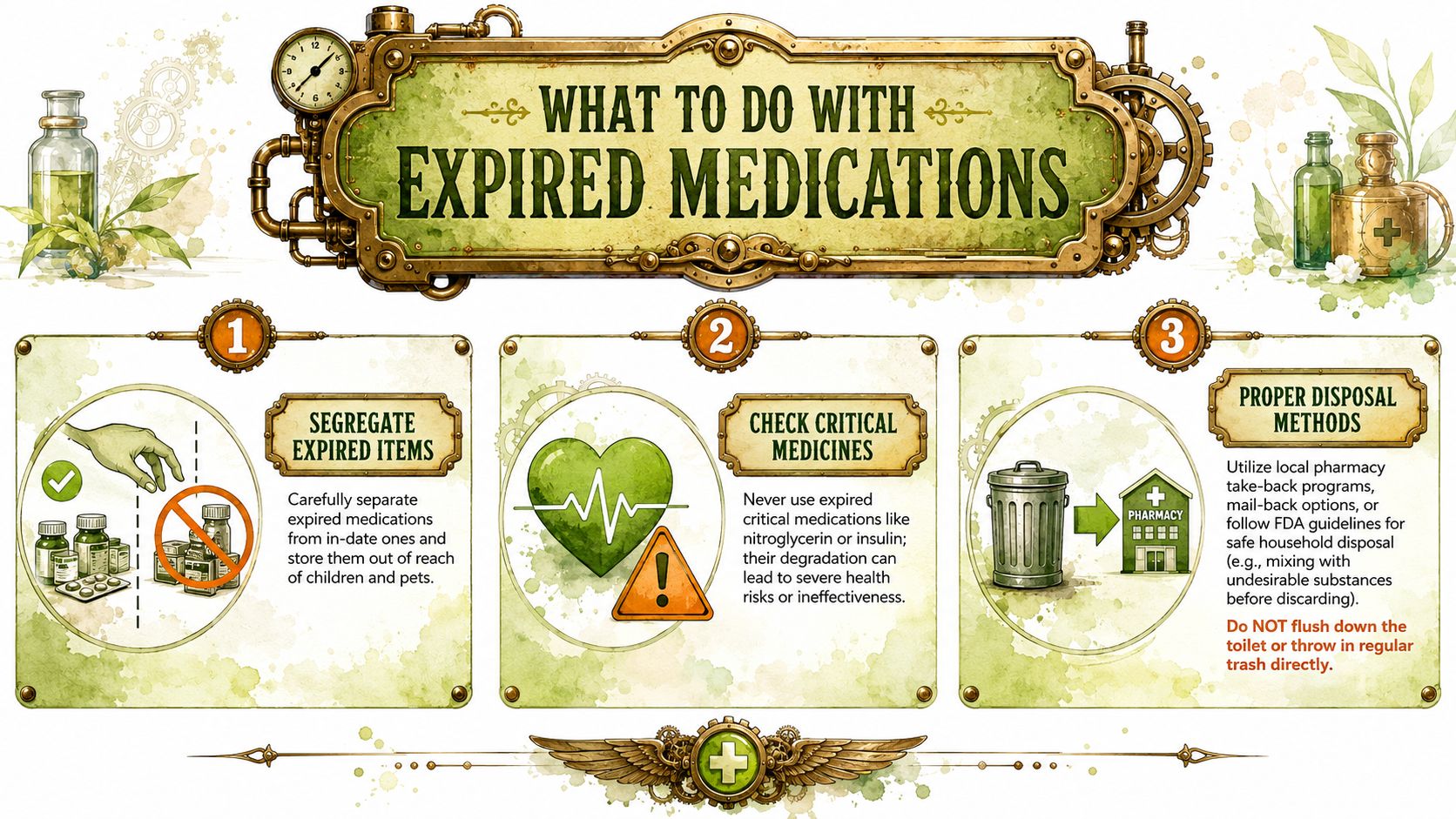
A visual checklist can help when you're sorting a drawer or medicine box:
A safe home checklist
Separate expired items straight away.
Put them in a bag or box away from current medicines. Keep them out of reach of children and pets.Check whether any are critical medicines.
Be especially cautious with medicines where a drop in reliability could be dangerous, such as insulin or nitroglycerin, which UK guidance highlights as needing strict attention [3].Don't throw medicines into normal rubbish if you can avoid it.
Take them to a pharmacy for safe disposal. Pharmacies are the standard route for medicine returns in the UK [2].Remove or cover personal details on labels.
Peel off the label, black out your name and address, or ask the pharmacy to handle it.Replace what you still need.
If the expired item is part of your regular treatment, order a fresh supply or contact your GP or pharmacist promptly.
Here's a short explainer that many patients find useful before clearing out a cupboard:
Real-life examples
Busy parent scenario
You find a half-used bottle of reconstituted antibiotic in the fridge from your child's last infection. Even if it looks fine, this type of medicine usually expires within 7 to 14 days after preparation [2]. It shouldn't be saved for the next illness.
Shift worker scenario
You keep headache tablets in your work bag and a spare strip at home. The home strip sat in a damp bathroom drawer for months. Even if the date on the box looks acceptable, poor storage can affect stability before the printed date becomes the issue.
Gym-goer scenario
You discover an out-of-date adrenaline auto-injector in your sports bag before a trip. This isn't one to gamble on. Replace emergency medicines before you need them. If you use an adrenaline device, this EpiPen 300mcg twin pack page may help you identify the product and arrange a current supply where clinically appropriate.
When to seek urgent help
Get urgent medical advice if:
- You used an expired medicine and now feel unwell
- An emergency medicine failed when needed
- A child has swallowed an old or unknown medicine
- You're unsure whether a missed or weakened dose could put you at risk
Call 999 for severe symptoms such as breathing trouble, collapse, chest pain, or signs of a serious allergic reaction.
Pharmacist's tip: Do a quick medicine check whenever the clocks change. Linking it to a familiar date makes the habit easier to keep.
Summary
Medication expiration dates are more than tiny print on a box. They tell you how long a manufacturer guarantees a medicine's quality while it stays unopened and stored properly. Once a medicine is opened, mixed, or repackaged, different time limits may apply.
Store medicines in a cool, dry place, not in a steamy bathroom or sunny kitchen. Be extra careful with liquids, eye drops, creams, insulin, and mixed antibiotics. If you find expired items, separate them, don't use them casually, and return them to a pharmacy for safe disposal.
If anything about the label, date, or storage seems unclear, ask a pharmacist. It's a small check that can prevent a big problem.
FAQs
Can I use tablets one day past expiry?
It's safest not to. The manufacturer no longer guarantees the medicine's quality after the expiry point, even if the tablets look normal [1][5]. If it's a regular medicine, ask a pharmacist about a replacement.
Do opened medicines expire sooner than unopened ones?
Often, yes. Some opened liquid and topical medicines must be discarded within 28 days to 6 months, depending on the formulation [3]. Eye drops, creams, and insulin are common examples where opening changes the clock.
How long do reconstituted antibiotics last?
They usually expire within 7 to 14 days after preparation under UK guidance [2]. That's why you shouldn't keep leftover antibiotic liquid for future infections.
Are loose tablets the same as tablets in blister packs?
No. UK guidance says loose tablets or capsules dispensed without a printed date should be used within 6 months, while blister packs have an 8-week limit after dispensing [2]. Packaging affects stability.
Should I keep medicines in the bathroom cabinet?
No. Bathrooms are usually warm and humid, which can speed up medicine breakdown. A cool, dry cupboard is usually better.
Can I throw expired medicines in the bin?
It's better to return them to a pharmacy for safe disposal [2]. That lowers the chance of accidental use and helps dispose of medicines responsibly.
What if I swallowed expired cream or used expired eye drops?
Contact a pharmacist, NHS 111, or your GP for advice, especially if you notice irritation, worsening symptoms, or the product was well past its in-use date. Seek urgent help if there's severe pain, swelling, or breathing problems.
How do I remember opened medicine dates?
Write the opening date on the label or box as soon as you start using it. This works especially well for eye drops, creams, and liquid medicines.
If you need help replacing out-of-date treatment, checking a label, or arranging safe medicine support from a UK-regulated online pharmacy, Courier Pharmacy offers patient-focused guidance, prescribing pathways where appropriate, and services for both standard and personalised medicines.
Meta description: Medication expiration dates explained for UK patients. Learn what expiry dates mean, how opening changes them, and how to dispose of medicines safely.
Suggested internal links for medicalmojo.co.uk
- A guide to using antibiotics safely
- How to store medicines at home
- What to do if you miss a dose
- Eye drops safety and common mistakes
- How online pharmacies work in the UK
Byline: Medical Mojo Editorial Team
Clinical review: Reviewed by a UK-registered pharmacist
How this content was created
This article was written using UK pharmacy and NHS-linked guidance provided in the source set, with a clinical accuracy check for patient-friendly wording, safety advice, and UK regulatory interpretation.
Visual ideas for design
- Steampunk medicine drawer scene
Alt text: “Old medicine boxes and pill bottles in a home drawer, with expiry dates highlighted in bright lime green.” - Expiry label explainer graphic
Alt text: “UK medicine box showing EXP and Use by labels with simple callouts explaining the difference.” - Opened medicines checklist infographic
Alt text: “Chart showing how long opened eye drops, creams, liquids, and blister packs last under UK guidance.” - Safe disposal journey graphic
Alt text: “Patient separating expired medicines and returning them to a pharmacy, shown in light grey and pale yellow-green tones.”
Disclaimer: This information is for general education only and isn't a substitute for personal medical advice. If you're unsure about a medicine, speak to a pharmacist, GP, or NHS 111.
References
[1] Médecins Sans Frontières (MSF) (n.d.) Expiry date and use by date definitions. Available at: https://unicat.msf.org/intros/21334
[2] Gloucestershire Health and Care NHS Foundation Trust (n.d.) Expiry dates of medication. Available at: https://www.ghc.nhs.uk/wp-content/uploads/CHST-Expiry-Dates-of-Medication.pdf
[3] Tees, Esk and Wear Valleys NHS Foundation Trust (2022) Medication Expiry Dates MSS16. Available at: https://www.tewv.nhs.uk/wp-content/uploads/2022/05/Medication-Expiry-Dates-MSS16.pdf
[4] Express (2016) Half of Brits fail to check medicine expiry dates, Asda survey finds. Available at: https://www.express.co.uk/life-style/health/698566/half-Brits-fail-check-medicine-expiry-dates-Asda-survey
[5] Bath and North East Somerset, Swindon and Wiltshire guidance (2021) Expiry date guidelines. Available at: https://bswtogether.org.uk/medicines/wp-content/uploads/sites/3/2020/05/Expiry-date-guidelines-updated-July-2021.pdf


