Medicine for a Sore Throat: A Practical UK Guide
Find the right medicine for a sore throat with this practical UK guide. Covers OTC options, antibiotics, pharmacist tips and red flags to watch for.
Most sore throats get better within about one week without antibiotics. For most UK adults, start with paracetamol or ibuprofen, fluids, rest and simple throat care.
You're probably reading this while swallowing feels like work, speaking feels irritating, and the medicine cupboard offers too many choices. The right treatment depends on your symptoms, age, health and the chance of a bacterial infection. This guide follows the NICE NG84 and NHS approach, including when Pharmacy First makes sense.
Five key takeaways
- Start with pain relief: Paracetamol or suitable ibuprofen usually helps most.
- Expect improvement: Acute sore throat commonly settles within about one week.
- Don't chase antibiotics: NICE advises against them for low FeverPAIN or Centor scores.
- Use Pharmacy First: In England, eligible people aged five and over can receive assessment and treatment through a pharmacist.
- Act on red flags: Breathing trouble, drooling, severe swelling or inability to drink needs urgent help.
What a sore throat really is and what causes it
A sore throat means inflammation at the back of the throat, often involving the tonsils. You may notice soreness, scratchiness, redness or pain when swallowing. Clinicians may call this pharyngitis or tonsillitis, depending on the area affected.
The NHS and NICE describe acute sore throat as commonly viral and self-limiting. NICE says most people recover within about one week without antibiotics [1]. Cold viruses, influenza and COVID-19 can all cause throat pain. Glandular fever can also produce a marked sore throat, especially with swollen glands and tiredness.
Bacteria can cause sore throat too. The main bacterial concern is Group A Streptococcus, often called Strep A. However, symptoms alone don't always separate viral and bacterial infections. A cough and runny nose often fit a viral illness, while fever, swollen tonsils and tender neck glands may raise the likelihood of Strep A.
Smoking, acid reflux, post-nasal drip and dry indoor air can irritate the throat without causing a new infection. That matters because antibiotics won't fix irritation.
Common causes at a glance
| Cause type | Common examples | Typical duration | Key feature |
|---|---|---|---|
| Viral infection | Colds, influenza, COVID-19 | Often about one week | May include cough or blocked nose |
| Bacterial infection | Group A Streptococcus | Often self-limiting | Fever, tonsil changes or tender neck glands may occur |
| Irritation | Smoking, reflux, dry air | Variable | Symptoms may recur or lack infection signs |
| Other causes | Glandular fever or less common infections | Variable | May need clinical assessment |
For practical advice on related cold symptoms, see this guide to coughs and colds. The key point remains simple. A painful throat doesn't automatically mean you need prescription medicine.
Over-the-counter medicine for a sore throat that actually helps
The best medicine for a sore throat usually starts with straightforward pain relief. NICE advises considering paracetamol first, or ibuprofen if it's suitable for you [2].
Adults commonly use paracetamol 500 mg tablets or ibuprofen 200 to 400 mg tablets. Always follow the pack directions and check the maximum daily amount. Take ibuprofen with food, and ask a pharmacist before using it if you have stomach ulcers, kidney problems, certain heart conditions, asthma triggered by anti-inflammatory medicines, or take medicines that may interact.
Don't double up accidentally. Many cold-and-flu products already contain paracetamol, so check the active ingredients before taking another dose. Avoid aspirin in anyone under 16 unless a clinician specifically advises it.
Match the product to the symptom
Medicated lozenges can soothe the throat. Brands such as Strepsils, Tyrozets and Difflam use different ingredients, including antiseptic, local anaesthetic or anti-inflammatory effects. NICE notes that some medicated lozenges and sprays provide only a small reduction in pain [3]. They can help, but they aren't a cure.
Benzydamine sprays, such as Difflam, may suit someone who finds swallowing lozenges difficult. Chloraseptic-style sprays can numb discomfort for a short time. Follow the product leaflet, particularly around age limits and how often you can use the product.
Warm salty-water gargles can ease irritation. Don't give gargles to young children who may swallow the water or choke. Menthol lozenges, honey products and ice lollies may feel soothing, but they don't shorten the illness.
| Product type | Active ingredient | Typical adult use | Pharmacist verdict |
|---|---|---|---|
| Tablets | Paracetamol | Follow the pack directions | Best simple starting point for pain or fever |
| Anti-inflammatory tablets | Ibuprofen | Follow the pack directions, with food | Useful if suitable, but not for everyone |
| Medicated lozenges | Varies by brand | Dissolve slowly as directed | Reasonable add-on for local relief |
| Throat spray | Benzydamine or local anaesthetic | Use as stated on the label | Handy when swallowing is difficult |
| Salt-water gargle | Salt and warm water | Gargle, then spit out | Cheap option for adults and older children |
You can find general information about paracetamol tablets, but use the product label and pharmacist advice for your own circumstances.
Pharmacist's tip: Treat the pain properly. People often drink too little because swallowing hurts, then feel worse from dehydration.
When antibiotics are the right medicine for a sore throat
Antibiotics make sense when a bacterial infection is more likely and treatment offers enough benefit. NICE uses FeverPAIN and Centor to guide that decision rather than prescribing for every red throat [4].
Centor looks for four features:
- Tonsillar exudate: White or pus-like coating on the tonsils.
- Tender neck glands: Painful glands at the front of the neck.
- Fever: A history of temperature over 38°C.
- No cough: The absence of a cough increases the score.
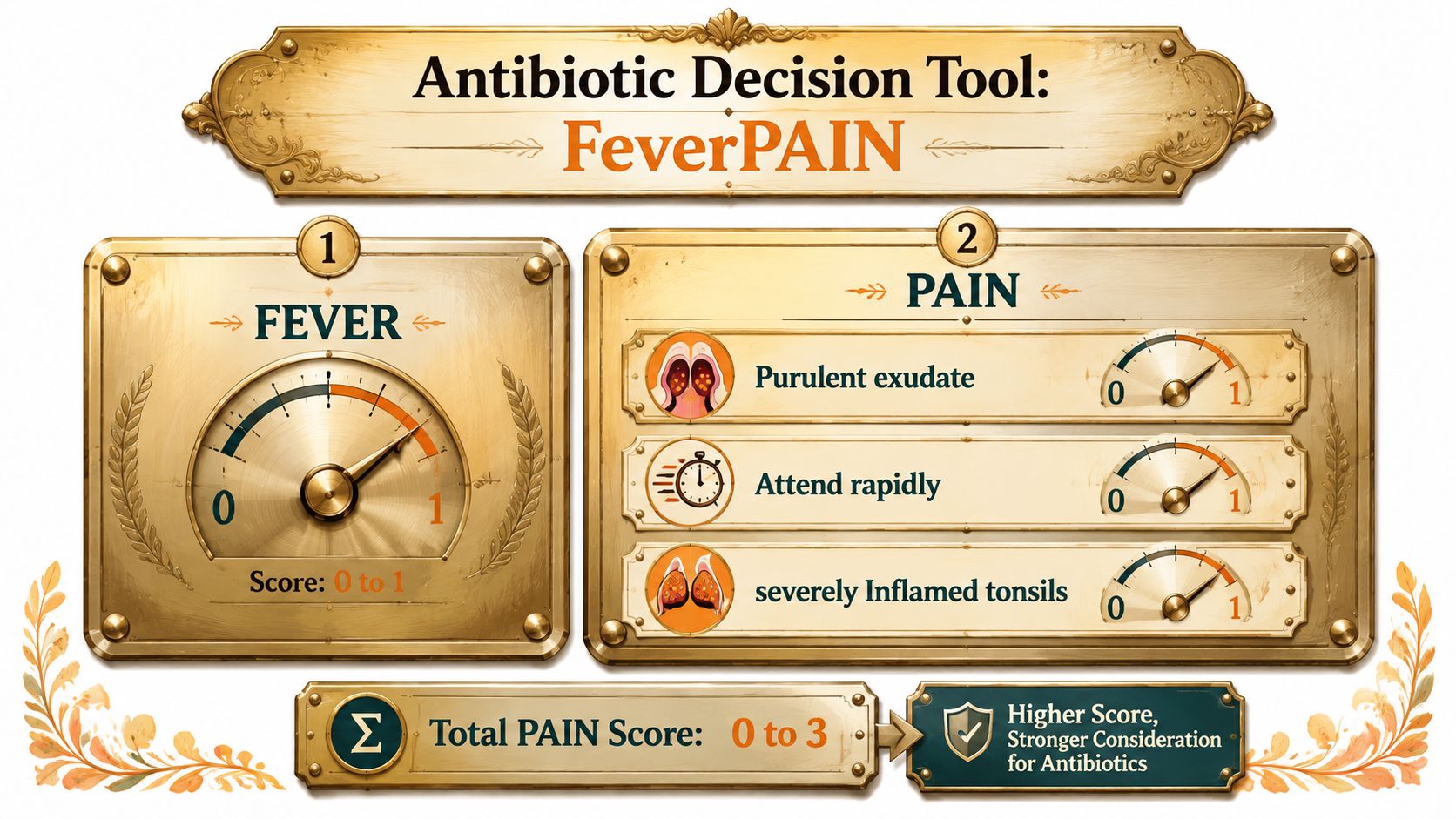
FeverPAIN uses a related clinical pattern, including fever, tonsil changes, rapid attendance and severe inflammation. You shouldn't diagnose yourself from a score alone, but the system helps clinicians judge whether antibiotics might help.
NICE advises no antibiotic for FeverPAIN 0 to 1 or Centor 0 to 2. FeverPAIN 2 to 3 may lead to no antibiotic or a back-up prescription. Higher scores may justify an immediate or back-up antibiotic, depending on severity and clinical assessment [2].
NICE's evidence summary says that withholding antibiotics rarely causes complications in most cases [1]. UK prescribing has also moved away from routine treatment because antibiotics can cause side effects and contribute to resistance. NICE estimates that antibiotics shorten symptoms by only about 16 hours on average [1].
England's Pharmacy First service gives eligible people aged five and over another assessment route. A pharmacist can use the relevant clinical criteria and, where appropriate, supply phenoxymethylpenicillin or clarithromycin under a Patient Group Direction.
This short video provides a visual overview of the decision process:
Prescription medicine for a sore throat in UK practice
A prescription antibiotic is appropriate only after a pharmacist, GP or other authorised clinician has assessed the symptoms against NICE NG84 and NHS guidance. For adults who can take penicillin, phenoxymethylpenicillin remains the usual first choice. Section 2 explains when antibiotics may offer benefit, so this section focuses on safe supply and use rather than repeating the dosing guidance.
If penicillin is unsuitable, the prescriber may choose clarithromycin. Erythromycin can be considered during pregnancy when clinically appropriate. The decision depends on allergy history, pregnancy, other medicines, age and the overall clinical picture.
England's Pharmacy First service gives eligible people aged five and over a route to assessment without a GP appointment. A pharmacist follows the same clinical criteria and, where appropriate, can supply phenoxymethylpenicillin or clarithromycin under a Patient Group Direction. The service is not a way to obtain antibiotics on request.
Do not use leftover antibiotics or share another person's prescription. Take the medicine exactly as directed and complete the prescribed course unless a clinician tells you to stop. Contact the prescriber promptly if you develop a serious reaction, cannot keep the medicine down, or your symptoms worsen.
A prescription painkiller rarely adds much when suitable over-the-counter pain relief is already being used correctly. Steroid tablets have a limited role and are not routine treatment for an ordinary sore throat.
For information about the assessment and supply process, see how treatment ordering works at Courier Pharmacy. Online assessment does not replace urgent help for breathing difficulty, drooling or severe trouble swallowing.
Choosing the right UK pathway for care
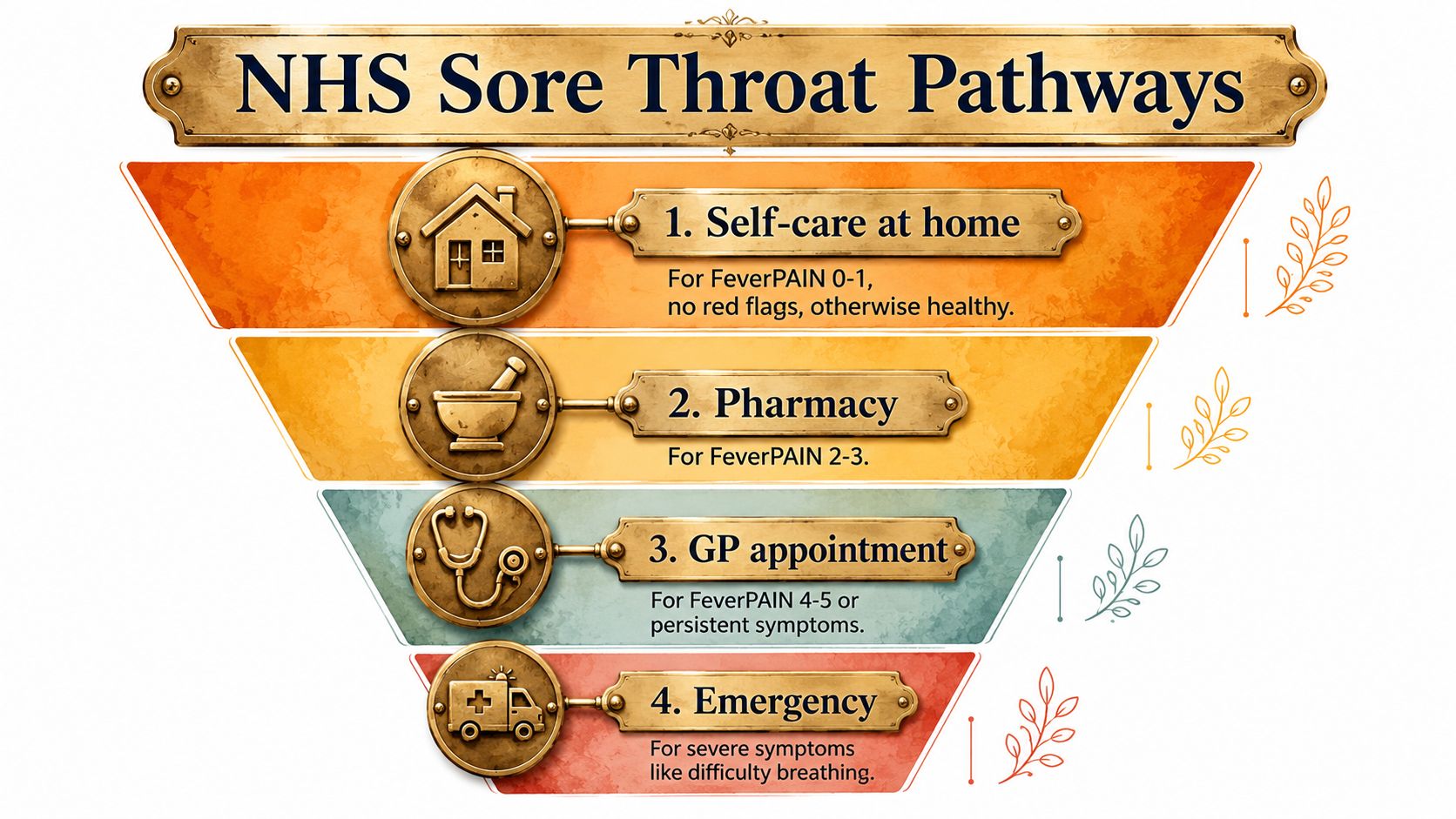
Your symptoms, ability to swallow and overall health should determine the next step, in line with NICE NG84 and NHS guidance. Start with self-care if you can drink, breathe normally and feel reasonably well. A low FeverPAIN score supports this choice, but red flags take priority over any score.
Four practical routes
- Self-care: Use this for mild symptoms without breathing or swallowing problems.
- Pharmacy First: In England, eligible people aged five and over can seek assessment without booking a GP appointment. The pharmacist applies NHS clinical criteria and refers you when the problem needs medical review.
- GP appointment: Choose this for recurrent tonsillitis, pregnancy, a weakened immune system or symptoms that fail to settle.
- Urgent care: Seek urgent help for breathing difficulty, drooling, severe trouble swallowing or signs of serious illness.
An online pharmacy service in the UK may offer an assessment route for suitable conditions. An online questionnaire supports clinical review, but it cannot replace emergency care when someone is struggling to breathe or swallow.
If you are unsure whether to contact a pharmacist, GP or urgent service, call NHS 111. State the person's age, how long symptoms have lasted, and whether they can drink and swallow saliva.
Two real-life UK sore throat scenarios
A supermarket worker in Leeds develops a painful throat before several night shifts. She has a cough, no visible tonsil coating and no tender neck glands. Rather than chase antibiotics, she uses suitable ibuprofen with food, a soothing lozenge and plenty of fluids. She also arranges a same-day Pharmacy First assessment through the NHS app because work makes a GP appointment difficult.
The pharmacist checks her symptoms and confirms that self-care is appropriate. Her work pattern changes the access decision, not the clinical threshold.
In Bristol, a parent wakes on a Sunday to find their seven-year-old has a fever, swollen tonsils and refuses drinks. The parent gives suitable paracetamol suspension according to the product instructions and offers small sips of fluid. When the child stops swallowing, the parent calls NHS 111.
The remote assessment identifies a dehydration risk and directs the family to urgent review. The lesson is practical. Pharmacy First can help with assessment, but a child who can't swallow needs prompt clinical attention, whatever the likely cause.
Pharmacist's tip: Don't let a busy schedule decide that an antibiotic is necessary. Let the symptoms and clinical assessment decide.
Simple self-care that supports recovery
NICE NG84 and NHS guidance support simple measures alongside suitable pain relief. Keep drinking, even if swallowing hurts. Choose cool or warm fluids according to what feels easiest. Water, diluted squash, soup and warm drinks all count.
Rest your voice. Whispering can strain the throat, so speak softly and only when needed. If lying flat increases irritation, raise your head slightly while sleeping.
A short home-care checklist
- Drink regularly: Take frequent sips rather than waiting until your mouth feels dry.
- Try honey: Honey in warm water may soothe adults and children over one year old. Never give honey to a child under one.
- Use moisture: A humidifier may make dry air more comfortable. Keep hot water safely away from children.
- Gargle carefully: Adults and older children can try warm salty water, then spit it out. Young children should not gargle.
- Choose gentle foods: Soft, cool foods may be easier to swallow than sharp, spicy or very hot meals.
- Avoid smoke: Smoking can further irritate an inflamed throat.
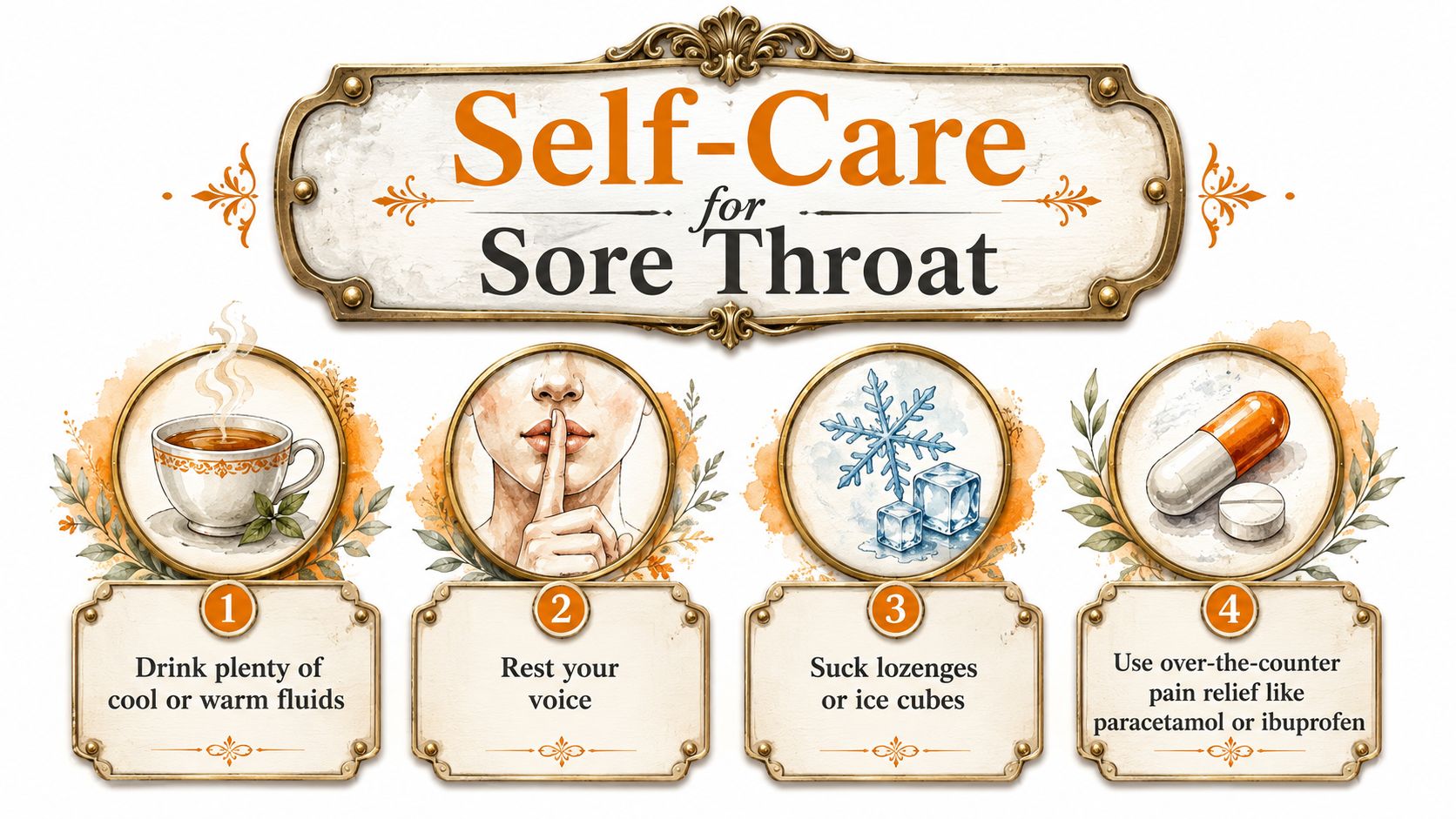
Use suitable paracetamol or ibuprofen with these measures. If you are considering an ibuprofen product, check the dose and warnings, including whether it is suitable with your health conditions or regular medicines. A pharmacist can help you choose safely.
When self-care stops being enough
Seek urgent medical help if you develop:
- Breathing difficulty: Noisy breathing or stridor needs urgent attention.
- Swallowing failure: Get help if you cannot swallow fluids or saliva.
- Drooling: This can mean you cannot manage your own saliva.
- A muffled voice: A “hot potato” voice may signal swelling around the tonsil.
- Severe one-sided pain: Take particular care when there is visible swelling at the back of the throat.
- Neck swelling: Marked swelling needs urgent assessment.
- Persistent fever: Seek advice when fever does not respond to suitable pain relief.
- No improvement: Contact a clinician if symptoms continue beyond about one week without improvement.
These warning signs are uncommon, but do not ignore them. Contact NHS 111, your GP or a Pharmacy First pharmacist when symptoms are severe, unclear or worsening. Call 999 or attend A&E for severe breathing difficulty, rapidly worsening swelling or a person who appears seriously unwell.
Very young children, frail older adults and people with weakened immune systems need a lower threshold for clinical review.
Sore throat medicine summary and common questions
Keep this five-line plan somewhere easy to find:
- Most sore throats settle within about one week.
- Start with paracetamol or suitable ibuprofen and self-care.
- Use Pharmacy First when symptoms need a professional review.
- Antibiotics need clinical justification, not just a painful throat.
- Seek urgent help for breathing trouble, drooling or severe swelling.
| Step | What to do | When |
|---|---|---|
| 1 | Check breathing, swallowing and general illness | Straight away |
| 2 | Use suitable pain relief and fluids | From the start |
| 3 | Ask a pharmacist about lozenges or sprays | If local pain persists |
| 4 | Contact Pharmacy First, GP or NHS 111 | If symptoms are severe or unclear |
| 5 | Seek urgent help for red flags | Immediately |
Is ibuprofen better than paracetamol for a sore throat?
Neither is always better. Paracetamol suits many people, while ibuprofen may help when inflammation contributes to pain. Ibuprofen isn't suitable for everyone, so check with a pharmacist if you have other health problems or take regular medicines [2].
When should I worry about tonsillitis?
Worry when you can't drink, can't swallow saliva, have breathing difficulty, severe one-sided pain or marked swelling. Contact NHS 111 or urgent care rather than trying more lozenges.
Why aren't antibiotics prescribed routinely?
NICE says acute sore throat is often viral and usually settles without antibiotics [1]. Antibiotics offer limited symptom benefit for many people and can cause side effects, so clinicians reserve them for cases where bacterial infection is more likely.
How long should a sore throat last?
Most acute sore throats improve within about one week [1]. Contact a clinician if symptoms last beyond that without improvement, or sooner if they worsen.
Can children take the same over-the-counter medicines?
Children can use some paracetamol or ibuprofen products, but doses depend on the child's age, formulation and sometimes weight. Use a product made for children and follow its label. Never give aspirin to anyone under 16 unless a clinician advises it.
Do Strepsils and similar lozenges work?
They may provide modest, short-term soothing or pain relief. NICE says the reduction in pain from some medicated lozenges and sprays is small [3]. They don't replace fluids, suitable analgesia or clinical assessment when warning signs appear.
Suggested visuals for the designer include a painterly steampunk throat-care checklist using bright lime green, pale yellow-green, light grey and ornate brass plaque overlays. Alt text: “Painterly UK pharmacist guide showing safe sore throat medicine and self-care choices.”
A second visual could show a brass FeverPAIN dial beside a lime-green Pharmacy First sign. Alt text: “FeverPAIN score and UK Pharmacy First route for sore throat assessment.”
A third could illustrate a medicine-cabinet decision board with paracetamol, ibuprofen, fluids and urgent warning signs. Alt text: “UK sore throat treatment decision board with pain relief, hydration and red flags.”
Summary
Most sore throats improve within about one week.
Start with paracetamol or suitable ibuprofen.
Drink regularly and rest your voice.
Ask a pharmacist when symptoms are severe or confusing.
Antibiotics belong with higher-risk or clinically confirmed bacterial cases.
Get urgent help for breathing problems, drooling or severe swelling.
Disclaimer: This article is for information only and isn't a substitute for medical advice, diagnosis or treatment. Always follow the medicine label and seek professional advice when unsure.
Meta description: Medicine for a sore throat explained for UK adults, including NHS self-care, pain relief, Pharmacy First, antibiotics and urgent warning signs.
Suggested internal links
- Coughs and colds
- Paracetamol tablets
- Ibuprofen 400 mg tablets
- How treatment ordering works
- Online pharmacy UK
Byline: Written by the Medical Mojo editorial team.
Clinical review: Reviewed by a UK-registered pharmacist.
How this content was created: We based the clinical advice on NICE NG84, NICE recommendations and NHS sore throat guidance. The content was checked for UK terminology, medicine safety, Pharmacy First context and clear escalation advice.
References
[1] National Institute for Health and Care Excellence (2018) Sore throat, acute antimicrobial prescribing, NICE guideline NG84.
[2] National Institute for Health and Care Excellence (2018) Recommendations for acute sore throat.
[3] National Institute for Health and Care Excellence (2018) Sore throat, acute antimicrobial prescribing, PDF.
[4] National Institute for Health and Care Excellence (2018) Terms used in the guideline.
[5] NHS (n.d.) Sore throat.
[6] Royal College of General Practitioners (2025) NICE and UKHSA antimicrobial prescribing summary.
[7] American Thoracic Society (2023) Sore throat antibiotic prescribing analysis.
[8] Courier Pharmacy (n.d.) Courier Pharmacy.
Visit Courier Pharmacy to explore pharmacist-reviewed treatment options and over-the-counter medicines for suitable conditions. If your sore throat needs prescription assessment, complete the online consultation and seek urgent NHS care instead for breathing or swallowing problems.


