Melatonin for Sleep UK: What the NHS Actually Says
Melatonin for sleep UK: a pharmacist-led guide to NHS rules, licensed use, dosing, safety, and how to access it legally through a GPhC pharmacy.

SEO brief
- Primary keyword: melatonin for sleep UK
- Secondary keywords: prescription-only medicine, NHS guidance, sleep hygiene, jet lag, prolonged-release melatonin, online pharmacy
- Search intent: Understand what melatonin is, whether it works, and how to access it legally in the UK
- Target reader: UK adults, carers, and patients curious about melatonin
- Product/service mention: Courier Pharmacy online prescription service for melatonin where appropriate
- Internal links available: Courier Pharmacy articles and product pages used below
Melatonin gets talked about like a harmless sleep supplement, but that's not how it works in the UK. Here, it's a prescription-only medicine, and the NHS uses it for specific sleep problems, not as a general fix for every bad night. If you've seen it sold online and wondered why the advice feels confusing, you're not alone.
Melatonin for sleep UK is best understood as a tool for timing, not sedation. It can help the body's sleep clock shift in the right direction, but it won't knock you out like a traditional sleeping tablet. That matters, because the right use, the right dose, and the right patient are all part of safe prescribing.
- It's a medicine, not a shop-bought sleep aid.
- It works best for specific sleep patterns, not every insomnia problem.
- UK rules are different from what you'll read on general sleep blogs.
- Sleep hygiene still comes first in most cases.
- Legitimate UK access always includes a clinical assessment.
What Melatonin Actually Is and Why It Matters in the UK
A busy parent buys a box of “sleep support” gummies, expects a miracle, and ends up disappointed. That's a common story, because melatonin is often marketed as if it were a gentle bedtime sedative. In the UK, it's more accurate to think of it as a hormone-based medicine that helps guide the body clock.
Your body makes melatonin naturally in darkness. The message it carries is simple, “night is here, it's time to wind down.” The brain's master clock, the suprachiasmatic nucleus, uses light as its main cue, and melatonin helps carry that timing signal through the body.
Practical rule: melatonin nudges sleep timing, it doesn't force sleep in the way many people expect.
Why the word “sleep” can be misleading
The phrase melatonin for sleep UK gets searched by people who usually want three things, quicker sleep onset, fewer broken nights, and a safe way to reset their routine. Melatonin can help with the first part most clearly. It tends to reduce sleep-onset latency, which is the time it takes to fall asleep.
That's why the medicine is a better fit for some patterns than others. It may help when the body clock is running late, or when sleep problems sit alongside neurodevelopmental conditions. It's much less convincing as a broad answer to general chronic insomnia.
The form matters too. In UK practice, you'll hear about immediate-release and modified-release products. Immediate-release versions act more quickly, while modified-release products are designed to keep levels up for longer through the night. That difference matters because a person who struggles to fall asleep doesn't always need the same product as someone who falls asleep but wakes often.
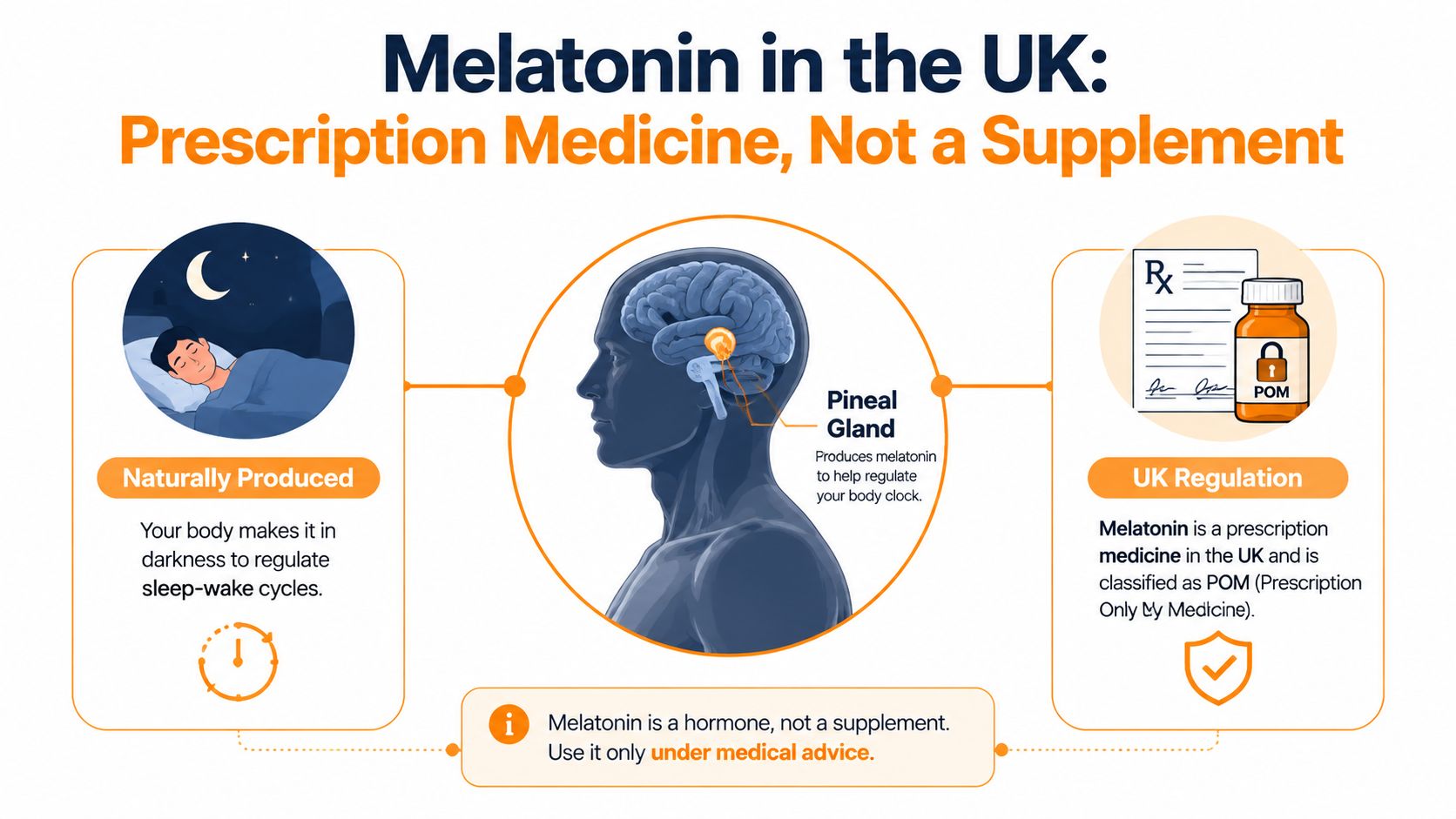
For UK readers, the practical point is clear. This medicine sits at the crossroads of sleep, timing, and regulation. That's why the right question isn't “Does melatonin work?” but “Does it fit this sleep problem, in this patient, under UK rules?”
Read more about what melatonin is on Courier Pharmacy
What the Evidence Shows for Sleep in the UK
Melatonin is often spoken about like a general sleep aid. In UK practice, it is more accurate to treat it as a body-clock medicine. That matters because the evidence is strongest when sleep timing is part of the problem, and less convincing when insomnia is the only issue.
Who tends to benefit most
Children and adolescents with certain neurodevelopmental conditions are one group where melatonin can make a clearer difference. A UK clinical audit of 4,151 young patients prescribed melatonin found that 3,053 (74%) had a neurodevelopmental disorder, and among those prescribed it regularly, the main reason in 2,655 (73%) cases was to reduce sleep latency (PMC audit). In selected paediatric patients, the MENDS trial data cited in NHS-facing guidance showed about 45 minutes less time to fall asleep and about 23 minutes more total sleep (NHS Nottinghamshire APC review).
Adults usually see a smaller benefit. UK-facing reviews report that the expected effect in adults is often modest, with sleep-onset improvements of roughly 4 to 7 minutes and total sleep gains of around 8 to 13 minutes versus placebo (Scottish NHS guideline).
That is the key pattern. If melatonin helps, the problem is often timing, not just a lack of sedation.
What that means in real life
That evidence fits some UK situations better than others. Someone with delayed sleep phase, a traveller with jet lag, or a child with a neurodevelopmental sleep problem may notice a clearer benefit. Someone with long-standing insomnia and no body-clock issue may find the effect disappointing.
The audit also showed that melatonin was used regularly in 3,651 (88%) cases, and the common goals included reducing night-time waking and increasing total sleep duration (PMC audit). That shows how clinicians often use it as a managed treatment, not as an everyday sleep supplement.
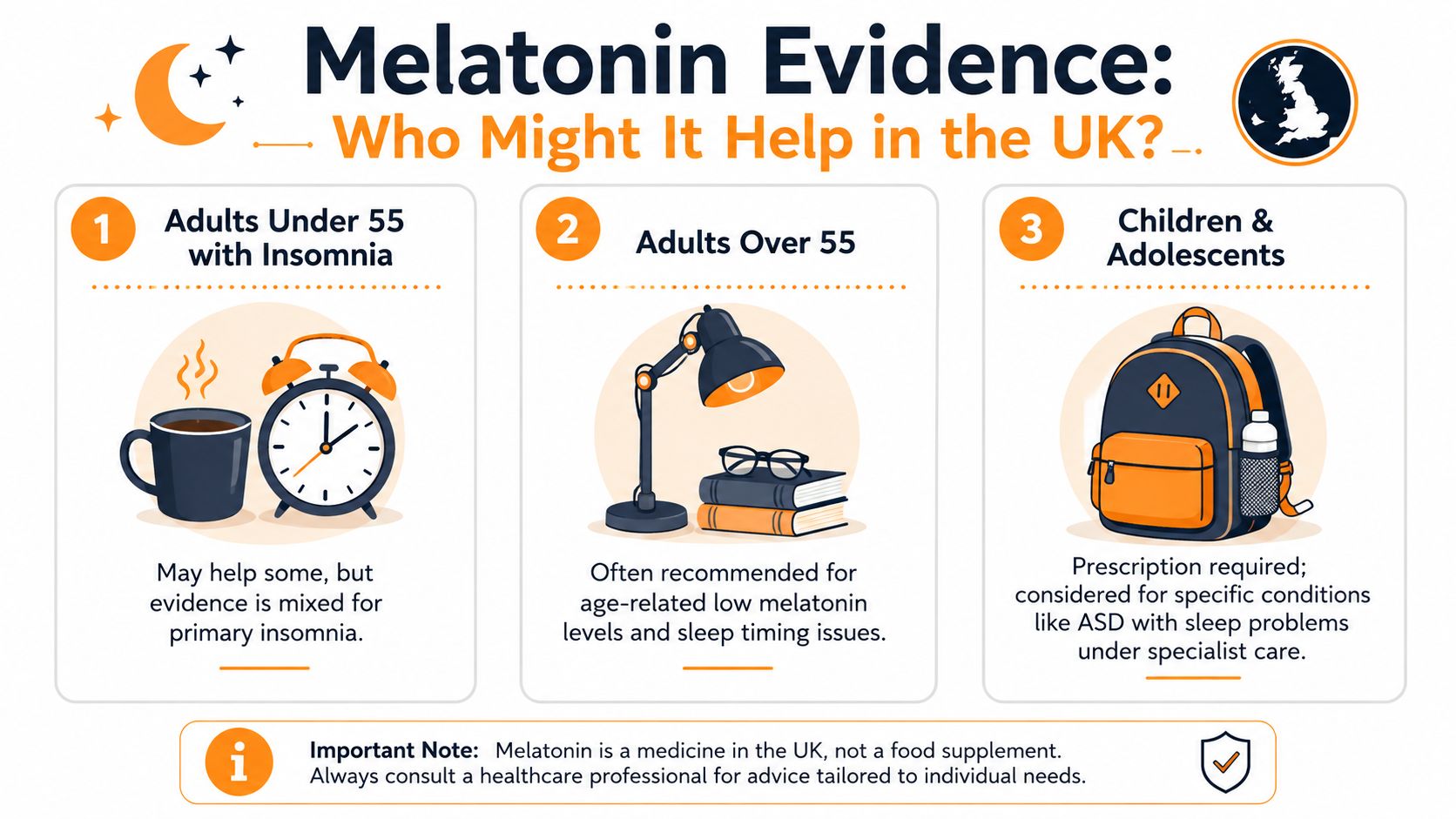
For UK readers, the practical takeaway is straightforward. Melatonin can help, but it helps most where sleep timing is part of the picture. If you want to understand why it sits in a prescription-only category here, see why melatonin is treated differently in the UK.
UK Legal Status and Licensed Indications
Melatonin sits in a narrow place in the UK. It is a prescription-only medicine, so it is not something you can legally pick up from a shop shelf like a general sleep aid (NHS melatonin guidance). That prescription-only status is one reason people find the UK rules more restrictive than the rules in some other countries.
What it's licensed for in the UK
The main adult licensed indication is short-term treatment of primary insomnia in people aged 55 years and over (North East London ICB guideline). UK guidance also notes a licensed short-term use for jet lag in adults (NHS-linked factsheet).
For adult insomnia prescribing, NHS documents commonly frame treatment as short-term, often up to 13 weeks (Kent and Medway guideline). NHS medicines advice also describes typical adult use as a 1 to 4 week course in many cases (NHS common questions).
| Aspect | UK position |
|---|---|
| Legal status | Prescription-only medicine |
| Main licensed adult use | Primary insomnia in people aged 55 years and over |
| Other licensed adult use | Short-term treatment of jet lag |
| Typical adult duration | Short-term, often up to 13 weeks |
| Shop purchase | Not legally sold as a general OTC product |
Licensed and unlicensed use are not the same thing
A lot of UK prescribing happens outside the narrow licensed adult insomnia indication. That does not automatically mean it is wrong, but it does mean the prescriber is making a judgement based on the person in front of them. In practice, that is why a pharmacist may ask a few extra questions before dispensing.
The England-wide practice analysis found that prescribing was more common in practices serving more children, more older people, and more deprived communities, with rate ratios of 1.51, 1.66, and 1.59 respectively, and by 2019, 88.2% of prescribing was licensed while 23.3% of total cost still came from unlicensed products, worth £10 million (practice-level analysis). That split shows how much UK melatonin use sits between formal licensing and real-world need.
Online access adds another layer of confusion. Some sites sell melatonin in ways that do not reflect UK prescribing rules, which is why people can see a product marketed like an ordinary supplement even though the UK treats it as a medicine. For a plain-English explanation of that gap, see why melatonin access differs in the UK.
Doses and Formulations Used in the UK
UK prescribing starts with the product, not just the dose. For adults aged 55 and over, the best-known licensed option is 2 mg prolonged-release melatonin, often associated with Circadin and equivalent products. The prolonged-release design matters because it supports a steadier night-time profile, rather than a quick burst that fades fast. You can see how that product is presented in UK practice on Circadin 2 mg prolonged-release tablets.
What a sensible UK prescription usually looks like
Prescribers often start low and review response rather than chasing a bigger dose. Higher doses do not reliably mean better sleep, and they can bring more morning grogginess. The aim is to match the medicine to the sleep pattern, then reassess whether it is helping.
Immediate-release and modified-release products have different jobs. Immediate-release versions are more relevant when sleep onset is the main issue. Modified-release products are more relevant when staying asleep through the night is part of the problem.
For jet lag, NHS-linked material describes a 12 mg nightly dose and says it should be taken 30 minutes before bed or 1 to 2 hours before bed if swallowed whole. That is a very different use from routine insomnia treatment, so the same dose does not fit every situation.
Pharmacist's tip: if a prescription just says “melatonin”, check the strength, the release type, and the reason it was prescribed before you assume how to take it.
Paediatric practice needs extra care
Children and adolescents are often prescribed melatonin in unlicensed forms, such as liquids or capsules, because the child's age, swallowing ability, and clinical need shape the choice. UK services tend to use it where sleep disturbance overlaps with neurodevelopmental conditions, not as a casual bedtime aid. In that setting, the problem is about timing, not just “not sleeping hard enough.”
Safety, Side Effects and Interactions
“Natural” doesn't mean harmless. Melatonin can still cause side effects, and that matters especially when someone sees it online and assumes it's a gentle supplement. The common issues people notice are morning drowsiness, headaches, dizziness, and vivid dreams.
Who needs extra caution
Certain medicines can interact with melatonin. That includes other CNS depressants, some anticoagulants, antiepileptics, hormonal contraceptives, and even caffeine timing, which can blunt the sleep effect if it's taken too late in the day. People with autoimmune conditions, those who are pregnant, and anyone with severe liver problems should get personalised advice before use.
The main thing to remember is that a bigger dose doesn't automatically fix poor sleep. It can make the next morning harder. If someone keeps feeling groggy, the dose, timing, or formulation may need review.
Pharmacist's tip: if melatonin leaves you foggy the next day, don't just push through. Speak to a pharmacist or prescriber about timing and dose before taking more.
When to seek urgent help
Seek urgent medical help if you develop sudden severe symptoms, breathing problems, chest pain, a severe allergic reaction, or unusual confusion after taking melatonin. If a child has taken melatonin unintentionally or you think too much has been taken, get immediate medical advice.
Read more about melatonin side effects
Sleep Hygiene First, Melatonin Second
A night-shift nurse and a parent of a teenager with ADHD can both say, “I'm not sleeping,” but the fix may be different. One may need a better wind-down plan and light control. The other may need a structured clinical review because sleep timing and attention difficulties can overlap.
What to try before asking for melatonin
The basics still matter more than many want to hear. Keep a consistent wake time, get morning light, build a wind-down routine, cut back on caffeine after early afternoon, and reduce screens before bed. Those steps won't solve every sleep problem, but they do remove the common avoidable triggers.
If you're a night-shift worker, the issue may be misaligned body clock rather than simple insomnia. If you're a parent, the problem may be a mix of routine, anxiety, and a child who isn't sleepy at the same time every night. In both cases, sleep hygiene is the first filter before medicine enters the picture.
What prescribers like to see
Practical rule: bring a 7-day sleep diary to the consultation. It helps show bedtime, wake time, night waking, caffeine, and naps.
That diary makes it easier to judge whether melatonin is a sensible next step or a poor fit. It also helps distinguish someone who needs advice on routine from someone who may need a prescription review.
Melatonin fits best as an adjunct, not as the whole plan. If the routine is chaotic, the body clock is fighting hard, and no changes have been tried, the medicine often disappoints. If the routine is in place and the timing problem still persists, it may have a clearer role.
Accessing Melatonin Safely Through a UK Online Pharmacy
A legitimate UK route for melatonin starts with a clinical assessment, not a checkout button. That matters because melatonin is still prescription-only, so any real supply has to include review by a qualified prescriber. Courier Pharmacy is one example of a GPhC-registered online pharmacy that uses a secure online questionnaire, clinical review, dispensing from MHRA-registered wholesalers, and signed-for delivery when treatment is appropriate.
A shift worker who has already tried light control and sleep timing strategies may be assessed for whether melatonin fits. A parent of a teenager with ADHD may be asked about bedtime patterns, school mornings, and any other medicines first. That's the right way round, because the prescription should follow the sleep problem, not the other way round.

If you'd rather discuss things with a prescriber online than book a face-to-face appointment, that can be a practical option. It still needs a proper consultation, identity checks, and a decision based on your symptoms and medicines.
Pharmacist's tip: if you snore loudly, stop breathing in sleep, feel very low, or take several regular medicines, speak to your GP first. Those are not “simple insomnia” clues.
Learn how a UK online pharmacy works
Key Takeaways and FAQs
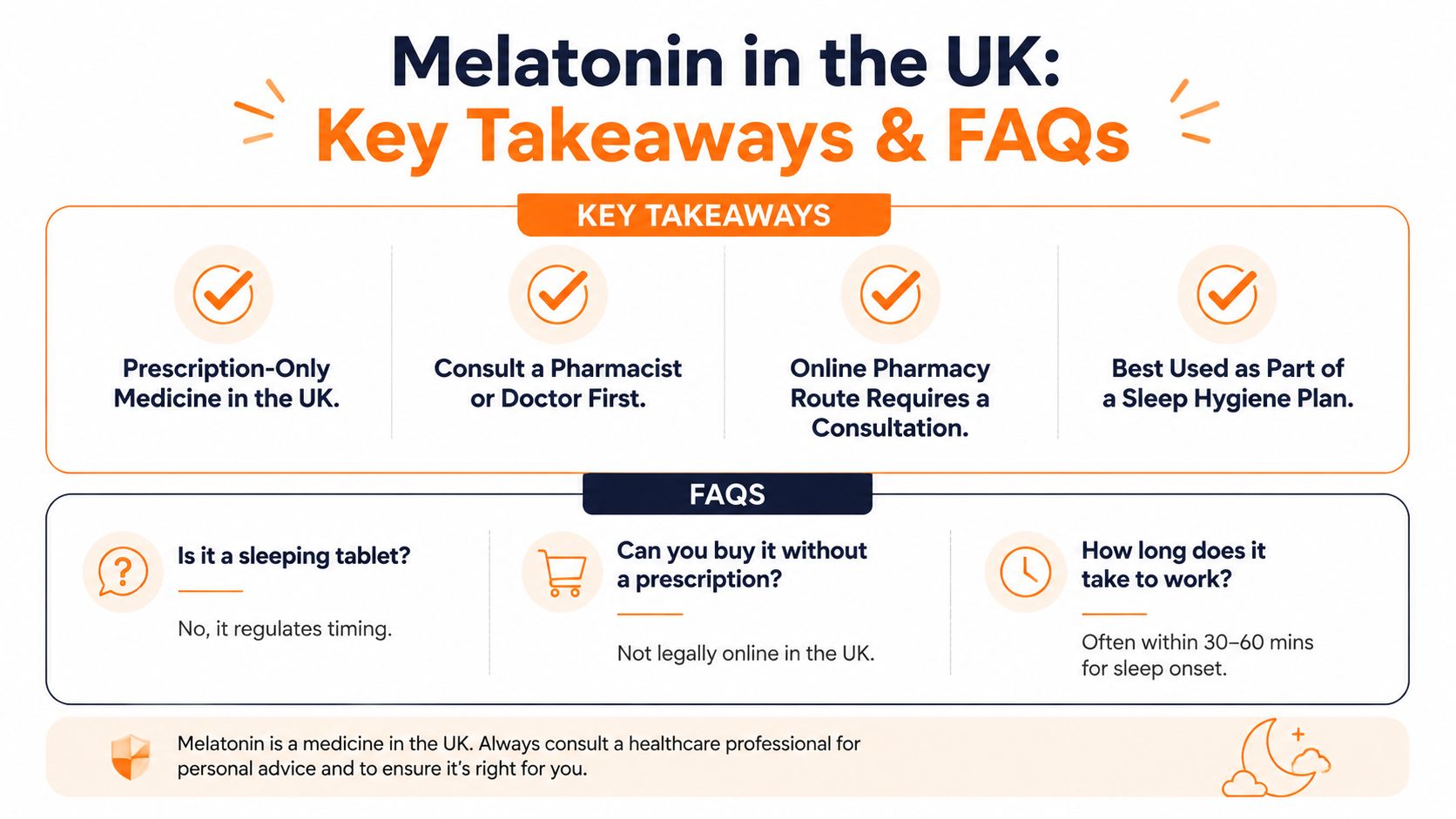
Melatonin in the UK is a prescription-only medicine, so it sits in a narrower place than an everyday sleep supplement. In practice, it suits some people better than others, especially where the main problem is sleep timing rather than general tiredness. Good use starts with sleep hygiene, then a proper clinical check to see whether melatonin fits the pattern.
An online pharmacy route is only legitimate when a consultation happens first. That step is there for a reason. It helps check the sleep problem, other medicines, and whether melatonin is appropriate. If a website offers it without assessment, that is a warning sign.
FAQs
Is melatonin a sleeping tablet?
It helps the body's sleep-wake timing rather than acting like a sedative. A simple way to view it is as a clock regulator, which is why it can help certain sleep problems and do very little for others.
Can you buy melatonin without a prescription in the UK?
No. In the UK, melatonin is a prescription-only medicine, and the NHS explains the same legal position in its melatonin guidance.
How long can you take melatonin for?
That depends on why it was prescribed and which formulation is being used. UK guidance often uses short courses, and some local guidance sets a maximum of 13 weeks for the licensed adult insomnia indication, as noted in local NHS formulary guidance.
What if I miss a dose?
Take the next dose at the usual time. Do not take an extra dose unless a prescriber has specifically told you to do that.
Is melatonin suitable for children?
Sometimes, but only with proper medical advice. In UK practice, it is used for specific sleep problems, especially when neurodevelopmental conditions are involved, rather than as a routine child sleep remedy.
How do I check if an online pharmacy is legitimate?
Look for GPhC registration and a proper consultation before any prescription medicine is supplied. If a site sells melatonin with no assessment, treat that as a clear warning sign.
What if I'm not sure whether my sleep problem is simple insomnia?
Speak to a pharmacist or GP first. Loud snoring, gasping at night, severe anxiety, or low mood all need a proper review, because they can point to something other than straightforward insomnia.
This article is for information only and is not a substitute for medical advice. If you are checking a UK online pharmacy, use the GPhC register and NHS guidance to keep things safe and legal.
Courier Pharmacy can help when melatonin is a genuine fit and you want a UK-prescribed route with proper clinical review. If you'd like to see whether your sleep problem suits a regulated consultation, visit Courier Pharmacy and read the service details before you apply.


