Minoxidil For Female: Your Expert UK Guide
Minoxidil for female hair loss: Our expert UK guide explains how it works, expected results, side effects, & safe online treatment.
SEO brief
- Primary keyword: minoxidil for female
- Secondary keywords: female pattern hair loss, minoxidil for women UK, topical minoxidil, oral minoxidil, 5% minoxidil foam, hair loss treatment for women
- Search intent: informational with practical treatment guidance
- Target reader: UK women worried about thinning hair and trying to choose or use minoxidil safely
- Product/service mention: Courier Pharmacy online prescribing and compounding service
- Internal links available: assumed from brief and included where requested
Minoxidil is a clinically proven, MHRA-regulated treatment for female pattern hair loss that helps stimulate hair follicles and support regrowth. In a 48-week trial of 381 women, 5% topical minoxidil outperformed both 2% minoxidil and placebo, while a separate study of 148 women using low-dose oral minoxidil found 79.7% clinical improvement and 20.3% stabilisation [1][2].
If you're reading this while checking your widening parting in the bathroom mirror, you're not alone. Many women notice gradual thinning long before anyone else does, and the hardest part is often knowing what to try first. This guide explains how minoxidil works, which type may suit you, how to fit it into real life, what side effects to watch for, and how to get treatment safely in the UK.
Five key takeaways
- Minoxidil works best for female pattern hair loss. Think widening parting, reduced density, and gradual thinning rather than sudden patchy loss.
- Topical 2% is the main OTC option for women in the UK. Some women also use 5% foam off-label under clinical advice [3].
- Consistency matters more than perfection. Missing regular applications can reduce progress.
- Foam may suit sensitive scalps better. Some women react to propylene glycol in liquid formulas [4].
- Oral minoxidil is prescription-only and off-label. It can help if topical treatment doesn't suit you, but it needs proper medical review [2][5].
What is minoxidil and how does it work for women
Minoxidil is a medicine used to treat female pattern hair loss, also called FPHL. It doesn't create brand-new follicles, but it can help struggling follicles work better for longer.
A simple way to picture it is this. Imagine your scalp like a garden. Some plants are thriving, some are smaller each season, and some look half asleep. Minoxidil acts a bit like turning on the water and sunlight for the weaker plants, helping them stay in their growth phase for longer.

What female pattern hair loss usually looks like
Female pattern hair loss often shows up as:
- A wider parting that seems more obvious in bright light
- Reduced volume when you tie your hair up
- More scalp show-through at the crown
- Gradual thinning rather than sudden bald patches
In the UK, female pattern hair loss becomes more common with age. British Hair & Nail Society figures cited in UK guidance suggest prevalence is about 10% by age 50 and 30% by age 70 [1].
Female pattern hair loss usually creeps in slowly. Many women notice it first in photos, under bathroom lighting, or when their ponytail feels thinner.
How minoxidil helps the follicle
Minoxidil works by being converted in the hair follicle to minoxidil sulphate, its active form. That process opens potassium channels and is thought to improve blood flow, deliver more nutrients to the follicle, and keep hair in the anagen, or growth phase, for longer [3].
That matters because in female pattern hair loss, follicles gradually shrink and produce finer, shorter hairs. Minoxidil helps push against that process.
If you'd like the deeper science, this explainer on minoxidil and hair growth from discovery to modern mechanisms gives a useful overview.
Featured snippet answer
Does minoxidil work for women?
Yes. Clinical trial data in women shows that topical minoxidil improves hair growth and scalp coverage, especially with consistent long-term use [1].
Choosing the right minoxidil formulation for you
You spot more scalp at the parting, finally decide to try minoxidil, then hit a practical question. Which version is likely to fit your life and your scalp?
For most women in the UK, the choice comes down to comfort, convenience, and whether a clinician feels a stronger option is appropriate.
The main UK options
In the UK, 2% topical solution is the main MHRA-licensed OTC option for women. 5% topical solution is licensed for men. 5% foam is often used off-label for women after clinical review [3].
That wording can sound a bit daunting. Off-label does not mean improper or unsafe by default. It means the prescriber is using clinical judgement where the product licence does not specifically cover that patient group, based on the evidence available and the person sitting in front of them.
The practical difference is often less about chemistry and more about day-to-day use. Liquid can suit some women perfectly well, but others find it drips, leaves the roots feeling damp, or irritates the scalp. Foam is often easier to place and can feel less messy, especially before work or school runs.
| Feature | 2% Liquid Solution | 5% Foam |
|---|---|---|
| UK position | Main OTC option for women | Often used off-label with clinician input |
| Texture | Wet liquid | Lighter foam |
| Routine | Can feel messier | Often easier to fit into daily life |
| Scalp comfort | May irritate some scalps | Often preferred if liquid stings or itches |
| Who may suit it | First-time users, cautious starters | Women needing a simpler routine or better tolerance |
If you want to see a UK pharmacy example of the foam discussed in specialist practice, 5% topical hair loss foam shows the type of formulation some women use after review.
When the base matters as much as the strength
Sometimes the problem is not minoxidil itself. It is the vehicle, which means the ingredients used to carry the medicine onto the scalp.
A simple way to picture it is this. Tea can be fine, but not if it is served in a cup that burns your hand. In the same way, the active medicine may be suitable, while the liquid base causes stinging, dryness, or itching.
This matters in real life. If your scalp feels sore every evening, you are much less likely to keep using the treatment long enough to judge whether it works.
Some women may need a different base, especially if they have:
- A sensitive scalp that becomes red, tight, or itchy
- A history of contact reactions to hair or skin products
- Trouble sticking with liquid formulas because they feel sticky or interfere with styling
- A need for a specific formulation without certain ingredients
In those cases, a clinician may consider a custom-made base through a compounding pharmacy. That can be helpful for women who need a different texture, want to avoid certain excipients, or are trying to make treatment workable around a busy routine. Courier Pharmacy offers this kind of personalised prescribing approach through online assessment and clinical review, which can be useful when standard shelf options have not been a good fit.
Practical rule: If minoxidil seems right on paper but the formulation makes your scalp miserable, the answer may be to change the base or format rather than give up on treatment altogether.
Featured snippet answer
Is 5% minoxidil better than 2% for women?
For some women, 5% minoxidil may give better results than 2%, but it can also bring a higher chance of irritation or unwanted hair growth. The best choice depends on your scalp, your routine, and whether a clinician thinks off-label 5% use is appropriate [1].
How to apply minoxidil correctly and consistently
Technique matters. You want the product on your scalp, not rubbed through the length of your hair.
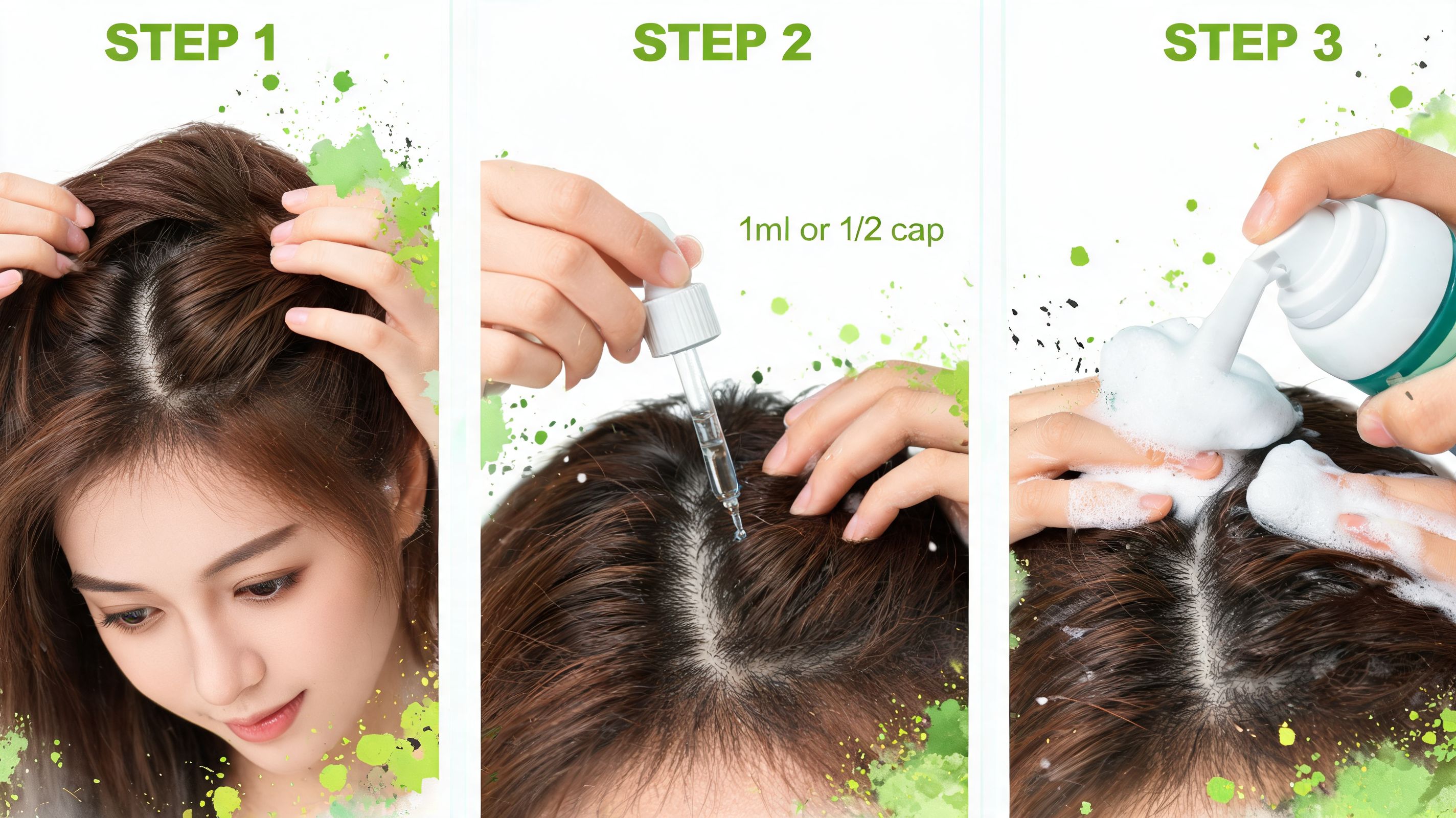
A simple daily routine
Use it on a dry scalp. Part the hair to expose the thinning area, apply the product to the scalp, and wash your hands afterwards.
A simple approach looks like this:
- Start with dry hair and scalp. Damp hair can make placement less precise.
- Part the hair where thinning is most obvious. Think crown, parting, or both.
- Apply the measured amount to the scalp. Don't spread it through the hair shaft.
- Let it dry before bed, hats, or styling.
- Wash your hands well. This helps lower the risk of accidental facial hair growth.
For women using liquid, some clinicians recommend 5% topical hair loss liquid only after review, especially if they need a stronger option or can't tolerate standard routines.
Real-life examples
Busy parent example
Sarah notices thinning near her parting while getting ready for the school run. She keeps the bottle beside her toothbrush, applies it after drying her hair roots, then washes her hands before doing breakfast. Linking it to an existing habit helps her remember.
Shift worker example
Amira works nights in the NHS. Morning and evening don't mean much in her week, so she ties minoxidil to one fixed point instead. She applies it after her main shower, before her sleep, no matter what time the clock says.
Pharmacist's tip
Pick one anchor habit. Brushing your teeth, doing skincare, or plugging in your phone all work better than relying on memory alone.
A quick visual guide can help if you're unsure about placement:
Featured snippet answer
Do you put minoxidil on hair or scalp?
Put it on the scalp. It needs to reach the follicles, so part the hair and apply it directly to thinning areas.
What to expect from your minoxidil treatment journey
The hardest part of minoxidil is often the waiting. Hair grows slowly, and the mirror doesn't always show early change clearly.
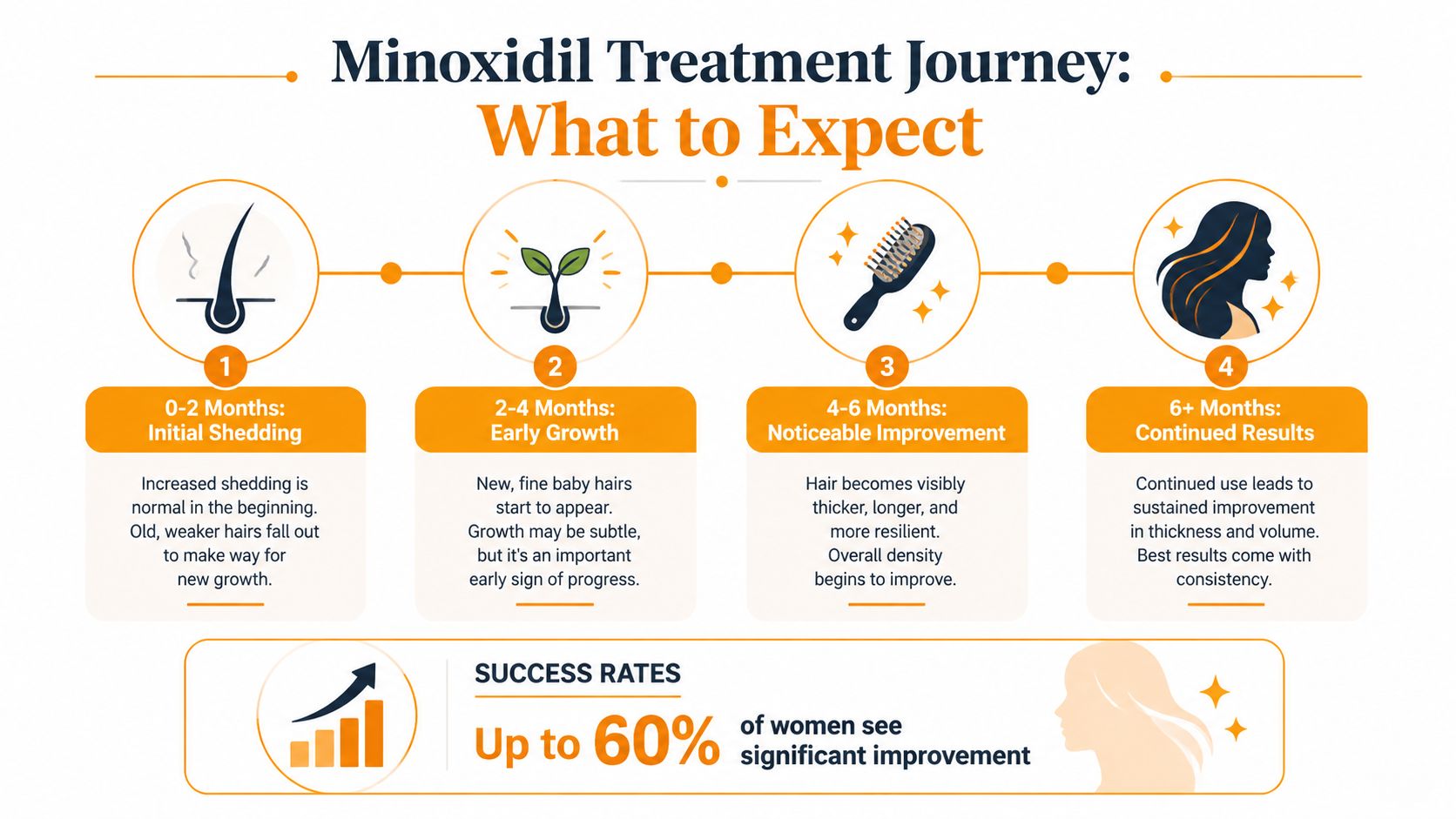
The results timeline in plain English
Early on, some women notice extra shedding. That can feel alarming, but it may reflect older hairs making way for newer growth.
Then the timeline usually feels gradual:
- Early phase: the scalp may look the same, even if the treatment is starting to work
- Middle phase: you may spot finer new hairs around the parting or crown
- Later phase: density and coverage can improve more clearly if you keep going
If you want a fuller timeline, this guide on how long minoxidil takes to work explains the pattern many patients notice.
What success can look like
The clearest evidence comes from the 48-week trial in 381 women. In that study, 5% topical minoxidil significantly outperformed both 2% minoxidil and placebo, and the 5% group had superior patient-rated benefit in hair growth and scalp coverage compared with 2%. Both strengths also improved psychosocial perceptions of hair loss, which matters because thinning hair often affects confidence as much as appearance [1].
That's a useful reminder that success isn't only “more hairs on a chart”. It can also mean:
- Less scalp show-through
- Better styling coverage
- Less distress about washing or brushing
- Feeling more like yourself again
Real-life example
A gym-goer may not care about counting hairs. She may care that overhead changing-room lights no longer make her crown look sparse. A teacher may judge success by whether she stops checking the back of her head in every staff toilet mirror.
Pharmacist's tip
Take baseline photos in the same lighting, same angle, and same hairstyle. Your eyes miss slow progress. Photos usually don't.
Featured snippet answer
How long does minoxidil take to work for women?
It takes patience. Clinical studies followed women for 48 weeks, and visible improvement usually builds gradually with consistent use [1].
Understanding potential side effects and safety advice
Most women use minoxidil without major problems, but side effects do happen. The key is knowing which ones are annoying, which ones are manageable, and which ones mean you should stop and ask for help.

Common and manageable effects
With topical minoxidil, the most common issues are local ones. Think itching, dryness, flaking, or irritation. Women using stronger formulas may also notice more facial hair growth if product drips onto the face or if hands aren't washed after application [1][3].
With low-dose oral minoxidil, side effects are more systemic because the medicine goes through the whole body. In a retrospective analysis of 148 women, hypertrichosis occurred in 15.5% and pedal oedema in 4.7%. These effects were described as dose-dependent and reversible [2].
A few practical ways to reduce trouble:
- Apply carefully to the scalp only
- Wash hands straight away
- Let the product dry fully before lying down
- Consider foam or a specialized formula if liquid irritates
- Start with the lowest appropriate dose if a prescriber recommends oral treatment
Short facial hairs usually happen because product travels where it shouldn't. Careful application matters more than people realise.
When to stop and get medical advice
Stop and seek medical advice if you develop symptoms that suggest the medicine is affecting you beyond the scalp. That includes:
- Dizziness or faintness
- A fast or pounding heartbeat
- Chest pain
- Breathlessness
- Swelling that worries you
Pregnancy and breastfeeding also need caution. Oral minoxidil is not a casual add-on, and topical use should still be checked with a clinician if you're pregnant, trying to conceive, or breastfeeding.
Pharmacist's tip
If your scalp stings, don't keep “pushing through” for weeks. A different formula, especially a foam or tailored base, may make the treatment usable.
Featured snippet answer
What is the most common side effect of minoxidil for women?
For oral minoxidil, the most common reported side effect in one study was unwanted hair growth, seen in 15.5% of women [2].
Alternatives and complementary hair loss treatments
Minoxidil is often first-line, but it isn't the only conversation worth having. Some women need a different route. Others need a combination plan.
When oral minoxidil enters the conversation
Low-dose oral minoxidil, often shortened to LDOM, is an off-label option for women who haven't responded to topical treatment or can't tolerate it.
One study found that at a median dose of 0.625 mg, low-dose oral minoxidil produced a response in 78% of women who had not responded to topical therapy. Typical daily doses were 0.25 to 1 mg, started low and titrated upward under prescriber supervision [5].
This can appeal to women who:
- React badly to scalp products
- Struggle with daily topical routines
- Need a simpler treatment plan
- Have poor topical absorption
Other options to discuss with a clinician
Other treatments may come into the plan depending on the cause of hair loss and your health history.
These can include:
- Spironolactone for some women with a hormonal pattern
- Low-level laser therapy as a non-drug option
- Microneedling as a complementary approach
- Blood tests or scalp review if the diagnosis is uncertain
A woman with a hectic travel schedule may prefer a tablet after a proper medical review. A woman with acne, irregular periods, and thinning may need a broader hormone-focused discussion instead of assuming every problem starts and ends with minoxidil.
Featured snippet answer
Is oral minoxidil better than topical for women?
Not always. Oral minoxidil can be helpful when topical treatment doesn't suit you, but it's off-label and needs medical supervision [5].
How to get minoxidil safely in the UK
In the UK, the safest route depends on which form you need. Topical 2% minoxidil is available over the counter, while stronger or oral options may need a prescription and clinical review.
A safe buying checklist
Before you buy from any online seller, check the basics:
- GPhC registration: The pharmacy should clearly show that it is regulated.
- Real prescriber review: Prescription medicines should not be sold after a simple checkout only.
- Clear contact details: You should be able to find a real address and support options.
- Plain safety information: The site should explain who should avoid treatment and what side effects to watch for.
- Proper follow-up: Hair loss treatment is long-term, so support matters.
If you use an online provider, a safe process usually includes a questionnaire, a clinician reviewing your answers, and advice on whether OTC topical treatment, off-label foam, compounded treatment, or oral treatment makes sense. For example, Courier Pharmacy's UK online pharmacy service describes a regulated route that includes prescriber review and access to personalised formulations where appropriate.
One final point matters. Don't buy hair loss treatment from social media ads or marketplaces where the seller is hard to verify. With medicines, convenience should never outrun safety.
Pharmacist's tip
If a website offers prescription hair loss medicine with no health questions and no prescriber check, walk away.
If you'd like a regulated UK route to discuss topical, off-label, or personalised minoxidil options, Courier Pharmacy offers online prescribing with human review and access to individualized formulations where clinically appropriate.
Summary
Minoxidil for female pattern hair loss is one of the best-studied treatment options available in the UK. It works by helping hair follicles stay in their growth phase for longer. For many women, the first decision is between OTC 2% liquid and a stronger off-label option such as 5% foam under guidance. Consistency matters, and results take time. Side effects are often manageable, but oral treatment needs proper supervision. If you're unsure what type of hair loss you have, speak to a pharmacist, GP, or dermatologist before you start.
FAQs
Can women use minoxidil in the UK?
Yes. Women in the UK can use minoxidil, and 2% topical solution is the main OTC licensed option. Some women also use 5% foam off-label after clinical review [3].
What type of hair loss does minoxidil help most?
It helps most with female pattern hair loss. That usually looks like gradual thinning, a wider parting, and reduced density rather than sudden patchy loss.
Is 5% minoxidil foam safe for women?
It can be used for women under clinical supervision, but it is commonly treated as off-label in UK practice. It may work better for some women, though side effects can be more common than with 2% [1][3].
Does minoxidil cause shedding at first?
Some women do notice early shedding. This can happen as older hairs shift out and new growth cycles begin. It can be unsettling, but it doesn't always mean the treatment is harming your hair.
Can I stop using minoxidil once my hair improves?
Minoxidil usually needs ongoing use to maintain results. If you stop, the benefits often fade over time because the follicles lose that treatment support.
Is foam better than liquid?
For some women, yes. Foam often feels easier to use and may be kinder to sensitive scalps, especially if standard liquids irritate because of the formula base [3][4].
What are the side effects of oral minoxidil in women?
In one study of women using low-dose oral minoxidil, hypertrichosis was reported in 15.5% and pedal oedema in 4.7% [2]. Because it works through the whole body, it should only be used under medical supervision.
Can I use minoxidil during pregnancy or breastfeeding?
You should get medical advice first. Pregnancy and breastfeeding are situations where extra caution is needed, especially with oral treatment.
When should I see a doctor instead of self-treating?
Seek medical advice if hair loss is sudden, patchy, painful, associated with scalp rash, or comes with symptoms such as fatigue or hormonal changes. Also get help if you develop dizziness, chest pain, or palpitations while using minoxidil.
Meta description
Minoxidil for female hair loss explained by a UK pharmacist. Learn how it works, side effects, 2% vs 5%, oral options, and safe UK access.
Internal links suggested
- Hair loss treatment overview for women
- Online pharmacy safety guide
- Women's health treatments
- Understanding prescription-only medicines online
- How to spot side effects early
Visual guidance for the designer
Infographic idea 1: “2% liquid vs 5% foam” comparison card in bright lime green, pale yellow-green, and light grey with brass-style labels.
Alt text: Comparison infographic showing differences between 2% liquid minoxidil and 5% foam for women in the UK.Infographic idea 2: “How minoxidil wakes up follicles” with a garden analogy and simple follicle drawings.
Alt text: Diagram showing how minoxidil helps hair follicles stay in the growth phase longer.Infographic idea 3: “Daily minoxidil routine” for a busy parent and shift worker using painterly icons and ornate brass plaque overlays.
Alt text: Step-by-step visual guide showing how women can fit minoxidil into busy daily routines.
Byline
Author: Medical Mojo Editorial Team, UK health writers
Clinical review: Reviewed by a UK-registered pharmacist
How this content was created
This article was written using the verified evidence supplied in the brief, including peer-reviewed journal data and UK-relevant pharmacy guidance. A clinician-style editorial review checked the content for safety, plain-English readability, and alignment with UK practice.
Disclaimer: This article is for information only and isn't a substitute for personal medical advice.
References
[1] Lucky, A.W., Piacquadio, D.J., Ditre, C.M. et al. (2004) ‘A randomized, placebo-controlled trial of 5% and 2% topical minoxidil solutions in the treatment of female pattern hair loss', Journal reference via PubMed. Available at: https://pubmed.ncbi.nlm.nih.gov/15034503/
[2] Ramos, P.M., Sinclair, R., Kasprzak, M. et al. (2020) ‘Low-dose oral minoxidil for female pattern hair loss. A unicenter descriptive study of 148 women', International Journal of Dermatology / PMC. Available at: https://pmc.ncbi.nlm.nih.gov/articles/PMC7325226/
[3] Wimpole Clinic (n.d.) ‘Minoxidil for women dosage, results, side effects'. Available at: https://wimpoleclinic.com/blog/minoxidil-for-women-dosage-results-side-effects/
[4] Xyon Health (n.d.) ‘Minoxidil for women'. Available at: https://xyonhealth.com/blogs/library/minoxidil-for-women
[5] Oana Health (n.d.) ‘Minoxidil dosage for women studies and recommendations'. Available at: https://www.oanahealth.com/post/minoxidil-dosage-women-studies-recommend


