MTHFR Gene Test Explained: Results and What They Mean
An MTHFR gene test checks two common variants. Learn what C677T and A1298C results mean, when UK doctors order one and what to do next.

If a gene test comes back "positive", surely that means something is wrong. That's the assumption that makes an MTHFR result frightening, and it's the one worth testing first. An MTHFR gene test reads two common spelling changes in a gene that helps your body use folate. In the UK, many people carry at least one of them. This guide sets out what the test checks, how common each result is, when UK doctors order it, why homocysteine and folate often tell you more, and what to do with a report that landed in your inbox at 11pm. No alarm, just the evidence.
Five things to take away
- A positive result is usually a common variant. Around 60-70% of people carry at least one, so "detected" describes most of the population rather than a rare fault.
- UK guidance keeps MTHFR out of routine clot testing. The 2022 haematology guideline is explicit about this, and NHS labs generally don't offer the test.
- Folate and homocysteine carry more practical weight than the genotype. One is something you can change, the other is something you can measure.
- A genotype alone shouldn't change your medicines or your contraception. Decisions like that belong with a clinician who has your full history.
- Take the report to a clinician, not to a supplement list. A genotype read without context is guesswork with a barcode on it.
What an MTHFR gene test checks and how common results are
An MTHFR gene test reads two positions in the MTHFR gene and tells you how many copies of a common spelling change you carry at each one. The two are C677T and A1298C. A blood sample or a mouth swab is enough. The report lists your genotype at each position: no variant, one copy (heterozygous) or two copies (homozygous). A compound heterozygous result means one copy of each.
None of that measures how you feel, how much folate sits in your blood, or whether anything is wrong. The gene carries instructions for an enzyme that helps the body use folate and turn homocysteine into methionine. A common variant can make that enzyme run a little slower. One slower worker on a production line doesn't stop the line. It keeps moving.
What the numbers say about your result
These variants are common. East Genomics, an NHS genetics service, reports that 60-70% of people carry at least one of the two commonly discussed variants, MTHFR 677C>T or 1298A>C, and around 10% are either homozygous for one variant or compound heterozygous for both. Great Ormond Street Hospital gives a UK-specific estimate for C677T: about one-third of White British people carry one copy, and about 10% carry two. Its clinical genetics guidance adds that people with two copies generally remain well when folic-acid status is normal.
| Variant | Genotype | UK prevalence | Usual reading |
|---|---|---|---|
| C677T | One copy (CT) | About one-third of White British people | Usually no effect on its own |
| C677T | Two copies (TT) | About 10% | Generally well when folic-acid status is normal |
| A1298C | One or two copies | Counted within the 60-70% who carry at least one variant | Common; usually a normal variation, not disease |
| Either variant | At least one variant | 60-70% of people | Common; read alongside symptoms, diet and folate |
| Homozygous or compound heterozygous | Two copies, or one of each | Around 10% | Needs clinical interpretation; not a diagnosis alone |
Reading your own row
- One copy of C677T. Enzyme activity dips slightly at most. On its own this is a genetic fact about you, not a finding to treat.
- Two copies of C677T. The enzyme runs slower and homocysteine can sit a little higher, mainly when folate intake is low. Individuals with two copies often stay well.
- A1298C, one or two copies. Common, and usually a normal variation. A1298C alone has a smaller effect on the enzyme than two copies of C677T.
Say a busy parent orders a wellness panel between school runs. The report says "MTHFR variant detected" and she spends a week convinced her fatigue is genetic. Her genotype is shared by most adults in the country. What her report doesn't show is her iron, her thyroid or her sleep.
A shift worker reads an online claim that MTHFR causes tiredness and buys a second test to confirm it. The second test can't answer the question either, because the question was never genetic in the first place.
The published UK figures don't break out A1298C on its own, so treat any precise percentage you see online for that variant with caution. Prevalence data also don't tell you what your result means for you. They tell you how ordinary it is.
The rule to hold on to: an MTHFR report lists genotypes. A diagnosis comes from a clinician holding your symptoms, your diet, your blood results and your history at the same time.
How MTHFR affects folate and homocysteine

Folate is a B vitamin the body needs to make and repair DNA. It also helps recycle homocysteine, an amino acid that arrives with protein-rich food. Picture the MTHFR enzyme as a worker at a recycling depot, taking used homocysteine and turning it back into something useful, methionine. NHS Tayside describes exactly that step, and notes that common MTHFR variants can cause a mild homocysteine increase, particularly when folate intake or folate status is low.
That same guidance is honest about the rest. The health implications of a mild rise are uncertain. Uncertainty isn't the same as danger, and it isn't the same as proof either. What it means in practice is that nobody should look at a genotype and assume it explains their symptoms.
Take a gym-goer who trains five mornings a week, eats very little green vegetables, and asks whether his gene explains why he feels flat. His folate intake is the obvious place to start. When folate intake is low, the effect of a common variant is at its largest, which makes the diet the first thing to look at rather than the last.
Here's the part people find hardest to sit with. The cause and effect chain runs from folate status to homocysteine, not from a variant straight to a symptom. A person with two copies and a good folate intake may have a completely normal homocysteine. A person with no variant and a poor diet may have a raised one.
Plenty of people carry a variant, eat reasonably well and never develop a related problem. That's the ordinary case, not the exception.
Whether your own homocysteine is raised is a question a blood test answers directly. A genotype can't answer it, and neither can a supplement label.
When UK Doctors Order an MTHFR Test
Most of the time, they don't. An MTHFR test isn't part of routine UK care, and knowing why helps when your GP seems underwhelmed by a private report.
The single most useful fact to carry into a consultation is this one.
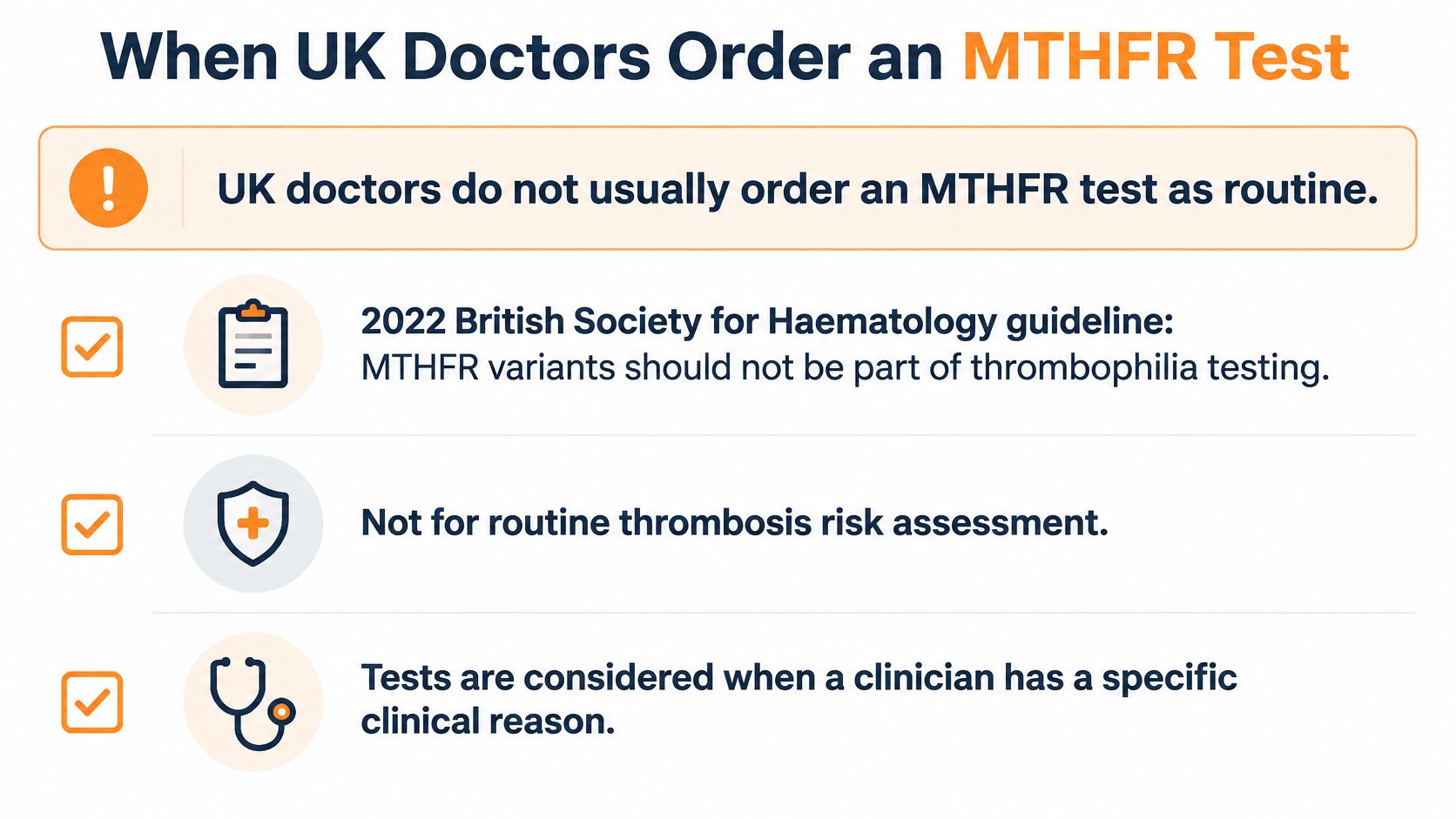
The 2022 British Society for Haematology guideline states that genetic testing for MTHFR variants should not be included in thrombophilia panels, because these variants lack a clinically significant demonstrated link with thrombosis. Testing may be considered when features suggest homocystinuria, a rare inherited metabolic condition. NHS genetics guidance takes the same view from a different angle: NHS laboratories generally don't offer routine diagnostic testing for the common MTHFR polymorphisms, citing the absence of evidence for clinical utility. That is a real policy milestone, not a technicality. Carrying a common variant is no longer treated as evidence of inherited clotting risk.
| Situation | Usual UK approach | Who to ask |
|---|---|---|
| Routine screening with no symptoms | Not recommended | Your GP |
| Unexplained tiredness or migraine | Not used to explain symptoms alone; check folate and B12 first | Your GP |
| Suspected homocystinuria | Testing considered, alongside homocysteine | GP, metabolic or genetics team |
| Raised homocysteine on a blood test | Confirm the result first; genotype rarely needed | Your GP or haematology team |
| Previous venous thrombosis or specific family history | Testing reserved for selected cases | Haematology or genetics team |
Questions to ask before you pay for a test
- What will this test check, and what will it not show?
- What would change in my care if the result came back positive?
- Would homocysteine, folate or B12 tell us more first?
- Who will interpret the report with me?
If you're weighing a private genomic test against an NHS pathway, this guide to NHS and private DNA testing in the UK sets out what each route covers.
If you prefer a walkthrough to a checklist, this short video covers the same ground.
Pharmacist's tip: if you bought the test privately, take the full report and a complete list of your medicines to your GP before you act on it. A genotype read without that context is guesswork.
Why Homocysteine Often Tells More Than the Gene
A homocysteine blood test measures the amino acid itself. That beats a genotype for a simple reason: it shows what's happening in your body this month, not what might happen over a lifetime.
Homocysteine builds up when the body can't recycle it efficiently. Sample handling matters more than is often realised. NHS laboratory guidance recommends a fasting sample where possible and rapid processing, with plasma generally separated from cells within 1 hour, because delayed separation can produce an artefactual increase. In plain terms, a sample left sitting can come back falsely high. Confirm before you act on a number.
| Cause | Examples | Usual check |
|---|---|---|
| Folate deficiency | Low intake of leafy vegetables and fortified foods | Serum folate |
| Vitamin B12 deficiency | Low intake or poor absorption | Serum B12 |
| Vitamin B6 deficiency | Low dietary intake | Vitamin B6 level |
| Kidney impairment | Reduced kidney function | Kidney function tests |
| Hypothyroidism | Underactive thyroid | Thyroid function tests |
| Smoking | Tobacco use | Discuss stopping with a GP or pharmacist |
| Certain medicines | Methotrexate, anticonvulsants, trimethoprim, nitrous oxide, levodopa, fibrates, ciclosporin | Review with prescriber; do not stop without advice |
Notice how few of those rows involve genes. Raised homocysteine has many acquired causes, which is why a genotype on its own can't establish causality. The same NHS guidance describes the test as an aid in investigating inherited methionine-metabolism disorders and suspected folate or B12 deficiency, and it doesn't recommend routine thrombophilia screening.
Medicines deserve their own line, because people can make dangerous decisions about them. Several common drugs raise homocysteine, including methotrexate, anticonvulsants, trimethoprim and ciclosporin. None of them should be stopped because of a gene report. Talk to the prescriber who knows why you take it.
What a useful follow-up looks like
Confirm an abnormal result on a properly handled sample. Measure folate and B12. Check kidney and thyroid function where relevant. Markedly raised results go to metabolic or clinical-genetics services, because that pattern needs specialist eyes rather than a supplement.
If you're unsure how to arrange the blood draw itself, this guide to home blood tests in the UK walks through what to expect.
Pharmacist's tip: bring a full list of medicines and supplements to the appointment, including anything you buy online. Several common products, from certain acne treatments to multivitamins, change what these results mean.
Does MTHFR explain miscarriage, contraception or clots
Many websites say MTHFR explains recurrent miscarriage and decides whether oestrogen-containing contraception is safe. The evidence is far more modest than that, and the decisions involved are too important to build on a genotype alone.
East Genomics reports that C677T homozygotes may have slightly higher homocysteine and a small absolute increase in venous thrombosis or recurrent pregnancy-loss risk. It also notes that the American College of Medical Genetics does not recommend testing for thrombophilia or recurrent pregnancy loss. UK National Screening Committee guidance recommends against general-population, antenatal or newborn thrombophilia screening. Testing is reserved for selected circumstances, such as a prior venous thromboembolism or a specific first-degree family history.
Small absolute increase means what it says. Across large groups there's a slight difference. For one person sitting in a clinic room, it doesn't predict what will happen, and it doesn't tell you which treatment to use.
A genotype should never decide anticoagulation or contraception on its own. Those choices belong with a clinician weighing your history, your blood pressure, your migraine status, your smoking status and your family history, which are far stronger predictors than a common polymorphism.
Consider a woman who has had two early losses and asks whether her MTHFR result explains them. The useful appointment is with obstetric and haematology teams, bringing her full pregnancy and family history. Recurrent loss has a long list of possible causes, and a proper assessment works through them.
Three questions for that appointment
- What else is being checked? Ask which causes of pregnancy loss or clotting are on the list and which have already been excluded.
- Would treatment change if the result were different? If the answer is no, the genotype isn't steering anything.
- What's the plan for the next pregnancy? Timing, monitoring and who to call early are more useful than a genotype label.
Pharmacist's tip: pregnancy changes many blood markers, so if you're using home tests during pregnancy, speak to your midwife or GP before acting on any result.
If fertility is the wider concern, this explanation of CoQ10 and fertility covers where supplement evidence is stronger and where it thins out.
Food, folate and genetic counselling
No routine treatment targets the gene itself. Care targets what's low or high, and for many patients that means folate and vitamin B12.
Food sources worth knowing: leafy greens such as spinach and kale, beans and pulses, fortified breakfast cereals, and fruit including oranges. These are everyday items, not specialist products.
For women planning a pregnancy, NHS advice is 400 micrograms of folic acid daily, started before conception and continued until the 12th week. A genotype doesn't change that advice in either direction.
High-dose folic acid is a different matter. Don't self-prescribe it from an online list, because doses well above the standard can mask a vitamin B12 deficiency while the underlying nerve damage continues. If you think you need a higher dose, ask why and get it assessed properly.
A shift worker who skips meals and copies a supplement stack from a forum is a common version of this. A GP can check folate and B12 first, which is cheaper and more informative than guessing.
When genetic counselling helps
A GP can refer you to an NHS clinical genetics service when there's a strong family history of clots or pregnancy loss, or an unusual result that doesn't fit the usual pattern. A counsellor explains what the result means for relatives, what it can and cannot show, and which questions are worth asking.
For context on how folate forms differ, this piece on leucovorin and calcium folinate explains where those products sit and why they aren't a general upgrade on standard folic acid.
Pharmacist's tip: bring every supplement and herbal product to the appointment, including the ones you assume don't count. Interactions and masking effects hide in the products people forget to mention.
Common questions about MTHFR tests
Is an MTHFR result a diagnosis
No. It lists your genotypes at two positions and describes common variation. A diagnosis comes from a clinician matching symptoms, examination and blood results.
Does MTHFR cause tiredness or migraine
The gene alone doesn't explain either. Check folate, B12, iron, thyroid function and sleep first, because those are common, treatable and measurable.
Can MTHFR cause miscarriage
Evidence for a link is limited to a small absolute increase in risk among C677T homozygotes. A clinician assesses the whole history rather than one variant.
Should I take extra folic acid if I carry two copies
Not without advice. Many people with two copies remain well when folic-acid status is normal, and high doses carry their own risks.
Is MTHFR testing available on the NHS
Routine testing generally isn't offered. Ask your GP whether your specific case warrants it, and why. If you'd rather explore a private route, the Nutrigen Genetic Test is one option to discuss with a clinician first.
Should I stop my medicines after a result
No. Keep taking them and speak to your prescriber before any change. Stopping suddenly is far riskier than carrying a common variant.
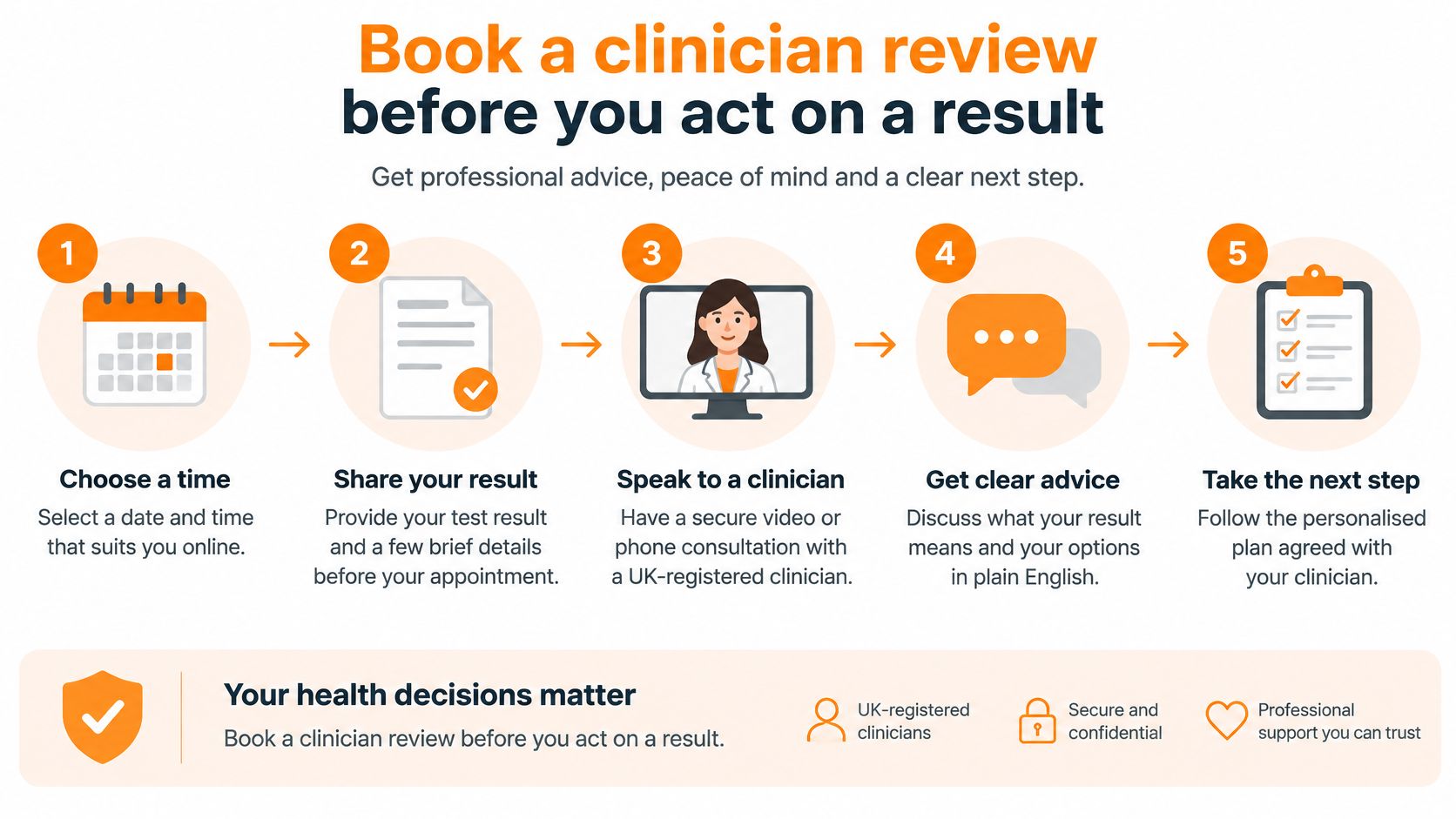
Book a clinician review before you act on a result
Book that review before you change any treatment, supplement or diet based on a result. Four steps cover most of it.
- Ask your GP what the result means for you. Bring the full report, not a screenshot of one line.
- Ask whether homocysteine, folate and B12 need checking. These are the measurements that change decisions.
- Share any family history of clots or pregnancy loss. That history often matters more than the genotype.
- Keep taking your current medicines unless a prescriber advises a change.
Signs that need urgent help
- Sudden chest pain or difficulty breathing
- Sudden breathlessness with a racing heart
- A swollen, painful leg, especially one calf
- Stroke signs such as a drooping face, weak arm or slurred speech
- Heavy bleeding in pregnancy
Call 999 for any of these. Call 111 for urgent advice that isn't an emergency.
If your test came from us, your results are private and shared only with you, and we can forward them to your GP if you ask. Our home blood test results are reviewed by qualified healthcare professionals for accuracy and safety.
This article is informational only and doesn't replace medical advice.
If you'd rather act on numbers your GP can use, Courier Pharmacy offers home blood tests with results reviewed by qualified healthcare professionals, and we can send them on to your GP if you'd prefer. We also offer genetic testing for people who want the wider picture discussed properly rather than guessed at. Start with a test that answers a question someone can act on, and visit Courier Pharmacy to see which one fits.


