Decoding the Normal Range for Thyroid Function Tests: A Guide to Understanding Your Thyroid Health
Feeling tired or off? This guide decodes the normal range for thyroid function tests (TSH, FT4, FT3), explaining what your results truly mean for your health.
In this article
- 5 Key Takeaways from This Guide
- The Three Key Players in Thyroid Testing
- TSH: The Messenger
- Free T4: The Warehouse Stock
- Free T3: The Active-Duty Soldier
- Typical UK Reference Ranges
- Typical UK Reference Ranges for Thyroid Function Tests
- Why a 'Normal' Result Can Still Feel Wrong
- The Problem with 'Normal'
- Uncovering Subclinical Hypothyroidism
- Your Symptoms Are Valuable Data
- Hidden Factors That Can Skew Your Thyroid Results
- Time of Day and Recent Illness
- The Impact of Medications and Supplements
- Age and Pregnancy: The Natural Shifts
- Navigating the Problem of Different Lab Ranges
- Why Consistency Is Key
- The Impact on Diagnosis and Treatment
- Taking Control of Your Testing
- Taking Proactive Steps for Your Thyroid Health
- Convenient and Reliable Thyroid Testing
- The Importance of a Complete Assessment
- Your Personalised Path to Feeling Well
- Summary
- Frequently Asked Questions (FAQs)
- How often should I get my thyroid levels checked?
- Can diet and lifestyle really improve my thyroid function?
- What are the red flag symptoms I should never ignore?
Staring at your thyroid test results can feel like you've been handed a document in a foreign language. This guide is your translator. We’ll start with the basics: what the numbers mean and why understanding the normal range for thyroid function tests is the first step toward taking control of your health.
5 Key Takeaways from This Guide
- A Full Picture is Essential: A complete thyroid panel (TSH, Free T4, and Free T3) provides a much clearer view of your health than TSH alone.
- 'Normal' Isn't Always Optimal: Standard lab ranges are broad averages. You can be within the 'normal' range but still feel unwell. Finding your optimal range is the goal.
- Your Symptoms are Vital Clues: Persistent fatigue, weight changes, hair loss, or mood swings are important signals that should be considered alongside your lab results.
- Context is Everything: Factors like the time of day your blood was drawn, medications (especially biotin), age, and pregnancy can all influence your test results.
- Lab Ranges Vary: The 'normal' range can differ from one lab to another, which can cause confusion and affect diagnosis. Consistency in testing is key.
The Three Key Players in Thyroid Testing
To really get to grips with your thyroid results, you need to meet the main characters: TSH, Free T4, and Free T3. Understanding the normal range for thyroid function tests is much easier once you know the role each one plays. Let's break them down, skipping the dense medical jargon.
TSH: The Messenger
Think of Thyroid-Stimulating Hormone (TSH) as a direct message from your brain's pituitary gland. It's not actually a thyroid hormone itself, but the instruction telling your thyroid to get to work. Its main job is to kickstart the production of the other two key hormones, T4 and T3.
When your body is running low on thyroid hormone, the pituitary sends out a loud-and-clear TSH signal. If you've got plenty, it sends a much quieter one. This feedback loop makes TSH a fantastic first indicator of a potential problem.
Free T4: The Warehouse Stock
Thyroxine, or T4, is the main hormone your thyroid gland pumps out. Most of it travels through your bloodstream attached to proteins, acting like a big storage reservoir. The "Free" T4 (FT4) is the bit that's unbound and ready to be converted into the active hormone, T3, whenever your cells need it.
You can imagine FT4 as the stock sitting in a warehouse, ready to be shipped out and put to use. A healthy level of FT4 means you have enough raw material on hand to meet your body's energy demands.
Free T3: The Active-Duty Soldier
Triiodothyronine, or T3, is the real powerhouse. While the thyroid makes a little T3 directly, most of it is converted from T4 in other places like your liver and kidneys. "Free" T3 (FT3) is the active form that gets into your cells and drives your metabolism, energy levels, and body temperature.
Think of FT3 as the active-duty soldier on the front lines, carrying out its orders. You could have plenty of T4 in the warehouse, but if your body isn't converting it properly into active T3, you're still going to feel pretty rough.
A Pharmacist's Tip: "I often use an analogy to explain the TSH-thyroid relationship. Imagine TSH as a manager yelling for more product. If the yell is loud (high TSH), it means the shelves are empty (low thyroid hormone). If the manager is quiet (low TSH), the shelves are overflowing."
This infographic gives a great visual of the essential functions your thyroid looks after.
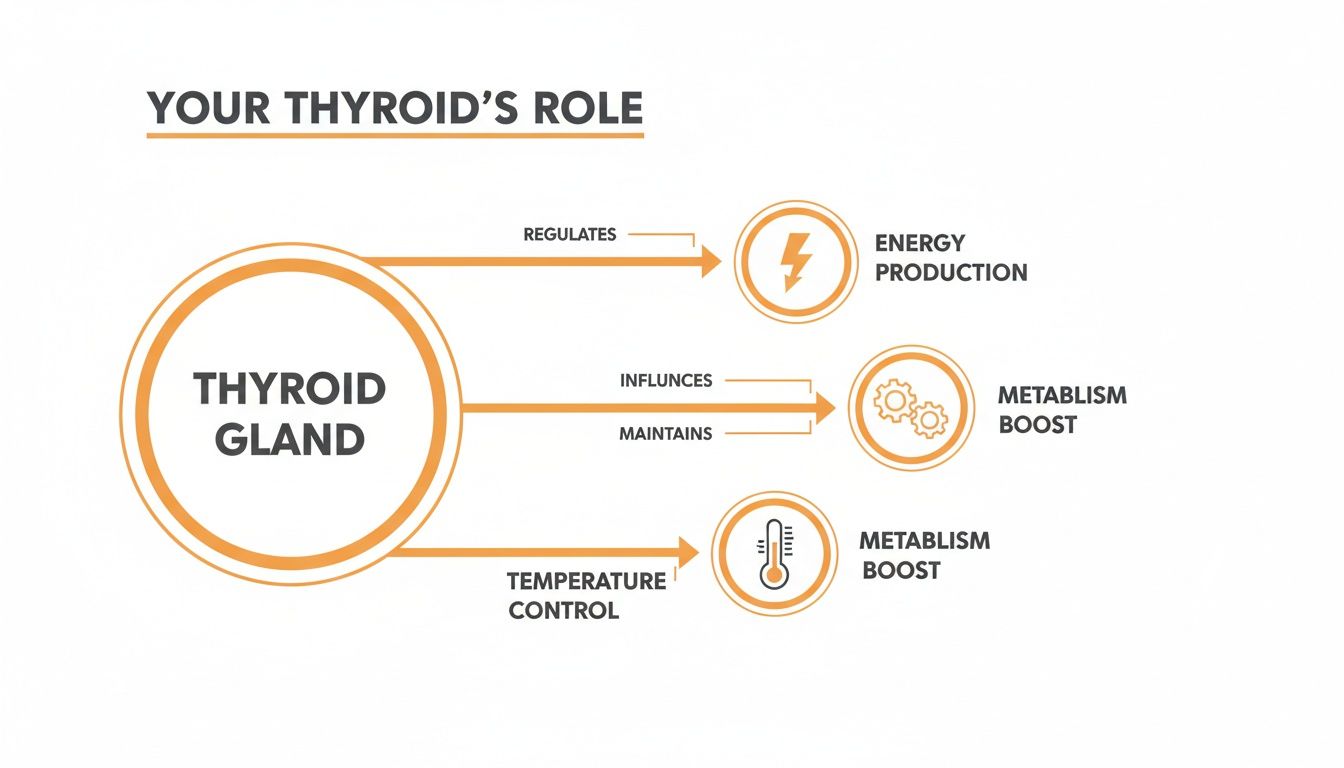
As you can see, the thyroid is basically the central control system for your body’s energy, metabolism, and internal thermostat.
Typical UK Reference Ranges
It’s crucial to know what numbers laboratories are working with as a baseline. According to guidance from the British Thyroid Foundation, the typical normal ranges for healthy adults are pretty well-defined, though you might see slight variations from lab to lab. You can find more details on the UK thyroid function test guidelines on the BTF website.
Here’s a simple table summarising these key ranges and what each marker does.
Typical UK Reference Ranges for Thyroid Function Tests
| Test Name | Abbreviation | Typical UK Normal Range | Primary Role |
|---|---|---|---|
| Thyroid-Stimulating Hormone | TSH | 0.4 - 4.0 mU/L | Signals the thyroid to produce hormones |
| Free Thyroxine | FT4 | 9.0 - 25.0 pmol/L | Inactive 'storage' hormone |
| Free Triiodothyronine | FT3 | 3.5 - 7.8 pmol/L | Active hormone used by cells |
Getting to know these three players—the messenger (TSH), the warehouse stock (FT4), and the active soldier (FT3)—is the foundation of understanding your results. Looking at them all together gives a much clearer, more accurate picture of your thyroid health than focusing on just one marker alone.
Why a 'Normal' Result Can Still Feel Wrong
Have you ever walked out of a doctor's appointment feeling completely deflated? You’ve just been told your thyroid test results are 'normal,' but you still feel exhausted, foggy-headed, and just off. It’s a frustratingly common experience, and if this sounds familiar, you are definitely not alone.
This situation reveals a crucial gap in how we often look at thyroid health: the big difference between a standard lab range and what’s truly optimal for you. Those 'normal' values on your report aren't a magical target for perfect health. They’re a broad statistical average, calculated from a huge population of people.
And here's the catch: that population includes people who aren't in peak condition. When your result is compared against this wide average, it can easily hide a subtle but very real imbalance that’s causing your symptoms. The goal shouldn’t be just to squeeze into the broad normal range for thyroid function tests, but to find the level where you actually feel your best.
The Problem with 'Normal'
Think of the standard reference range like a shoe shop claiming that anything from a size 5 to a size 11 is a 'normal' fit. Sure, if you're a size 7, your foot technically fits within that range, but that doesn't mean a size 11 shoe is going to feel right. Your optimal thyroid level is like your perfect shoe size—specific and unique to you.
Many people only start to feel better when their levels are in a much tighter, more optimal range. This is especially true when it comes to TSH.
A Pharmacist's Real-Life Insight: "I regularly see patients with a TSH of 3.8 mU/L—technically 'normal' according to most labs—who are struggling with classic hypothyroid symptoms like fatigue and weight gain. For them, feeling well often means working with a clinician to get that TSH down closer to 1.5 mU/L."
Uncovering Subclinical Hypothyroidism
This is where the idea of subclinical hypothyroidism becomes so important. It’s a state where your TSH is slightly elevated, but your Free T4 level is still within the standard normal range. Essentially, your brain is having to "shout" a bit louder (higher TSH) to get your thyroid to produce enough hormone.
Even though the T4 level looks fine on paper, that extra effort is a clear sign your thyroid is struggling. This subtle imbalance is often enough to cause persistent and draining symptoms, including:
- Constant tiredness or fatigue
- Difficulty losing weight or unexplained weight gain
- Brain fog and poor concentration
- Low mood or depression
- Feeling cold when others don't
A quick look at UK prevalence data shows just how common these issues are. While overt hypothyroidism affects 0.3% of young UK women (rising to 2% over 60), the subclinical state (high TSH, normal FT4) is seen in 4-6% of those under 40 and a staggering 10-15% of people aged 60-75. You can find more statistics on the British Thyroid Foundation website.
This early stage of thyroid dysfunction is frequently missed if a doctor is only focused on keeping results inside the broad 'normal' lab range. Because the symptoms can overlap with autoimmune conditions, it's also smart to explore all possibilities. You can learn more about related issues in our comprehensive guide on Hashimoto's Disease.
Your Symptoms Are Valuable Data
At the end of the day, how you feel is just as important as the numbers on the page. Your symptoms aren't just complaints; they are vital pieces of data that give context to your lab results. A good clinician will listen carefully to your experience and use it alongside your tests to build a complete picture of your health.
If you've been told your results are 'normal' but your gut tells you something is still wrong, trust that instinct. It could be time to seek a more detailed assessment that looks beyond standard ranges and focuses on what is optimal for you, with the goal of getting you back to feeling like yourself again.
Hidden Factors That Can Skew Your Thyroid Results
A blood test gives you a snapshot of your health at one specific moment. But when it comes to understanding the normal range for thyroid function tests, that single snapshot can be surprisingly blurry. All sorts of hidden variables can influence the picture it captures, potentially skewing your results and leading to the wrong conclusions about your thyroid health.
It’s crucial to realise that what’s considered “normal” isn’t a fixed target; it’s a moving one. Let’s pull back the curtain on the everyday factors you might not suspect that can throw your thyroid test results off course, reinforcing why context is always king.
Time of Day and Recent Illness
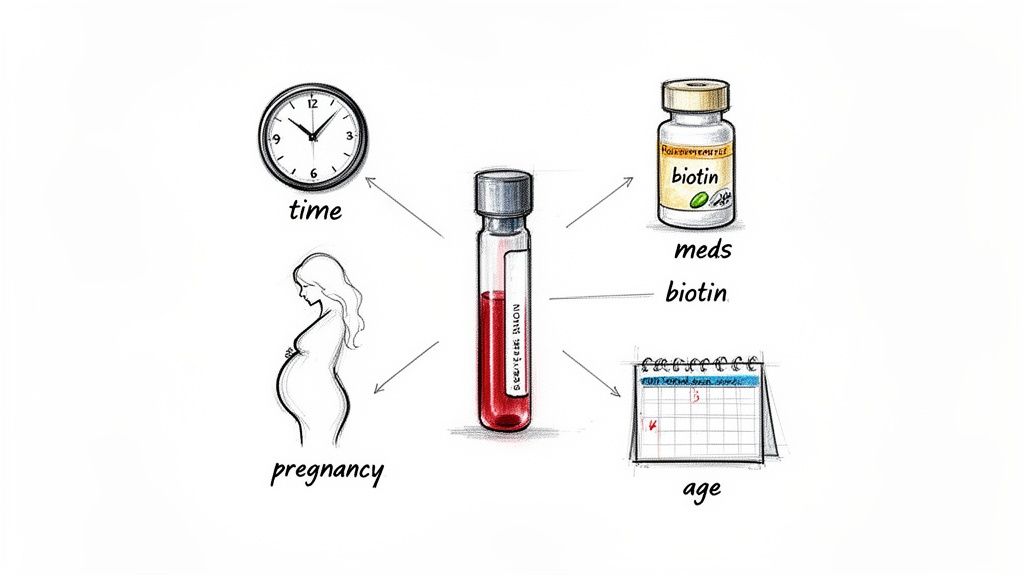
Did you know your TSH level naturally fluctuates throughout the day? It follows a 24-hour cycle, hitting its peak during the night and dropping to its lowest point in the afternoon. This means a blood test taken at 4 PM could show a much lower TSH than one taken at 8 AM, which might just be enough to mask a subtle case of hypothyroidism. For this reason, consistency is absolutely key for accurate monitoring.
On top of that, simply being unwell can temporarily push your TSH levels down. This is often called non-thyroidal illness syndrome, and it's your body's clever way of conserving energy when it's under stress from sickness. Testing while you’re battling the flu or another bug won’t give a true picture of your baseline thyroid function.
The Impact of Medications and Supplements
Many common medications and supplements can interfere with your thyroid, either by affecting its function directly or by messing with the tests themselves. It’s an often-overlooked factor, but it can have a major impact on your results.
One of the biggest culprits is biotin (Vitamin B7), a hugely popular supplement for hair, skin, and nails. High doses of biotin can interfere with the lab assays used for thyroid testing, often creating a misleading picture of falsely low TSH and falsely high T4 and T3 levels. This could make an underactive thyroid look completely normal, or even overactive.
A Pharmacist's Tip: "Always get your thyroid tested first thing in the morning and stop taking any biotin supplements for at least two days beforehand. Biotin can interfere with the test, giving you a falsely 'good' result while masking an underlying problem."
Other substances that can muddy the waters include:
- Corticosteroids: Frequently used for inflammation, these can suppress TSH.
- Oral Contraceptives: Oestrogen can increase the proteins that bind to thyroid hormones, which may alter total T4 and T3 levels.
- Certain Antidepressants and Anticonvulsants: These can also influence how your body metabolises thyroid hormones, affecting the final test results.
It's also important to understand the potential interactions between newer medications like Mounjaro and thyroid hormones to get a clear picture of your health. You can learn more in our detailed guide on Mounjaro and Levothyroxine interactions.
Age and Pregnancy: The Natural Shifts
Your body’s needs change throughout your life, and your thyroid function adapts right along with them. What’s considered a normal TSH for a 30-year-old is quite different from what’s normal for an 80-year-old. As we get older, TSH levels tend to gradually increase, and labs often adjust their reference ranges to reflect this natural shift.
Pregnancy brings even more dramatic changes. During the first trimester, a surge in the hormone hCG (the same one detected in pregnancy tests) actually stimulates the thyroid, causing TSH levels to drop. Because of this, specific, trimester-by-trimester reference ranges are essential for managing thyroid health during pregnancy to ensure the well-being of both mother and baby. Knowing how thyroid health affects conception is critical for anyone planning a family. You can learn more about optimising your health in our article about fertility.
Because a thyroid test is so sensitive to these variables, a single "normal" or "abnormal" result should never be viewed in isolation. A thorough review of your overall health, lifestyle, and medications is essential for an accurate diagnosis and effective management.
Navigating the Problem of Different Lab Ranges
One of the most confusing experiences when managing your thyroid health is seeing your results change, seemingly overnight, just by switching laboratories. It's a common frustration: you've been carefully tracking your TSH for months, only to get a result from a new lab that tells a completely different story.
This isn't a mistake. It’s a genuine issue caused by lab-to-lab variations in the normal range for thyroid function tests.
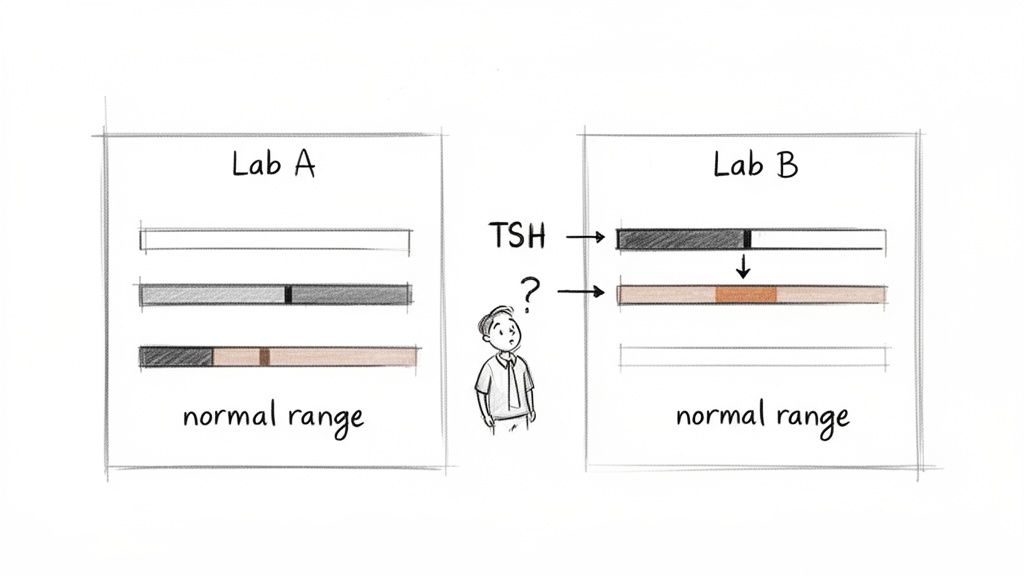
So, how can a TSH level of 4.2 mU/L be flagged as concerning in Manchester but dismissed as perfectly normal in London? The answer comes down to how each laboratory establishes its own "reference range." These ranges are built on data from the local population the lab serves, meaning subtle differences in a community's average age, genetics, or overall health can shift the goalposts for what’s considered “normal.”
Why Consistency Is Key
This isn’t just a statistical quirk; it has real-world consequences. A small shift in a reference range can be the difference between starting medication that helps you feel better and being told to "wait and see" while your symptoms drag on.
A Pharmacist's Experience: "A client moved cities and was taken off their thyroid medication because their new GP said their levels were fine. Their TSH value hadn't changed at all—only the new lab's 'normal' range had. It created unnecessary confusion and a delay in care until the situation was clarified."
This is exactly why having a consistent healthcare partner is so vital. When you stick with one provider for your tests, you establish a stable baseline. This allows your clinician to spot genuine trends in your thyroid function, rather than trying to make sense of numbers skewed by constantly moving targets.
The Impact on Diagnosis and Treatment
The effect of these variations is well-documented. A major study across UK NHS laboratories found significant differences in thyroid function test reference ranges, which directly influenced how often levothyroxine (LT4) was prescribed.
The researchers discovered that even small tweaks to these ranges led to big shifts in treatment rates. You can dig into the full details of this research in the European Journal of Endocrinology.
This highlights a critical point: your access to treatment can sometimes depend more on your postcode than on your actual health. It's why working with a team that looks beyond a single lab report is absolutely essential.
Taking Control of Your Testing
To break this frustrating cycle, here are a few practical steps you can take:
- Stick to One Lab: If possible, use the same laboratory for all your thyroid tests. This ensures your results are always comparable.
- Focus on Your Optimal Range: Work with your healthcare provider to pinpoint the specific range where you feel your best, which might be narrower than the lab's general "normal" values.
- Keep Your Own Records: Maintain a log of your test results over time. This empowers you to spot your own patterns and have more informed discussions with your clinician.
By understanding that not all lab ranges are created equal, you can become a better advocate for your own health. The goal is to make sure your treatment is guided by a consistent, accurate picture of your thyroid function, not the location of the laboratory.
Taking Proactive Steps for Your Thyroid Health
Understanding your thyroid numbers is the first step, but taking action is what really counts. Once you’ve wrapped your head around the complexities of the normal range for thyroid function tests, the next logical move is to figure out what to do with that information. This section is your roadmap for what comes next, helping you find a clear path forward and get the answers you deserve.
The goal here is to move beyond lab values on a page and towards a plan that’s built around how you actually feel. Proper thyroid management isn’t just about hitting a statistical target—it’s about getting your energy, mental clarity, and sense of well-being back.
Convenient and Reliable Thyroid Testing
Getting accurate data is the bedrock of any solid health plan. Thankfully, modern testing makes this process more straightforward and accessible than ever. You’re no longer limited to booking appointments and travelling to a clinic just for a blood draw.
At Courier Pharmacy, we offer testing methods designed to fit into your life:
- At-Home Collection: Our simple-to-use home blood test kits are a game-changer. They include the traditional finger-prick method as well as the advanced Tasso+ device, which offers a virtually painless way to collect a good blood sample from your upper arm.
- Venous Blood Draws: If you’d rather stick with a classic approach, we can easily arrange for a traditional venous blood draw at a location that’s convenient for you.
Both options deliver reliable, accurate results, giving you the crucial information you need to understand your thyroid status without all the usual hassle.
The Importance of a Complete Assessment
Receiving your test results is just the beginning. The most critical part of the process is the interpretation, where a qualified prescriber looks at the whole picture of your health. A number in isolation simply doesn't tell the whole story.
A holistic assessment is essential. A clinician must review your lab results alongside your specific symptoms, medical history, and lifestyle factors. This is the only way to connect the dots between what the numbers say and how you feel every day.
This comprehensive approach directly tackles the challenges we discussed earlier, like why a "normal" result can still feel wrong or how confusing different lab ranges can be. By seeing the complete picture, a clinician can develop a personalised plan that actually makes sense for you.
For instance, someone with a TSH of 3.9 mU/L might be told they are "fine" based on a standard lab range. But when a skilled prescriber sees that result alongside symptoms of fatigue, brain fog, and weight gain, they may recognise the need for more investigation or even a trial of treatment to find an optimal level.
Your Personalised Path to Feeling Well
Ultimately, taking proactive steps means finding a healthcare partner who listens and looks beyond the basics. It’s about building a strategy that’s tailored to your unique body and your personal health goals.
Whether that involves adjusting medication, exploring lifestyle changes, or simply monitoring your levels with a consistent, reliable partner, you are in the driver's seat. By combining convenient testing with expert, holistic assessment, you can finally move from confusion to clarity and start the journey to feeling your best.
Summary
Navigating thyroid health can be complex, but understanding the normal range for thyroid function tests is a crucial first step. Remember that 'normal' doesn't always mean optimal, and your symptoms are just as important as your lab numbers. Factors like time of day, medications, and even the lab you use can influence your results. For a true picture of your health, it's essential to look at a full panel (TSH, FT4, and FT3), consider the context, and work with a healthcare provider who focuses on finding the specific range where you feel your best.
Frequently Asked Questions (FAQs)
How often should I get my thyroid levels checked?
If you have a diagnosed thyroid condition, your clinician will likely check your levels every 6-12 months. If you are experiencing persistent symptoms like fatigue, unexplained weight changes, or mood swings but have no diagnosis, it’s wise to get tested. You can learn more about how fatigue relates to other conditions in our guide on understanding chronic fatigue syndrome.
Can diet and lifestyle really improve my thyroid function?
Yes, absolutely. While not a substitute for necessary medication, diet and lifestyle are powerful tools. Key nutrients like iodine (found in seafood and dairy) and selenium (found in Brazil nuts and fish) are essential for hormone production and conversion. Managing stress is also critical, as chronic stress can interfere with proper thyroid function.
What are the red flag symptoms I should never ignore?
While most thyroid issues develop gradually, certain symptoms require immediate medical attention as they could signal a rare but dangerous "thyroid storm." Seek urgent medical help if you experience a combination of a high fever (over 38.5°C), a very rapid heartbeat (over 140 bpm), severe agitation, confusion, or jaundice (yellowing skin/eyes).
At Courier Pharmacy, we're here to help you move from confusion to clarity with your thyroid health. Our convenient home testing options and expert clinical reviews provide the comprehensive support you need to feel your best. Start your journey to better health today at https://courierpharmacy.co.uk.


