Omacor for Reducing Triglycerides: A UK Patient Guide
Learn how Omacor for reducing triglycerides works in the UK. This guide covers dosage, effectiveness, side effects, and crucial NHS prescribing rules.

SEO brief
- Primary keyword: Omacor for reducing triglycerides
- Secondary keywords: Omacor dosage, high triglycerides treatment UK, Omacor side effects, specialist lipid clinic, NHS prescribing rules
- Search intent: Informational. The reader wants to know if Omacor works, what dose is used, what the risks are, and whether they can get it in the UK.
- Target reader: UK adults with raised triglycerides, plus carers and health-conscious readers
- Product/service mention (if any): Omacor and related testing or pharmacy support where relevant
- Internal links available: Assumed from Courier Pharmacy and related educational pages provided
Omacor can reduce triglycerides by 20 to 30% in routine licensed use, and by up to 45% at 4 capsules daily (4g) in severe hypertriglyceridaemia. In the UK, though, it usually isn't a routine GP prescription. Many NHS pathways reserve it for very severe triglycerides, often over 10 mmol/L, and specialist lipid clinics usually control access [1][2][3].
That catches many patients out. They hear “prescription omega-3” and assume it works like a stronger fish oil capsule they can ask for. In practice, Omacor sits in a narrow part of lipid management. Dose matters. Monitoring matters. NHS access rules matter even more.
This guide gives you the straight answer on whether Omacor is worth asking about. You'll learn how it works, what dose lowers triglycerides, which side effects deserve attention, and why your GP may not be able to prescribe it even when the licence appears to allow it.
Five key takeaways
- It can work well: Omacor lowers triglycerides, but the effect depends heavily on dose [1][2].
- 4g matters for severe cases: Lower doses often won't match the effect expected in very high triglycerides [1].
- It's not the same as shop-bought fish oil: Omacor is a prescription medicine with a specific formulation and monitoring requirements.
- AF risk is often missed: The risk of atrial fibrillation is dose-dependent and highest at 4g/day [4].
- NHS access is tight: Many UK pathways restrict Omacor to specialist clinics and very high triglyceride levels [5][6].
What is Omacor and how does it lower triglycerides
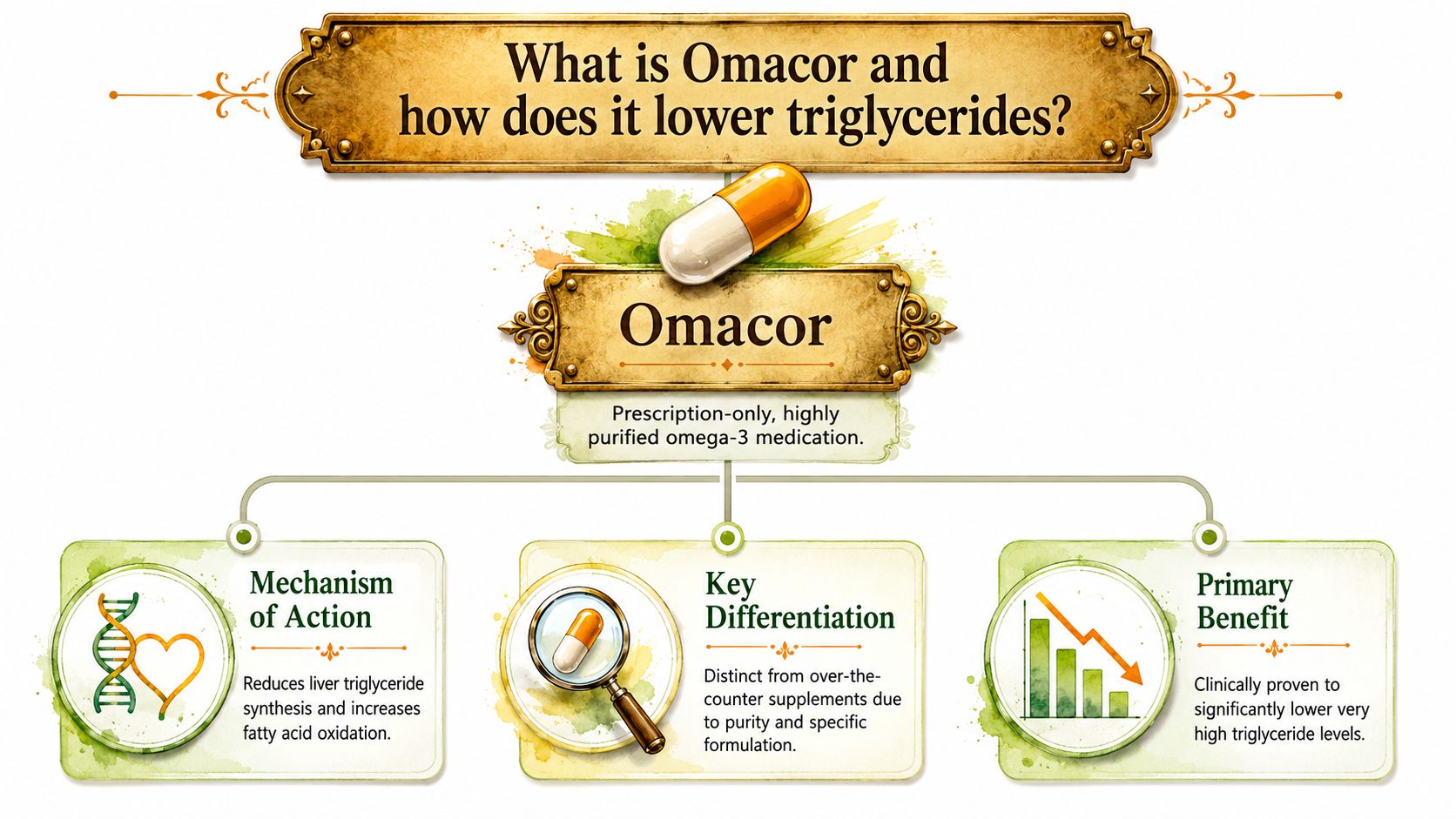
Omacor is a prescription-only omega-3 medicine used for high triglycerides. It isn't the same as picking up a generic fish oil supplement from a supermarket shelf. The formulation, dose, and clinical use are different.
A prescription medicine, not a standard supplement
Patients often assume all omega-3 products do the same job; however, they don't. Omacor is used in defined clinical settings, with licensed dosing and monitoring.
If you're looking at the medicine itself, Courier Pharmacy's Omacor product page shows it as a prescription medicine rather than a wellness supplement. That's the right way to think about it.
Practical rule: If a product is being used to manage very high triglycerides, treat it like a medicine, not a nutrition add-on.
How it works in simple terms
Triglycerides are fats carried in your blood. Your liver helps make and package them into particles called VLDL, short for very low density lipoprotein. Omacor lowers plasma triglyceride levels by reducing VLDL, rather than affecting LDL or HDL in the same way [1].
A simple way to picture it is this. If the liver is a factory sending out triglyceride-rich parcels, Omacor turns down the factory output. Fewer VLDL particles usually means fewer triglycerides circulating in the bloodstream.
Featured snippet answer
Does Omacor lower cholesterol or triglycerides?
It mainly targets triglycerides by reducing VLDL production. It doesn't act on LDL or HDL in the same way [1].
Pharmacist's tip
Pharmacist's tip: Don't swap prescribed Omacor for over-the-counter fish oil and expect the same result. In clinic, that substitution is one of the commonest reasons people think “omega-3 didn't work”.
Understanding Omacor dosage and expected results
Dose is where Omacor becomes more interesting, and more misunderstood. Many people hear that it's licensed for hypertriglyceridaemia, then assume one or two capsules will do the job. For severe triglyceride problems, that often isn't enough.
The dose changes the outcome
UK clinical guidance reflects a licensed starting dose of 2 capsules daily, with an increase to 4 capsules daily if needed for hypertriglyceridaemia [1]. At 2 capsules daily, Omacor achieves a sustained triglyceride reduction of 20 to 30% in UK-licensed clinical protocols [1].
For patients with severe hypertriglyceridaemia, the stronger effect comes at 4 capsules daily (4g). Clinical trials showed that 4g/day significantly reduced mean triglyceride concentrations by 45%, with a 32% reduction in VLDL cholesterol in severe cases [2].
The “why” matters here. Lower doses produce roughly half the triglyceride reduction seen with fenofibrate when a fenofibrate-like effect is the treatment goal [1].
| Daily Dose | Number of Capsules | Typical Triglyceride Reduction |
|---|---|---|
| 2g daily | 2 capsules | 20 to 30% sustained reduction in UK-licensed protocols [1] |
| 4g daily | 4 capsules | Up to 45% mean reduction in severe hypertriglyceridaemia [2] |
What results can patients realistically expect
The headline figure depends on who is taking it and why. In severe hypertriglyceridaemia, one randomised double-blind study found a -32.1% change in triglyceride serum levels with Omacor 4g/day, compared with -5.4% in the placebo group, with significant reductions seen as early as week 2 [2].
Longer-term data also supports continued benefit. UK-licensed trial benchmarks show 4g/day can reduce serum triglycerides by 20 to 30% over 12 months, while more severe cases may see the larger 45% average reduction already noted [3].
A useful rule from product guidance is this. Patients should show a measurable triglyceride response within 2 months on 4g/day. If they don't, Omacor should be discontinued because an inadequate early response predicts poor long-term benefit [3].
For readers trying to make sense of lipid results, this guide to understanding a cholesterol blood test can help you see where triglycerides fit alongside the rest of your lipid panel.
Featured snippet answer
How many Omacor capsules lower triglycerides?
For hypertriglyceridaemia, treatment may start at 2 capsules daily, but 4 capsules daily is often needed for stronger triglyceride lowering [1][2].
Pharmacist's tip
Pharmacist's tip: When patients say Omacor “didn't do much”, I first check the dose. With severe triglycerides, under-dosing is a very common reason for disappointment.
Key risks and side effects you must monitor
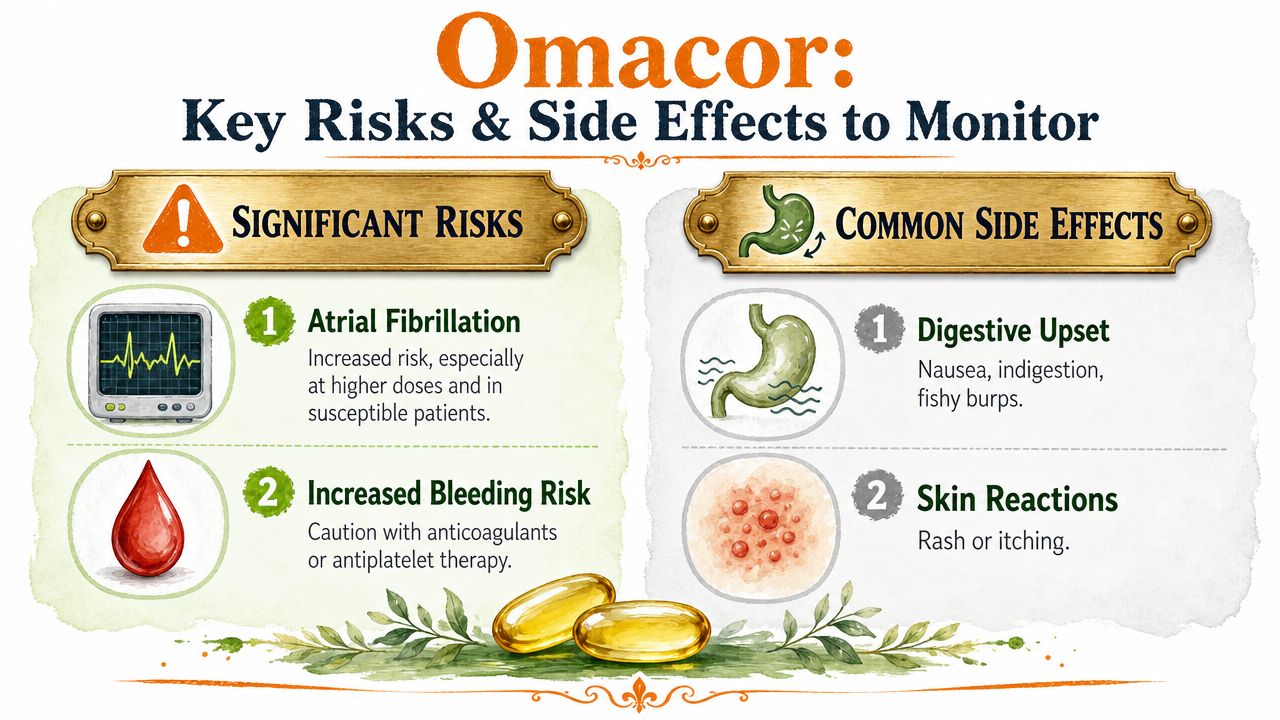
Omacor is often framed as a gentle option because it's an omega-3 medicine. That's too simplistic. The main concern in current UK safety updates isn't a fishy aftertaste. It's heart rhythm risk at the higher treatment dose.
The atrial fibrillation issue
Recent UK government safety data confirms a dose-dependent increased risk of atrial fibrillation, with the risk highest at 4g/day, which is the same dose used for severe hypertriglyceridaemia [4].
That means the dose most likely to lower triglycerides effectively is also the dose that needs the closest watch for heart rhythm symptoms.
Watch for:
- Palpitations: a racing, fluttering, or irregular heartbeat
- Light-headedness: especially if it comes on suddenly
- Breathlessness: new shortness of breath without a clear cause
If atrial fibrillation develops, the medicine should be permanently discontinued [4].
New palpitations on high-dose Omacor aren't something to “wait out” for a few weeks. They need prompt review.
Other blood test checks that matter
Omacor can also raise LDL-C by 31% in some individuals, and clinicians should monitor triglycerides, LDL-C, and ALT during treatment [3]. ALT is a liver enzyme. It can rise occasionally even when AST does not [3].
That creates a practical problem. A patient may be pleased that their triglycerides have fallen, while the follow-up bloods show LDL has moved in the wrong direction. That's why lipid monitoring isn't optional.
If you're trying to understand routine blood monitoring, this guide to the full blood count test won't replace lipid or liver tests, but it does help patients get more confident with lab results in general.
When to seek urgent help
Seek urgent medical help if you have:
- severe or worsening breathlessness
- fainting or near-fainting
- chest pain
- sustained rapid or irregular heartbeat
Pharmacist's tip
Pharmacist's tip: Ask before you start treatment how often your specialist plans to repeat triglycerides, LDL-C, and liver enzymes. If no one has mentioned monitoring, that conversation needs to happen.
The reality of getting Omacor on the NHS in the UK
This is the part most online articles gloss over. A medicine can be licensed and still be hard to get on the NHS. Omacor is a very good example.
Why your GP often can't start it
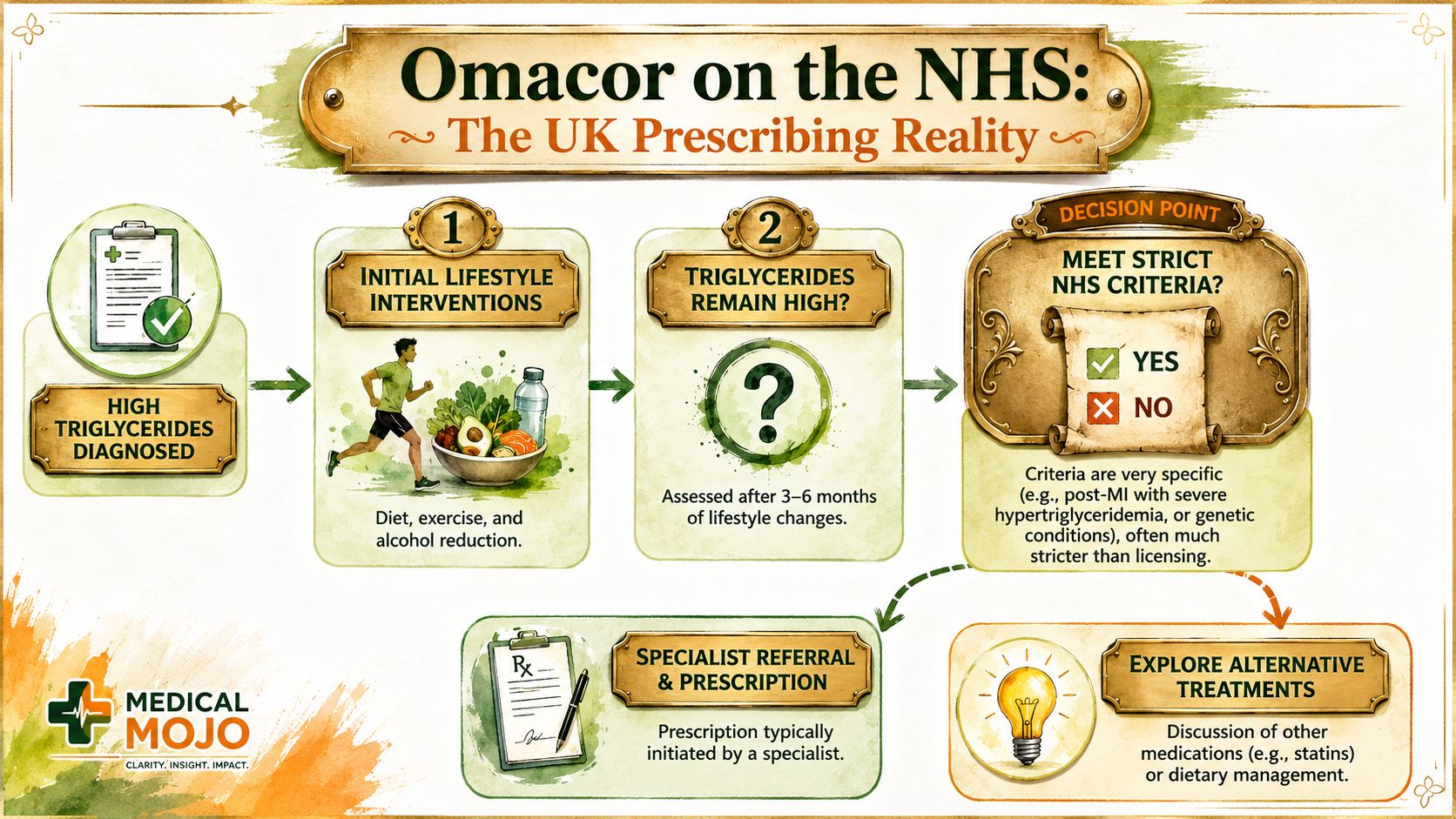
Some NHS guidance states that Omacor is “NOT RECOMMENDED FOR PRESCRIBING IN PRIMARY OR SECONDARY CARE” for most indications, and only permits use in specialist clinics for severe cases with triglycerides at or above 10 mmol/L after lifestyle and other therapies fail [5].
That wording is blunt, but it's helpful. It tells patients why the answer from a GP may be “I can't prescribe that”, even when the medicine exists and even when the patient has read about its licensed indication.
If you're unsure what online pharmacy care can and can't do alongside NHS care, Courier Pharmacy's online pharmacy page explains the broader service model. It doesn't override NHS formulary rules, but it helps patients understand where private prescribing and specialist advice may fit.
Who may actually qualify
Nottinghamshire guidance gives a practical picture of the sort of patient who may be considered. Omega-3 fatty acids such as Omacor can be considered only for people with a history of pancreatitis or perceived pancreatitis risk, where triglycerides are persistently 10 mmol/L or higher, and the patient is already on a fibrate or cannot tolerate one [6].
The same guidance also says clinicians should review and consider stopping Omacor if triglycerides are persistently below 5 mmol/L, because at that point the atrial fibrillation risk may outweigh the benefit [6].
This is why Omacor isn't a routine “high triglycerides tablet” in UK primary care. In many areas, the pathway looks more like this:
- First: tackle alcohol, diet, weight, and glycaemic control
- Next: use other lipid-lowering treatment where appropriate
- Then: refer urgently to a specialist lipid clinic if triglycerides remain very high
- Only after that: Omacor may be considered in a narrow group
Featured snippet answer
Can my GP prescribe Omacor in the UK?
Often, no. Many NHS pathways restrict Omacor to specialist lipid clinics for very severe triglycerides, commonly 10 mmol/L or above [5][6].
Real-life example
A busy parent with moderately raised triglycerides might expect Omacor after reading the patient leaflet online. In reality, if their triglycerides aren't in the very severe range and they haven't gone through the specialist pathway, NHS prescribing is unlikely.
A shift worker with recurrent very high triglycerides and pancreatitis risk may be in a different position. That person is much closer to the group specialist clinics review for Omacor.
What to discuss with your doctor if Omacor isn't an option
When Omacor isn't available, the appointment shouldn't end with “nothing else to do”. It should turn into a clearer plan. The useful discussion is usually about causes, alternatives, and whether you need a lipid specialist rather than another routine repeat test.

Questions worth taking to the appointment
Take focused questions, not a vague request for “something stronger”.
- Ask what the main driver is: alcohol, diabetes control, weight, medicines, or inherited lipid problems can all push triglycerides up.
- Ask whether a fibrate has been considered: NHS pathways often expect this step before Omacor in severe cases [6].
- Ask if you need specialist referral: especially if triglycerides stay very high or pancreatitis risk is part of the picture.
- Ask which blood tests need repeating: triglycerides don't sit in isolation from the rest of your lipid and metabolic picture.
If Omacor isn't an option, the next best move is usually better assessment, not blind trial-and-error.
Real-life examples
A gym-goer with high triglycerides sometimes assumes training alone should have fixed the issue. If bloods still look poor, a clinician may need to look harder at alcohol intake, family history, or hidden metabolic issues rather than merely adding supplements.
A middle-aged office worker with diabetes and raised triglycerides may need tighter glucose review before anyone even considers specialist lipid therapy. In practice, improving the underlying driver often matters more than jumping straight to a niche medicine.
Pharmacist's tip
Pharmacist's tip: Bring your latest blood results to the consultation if you have them. A treatment discussion based on actual triglycerides, LDL-C, and liver tests is far more useful than trying to remember numbers from memory.
Pharmacist's tip
Pharmacist's tip: If your triglycerides have been high more than once, ask whether the sample was fasting and whether the pattern is persistent. One isolated result rarely tells the whole story.
Pharmacist's tip
Pharmacist's tip: If you need a more personalised review, advanced testing can sometimes clarify the bigger metabolic picture. For example, this guide to PPARs and the body's metabolic switch gives context for how metabolism and lipid handling connect. Courier Pharmacy also offers blood testing and broader medicine support where clinically appropriate.
If you're trying to make sense of high triglycerides, NHS restrictions, and what your next step should be, Courier Pharmacy is one option for prescription support, testing, and pharmacist-led guidance in the UK. It won't change local NHS formulary rules, but it can help you understand your results, treatment options, and whether specialist review or further investigation is the sensible next move.
Summary
Omacor can lower triglycerides well, but it isn't a casual add-on. The dose makes a major difference, and severe cases often need 4 capsules daily for a meaningful effect [1][2]. That same higher dose carries an important atrial fibrillation warning [4]. Patients also need follow-up blood tests because LDL-C and liver enzymes can change during treatment [3]. In the UK, the biggest surprise is access. Many NHS pathways reserve Omacor for specialist clinics and very severe triglyceride levels, often with pancreatitis risk in the background [5][6]. If it isn't available to you, a focused review of causes, alternatives, and referral options is the right next step.
FAQs
Does Omacor really reduce triglycerides?
Yes. In UK-licensed use, Omacor can reduce triglycerides by 20 to 30%, and in severe hypertriglyceridaemia 4g/day has shown a 45% mean reduction in trials [1][2].
How long does Omacor take to work?
In one randomised study, significant triglyceride reductions with 4g/day appeared as early as week 2 [2]. Product guidance also expects a measurable response within 2 months on 4g/day [3].
Is Omacor the same as fish oil capsules from a shop?
No. Omacor is a prescription medicine with a defined formulation, dose, and monitoring plan. Standard fish oil supplements aren't a direct substitute.
What dose of Omacor is used for high triglycerides?
Licensed treatment for hypertriglyceridaemia starts at 2 capsules daily and can increase to 4 capsules daily if needed [1]. The higher dose is often necessary in severe cases [2].
Can Omacor raise bad cholesterol?
It can. Clinical data show LDL-C may rise by 31% in some people, which is why follow-up lipid testing matters [3].
What side effect should worry me most?
The key issue at treatment doses is atrial fibrillation risk, especially at 4g/day [4]. New palpitations, breathlessness, or light-headedness need prompt review.
Can I get Omacor from my GP?
Often not. Many NHS pathways restrict Omacor to specialist lipid clinics, especially for triglycerides 10 mmol/L or above after other measures fail [5][6].
Who is most likely to be considered for Omacor on the NHS?
Patients with persistently very high triglycerides, often 10 mmol/L or above, especially when pancreatitis risk is part of the picture and other options such as fibrates have failed or aren't tolerated [5][6].
Should Omacor be stopped if triglycerides improve?
Some local guidance says clinicians should review treatment and consider stopping Omacor if triglycerides are persistently below 5 mmol/L, because AF risk may then outweigh benefit [6]. That decision should sit with the treating clinician.
Meta description
Omacor for reducing triglycerides can work well, but UK NHS access is strict. Learn dose, risks, side effects, and who may qualify.
Suggested internal links
- Omacor Omega-3 Acid 1000mg 100 Capsules
- Your guide to understanding a cholesterol blood test
- Your guide to understanding the full blood count test
- Online pharmacy UK
- What are the PPARs. A guide to your body's metabolic switch
Visual guidance
Dose comparison infographic
Use lime green and pale yellow-green panels with brass plaque labels for 2g vs 4g dosing.
Alt text: Omacor dose comparison showing 2 capsules versus 4 capsules and expected triglyceride lowering.Specialist referral pathway graphic
Show GP review, repeat bloods, lifestyle work, fibrate review, then lipid clinic referral.
Alt text: UK pathway diagram showing when patients with very high triglycerides may be referred to a specialist lipid clinic.Monitoring checklist card
A painterly checklist with icons for triglycerides, LDL-C, ALT, palpitations, and breathlessness.
Alt text: Omacor monitoring checklist covering blood tests and heart rhythm symptoms.
Byline
Author: Medical Mojo Editorial Team, reviewed by a UK-registered pharmacist
Clinical review: Clinical review by an independent UK pharmacist prescriber
How this content was created
This article was written using UK prescribing guidance, MHRA safety updates, and peer-reviewed trial data listed below. A clinician reviewed the content for accuracy, safety, and UK relevance. This information is for education only and isn't a substitute for personal medical advice.
References
[1] Midlands Medicines. (n.d.) Omacor summary document and dosing guidance. Available at: http://www.midlandsmedicines.nhs.uk/filestore/Omacor-SD.pdf
[2] Nordøy, A. et al. (1998) Omega-3 fatty acids as ethyl esters for severe hypertriglyceridaemia. PubMed. Available at: https://pubmed.ncbi.nlm.nih.gov/9865671/
[3] Davidson, M.H. and colleagues. (2001) Long-term and monitoring data for omega-3-acid ethyl esters. PubMed. Available at: https://pubmed.ncbi.nlm.nih.gov/11303007/
[4] Medicines and Healthcare products Regulatory Agency. (2023) PSUSA review for Omacor and atrial fibrillation risk. Available at: https://assets.publishing.service.gov.uk/media/65ce2350c96cf300126a3820/Omacor_-_TO_PUBLISH.pdf
[5] HWE Clinical Guidance. (n.d.) NHS prescribing restriction for Omacor. Available at: https://www.hweclinicalguidance.nhs.uk/all-clinical-areas-documents/download?cid=2476&checksum=c8067ad1937f728f51288b3eb986afaa
[6] Nottinghamshire APC. (2024) Guidelines for management of hypertriglyceridaemia. Available at: https://www.nottsapc.nhs.uk/media/ieze1z04/nottinghamshire-guidelines-for-management-of-hypertriglyceridaemia-2024-v3.pdf


